
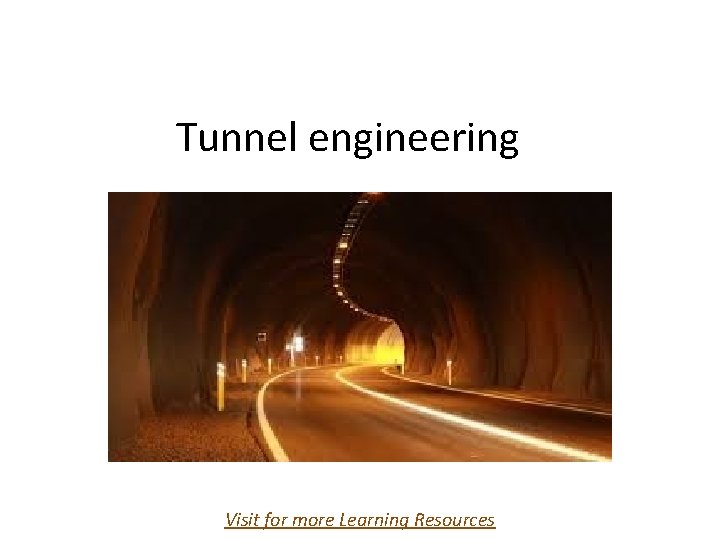
Tunnel engineering Visit for more Learning Resources Definition

- Slides: 10
Tunnel engineering Visit for more Learning Resources
Definition & necessity Underground passage which are constructed without disturbing the ground surface • • • route to be connected by shorter distance Conveying water for power generation To avoid acquisition of valuble land Protection againt landslide, snow fall Coneveying water, oil, gas
Advantages • The connect terminal station by short route • Less route length result in less transportation cost • They carry railway, road and water, oil, gas • Avoiding holding up of traffic for long time • To avoid acquisition of valuble land • Protection againt landslide, snow fall
Disadvantages • • • Require skilled labour & supervision Require Special equipment Costly in construction Require more time May cause suffocation if ventilation not provided properly
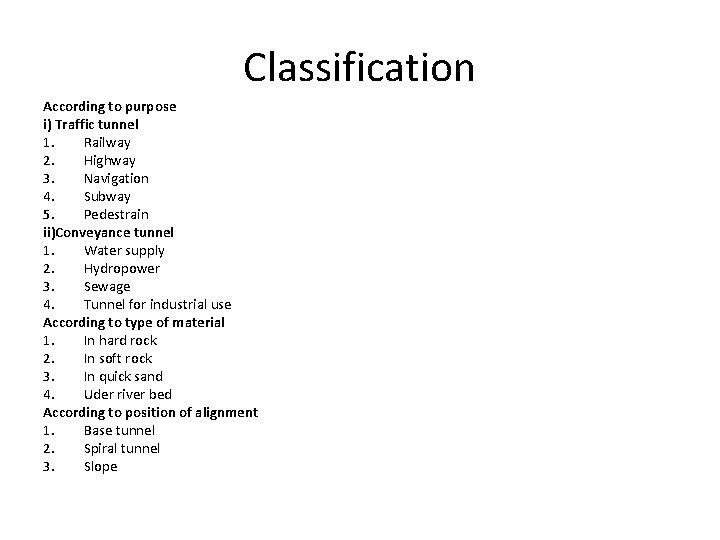
Classification According to purpose i) Traffic tunnel 1. Railway 2. Highway 3. Navigation 4. Subway 5. Pedestrain ii)Conveyance tunnel 1. Water supply 2. Hydropower 3. Sewage 4. Tunnel for industrial use According to type of material 1. In hard rock 2. In soft rock 3. In quick sand 4. Uder river bed According to position of alignment 1. Base tunnel 2. Spiral tunnel 3. Slope
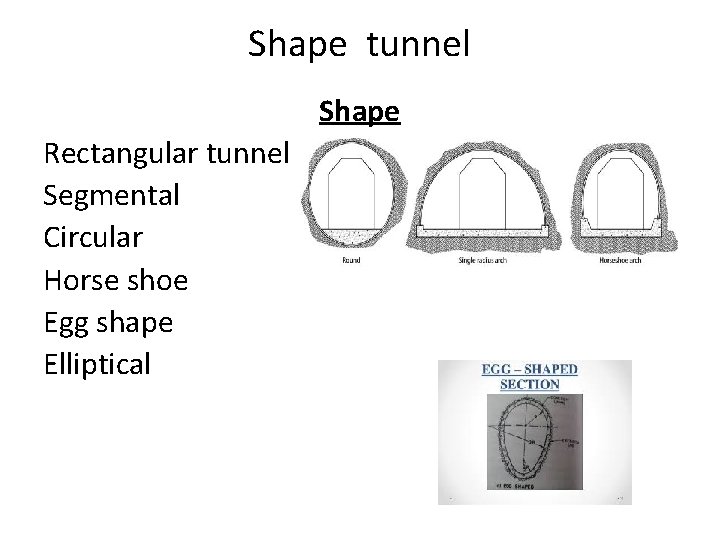
Shape tunnel Shape Rectangular tunnel Segmental Circular Horse shoe Egg shape Elliptical
Tunnel surveying Involve the following operation 1. Location center line on the ground 2. Construction of shaft over center line 3. Transferring the center line inside the tunnel
Shaft • When the length of tunnel is small, it can be constructed by excavation • The vertical opening along the alignment
Purpose of shaft To start excavation from both side To provide adequate natural ventilation To remove excavated material To provide passage for pumping out water To provide passage for construction tool, machinery • To transfer the center line inside the tunnel • • •
Construction of shaft • • Drilling & blasting Mucking Timbering Pumping For more detail contact us