
Tuning bandit algorithms in stochastic environments JeanYves Audibert

Tuning bandit algorithms in stochastic environments Jean-Yves Audibert, CERTIS - Ecole des Ponts Remi Munos, INRIA Futurs Lille Csaba Szepesvári, University of Alberta The 18 th International Conference on Algorithmic Learning Theor October 3, 2007, Sendai International Center, Sendai, Japan
Contents Bandit problems p UCB and Motivation p Tuning UCB by using variance estimates p Concentration of the regret p Finite horizon – finite regret (PAC-UCB) p p Conclusions
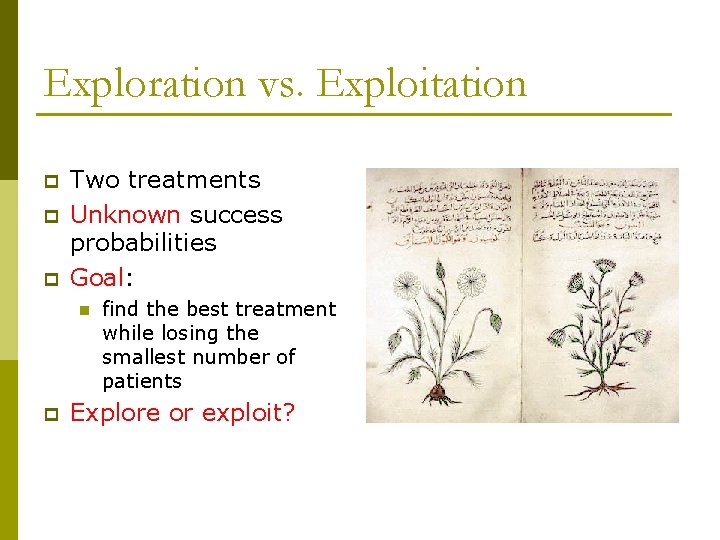
Exploration vs. Exploitation p p p Two treatments Unknown success probabilities Goal: n p find the best treatment while losing the smallest number of patients Explore or exploit?
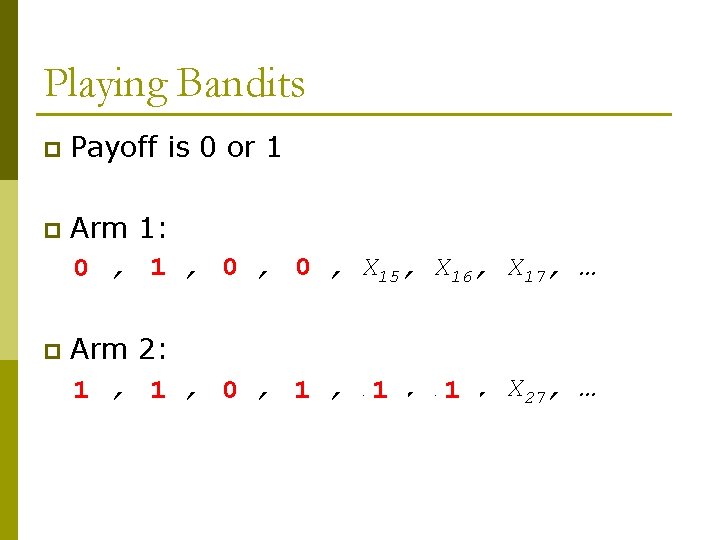
Playing Bandits p Payoff is 0 or 1 p Arm 1: X 011, X 112, X 013, X 014, X 15, X 16, X 17, … p Arm 2: X 121, X 122, X 023, X 124, X 125, X 126, X 27, …
Exploration vs. Exploitation: Some Applications p Simple processes: n n n p Clinical trials Job shop scheduling (random jobs) What ad to put on a web-page More complex processes (memory): n n Optimizing production Controlling an inventory Optimal investment Poker
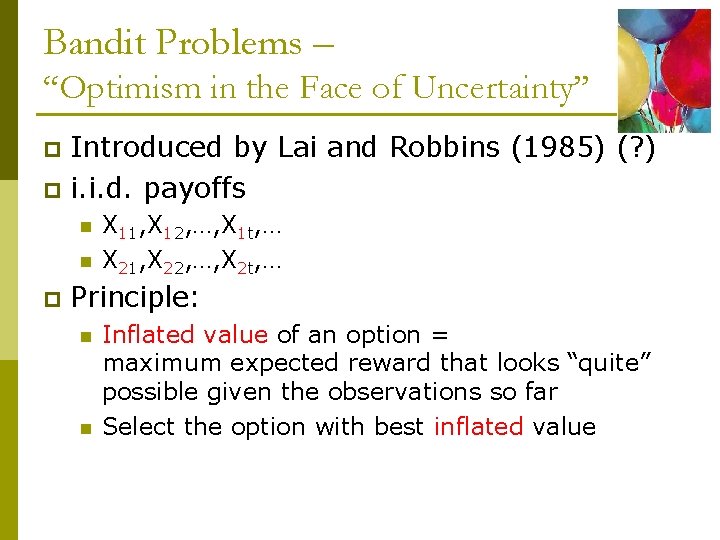
Bandit Problems – “Optimism in the Face of Uncertainty” Introduced by Lai and Robbins (1985) (? ) p i. i. d. payoffs p n n p X 11, X 12, …, X 1 t, … X 21, X 22, …, X 2 t, … Principle: n n Inflated value of an option = maximum expected reward that looks “quite” possible given the observations so far Select the option with best inflated value
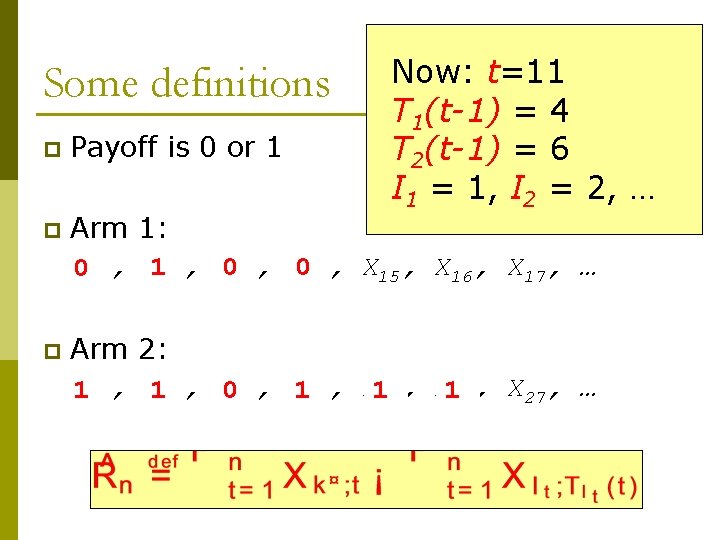
Some definitions Now: t=11 T 1(t-1) = 4 T 2(t-1) = 6 I 1 = 1, I 2 = 2, … p Payoff is 0 or 1 p Arm 1: X 011, X 112, X 013, X 014, X 15, X 16, X 17, … p Arm 2: X 121, X 122, X 023, X 124, X 125, X 126, X 27, …
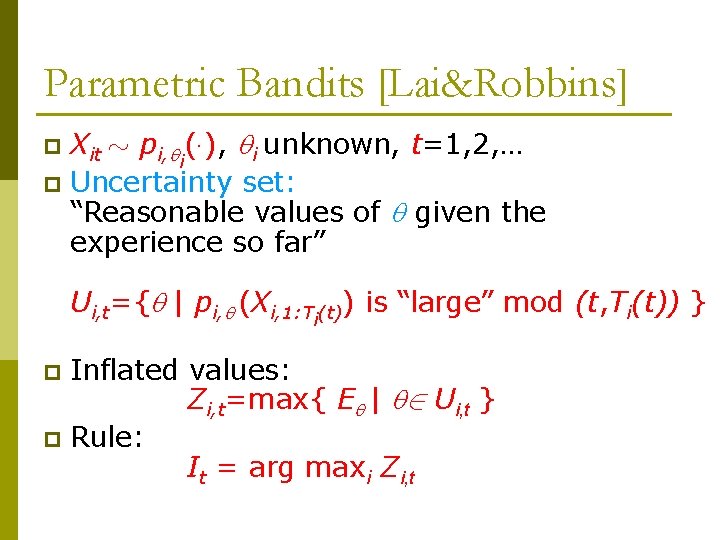
Parametric Bandits [Lai&Robbins] Xit » pi, i(¢), i unknown, t=1, 2, … p Uncertainty set: “Reasonable values of given the experience so far” p Ui, t={ | pi, (Xi, 1: Ti(t)) is “large” mod (t, Ti(t)) } Inflated values: Zi, t=max{ E | 2 Ui, t } p Rule: It = arg maxi Zi, t p
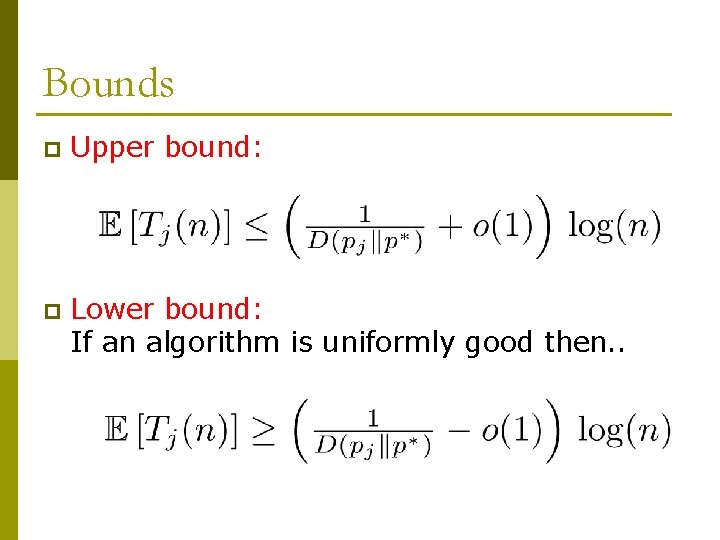
Bounds p Upper bound: p Lower bound: If an algorithm is uniformly good then. .
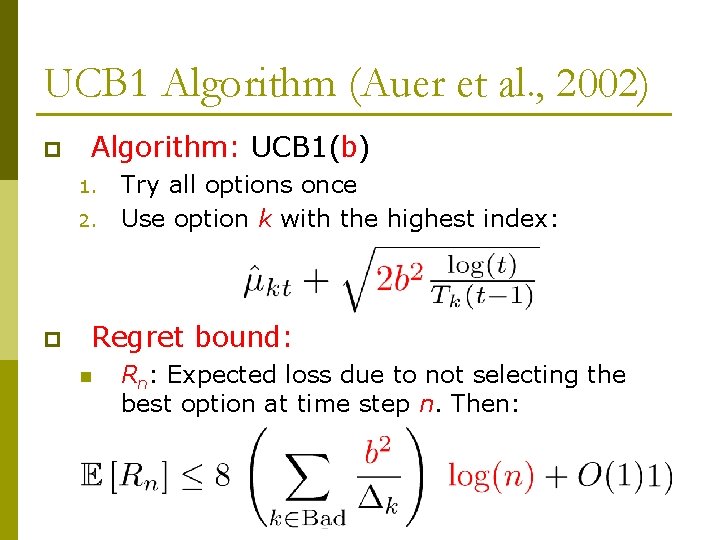
UCB 1 Algorithm (Auer et al. , 2002) p Algorithm: UCB 1(b) 1. 2. p Try all options once Use option k with the highest index: Regret bound: n Rn: Expected loss due to not selecting the best option at time step n. Then:
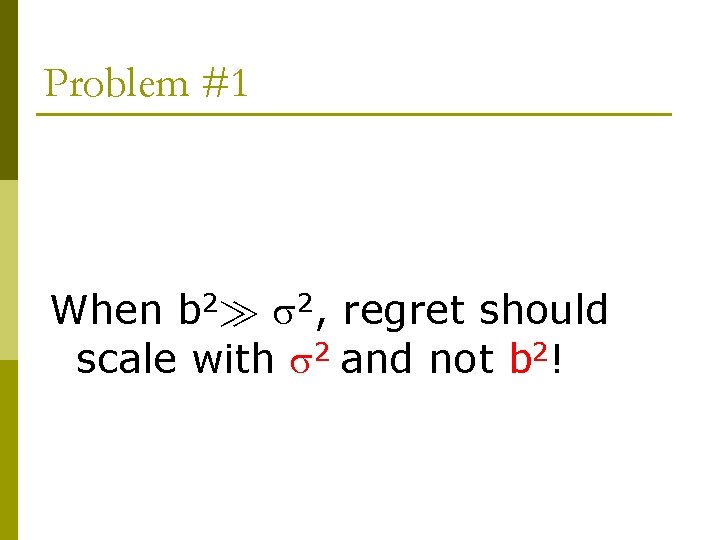
Problem #1 When b 2À 2, regret should scale with 2 and not b 2!
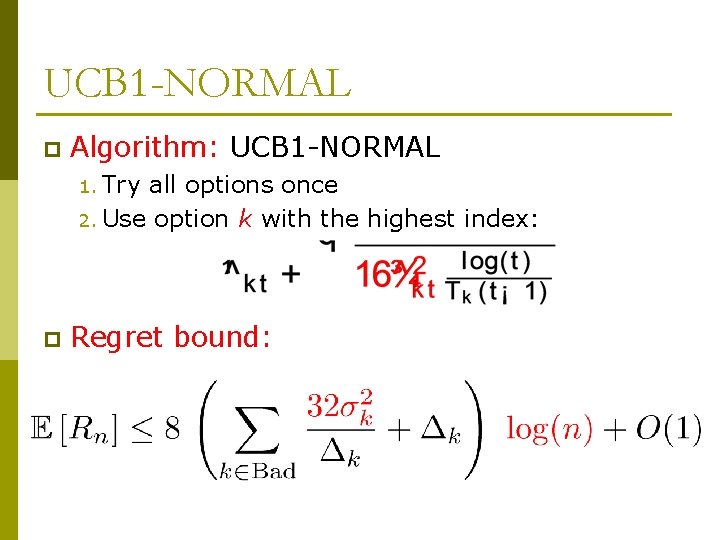
UCB 1 -NORMAL p Algorithm: UCB 1 -NORMAL 1. Try all options once 2. Use option k with the highest index: p Regret bound:
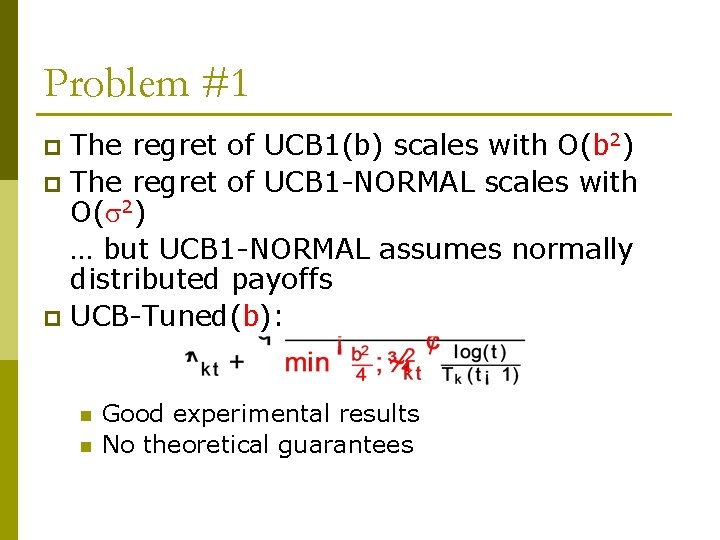
Problem #1 The regret of UCB 1(b) scales with O(b 2) p The regret of UCB 1 -NORMAL scales with O( 2) … but UCB 1 -NORMAL assumes normally distributed payoffs p UCB-Tuned(b): p n n Good experimental results No theoretical guarantees

UCB-V p Algorithm: UCB-V(b) 1. Try all options once 2. Use option k with the highest index: p Regret bound:
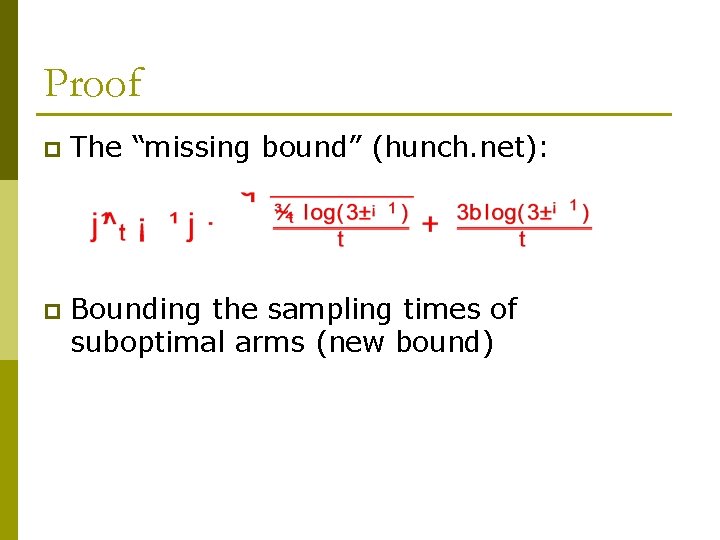
Proof p The “missing bound” (hunch. net): p Bounding the sampling times of suboptimal arms (new bound)
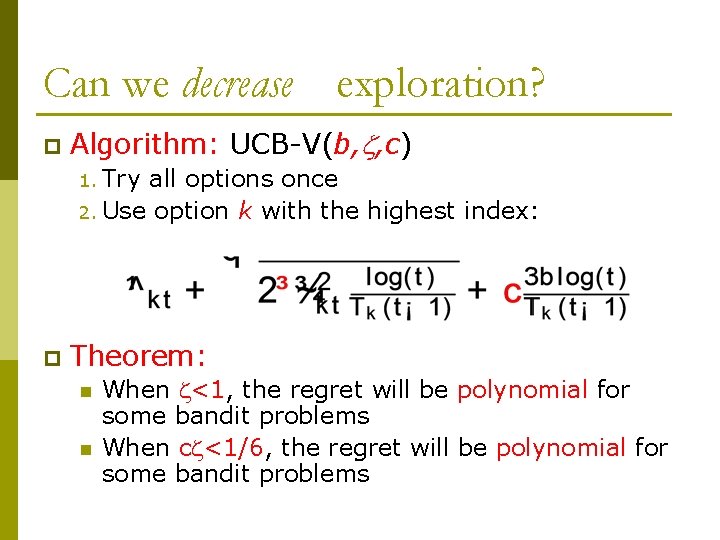
Can we decrease exploration? p Algorithm: UCB-V(b, , c) 1. Try all options once 2. Use option k with the highest index: p Theorem: n n When <1, the regret will be polynomial for some bandit problems When c <1/6, the regret will be polynomial for some bandit problems
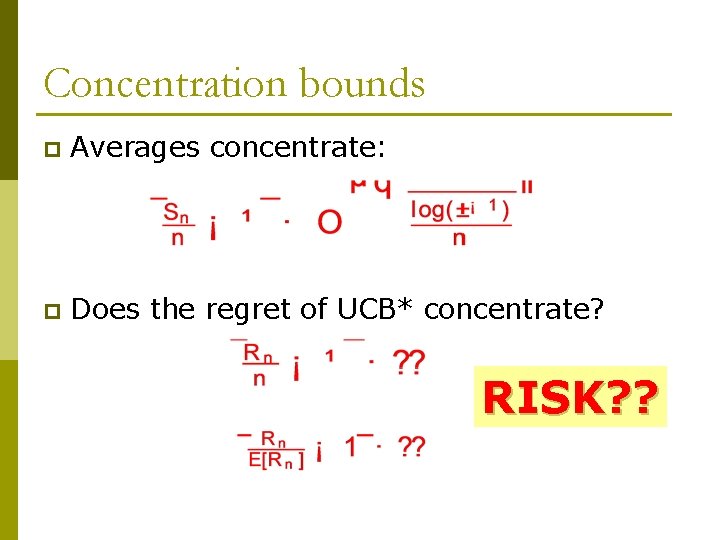
Concentration bounds p Averages concentrate: p Does the regret of UCB* concentrate? RISK? ?
Logarithmic regret implies high risk p Theorem: Consider the pseudo-regret Rn = k=1 K Tk(n) k. Then for any >1 and z> log(n), P(Rn>z)· C z- (Gaussian tail: P(Rn>z)· C exp(-z 2)) p Illustration: n n Two arms; 2 = 2 - 1>0. Modes of law of Rn at O(log(n)), O( 2 n)! Only happens when the support of the second best arm’s distribution overlaps with that of the optimal arm
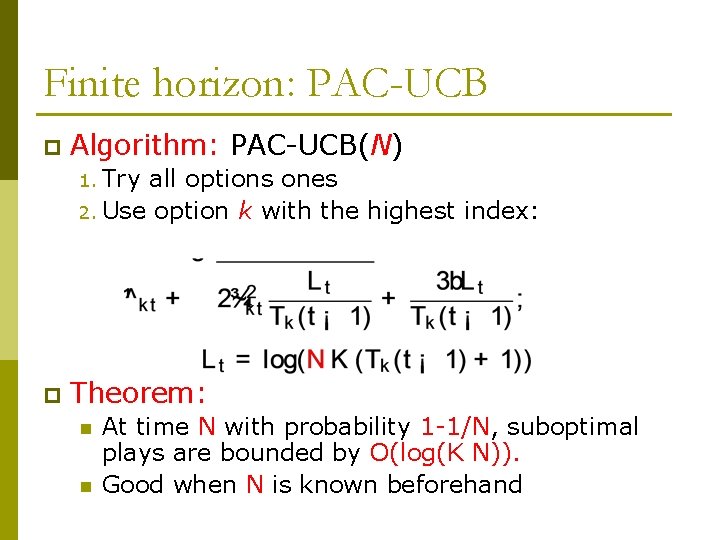
Finite horizon: PAC-UCB p Algorithm: PAC-UCB(N) 1. Try all options ones 2. Use option k with the highest index: p Theorem: n n At time N with probability 1 -1/N, suboptimal plays are bounded by O(log(K N)). Good when N is known beforehand
Conclusions Taking into account the variance lessens dependence on the a priori bound b p Low expected regret => high risk p PAC-UCB: p n Finite regret, known horizon, exponential concentration of the regret Optimal balance? Other algorithms? p Greater generality: look up the paper! p

Thank you! Questions?
References p p p Optimism in the face of uncertainty: Lai, T. L. and Robbins, H. (1985). Asymptotically efficient adaptive allocation rules. Advances in Applied Mathematics, 6: 4– 22. UCB 1 and more: Auer, P. , Cesa-Bianchi, N. , and Fischer, P. (2002). Finite time analysis of the multiarmed bandit problem. Machine Learning, 47(2 -3): 235– 256. Audibert, J. , Munos, R. , and Szepesvári, Cs. (2007). Tuning bandit algorithms in stochastic environments, ALT-2007.
- Slides: 22