
Tuning and Validation of Ocean Mixed Layer Models
- Slides: 32
Tuning and Validation of Ocean Mixed Layer Models David Acreman www. ncof. gov. uk
In partnership to provide world-class ocean forecasting and research www. ncof. gov. uk
Overview • • • The FOAM system The ocean “mixed layer” Kraus-Turner and KPP models Model performance and tuning at OWS Papa Model performance and tuning vs Argo data Effect of tuning in a global model www. ncof. gov. uk
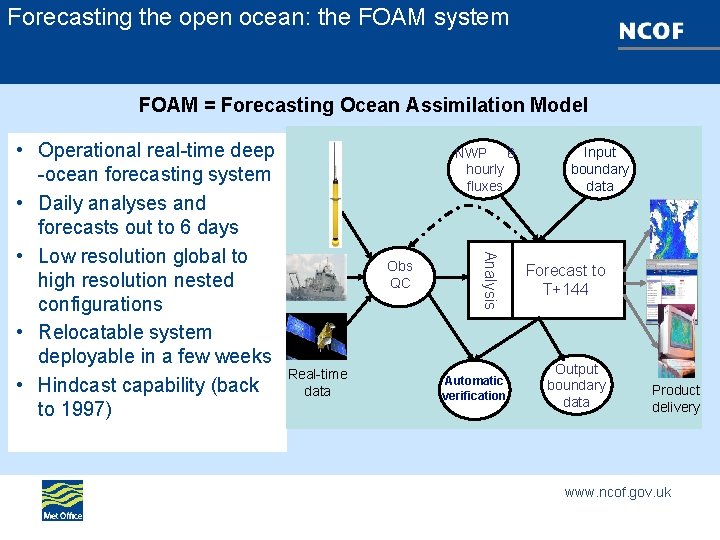
Forecasting the open ocean: the FOAM system FOAM = Forecasting Ocean Assimilation Model NWP 6 hourly fluxes Obs QC Real-time data Analysis • Operational real-time deep -ocean forecasting system • Daily analyses and forecasts out to 6 days • Low resolution global to high resolution nested configurations • Relocatable system deployable in a few weeks • Hindcast capability (back to 1997) Automatic verification Input boundary data Forecast to T+144 Output boundary data Product delivery www. ncof. gov. uk
The Mixed Layer (1) • Surface layer of the ocean where temperature, salinity and density are near uniform due to turbulent mixing. • Mixed layer deepens due to wind mixing and convection. • Mixed layer shallows when winds are low and solar heating restores stratification. • The depth of the mixed layer shows seasonal variability (deepens in autumn, shallows in spring). www. ncof. gov. uk
The Mixed Layer (2) • Mixed layer depth is an important output from FOAM • Properties of the mixed layer affect oceanatmosphere fluxes. • Mixed layer depth also influences biological processes. www. ncof. gov. uk
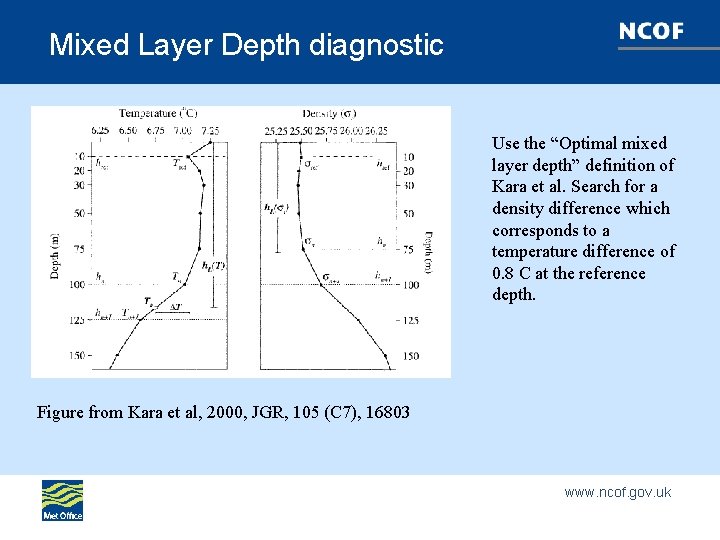
Mixed Layer Depth diagnostic Use the “Optimal mixed layer depth” definition of Kara et al. Search for a density difference which corresponds to a temperature difference of 0. 8 C at the reference depth. Figure from Kara et al, 2000, JGR, 105 (C 7), 16803 www. ncof. gov. uk
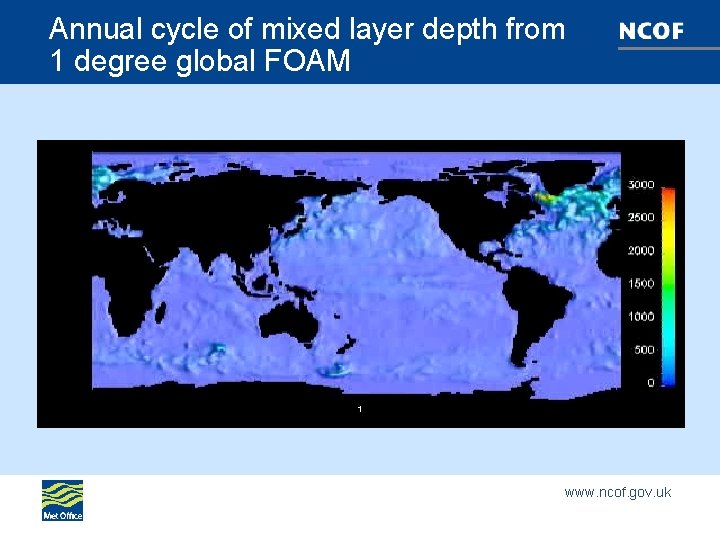
Annual cycle of mixed layer depth from 1 degree global FOAM www. ncof. gov. uk
The Kraus-Turner Model • The Met Office ocean model uses a bulk mixed layer model, based on Kraus and Turner (1967), to mix tracers. • The model assumes a well mixed surface layer and uses a TKE budget to calculate mixed layer depth. • A 1 D configuration was used to validate and tune the model. www. ncof. gov. uk
K-Profile Parameterisation of Large et al • • More sophisticated than KT. Doesn’t assumed well mixed surface layer. Models turbulent fluxes as diffusion terms. Based on atmospheric boundary layer models. www. ncof. gov. uk
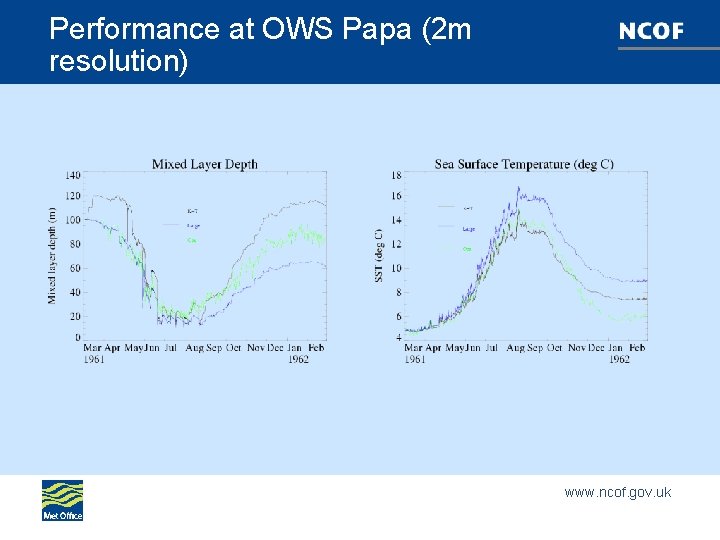
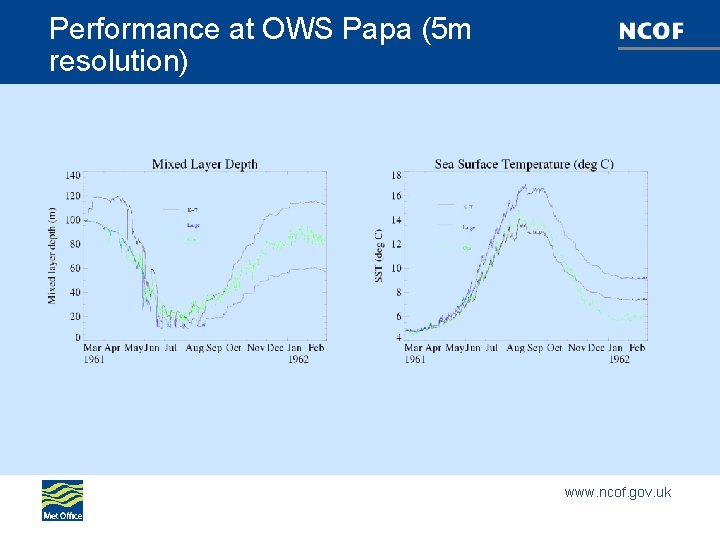
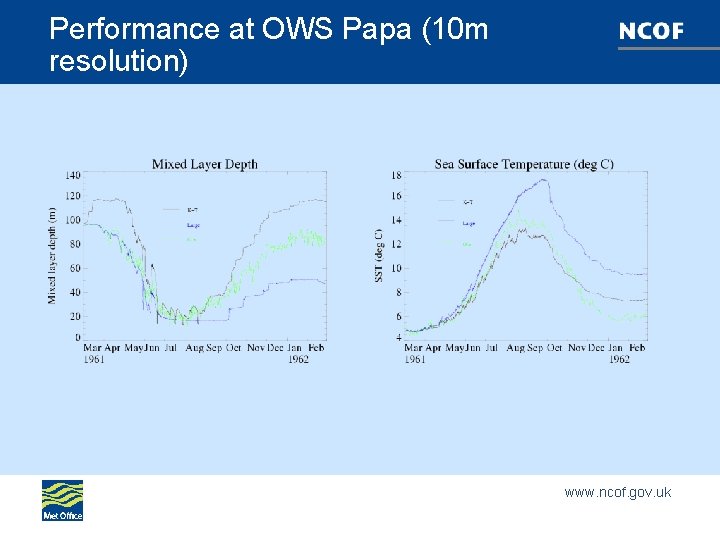
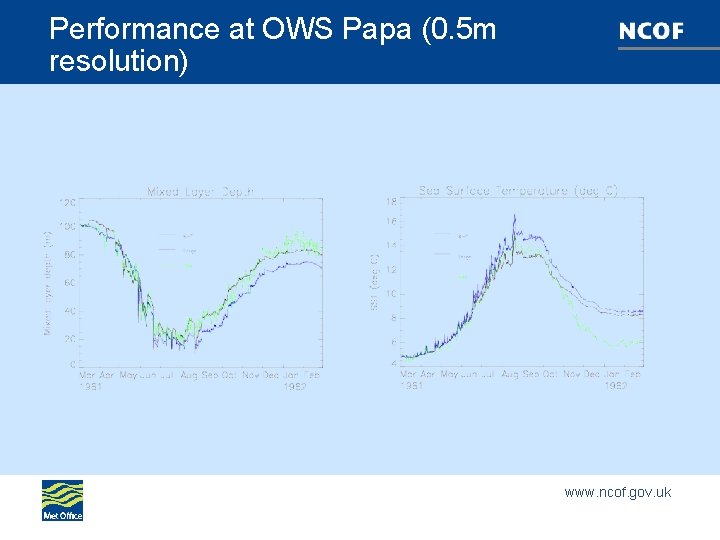
Ocean Weather Station Papa • Frequently used for validation and tuning of 1 D mixed layer models • Located in N. E. Pacific at 50 N, 145 W • Ran Kraus-Turner and KPP models for one year starting in March 1961 (same as Large et al 1994) • Used vertical resolutions of 0. 5 m, 2 m, 5 and 10 m • Forcing fluxes calculated using bulk formulae (met data courtesy of Paul Martin) www. ncof. gov. uk
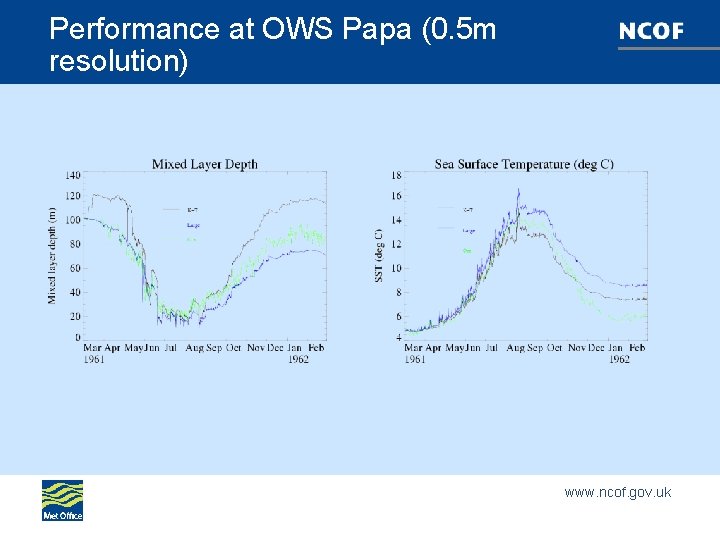
Performance at OWS Papa (0. 5 m resolution) www. ncof. gov. uk
Performance at OWS Papa (2 m resolution) www. ncof. gov. uk
Performance at OWS Papa (5 m resolution) www. ncof. gov. uk
Performance at OWS Papa (10 m resolution) www. ncof. gov. uk
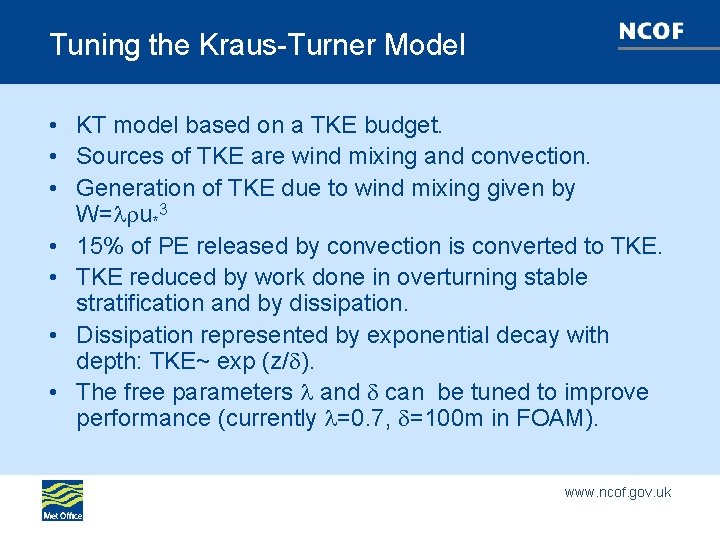
Tuning the Kraus-Turner Model • KT model based on a TKE budget. • Sources of TKE are wind mixing and convection. • Generation of TKE due to wind mixing given by W= u*3 • 15% of PE released by convection is converted to TKE. • TKE reduced by work done in overturning stable stratification and by dissipation. • Dissipation represented by exponential decay with depth: TKE~ exp (z/ ). • The free parameters and can be tuned to improve performance (currently =0. 7, =100 m in FOAM). www. ncof. gov. uk
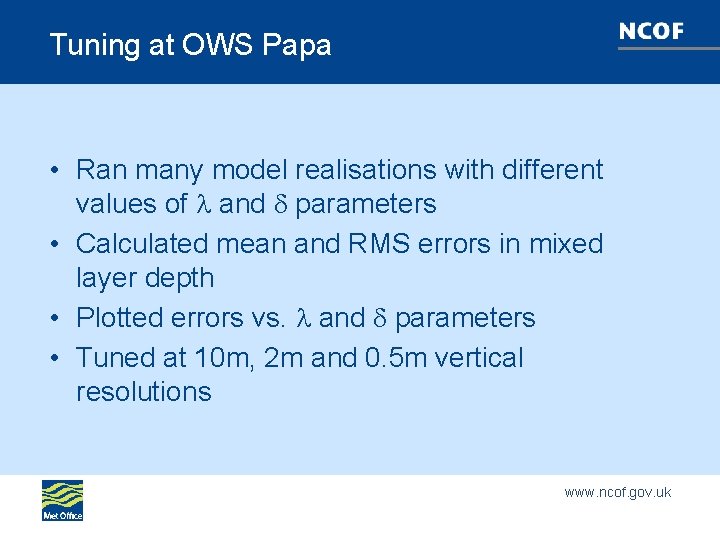
Tuning at OWS Papa • Ran many model realisations with different values of and parameters • Calculated mean and RMS errors in mixed layer depth • Plotted errors vs. and parameters • Tuned at 10 m, 2 m and 0. 5 m vertical resolutions www. ncof. gov. uk
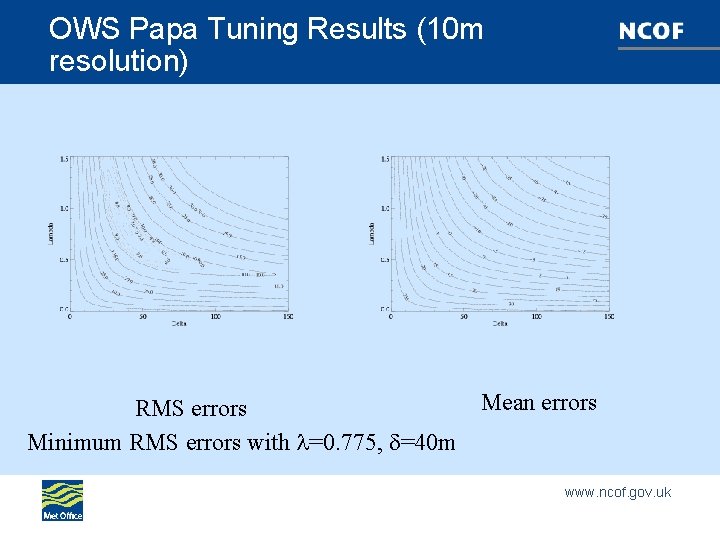
OWS Papa Tuning Results (10 m resolution) Mean errors RMS errors Minimum RMS errors with =0. 775, =40 m www. ncof. gov. uk
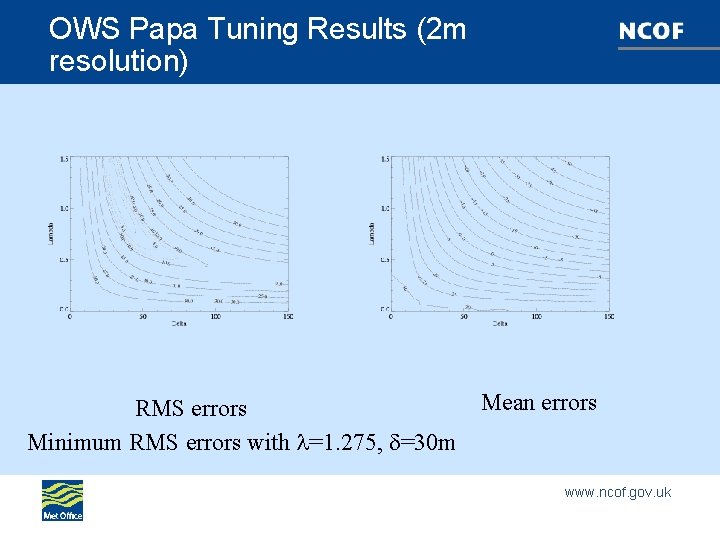
OWS Papa Tuning Results (2 m resolution) Mean errors RMS errors Minimum RMS errors with =1. 275, =30 m www. ncof. gov. uk
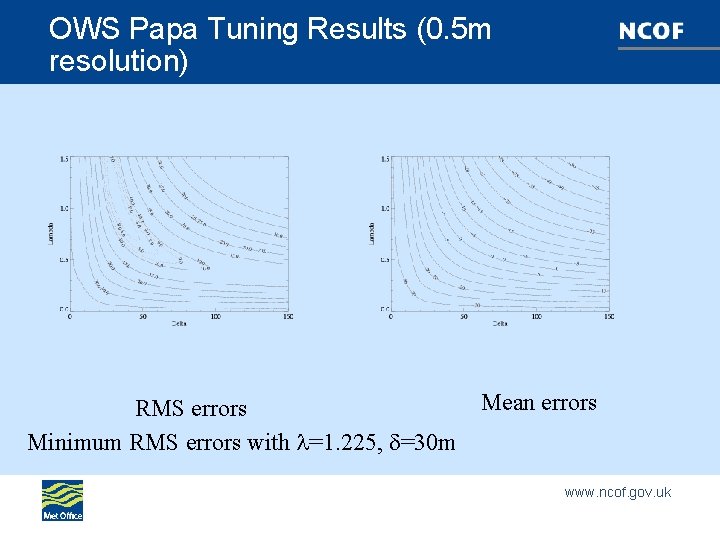
OWS Papa Tuning Results (0. 5 m resolution) Mean errors RMS errors Minimum RMS errors with =1. 225, =30 m www. ncof. gov. uk
Performance at OWS Papa (0. 5 m resolution) www. ncof. gov. uk
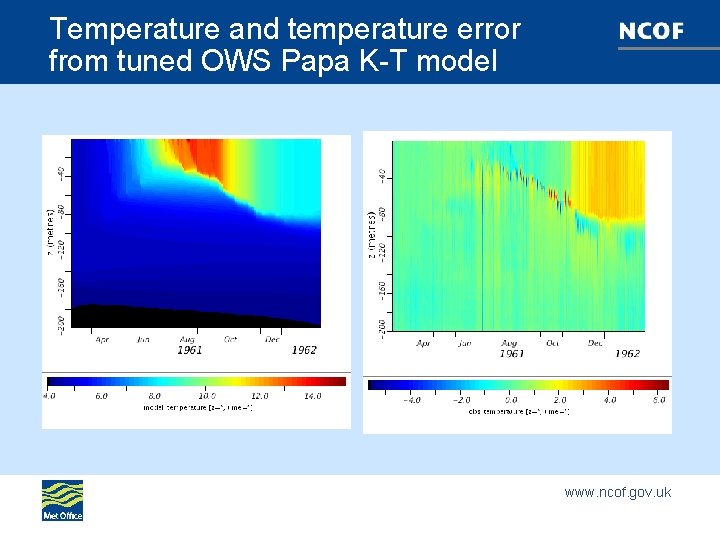
Temperature and temperature error from tuned OWS Papa K-T model www. ncof. gov. uk
Model tuning using Argo data • Argo floats are autonomous profiling floats which record temperature and salinity profiles approximately every 10 days. • A large number of annual cycles are available for model tuning. www. ncof. gov. uk
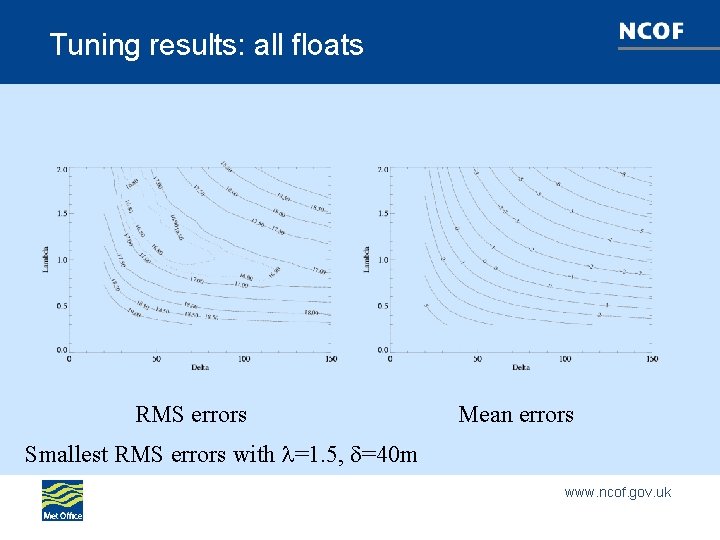
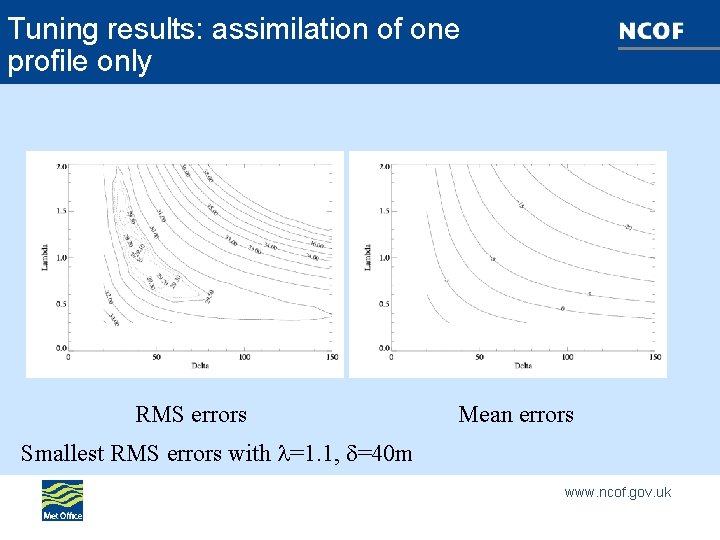
Kraus-Turner Model Tuning using Argo • Forcing from Met Office NWP fluxes. • Initial conditions from Levitus climatology. • Temperature and salinity profiles assimilated over 10 day window. • Vertical model levels based on operational FOAM system (~10 m near surface). • Calculate mean and RMS errors, excluding cases with significant advection. • Average over sample of 218 floats. • Run KT model using different values of and . www. ncof. gov. uk
Tuning results: all floats RMS errors Mean errors Smallest RMS errors with =1. 5, =40 m www. ncof. gov. uk
Tuning results: assimilation of one profile only RMS errors Mean errors Smallest RMS errors with =1. 1, =40 m www. ncof. gov. uk
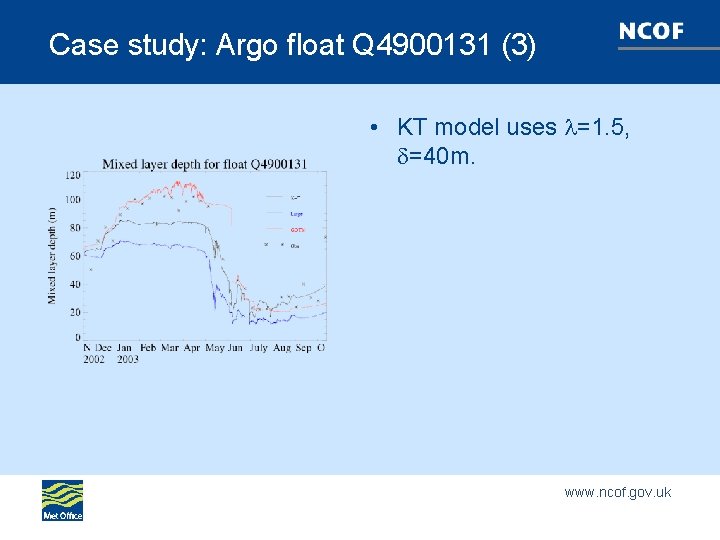
Case study: Argo float Q 4900131 • Location: 46 N, 134 W. • Forcing from Met Office NWP fluxes. • Initial conditions from float temperature and salinity profiles. • No assimilation of data. • Compare three different models: Kraus-Turner, Large and GOTM. • Run models at high vertical resolution (0. 5 m) and study annual cycle. www. ncof. gov. uk
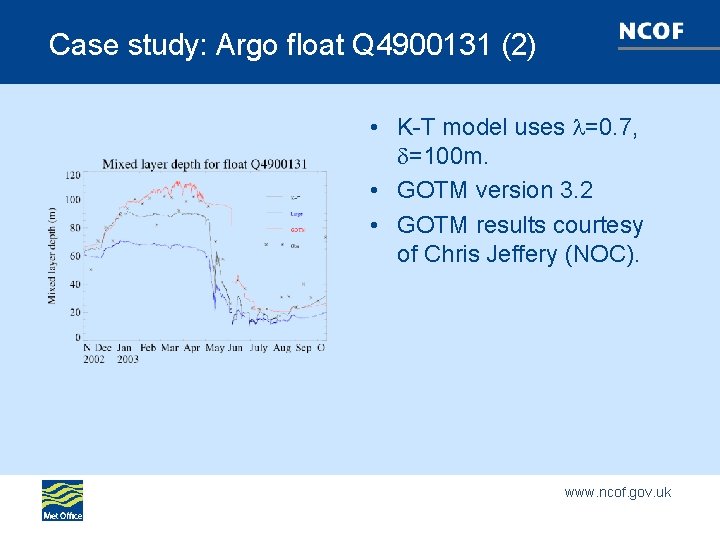
Case study: Argo float Q 4900131 (2) • K-T model uses =0. 7, =100 m. • GOTM version 3. 2 • GOTM results courtesy of Chris Jeffery (NOC). www. ncof. gov. uk
Case study: Argo float Q 4900131 (3) • KT model uses =1. 5, =40 m. www. ncof. gov. uk
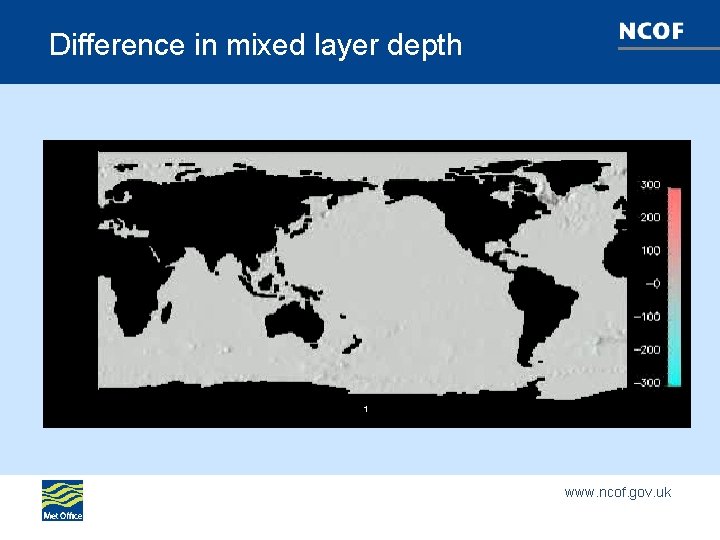
New parameters in global FOAM • Ran 1 year hindcast using global 1 degree FOAM • Kraus-Turner parameters were changed to =1. 5, =40 m • Plotted difference in mixed layer depth between models with old and new parameters www. ncof. gov. uk
Difference in mixed layer depth www. ncof. gov. uk
Conclusions • The Kraus-Turner model can give a good representation of mixed layer depths when tuned. • Optimum parameters for the Kraus-Turner scheme are =1. 5, =40 m with assimilation. • Without ongoing assimilation the optimum value of is reduced. • The Large et al KPP scheme tends to give mixed layers which are too shallow particularly at low vertical resolutions. www. ncof. gov. uk