
Tune Measurement at GSI SIS18 Methods and Results

- Slides: 41
Tune Measurement at GSI SIS-18: Methods and Results R. Singh 1, 2, P. Forck 1, P. Kowina 1, W. Kaufmann 1, K. Lang 1 1 GSI, Darmstadt, Germany 2 TEMF, TU Darmstadt, Germany Ditanet International Conference 9 th November, 2011 Seville, Spain Rahul Singh Tune measurements at GSI: Methods and 1
Outline • Introduction • Methods Tune, Orbit and Position Measurement System (TOPOS) Base Band Tune Measurement System (BBQ) • Results • Opportunities and Conclusion Rahul Singh Tune measurements at GSI: Methods and 2
Outline • Introduction • Methods Tune, Orbit and Position Measurement System (TOPOS) Base Band Tune Measurement System (BBQ) • Results • Opportunities and Conclusion Rahul Singh Tune measurements at GSI: Methods and 3
Introduction to Tune • What is betatron tune ? • Why is tune measured ? • How is tune measured ? Rahul Singh Tune measurements at GSI: Methods and 4
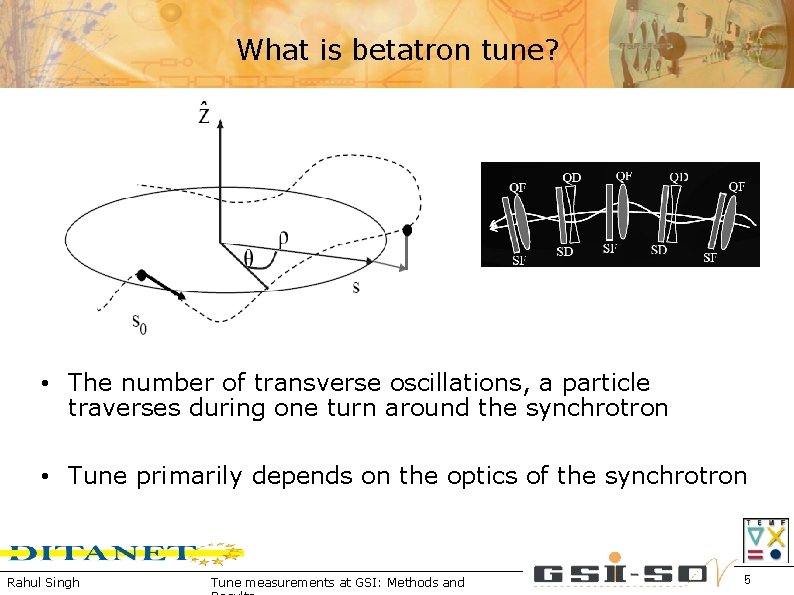
What is betatron tune? • The number of transverse oscillations, a particle traverses during one turn around the synchrotron • Tune primarily depends on the optics of the synchrotron Rahul Singh Tune measurements at GSI: Methods and 5
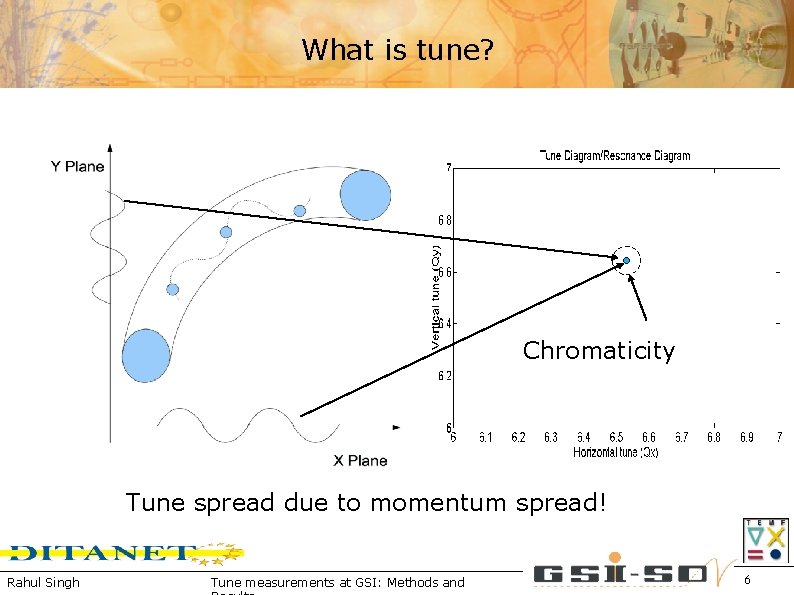
What is tune? Chromaticity Tune spread due to momentum spread! Rahul Singh Tune measurements at GSI: Methods and 6
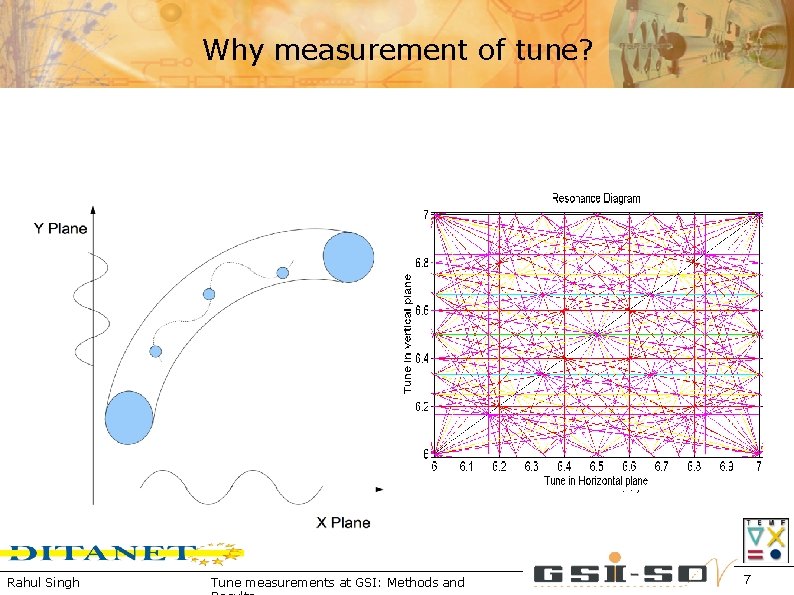
Why measurement of tune? Rahul Singh Tune measurements at GSI: Methods and 7
Why measurement of tune? • Not to lose particles or lose particles at will(slow extraction) • Correct unwanted tune movements, i. e control it • Precise control of the tune is crucial for high current operations especially for the storage of low energy ion beams (Tune shifts depending on intensity) Rahul Singh Tune measurements at GSI: Methods and 8
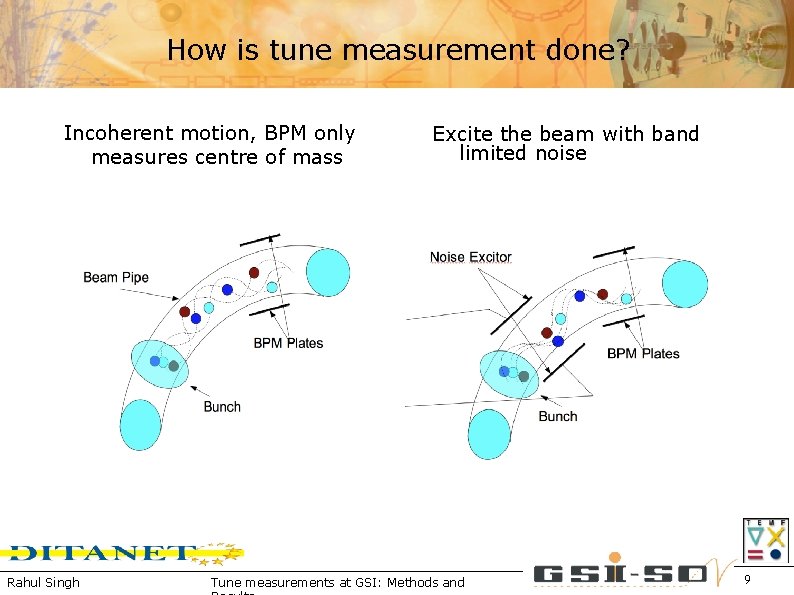
How is tune measurement done? Incoherent motion, BPM only measures centre of mass Rahul Singh Excite the beam with band limited noise Tune measurements at GSI: Methods and 9
Outline • Introduction • Methods Tune, Orbit and Position Measurement System (TOPOS) Base Band Tune Measurement System (BBQ) • Results • Opportunities and Conclusion Rahul Singh Tune measurements at GSI: Methods and 10
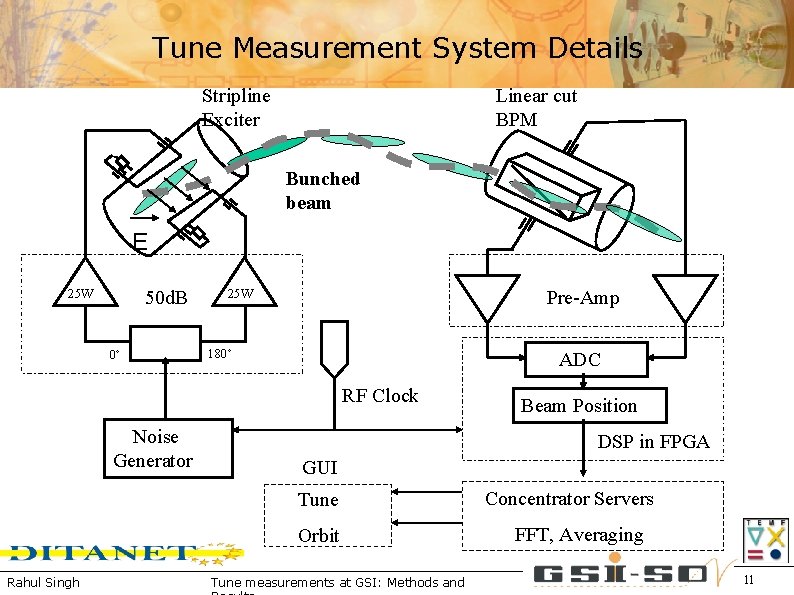
Tune Measurement System Details Linear cut BPM Stripline Exciter Bunched beam E 50 d. B 25 W 0˚ Pre-Amp 25 W 180˚ ADC RF Clock Noise Generator DSP in FPGA GUI Tune Orbit Rahul Singh Beam Position Tune measurements at GSI: Methods and Concentrator Servers FFT, Averaging 11
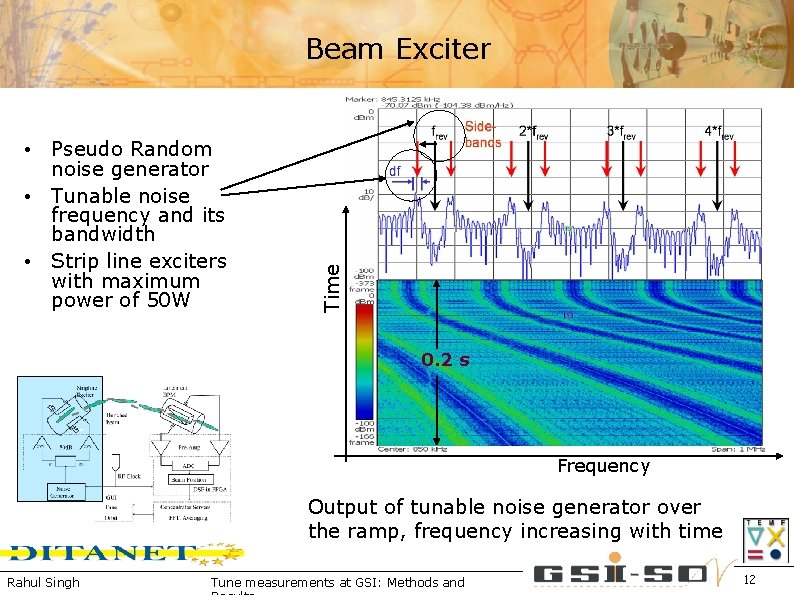
• Pseudo Random noise generator • Tunable noise frequency and its bandwidth • Strip line exciters with maximum power of 50 W Time Beam Exciter 0. 2 s Frequency Output of tunable noise generator over the ramp, frequency increasing with time Rahul Singh Tune measurements at GSI: Methods and 12
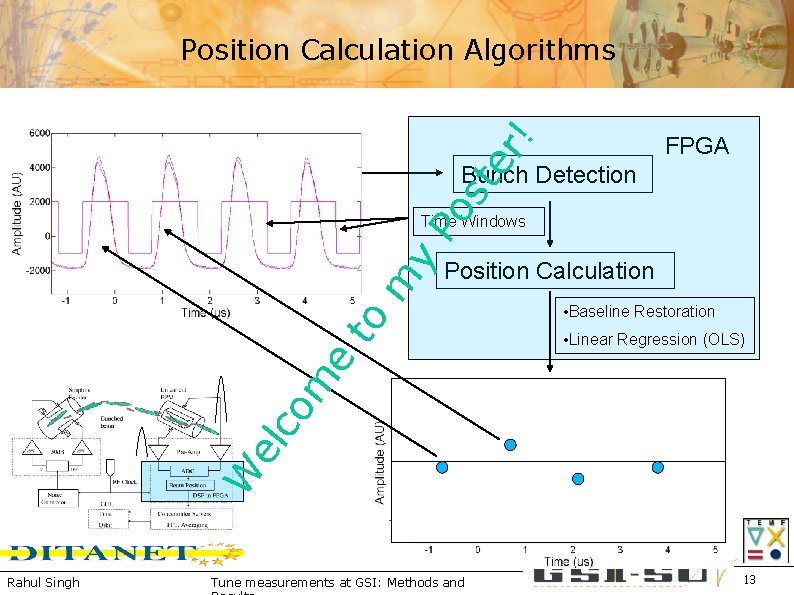
Position Calculation Algorithms st er ! FPGA Po Bunch Detection Position Calculation • Baseline Restoration • Linear Regression (OLS) W el co m e to m y Time Windows Rahul Singh Tune measurements at GSI: Methods and 13
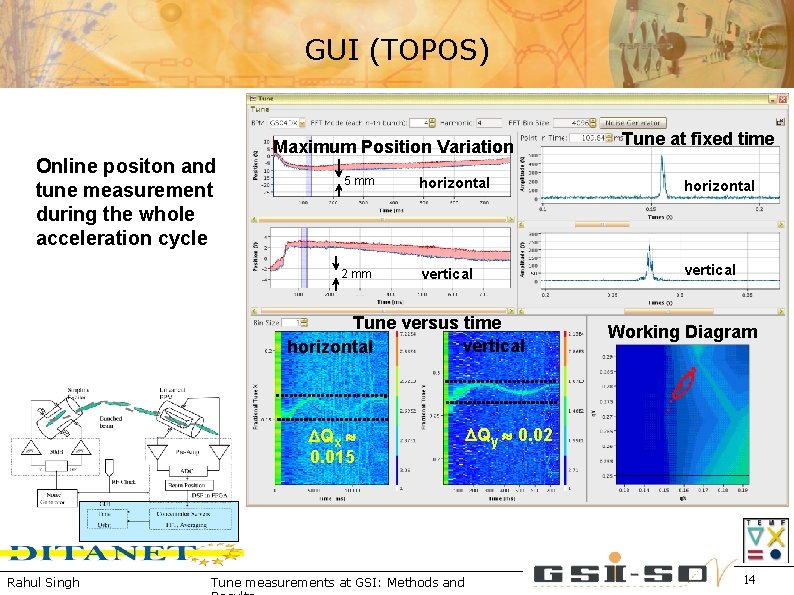
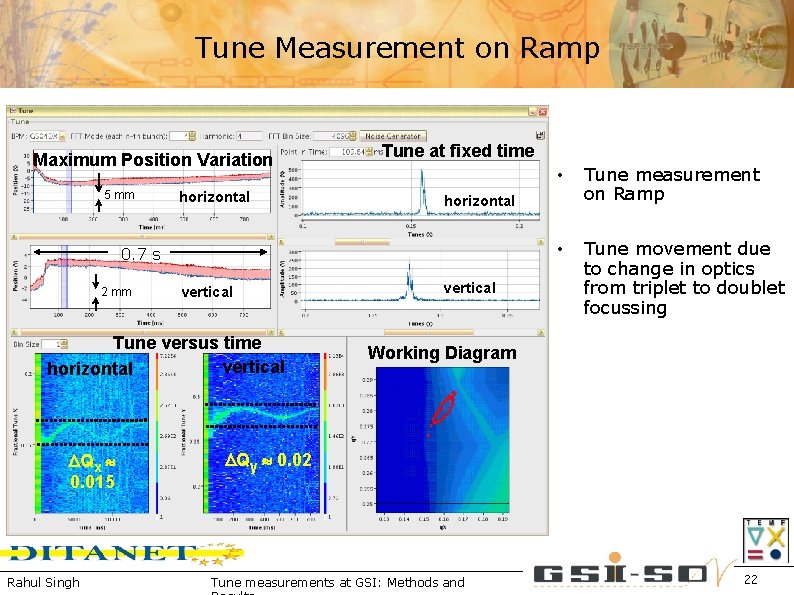
GUI (TOPOS) Online positon and tune measurement during the whole acceleration cycle Maximum Position Variation 5 mm horizontal 2 mm vertical Tune versus time vertical horizontal Qx 0. 015 Rahul Singh Tune at fixed time Working Diagram Qy 0. 02 Tune measurements at GSI: Methods and 14
Outline • Introduction • Methods Tune, Orbit and Position Measurement System (TOPOS) Base Band Tune Measurement System (BBQ) Designed by Marek Gasior et al (BE/BI/QP), CERN • Results • Opportunities and Conclusion Rahul Singh Tune measurements at GSI: Methods and 15
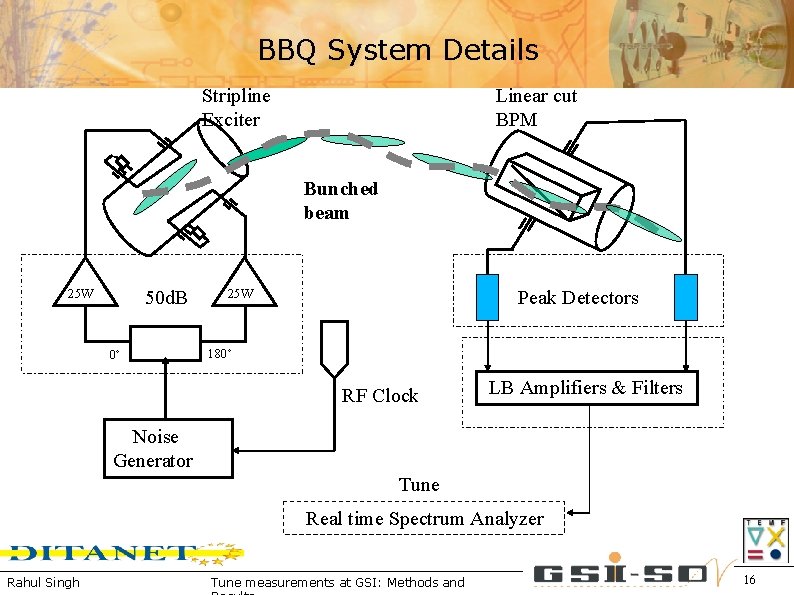
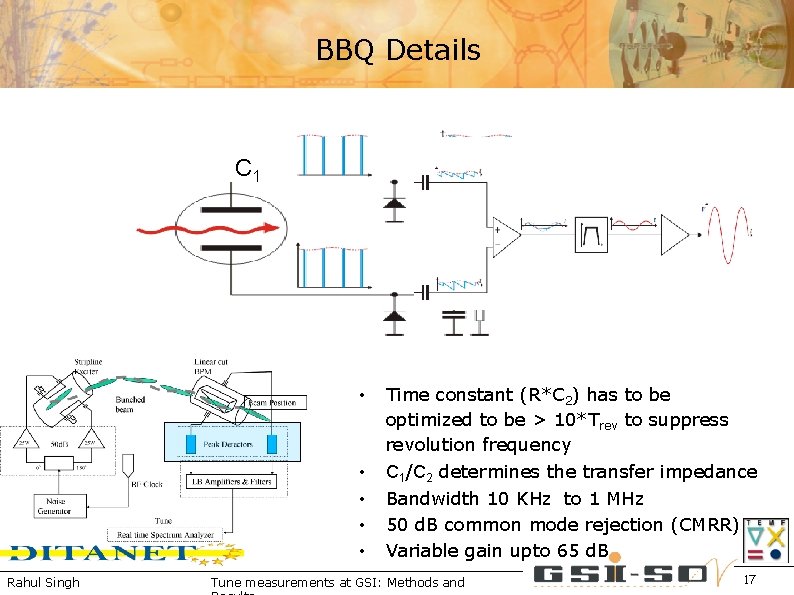
BBQ System Details Linear cut BPM Stripline Exciter Bunched beam 50 d. B 25 W 0˚ Peak Detectors 25 W 180˚ RF Clock LB Amplifiers & Filters Noise Generator Tune Real time Spectrum Analyzer Rahul Singh Tune measurements at GSI: Methods and 16
BBQ Details C 1 C 2 Rahul Singh R • Time constant (R*C 2) has to be optimized to be > 10*Trev to suppress revolution frequency • • C 1/C 2 determines the transfer impedance Bandwidth 10 KHz to 1 MHz 50 d. B common mode rejection (CMRR) Variable gain upto 65 d. B Tune measurements at GSI: Methods and 17
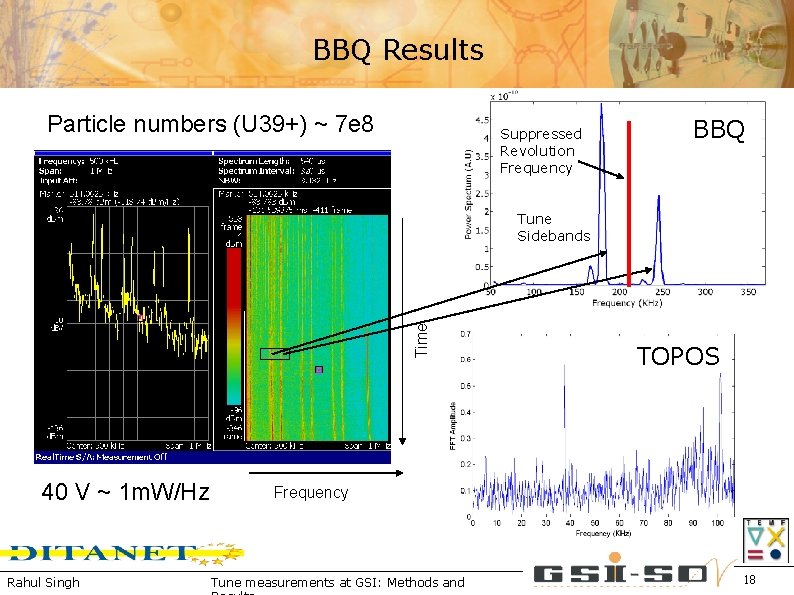
BBQ Results Particle numbers (U 39+) ~ 7 e 8 Suppressed Revolution Frequency BBQ Time Tune Sidebands 40 V ~ 1 m. W/Hz Rahul Singh TOPOS Frequency Tune measurements at GSI: Methods and 18
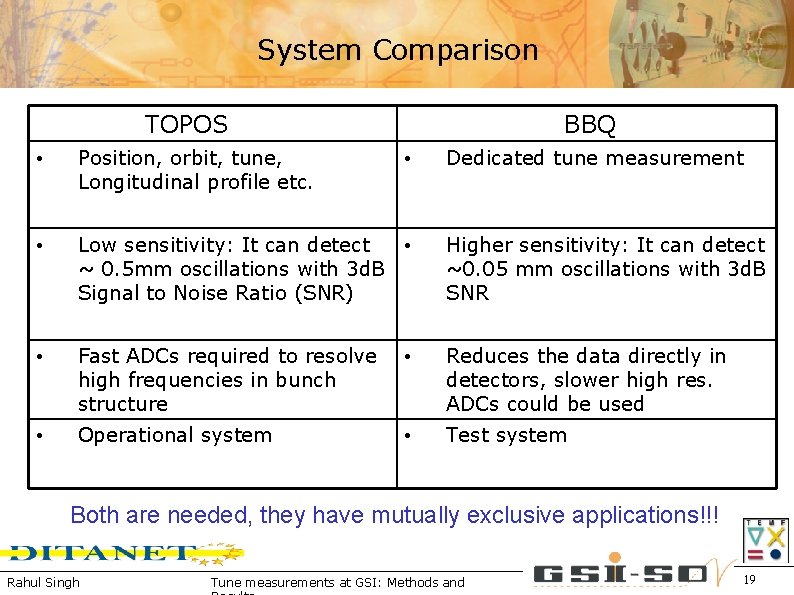
System Comparison TOPOS BBQ • Position, orbit, tune, Longitudinal profile etc. • Low sensitivity: It can detect • ~ 0. 5 mm oscillations with 3 d. B Signal to Noise Ratio (SNR) Higher sensitivity: It can detect ~0. 05 mm oscillations with 3 d. B SNR • Fast ADCs required to resolve • high frequencies in bunch structure Reduces the data directly in detectors, slower high res. ADCs could be used • Operational system Test system • • Dedicated tune measurement Both are needed, they have mutually exclusive applications!!! Rahul Singh Tune measurements at GSI: Methods and 19
Outline • Introduction • Methods Tune, Orbit and Position Measurement System (TOPOS) Base Band Tune Measurement System (BBQ) • Results • Opportunities and Conclusion Rahul Singh Tune measurements at GSI: Methods and 20
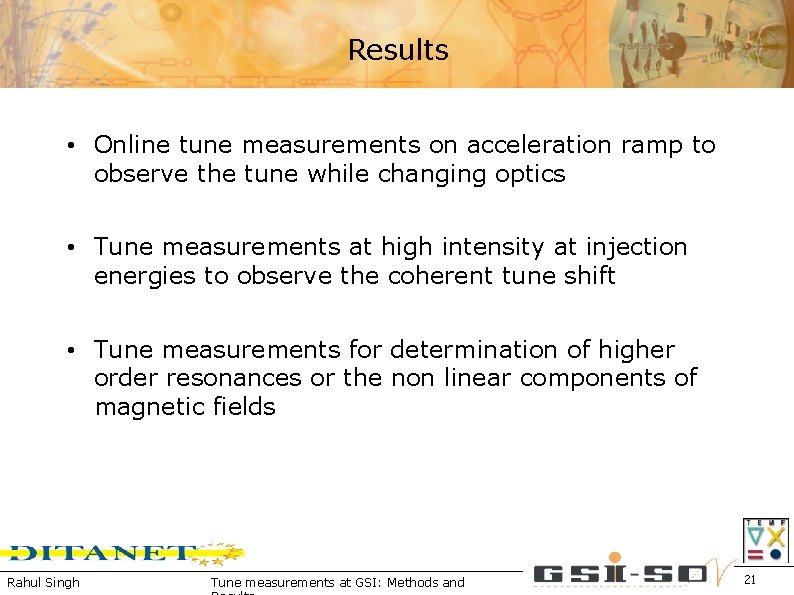
Results • Online tune measurements on acceleration ramp to observe the tune while changing optics • Tune measurements at high intensity at injection energies to observe the coherent tune shift • Tune measurements for determination of higher order resonances or the non linear components of magnetic fields Rahul Singh Tune measurements at GSI: Methods and 21
Tune Measurement on Ramp Maximum Position Variation 5 mm horizontal Tune at fixed time vertical Tune versus time vertical horizontal Qx 0. 015 Rahul Singh Tune measurement on Ramp • Tune movement due to change in optics from triplet to doublet focussing horizontal 0. 7 s 2 mm • vertical Working Diagram Qy 0. 02 Tune measurements at GSI: Methods and 22
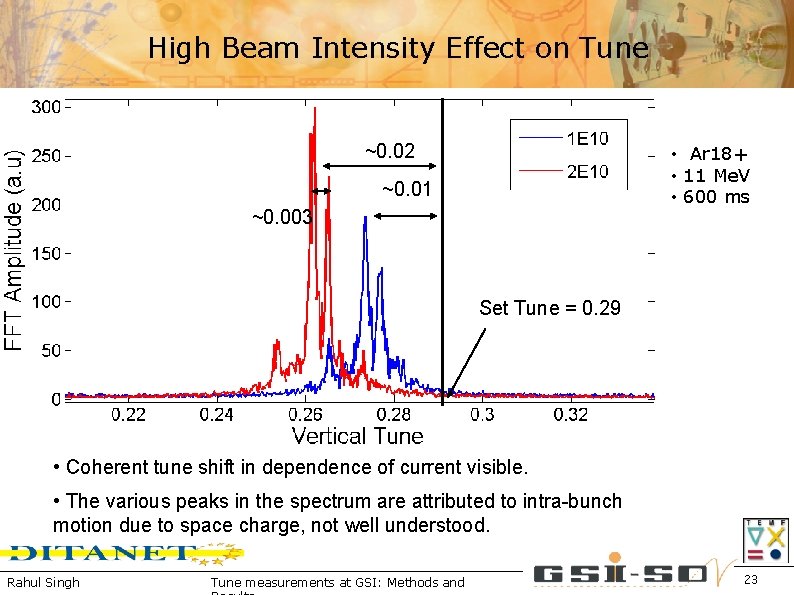
High Beam Intensity Effect on Tune ~0. 02 • Ar 18+ • 11 Me. V • 600 ms ~0. 01 ~0. 003 Set Tune = 0. 29 • Coherent tune shift in dependence of current visible. • The various peaks in the spectrum are attributed to intra-bunch motion due to space charge, not well understood. Rahul Singh Tune measurements at GSI: Methods and 23
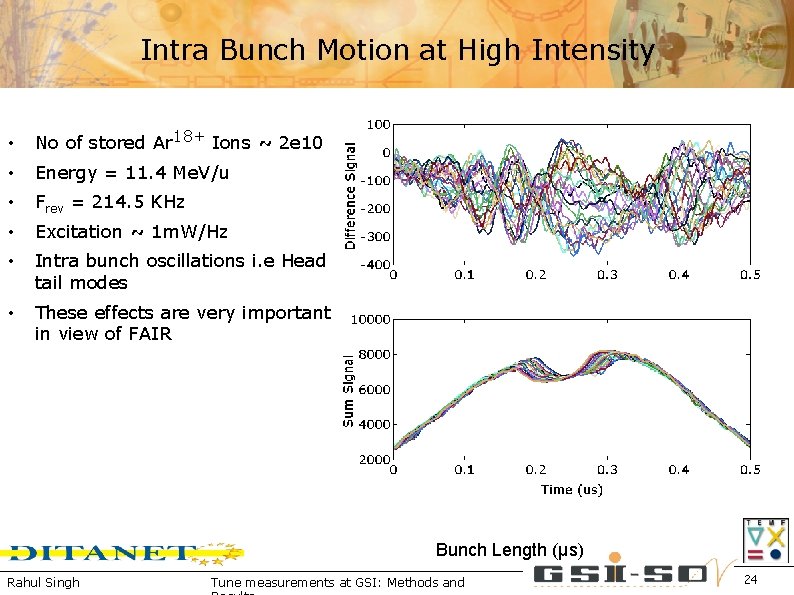
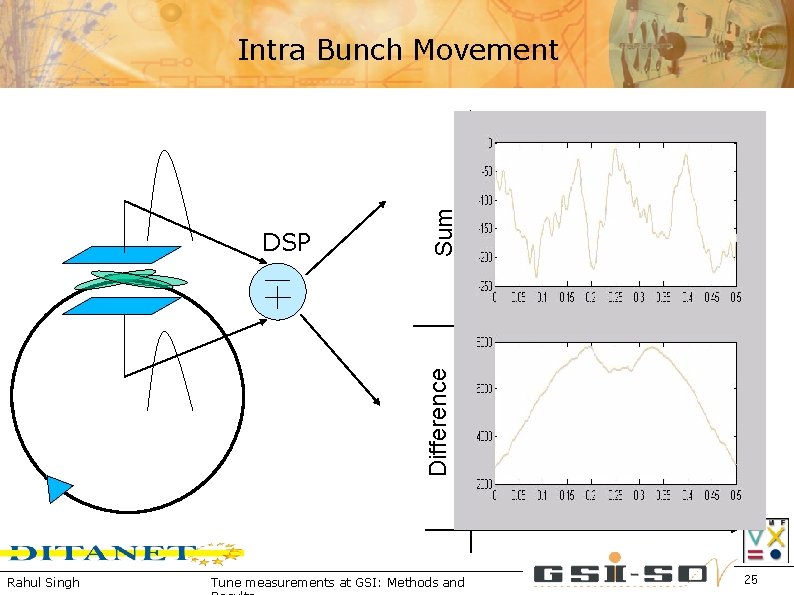
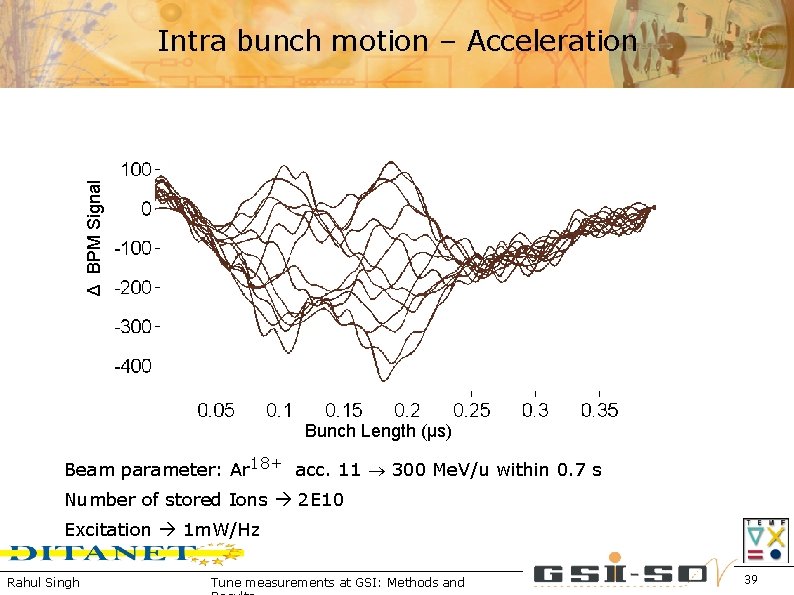
Intra Bunch Motion at High Intensity • No of stored Ar 18+ Ions ~ 2 e 10 • Energy = 11. 4 Me. V/u • Frev = 214. 5 KHz • Excitation ~ 1 m. W/Hz • Intra bunch oscillations i. e Head tail modes • These effects are very important in view of FAIR Bunch Length (μs) Rahul Singh Tune measurements at GSI: Methods and 24
Difference DSP Sum Intra Bunch Movement Rahul Singh Tune measurements at GSI: Methods and 25
Conclusions • Two parallel working tune measurement systems • TOPOS offers opportunities for detailed beam investigations • Insight into the beam physics at SIS-18 Rahul Singh Tune measurements at GSI: Methods and 26
Acknowledgement • European ITN- DITANET for funding the work and associated people to provide this opportunity • CERN BI group especially M. Gasior for help on BBQ system • Highly Supportive Beam Diagnostics Group at GSI Thanks for attention! Questions? Rahul Singh Tune measurements at GSI: Methods and 27
Extra Slides Rahul Singh Tune measurements at GSI: Methods and 28
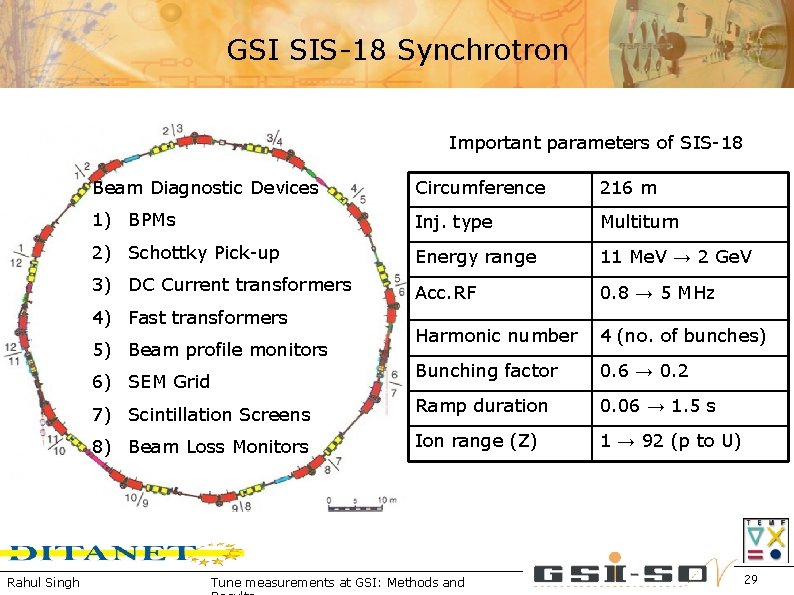
GSI SIS-18 Synchrotron Important parameters of SIS-18 Beam Diagnostic Devices Circumference 216 m 1) BPMs Inj. type Multiturn 2) Schottky Pick-up Energy range 11 Me. V → 2 Ge. V 3) DC Current transformers Acc. RF 0. 8 → 5 MHz Harmonic number 4 (no. of bunches) Bunching factor 0. 6 → 0. 2 7) Scintillation Screens Ramp duration 0. 06 → 1. 5 s 8) Beam Loss Monitors Ion range (Z) 1 → 92 (p to U) 4) Fast transformers 5) Beam profile monitors 6) SEM Grid Rahul Singh Tune measurements at GSI: Methods and 29
Opportunities • Make a user friendly interactive system to determine Position/ tune/ bunch movements in real time • Position calculation algorithms robust to beam conditions, bunch mismatch etc. • Test and understand the limits of both TOPOS and BBQ systems Rahul Singh Tune measurements at GSI: Methods and 30
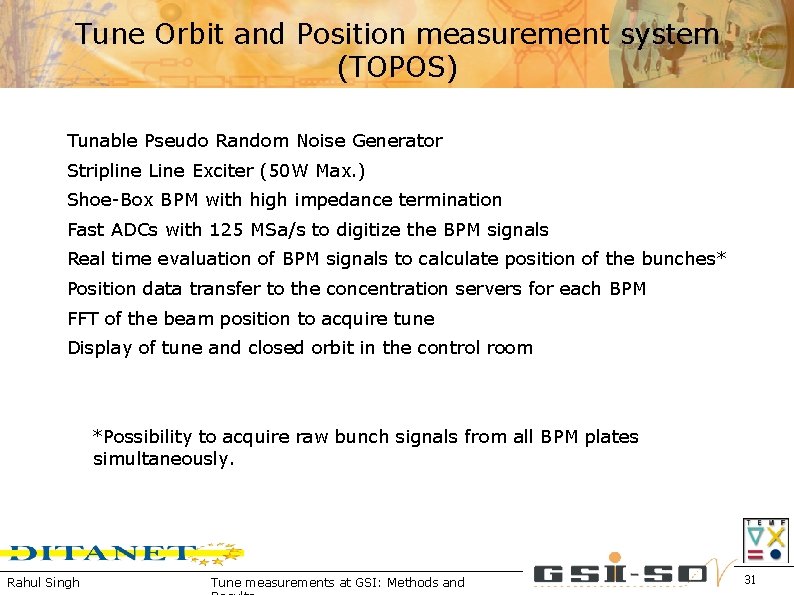
Tune Orbit and Position measurement system (TOPOS) Tunable Pseudo Random Noise Generator Stripline Line Exciter (50 W Max. ) Shoe-Box BPM with high impedance termination Fast ADCs with 125 MSa/s to digitize the BPM signals Real time evaluation of BPM signals to calculate position of the bunches* Position data transfer to the concentration servers for each BPM FFT of the beam position to acquire tune Display of tune and closed orbit in the control room *Possibility to acquire raw bunch signals from all BPM plates simultaneously. Rahul Singh Tune measurements at GSI: Methods and 31
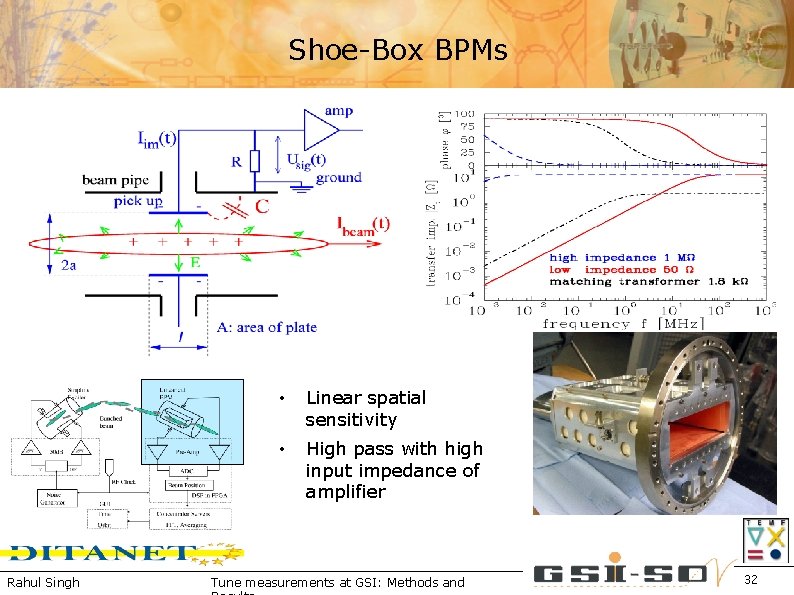
Shoe-Box BPMs Rahul Singh • Linear spatial sensitivity • High pass with high input impedance of amplifier Tune measurements at GSI: Methods and 32
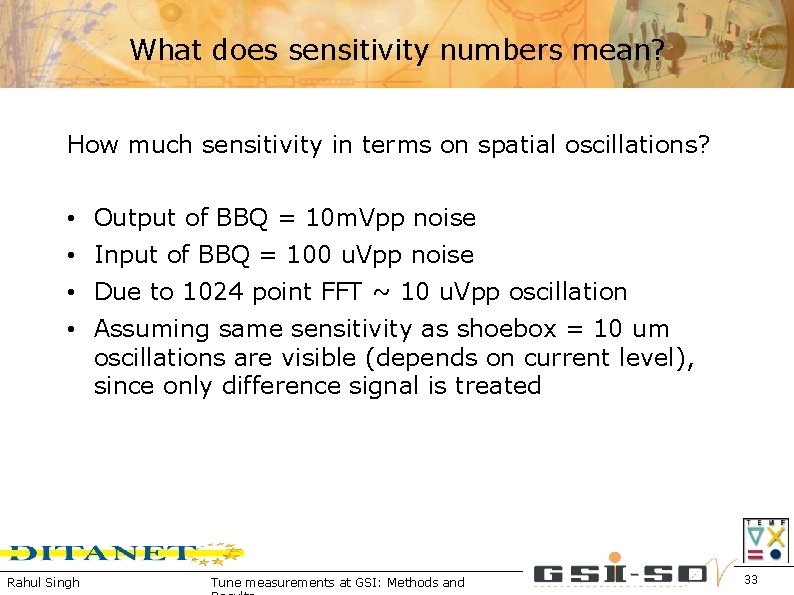
What does sensitivity numbers mean? How much sensitivity in terms on spatial oscillations? • Output of BBQ = 10 m. Vpp noise • Input of BBQ = 100 u. Vpp noise • Due to 1024 point FFT ~ 10 u. Vpp oscillation • Assuming same sensitivity as shoebox = 10 um oscillations are visible (depends on current level), since only difference signal is treated Rahul Singh Tune measurements at GSI: Methods and 33
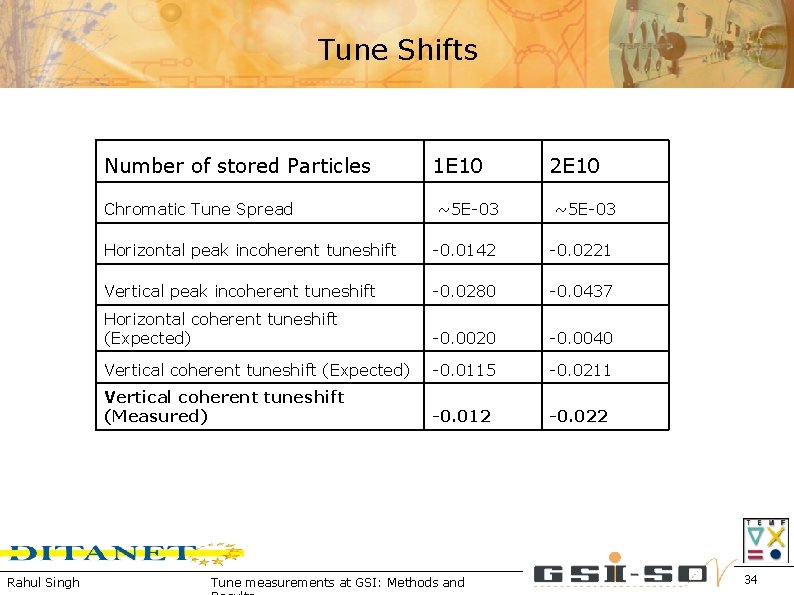
Tune Shifts Rahul Singh Number of stored Particles 1 E 10 2 E 10 Chromatic Tune Spread ~5 E-03 Horizontal peak incoherent tuneshift -0. 0142 -0. 0221 Vertical peak incoherent tuneshift -0. 0280 -0. 0437 Horizontal coherent tuneshift (Expected) -0. 0020 -0. 0040 Vertical coherent tuneshift (Expected) -0. 0115 -0. 0211 Vertical coherent tuneshift (Measured) -0. 012 -0. 022 Tune measurements at GSI: Methods and 34
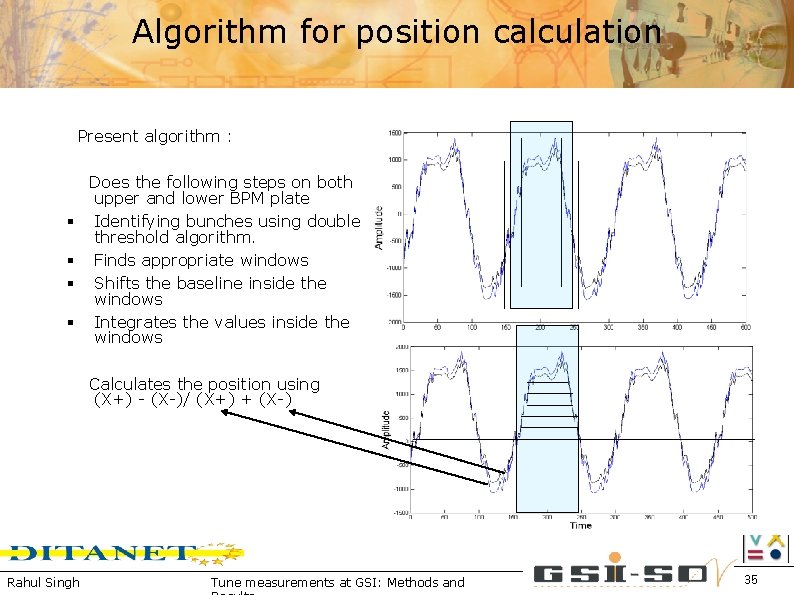
Algorithm for position calculation Present algorithm : Does the following steps on both upper and lower BPM plate § Identifying bunches using double threshold algorithm. § Finds appropriate windows § Shifts the baseline inside the windows § Integrates the values inside the windows Calculates the position using (X+) - (X-)/ (X+) + (X-) Rahul Singh Tune measurements at GSI: Methods and 35
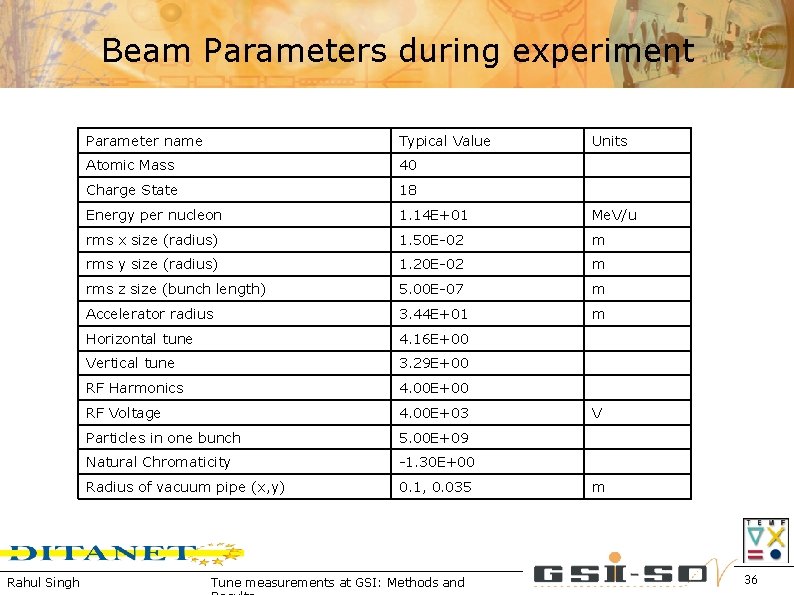
Beam Parameters during experiment Rahul Singh Parameter name Typical Value Units Atomic Mass 40 Charge State 18 Energy per nucleon 1. 14 E+01 Me. V/u rms x size (radius) 1. 50 E-02 m rms y size (radius) 1. 20 E-02 m rms z size (bunch length) 5. 00 E-07 m Accelerator radius 3. 44 E+01 m Horizontal tune 4. 16 E+00 Vertical tune 3. 29 E+00 RF Harmonics 4. 00 E+00 RF Voltage 4. 00 E+03 V Particles in one bunch 5. 00 E+09 Natural Chromaticity -1. 30 E+00 Radius of vacuum pipe (x, y) 0. 1, 0. 035 m Tune measurements at GSI: Methods and 36
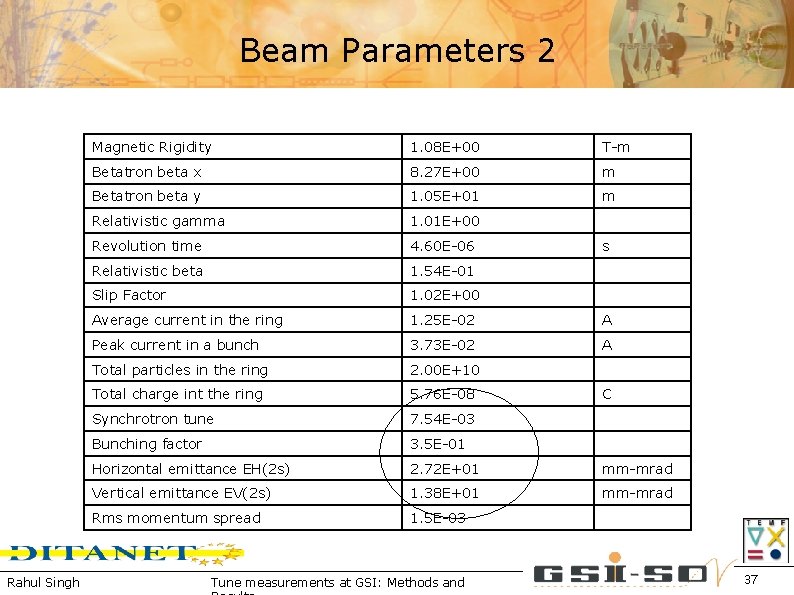
Beam Parameters 2 Rahul Singh Magnetic Rigidity 1. 08 E+00 T-m Betatron beta x 8. 27 E+00 m Betatron beta y 1. 05 E+01 m Relativistic gamma 1. 01 E+00 Revolution time 4. 60 E-06 s Relativistic beta 1. 54 E-01 Slip Factor 1. 02 E+00 Average current in the ring 1. 25 E-02 A Peak current in a bunch 3. 73 E-02 A Total particles in the ring 2. 00 E+10 Total charge int the ring 5. 76 E-08 C Synchrotron tune 7. 54 E-03 Bunching factor 3. 5 E-01 Horizontal emittance EH(2 s) 2. 72 E+01 mm-mrad Vertical emittance EV(2 s) 1. 38 E+01 mm-mrad Rms momentum spread 1. 5 E-03 Tune measurements at GSI: Methods and 37
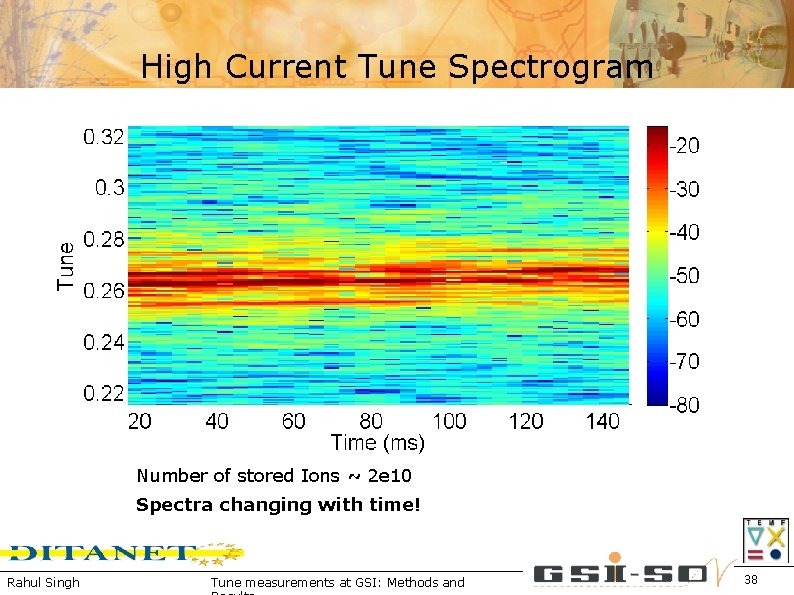
High Current Tune Spectrogram Number of stored Ions ~ 2 e 10 Spectra changing with time! Rahul Singh Tune measurements at GSI: Methods and 38
Δ BPM Signal Intra bunch motion – Acceleration Bunch Length (μs) Beam parameter: Ar 18+ acc. 11 300 Me. V/u within 0. 7 s Number of stored Ions 2 E 10 Excitation 1 m. W/Hz Rahul Singh Tune measurements at GSI: Methods and 39
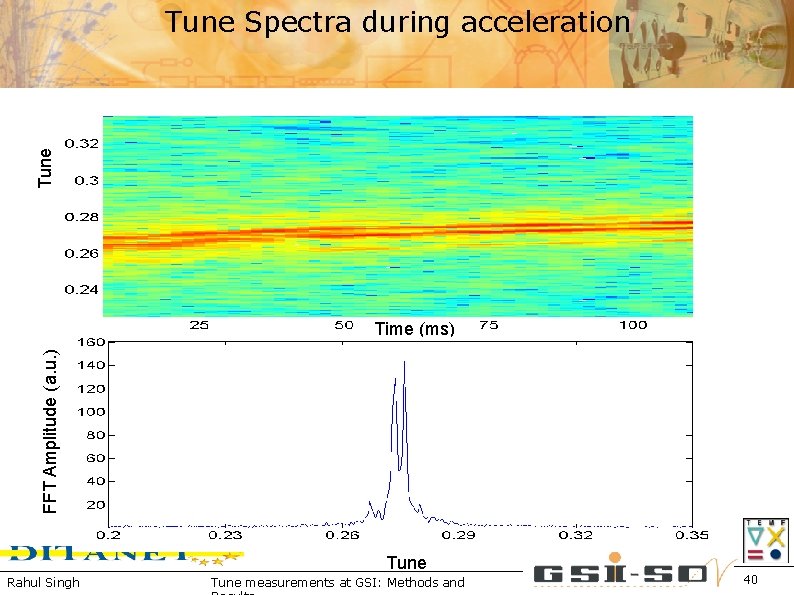
Tune Spectra during acceleration FFT Amplitude (a. u. ) Time (ms) Tune Rahul Singh Tune measurements at GSI: Methods and 40
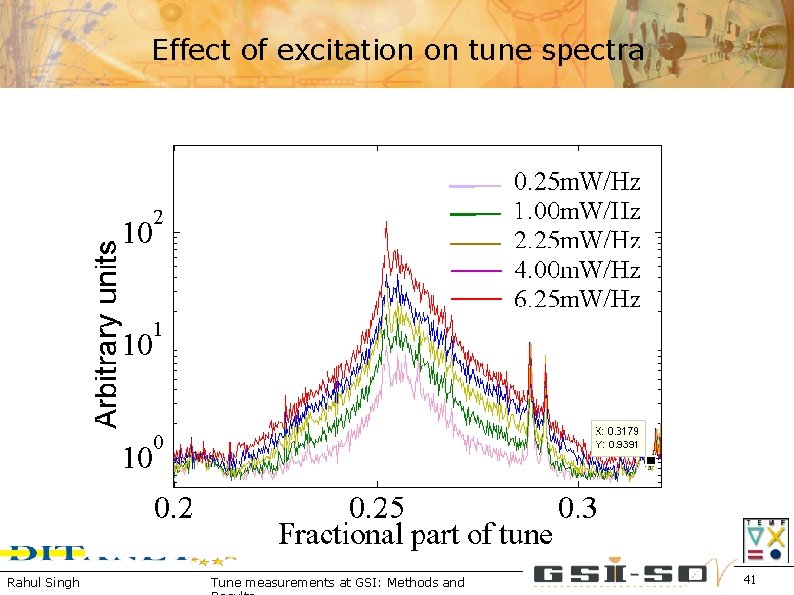
Effect of excitation on tune spectra Rahul Singh Tune measurements at GSI: Methods and 41