
Tunable Control of Magnetic Properties in Transition Metal
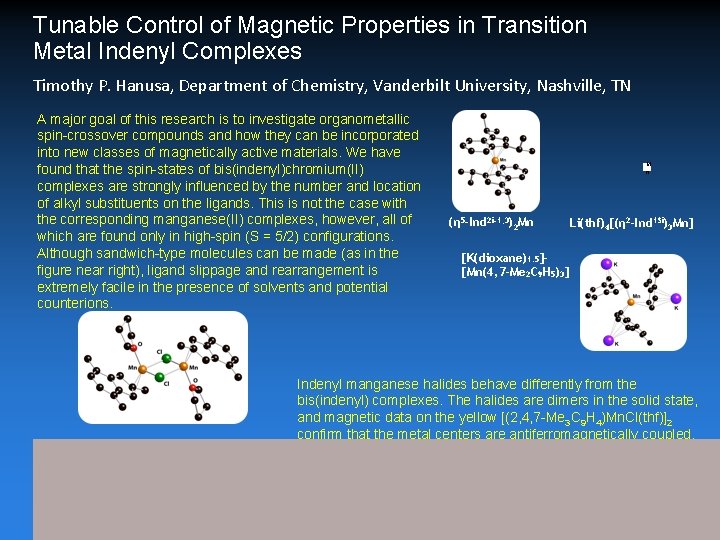
Tunable Control of Magnetic Properties in Transition Metal Indenyl Complexes Timothy P. Hanusa, Department of Chemistry, Vanderbilt University, Nashville, TN A major goal of this research is to investigate organometallic spin-crossover compounds and how they can be incorporated into new classes of magnetically active materials. We have found that the spin-states of bis(indenyl)chromium(II) complexes are strongly influenced by the number and location of alkyl substituents on the ligands. This is not the case with the corresponding manganese(II) complexes, however, all of which are found only in high-spin (S = 5/2) configurations. Although sandwich-type molecules can be made (as in the figure near right), ligand slippage and rearrangement is extremely facile in the presence of solvents and potential counterions. ppm O 2 / < 0 °C room temp. M n (η 5 -Ind 2 i-1, 3)2 Mn Li(thf)4[(η 2 -Ind 1 Si)3 Mn] [K(dioxane)1. 5][Mn(4, 7 -Me 2 C 9 H 5)3] Indenyl manganese halides behave differently from the bis(indenyl) complexes. The halides are dimers in the solid state, and magnetic data on the yellow [(2, 4, 7 -Me 3 C 9 H 4)Mn. Cl(thf)]2 confirm that the metal centers are antiferromagnetically coupled. In hydrocarbon solutions, the chloro complex is extremely sensitive to oxygen (< 5 ppm), and when cooled below room temperature, forms a royal blue superoxide complex. Such Mn/O 2– species may be useful in the design of new magnetically ordered materials.
- Slides: 1