
TUKLAS LUNAS PROGRAM Department of Science and Technology

![Program Partners [CATEGORY NAME] [PERCENTAGE](5 ) [CATEGORY NAME] [PERCENTAGE] (4) [CATEGORY NAME] [PERCENTAGE](7) [CATEGORY](https://slidetodoc.com/presentation_image_h/7382959bef8610dc7a69c682fee67e09/image-14.jpg "Program Partners [CATEGORY NAME] [PERCENTAGE](5 ) [CATEGORY NAME] [PERCENTAGE] (4) [CATEGORY NAME] [PERCENTAGE](7) [CATEGORY")
- Slides: 30
TUKLAS LUNAS PROGRAM
Department of Science and Technology Philippine Council for Health Research and Development
National Unified Health Research Agenda (NUHRA) Research Themes: 1. Responsive health systems, 2. Research to enhance and extend healthy lives, 3. Holistic approaches to health and wellness, 4. Health resiliency, 5. Global competitiveness and innovation in health, and 6. Research in equity and health
Research Priorities for Health S&T • Diagnostics • Drug discovery and development • Functional foods • Hospital equipment and biomedical devices • Information and communication technology for health • Dengue • Nutrition and food quality and safety • Disaster risk reduction • Climate Change Adaptation • Genomics/Molecular technology (Platform technology across research priorities)
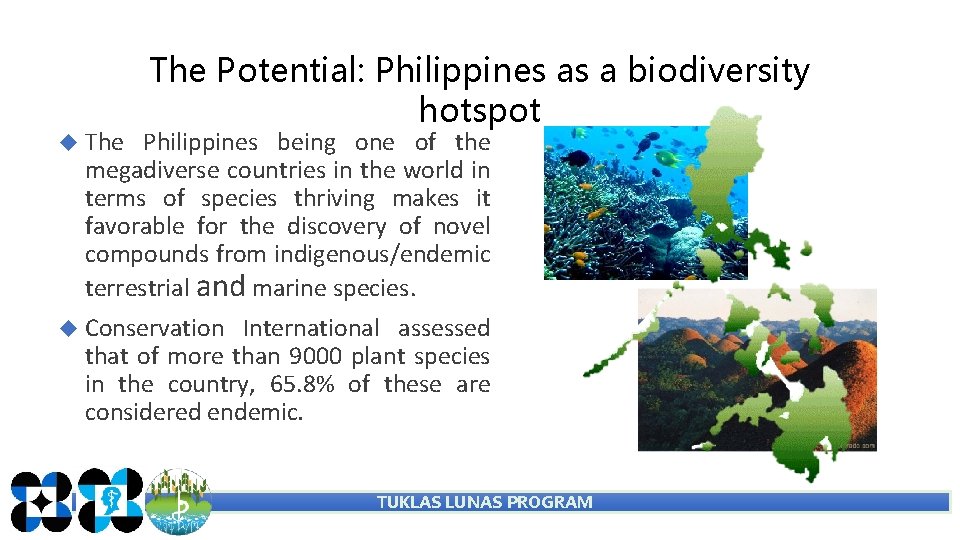
The Potential: Philippines as a biodiversity hotspot Philippines being one of the megadiverse countries in the world in terms of species thriving makes it favorable for the discovery of novel compounds from indigenous/endemic terrestrial and marine species. Conservation International assessed that of more than 9000 plant species in the country, 65. 8% of these are considered endemic. TUKLAS LUNAS PROGRAM
The Gap • few plant-derived products with approved therapeutic claim and are now being used as herbal drugs. • A wide variety of commercially available supplements which have not been subjected to chemical standardization and pre-/clinical evaluation • Despite the biodiversity of the Philippines, this has been largely untapped for discovering new drugs. TUKLAS LUNAS PROGRAM
TUKLAS LUNAS PROGRAM: the Drug Discovery and Development Program of DOST Vision “To produce world-class medicines derived from the Philippine biodiversity, leveraging on local expertise”
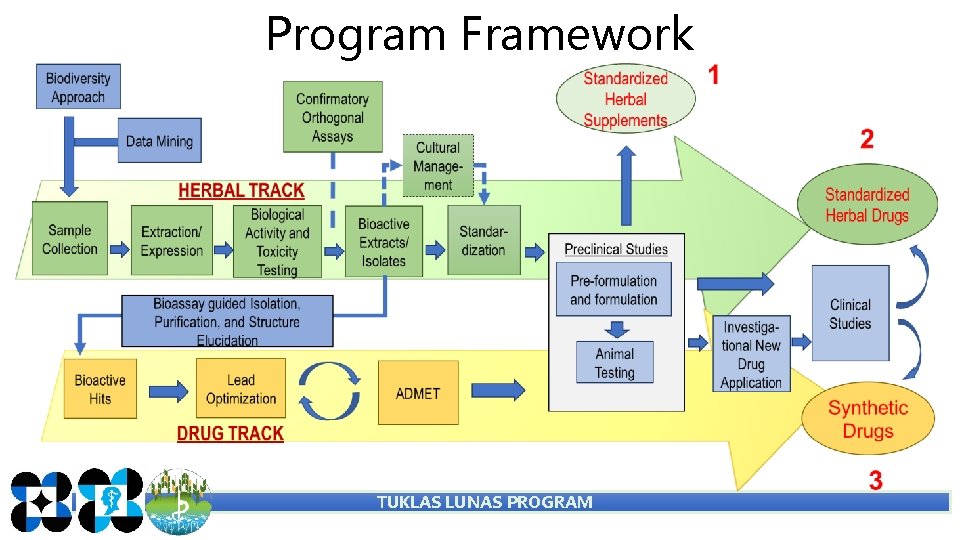
The Strategy • Goal: To improve access of Filipinos to safe and affordable drugs derived from local natural resources and support the development of the local herbal and pharmaceutical industry. • Approach: Parallel paths of drug discovery: 1) the development of standardized herbal drugs, and 2) the identification and characterization of high-value purified active compounds derived from marine and terrestrial sources for specific therapeutic indications TUKLAS LUNAS PROGRAM
Why implement a strategic drug discovery and development program? • Drug discovery and development is a very resource intensive activity. • Minimum 15 years to develop one drug and a huge amount of monetary investment is necessary to develop a drug. • Harness the potential of our biodiversity to respond to the growing health needs of the Filipinos. • However, with proper strategies, limited resource may be maximized and discovery cost may be minimized without compromising the quality of the products developed from natural source. TUKLAS LUNAS PROGRAM
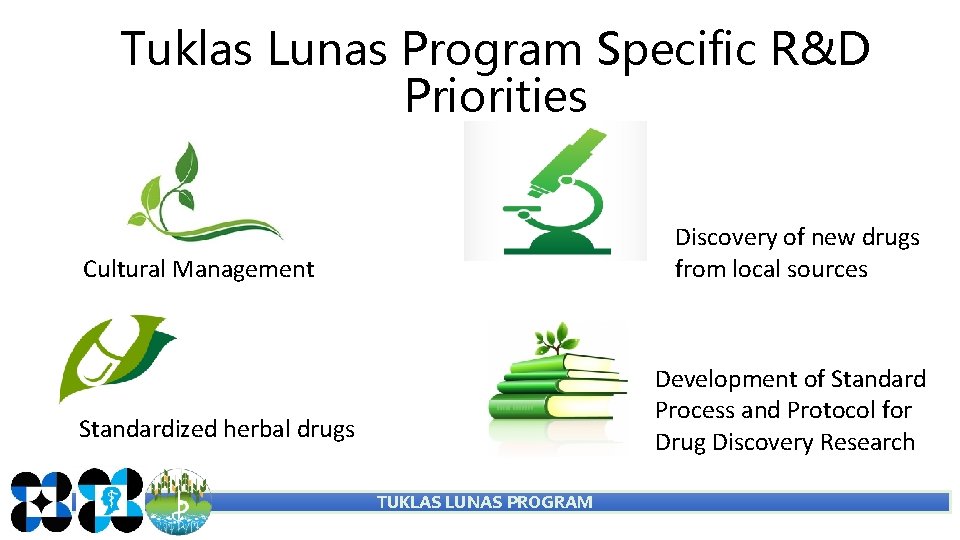
Tuklas Lunas Program Specific R&D Priorities Discovery of new drugs from local sources Cultural Management Development of Standard Process and Protocol for Drug Discovery Research Standardized herbal drugs TUKLAS LUNAS PROGRAM
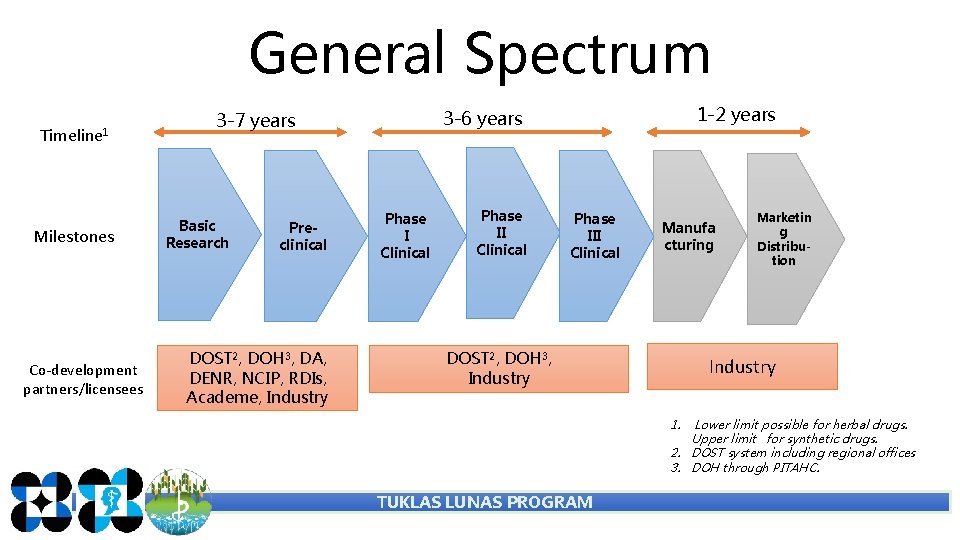
General Spectrum Timeline 1 Milestones Co-development partners/licensees Basic Research Preclinical DOST 2, DOH 3, DA, DENR, NCIP, RDIs, Academe, Industry 1 -2 years 3 -6 years 3 -7 years Phase I Clinical Phase III Clinical Manufa cturing DOST 2, DOH 3, Industry Marketin g Distribution Industry 1. Lower limit possible for herbal drugs. Upper limit for synthetic drugs. 2. DOST system including regional offices 3. DOH through PITAHC. TUKLAS LUNAS PROGRAM
Program Framework TUKLAS LUNAS PROGRAM
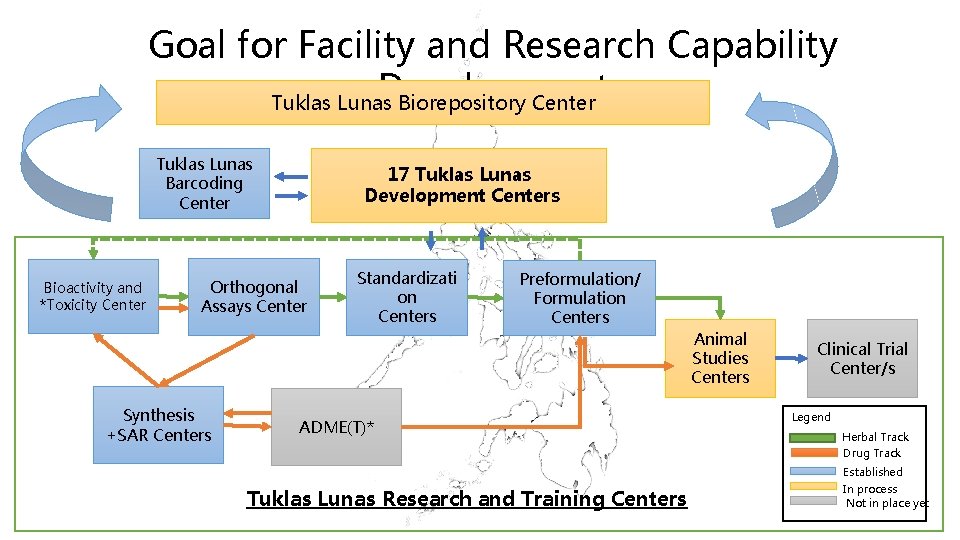
Goal for Facility and Research Capability Development Tuklas Lunas Biorepository Center Tuklas Lunas Barcoding Center Bioactivity and *Toxicity Center 17 Tuklas Lunas Development Centers Orthogonal Assays Center Standardizati on Centers Preformulation/ Formulation Centers Animal Studies Centers Synthesis +SAR Centers ADME(T)* Clinical Trial Center/s Legend Herbal Track Drug Track Established Tuklas Lunas Research and Training Centers In process Not in place yet
Program Partners [CATEGORY NAME] [PERCENTAGE](5 ) [CATEGORY NAME] [PERCENTAGE] (4) [CATEGORY NAME] [PERCENTAGE](7) [CATEGORY NAME] [PERCENTAGE] (15) Distribution based on type of Institution [CATEGORY NAME] [PERCENTAGE](6 ) [CATEGORY NAME] [PERCENTAGE](15) Distribution based on major island group
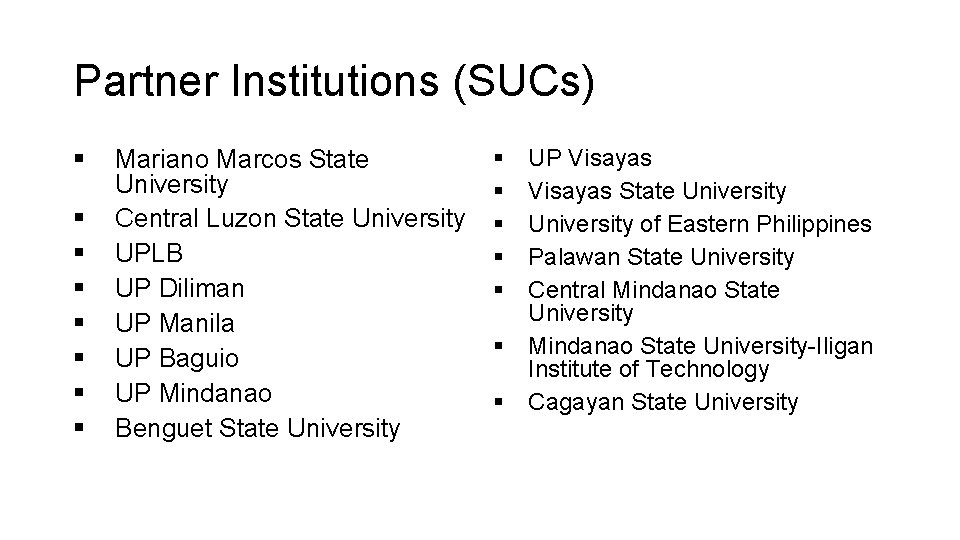
Partner Institutions (SUCs) § § § § Mariano Marcos State University Central Luzon State University UPLB UP Diliman UP Manila UP Baguio UP Mindanao Benguet State University § § § UP Visayas State University of Eastern Philippines Palawan State University Central Mindanao State University § Mindanao State University-Iligan Institute of Technology § Cagayan State University
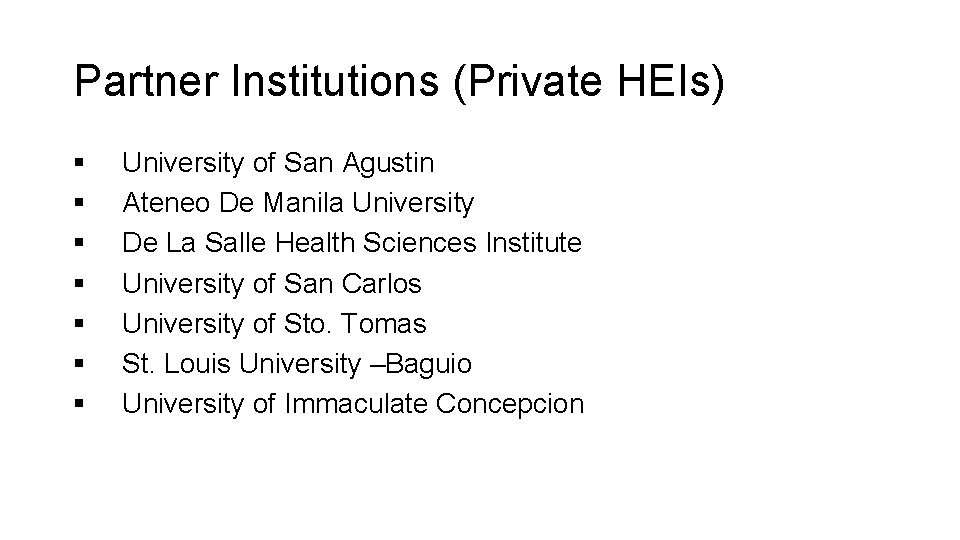
Partner Institutions (Private HEIs) § § § § University of San Agustin Ateneo De Manila University De La Salle Health Sciences Institute University of San Carlos University of Sto. Tomas St. Louis University –Baguio University of Immaculate Concepcion
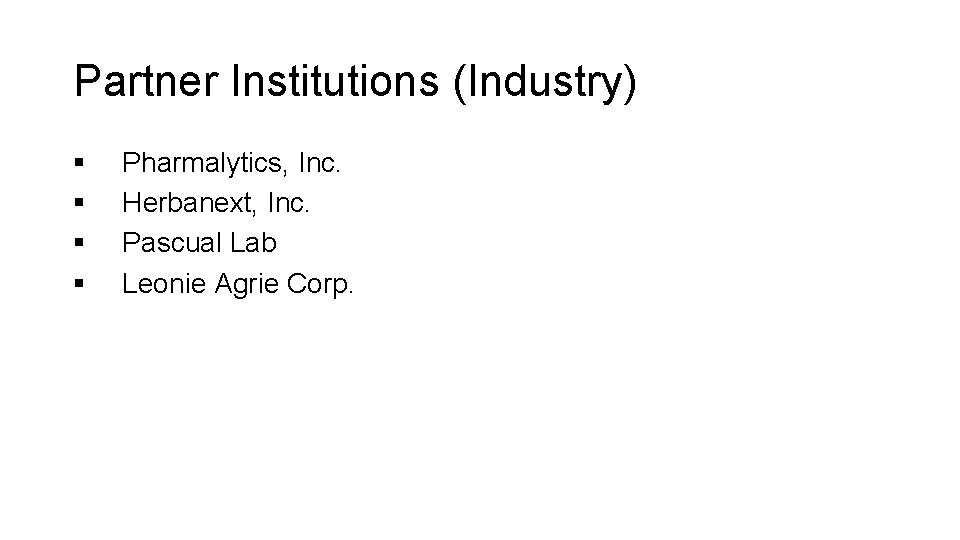
Partner Institutions (Industry) § § Pharmalytics, Inc. Herbanext, Inc. Pascual Lab Leonie Agrie Corp.
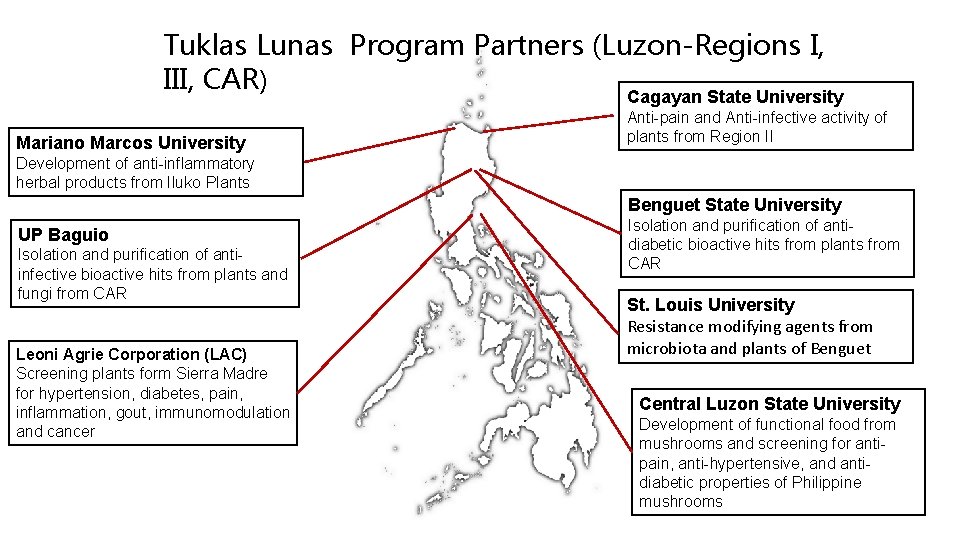
Tuklas Lunas Program Partners (Luzon-Regions I, III, CAR) Cagayan State University Mariano Marcos University Anti-pain and Anti-infective activity of plants from Region II Development of anti-inflammatory herbal products from Iluko Plants Benguet State University UP Baguio Isolation and purification of antiinfective bioactive hits from plants and fungi from CAR Leoni Agrie Corporation (LAC) Screening plants form Sierra Madre for hypertension, diabetes, pain, inflammation, gout, immunomodulation and cancer Isolation and purification of antidiabetic bioactive hits from plants from CAR St. Louis University Resistance modifying agents from microbiota and plants of Benguet Central Luzon State University Development of functional food from mushrooms and screening for antipain, anti-hypertensive, and antidiabetic properties of Philippine mushrooms
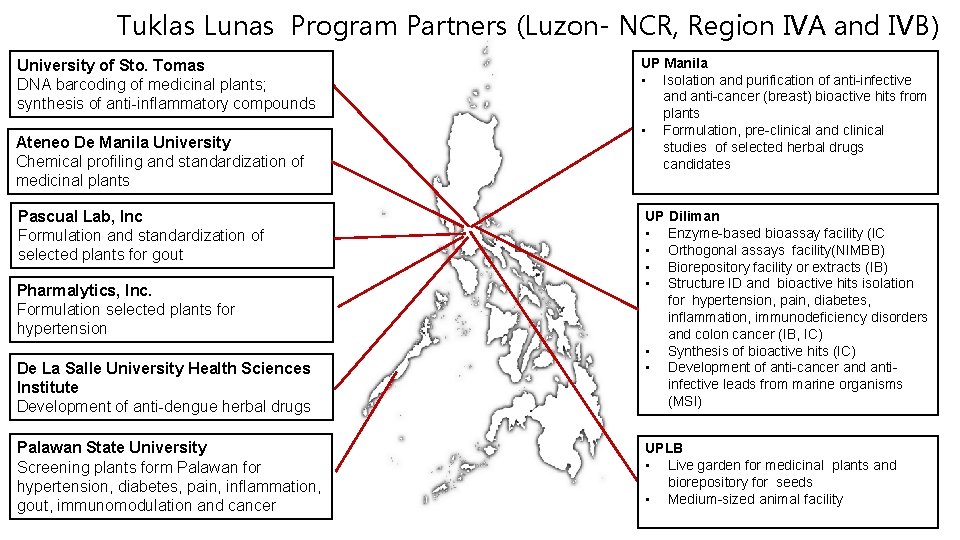
Tuklas Lunas Program Partners (Luzon- NCR, Region IVA and IVB) University of Sto. Tomas DNA barcoding of medicinal plants; synthesis of anti-inflammatory compounds Ateneo De Manila University Chemical profiling and standardization of medicinal plants Pascual Lab, Inc Formulation and standardization of selected plants for gout Pharmalytics, Inc. Formulation selected plants for hypertension De La Salle University Health Sciences Institute Development of anti-dengue herbal drugs Palawan State University Screening plants form Palawan for hypertension, diabetes, pain, inflammation, gout, immunomodulation and cancer UP Manila • Isolation and purification of anti-infective and anti-cancer (breast) bioactive hits from plants • Formulation, pre-clinical and clinical studies of selected herbal drugs candidates UP Diliman • Enzyme-based bioassay facility (IC • Orthogonal assays facility(NIMBB) • Biorepository facility or extracts (IB) • Structure ID and bioactive hits isolation for hypertension, pain, diabetes, inflammation, immunodeficiency disorders and colon cancer (IB, IC) • Synthesis of bioactive hits (IC) • Development of anti-cancer and antiinfective leads from marine organisms (MSI) UPLB • Live garden for medicinal plants and biorepository for seeds • Medium-sized animal facility
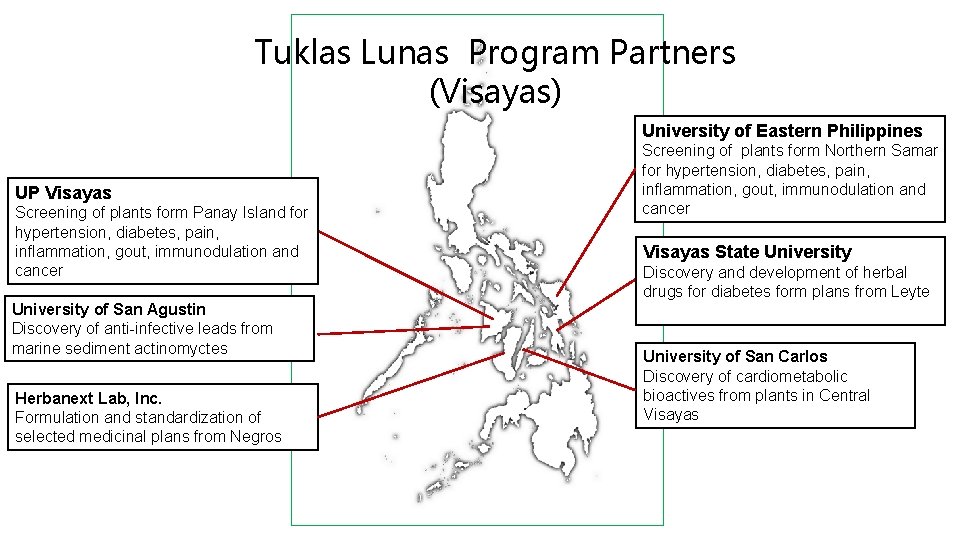
Tuklas Lunas Program Partners (Visayas) University of Eastern Philippines UP Visayas Screening of plants form Panay Island for hypertension, diabetes, pain, inflammation, gout, immunodulation and cancer University of San Agustin Discovery of anti-infective leads from marine sediment actinomyctes Herbanext Lab, Inc. Formulation and standardization of selected medicinal plans from Negros Screening of plants form Northern Samar for hypertension, diabetes, pain, inflammation, gout, immunodulation and cancer Visayas State University Discovery and development of herbal drugs for diabetes form plans from Leyte University of San Carlos Discovery of cardiometabolic bioactives from plants in Central Visayas
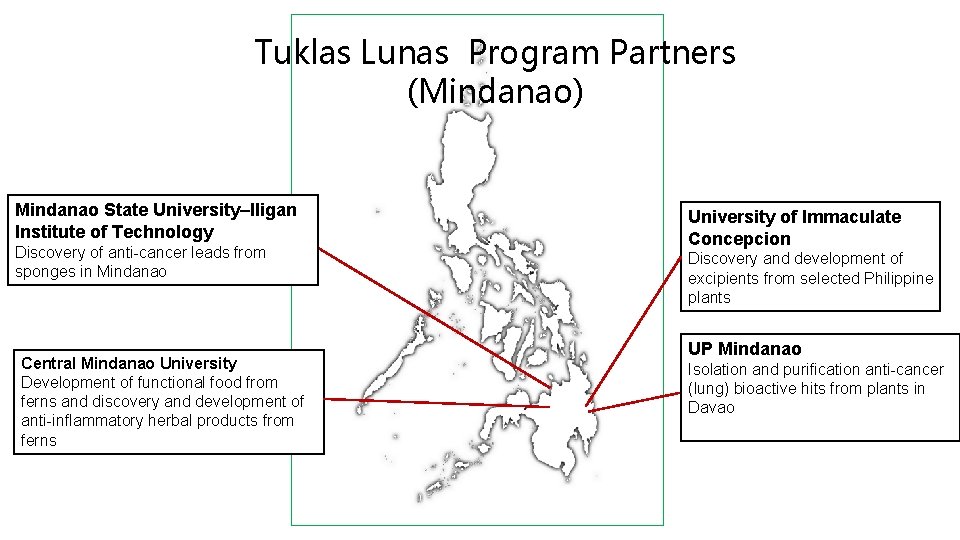
Tuklas Lunas Program Partners (Mindanao) Mindanao State University–Iligan Institute of Technology Discovery of anti-cancer leads from sponges in Mindanao Central Mindanao University Development of functional food from ferns and discovery and development of anti-inflammatory herbal products from ferns University of Immaculate Concepcion Discovery and development of excipients from selected Philippine plants UP Mindanao Isolation and purification anti-cancer (lung) bioactive hits from plants in Davao
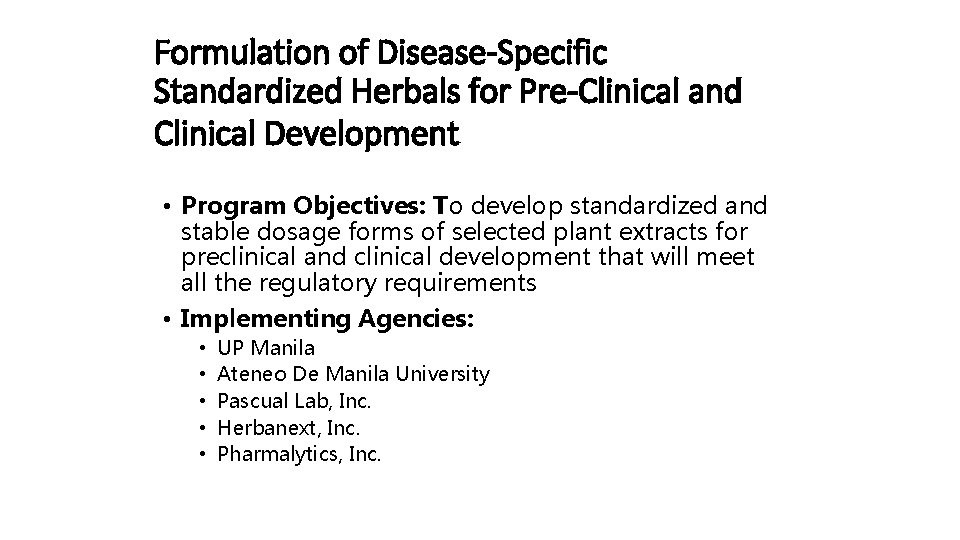
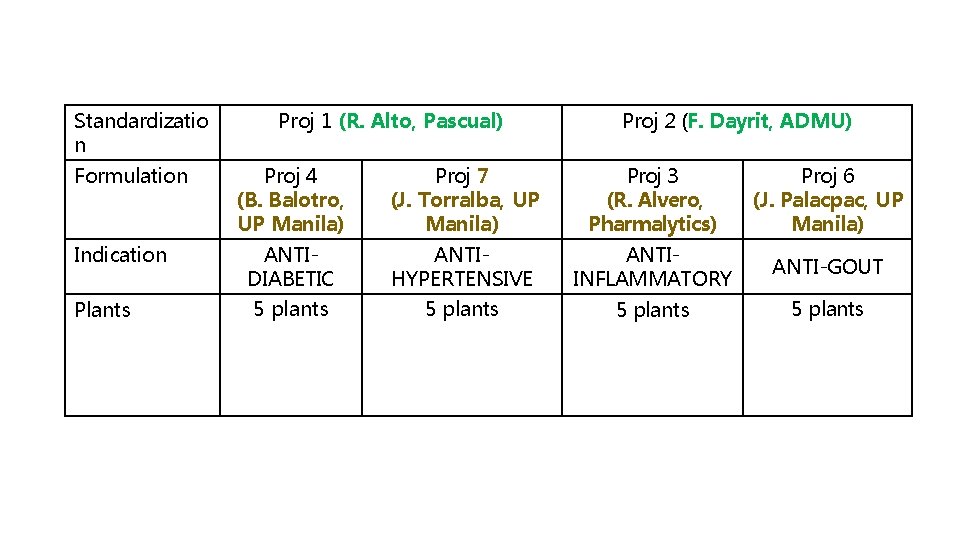
Formulation of Disease-Specific Standardized Herbals for Pre-Clinical and Clinical Development • Program Objectives: To develop standardized and stable dosage forms of selected plant extracts for preclinical and clinical development that will meet all the regulatory requirements • Implementing Agencies: • • • UP Manila Ateneo De Manila University Pascual Lab, Inc. Herbanext, Inc. Pharmalytics, Inc.
Standardizatio n Formulation Indication Plants Proj 1 (R. Alto, Pascual) Proj 2 (F. Dayrit, ADMU) Proj 4 (B. Balotro, UP Manila) Proj 7 (J. Torralba, UP Manila) Proj 3 (R. Alvero, Pharmalytics) Proj 6 (J. Palacpac, UP Manila) ANTIDIABETIC 5 plants ANTIHYPERTENSIVE 5 plants ANTIINFLAMMATORY ANTI-GOUT 5 plants
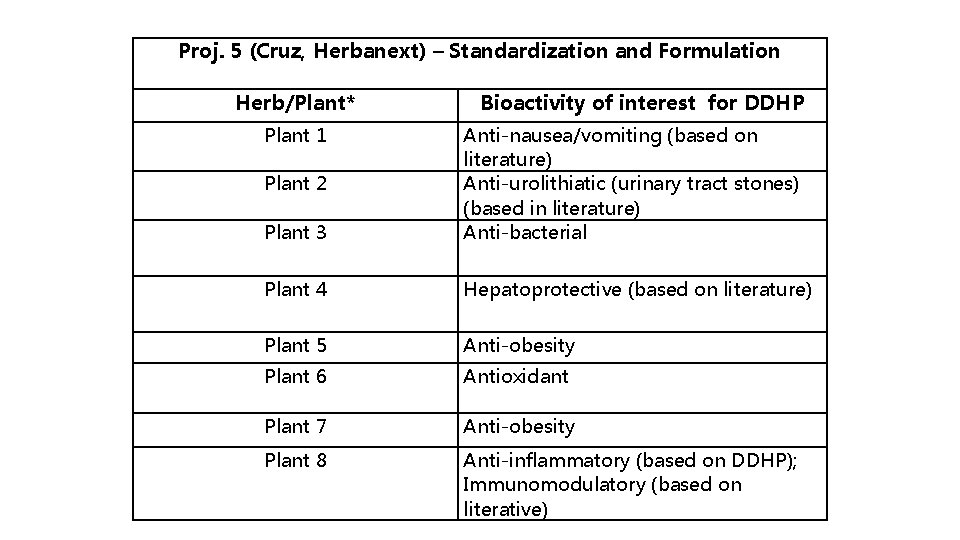
Proj. 5 (Cruz, Herbanext) – Standardization and Formulation Herb/Plant* Plant 1 Bioactivity of interest for DDHP Plant 3 Anti-nausea/vomiting (based on literature) Anti-urolithiatic (urinary tract stones) (based in literature) Anti-bacterial Plant 4 Hepatoprotective (based on literature) Plant 5 Anti-obesity Plant 6 Antioxidant Plant 7 Anti-obesity Plant 8 Anti-inflammatory (based on DDHP); Immunomodulatory (based on literative) Plant 2
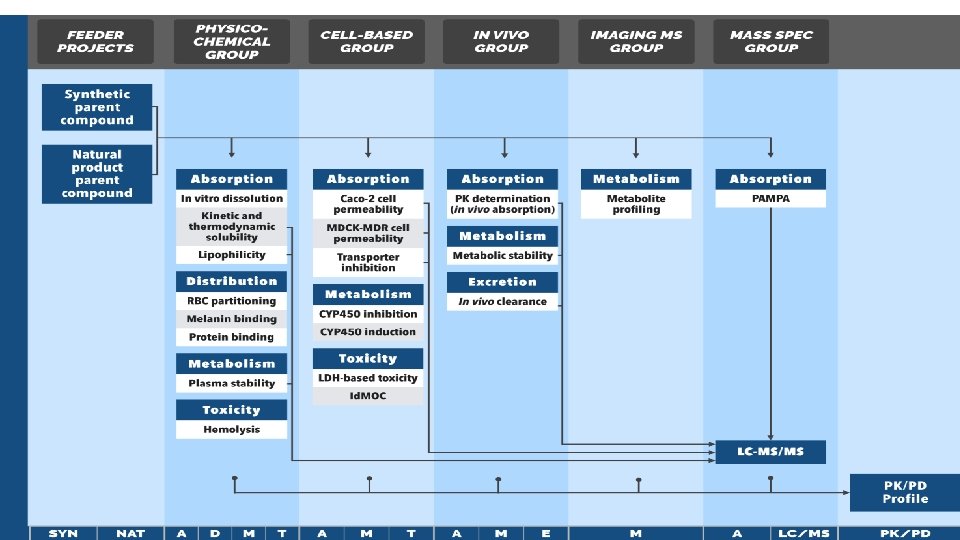
Bridging efficacy and safety: IND-enabling suite of ADME-Tox assays
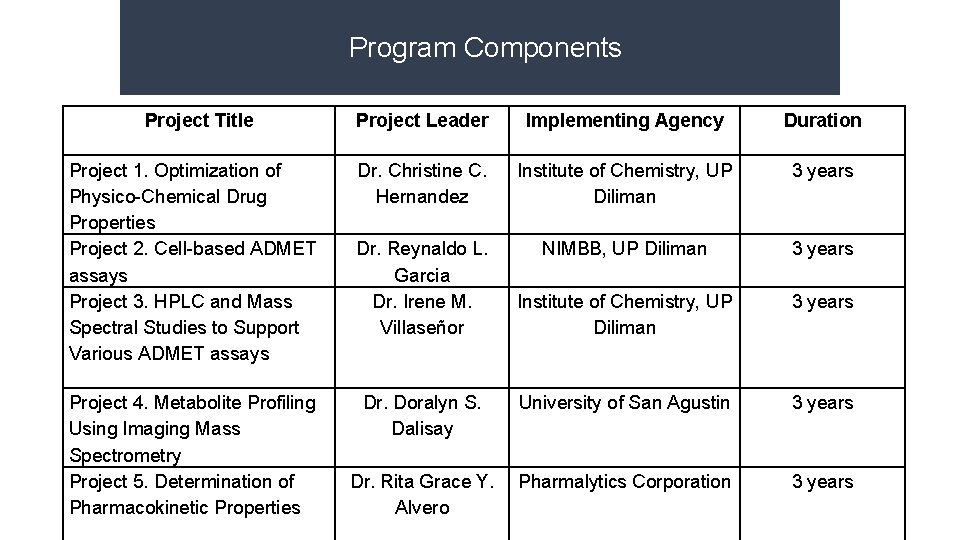
Program Components Project Title Project Leader Implementing Agency Duration Project 1. Optimization of Physico-Chemical Drug Properties Project 2. Cell-based ADMET assays Project 3. HPLC and Mass Spectral Studies to Support Various ADMET assays Dr. Christine C. Hernandez Institute of Chemistry, UP Diliman 3 years Dr. Reynaldo L. Garcia Dr. Irene M. Villaseñor NIMBB, UP Diliman 3 years Institute of Chemistry, UP Diliman 3 years Project 4. Metabolite Profiling Using Imaging Mass Spectrometry Project 5. Determination of Pharmacokinetic Properties Dr. Doralyn S. University of San Agustin Dalisay Dr. Rita Grace Y. Pharmalytics Corporation Alvero 3 years
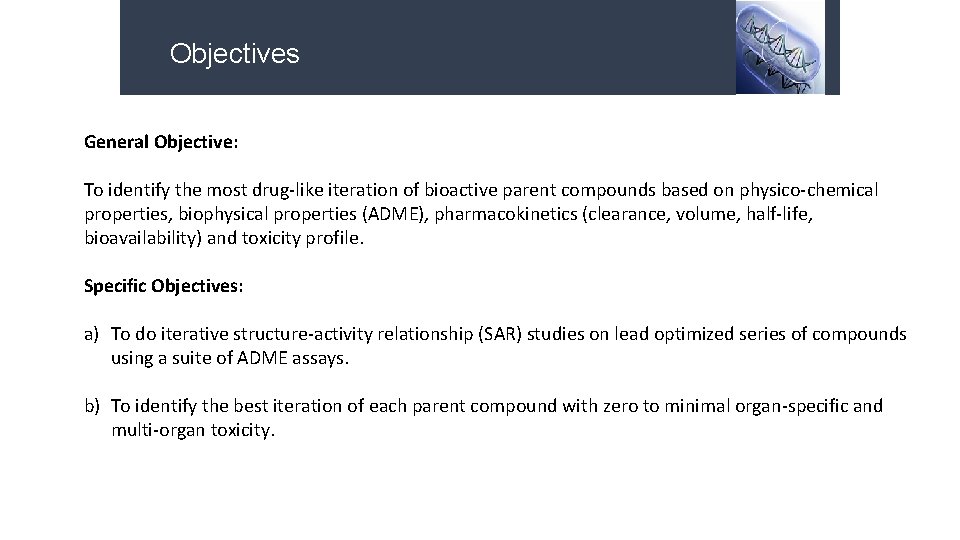
Objectives General Objective: To identify the most drug-like iteration of bioactive parent compounds based on physico-chemical properties, biophysical properties (ADME), pharmacokinetics (clearance, volume, half-life, bioavailability) and toxicity profile. Specific Objectives: a) To do iterative structure-activity relationship (SAR) studies on lead optimized series of compounds using a suite of ADME assays. b) To identify the best iteration of each parent compound with zero to minimal organ-specific and multi-organ toxicity.
End Goal • Promising candidates are pursued further until possible commercialization/technology transfer; • Use of validated protocols by all funded projects so outputs can feed into the downstream drug discovery pipeline; • Products that will be produced meet FDA requirements and standards; TUKLAS LUNAS PROGRAM
TUKLAS LUNAS PROGRAM For more information, contact: R&D Management Division PHILIPPINE COUNCIL FOR HEALTH RESEARCH AND DEVELOPMENT Department of Science and Technology Gen. Santos Avenue, Bicutan, Taguig City Tel No: (632) 8377535 loc 304/305