
Tuesday 19 January 2010 Lecture 5 Radiative transfer
- Slides: 19
Tuesday, 19 January 2010 Lecture 5: Radiative transfer theory where light comes from and how it gets to where it’s going Reading Ch 1. 2 review, 1. 3, 1. 4 http: //hyperphysics. phy-astr. gsu. edu/hbase/atmos/blusky. html (scattering) http: //id. mind. net/~zona/mstm/physics/light/ray. Optics/refraction 1. html (refraction) http: //id. mind. net/~zona/mstm/physics/light/ray. Optics/refraction/snells. Law 1. html (Snell’s Law) Review On Solid Angles, (class website -- Ancillary folder: Steradian. ppt) Last lecture: color theory data spaces color mixtures absorption
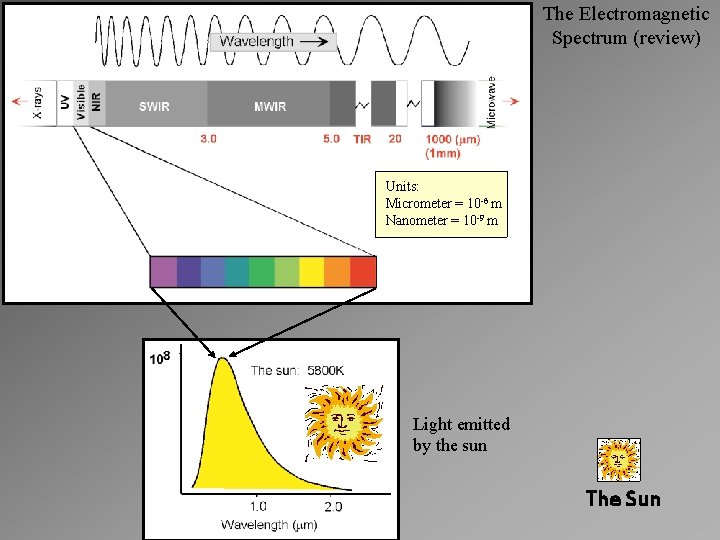
The Electromagnetic Spectrum (review) Units: Micrometer = 10 -6 m Nanometer = 10 -9 m Light emitted by the sun The Sun
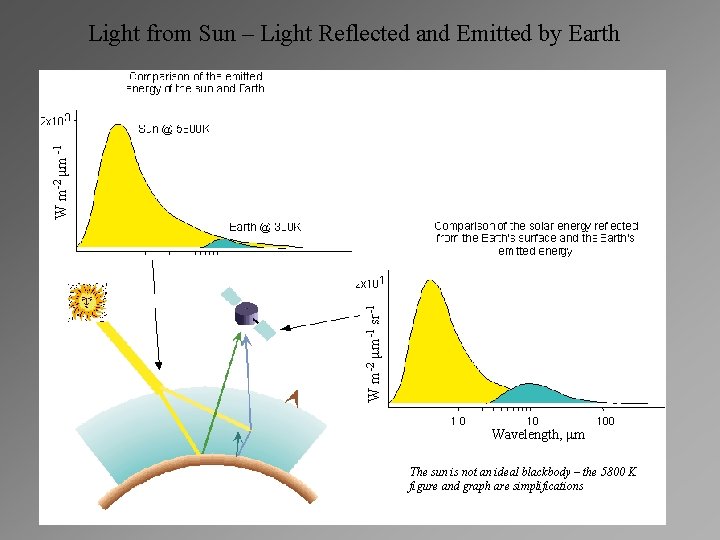
W m-2 μm-1 sr-1 W m-2 μm -1 Light from Sun – Light Reflected and Emitted by Earth Wavelength, μm The sun is not an ideal blackbody – the 5800 K figure and graph are simplifications
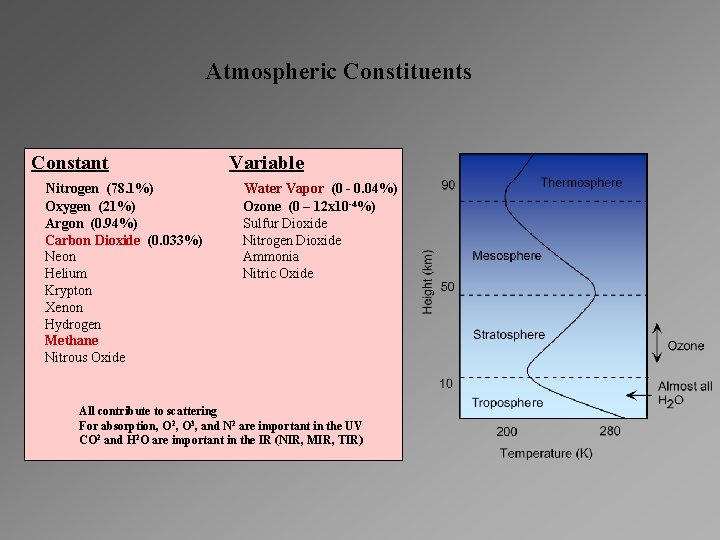
Atmospheric Constituents Constant Nitrogen (78. 1%) Oxygen (21%) Argon (0. 94%) Carbon Dioxide (0. 033%) Neon Helium Krypton Xenon Hydrogen Methane Nitrous Oxide Variable Water Vapor (0 - 0. 04%) Ozone (0 – 12 x 10 -4%) Sulfur Dioxide Nitrogen Dioxide Ammonia Nitric Oxide All contribute to scattering For absorption, O 2, O 3, and N 2 are important in the UV CO 2 and H 2 O are important in the IR (NIR, MIR, TIR)
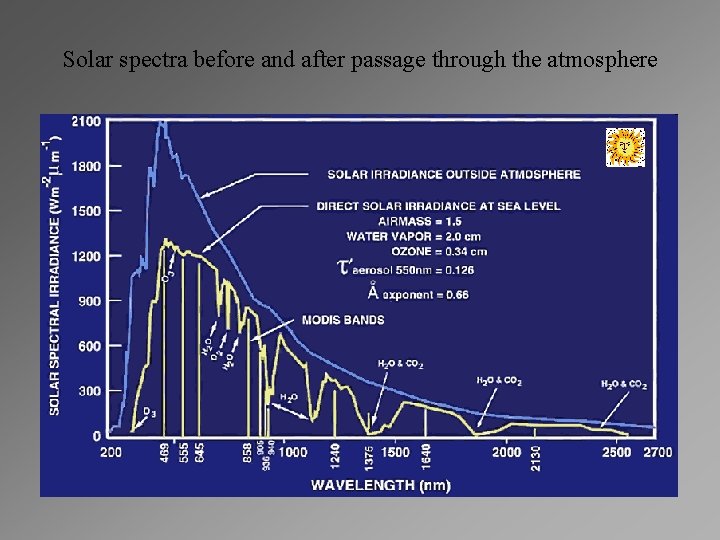
Solar spectra before and after passage through the atmosphere
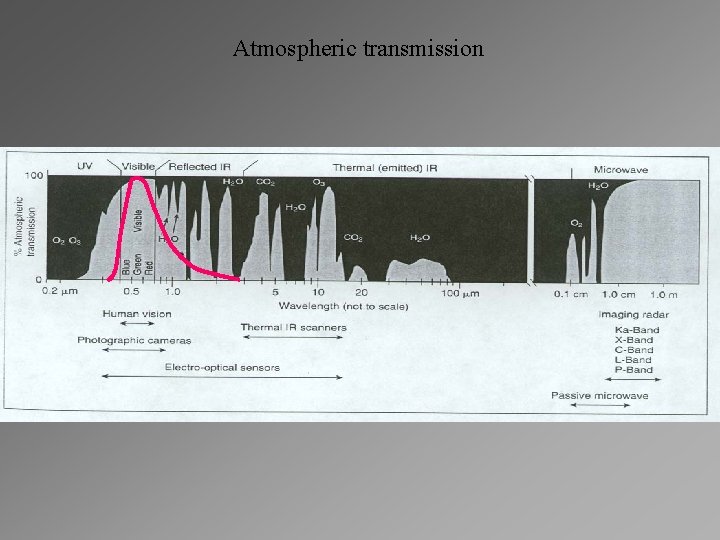
Atmospheric transmission
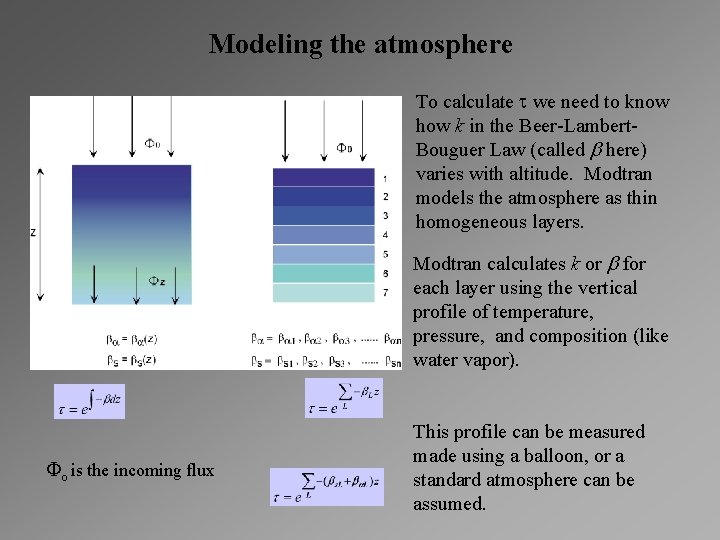
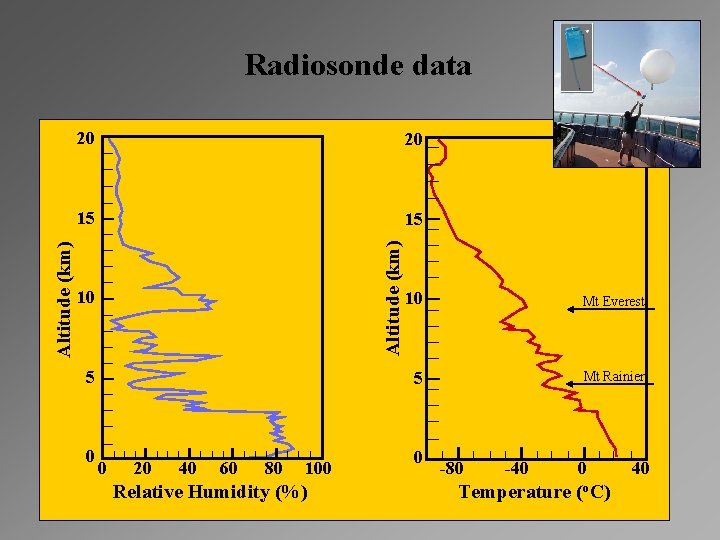
Modeling the atmosphere To calculate t we need to know how k in the Beer-Lambert. Bouguer Law (called b here) varies with altitude. Modtran models the atmosphere as thin homogeneous layers. Modtran calculates k or b for each layer using the vertical profile of temperature, pressure, and composition (like water vapor). Fo is the incoming flux This profile can be measured made using a balloon, or a standard atmosphere can be assumed.
20 20 15 15 Altitude (km) Radiosonde data 10 5 0 0 20 40 60 80 100 Relative Humidity (%) 10 Mt Everest 5 Mt Rainier 0 -80 -40 0 Temperature (o. C) 40
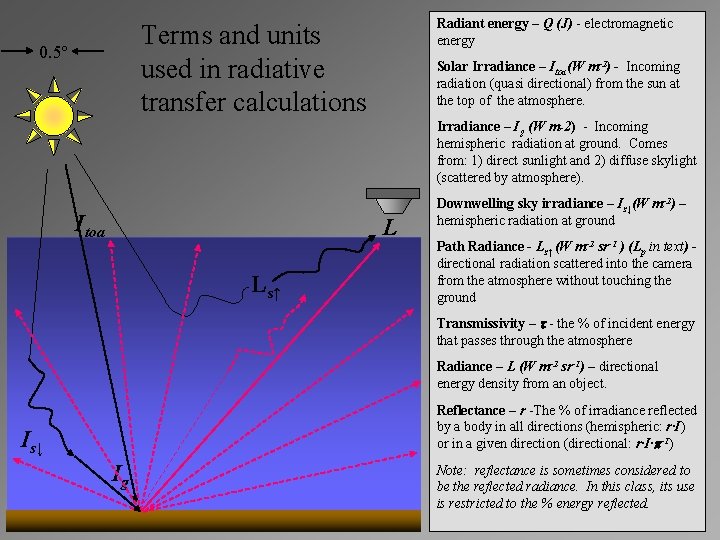
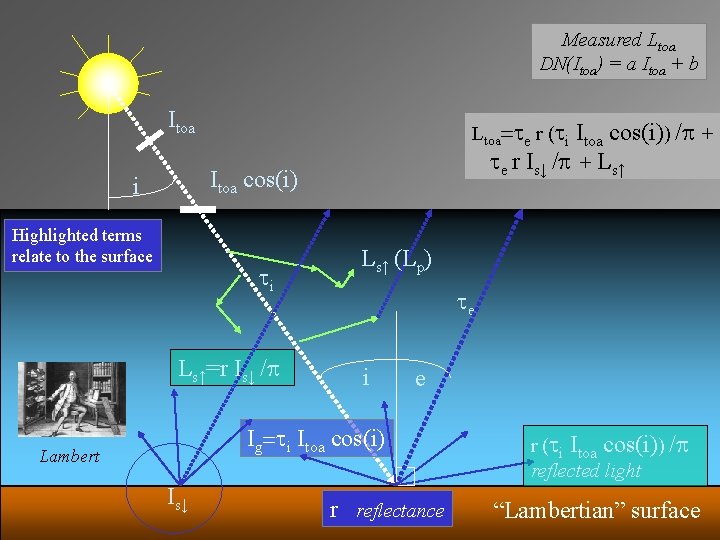
Radiant energy – Q (J) - electromagnetic energy Terms and units used in radiative transfer calculations 0. 5º Solar Irradiance – Itoa(W m-2) - Incoming radiation (quasi directional) from the sun at the top of the atmosphere. Irradiance – Ig (W m-2) - Incoming hemispheric radiation at ground. Comes from: 1) direct sunlight and 2) diffuse skylight (scattered by atmosphere). Itoa L Ls↑ Downwelling sky irradiance – Is↓(W m-2) – hemispheric radiation at ground Path Radiance - Ls↑ (W m-2 sr-1 ) (Lp in text) directional radiation scattered into the camera from the atmosphere without touching the ground Transmissivity – t - the % of incident energy that passes through the atmosphere Radiance – L (W m-2 sr-1) – directional energy density from an object. Reflectance – r -The % of irradiance reflected by a body in all directions (hemispheric: r·I) or in a given direction (directional: r·I·p-1) Is↓ Ig Note: reflectance is sometimes considered to be the reflected radiance. In this class, its use is restricted to the % energy reflected.
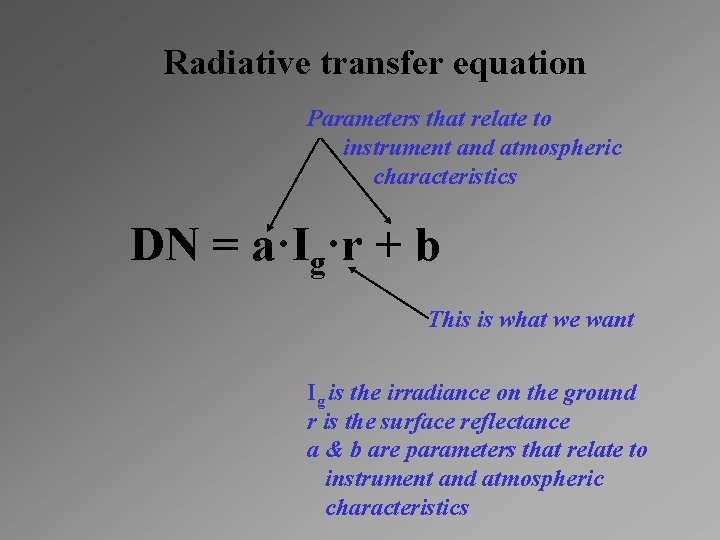
Radiative transfer equation Parameters that relate to instrument and atmospheric characteristics DN = a·Ig·r + b This is what we want Ig is the irradiance on the ground r is the surface reflectance a & b are parameters that relate to instrument and atmospheric characteristics
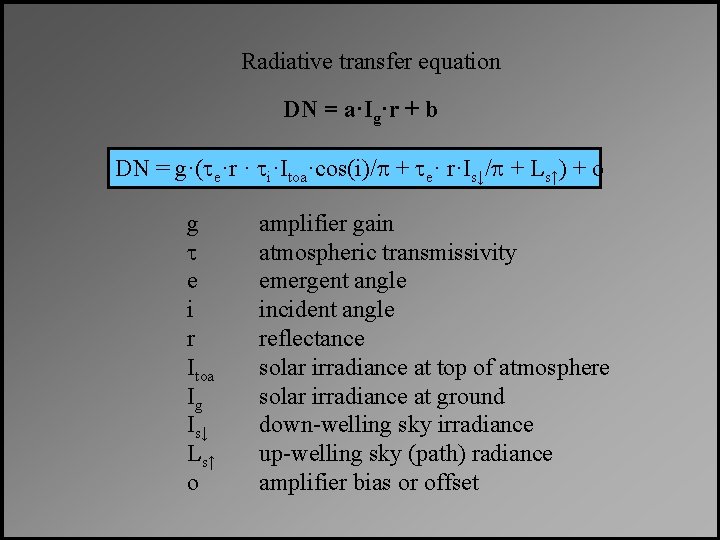
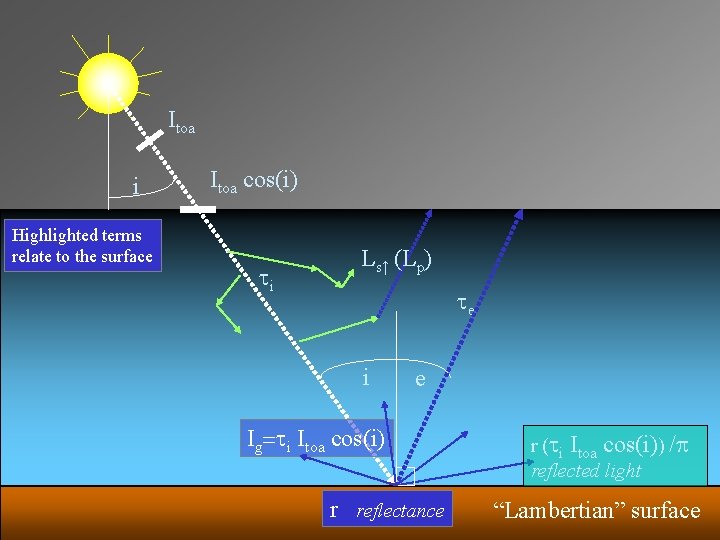
Radiative transfer equation DN = a·Ig·r + b DN = g·(te·r · ti·Itoa·cos(i)/p + te· r·Is↓/p + Ls↑) + o g t e i r Itoa Ig Is↓ Ls↑ o amplifier gain atmospheric transmissivity emergent angle incident angle reflectance solar irradiance at top of atmosphere solar irradiance at ground down-welling sky irradiance up-welling sky (path) radiance amplifier bias or offset
The factor of p Consider a perfectly reflective (r=100%) diffuse “Lambertian” surface that reflects equally in all directions. Lambert
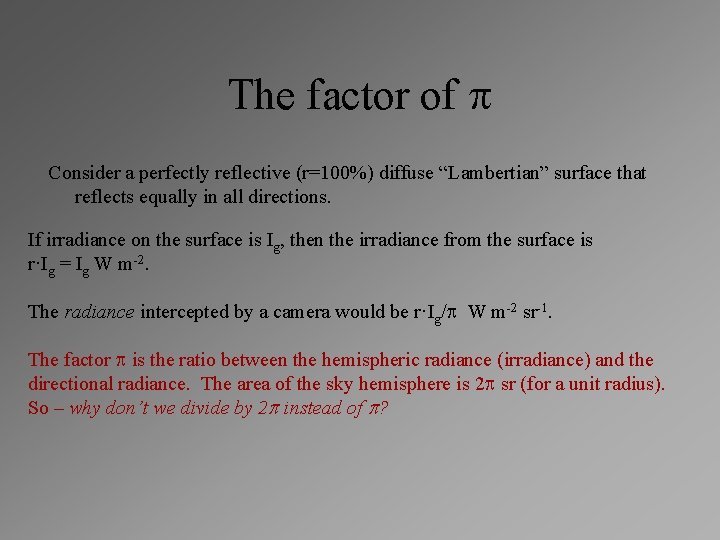
The factor of p Consider a perfectly reflective (r=100%) diffuse “Lambertian” surface that reflects equally in all directions. If irradiance on the surface is Ig, then the irradiance from the surface is r·Ig = Ig W m-2. The radiance intercepted by a camera would be r·Ig/p W m-2 sr-1. The factor p is the ratio between the hemispheric radiance (irradiance) and the directional radiance. The area of the sky hemisphere is 2 p sr (for a unit radius). So – why don’t we divide by 2 p instead of p?
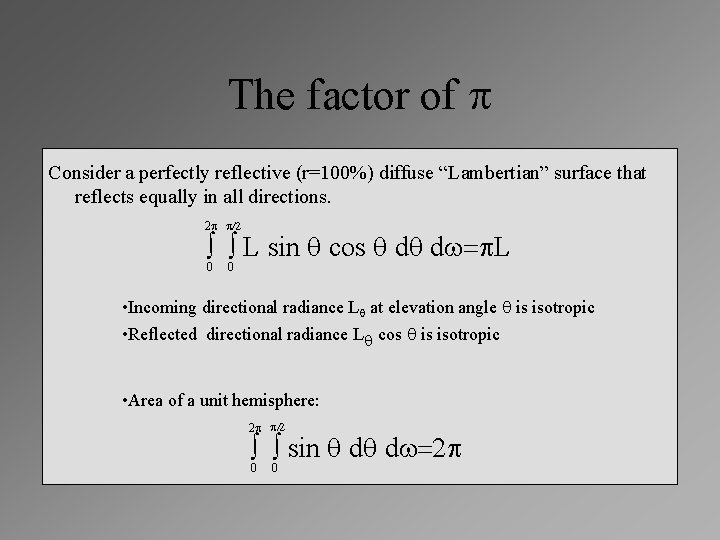
The factor of p Consider a perfectly reflective (r=100%) diffuse “Lambertian” surface that reflects equally in all directions. 2 p p/2 ∫ ∫ L sin cos d dw=p. L 0 0 • Incoming directional radiance L at elevation angle is isotropic • Reflected directional radiance L cos is isotropic • Area of a unit hemisphere: 2 p p/2 ∫ ∫ sin d dw=2 p 0 0
Itoa i Highlighted terms relate to the surface Itoa cos(i) ti Ls↑ (Lp) te i e Ig=ti Itoa cos(i) r reflectance r (ti Itoa cos(i)) /p reflected light “Lambertian” surface
Measured Ltoa DN(Itoa) = a Itoa + b Itoa Ltoa=te r (ti Itoa cos(i)) /p + te r Is↓ /p + Ls↑ Itoa cos(i) i Highlighted terms relate to the surface ti Ls↑=r Is↓ /p Ls↑ (Lp) te i e Ig=ti Itoa cos(i) Lambert Is↓ r reflectance r (ti Itoa cos(i)) /p reflected light “Lambertian” surface
Next lecture: Atmospheric scattering and other effects Mauna Loa, Hawaii