
Tuesday 10 Puritans and Native Americans Moving South




- Slides: 53
Tuesday 10
Puritans and Native Americans
Moving South Again
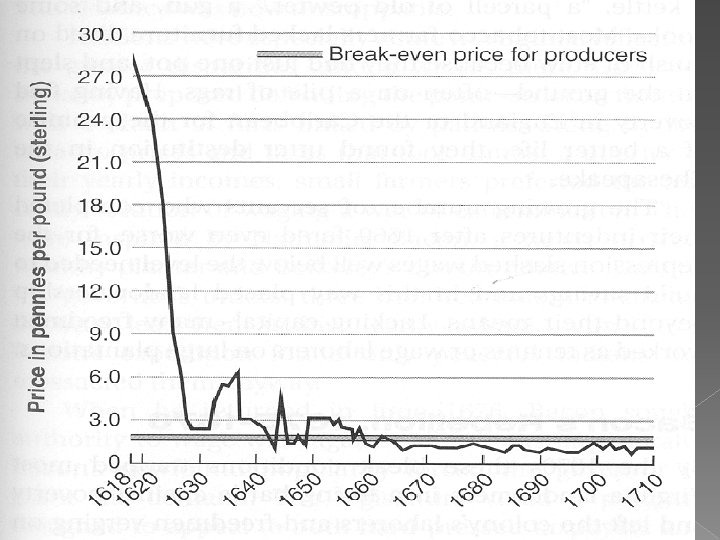
Chesapeake � Compared to New England the Chesapeake was a dispersed community � Based on a hierarchical system › Rich land owners › Indented servants › Slaves. � Region been developed on the back of Tobacco � Vast profits over a period of 11 years from 1618 � 1629 the bottom dropped out of the market
� Drop in profits led to a situation whereby � Indentured servants � have no or little money or opportunities to themselves up as plantation owners � Plantation owners able to survive through › Expanding length of indenture › Increasing punishments for infractions of contract � Renting land, � Selling other crops � From money earned local government. from positions in the set
�Wealthy landowners also closed up �people forced to either �work as poorly paid and abused servants or �to flee from the local area into the ever expanding backcountry
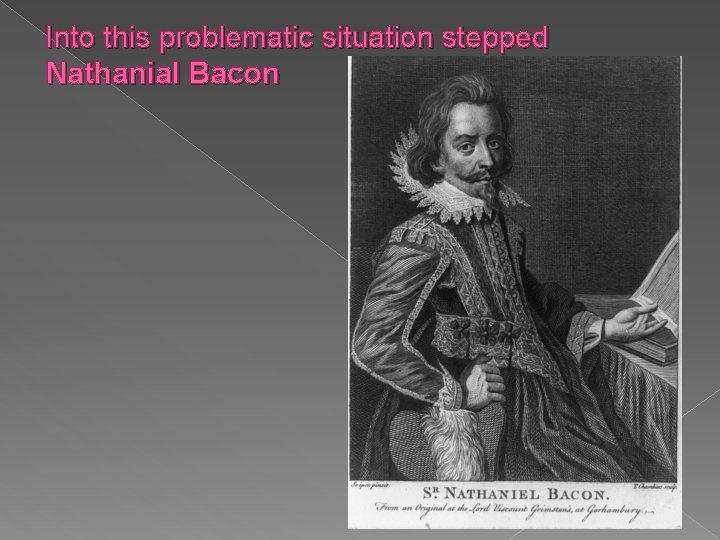
Into this problematic situation stepped Nathanial Bacon
�Bacon � 29 year old Cambridge graduate �wealthy English Family �related by marriage to the governor of Virginia Sir William Berkley. �Bacon was given a land grant and also a seat on the council.
� Many people outside the wealthy looking for scapegoats for their situation � July 1675 a group was found. � Group of Doeg Indians raided plantation on the outskirts of colony � Plantation of Thomas Mathews � Not a random attack by “wild Indians” � Attempt to get paid for goods that Mathews had obtained from the tribe.
� Several Indians killed � herdsman of Mathews plantation killed � Local colonists went after Doeg Indians � Killed ten or more � also killed a number of Susquehannocks � at peace with and regularly traded with the English. � Governor in Berkeley stepped
�Attempted to restore order �Ordered investigation �set up meeting between English and Susquehannocks �During meeting local militia killed the chiefs sent to negotiate. �Susquehannocks went on a series of retaliatory attacks �Bacon’s overseer was killed.
�Berkeley planned a series of forts to protect the outlying communities. �paid for out of taxes �Outlying planters �Financially strapped by low Tobacco prices � preferred the cheaper option �Outright war to kill all Indians and seize their lands.
�Elected Bacon as their leader �April 1676 �Led 300 men on an all out attack on the local Indian population �Found only friendly Indians but killed them anyway
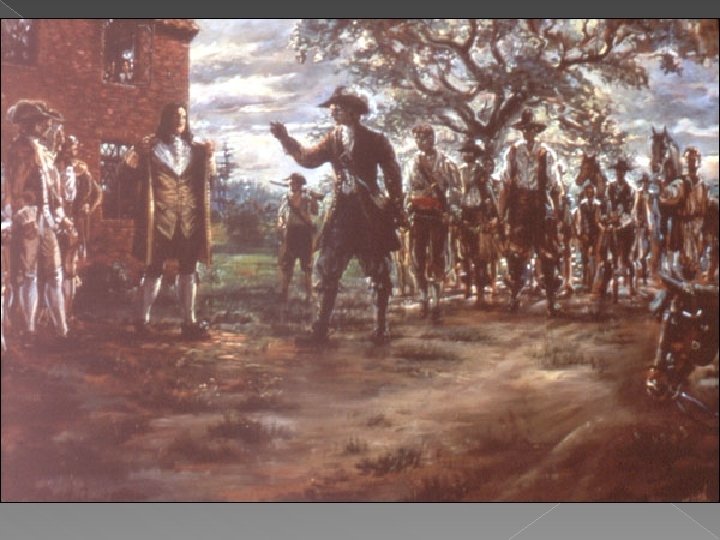
�Bacon’s popularity high �Legislature passed legislation that › allowed for any Indians to be termed enemies if they left their village without permission from the English › this would then allow their lands and property to be taken. �How would you react if 1000 angry men came charging towards your village?
� Rich landowners planned to expand wealth � Governor realized policy not working �ordered the end of hostilities � Bacon returned at the head of his army and rode into Jamestown. �Chased the governor away �Burnt the capital building �offered freedom to any of Berkeley’s supporters, servants or slaves who joined him
�Bacon and rebellion was at the height of power �Bacon died › possibly of dysentery �Rebellion was over. �Berkeley regained control › punished Bacon’s supporters severely
Aftermath � English uprising government sent to troops to quell › Virginia at peace long before they arrived. � Authorities recalled Berkeley � New governor implemented some reforms, but also hit rebels hard › executing leaders › imprisoning others � sending message that rebellion was never justified, no matter what the provocation. � long term effect Indian frontier again pushed back.
Possible Explanations Instability on frontier, mixing of freed servants, blacks, Indians; taxes high, discontent over spending priorities, so rebellion a symbol of class conflict 2. lower death rates and immigration of royalists meant social mobility falling, est of First Families of Va – even Bacon excluded 3. Bacon as popular democratic hero, struggling vs tyranny – failure leads to ‘end of American Independence’ 1.
King Philip’s War New England � Indian – White relations at low ebb by 1670 s. � Treaties with Indians not kept � Metacom – named ‘King Philip’ by whites, chief of Wampanoags, � Specific grievances › loss of tribal lands › effect of alcohol and guns on people › Puritan treatment of ‘praying Indians’ �confined to praying villages, taken away from homes and families
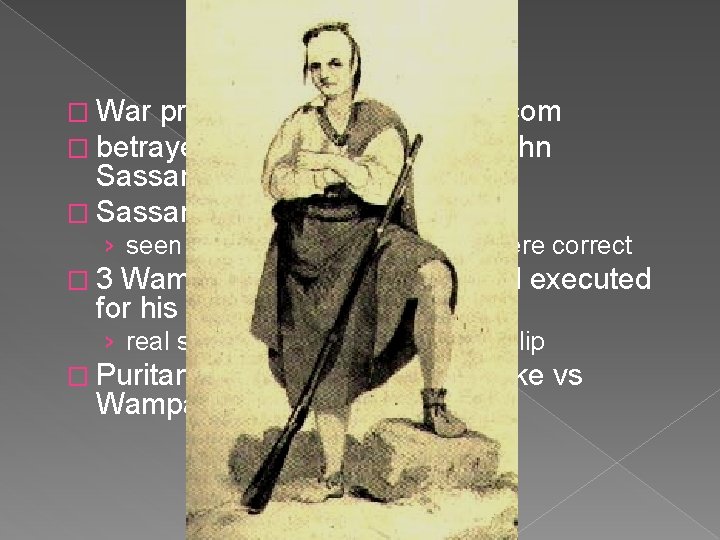
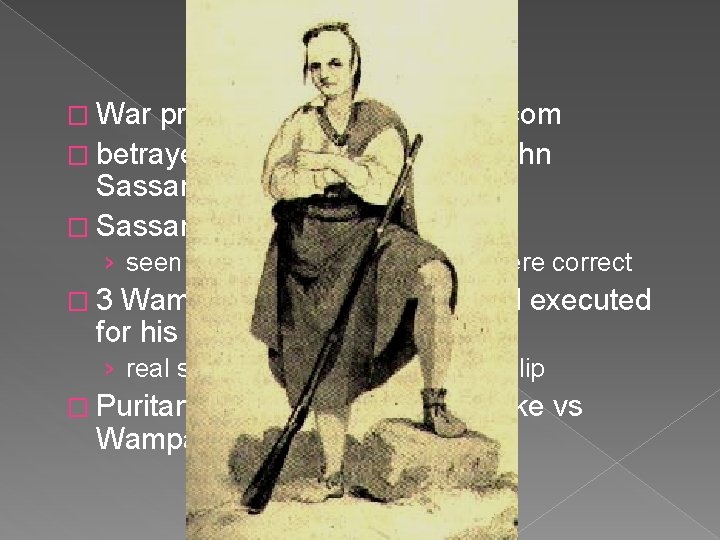
� War probably planned by Metacom � betrayed by Christian Indian, John Sassamon � Sassamon murdered › seen as evidence his warnings were correct � 3 Wampanoag Indians tried and executed for his murder › real suspicion directed at King Philip � Puritans mount pre-emptive strike vs Wampanoag in late 1675
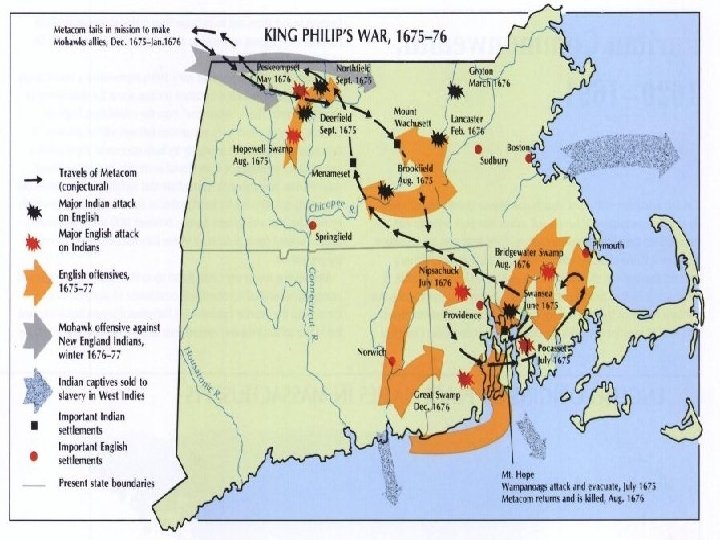
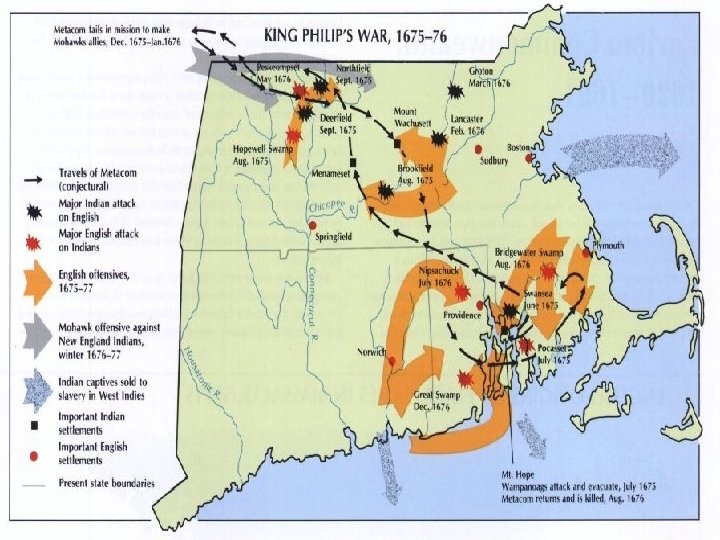
� Wampanoags have better of initial skirmishes � Nipmuc, Narragansett, Pocasset and Pocomtuck joining in – general Indian war � War drags on in to 1676 � Indians unable to fight long war › lack supplies and planning � English re-group, re-supply, and counter- attack � capture and kill King Philip
Consequences � 3000 Indians killed (50% of popn) › loss of tribal leaders › exile of many Indians to west › captives sold into slavery › remaining tribes confined to praying villages �End Indian threat in New England
�cost £ 100, 000 › came close to bankrupting many colonies � 2500 white settlers killed, (10% of white men of fighting age) �damaged 52 of 90 settlements in New England › totally destroyed 12
�Psychological pain �‘so dreadful a judgment’ warning from God �yet victory shows God still on white side � �White settlement restricted, doesn’t reach 1675 levels again until 1710
Conclusions � 1670 s threatened but ultimately confirmed English control over the Native Americans › 1680 sees Pueblo revolt for Spanish Also � Va and NE still developing and finding their feet � 1670 s show tensions between new and old settlers
Thursday
Restoration Colonies � 1) The Carolinas � 1663 territory to the south of Virginia granted to eight politically powerful individuals › 6 also directors of the Royal African Company – would be important in the growth of the region � Colony named Carolina in honor of Charles II � Popular with planters from Barbados, where land was limited.
� Established new capital at Charles Town 1670, � planters grew rice and indigo and began importing large numbers of African slaves. � 2) New York � 1664 became New York from New Amsterdam � Many Dutch merchants remained in New York, & Dutch influence over language and culture lingered
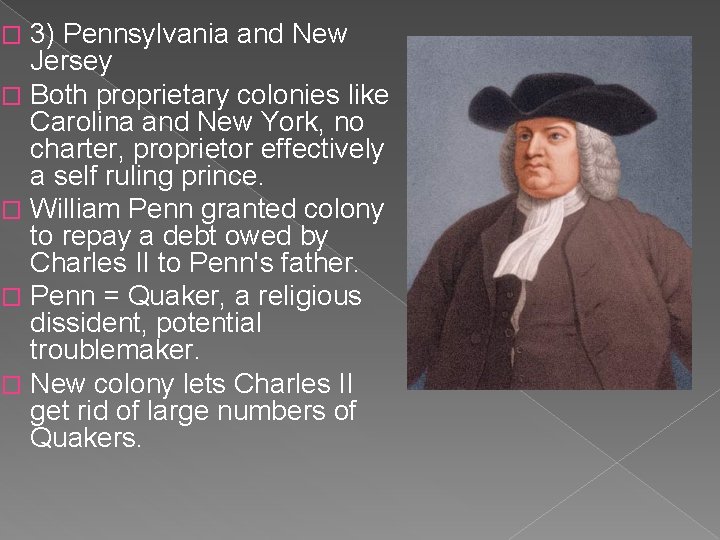
3) Pennsylvania and New Jersey � Both proprietary colonies like Carolina and New York, no charter, proprietor effectively a self ruling prince. � William Penn granted colony to repay a debt owed by Charles II to Penn's father. � Penn = Quaker, a religious dissident, potential troublemaker. � New colony lets Charles II get rid of large numbers of Quakers. �
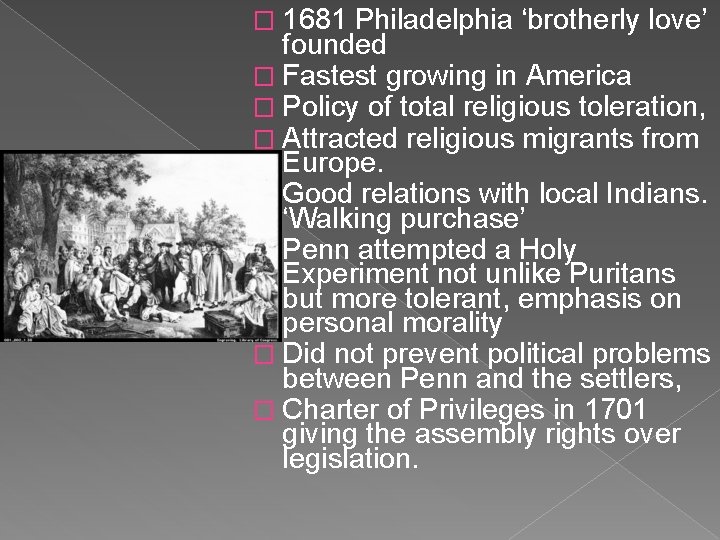
� 1681 Philadelphia ‘brotherly love’ founded � Fastest growing in America � Policy of total religious toleration, � Attracted religious migrants from Europe. � Good relations with local Indians. ‘Walking purchase’ � Penn attempted a Holy Experiment not unlike Puritans but more tolerant, emphasis on personal morality � Did not prevent political problems between Penn and the settlers, � Charter of Privileges in 1701 giving the assembly rights over legislation.
King Philip’s War New England � Indian – White relations at low ebb by 1670 s. � Treaties with Indians not kept � Metacom – named ‘King Philip’ by whites, chief of Wampanoags, � Specific grievances › loss of tribal lands › effect of alcohol and guns on people › Puritan treatment of ‘praying Indians’ �confined to praying villages, taken away from homes and families
� War probably planned by Metacom � betrayed by Christian Indian, John Sassamon � Sassamon murdered › seen as evidence his warnings were correct � 3 Wampanoag Indians tried and executed for his murder › real suspicion directed at King Philip � Puritans mount pre-emptive strike vs Wampanoag in late 1675
� Wampanoags have better of initial skirmishes � Nipmuc, Narragansett, Pocasset and Pocomtuck joining in – general Indian war � War drags on in to 1676 � Indians unable to fight long war › lack supplies and planning � English re-group, re-supply, and counter- attack � capture and kill King Philip
Consequences � 3000 Indians killed (50% of popn) › loss of tribal leaders › exile of many Indians to west › captives sold into slavery › remaining tribes confined to praying villages �End Indian threat in New England
�cost £ 100, 000 › came close to bankrupting many colonies � 2500 white settlers killed, (10% of white men of fighting age) �damaged 52 of 90 settlements in New England › totally destroyed 12
�Psychological pain �‘so dreadful a judgment’ warning from God �yet victory shows God still on white side � �White settlement restricted, doesn’t reach 1675 levels again until 1710
Conclusions � 1670 s threatened but ultimately confirmed English control over the Native Americans › 1680 sees Pueblo revolt for Spanish Also � Va and NE still developing and finding their feet � 1670 s show tensions between new and old settlers
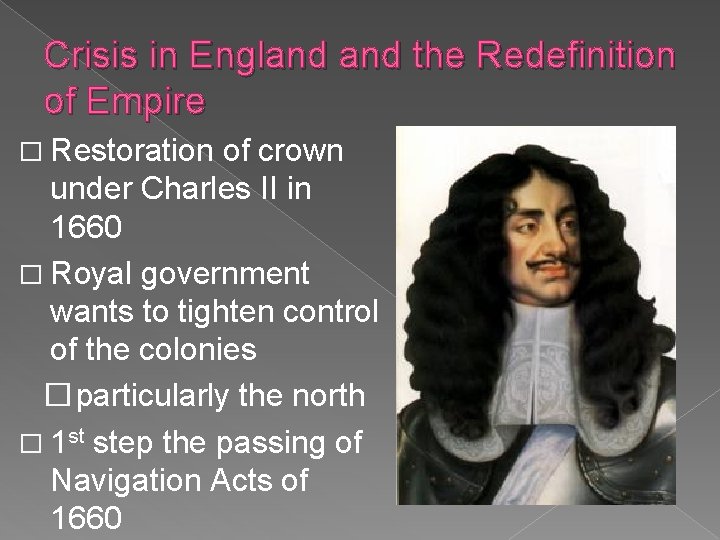
Crisis in England the Redefinition of Empire � Restoration of crown under Charles II in 1660 � Royal government wants to tighten control of the colonies � particularly the north � 1 st step the passing of Navigation Acts of 1660
1660 & 1663 Navigation Acts � Restricted all trade with the empire to ships built in England or its colonies � High value commodities, that produced tax revenue, were ‘enumerated’ › That is they had to be shipped to England alone � Non-English European goods had to be imported through England � Aimed at introducing control and mercantilism › i. e. colonies exist to enrich homeland
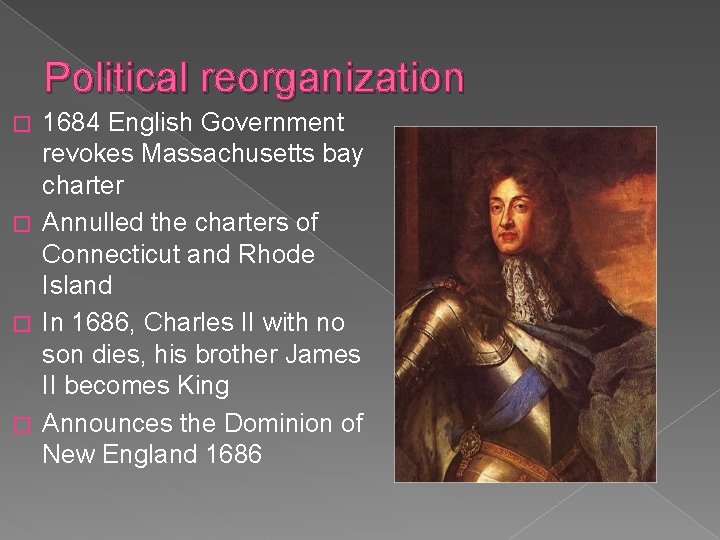
Political reorganization 1684 English Government revokes Massachusetts bay charter � Annulled the charters of Connecticut and Rhode Island � In 1686, Charles II with no son dies, his brother James II becomes King � Announces the Dominion of New England 1686 �
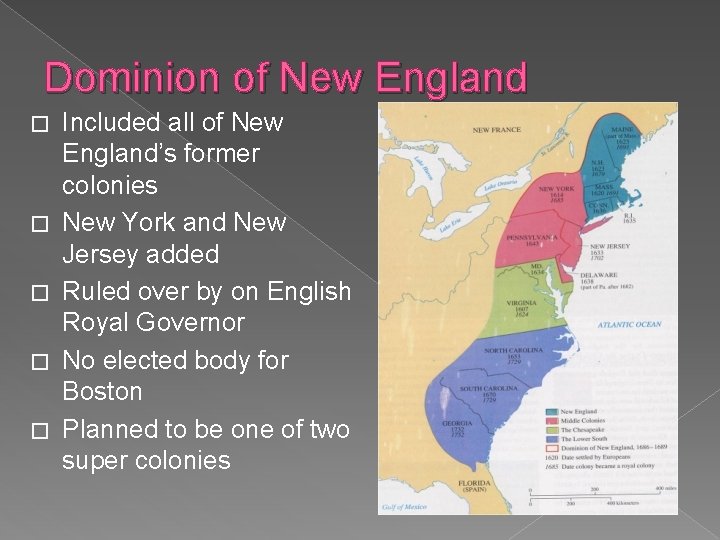
Dominion of New England � � � Included all of New England’s former colonies New York and New Jersey added Ruled over by on English Royal Governor No elected body for Boston Planned to be one of two super colonies
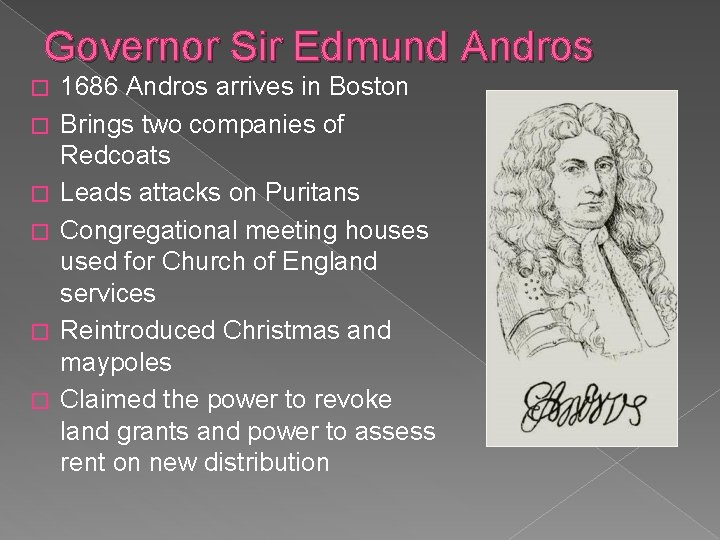
Governor Sir Edmund Andros � � � 1686 Andros arrives in Boston Brings two companies of Redcoats Leads attacks on Puritans Congregational meeting houses used for Church of England services Reintroduced Christmas and maypoles Claimed the power to revoke land grants and power to assess rent on new distribution
� Andros increases taxes � effectively taxation without representation enforces Navigation Acts � appoints cronies to high office � rules with absolutist air ‘either you are subjects or you are rebels’ � Widespread fear of French in Canada, stirring up Indians, � Suspicion of James’s pro-French policies � Louis XIV not seen as good role model.
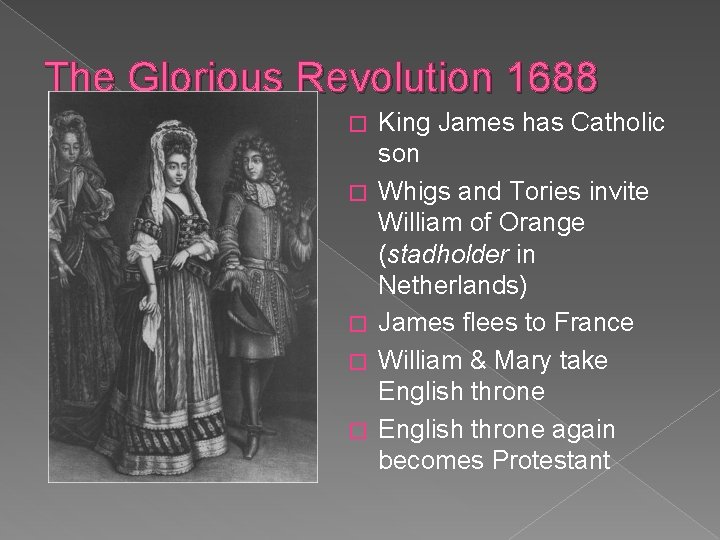
The Glorious Revolution 1688 � � � King James has Catholic son Whigs and Tories invite William of Orange (stadholder in Netherlands) James flees to France William & Mary take English throne again becomes Protestant
In New England � Indians start to harass settlements in Northern New England � Andros sends troops north, leaving Boston defenceless, troops mutiny at Saco River, April 1689. � Popular uprising, led by elite merchants and puritans, who feared an uprising led by mob � Andros unable to secure any support, flees to city fort
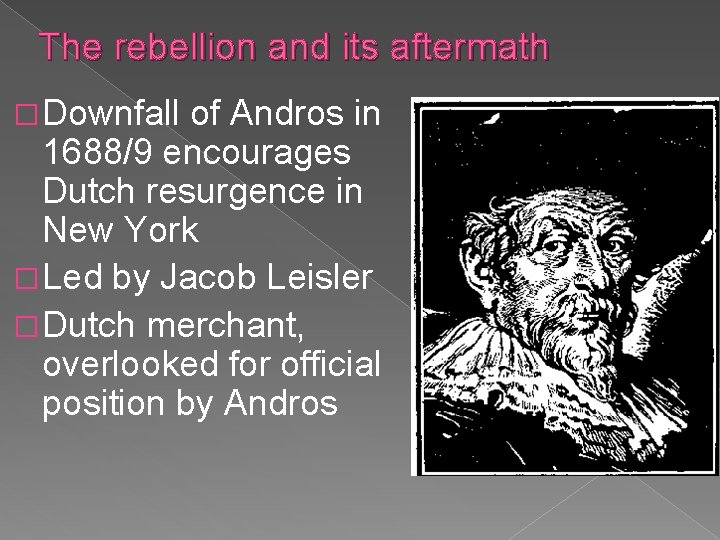
The rebellion and its aftermath � Downfall of Andros in 1688/9 encourages Dutch resurgence in New York � Led by Jacob Leisler � Dutch merchant, overlooked for official position by Andros
� Leisler rules New York 1689 -91 � Professes loyalty to William � but refuses to hand over control to English officials in 1691. � Crushed by English forces � Leisler hanged for treason. � Harsh reprisals vs Dutch � Message - rebellion not tolerated. � Decline of Dutch culture accelerated
The aftermath for New England � Power vacuum – Council of Safety established to manage affairs until return of charters and guidance from William � Charters returned 1691, but Massachusetts Bay became Royal Colony � New governor Sir Wm Phipps = merchant, not puritan. � Religious toleration established, franchise changed to property qualification rather than religious one � Confirmed end of puritan experiment
� Does not mean the end of Puritans just end of their domination over the region � Other issues also threaten the Puritans � Deaths affect concept › › �A John Winthrop 1649 John Davenport 1670 Ann Bradstreet 1672 Roger Williams 1683 new generation is taking charge � Most members of the ministry now educated at Harvard not Cambridge
And now on to one result (? ) of all this
� Now we are going to look at the events that occurred between June – September 1692 in a New England town � During this period 19 men and women were carted to Gallows Hill for hanging � Another man pressed to death under heavy stones � Dozens languished in jail for months without trials. � Then, almost as soon as it had begun, the hysteria that swept through Puritan Massachusetts ended.
� Why did this travesty of justice occur? � Why did it occur in where it did? � Nothing about this tragedy was inevitable. � Only an unfortunate combination of › › › an ongoing frontier war economic conditions congregational strife teenage boredom personal jealousies � can account for the accusations, trials, and executions that occurred in the spring and summer of 1692 in Salem