
Tubulointerstitial diseases urolithiasis Ali Al Khader M D

Tubulointerstitial diseases & urolithiasis Ali Al Khader, M. D. Faculty of Medicine Al-Balqa’ Applied University Email: ali. alkhader@bau. edu. jo

Remember that: Impaired renal function (Azotemia) is classified into: • Prerenal azotemia…remember dehydration …Urea is elevated much more than the elevation in creatinine • Renal azotemia…a problem in the renal parenchyma (glomeruli, tubulointerstitium…etc. ) …Acute tubular necrosis (ATN) is the most common cause of acute kidney injury …of its main causes: Ischemia and drugs • Postrenal azotemia…obstruction in urine flow
We will discuss: • Inflammation…tubulointerstitial nephritis • Urolithiasis

acute Tubulointerstitial nephritis chronic • The glomeruli may be spared altogether or affected only late in the course • In most cases of TIN caused by bacterial infection, the renal pelvis is prominently involved—hence the more descriptive term pyelonephritis • For nonbacterial cases, we use “tubulointerstitial nephritis” -drugs -metabolic (e. g. , hypokalemia) -physical (e. g. , irradiation) -viral -immune
Acute pyelonephritis • Suppurative • The great majority are associated with infection of the lower urinary tract • Enteric gram-negative rods • Persons at risk of recurrent UTI and resulting pyelonephritis: -those who undergo urinary tract manipulations (instrumentation, e. g. , cystoscopy, catheterization…etc. ) -those who have congenital or acquired anomalies of the lower urinary tract • Staphylococci and Streptococcus faecalis are much less common
Acute pyelonephritis, cont’d • Ascending infection from the lower urinary tract is the most important and common route by which the bacteria reach the kidney …the other route is hematogenous from 1 to 40 years of age • UTI in general is more common in females…urethral proximity to the rectum with more risk of colonization …also: the short urethra, and trauma to the urethra during sexual intercourse, facilitate the entry of bacteria into the urinary bladder • UTI is particularly frequent among patients with urinary tract obstruction, as may occur with benign prostatic hyperplasia and uterine prolapse k ris d e s ar c i t e Diab rea c n i at
Acute pyelonephritis, cont’d • VUR (vesicoureteral reflux): -present in 20% to 40% of young children with UTI the n i g n i d i o after v e n i r u l a u esid rowth r g l n i a i s r t l e t u c s -VUR re d up avors ba e f l l h e c i p h o -may be due to flaccid bladder due to spinal cord injury r w p , act can be e n i r u urinary tr r nal e e d r d e a l h t b o d t e t rther in a f -the infec d s of the n p i a t s i e v h l t e t p a al ts -may be due to neurogenic bladder in diabetics to the ren through open duc ma parenchy reflux) l a n e r a r t in papillae ( • Pregnancy: • 4% to 6% of pregnant women develop bacteriuria sometime during pregnancy … 20% to 40% of these eventually develop symptomatic urinary infection if not treated -due to congenital defect that results in incompetence of the ureterovesical valve
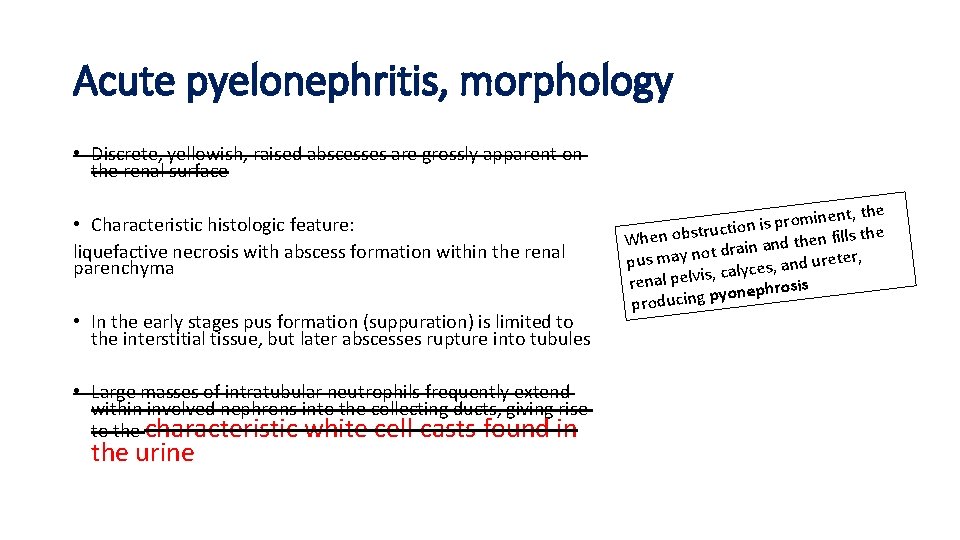
Acute pyelonephritis, morphology • Discrete, yellowish, raised abscesses are grossly apparent on the renal surface • Characteristic histologic feature: liquefactive necrosis with abscess formation within the renal parenchyma • In the early stages pus formation (suppuration) is limited to the interstitial tissue, but later abscesses rupture into tubules • Large masses of intratubular neutrophils frequently extend within involved nephrons into the collecting ducts, giving rise to the characteristic white cell casts found in the urine , the t n e in m o r ction is p u r t s b o n fills the e n e Wh h t d n a t drain pus may no lyces, and ureter, , ca renal pelvis nephrosis pyo producing
Acute pyelonephritis, papillary necrosis • Infrequent condition • 3 predisposing conditions: -diabetes -urinary tract obstruction -analgesic abuse • Ischemic and suppurative necrosis of the tips of the renal pyramids (renal papillae) *Gross morphology: -sharply defined gray-white to yellow necrosis of the apical two thirds of the pyramids…pathognomonic -one papilla or several or all papillae may be affected *Microscopic morphology: coagulative necrosis, with surrounding neutrophilic infiltrate
Acute pyelonephritis, clinical notes • Pain at costovertebral angle • Systemic symptoms & signs • Lower urinary symptoms may be present as a clue of UTI…frequency, urgency, dysuria…etc. • The urine appears turgid due to the contained pus (pyuria) • If uncomplicated…self-limited even without antibiotics …symptoms last for 1 week but bacteriuria may persist longer • The disease is usually unilateral • Papillary necrosis…poor prognosis
Chronic pyelonephritis • Chronic pyelonephritis: -Chronic interstitial inflammation -Scarring & deformity of pelvicalyceal system -Important cause of chronic renal failure • 2 types: -chronic obstructive pyelonephritis -chronic reflux-associated pyelonephritis

Chronic obstructive pyelonephritis • Bilateral…like urethral anomalies (e. g. , posterior urethral valve) • Unilateral…ureteric obstruction…e. g. , calculi
Chronic reflux-associated pyelonephritis, reflux nephropathy • More common than chronic obstructive pyelonephritis • Congenital vesicoureteral reflux and intrarenal reflux …may be unilateral or bilateral …scarring and atrophy of one kidney or may involve both, potentially leading to chronic renal insufficiency

Chronic pyelonephritis, morphology • Unequal scarring…in contrast to vascular benign nephrosclerosis or chronic glomerulonephritis • The hallmark of chronic pyelonephritis is scarring involving the pelvis or calyces, or both, leading to papillary blunting and marked calyceal deformities Elsevier. Kumar et al. Robbins and Cotran pathologic basis of diseases 9 th
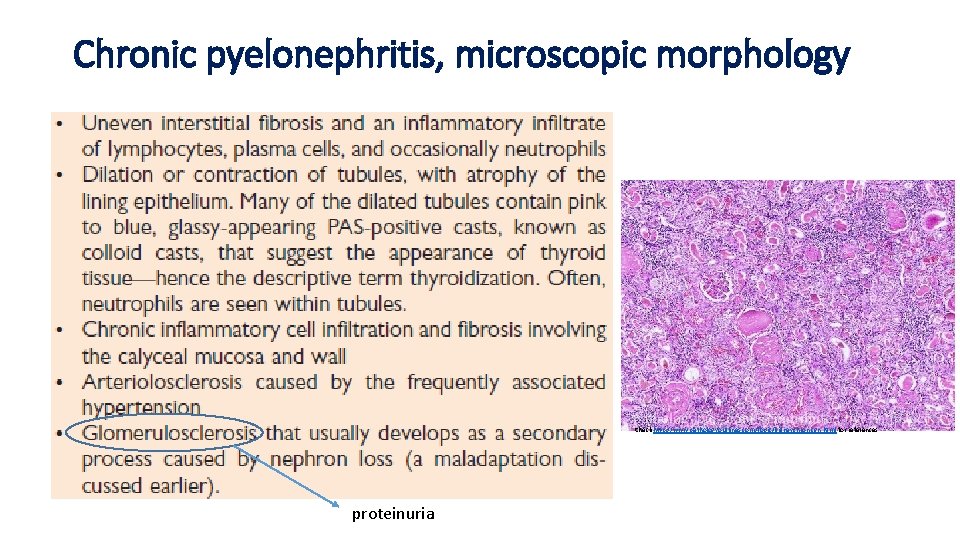
Chronic pyelonephritis, microscopic morphology Check http: //www. pathologyoutlines. com/topic/kidneychronicgn. html for references proteinuria
Chronic pyelonephritis, clinical course • Insidious onset with late presentation due to abnormal labs or hypertension • Radiology is characteristic: …The affected kidney is asymmetrically contracted, with some degree of blunting and deformity of the calyceal system (caliectasis) • Bacteriuria is not a must • With bilateral progressive involvement…polyuria & nocturia …loss of concentrating ability
Drug-induced interstitial nephritis • Acute drug-induced TIN is associated most frequently with: -synthetic penicillins (methicillin, ampicillin) -other synthetic antibiotics (rifampin) -diuretics (thiazides) -nonsteroidal anti-inflammatory agents -numerous other drugs (e. g. , phenindione, cimetidine) • Mostly hypersensitivity reactions (type I and type IV)
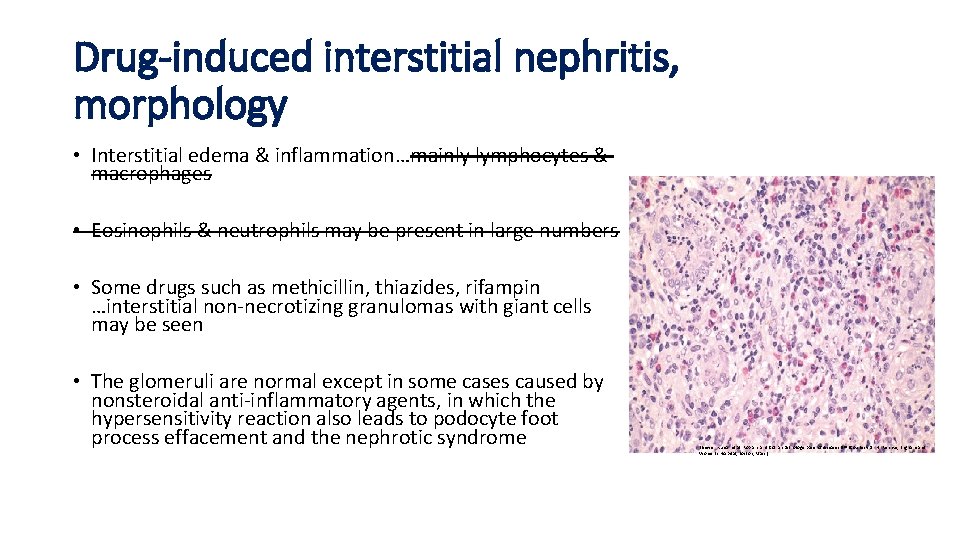
Drug-induced interstitial nephritis, morphology • Interstitial edema & inflammation…mainly lymphocytes & macrophages • Eosinophils & neutrophils may be present in large numbers • Some drugs such as methicillin, thiazides, rifampin …interstitial non-necrotizing granulomas with giant cells may be seen • The glomeruli are normal except in some cases caused by nonsteroidal anti-inflammatory agents, in which the hypersensitivity reaction also leads to podocyte foot process effacement and the nephrotic syndrome Elsevier. Kumar et al. Robbins and Cotran pathologic basis of diseases 9 th…(Courtesy Dr. H. Rennke, Brigham and Women’s Hospital, Boston, Mass. )
Drug-induced interstitial nephritis, clinical course • The disease begins about 15 days (range, 2 to 40 days) after exposure to the drug • Characterized by: -fever -eosinophilia (which may be transient) -rash (in about 25% of persons) -renal abnormalities *Urine: -hematuria -minimal or no proteinuria -leukocyturia (sometimes including eosinophils) • A rising serum creatinine or acute kidney injury with oliguria develops in about 50% of cases, particularly in older patients • Withdrawal of the offending drug is followed by recovery…may take several months for renal function to return to normal
Urolithiasis • Most often the calculi arise in the kidney • By the age of 70 years, 11% of men and 5. 6% of women in the United States will have experienced a symptomatic kidney stone • Symptomatic urolithiasis is more common in men than in women • Familial tendency toward stone formation has long been recognized
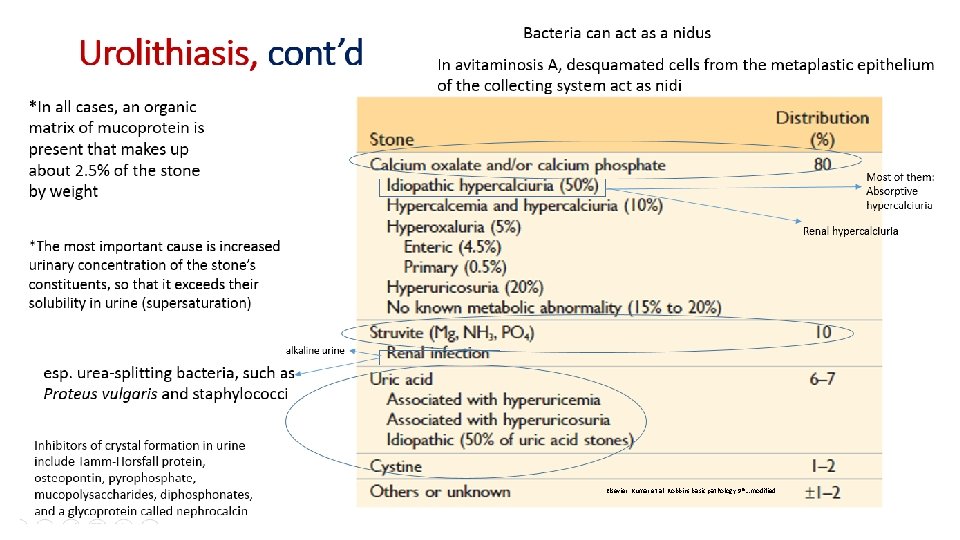
Elsevier. Kumar et al. Robbins basic pathology 9 th…modified
Urolithiasis, uric acid and cystine stones • Gout and diseases involving rapid cell turnover, such as the leukemias • About half of people with uric acid stones, however, have neither hyperuricemia nor increased urine urate but demonstrate an unexplained tendency to excrete a persistently acid urine (with a p. H less than 5. 5)…this low p. H favors uric acid stone formation—in contrast with the high p. H that favors formation of stones containing calcium phosphate • Cystine stones…genetic defect in cystine renal reabsorption …like uric acid stones: more with acidic urine
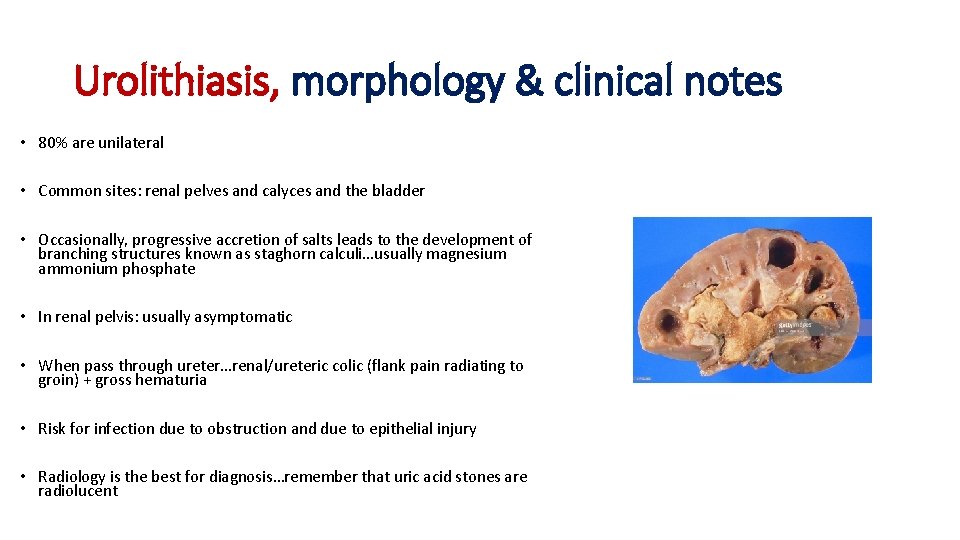
Urolithiasis, morphology & clinical notes • 80% are unilateral • Common sites: renal pelves and calyces and the bladder • Occasionally, progressive accretion of salts leads to the development of branching structures known as staghorn calculi…usually magnesium ammonium phosphate • In renal pelvis: usually asymptomatic • When pass through ureter…renal/ureteric colic (flank pain radiating to groin) + gross hematuria • Risk for infection due to obstruction and due to epithelial injury • Radiology is the best for diagnosis…remember that uric acid stones are radiolucent

Thank You
- Slides: 24