
Tuberculosis Update for Indiana 2017 Bradley Allen MD

Tuberculosis Update for Indiana – 2017 Bradley Allen, MD, Ph. D, FACP, FIDSA Indiana University School of Medicine Division of Infectious Diseases Roudebush VAMC Indianapolis March 2017
Disclosures • Medical Consultant, TB Control Program Indiana State Department of Health • Clinical trials with Merck, Genzyme and Romark • Have personally endured over 36 Tuberculin skin tests (all negative or perhaps misinterpreted) Major thanks to Kelly White, ISDH TB Control Program Epidemiologist, for Indiana data updates!
Outline/Objectives 1) Learn the current Tuberculosis Incidence World, U. S. and Indiana 2) Review the definition of Latent Infection versus Active TB Disease 3) Contrast New TB Testing and Screening Guidelines Dr. Deb Mc. Mahan 4) Compare current LTBI Treatment options Dr. Eva Muloma 5) Review available County and State Support Systems

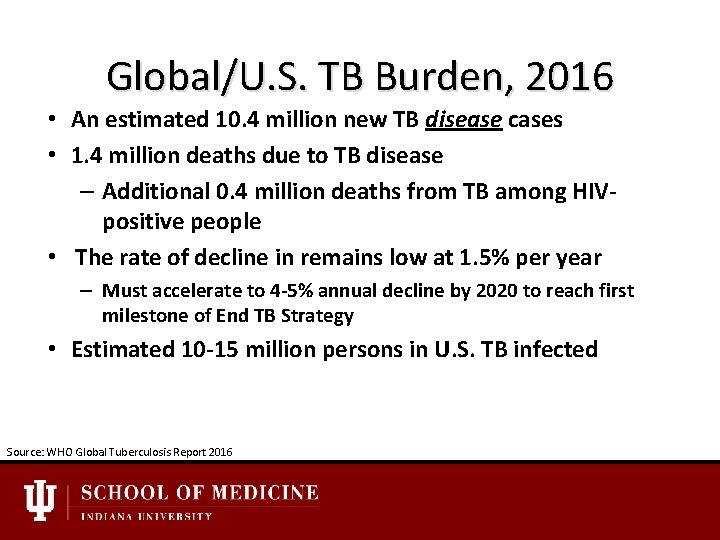
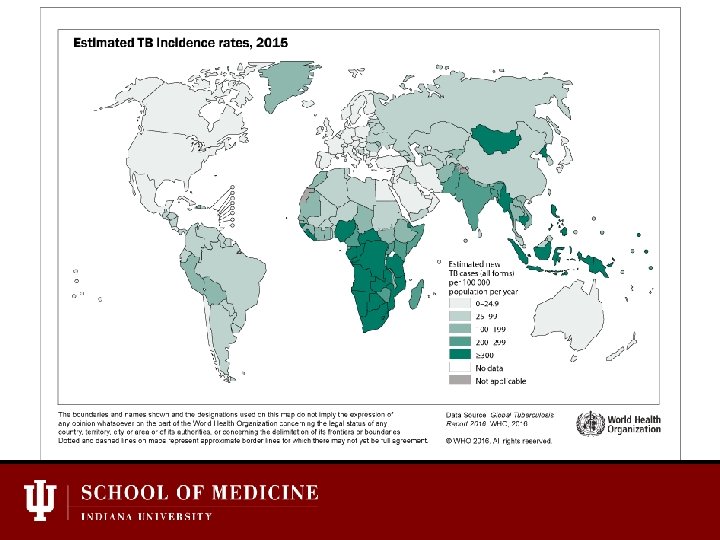
Global/U. S. TB Burden, 2016 • An estimated 10. 4 million new TB disease cases • 1. 4 million deaths due to TB disease – Additional 0. 4 million deaths from TB among HIVpositive people • The rate of decline in remains low at 1. 5% per year – Must accelerate to 4 -5% annual decline by 2020 to reach first milestone of End TB Strategy • Estimated 10 -15 million persons in U. S. TB infected Source: WHO Global Tuberculosis Report 2016
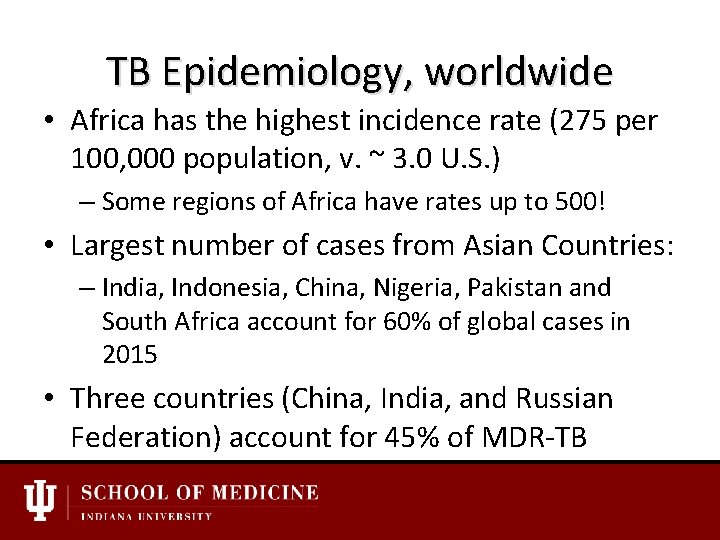
TB Epidemiology, worldwide • Africa has the highest incidence rate (275 per 100, 000 population, v. ~ 3. 0 U. S. ) – Some regions of Africa have rates up to 500! • Largest number of cases from Asian Countries: – India, Indonesia, China, Nigeria, Pakistan and South Africa account for 60% of global cases in 2015 • Three countries (China, India, and Russian Federation) account for 45% of MDR-TB
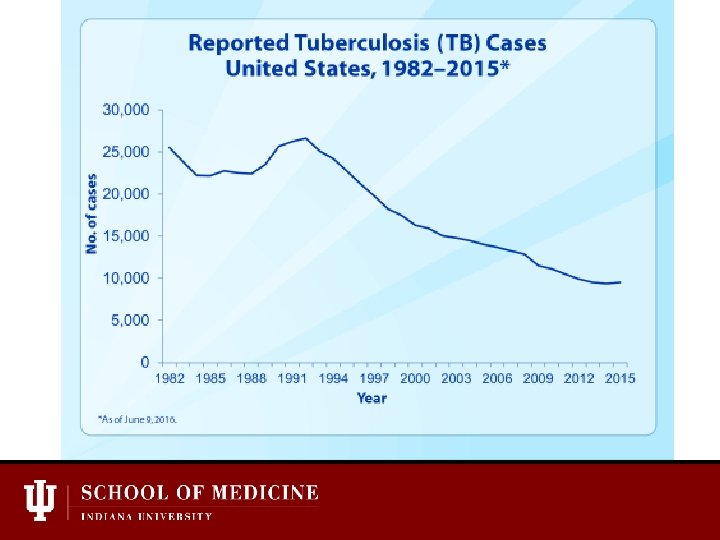
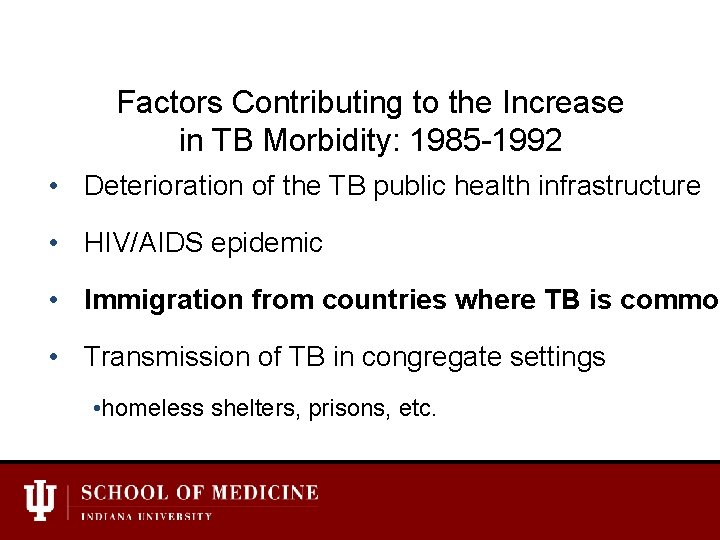
Factors Contributing to the Increase in TB Morbidity: 1985 -1992 • Deterioration of the TB public health infrastructure • HIV/AIDS epidemic • Immigration from countries where TB is common • Transmission of TB in congregate settings • homeless shelters, prisons, etc.
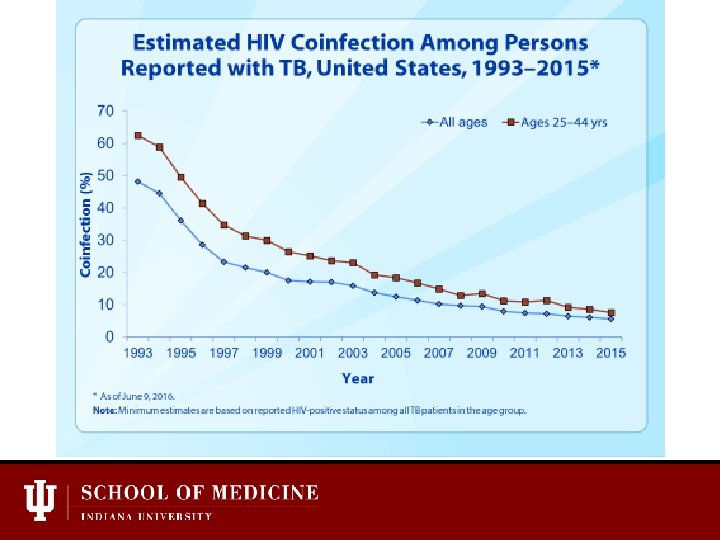
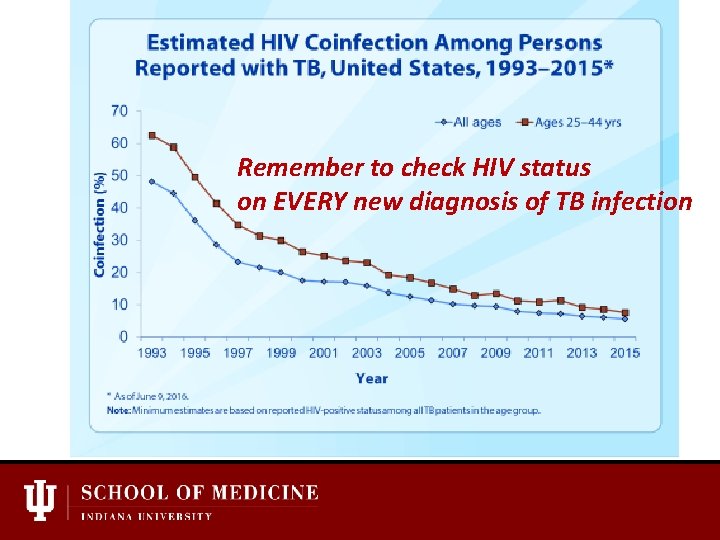
Remember to check HIV status on EVERY new diagnosis of TB infection
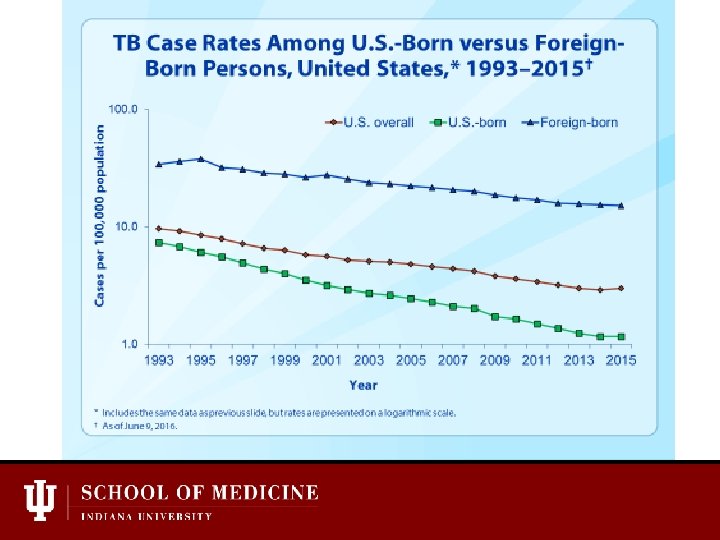
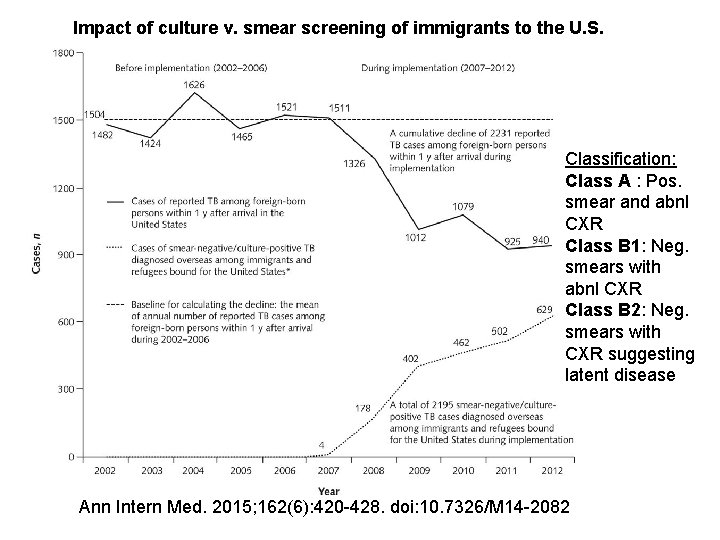
Impact of culture v. smear screening of immigrants to the U. S. Classification: Class A : Pos. smear and abnl CXR Class B 1: Neg. smears with abnl CXR Class B 2: Neg. smears with CXR suggesting latent disease Ann Intern Med. 2015; 162(6): 420 -428. doi: 10. 7326/M 14 -2082
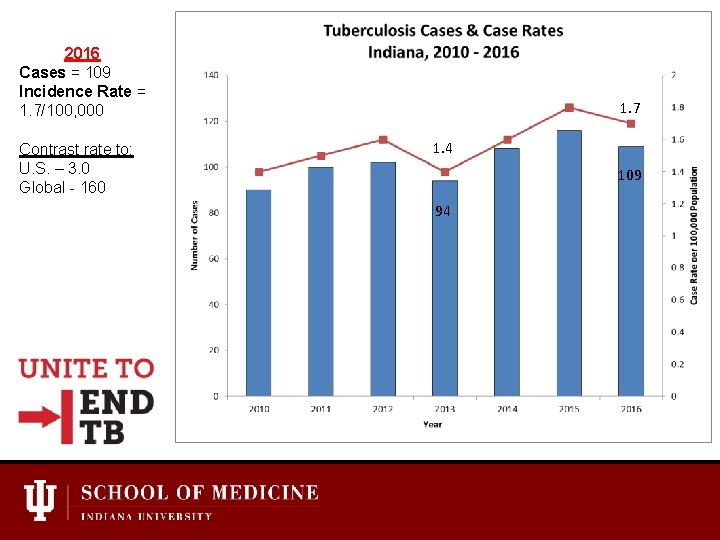
2016 Cases = 109 Incidence Rate = 1. 7/100, 000 Contrast rate to: U. S. – 3. 0 Global - 160 1. 7 1. 4 109 94
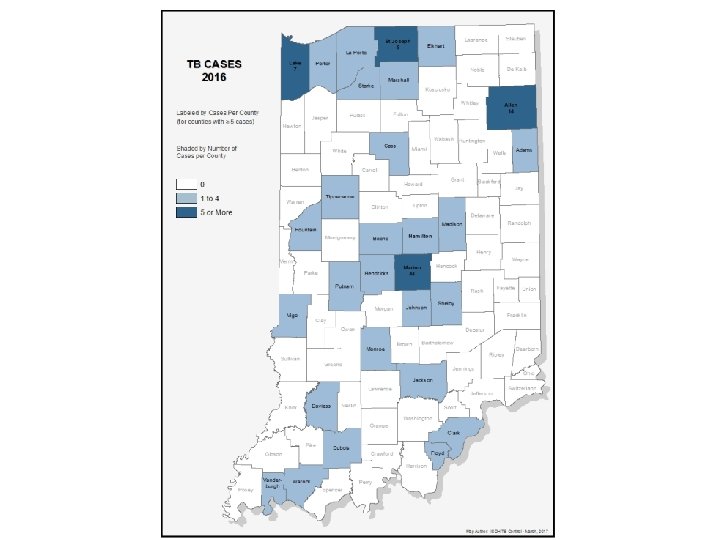
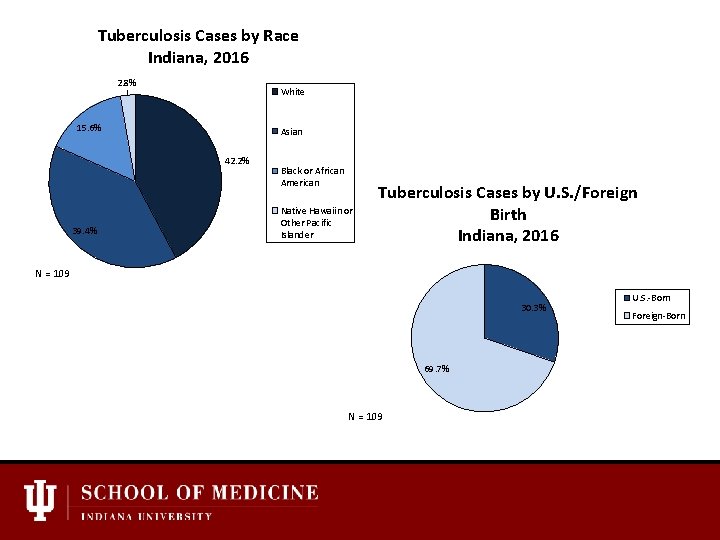
Tuberculosis Cases by Race Indiana, 2016 2. 8% White 15. 6% Asian 42. 2% 39. 4% Black or African American Native Hawaiin or Other Pacific Islander Tuberculosis Cases by U. S. /Foreign Birth Indiana, 2016 N = 109 30. 3% 69. 7% N = 109 U. S. -Born Foreign-Born
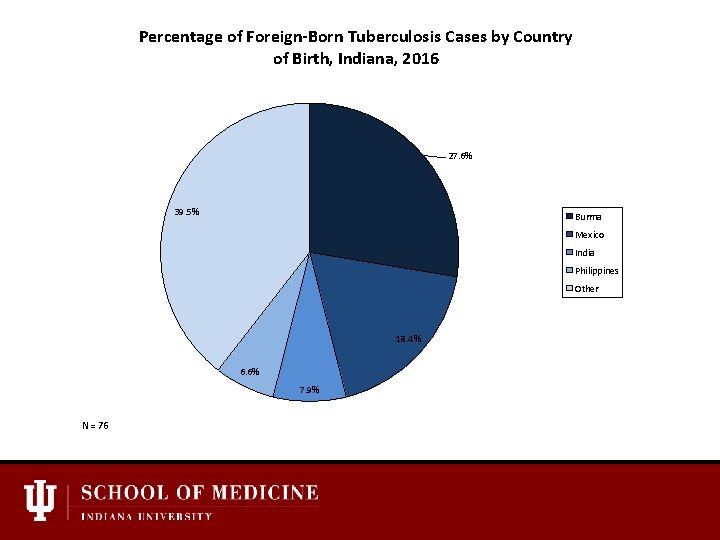
Percentage of Foreign-Born Tuberculosis Cases by Country of Birth, Indiana, 2016 27. 6% 39. 5% Burma Mexico India Philippines Other 18. 4% 6. 6% 7. 9% N= 76
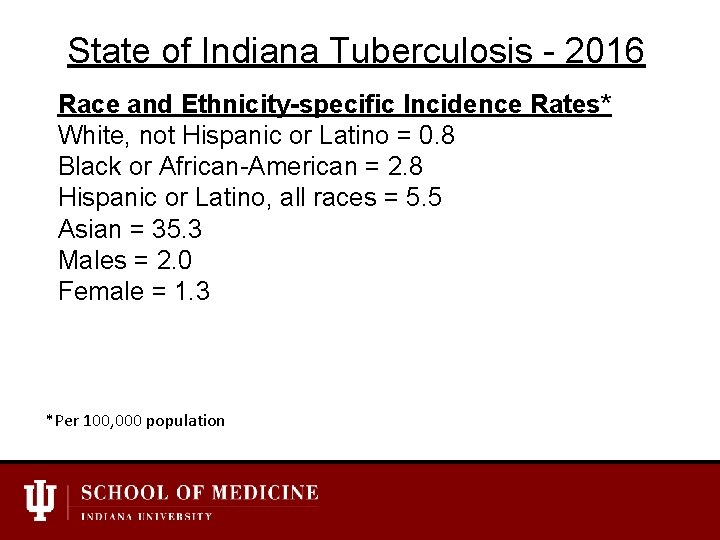
State of Indiana Tuberculosis - 2016 Race and Ethnicity-specific Incidence Rates* White, not Hispanic or Latino = 0. 8 Black or African-American = 2. 8 Hispanic or Latino, all races = 5. 5 Asian = 35. 3 Males = 2. 0 Female = 1. 3 *Per 100, 000 population
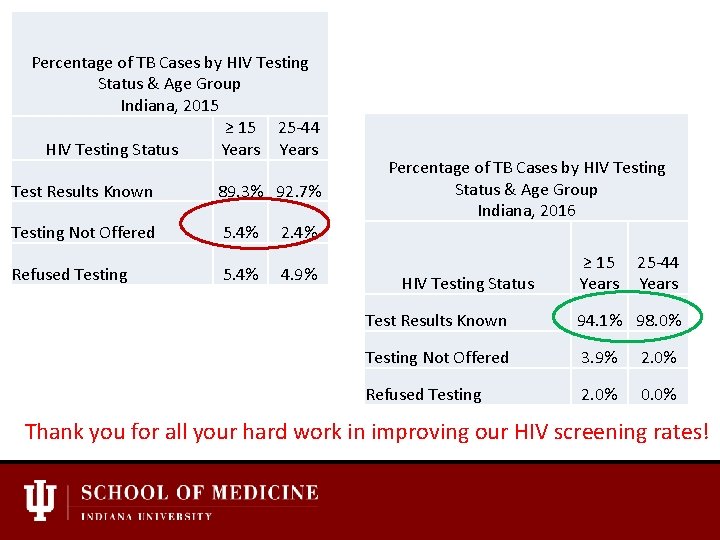
Percentage of TB Cases by HIV Testing Status & Age Group Indiana, 2015 ≥ 15 25 -44 HIV Testing Status Years Test Results Known 89. 3% 92. 7% Testing Not Offered 5. 4% Refused Testing 5. 4% Percentage of TB Cases by HIV Testing Status & Age Group Indiana, 2016 2. 4% 4. 9% HIV Testing Status ≥ 15 25 -44 Years Test Results Known 94. 1% 98. 0% Testing Not Offered 3. 9% 2. 0% Refused Testing 2. 0% 0. 0% Thank you for all your hard work in improving our HIV screening rates!
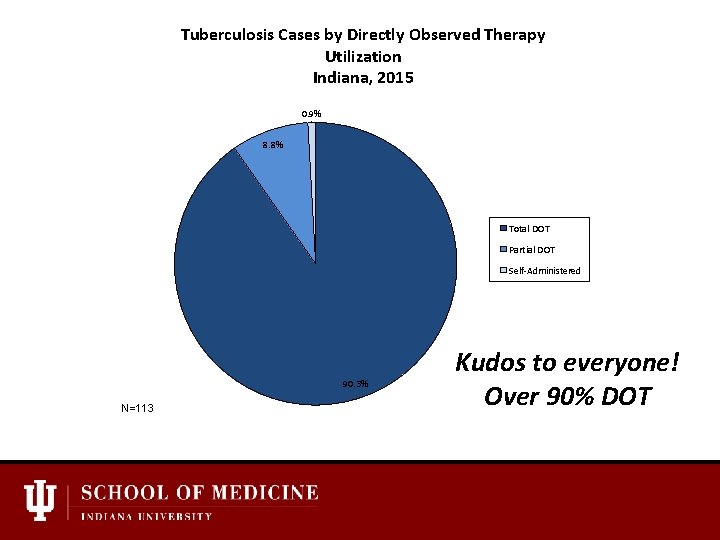
Tuberculosis Cases by Directly Observed Therapy Utilization Indiana, 2015 0. 9% 8. 8% Total DOT Partial DOT Self-Administered 90. 3% N=113 Kudos to everyone! Over 90% DOT
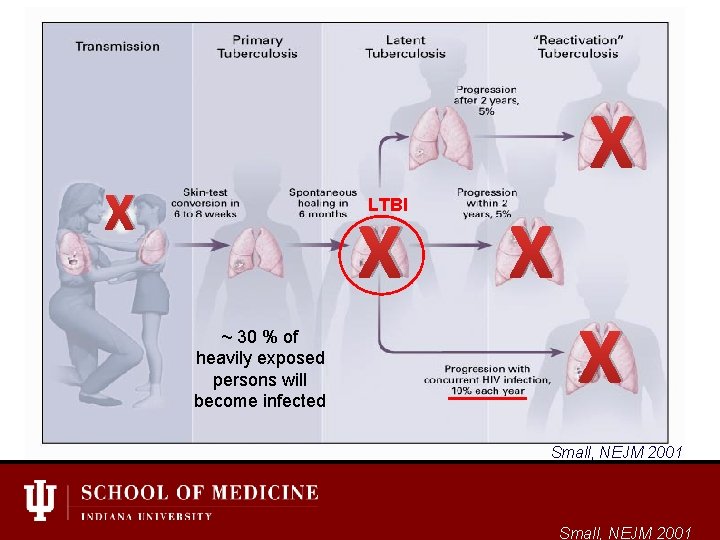
X X LTBI X ~ 30 % of heavily exposed persons will become infected X X Small, NEJM 2001
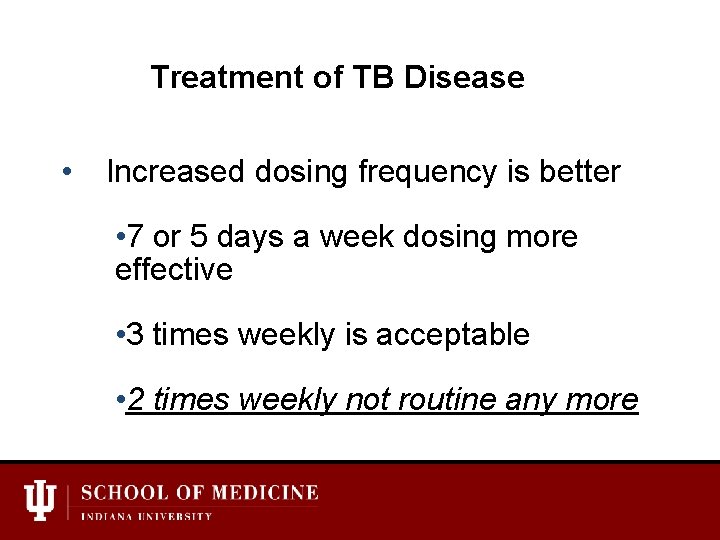
Treatment of TB Disease • Increased dosing frequency is better • 7 or 5 days a week dosing more effective • 3 times weekly is acceptable • 2 times weekly not routine any more
Treatment of LTBI • 3 HP dosing gaining momentum • 12 weekly doses by DOT • INH plus rifapentine • Other rifampin based regimens coming
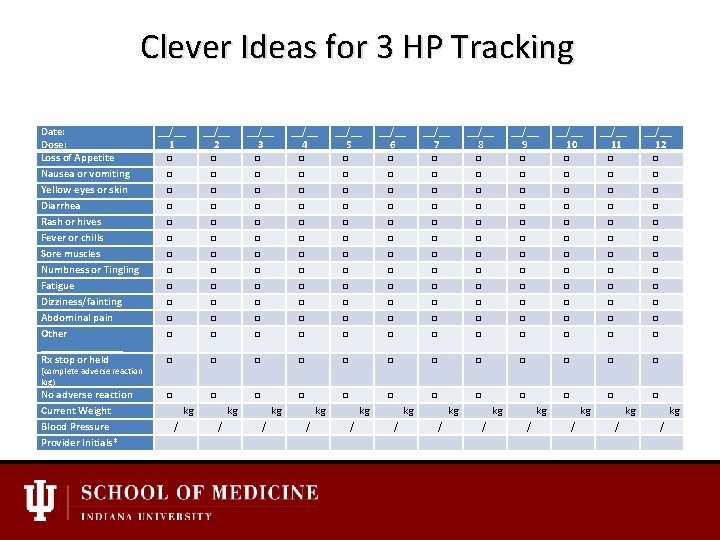
Clever Ideas for 3 HP Tracking Date: Dose: Loss of Appetite Nausea or vomiting Yellow eyes or skin Diarrhea Rash or hives Fever or chills Sore muscles Numbness or Tingling Fatigue Dizziness/fainting Abdominal pain Other ________ Rx stop or held __/__ __1__ □ □ □ __/__ __2__ □ □ □ __/__ __3__ □ □ □ __/__ __4__ □ □ □ __/__ __5__ □ □ □ __/__ __6__ □ □ □ __/__ __7__ □ □ □ __/__ __8__ □ □ □ __/__ __9__ □ □ □ __/__ __10__ □ □ □ __/__ __11__ □ □ □ __/__ __12__ □ □ □ □ □ □ No adverse reaction Current Weight Blood Pressure Provider Initials* □ □ □ (complete adverse reaction log) kg kg / kg / kg / /
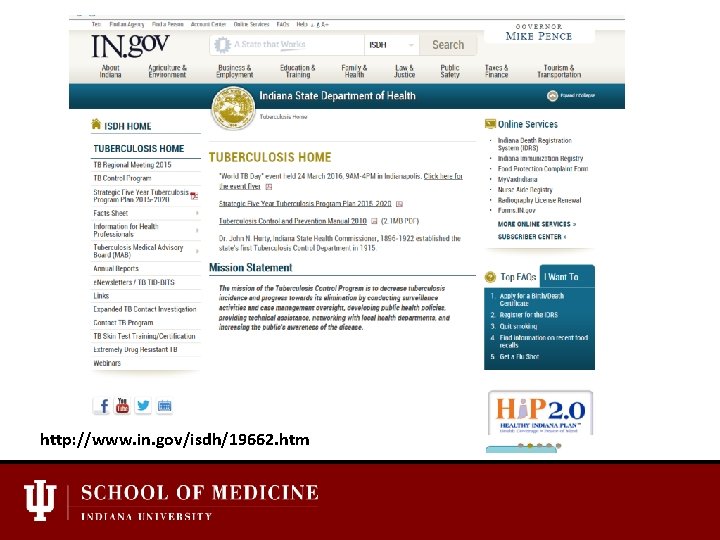
http: //www. in. gov/isdh/19662. htm
Questions?
References/Resources • • • Guidelines for Preventing the Transmission of Mycobacterium tuberculosis in Health-Care Settings, 2005 MMWR Dec. 30, 2005 / 54(RR 17); 1 -141 http: //www. cdc. gov/mmwr/preview/mmwrhtml/rr 5417 a 1. htm? s_cid=rr 5417 a 1_e CDC – TB 101 for Health Care Workers http: //www. cdc. gov/tb/webcourses/tb 101/ CDC Core Curriculum on Tuberculosis – updated 2011 http: //www. cdc. gov/tb/education/corecurr/index. htm Dr. Neil Schluger. CDC-sponsored trial comparing TST with QFT and T. SPOT in 2500 HCWs (NYC, Baltimore, Houston, Denver) Slater M, Parsonnet J, Banaei N. 2012. Investigation of false-positive results given by the Quanti. FERON-TB Gold In-Tube assay. J Clin Microbiol. 2012 Sep; 50(9): 31057. Pai M et al, Serial testing of health care workers for tuberculosis using interferon-g assay. AJRCCM 2006
References/Resources • Meta-analysis: New Tests for the Diagnosis of Latent Tuberculosis Infection: Areas of Uncertainty and Recommendations for Research Dick Menzies, MD, MSc; Madhukar Pai, MD, Ph. D; and George Comstock, MD, Dr. PH Ann Int Med 2007, 146: 340 -354 • Martinson NA, Barnes GL, Moulton LH, et al. New regimens to prevent tuberculosis in adults with HIV infection. N Engl J Med 2011; 365: 11– 20. • Recommendations for Use of an Isoniazid-Rifapentine Regimen with Direct Observation to Treat Latent Mycobacterium tuberculosis Infection. MMWR December 9, 2011 / 60(48); 1650 -1653 http: //www. cdc. gov/mmwr/preview/mmwrhtml/mm 6048 a 3. htm? s_cid= mm 6048 a 3_e%0 d%0 a
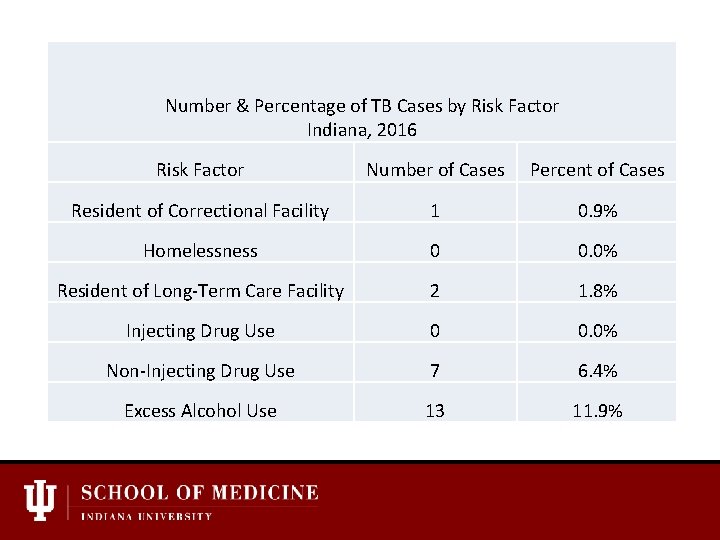
Number & Percentage of TB Cases by Risk Factor Indiana, 2016 Risk Factor Number of Cases Percent of Cases Resident of Correctional Facility 1 0. 9% Homelessness 0 0. 0% Resident of Long-Term Care Facility 2 1. 8% Injecting Drug Use 0 0. 0% Non-Injecting Drug Use 7 6. 4% Excess Alcohol Use 13 11. 9%
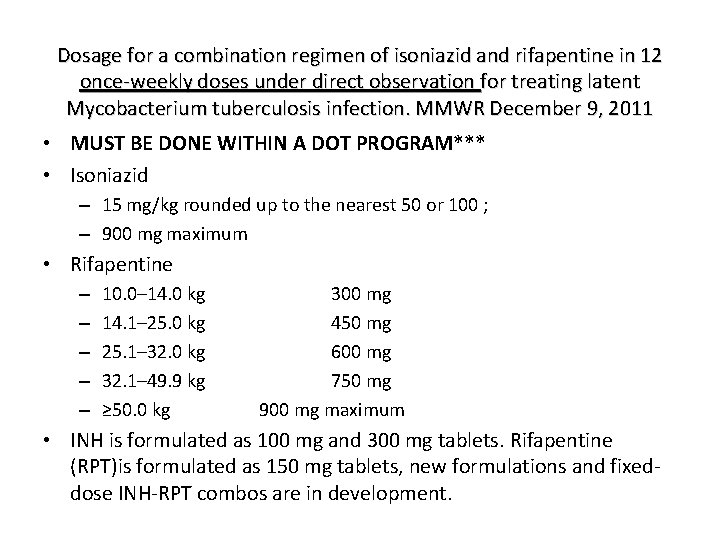
Dosage for a combination regimen of isoniazid and rifapentine in 12 once-weekly doses under direct observation for treating latent Mycobacterium tuberculosis infection. MMWR December 9, 2011 • MUST BE DONE WITHIN A DOT PROGRAM*** • Isoniazid – 15 mg/kg rounded up to the nearest 50 or 100 ; – 900 mg maximum • Rifapentine – – – 10. 0– 14. 0 kg 14. 1– 25. 0 kg 25. 1– 32. 0 kg 32. 1– 49. 9 kg ≥ 50. 0 kg 300 mg 450 mg 600 mg 750 mg 900 mg maximum • INH is formulated as 100 mg and 300 mg tablets. Rifapentine (RPT)is formulated as 150 mg tablets, new formulations and fixeddose INH-RPT combos are in development.
- Slides: 30