
TTPET General Meeting Status report on Cooling blocs
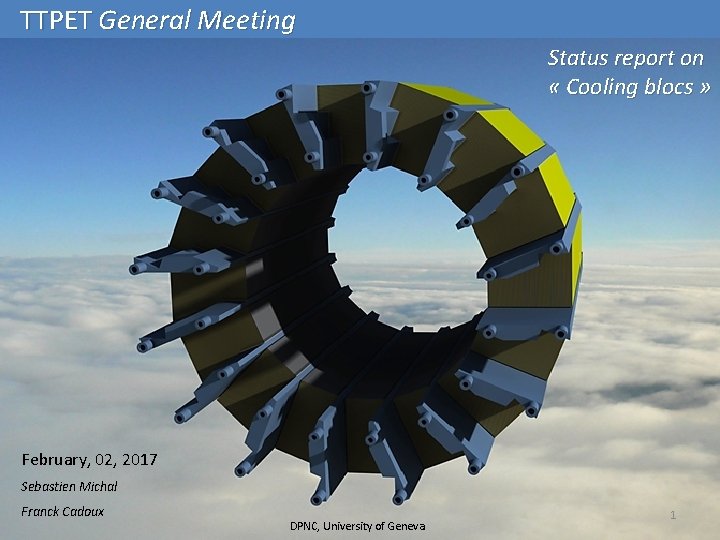
TTPET General Meeting Status report on « Cooling blocs » February, 02, 2017 Sebastien Michal Franck Cadoux DPNC, University of Geneva 1
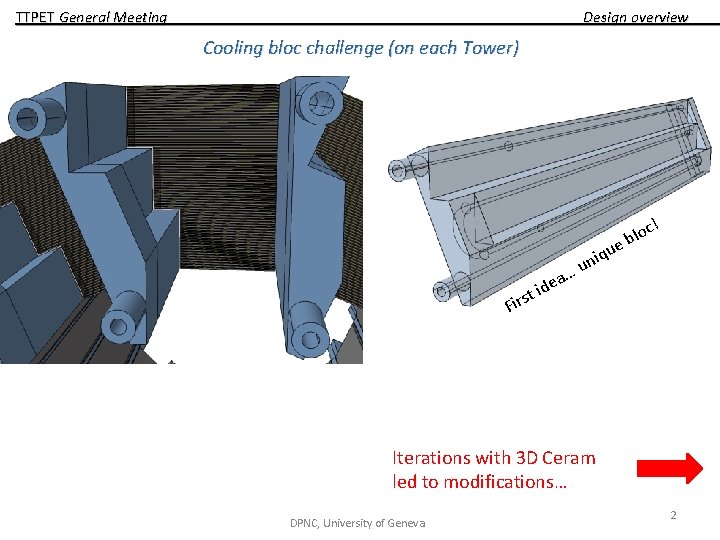
TTPET General Meeting Design overview Cooling bloc challenge (on each Tower) st Fir id ea… e u niq u ! c blo Iterations with 3 D Ceram led to modifications… DPNC, University of Geneva 2
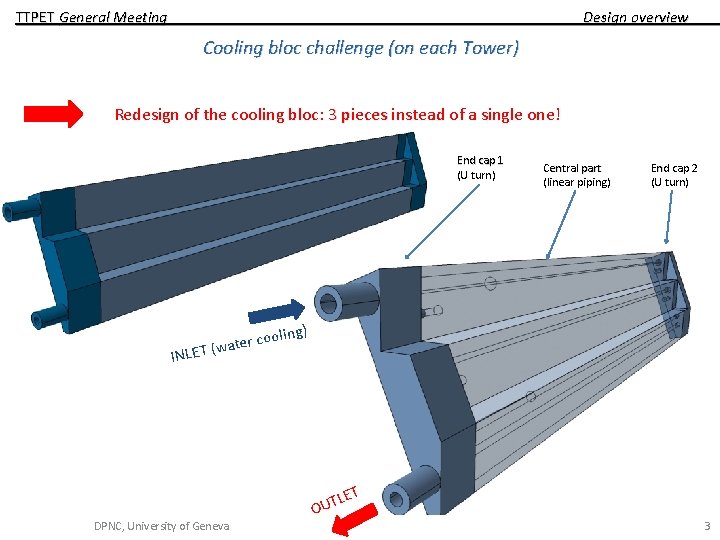
TTPET General Meeting Design overview Cooling bloc challenge (on each Tower) Redesign of the cooling bloc: 3 pieces instead of a single one! End cap 1 (U turn) INL cooli r e t a ET (w Central part (linear piping) End cap 2 (U turn) ng) ET DPNC, University of Geneva TL OU 3
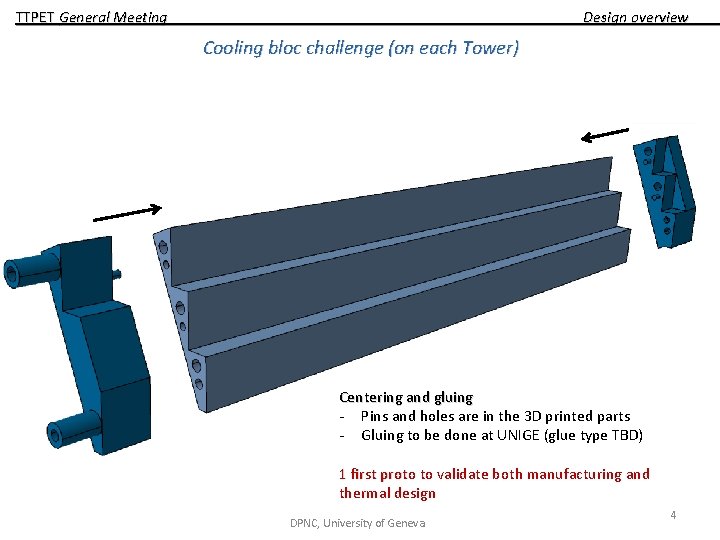
TTPET General Meeting Design overview Cooling bloc challenge (on each Tower) Centering and gluing - Pins and holes are in the 3 D printed parts - Gluing to be done at UNIGE (glue type TBD) 1 first proto to validate both manufacturing and thermal design DPNC, University of Geneva 4
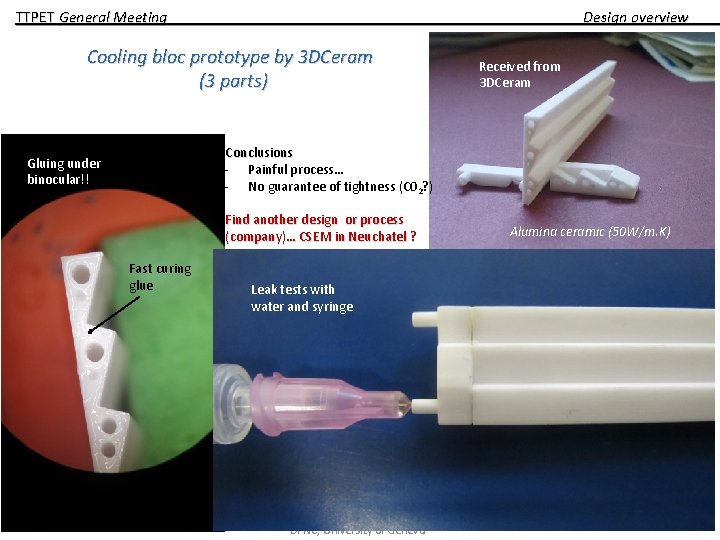
TTPET General Meeting Design overview Cooling bloc prototype by 3 DCeram (3 parts) Received from 3 DCeram Conclusions - Painful process… - No guarantee of tightness (C 02? ) Gluing under binocular!! Find another design or process (company)… CSEM in Neuchatel ? Fast curing glue Alumina ceramic (50 W/m. K) Leak tests with water and syringe DPNC, University of Geneva 5
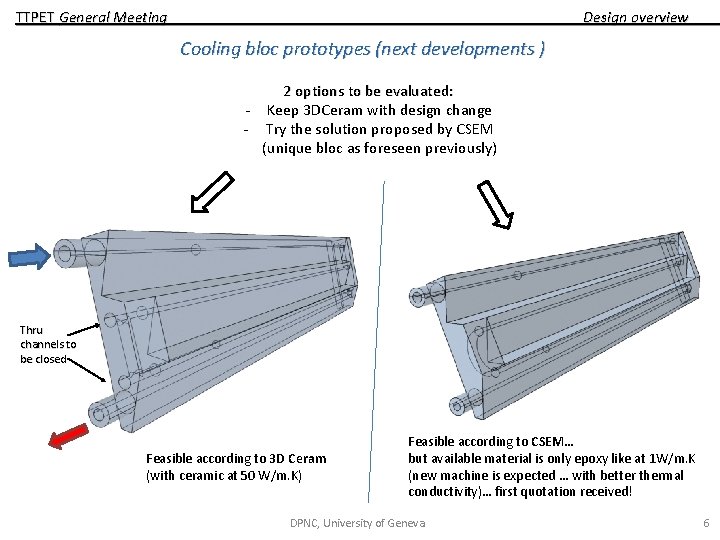
TTPET General Meeting Design overview Cooling bloc prototypes (next developments ) 2 options to be evaluated: - Keep 3 DCeram with design change - Try the solution proposed by CSEM (unique bloc as foreseen previously) Thru channels to be closed Feasible according to 3 D Ceram (with ceramic at 50 W/m. K) Feasible according to CSEM… but available material is only epoxy like at 1 W/m. K (new machine is expected … with better thermal conductivity)… first quotation received! DPNC, University of Geneva 6
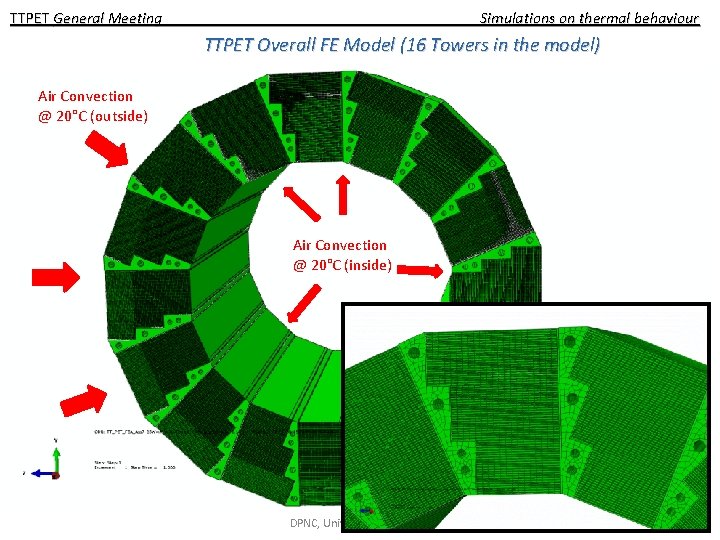
TTPET General Meeting Simulations on thermal behaviour TTPET Overall FE Model (16 Towers in the model) Air Convection @ 20°C (outside) Air Convection @ 20°C (inside) DPNC, University of Geneva 7
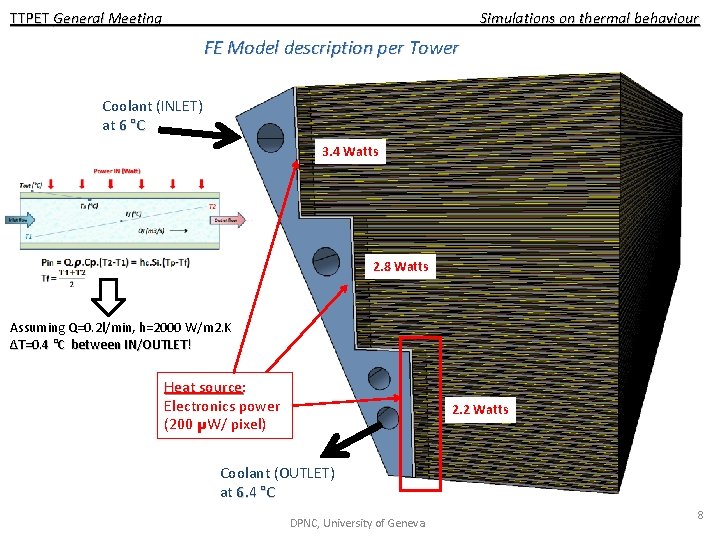
TTPET General Meeting Simulations on thermal behaviour FE Model description per Tower Coolant (INLET) at 6 °C 3. 4 Watts 2. 8 Watts Assuming Q=0. 2 l/min, h=2000 W/m 2. K ∆T=0. 4 °C between IN/OUTLET! Heat source: source Electronics power (200 µW/ pixel) 2. 2 Watts Coolant (OUTLET) at 6. 4 °C DPNC, University of Geneva 8
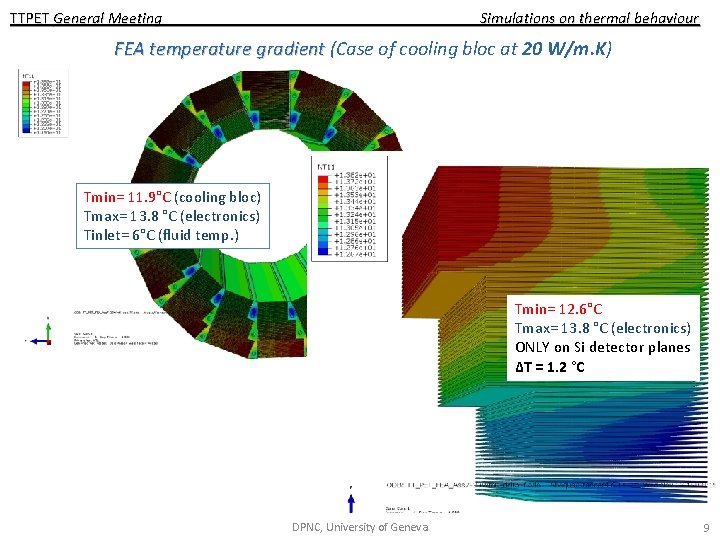
TTPET General Meeting Simulations on thermal behaviour FEA temperature gradient (Case of cooling bloc at 20 W/m. K) FEA temperature gradient Tmin= 11. 9°C (cooling bloc) Tmax= 13. 8 °C (electronics) Tinlet= 6°C (fluid temp. ) Tmin= 12. 6°C Tmax= 13. 8 °C (electronics) ONLY on Si detector planes ∆T = 1. 2 °C DPNC, University of Geneva 9
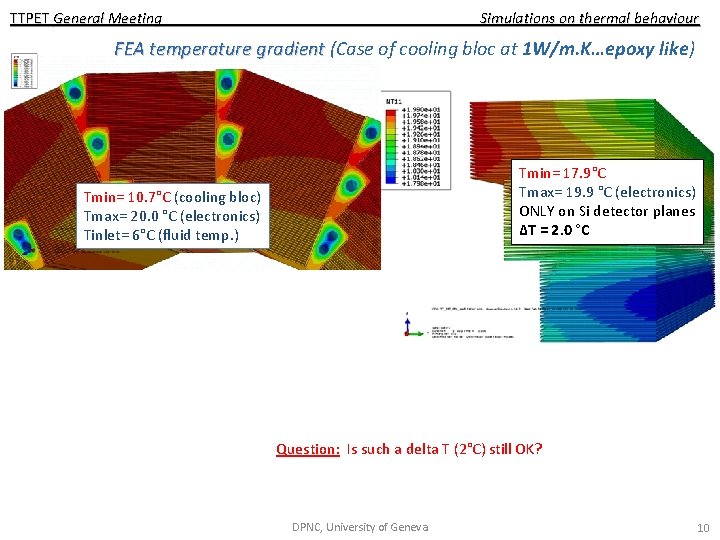
TTPET General Meeting Simulations on thermal behaviour FEA temperature gradient (Case of cooling bloc at 1 W/m. K…epoxy like) FEA temperature gradient Tmin= 17. 9°C Tmax= 19. 9 °C (electronics) ONLY on Si detector planes ∆T = 2. 0 °C Tmin= 10. 7°C (cooling bloc) Tmax= 20. 0 °C (electronics) Tinlet= 6°C (fluid temp. ) Question: Is such a delta T (2°C) still OK? DPNC, University of Geneva 10
TTPET General Meeting Outlooks and milestones for 2017 Within the next 6 months § Keep developing the cooling blocs (only with CSEM? ) § Thermally test the first cooling bloc prototypes with standard chiller (water cooling)… NEED Heaters! Who? By the end of the year… § Design the overall cooling system with pipes, manifolding and fittings § If tower prototype is ready, work on a real thermal tests (no heaters) to get thermal features… § If more heaters (fake towers) ready, try to think of a complete thermal test (open discussion…) DPNC, University of Geneva 11
- Slides: 11