
tt crosssection measurement in the ETjets final state









- Slides: 28
tt cross-section measurement in the ET+jets final state at CDF Giorgio Cortiana University of Padova and INFN Outline: Introduction, motivation, main tools Dataset and trigger Kin. sel. & background prediction Preliminary results Conclusions and plans 7 th RTN Workshop, Prague 8 -10 Feb 2006 Giorgio Cortiana - 1
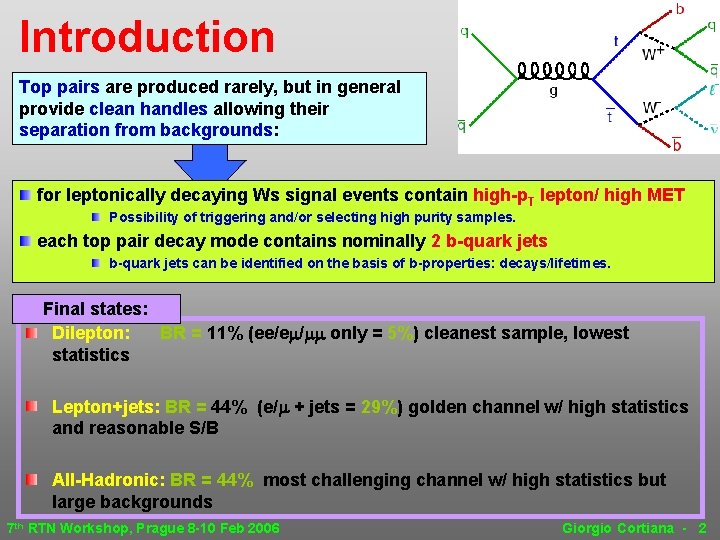
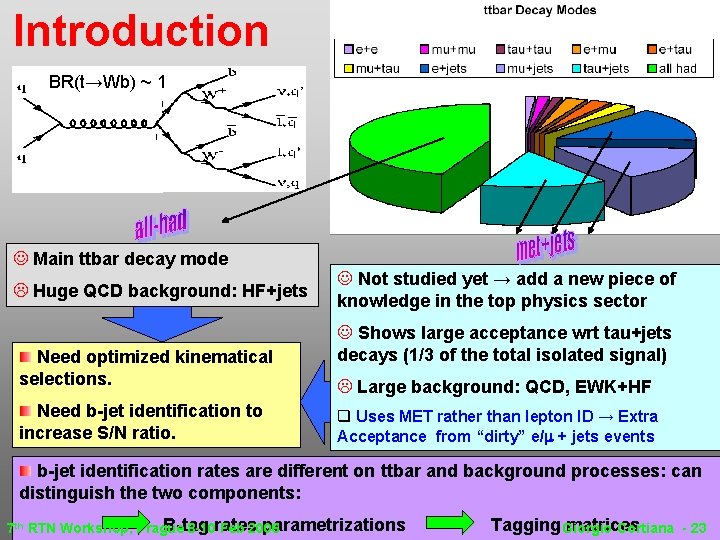
Introduction Top pairs are produced rarely, but in general provide clean handles allowing their separation from backgrounds: for leptonically decaying Ws signal events contain high-p. T lepton/ high MET Possibility of triggering and/or selecting high purity samples. each top pair decay mode contains nominally 2 b-quark jets can be identified on the basis of b-properties: decays/lifetimes. Final states: Dilepton: BR = 11% (ee/em/mm only = 5%) cleanest sample, lowest statistics Lepton+jets: BR = 44% (e/m + jets = 29%) golden channel w/ high statistics and reasonable S/B All-Hadronic: BR = 44% most challenging channel w/ high statistics but large backgrounds 7 th RTN Workshop, Prague 8 -10 Feb 2006 Giorgio Cortiana - 2
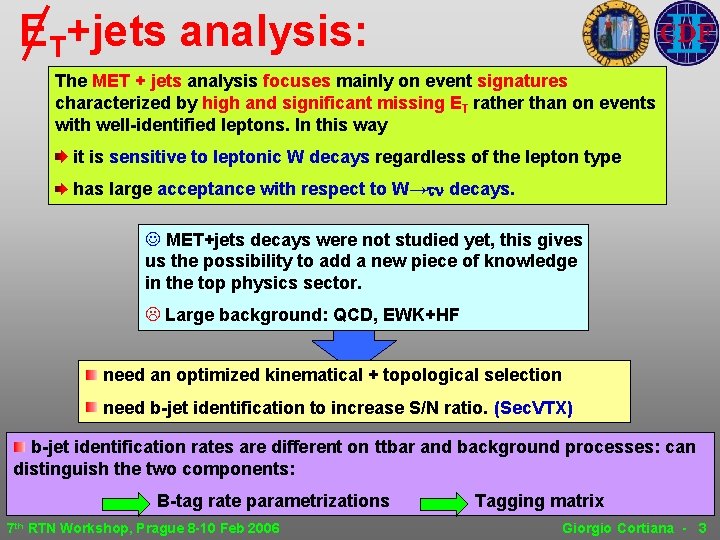
ET+jets analysis: The MET + jets analysis focuses mainly on event signatures characterized by high and significant missing ET rather than on events with well-identified leptons. In this way it is sensitive to leptonic W decays regardless of the lepton type has large acceptance with respect to W→tn decays. MET+jets decays were not studied yet, this gives us the possibility to add a new piece of knowledge in the top physics sector. Large background: QCD, EWK+HF need an optimized kinematical + topological selection need b-jet identification to increase S/N ratio. (Sec. VTX) b-jet identification rates are different on ttbar and background processes: can distinguish the two components: B-tag rate parametrizations 7 th RTN Workshop, Prague 8 -10 Feb 2006 Tagging matrix Giorgio Cortiana - 3
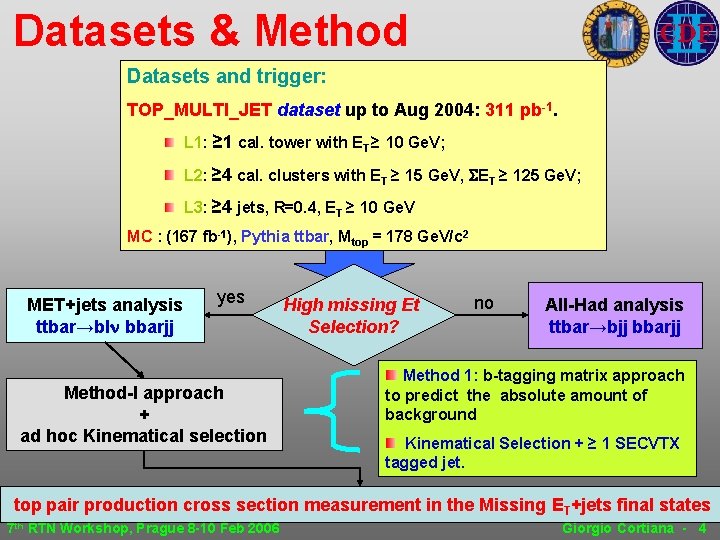
Datasets & Method Datasets and trigger: TOP_MULTI_JET dataset up to Aug 2004: 311 pb-1. L 1: ≥ 1 cal. tower with ET ≥ 10 Ge. V; L 2: ≥ 4 cal. clusters with ET ≥ 15 Ge. V, SET ≥ 125 Ge. V; L 3: ≥ 4 jets, R=0. 4, ET ≥ 10 Ge. V MC : (167 fb-1), Pythia ttbar, Mtop = 178 Ge. V/c 2 MET+jets analysis ttbar→bln bbarjj yes Method-I approach + ad hoc Kinematical selection High missing Et Selection? no All-Had analysis ttbar→bjj bbarjj Method 1: b-tagging matrix approach to predict the absolute amount of background Kinematical Selection + ≥ 1 SECVTX tagged jet. top pair production cross section measurement in the Missing ET+jets final states 7 th RTN Workshop, Prague 8 -10 Feb 2006 Giorgio Cortiana - 4
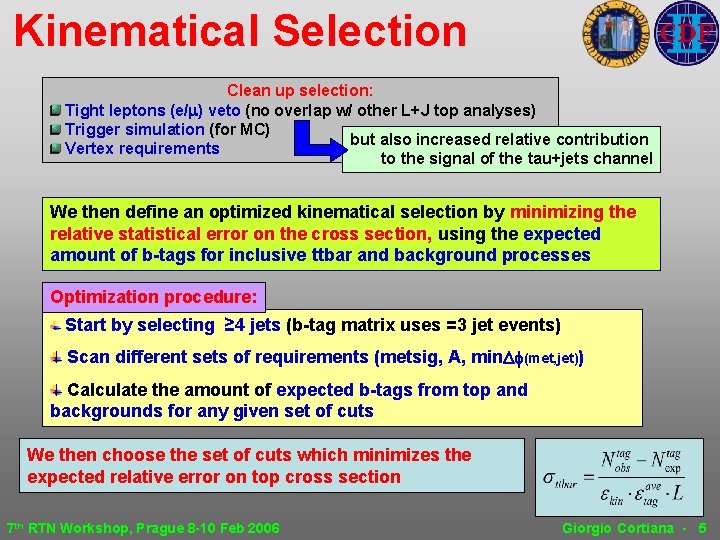
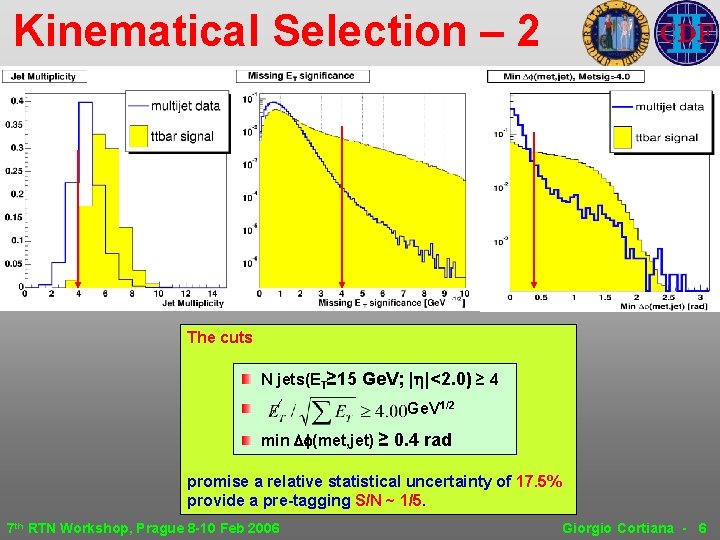
Kinematical Selection Clean up selection: Tight leptons (e/m) veto (no overlap w/ other L+J top analyses) Trigger simulation (for MC) but also increased relative contribution Vertex requirements to the signal of the tau+jets channel We then define an optimized kinematical selection by minimizing the relative statistical error on the cross section, using the expected amount of b-tags for inclusive ttbar and background processes Optimization procedure: Start by selecting ≥ 4 jets (b-tag matrix uses =3 jet events) Scan different sets of requirements (metsig, A, min. Df(met, jet)) Calculate the amount of expected b-tags from top and backgrounds for any given set of cuts We then choose the set of cuts which minimizes the expected relative error on top cross section 7 th RTN Workshop, Prague 8 -10 Feb 2006 Giorgio Cortiana - 5
Kinematical Selection – 2 The cuts N jets(ET≥ 15 Ge. V; |h|<2. 0) ≥ 4 Ge. V 1/2 min Df(met, jet) ≥ 0. 4 rad promise a relative statistical uncertainty of 17. 5% provide a pre-tagging S/N ~ 1/5. 7 th RTN Workshop, Prague 8 -10 Feb 2006 Giorgio Cortiana - 6
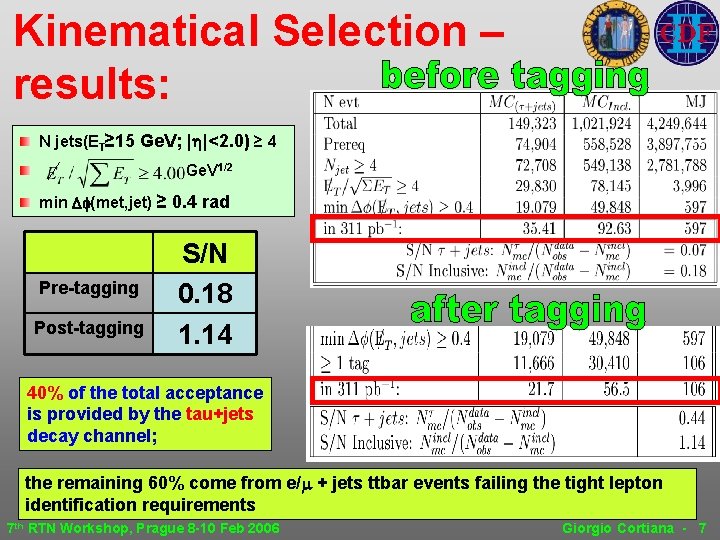
Kinematical Selection – results: N jets(ET≥ 15 Ge. V; |h|<2. 0) ≥ 4 Ge. V 1/2 min Df(met, jet) ≥ 0. 4 rad Pre-tagging Post-tagging S/N 0. 18 1. 14 40% of the total acceptance is provided by the tau+jets decay channel; the remaining 60% come from e/m + jets ttbar events failing the tight lepton identification requirements 7 th RTN Workshop, Prague 8 -10 Feb 2006 Giorgio Cortiana - 7
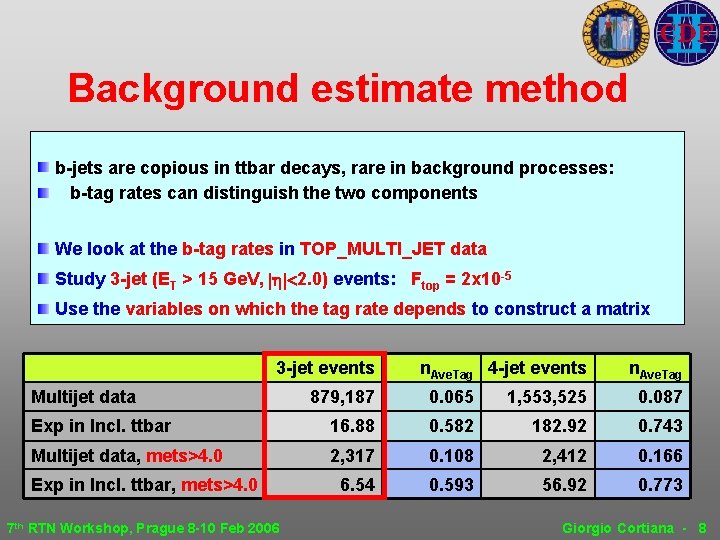
Background estimate method b-jets are copious in ttbar decays, rare in background processes: b-tag rates can distinguish the two components We look at the b-tag rates in TOP_MULTI_JET data Study 3 -jet (ET > 15 Ge. V, |h|<2. 0) events: Ftop = 2 x 10 -5 Use the variables on which the tag rate depends to construct a matrix 3 -jet events Multijet data n. Ave. Tag 4 -jet events n. Ave. Tag 879, 187 0. 065 1, 553, 525 0. 087 Exp in Incl. ttbar 16. 88 0. 582 182. 92 0. 743 Multijet data, mets>4. 0 2, 317 0. 108 2, 412 0. 166 6. 54 0. 593 56. 92 0. 773 Exp in Incl. ttbar, mets>4. 0 7 th RTN Workshop, Prague 8 -10 Feb 2006 Giorgio Cortiana - 8
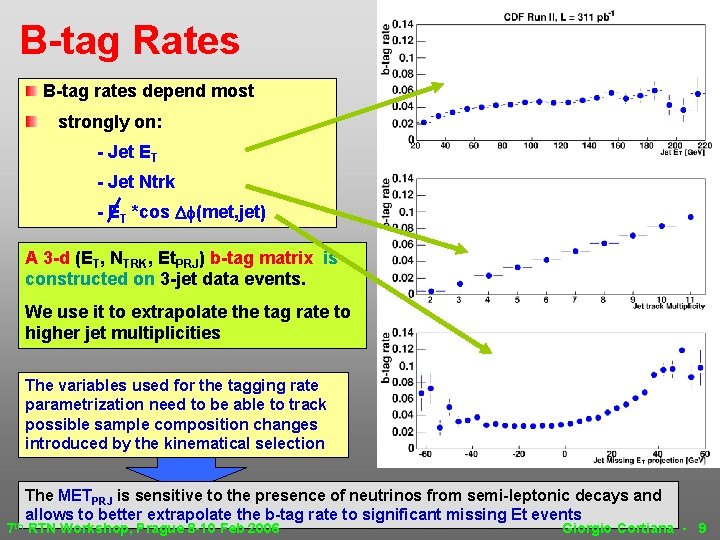
B-tag Rates B-tag rates depend most strongly on: - Jet ET - Jet Ntrk - ET *cos Df(met, jet) A 3 -d (ET, NTRK, Et. PRJ) b-tag matrix is constructed on 3 -jet data events. We use it to extrapolate the tag rate to higher jet multiplicities The variables used for the tagging rate parametrization need to be able to track possible sample composition changes introduced by the kinematical selection The METPRJ is sensitive to the presence of neutrinos from semi-leptonic decays and allows to better extrapolate the b-tag rate to significant missing Et events 7 th RTN Workshop, Prague 8 -10 Feb 2006 Giorgio Cortiana - 9
Background estimate – METPRJ The analysis has to cope with a background that aside QCD events contains EWK+HF processes too, the latter being selected by the missing energy requirement. JET MET Df MET The tagging matrix parametrization needs to be able to account for both these background processes. Df JET MET *cos Df(MET, jet): has a consistent correlation with the heavy flavor component of the sample and allows to distinguish MET origins in relation to geometrical properties: Instrumental MET due to energy mis-measurements is generally oriented along jets. Physics produced MET can be correlated or uncorrelated with jet direction: b-quarks semileptonic decays produce missing ET along the jet. W→ln + jets processes yield missing ET uncorrelated with jet directions. 7 th RTN Workshop, Prague 8 -10 Feb 2006 Giorgio Cortiana - 10
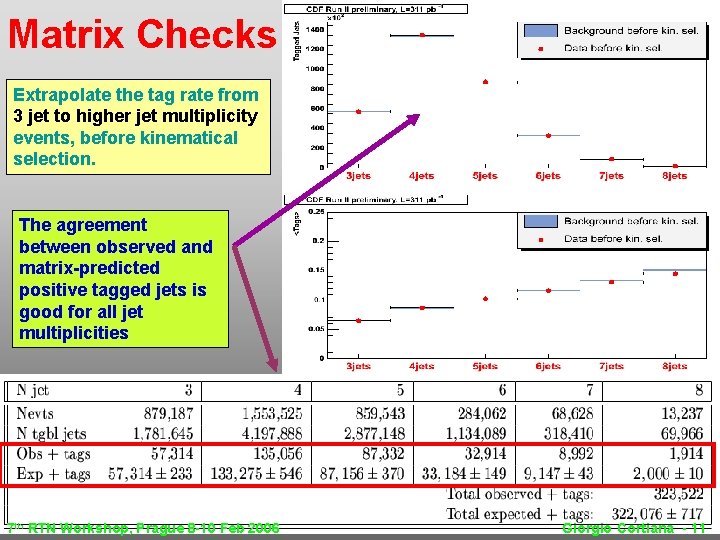
Matrix Checks Extrapolate the tag rate from 3 jet to higher jet multiplicity events, before kinematical selection. The agreement between observed and matrix-predicted positive tagged jets is good for all jet multiplicities 7 th RTN Workshop, Prague 8 -10 Feb 2006 Giorgio Cortiana - 11
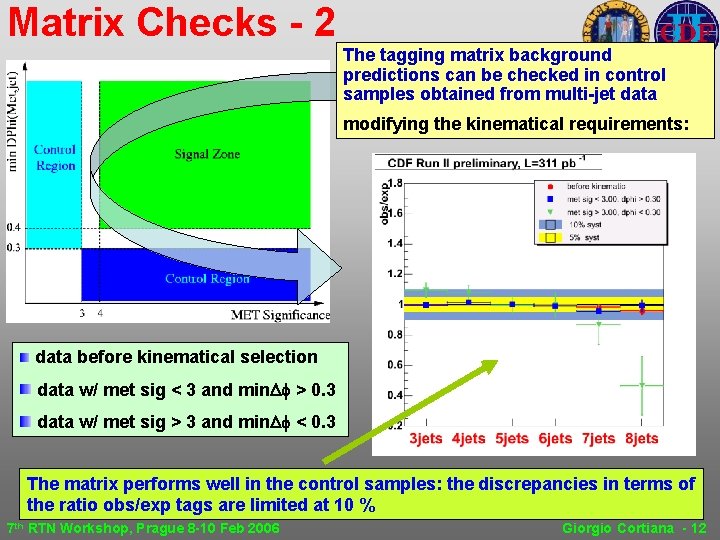
Matrix Checks - 2 The tagging matrix background predictions can be checked in control samples obtained from multi-jet data modifying the kinematical requirements: data before kinematical selection data w/ met sig < 3 and min. Df > 0. 3 data w/ met sig > 3 and min. Df < 0. 3 The matrix performs well in the control samples: the discrepancies in terms of the ratio obs/exp tags are limited at 10 % 7 th RTN Workshop, Prague 8 -10 Feb 2006 Giorgio Cortiana - 12
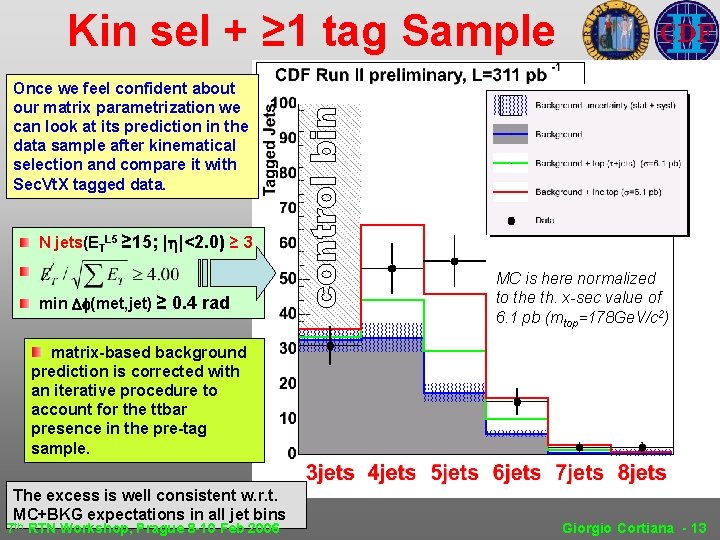
Kin sel + ≥ 1 tag Sample Once we feel confident about our matrix parametrization we can look at its prediction in the data sample after kinematical selection and compare it with Sec. Vt. X tagged data. N jets(ETL 5 ≥ 15; |h|<2. 0) ≥ 3 min Df(met, jet) ≥ 0. 4 rad MC is here normalized to the th. x-sec value of 6. 1 pb (mtop=178 Ge. V/c 2) matrix-based background prediction is corrected with an iterative procedure to account for the ttbar presence in the pre-tag sample. The excess is well consistent w. r. t. MC+BKG expectations in all jet bins 7 th RTN Workshop, Prague 8 -10 Feb 2006 Giorgio Cortiana - 13
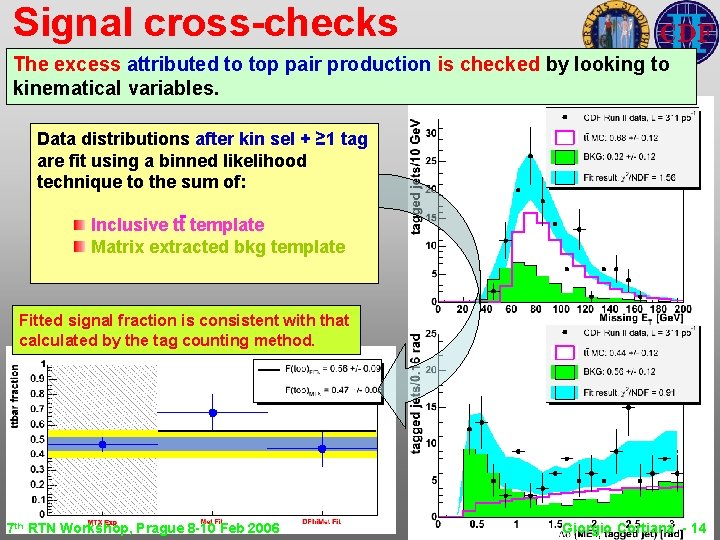
Signal cross-checks The excess attributed to top pair production is checked by looking to kinematical variables. Data distributions after kin sel + ≥ 1 tag are fit using a binned likelihood technique to the sum of: Inclusive tt template Matrix extracted bkg template Fitted signal fraction is consistent with that calculated by the tag counting method. 7 th RTN Workshop, Prague 8 -10 Feb 2006 Giorgio Cortiana - 14
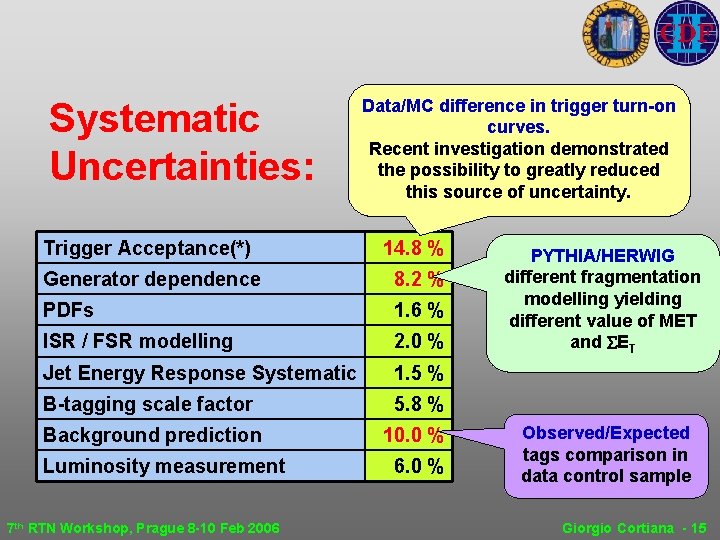
Systematic Uncertainties: Data/MC difference in trigger turn-on curves. Recent investigation demonstrated the possibility to greatly reduced this source of uncertainty. Trigger Acceptance(*) 14. 8 % Generator dependence 8. 2 % PDFs 1. 6 % ISR / FSR modelling 2. 0 % Jet Energy Response Systematic 1. 5 % B-tagging scale factor 5. 8 % Background prediction 10. 0 % Luminosity measurement 7 th RTN Workshop, Prague 8 -10 Feb 2006 6. 0 % PYTHIA/HERWIG different fragmentation modelling yielding different value of MET and SET Observed/Expected tags comparison in data control sample Giorgio Cortiana - 15
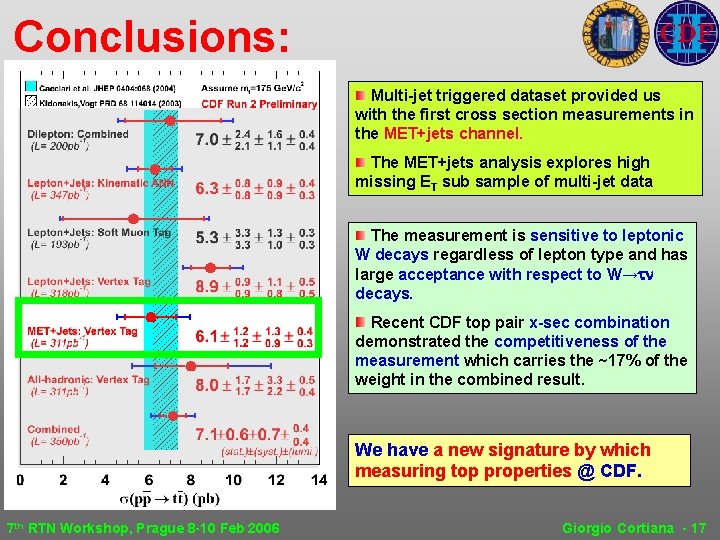
Cross section measurement A likelihood maximization is used to compute the top production cross section sttbar = 5. 9 ± 1. 2 (stat) +1. 4 (syst) pb - 1. 0 +1. 8 = 5. 9 - 1. 6 pb. 7 th RTN Workshop, Prague 8 -10 Feb 2006 Giorgio Cortiana - 16
Conclusions: Multi-jet triggered dataset provided us with the first cross section measurements in the MET+jets channel. The MET+jets analysis explores high missing ET sub sample of multi-jet data The measurement is sensitive to leptonic W decays regardless of lepton type and has large acceptance with respect to W→tn decays. Recent CDF top pair x-sec combination demonstrated the competitiveness of the measurement which carries the ~17% of the weight in the combined result. We have a new signature by which measuring top properties @ CDF. 7 th RTN Workshop, Prague 8 -10 Feb 2006 Giorgio Cortiana - 17
Missing energy to hit the top CDF has discovered a lost jewel in a new analysis which finds events with top quarks that would have otherwise never been unearthed. […] Fermilab Result of the Week Dec 22 nd, 2005 http: //www. fnal. gov/pub/today/archive_2005/today 05 -12 -22. html . . . what is next? The signal comes in with different decay modes, e/m/t + jets. It will be a interesting game try to separate them, in particular to distinguish taus from the other lepton categories. We already have the recipe/instruments to set up the standard tau-id but the efficiency is too low within the sample statistics. The main idea is that we just need to tag one of the jets to be different from the other (for e/t) and look for isolated muon track. A combined likelihood will maybe help Work is in progress in order to setup a Top Mass measurement method in this sample, w/ or w/o loose lepton identification (using for instance HT or other event variables sensible to mtop or information about the hadronic triplet). Lot of work is ahead, but things appear promising 7 th RTN Workshop, Prague 8 -10 Feb 2006 Giorgio Cortiana - 18
The End 7 th RTN Workshop, Prague 8 -10 Feb 2006 Giorgio Cortiana - 19
Backup Slides 7 th RTN Workshop, Prague 8 -10 Feb 2006 Giorgio Cortiana - 20
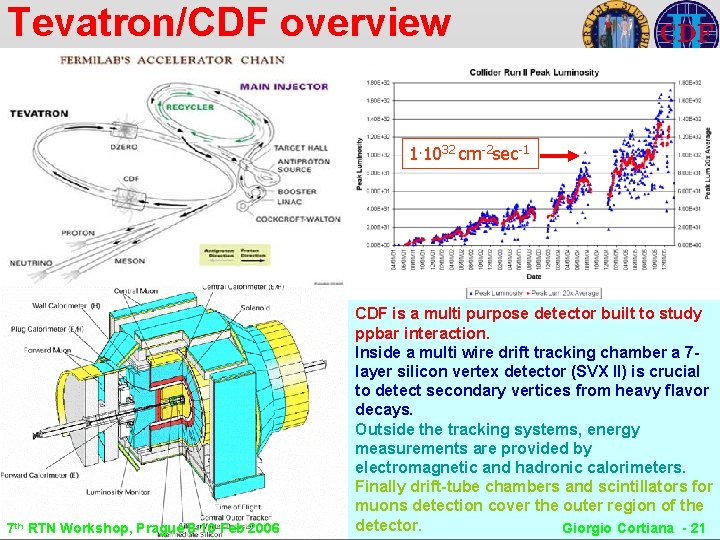
Tevatron/CDF overview 1. 1032 cm-2 sec-1 7 th RTN Workshop, Prague 8 -10 Feb 2006 CDF is a multi purpose detector built to study ppbar interaction. Inside a multi wire drift tracking chamber a 7 layer silicon vertex detector (SVX II) is crucial to detect secondary vertices from heavy flavor decays. Outside the tracking systems, energy measurements are provided by electromagnetic and hadronic calorimeters. Finally drift-tube chambers and scintillators for muons detection cover the outer region of the detector. Giorgio Cortiana - 21
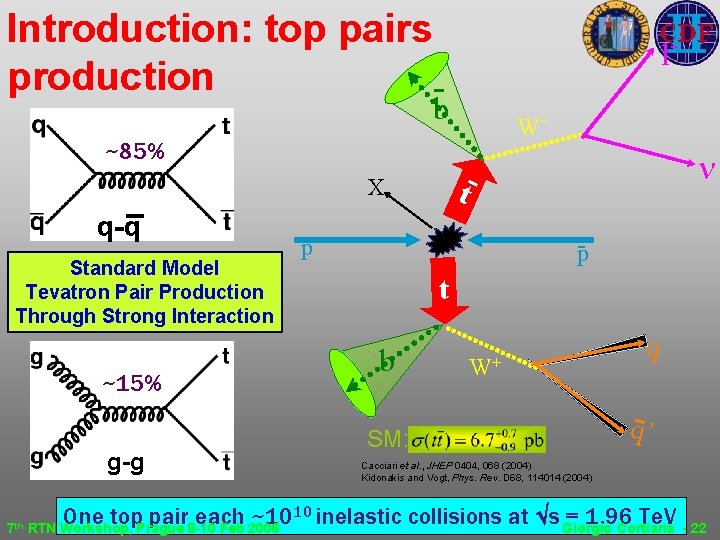
Introduction: top pairs production - l- b ~85% Standard Model Tevatron Pair Production Through Strong Interaction ~15% g-g 7 th n -t X q-q W- -p p t b W+ SM: q q-’ Cacciari et al. , JHEP 0404, 068 (2004) Kidonakis and Vogt, Phys. Rev. D 68, 114014 (2004) 10 inelastic collisions at s = 1. 96 Te. V One top pair each ~10 RTN Workshop, Prague 8 -10 Feb 2006 Giorgio Cortiana - 22
Introduction BR(t→Wb) ~ 1 Main ttbar decay mode Huge QCD background: HF+jets Need optimized kinematical selections. Need b-jet identification to increase S/N ratio. Not studied yet → add a new piece of knowledge in the top physics sector Shows large acceptance wrt tau+jets decays (1/3 of the total isolated signal) Large background: QCD, EWK+HF q Uses MET rather than lepton ID → Extra Acceptance from “dirty” e/m + jets events b-jet identification rates are different on ttbar and background processes: can distinguish the two components: B-tag parametrizations 7 th RTN Workshop, Prague 8 -10 rates Feb 2006 Tagging Giorgio matrices Cortiana - 23
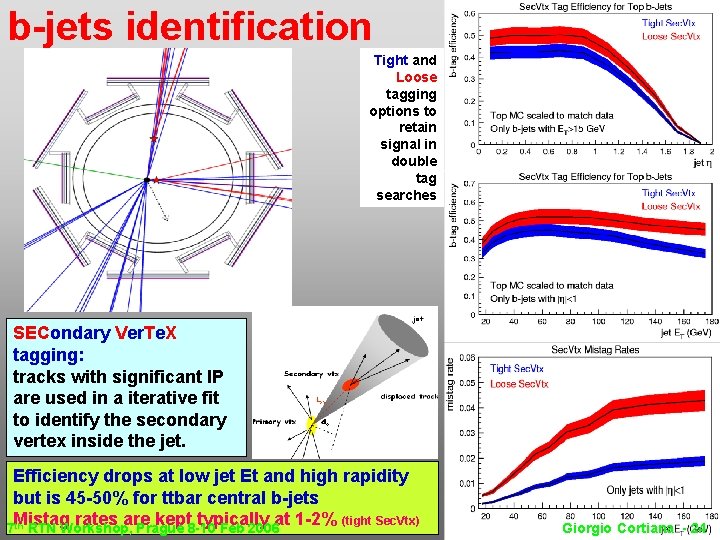
b-jets identification Tight and Loose tagging options to retain signal in double tag searches SECondary Ver. Te. X tagging: tracks with significant IP are used in a iterative fit to identify the secondary vertex inside the jet. Efficiency drops at low jet Et and high rapidity but is 45 -50% for ttbar central b-jets Mistag rates are kept typically at 1 -2% (tight Sec. Vtx) 7 th RTN Workshop, Prague 8 -10 Feb 2006 Giorgio Cortiana - 24
Background estimate – METPRJ Missing ET projection for inclusive ttbar and data 3 -jet events JET MET Df MET *cos Df(MET, jet): has a consistent correlation with heavy flavor component of the sample and allows to distinguish the origin of MET in relation to geometrical properties Instrumental MET due to energy mismeasurements is generally oriented along jets Physics-produced MET can be correlated or uncorrelated with jet direction: b-quarks semileptonic decays produce missing ET along the jet. + jets processes yield missing ET pointing away from jets. Cortiana - 25 7 th RTN Workshop, W→ln Prague 8 -10 Feb 2006 Giorgio
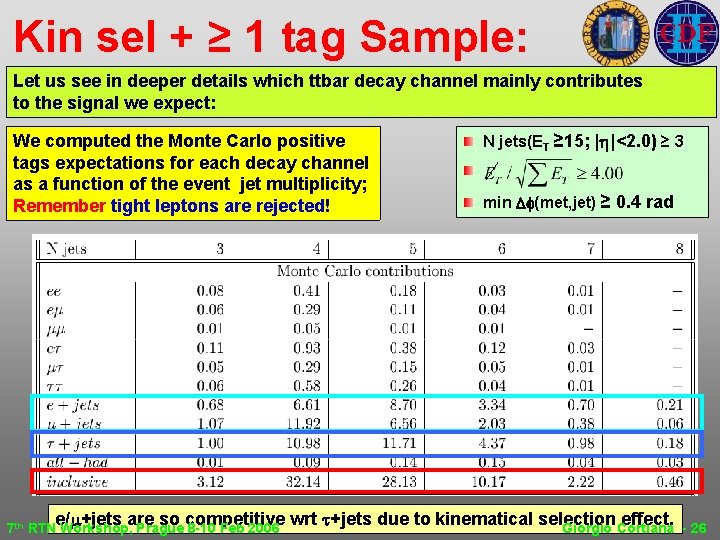
Kin sel + ≥ 1 tag Sample: Let us see in deeper details which ttbar decay channel mainly contributes to the signal we expect: We computed the Monte Carlo positive tags expectations for each decay channel as a function of the event jet multiplicity; Remember tight leptons are rejected! N jets(ET ≥ 15; |h|<2. 0) ≥ 3 min Df(met, jet) ≥ 0. 4 rad e/m+jets are so competitive wrt t+jets due to kinematical selection effect. Giorgio Cortiana 7 th RTN Workshop, Prague 8 -10 Feb 2006 - 26
Pre-tag iterative top subtraction The final sample kin sel + ≥ 1 tag consists of 106 events for a total of Nobs = 127 positive tagged jets. From tagging matrix prediction we expect Nexp = 67. 4 ± 7. 2 tags We need to correct the tagging matrix prediction in order to account for the ttbar presence in the pre-tagging sample by using an iterative method: The procedure stops when |Nexp’ –Nexp| < 1%. 10. 0 tags out of 67. 4 are attributed in this way to the ttbar presence in the pre-tagging sample. Nexp’ = 57. 4 ± 8. 1 is the corrected background amount to be used for a cross section measurement. 7 th RTN Workshop, Prague 8 -10 Feb 2006 Giorgio Cortiana - 27
Cross section vs Top Mass The Top mass used to generate our base Monte Carlo sample was set to 178 Ge. V/c 2. We used different other MC signal sample to evaluate the kinematical selection and cross section dependence on MTOP 7 th RTN Workshop, Prague 8 -10 Feb 2006 Giorgio Cortiana - 28