
TSS 2020 ONLINE Legal Translation a terminological challenge











- Slides: 53
TSS 2020 ONLINE
Legal Translation: a terminological challenge Frieda Steurs KU Leuven and INT, Leiden
Legal translation Law , language and translation 3 the nature of the concepts intralinguistic fuzziness and ambiguities interlinguistic non-equivalence or semi-equivalence Legal translation = a special and specialized area of translational activity Legal terminology = a fuzzy set Legal Translation = a challenge TSS 2020 ONLINE
Problems of Translating Legal Terminology 4 System-specificity inherent in legal language Any given language can have as many legal languages as there are systems (countries) using that language as a legal language Legal French: France, Belgium, Switserland, Canada, Morocco, Senegal, … One legal language must be translated into another legal language Gerard-René de Groot and Conrad J. P. van Laer (2008) TSS 2020 ONLINE
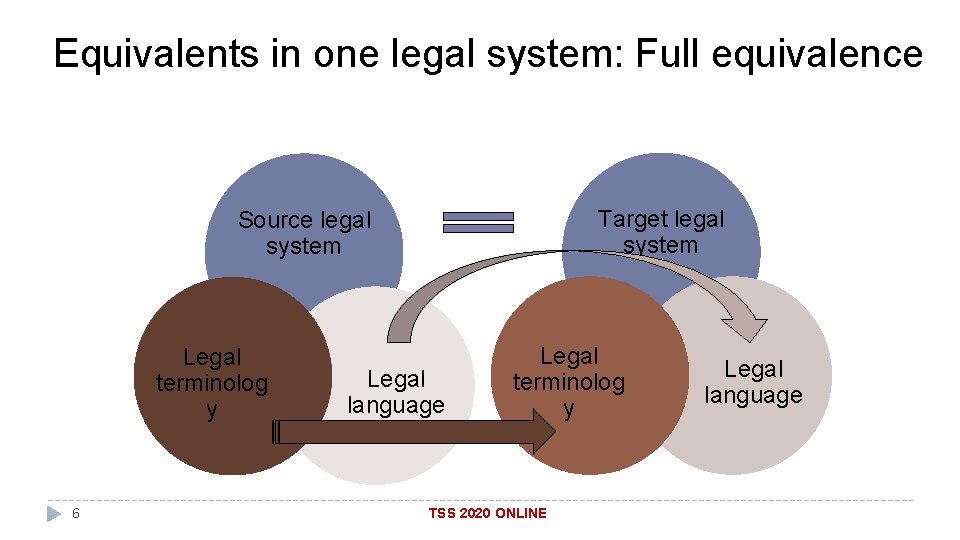
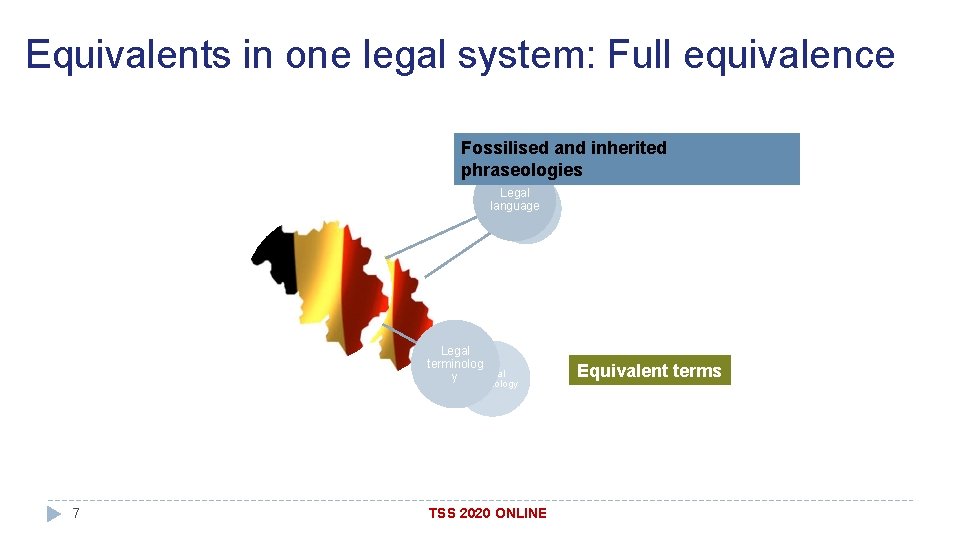
Equivalents in one legal system: Full equivalence Through comparative law, the translator of legal terminology needs to find an equivalent in the target language legal system for the term of the source language legal system Because of this multidimensional system-specificity of legal terms full equivalence only occurs where the source language and the target language relate to the same legal system/level of jurisdiction This is the case when translating within one identical multilingual legal system: Belgium, Finland, Switzerland, and Canada 5 TSS 2020 ONLINE
Equivalents in one legal system: Full equivalence Target legal system Source legal system Legal terminolog y 6 Legal language Legal terminolog y TSS 2020 ONLINE Legal language
Equivalents in one legal system: Full equivalence Fossilised and inherited phraseologies Legal language Legal terminolog Legal y terminology 7 TSS 2020 ONLINE Equivalent terms
Equivalents in one legal system: Partial equivalence 8 Where the source and target language relate to different national legal systems, some equivalence may exist: a) Partial unification/harmonisation of legal areas in the legal systems related to the source language and the target language (transposition of EU Directives) b) A concept of one legal system has been adopted by another one and still functions in that system in the same way (Indonesia/the Netherlands; Turkey/Switzerland; Japan/Germany; Taiwan/Germany) TSS 2020 ONLINE
Equivalents in one legal system: Partial equivalence Terms relating to different legal systems are seen by translators as equivalents. However, this may lead to mistakes. Example : the term marriage. The act of marriage usually creates normative or legal obligations between the individuals involved, and any offspring they may produce. In terms of legal recognition, most sovereign states and other jurisdictions limit marriage to opposite-sex couples and a diminishing number of these permit polygamy, child marriages and forced marriages. Over the twentieth century, a growing number of countries and other jurisdictions have lifted bans on and have established legal recognition for interracial marriage, interfaith marriage, and most recently, same-sex marriage. 9 TSS 2020 ONLINE
Moroccan Law vs. Belgian Law Moroccan law is largely influenced by French law (Code. Napoleon) , but also carries elements of Sharia law and African law. Translation of legal documents related to family law for Moroccan migrants in Belgium or France is anything but easy, because of the non-match between different conceptual systems. Morocan migrants always keep the Moroccon nationality, even if they also obtain a second nationality 10 TSS 2020 ONLINE
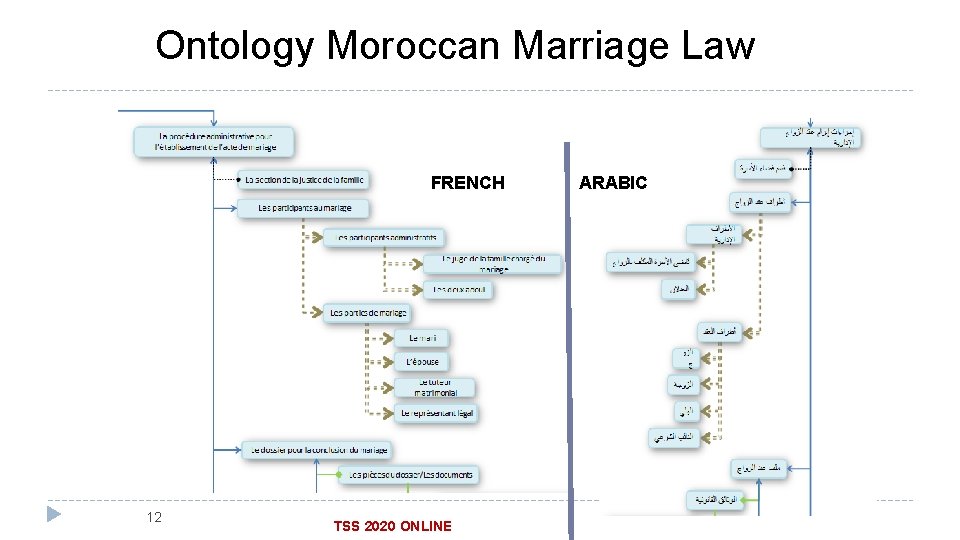
Moroccan Law vs. Belgian Law Concept System Construction: a Step toward better legal Communication (Lahoussine Idyouss, Ph. D, KU Leuven, 2016) Analysis of documents relating to marital law in : - Morocco (Arabic version/ French version) - France (French) - Belgium (French) The concepts are defined properly, and a concept modellling structure is used to represent the different related topic using tree diagrams (i-term) 11 TSS 2020 ONLINE
Ontology Moroccan Marriage Law FRENCH 12 TSS 2020 ONLINE ARABIC
Ontology Moroccan Marriage Law NAPOLEONTIC INFLUENCE SHARIAH INFLUENCE 13 TSS 2020 ONLINE
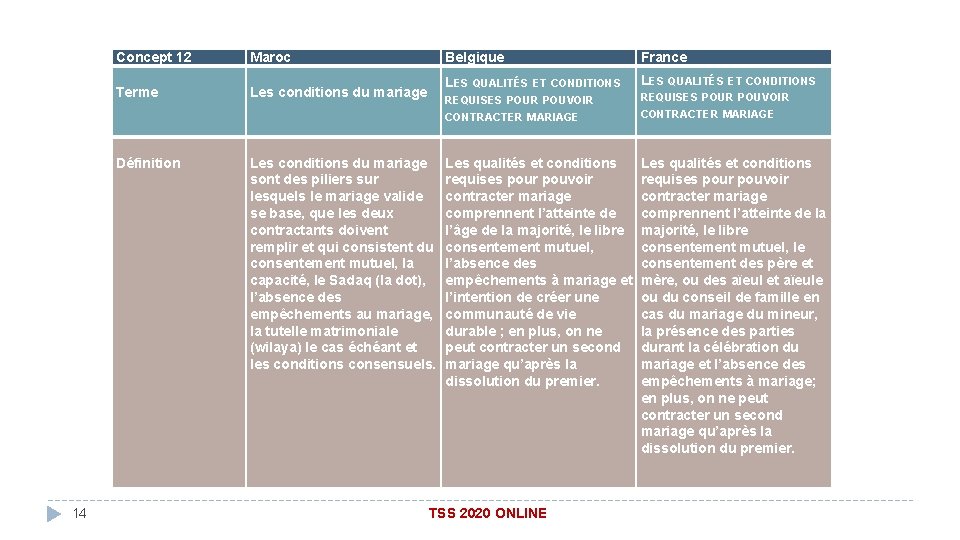
Concept 12 Maroc Belgique France 14 LES QUALITÉS ET CONDITIONS REQUISES POUR POUVOIR CONTRACTER MARIAGE Terme Les conditions du mariage Définition Les conditions du mariage sont des piliers sur lesquels le mariage valide se base, que les deux contractants doivent remplir et qui consistent du consentement mutuel, la capacité, le Sadaq (la dot), l’absence des empêchements au mariage, la tutelle matrimoniale (wilaya) le cas échéant et les conditions consensuels. LES QUALITÉS ET CONDITIONS REQUISES POUR POUVOIR CONTRACTER MARIAGE Les qualités et conditions requises pour pouvoir contracter mariage comprennent l’atteinte de la l’âge de la majorité, le libre consentement mutuel, le l’absence des consentement des père et empêchements à mariage et mère, ou des aïeul et aïeule l’intention de créer une ou du conseil de famille en communauté de vie cas du mariage du mineur, durable ; en plus, on ne la présence des parties peut contracter un second durant la célébration du mariage qu’après la mariage et l’absence des dissolution du premier. empêchements à mariage; en plus, on ne peut contracter un second mariage qu’après la dissolution du premier. TSS 2020 ONLINE
Multilingual challenges Monolingual countries Multilingual countries Need to compare legal documents on international level Internal translation within the own legal system (authentication) EU-legislation Implementation in memberstates International law External translation for the international level 15 TSS 2020 ONLINE
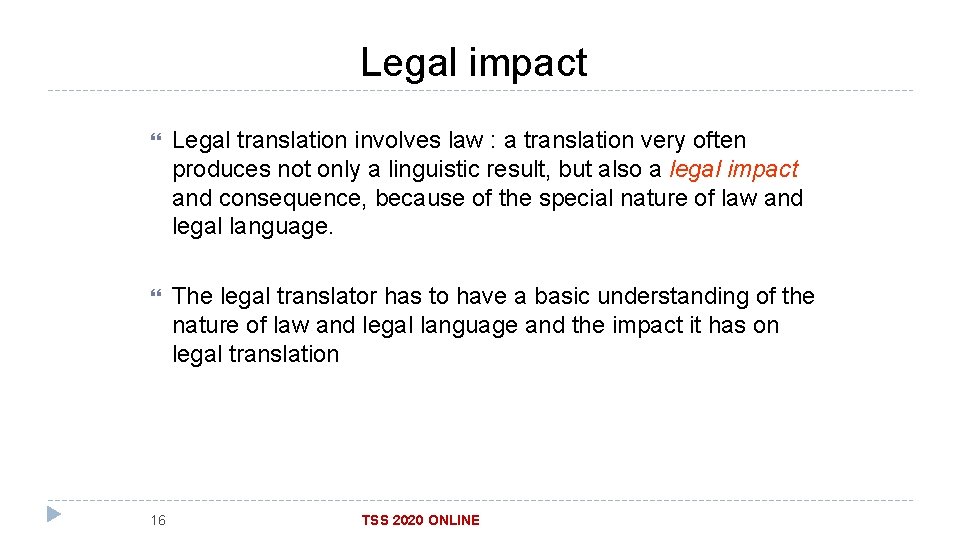
Legal impact Legal translation involves law : a translation very often produces not only a linguistic result, but also a legal impact and consequence, because of the special nature of law and legal language. The legal translator has to have a basic understanding of the nature of law and legal language and the impact it has on legal translation 16 TSS 2020 ONLINE
LSP vs LGP General language (LGP) Vocabulary = ambiguous Specialised, professional language (LSP) Terminology, domainoriented Non-ambiguous The legal domain is not that clearly defined ; fuzziness ; conceptual problems ; phraseology 17 TSS 2020 ONLINE LGP LSP idiomatic phrases
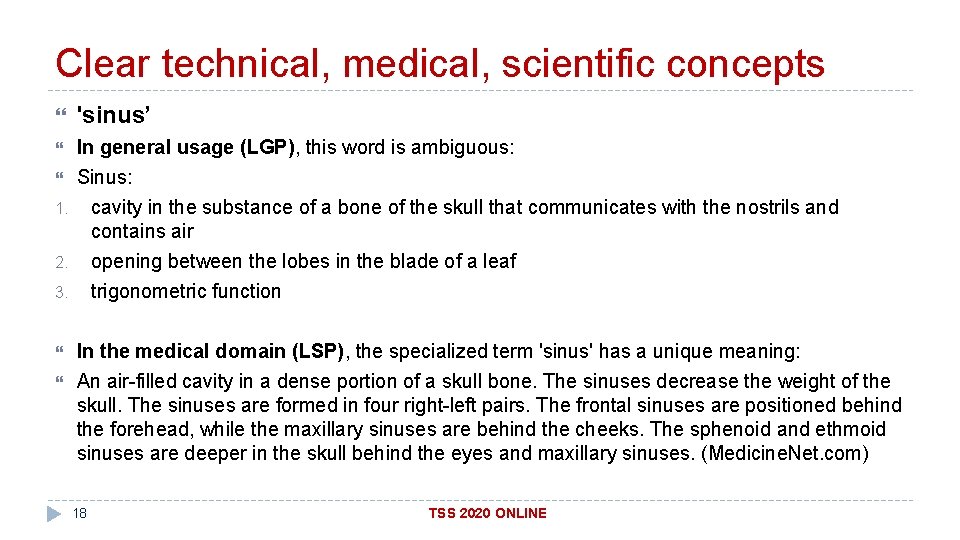
Clear technical, medical, scientific concepts 'sinus’ In general usage (LGP), this word is ambiguous: Sinus: cavity in the substance of a bone of the skull that communicates with the nostrils and contains air opening between the lobes in the blade of a leaf trigonometric function 1. 2. 3. In the medical domain (LSP), the specialized term 'sinus' has a unique meaning: An air-filled cavity in a dense portion of a skull bone. The sinuses decrease the weight of the skull. The sinuses are formed in four right-left pairs. The frontal sinuses are positioned behind the forehead, while the maxillary sinuses are behind the cheeks. The sphenoid and ethmoid sinuses are deeper in the skull behind the eyes and maxillary sinuses. (Medicine. Net. com) 18 TSS 2020 ONLINE
LGP/LSP Misdrijf: crime, offence, violation of the law The Netherlands (Dutch) Belgium (Dutch) Misdrijf Misdaad 19 Wanbedrijf Overtreding TSS 2020 ONLINE Misdaad Overtreding
Domain specific unique meaning vs polysemy Polysemy in natural language One-to-one concept-term in LSP homicide murder 20 manslaught er TSS 2020 ONLINE
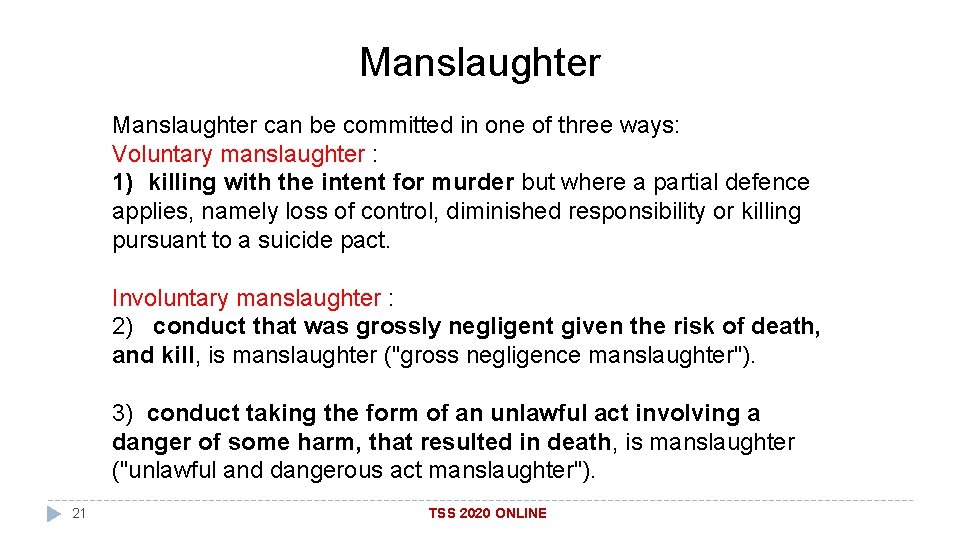
Manslaughter can be committed in one of three ways: Voluntary manslaughter : 1) killing with the intent for murder but where a partial defence applies, namely loss of control, diminished responsibility or killing pursuant to a suicide pact. Involuntary manslaughter : 2) conduct that was grossly negligent given the risk of death, and kill, is manslaughter ("gross negligence manslaughter"). 3) conduct taking the form of an unlawful act involving a danger of some harm, that resulted in death, is manslaughter ("unlawful and dangerous act manslaughter"). 21 TSS 2020 ONLINE
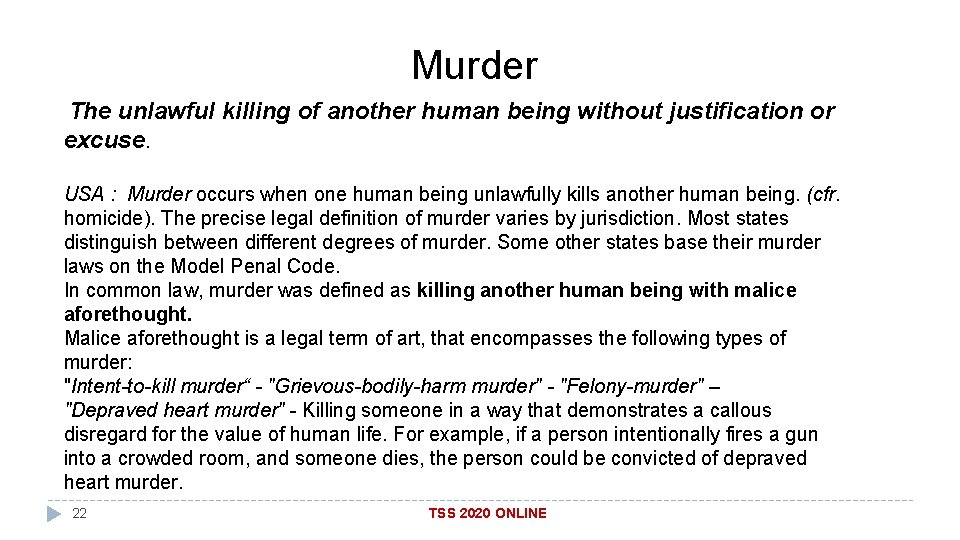
Murder The unlawful killing of another human being without justification or excuse. USA : Murder occurs when one human being unlawfully kills another human being. (cfr. homicide). The precise legal definition of murder varies by jurisdiction. Most states distinguish between different degrees of murder. Some other states base their murder laws on the Model Penal Code. In common law, murder was defined as killing another human being with malice aforethought. Malice aforethought is a legal term of art, that encompasses the following types of murder: "Intent-to-kill murder“ - "Grievous-bodily-harm murder" - "Felony-murder" – "Depraved heart murder" - Killing someone in a way that demonstrates a callous disregard for the value of human life. For example, if a person intentionally fires a gun into a crowded room, and someone dies, the person could be convicted of depraved heart murder. 22 TSS 2020 ONLINE
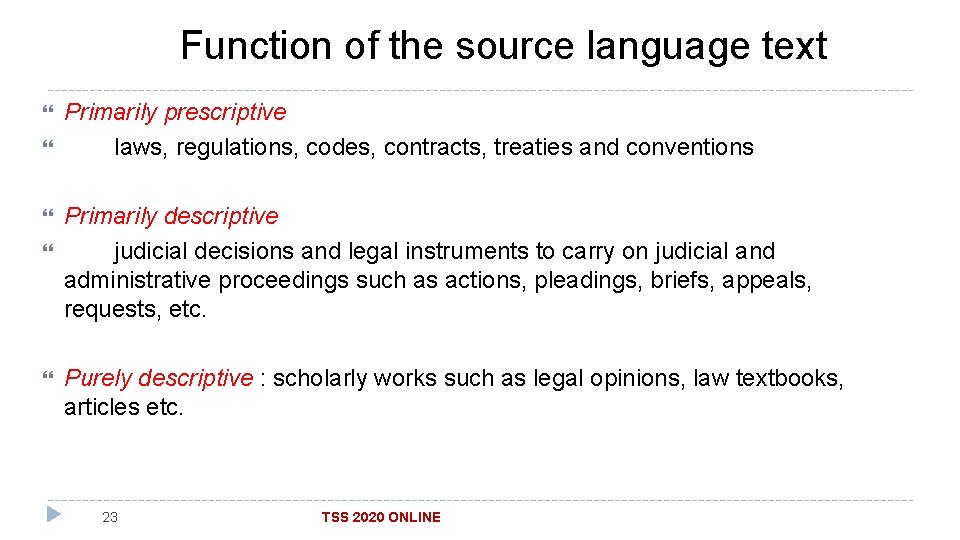
Function of the source language text Primarily prescriptive laws, regulations, codes, contracts, treaties and conventions Primarily descriptive judicial decisions and legal instruments to carry on judicial and administrative proceedings such as actions, pleadings, briefs, appeals, requests, etc. Purely descriptive : scholarly works such as legal opinions, law textbooks, articles etc. 23 TSS 2020 ONLINE
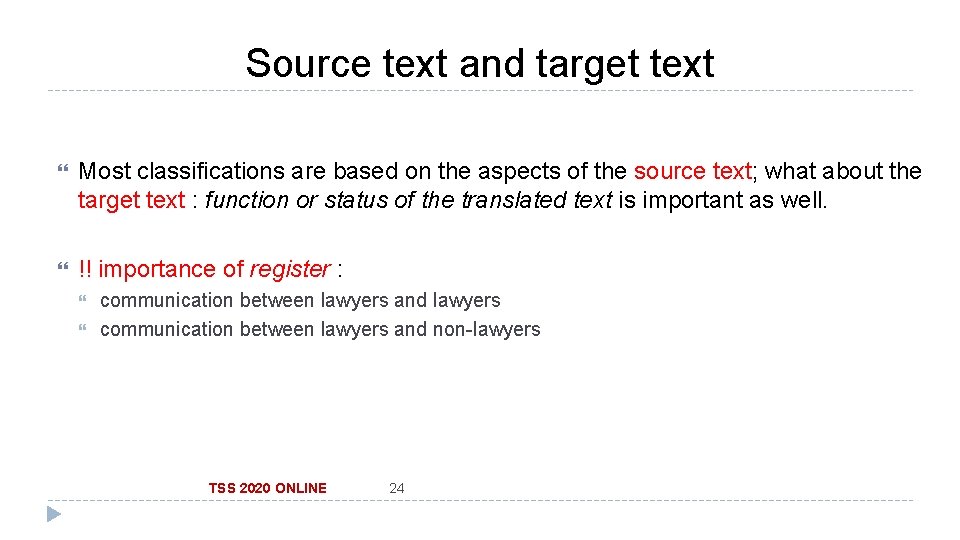
Source text and target text Most classifications are based on the aspects of the source text; what about the target text : function or status of the translated text is important as well. !! importance of register : communication between lawyers and lawyers communication between lawyers and non-lawyers TSS 2020 ONLINE 24
Translation and Authentication 25 Translation can be normative (i. e. the production of equally authentic legal texts in bilingual or multilingual settings, of the international legal instruments. ) Different language versions are equal in force (authentication) The texts are not translations of the law, but the law itself. In this type of translation , the communicative purposes of SL and TL are identical. The distinction between SL and TL even disappears. Translation can be informative (with descriptive function). Statutes, court decisions, scholarly works etc. Here, SL is the only legally enforceable language. TL is not; the translation is purely informative. E. g. : WTO : English, French and Spanish are the official languages; all other translation of texts is purely informative. Translation can be for the general legal and judicial purpose. (e. g. court translation and court interpreting) primarily translations are for information, but can be used in court proceedings as part of documentary evidence. TSS 2020 ONLINE
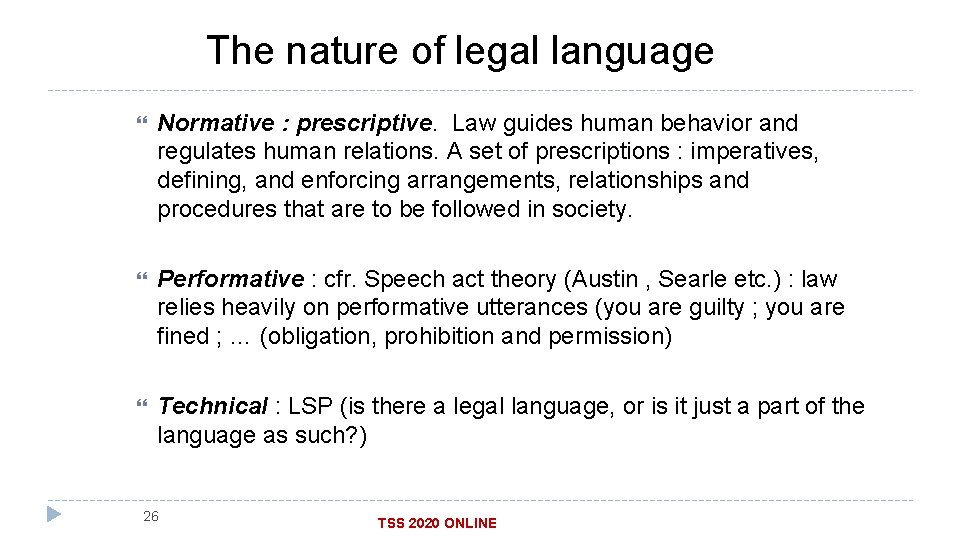
The nature of legal language Normative : prescriptive. Law guides human behavior and regulates human relations. A set of prescriptions : imperatives, defining, and enforcing arrangements, relationships and procedures that are to be followed in society. Performative : cfr. Speech act theory (Austin , Searle etc. ) : law relies heavily on performative utterances (you are guilty ; you are fined ; … (obligation, prohibition and permission) Technical : LSP (is there a legal language, or is it just a part of the language as such? ) 26 TSS 2020 ONLINE
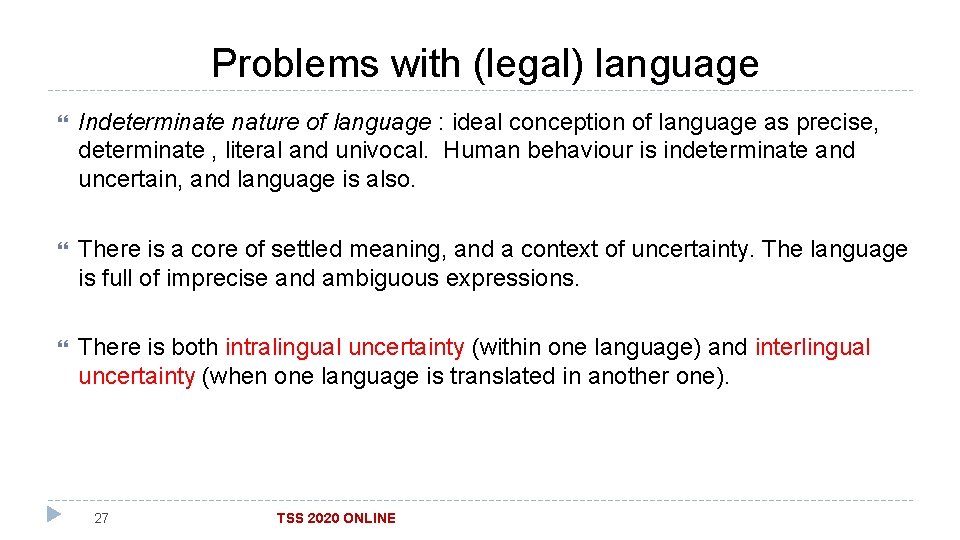
Problems with (legal) language Indeterminate nature of language : ideal conception of language as precise, determinate , literal and univocal. Human behaviour is indeterminate and uncertain, and language is also. There is a core of settled meaning, and a context of uncertainty. The language is full of imprecise and ambiguous expressions. There is both intralingual uncertainty (within one language) and interlingual uncertainty (when one language is translated in another one). 27 TSS 2020 ONLINE
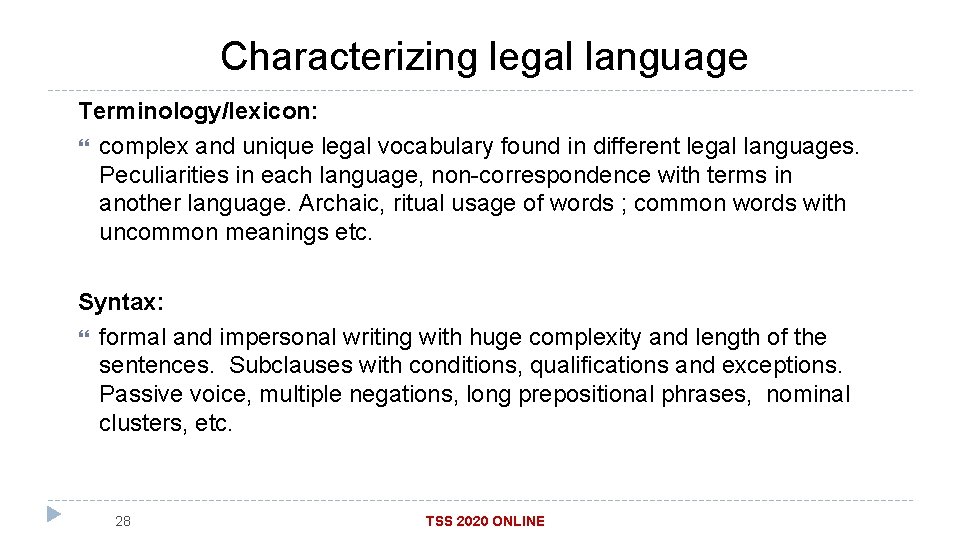
Characterizing legal language Terminology/lexicon: complex and unique legal vocabulary found in different legal languages. Peculiarities in each language, non-correspondence with terms in another language. Archaic, ritual usage of words ; common words with uncommon meanings etc. Syntax: formal and impersonal writing with huge complexity and length of the sentences. Subclauses with conditions, qualifications and exceptions. Passive voice, multiple negations, long prepositional phrases, nominal clusters, etc. 28 TSS 2020 ONLINE
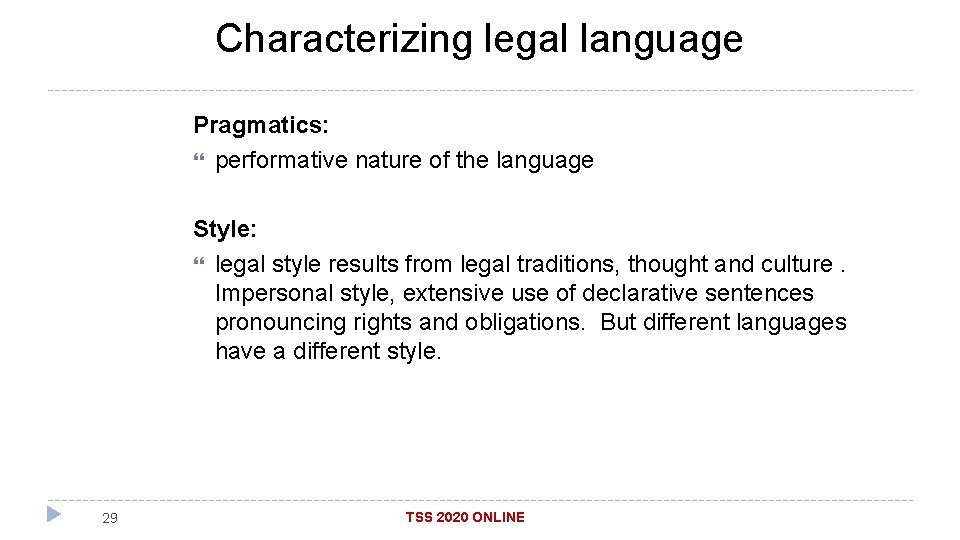
Characterizing legal language Pragmatics: performative nature of the language Style: legal style results from legal traditions, thought and culture. Impersonal style, extensive use of declarative sentences pronouncing rights and obligations. But different languages have a different style. 29 TSS 2020 ONLINE
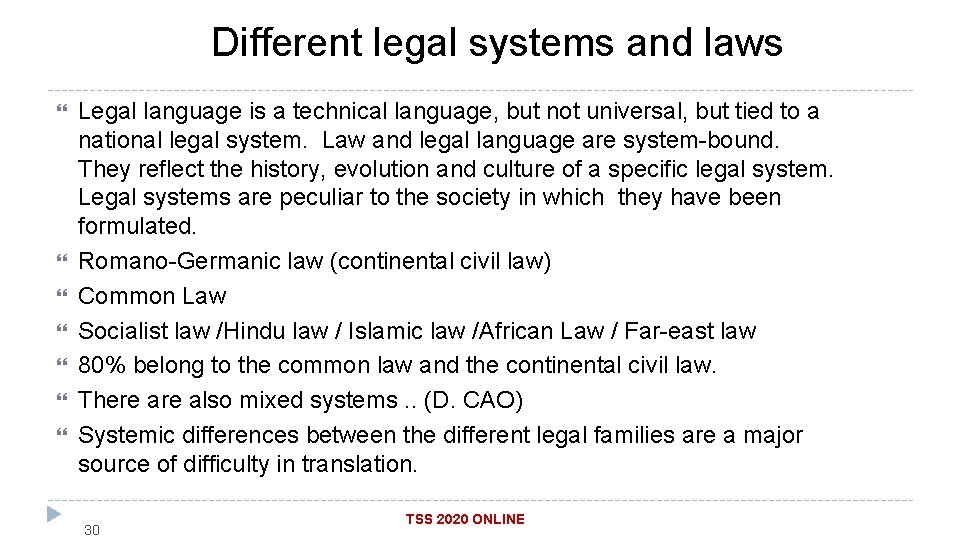
Different legal systems and laws Legal language is a technical language, but not universal, but tied to a national legal system. Law and legal language are system-bound. They reflect the history, evolution and culture of a specific legal system. Legal systems are peculiar to the society in which they have been formulated. Romano-Germanic law (continental civil law) Common Law Socialist law /Hindu law / Islamic law /African Law / Far-east law 80% belong to the common law and the continental civil law. There also mixed systems. . (D. CAO) Systemic differences between the different legal families are a major source of difficulty in translation. 30 TSS 2020 ONLINE
Civil law Corpus Juris Civilis (Roman Empire) XII Tables (Rome, 450 B. C. ) (Roman Law) European empires in colonial times Civil law spread all over the world Prevails in Europe, but also in Central and South America, in much of Asia and Africa Even in enclaves surrounded by common-law Louisiana, Puerto Rico, Quebec United Nations, European Union, etc. heavily influenced by civil law 31 TSS 2020 ONLINE
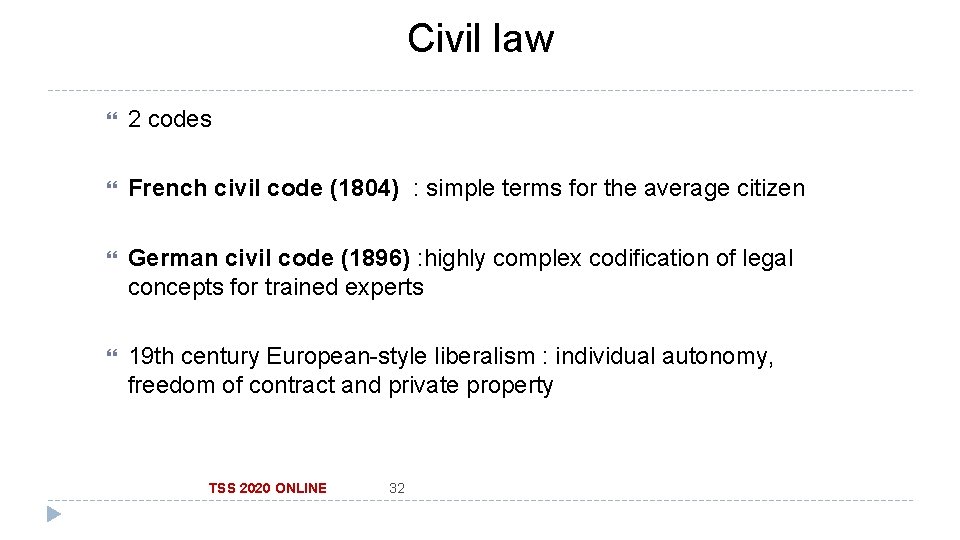
Civil law 2 codes French civil code (1804) : simple terms for the average citizen German civil code (1896) : highly complex codification of legal concepts for trained experts 19 th century European-style liberalism : individual autonomy, freedom of contract and private property TSS 2020 ONLINE 32
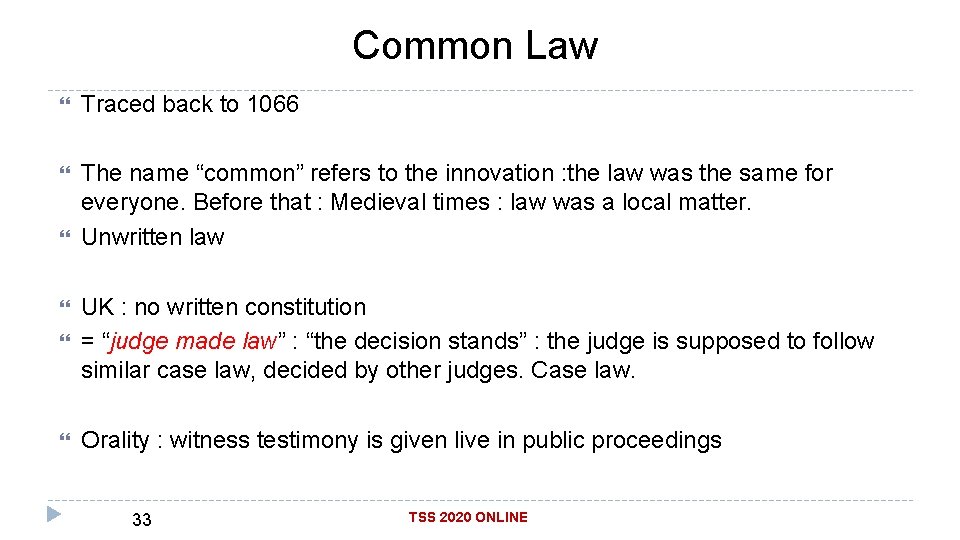
Common Law Traced back to 1066 The name “common” refers to the innovation : the law was the same for everyone. Before that : Medieval times : law was a local matter. Unwritten law UK : no written constitution = “judge made law” : “the decision stands” : the judge is supposed to follow similar case law, decided by other judges. Case law. Orality : witness testimony is given live in public proceedings 33 TSS 2020 ONLINE
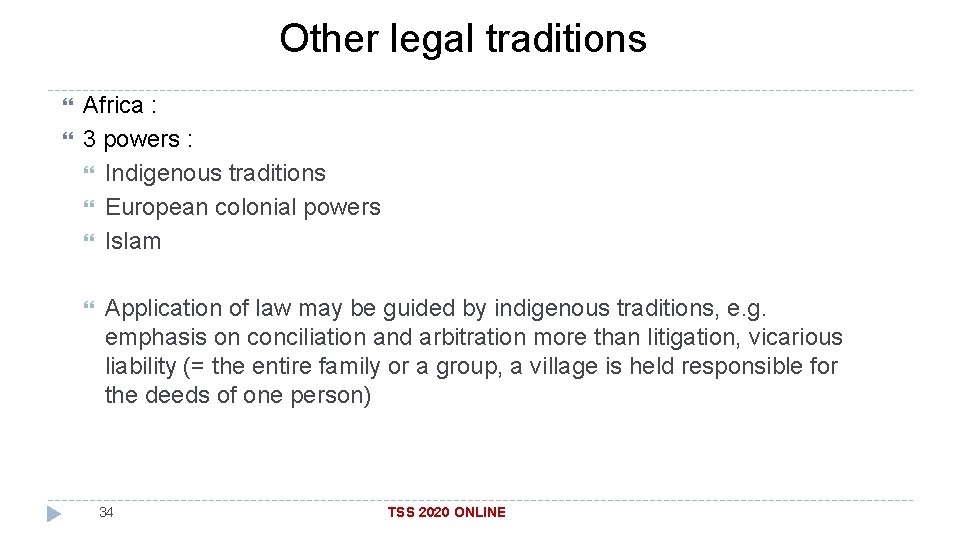
Other legal traditions Africa : 3 powers : Indigenous traditions European colonial powers Islam Application of law may be guided by indigenous traditions, e. g. emphasis on conciliation and arbitration more than litigation, vicarious liability (= the entire family or a group, a village is held responsible for the deeds of one person) 34 TSS 2020 ONLINE
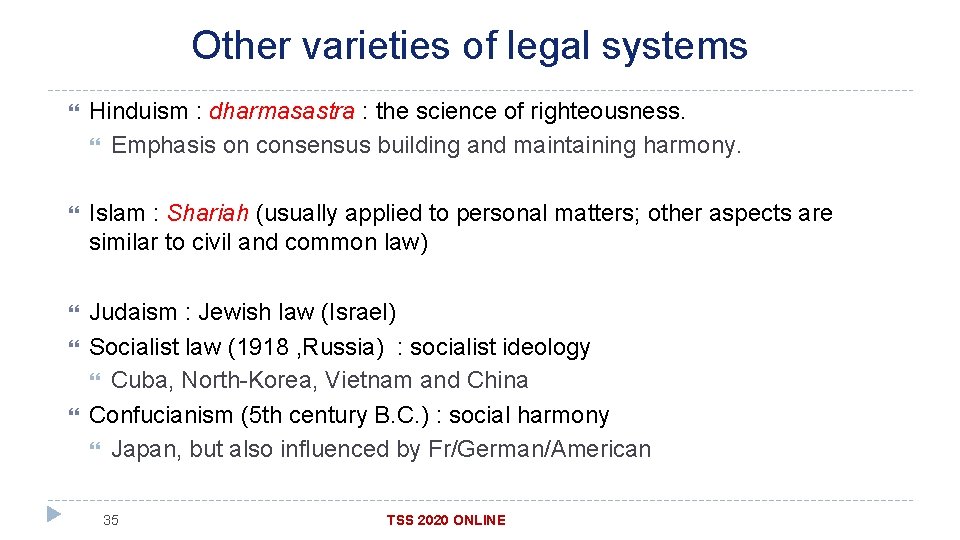
Other varieties of legal systems Hinduism : dharmasastra : the science of righteousness. Emphasis on consensus building and maintaining harmony. Islam : Shariah (usually applied to personal matters; other aspects are similar to civil and common law) Judaism : Jewish law (Israel) Socialist law (1918 , Russia) : socialist ideology Cuba, North-Korea, Vietnam and China Confucianism (5 th century B. C. ) : social harmony Japan, but also influenced by Fr/German/American 35 TSS 2020 ONLINE
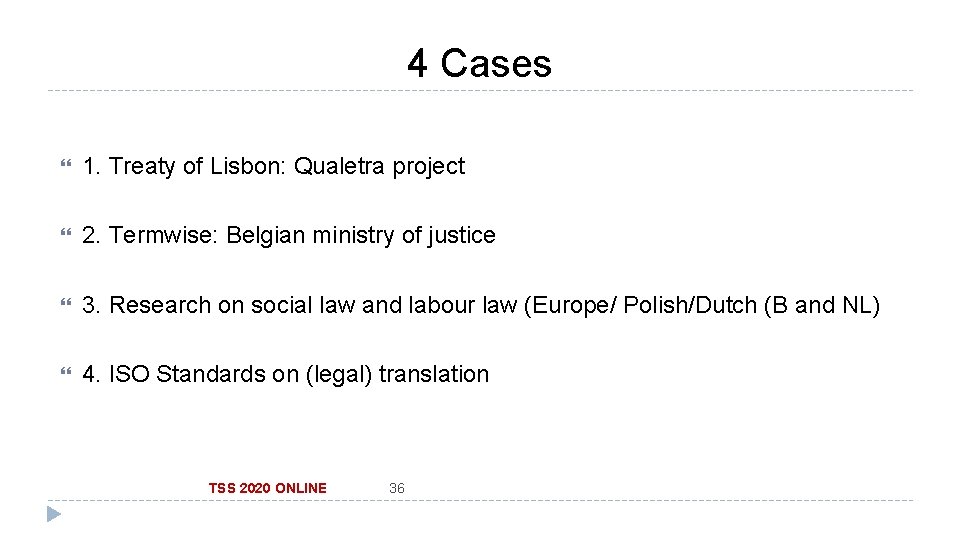
4 Cases 1. Treaty of Lisbon: Qualetra project 2. Termwise: Belgian ministry of justice 3. Research on social law and labour law (Europe/ Polish/Dutch (B and NL) 4. ISO Standards on (legal) translation TSS 2020 ONLINE 36
Treaty of Lisbon On 1 December 2009, the Treaty of Lisbon entered into force, thus ending several years of negotiation about institutional issues. The Treaty of Lisbon amends the current EU and EC treaties, without replacing them. It provides the Union with the legal framework and tools necessary to meet future challenges and to respond to citizens' demands. http: //europa. eu/lisbon_treaty/glance/index_en. htm http: //www. eulita. eu/relevant-documents TSS 2020 ONLINE 37
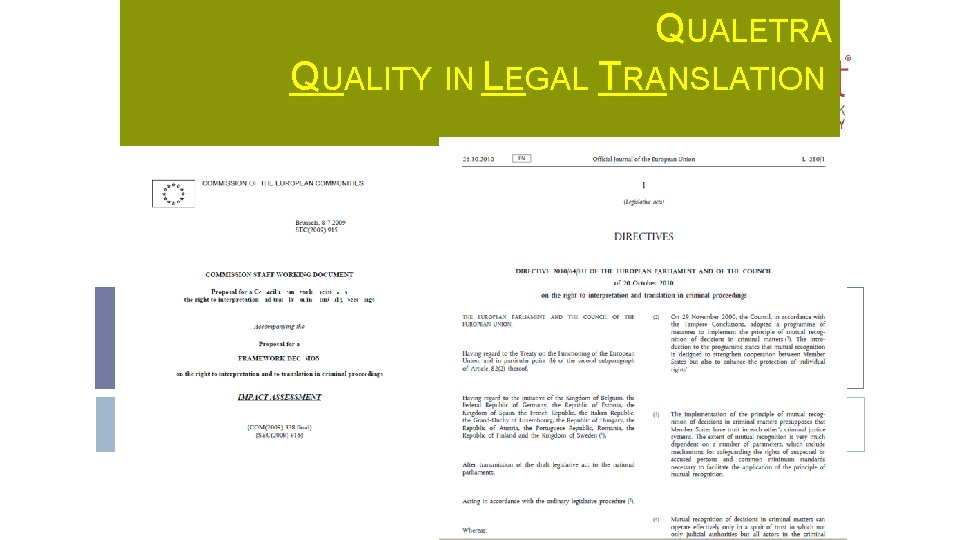
QUALETRA QUALITY IN LEGAL TRANSLATION QUALE TRA
Partners 39 TSS 2020 ONLINE
Background Information 40 QUALETRA (19 November 2012 – 18 November 2014) www. eulita. eu The project aimed at raising the quality of legal translation and training in criminal proceedings through the development of core curricula, assessment procedures and training materials TSS 2020 ONLINE
The project focus 41 development of training materials translation memories multilingual term bases accredited tests implementation of training programmes Improve the training of legal translators and practitioners to interact efficiently with beneficiaries: police, prosecutors, court staff, judges, lawyers and professionals providing victim support TSS 2020 ONLINE
Term. Wise Project type: Industrial Research Fund (IOF) • Knowledge platform: developing practical applications based on multidisciplinary fundamental research Project aims: • Developing software to support translators in dealing with highly specialised language use (case study: legal texts) based on fundamental research in terminology, translations studies, lexicology, corpus linguistics, computer science and software engineering • Target group: the translation section of the Federal Justice Dep. (B) • Target languages: Dutch-French, Belgian legal system Possible extensions: • Spinoffs : German community in Belgium • Other countries and specialised domains (e. g. medical, patents, . . ) 42 TSS 2020 ONLINE
User Needs of Legal Translators TERMWISE IS USER-DRIVEN: Need for terminological support expressed by the translators at the Belgian Federal Justice Services Their current state-of-the-art commercial CAT-tool gives insufficient support: Translation Memory: only gives translation suggestions for entire segments, not for specific terminology Concordancer: gives a list of hits from the TM, but not sorted by relevance, without source information, and examples from outside the TM are not included Termbase: has limited coverage and is outdated. The department has no resources for terminological work 43 TSS 2020 ONLINE
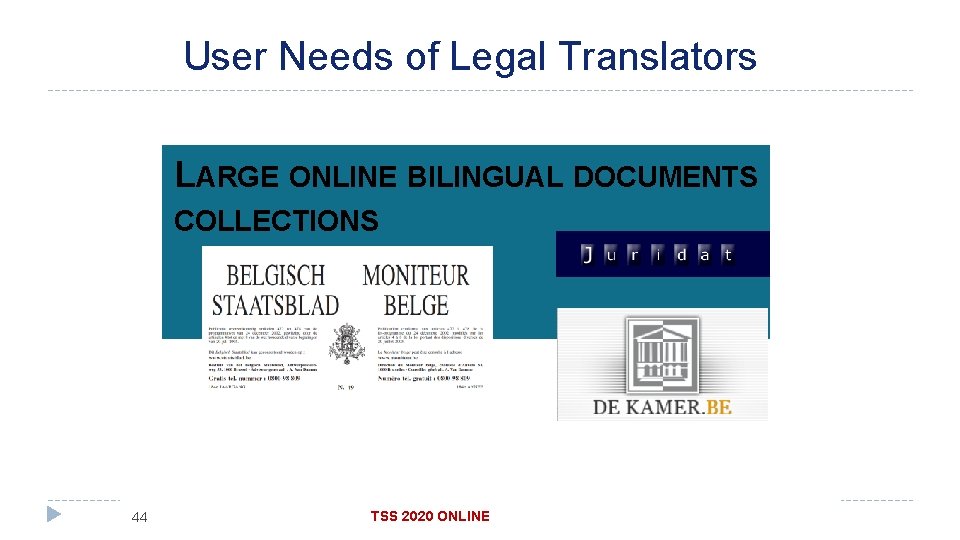
User Needs of Legal Translators LARGE ONLINE BILINGUAL DOCUMENTS COLLECTIONS 44 TSS 2020 ONLINE
User Needs of Legal Translators IDENTIFIED USER NEEDS: Access to previous translations of domain-specific single and multi-word expressions Examples of usage in context to infer correct phraseology Information about the source documents of the translation examples Examples from all relevant document collections that are available online Sorting the examples by relevance to the current translation assignment Easy access to the examples from within the CAT-tool 45 TSS 2020 ONLINE
Knowledge Extraction & Retrieval TASKS INVOLVED 46 Bilingual online documents from the Belgian legal domain Ø Web crawling of Belgisch Staatsblad/Moniteur Belge Different types of domain-specific expressions Ø Term Extraction French-Dutch Translation of the expressions Ø Bilingual Term Alignment Suggestions of translation examples relevant to assignment Ø Context-sensitive database querying TSS 2020 ONLINE
Case: social affairs and labour law EU legislation: on the equality of employees. Directive (EU) 2019/1152 of the European Parliament and of the Council of 20 June 2019 on transparent and predictable working conditions in the European Union. Article 2 of this directive refers to Principle No 5 of the European Pillar of Social Rights, which is an important document with regards to the upholding of fair and equal conditions on the European labour markets. Equal opportunities and access to the labour market 47 Fair working conditions Social protection and inclusion TSS 2020 ONLINE
Untranslatability of legal terms European transport sector: large numbers of Polish employees. Problems with contracts, labour conditions, payments, etc. The term: posting ('labour leasing’) Dutch: terbeschikkingstelling is usually considered to be a synonym of detachering Polish: delegowanie TSS 2020 ONLINE 48
ISO standards 17100 and 20771 ISO 17100 provides requirements for the core processes, resources, and other aspects necessary for the delivery of a quality translation service that meets applicable specifications. a translation service provider (TSP) can demonstrate conformity of specified translation services to ISO 17100: 2015 and the capability of its processes and resources to deliver a translation service that will meet the client's and other applicable specifications. Extension and upgrade of the old EN 15038 TSS 2020 ONLINE 49
ISO 20771 for legal translators ISO 20771 may be used as a way for individual legal translators to demonstrate their qualifications specifies requirements for the competences and qualifications of legal translators, revisers and reviewers, best translation practices and the translation process directly affecting the quality and delivery of legal translation services. In particular, it specifies the core processes, resources, confidentiality, professional development requirements, training and other aspects of the legal translation service provided by individual translators. TSS 2020 ONLINE 50
Conclusion Legal translation is a very specific type of specialized translation, with lots of challenges on the level of conceptual analysis, terminology and phraseology. Good resources and specialized translators are necessary. Computer assisted tools such as elaborate terminology databases, translation memories, term extraction tools etc. are very valuable assets. 51 TSS 2020 ONLINE
References 52 Cheng, L. , Sin, K. K & Wagner, A. (2014): The Ashgate Handbook of Legal Translation. Ashgate, Farnham/Burlington Heylen, K. , Steurs, F. (2014). Translating legal and administrative language: How to deal with legal terms and their flexible meaning potential. Turjuman, 23 (2), 96 -146. Id-Youss, H. , Steurs, F. , Alsulaiman, A. (2014). Translation technologies: Challenging new tasks and competences for translators. Dragoman, 2 (1), 1 -14 Kockaert, H. , Steurs, F. (2015). Handbook of Terminology. Amsterdam/New York: John Benjamins Publishing Kockaert, H. , Steurs, F. (2011). Un outil de gestion terminologique pour la traduction juridique en Belgique : état de la question et perspectives. Revue Française de Linguistique Appliquée, 16 (1), 93 -104. Steurs, F. , Kockaert, H. (2014). Language planning and domain dynamics: Challenges in term creation. Dragoman, 2 (2), 1 -14. Steurs, F. , Id-Youss, H. (2013). Functional equivalance and legal dynamism. Dragoman, 1 (2), 1 -15. TSS 2020 ONLINE
Frieda. Steurs@kuleuven. be Frieda. Steurs@ivdnt. org Thank you very much for your attention 53 TSS 2020 ONLINE