
TSN Yaakov J Stein Time sensitive deterministic flows


- Slides: 41
TSN Yaakov (J) Stein
Time sensitive (deterministic) flows Communications for some applications (see draft-ietf-detnet-use-cases) require deterministic or time-sensitive handling • professional video and audio (e. g. , intra-studio, broadcast, public address) • critical infrastructure supervisory control (e. g. , IEC 61850) • building automation systems • industrial M 2 M (e. g. , 802. 15. 4 e, 6 Ti. SCH) • vehicle to vehicle (V 2 V) and vehicle to infrastructure (V 2 I) communications • cellular fronthaul and backhaul • blockchain pools Common requirements • high availability (> 5 nines) • guaranteed message delivery • rapid response times • consistent response times • precise timing • synchronized actions • human interaction Y(J)S TSN 2
5 G URLLC When defining the 5 th generation of mobile networks ITU and 3 GPP decided to define three vertical market segments • enhanced Mobile Broadband (e. MBB) initial deployments higher data rates and moderate latency improvement requires New Radio and larger backhaul pipes • massive Machine Type Communications (m. MTC) low power wide area (LPWA) technologies, including NB-Io. T enhancements to Release 13/14 features • Ultra Reliable Low Latency Communications (URLLC) final stage mission/life critical applications ultra-reliable low end-to-end latency requires 5 G Core deployment Y(J)S TSN 3
TSN background Time Sensitive Networking (TSN) and Deterministic Networking (Det. Net) are Ethernet and IP/MPLS technologies that enable: • very low and guaranteed packet propagation latency • time aware scheduling/queuing • time coordinated forwarding • frame preemption • very high reliability • zero congestion loss (PLR of 10 -10) • resource reservation • seamless redundancy • dynamicity – flows can be removed or added w/o impacting other flows • co-existence of TSN traffic with regular traffic • up to 75% express traffic for applications such as IIo. T, V 2 x, fronthaul TSN is being developed for Ethernet by a task group in IEEE 802. 1 The same technologies are being developed for IP and MPLS by the Det. Net WG in the IETF Y(J)S TSN 4
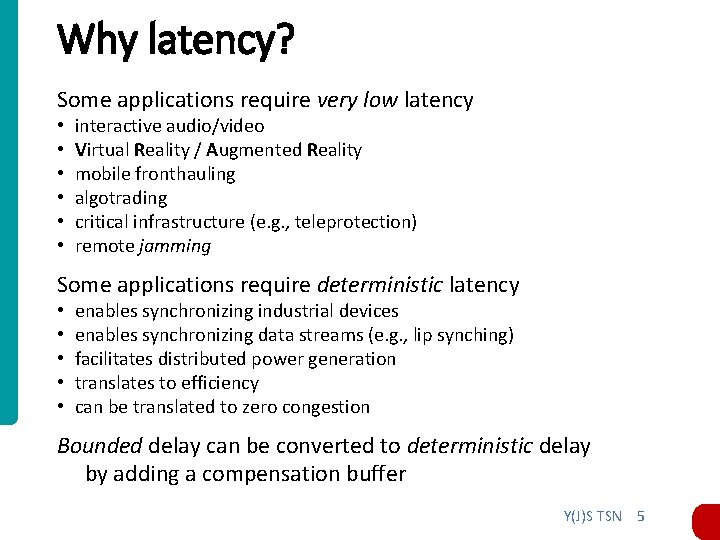
Why latency? Some applications require very low latency • • • interactive audio/video Virtual Reality / Augmented Reality mobile fronthauling algotrading critical infrastructure (e. g. , teleprotection) remote jamming Some applications require deterministic latency • • • enables synchronizing industrial devices enables synchronizing data streams (e. g. , lip synching) facilitates distributed power generation translates to efficiency can be translated to zero congestion Bounded delay can be converted to deterministic delay by adding a compensation buffer Y(J)S TSN 5
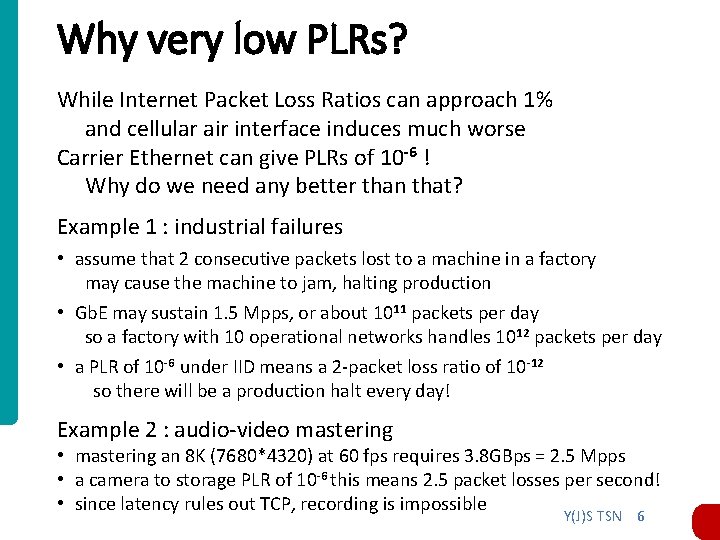
Why very low PLRs? While Internet Packet Loss Ratios can approach 1% and cellular air interface induces much worse Carrier Ethernet can give PLRs of 10 -6 ! Why do we need any better than that? Example 1 : industrial failures • assume that 2 consecutive packets lost to a machine in a factory may cause the machine to jam, halting production • Gb. E may sustain 1. 5 Mpps, or about 1011 packets per day so a factory with 10 operational networks handles 1012 packets per day • a PLR of 10 -6 under IID means a 2 -packet loss ratio of 10 -12 so there will be a production halt every day! Example 2 : audio-video mastering • mastering an 8 K (7680*4320) at 60 fps requires 3. 8 GBps = 2. 5 Mpps • a camera to storage PLR of 10 -6 this means 2. 5 packet losses per second! • since latency rules out TCP, recording is impossible Y(J)S TSN 6
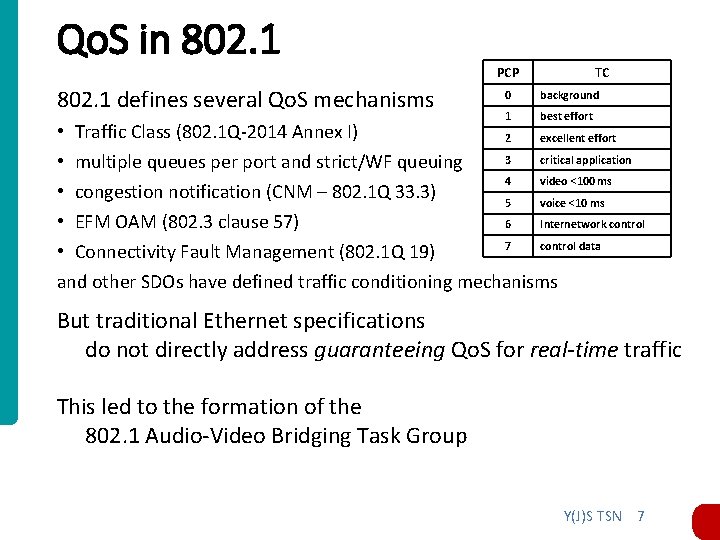
Qo. S in 802. 1 defines several Qo. S mechanisms PCP TC 0 background 1 best effort • Traffic Class (802. 1 Q-2014 Annex I) 2 excellent effort 3 critical application • multiple queues per port and strict/WF queuing 4 video <100 ms • congestion notification (CNM – 802. 1 Q 33. 3) 5 voice <10 ms • EFM OAM (802. 3 clause 57) 6 Internetwork control 7 control data • Connectivity Fault Management (802. 1 Q 19) and other SDOs have defined traffic conditioning mechanisms But traditional Ethernet specifications do not directly address guaranteeing Qo. S for real-time traffic This led to the formation of the 802. 1 Audio-Video Bridging Task Group Y(J)S TSN 7
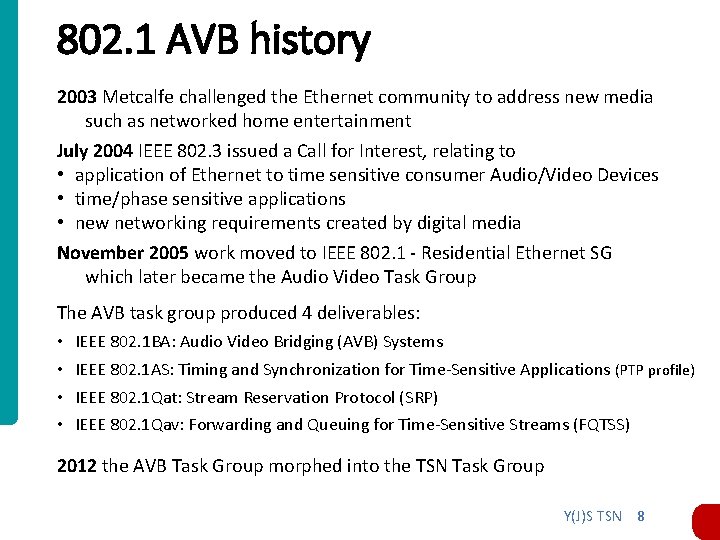
802. 1 AVB history 2003 Metcalfe challenged the Ethernet community to address new media such as networked home entertainment July 2004 IEEE 802. 3 issued a Call for Interest, relating to • application of Ethernet to time sensitive consumer Audio/Video Devices • time/phase sensitive applications • new networking requirements created by digital media November 2005 work moved to IEEE 802. 1 - Residential Ethernet SG which later became the Audio Video Task Group The AVB task group produced 4 deliverables: • • IEEE 802. 1 BA: Audio Video Bridging (AVB) Systems IEEE 802. 1 AS: Timing and Synchronization for Time-Sensitive Applications (PTP profile) IEEE 802. 1 Qat: Stream Reservation Protocol (SRP) IEEE 802. 1 Qav: Forwarding and Queuing for Time-Sensitive Streams (FQTSS) 2012 the AVB Task Group morphed into the TSN Task Group Y(J)S TSN 8
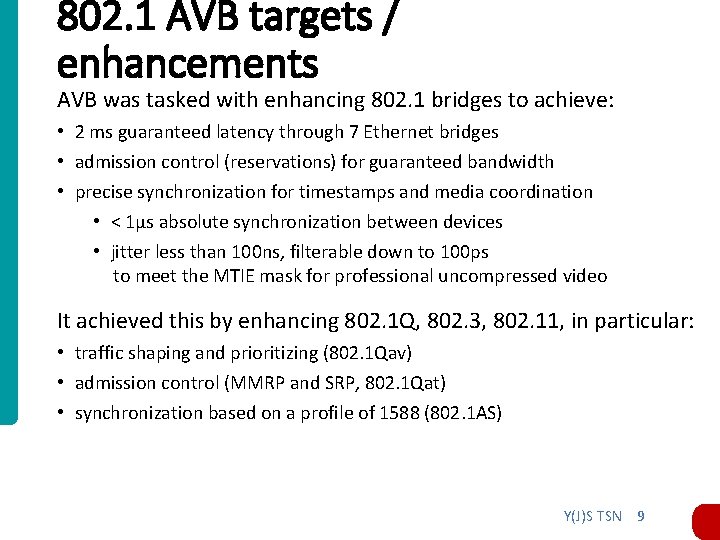
802. 1 AVB targets / enhancements AVB was tasked with enhancing 802. 1 bridges to achieve: • 2 ms guaranteed latency through 7 Ethernet bridges • admission control (reservations) for guaranteed bandwidth • precise synchronization for timestamps and media coordination • < 1µs absolute synchronization between devices • jitter less than 100 ns, filterable down to 100 ps to meet the MTIE mask for professional uncompressed video It achieved this by enhancing 802. 1 Q, 802. 3, 802. 11, in particular: • traffic shaping and prioritizing (802. 1 Qav) • admission control (MMRP and SRP, 802. 1 Qat) • synchronization based on a profile of 1588 (802. 1 AS) Y(J)S TSN 9
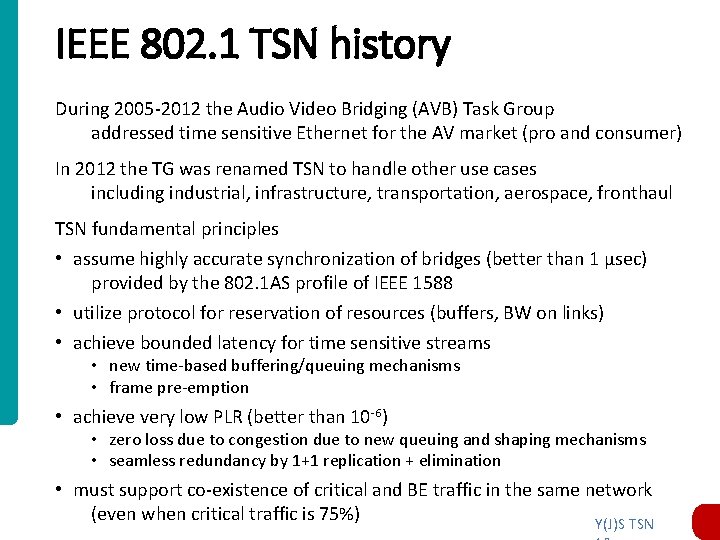
IEEE 802. 1 TSN history During 2005 -2012 the Audio Video Bridging (AVB) Task Group addressed time sensitive Ethernet for the AV market (pro and consumer) In 2012 the TG was renamed TSN to handle other use cases including industrial, infrastructure, transportation, aerospace, fronthaul TSN fundamental principles • assume highly accurate synchronization of bridges (better than 1 μsec) provided by the 802. 1 AS profile of IEEE 1588 • utilize protocol for reservation of resources (buffers, BW on links) • achieve bounded latency for time sensitive streams • new time-based buffering/queuing mechanisms • frame pre-emption • achieve very low PLR (better than 10 -6) • zero loss due to congestion due to new queuing and shaping mechanisms • seamless redundancy by 1+1 replication + elimination • must support co-existence of critical and BE traffic in the same network (even when critical traffic is 75%) Y(J)S TSN
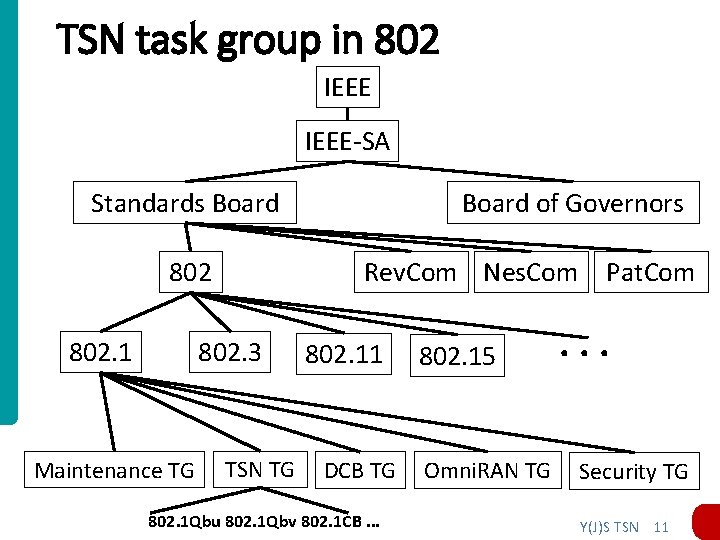
TSN task group in 802 IEEE-SA Standards Board 802. 1 Rev. Com Nes. Com Pat. Com 802. 3 Maintenance TG Board of Governors TSN TG 802. 11 DCB TG 802. 1 Qbu 802. 1 Qbv 802. 1 CB. . . 802. 15 Omni. RAN TG . . . Security TG Y(J)S TSN 11
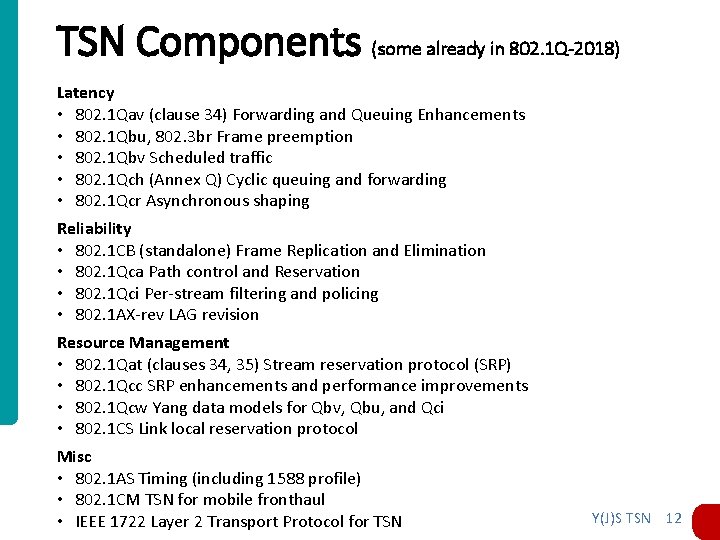
TSN Components (some already in 802. 1 Q-2018) Latency • 802. 1 Qav (clause 34) Forwarding and Queuing Enhancements • 802. 1 Qbu, 802. 3 br Frame preemption • 802. 1 Qbv Scheduled traffic • 802. 1 Qch (Annex Q) Cyclic queuing and forwarding • 802. 1 Qcr Asynchronous shaping Reliability • 802. 1 CB (standalone) Frame Replication and Elimination • 802. 1 Qca Path control and Reservation • 802. 1 Qci Per-stream filtering and policing • 802. 1 AX-rev LAG revision Resource Management • 802. 1 Qat (clauses 34, 35) Stream reservation protocol (SRP) • 802. 1 Qcc SRP enhancements and performance improvements • 802. 1 Qcw Yang data models for Qbv, Qbu, and Qci • 802. 1 CS Link local reservation protocol Misc • 802. 1 AS Timing (including 1588 profile) • 802. 1 CM TSN for mobile fronthaul • IEEE 1722 Layer 2 Transport Protocol for TSN Y(J)S TSN 12
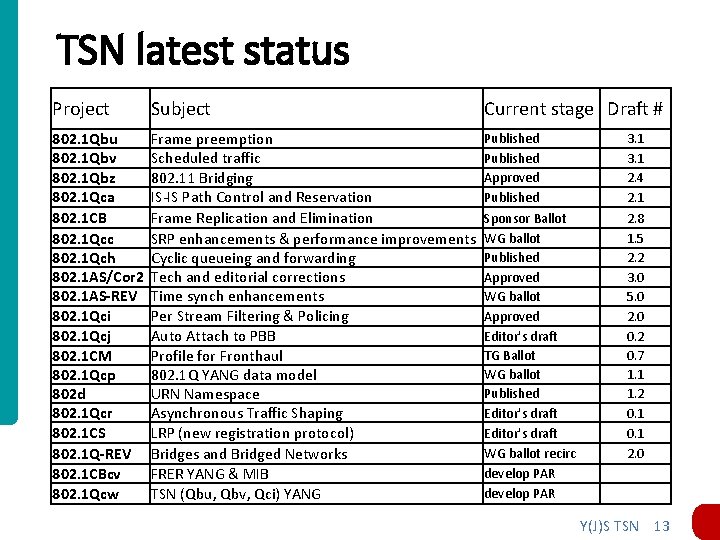
TSN latest status Project Subject Current stage Draft # 802. 1 Qbu 802. 1 Qbv 802. 1 Qbz 802. 1 Qca 802. 1 CB 802. 1 Qcc 802. 1 Qch 802. 1 AS/Cor 2 802. 1 AS-REV 802. 1 Qci 802. 1 Qcj 802. 1 CM 802. 1 Qcp 802 d 802. 1 Qcr 802. 1 CS 802. 1 Q-REV 802. 1 CBcv 802. 1 Qcw Frame preemption Scheduled traffic 802. 11 Bridging IS-IS Path Control and Reservation Frame Replication and Elimination SRP enhancements & performance improvements Cyclic queueing and forwarding Tech and editorial corrections Time synch enhancements Per Stream Filtering & Policing Auto Attach to PBB Profile for Fronthaul 802. 1 Q YANG data model URN Namespace Asynchronous Traffic Shaping LRP (new registration protocol) Bridges and Bridged Networks FRER YANG & MIB TSN (Qbu, Qbv, Qci) YANG Published Approved Published Sponsor Ballot WG ballot Published Approved WG ballot Approved Editor's draft TG Ballot WG ballot Published Editor's draft WG ballot recirc develop PAR 3. 1 2. 4 2. 1 2. 8 1. 5 2. 2 3. 0 5. 0 2. 0 0. 2 0. 7 1. 1 1. 2 0. 1 2. 0 Y(J)S TSN 13
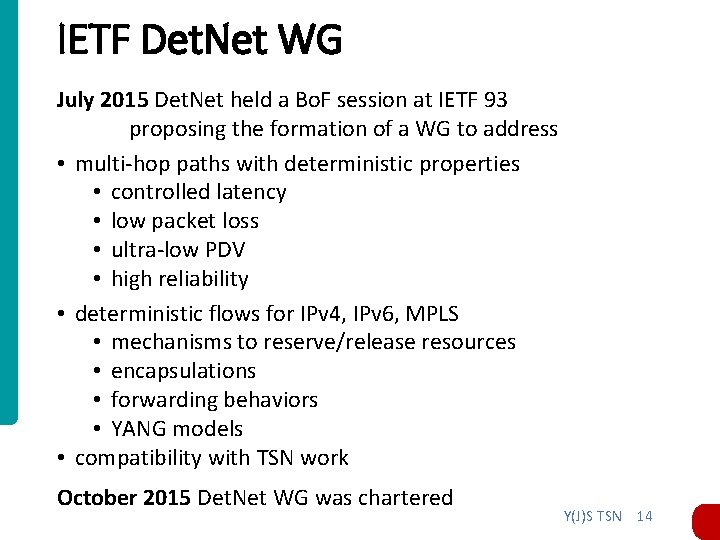
IETF Det. Net WG July 2015 Det. Net held a Bo. F session at IETF 93 proposing the formation of a WG to address • multi-hop paths with deterministic properties • controlled latency • low packet loss • ultra-low PDV • high reliability • deterministic flows for IPv 4, IPv 6, MPLS • mechanisms to reserve/release resources • encapsulations • forwarding behaviors • YANG models • compatibility with TSN work October 2015 Det. Net WG was chartered Y(J)S TSN 14
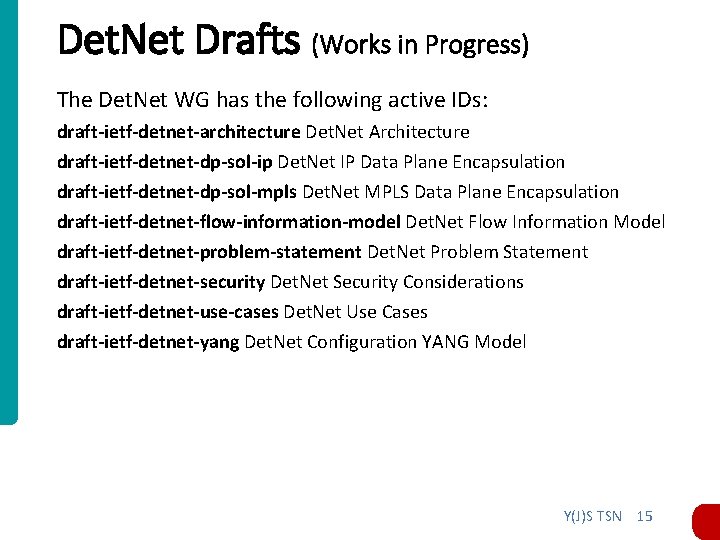
Det. Net Drafts (Works in Progress) The Det. Net WG has the following active IDs: draft-ietf-detnet-architecture Det. Net Architecture draft-ietf-detnet-dp-sol-ip Det. Net IP Data Plane Encapsulation draft-ietf-detnet-dp-sol-mpls Det. Net MPLS Data Plane Encapsulation draft-ietf-detnet-flow-information-model Det. Net Flow Information Model draft-ietf-detnet-problem-statement Det. Net Problem Statement draft-ietf-detnet-security Det. Net Security Considerations draft-ietf-detnet-use-cases Det. Net Use Cases draft-ietf-detnet-yang Det. Net Configuration YANG Model Y(J)S TSN 15
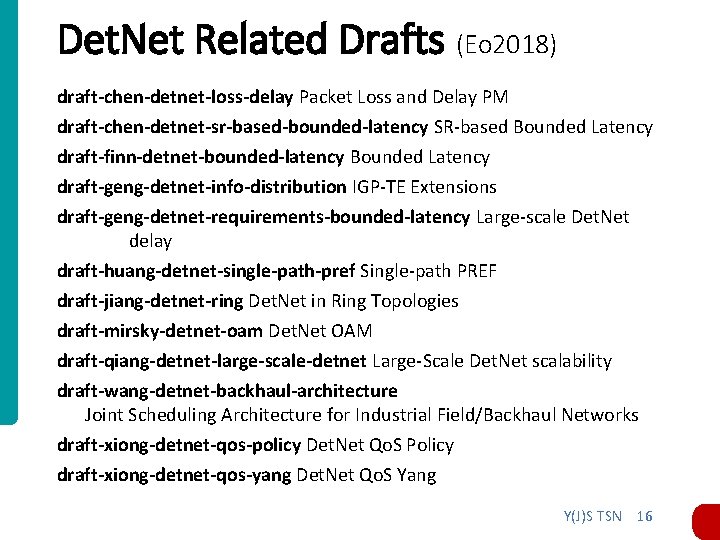
Det. Net Related Drafts (Eo 2018) draft-chen-detnet-loss-delay Packet Loss and Delay PM draft-chen-detnet-sr-based-bounded-latency SR-based Bounded Latency draft-finn-detnet-bounded-latency Bounded Latency draft-geng-detnet-info-distribution IGP-TE Extensions draft-geng-detnet-requirements-bounded-latency Large-scale Det. Net delay draft-huang-detnet-single-path-pref Single-path PREF draft-jiang-detnet-ring Det. Net in Ring Topologies draft-mirsky-detnet-oam Det. Net OAM draft-qiang-detnet-large-scale-detnet Large-Scale Det. Net scalability draft-wang-detnet-backhaul-architecture Joint Scheduling Architecture for Industrial Field/Backhaul Networks draft-xiong-detnet-qos-policy Det. Net Qo. S Policy draft-xiong-detnet-qos-yang Det. Net Qo. S Yang Y(J)S TSN 16
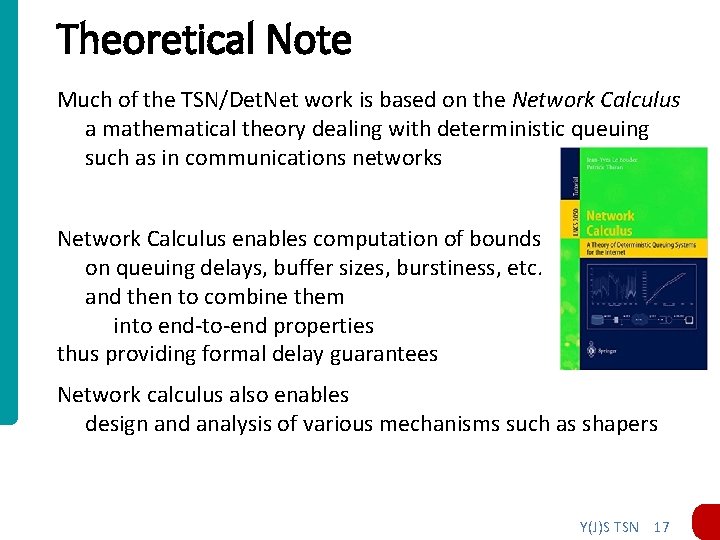
Theoretical Note Much of the TSN/Det. Net work is based on the Network Calculus a mathematical theory dealing with deterministic queuing such as in communications networks Network Calculus enables computation of bounds on queuing delays, buffer sizes, burstiness, etc. and then to combine them into end-to-end properties thus providing formal delay guarantees Network calculus also enables design and analysis of various mechanisms such as shapers Y(J)S TSN 17
802. 1 Qbu Frame preemption The major source of residence latency for a high priority packet is its waiting in a queue for a packet being output to complete transmission For example, assuming a 1500 B packet just started transmission the high priority packet needs to wait: • 10 Mbps 1. 7 msec • 100 Mbps : 170 msec • 1 Gbps : 17 msec • 10 Gbps 1. 7 msec • 100 Gbps 0. 17 msec and the situation will be much worse with 9 K jumbo packets which are being standardized It is possible with present protocols to runt the outgoing packet but this would require its retransmission and burden switches along the path to parse and discard it A solution to this problem (not the most important element in TSN!) involves preemption, frame fragmentation, and local reassembly Y(J)S TSN 18
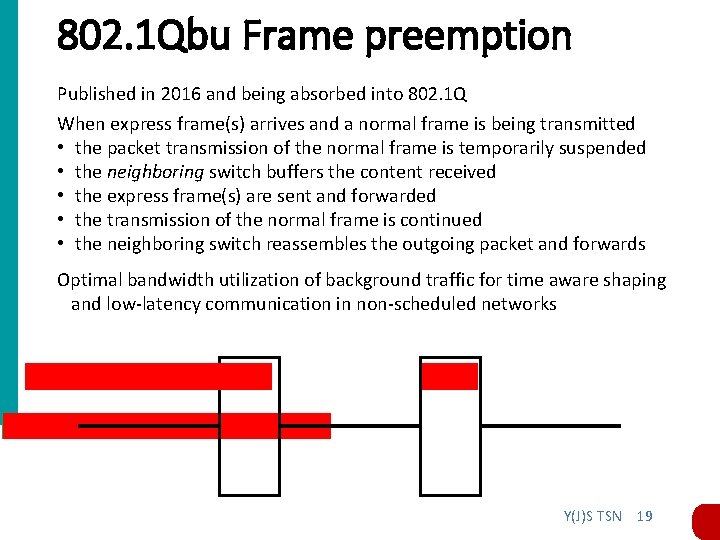
802. 1 Qbu Frame preemption Published in 2016 and being absorbed into 802. 1 Q When express frame(s) arrives and a normal frame is being transmitted • the packet transmission of the normal frame is temporarily suspended • the neighboring switch buffers the content received • the express frame(s) are sent and forwarded • the transmission of the normal frame is continued • the neighboring switch reassembles the outgoing packet and forwards Optimal bandwidth utilization of background traffic for time aware shaping and low-latency communication in non-scheduled networks Y(J)S TSN 19
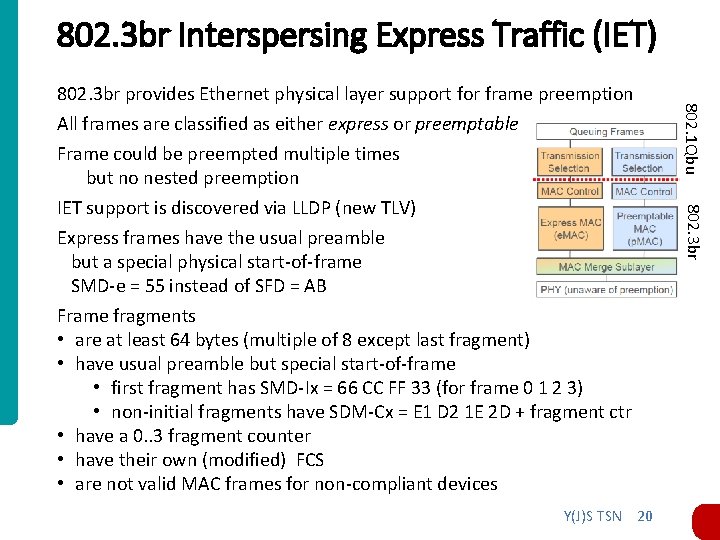
802. 3 br Interspersing Express Traffic (IET) Y(J)S TSN 20 802. 3 br All frames are classified as either express or preemptable Frame could be preempted multiple times but no nested preemption IET support is discovered via LLDP (new TLV) Express frames have the usual preamble but a special physical start-of-frame SMD-e = 55 instead of SFD = AB Frame fragments • are at least 64 bytes (multiple of 8 except last fragment) • have usual preamble but special start-of-frame • first fragment has SMD-Ix = 66 CC FF 33 (for frame 0 1 2 3) • non-initial fragments have SDM-Cx = E 1 D 2 1 E 2 D + fragment ctr • have a 0. . 3 fragment counter • have their own (modified) FCS • are not valid MAC frames for non-compliant devices 802. 1 Qbu 802. 3 br provides Ethernet physical layer support for frame preemption
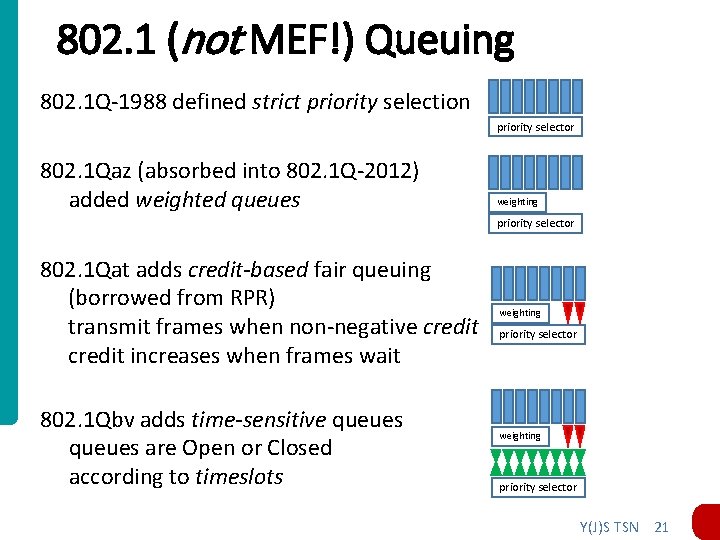
802. 1 (not MEF!) Queuing 802. 1 Q-1988 defined strict priority selection priority selector 802. 1 Qaz (absorbed into 802. 1 Q-2012) added weighted queues weighting priority selector 802. 1 Qat adds credit-based fair queuing (borrowed from RPR) transmit frames when non-negative credit increases when frames wait 802. 1 Qbv adds time-sensitive queues are Open or Closed according to timeslots weighting priority selector Y(J)S TSN 21
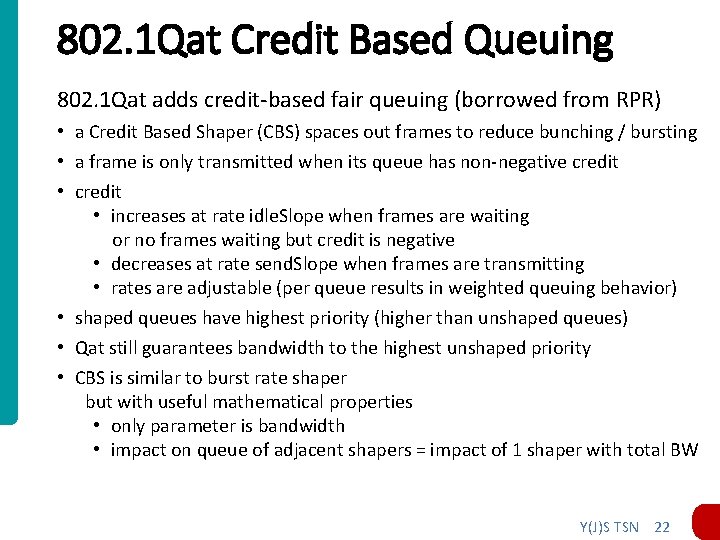
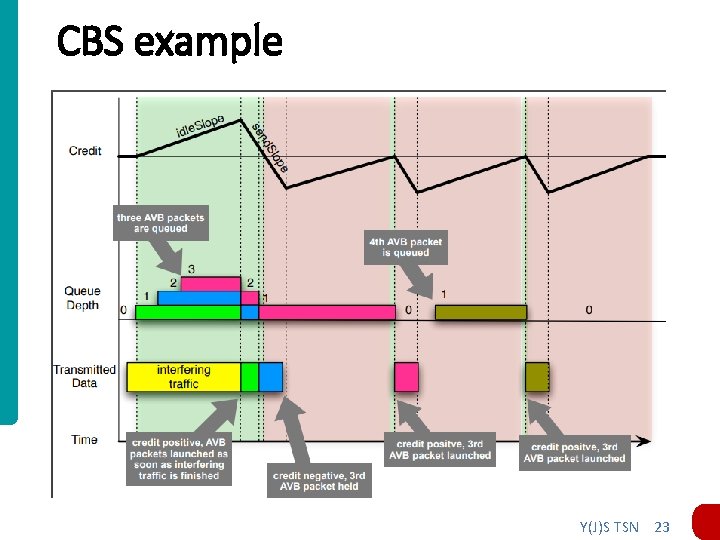
802. 1 Qat Credit Based Queuing 802. 1 Qat adds credit-based fair queuing (borrowed from RPR) • a Credit Based Shaper (CBS) spaces out frames to reduce bunching / bursting • a frame is only transmitted when its queue has non-negative credit • credit • increases at rate idle. Slope when frames are waiting or no frames waiting but credit is negative • decreases at rate send. Slope when frames are transmitting • rates are adjustable (per queue results in weighted queuing behavior) • shaped queues have highest priority (higher than unshaped queues) • Qat still guarantees bandwidth to the highest unshaped priority • CBS is similar to burst rate shaper but with useful mathematical properties • only parameter is bandwidth • impact on queue of adjacent shapers = impact of 1 shaper with total BW Y(J)S TSN 22
CBS example Y(J)S TSN 23
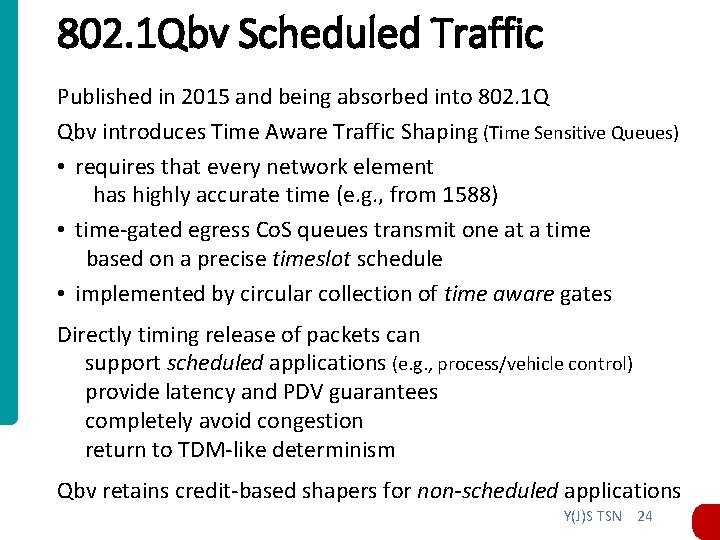
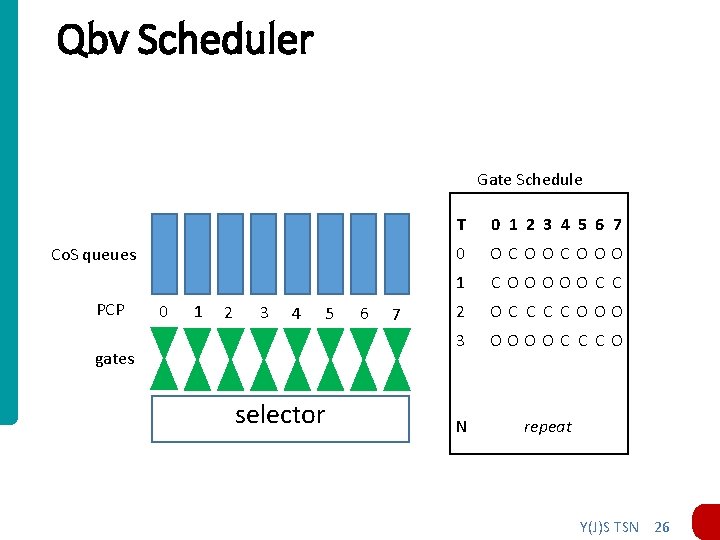
802. 1 Qbv Scheduled Traffic Published in 2015 and being absorbed into 802. 1 Q Qbv introduces Time Aware Traffic Shaping (Time Sensitive Queues) • requires that every network element has highly accurate time (e. g. , from 1588) • time-gated egress Co. S queues transmit one at a time based on a precise timeslot schedule • implemented by circular collection of time aware gates Directly timing release of packets can support scheduled applications (e. g. , process/vehicle control) provide latency and PDV guarantees completely avoid congestion return to TDM-like determinism Qbv retains credit-based shapers for non-scheduled applications Y(J)S TSN 24
Time Sensitive Queues In Qbv all Co. S queues (not just the TSN queues) are cyclically gated so non-TSN traffic is also released in timeslots Qbv generally results in bursts of packets belonging to a stream Timeslot schedules are dynamically computed by a centralized management system that configures the network nodes using SRP Schedules are specified with up to 1 ns granularity (although implementations may be less precise) thus PDV can be reduced to about 1 ns Schedules might require guard times between TSN timeslots unless preemption is used Y(J)S TSN 25
Qbv Scheduler Gate Schedule Co. S queues PCP 0 1 2 3 4 5 gates selector 6 7 T 0 1 2 3 4 5 6 7 0 OCOOCOOO 1 COOOOOC C 2 OC C C COOO 3 OOOOC C CO N repeat Y(J)S TSN 26
802. 1 AS-REV How do we synchronize all the network elements ? In general, TSN assumes that all time sensitive elements are sync’ed to a PTP-synchronized clock 802. 1 AS (produced by AVB TG) is a profile of IEEE 1588 The new revision of 802. 1 AS includes enhancements: • • • multiple synchronization domains common peer delay for multiple domains support for 802. 11 Fine Timing Measurement (FTM) support for 802. 1 AX LAG improved scalability support for 1588 1 -step improved support for long chains, rings more responsive faster GM change over reduced BMCA convergence time configure redundant paths and redundant GMs Y(J)S TSN 27
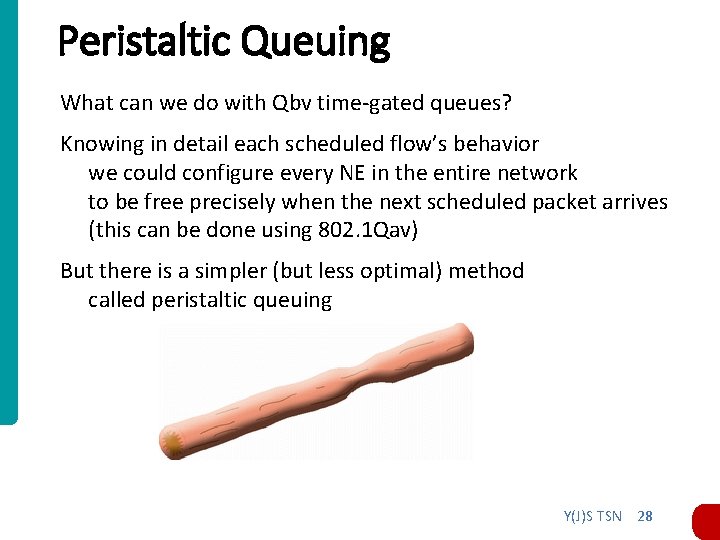
Peristaltic Queuing What can we do with Qbv time-gated queues? Knowing in detail each scheduled flow’s behavior we could configure every NE in the entire network to be free precisely when the next scheduled packet arrives (this can be done using 802. 1 Qav) But there is a simpler (but less optimal) method called peristaltic queuing Y(J)S TSN 28
802. 1 Qci/Qch Cycling Queuing 802. 1 Q-2018 Annex Q (CQF, formerly called peristaltic shaping) Exploits accurate timing to provide without intricate signaling defined (nonoptimal) upper latency bound Each switch collects frames according to PCP and forwards all packets of the same traffic class in one cycle Maximum bytes allowed per clock cycle configured by SRP Y(J)S TSN 29
802. 1 Qat SRP Stream Reservation Protocol is similar to RSVP or RSVP-TE in that it reserves network resources for flows and uses a Traffic Specification (Tspec) 802. 1 Qat published in 2010, absorbed into 802. 1 Q-2011 SRP is used to configure all of the TSN features SRP is based on the Multiple Reservation Protocol (802. 1 Qak) like MVRP (Multiple VLAN Registration Protocol) and MMRP (Multiple MAC Registration Protocol) SRP specifies the required resources and enables their dynamic maintenance and facilitates registration, deregistration, and retention of resource reservation information in relevant network elements • Talker Declarations are distributed along the path(s) to Listeners • Listener Declarations run back and actually reserve resources Y(J)S TSN 30
802. 1 Qcc SRP 802. 1 Qcc proposes enhancements to SRP as defined by Qat • support for 1000 s of streams • configurable SR (stream reservation) classes and streams • reduce chattiness • reduce CPU load for handling SRP • supports L 2 but probably won’t support L 3 (Det. Net) streaming (IETF has other protocols) Y(J)S TSN 31
802. 1 Qav FQTSS Forwarding and Queuing Enhancements for Time-Sensitive Streams Approved by AVB TG in 2009 and is now clause 35 of 802. 1 Q-2014 • planning and admission control (CAC) based on SRP • procedures for mapping priorities to traffic classes • class A - latency ≤ 2 msec • class B - latency ≤ 50 msec • control traffic (AS and SRP) • best effort traffic • precise synchronization based on 802. 1 AS • CBS shaping of streams at source based on 802. 1 Qat • identification of non-participating devices Y(J)S TSN 32
802. 1 Qcr Asynchronous Traffic Shaping New project ATS Define an asynchronous mechanism (w/o sync’ed nodes) for constant bit data rates and full-duplex links better than CBS Bounded delays/lossless for conformant flows even in presence of non-conformant flows 2 proposals - both intermediate between CBS and CQF • paternoster algorithm • ATS algorithm Y(J)S TSN 33
802. 1 CB Frame Replication and Elimination Published in 2017 Frame Replication and Elimination for Reliability Basically a packet-by-packet 1+1 protection mechanism • no failure detection needed • insert stream ID and sequence number into every FRER frame • frames are replicated at source • duplicates are eliminated at destination Several stream identifier methods: • DA + VID • SA + VID • DA + VID + IP SA + IP DA + DSCP +. . . Several sequence number methods: • new L 2 sequence number tag for Ethernet frames • HSR or PRP sequence numbers • Ethernet PW sequence numbers Y(J)S TSN 34
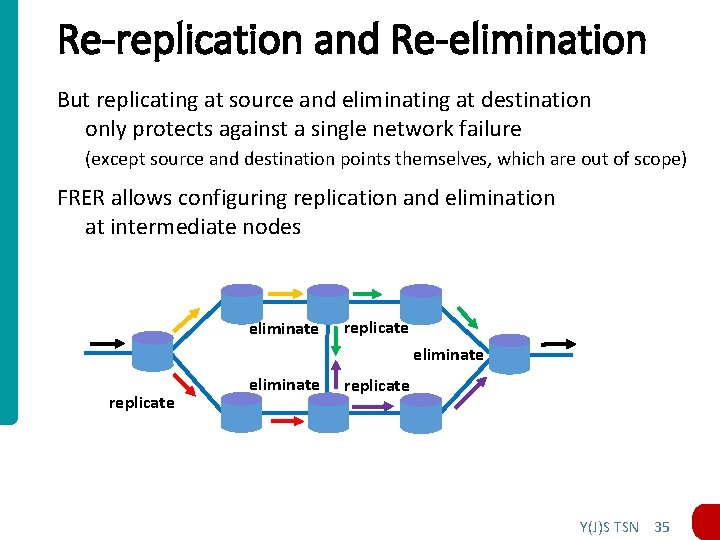
Re-replication and Re-elimination But replicating at source and eliminating at destination only protects against a single network failure (except source and destination points themselves, which are out of scope) FRER allows configuring replication and elimination at intermediate nodes eliminate replicate Y(J)S TSN 35
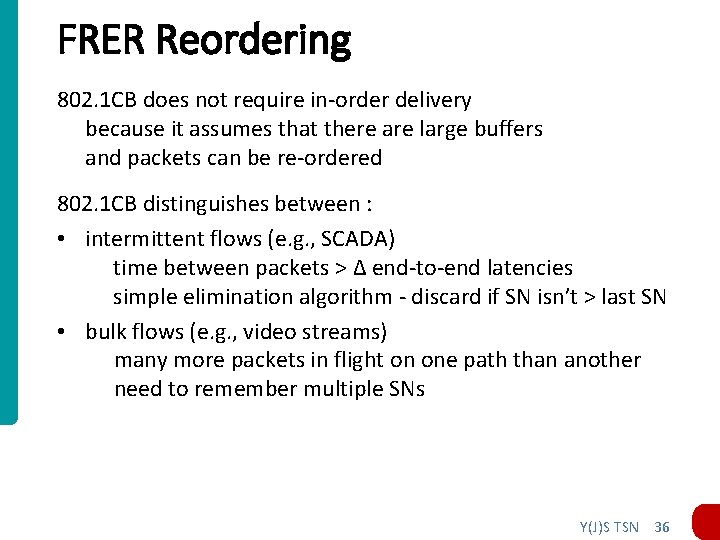
FRER Reordering 802. 1 CB does not require in-order delivery because it assumes that there are large buffers and packets can be re-ordered 802. 1 CB distinguishes between : • intermittent flows (e. g. , SCADA) time between packets > Δ end-to-end latencies simple elimination algorithm - discard if SN isn’t > last SN • bulk flows (e. g. , video streams) many more packets in flight on one path than another need to remember multiple SNs Y(J)S TSN 36
802. 1 Qca Path control and reservation Published in 2015 and being absorbed into 802. 1 Q Defines IS-IS extensions to enable the multiple paths required by 802. 1 CB FREF Redundancy paths are computed and distributed throughout the network Paths can be completely (explicitly) pinned or loosely pinned (only to certain points) Paths can be specified using metrics not usually used forwarding Includes algorithms for finding multiple maximally disjoint paths according to various criteria Y(J)S TSN 37
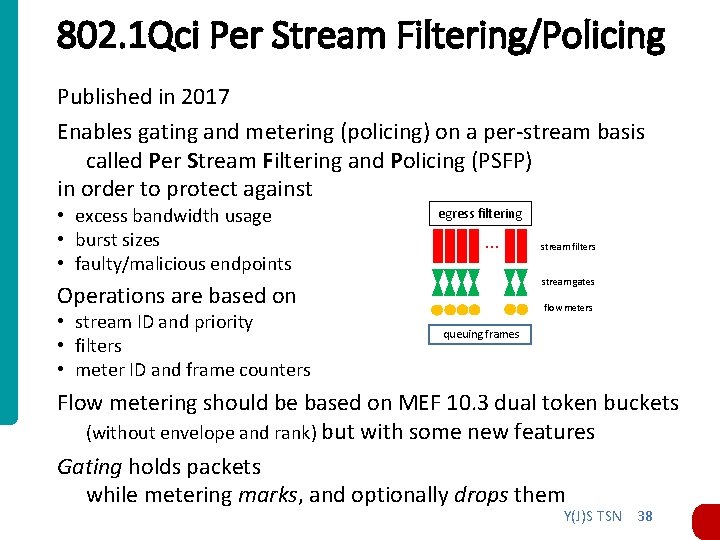
802. 1 Qci Per Stream Filtering/Policing Published in 2017 Enables gating and metering (policing) on a per-stream basis called Per Stream Filtering and Policing (PSFP) in order to protect against • excess bandwidth usage • burst sizes • faulty/malicious endpoints egress filtering . . . stream gates Operations are based on • stream ID and priority • filters • meter ID and frame counters stream filters flow meters queuing frames Flow metering should be based on MEF 10. 3 dual token buckets (without envelope and rank) but with some new features Gating holds packets while metering marks, and optionally drops them Y(J)S TSN 38
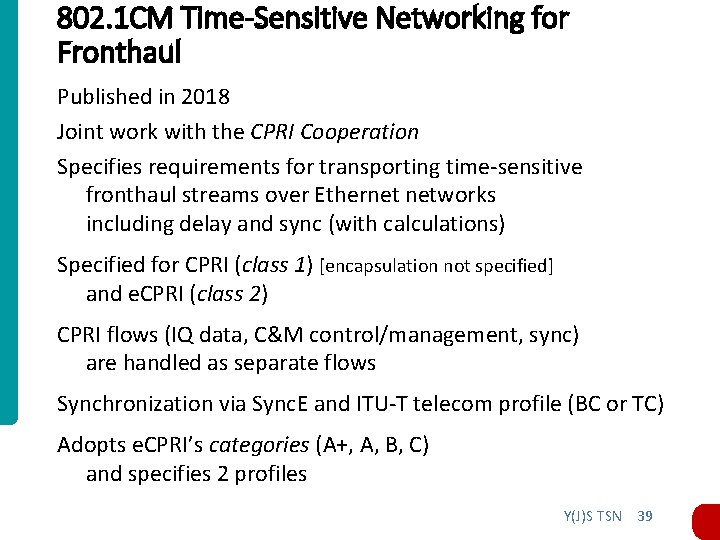
802. 1 CM Time-Sensitive Networking for Fronthaul Published in 2018 Joint work with the CPRI Cooperation Specifies requirements for transporting time-sensitive fronthaul streams over Ethernet networks including delay and sync (with calculations) Specified for CPRI (class 1) [encapsulation not specified] and e. CPRI (class 2) CPRI flows (IQ data, C&M control/management, sync) are handled as separate flows Synchronization via Sync. E and ITU-T telecom profile (BC or TC) Adopts e. CPRI’s categories (A+, A, B, C) and specifies 2 profiles Y(J)S TSN 39
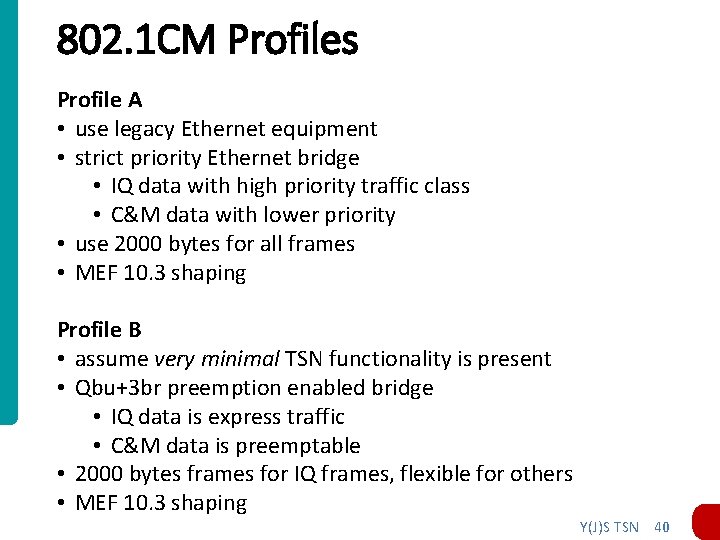
802. 1 CM Profiles Profile A • use legacy Ethernet equipment • strict priority Ethernet bridge • IQ data with high priority traffic class • C&M data with lower priority • use 2000 bytes for all frames • MEF 10. 3 shaping Profile B • assume very minimal TSN functionality is present • Qbu+3 br preemption enabled bridge • IQ data is express traffic • C&M data is preemptable • 2000 bytes frames for IQ frames, flexible for others • MEF 10. 3 shaping Y(J)S TSN 40
Thanks for listening Y(J)S TSN 41