
Tsinghua University School of Economics and Management The
- Slides: 34
Tsinghua University School of Economics and Management The Chinese Economy: Current Status, Outstanding Issues, and Mega-Trends David D. Li Tsinghua University April 21, 2008 Tsinghua SEM slide 0
Three topics 1. Fundamental features of today’s Chinese economy and society -- A Martian’s perception of today’s China 2. Challenges for sustainable development of China 3. Mega-trends of the Chinese economy and society April 21, 2008 Tsinghua SEM slide 1
1. Fundamental Features of Today’s Chinese Economy and Society April 21, 2008 Tsinghua SEM slide 2
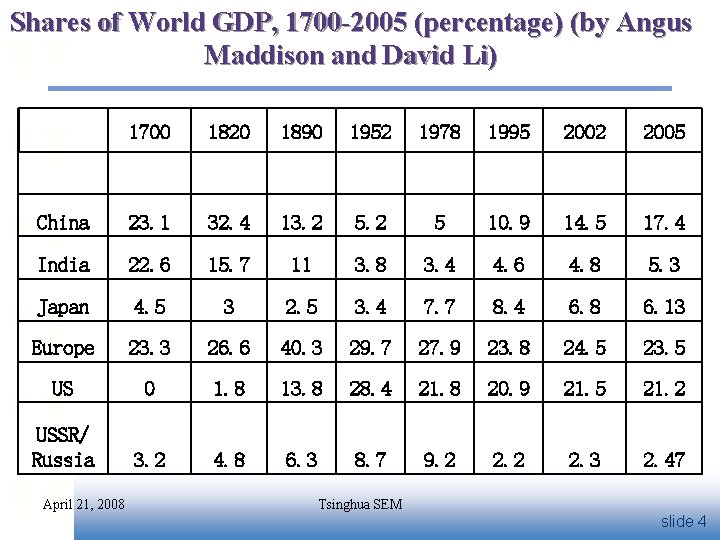
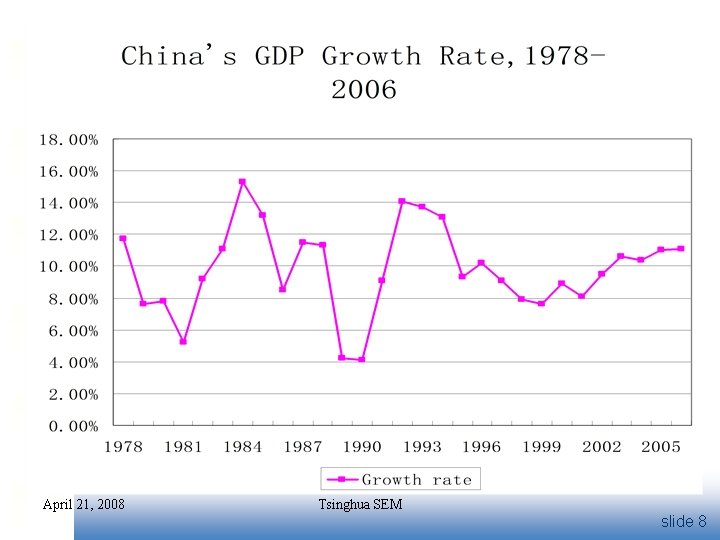
1. Rapid Socio-Economic Development of Historical Magnitude § China has become an economic power in the world – 1/7 or 1/6 of the U. S. (roughly that of California); – By real purchasing power of Chinese RMB, the Chinese economy is already No. 2; – China has become top 3 production and/or consumption country of many goods and services. § Implication: ¼ of the world’s business will be here in greater China April 21, 2008 Tsinghua SEM slide 3
Shares of World GDP, 1700 -2005 (percentage) (by Angus Maddison and David Li) 1700 1820 1890 1952 1978 1995 2002 2005 China 23. 1 32. 4 13. 2 5 10. 9 14. 5 17. 4 India 22. 6 15. 7 11 3. 8 3. 4 4. 6 4. 8 5. 3 Japan 4. 5 3 2. 5 3. 4 7. 7 8. 4 6. 8 6. 13 Europe 23. 3 26. 6 40. 3 29. 7 27. 9 23. 8 24. 5 23. 5 US 0 1. 8 13. 8 28. 4 21. 8 20. 9 21. 5 21. 2 USSR/ Russia 3. 2 4. 8 6. 3 8. 7 9. 2 2. 3 2. 47 April 21, 2008 Tsinghua SEM slide 4
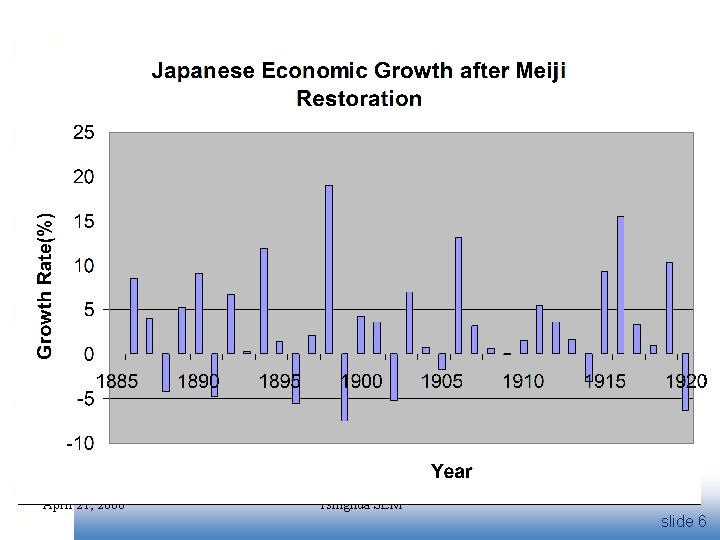
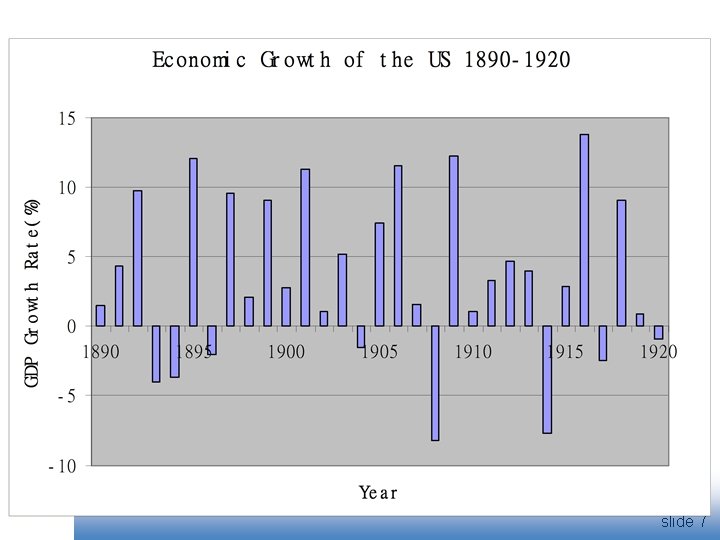
Comparable Historical Precedence 1. The emergence of the US 1890-1920 2. The rise of modern Japan after Meiji restoration (1870-1900) 3. By comparison, China’s economic emergence has been much less volatile April 21, 2008 Tsinghua SEM slide 5
April 21, 2008 Tsinghua SEM slide 6
April 21, 2008 Tsinghua SEM slide 7
April 21, 2008 Tsinghua SEM slide 8
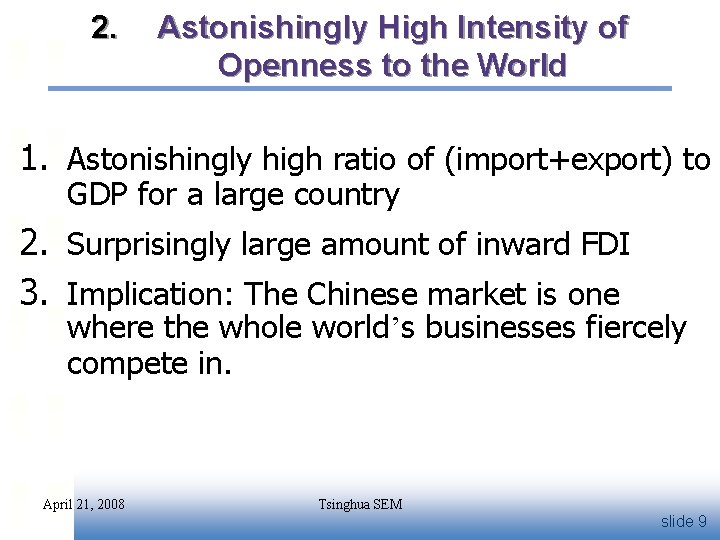
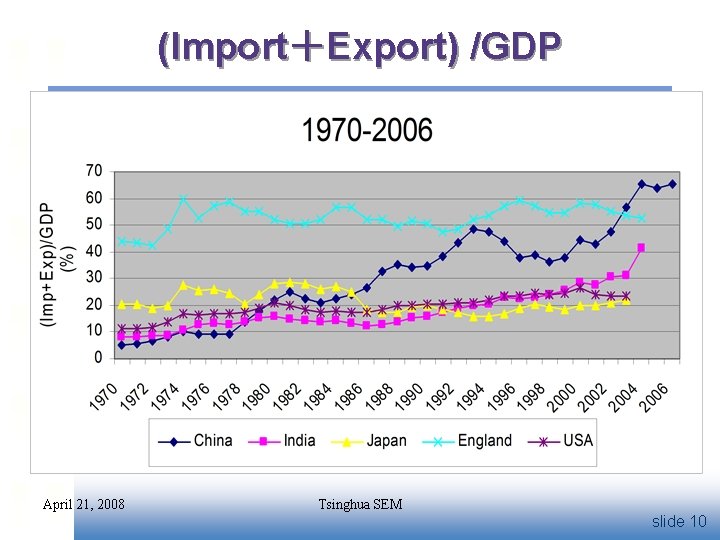
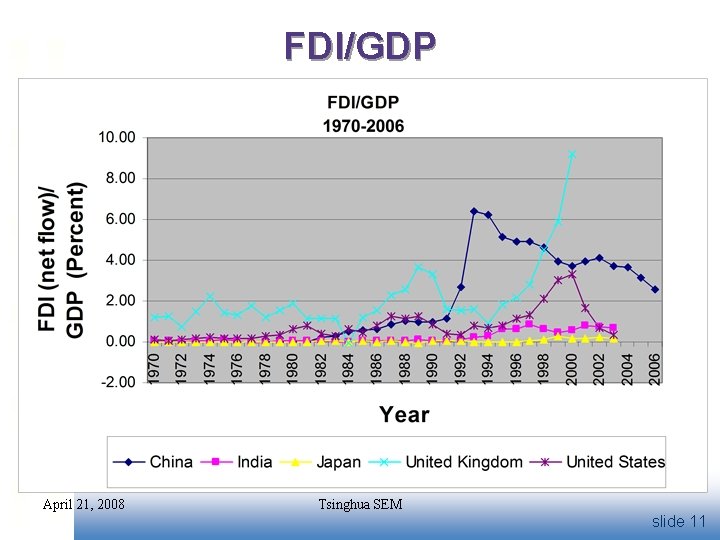
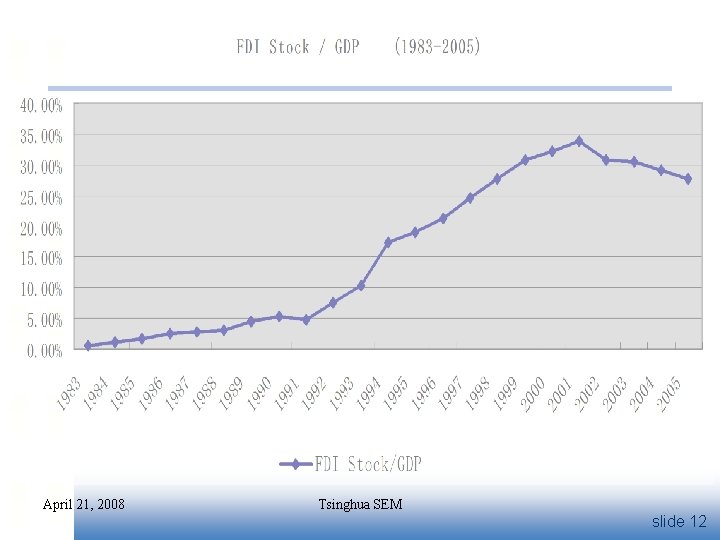
2. Astonishingly High Intensity of Openness to the World 1. Astonishingly high ratio of (import+export) to GDP for a large country 2. Surprisingly large amount of inward FDI 3. Implication: The Chinese market is one where the whole world’s businesses fiercely compete in. April 21, 2008 Tsinghua SEM slide 9
(Import+Export) /GDP April 21, 2008 Tsinghua SEM slide 10
FDI/GDP April 21, 2008 Tsinghua SEM slide 11
April 21, 2008 Tsinghua SEM slide 12
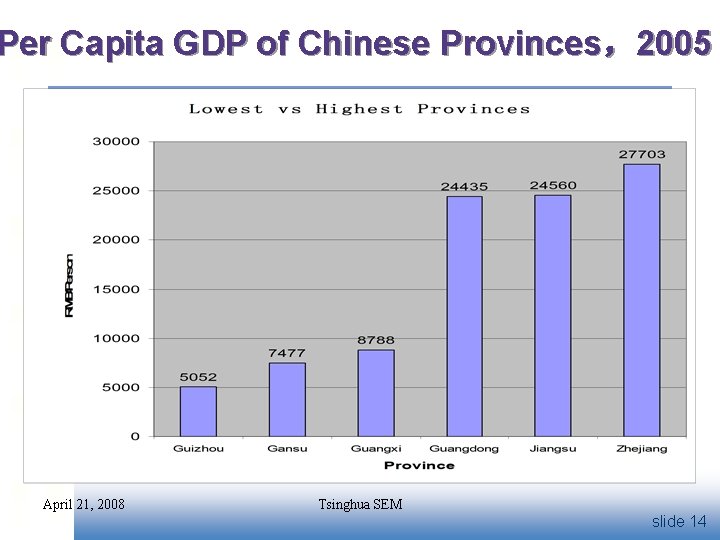
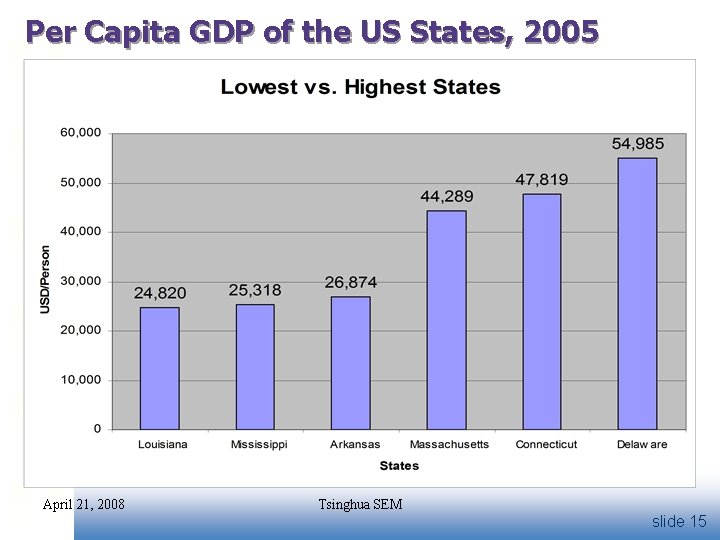
3. Tremendous Inter-regional Disparities 1. Large countries like China and the U. S. naturally have huge regional disparities; 2. But in China, these are much bigger due to the incomplete market reform E. g. Segmented markets: Restrictions on factor flow, including migration; 3. Implication: Think of China as consisting of 30 plus large economies and markets. April 21, 2008 Tsinghua SEM slide 13
Per Capita GDP of Chinese Provinces,2005 April 21, 2008 Tsinghua SEM slide 14
Per Capita GDP of the US States, 2005 April 21, 2008 Tsinghua SEM slide 15
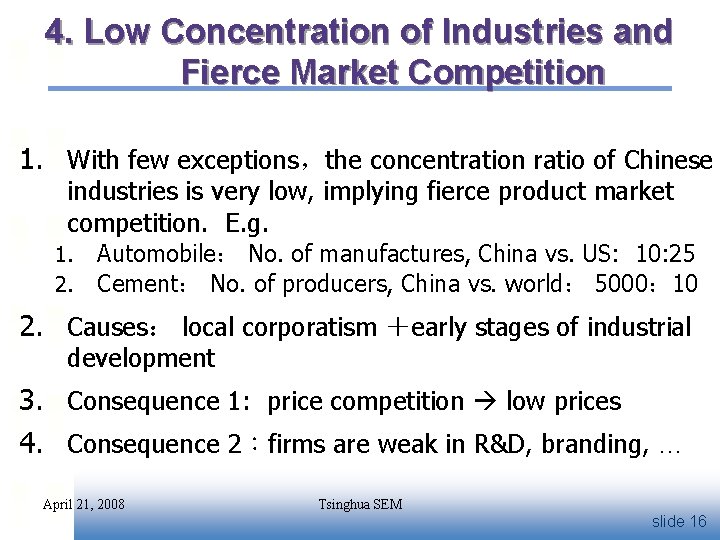
4. Low Concentration of Industries and Fierce Market Competition 1. With few exceptions,the concentration ratio of Chinese industries is very low, implying fierce product market competition. E. g. 1. 2. Automobile: No. of manufactures, China vs. US: 10: 25 Cement: No. of producers, China vs. world: 5000: 10 2. Causes: local corporatism +early stages of industrial development 3. Consequence 1: price competition low prices 4. Consequence 2:firms are weak in R&D, branding, … April 21, 2008 Tsinghua SEM slide 16
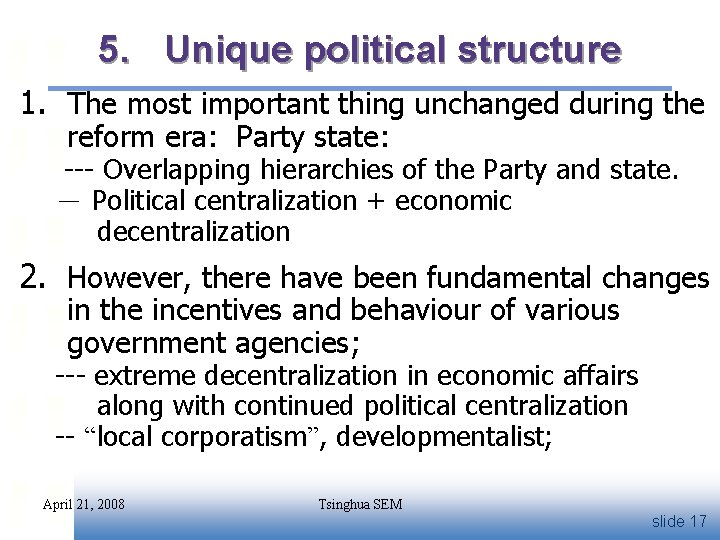
5. Unique political structure 1. The most important thing unchanged during the reform era: Party state: --- Overlapping hierarchies of the Party and state. - Political centralization + economic decentralization 2. However, there have been fundamental changes in the incentives and behaviour of various government agencies; --- extreme decentralization in economic affairs along with continued political centralization -- “local corporatism”, developmentalist; April 21, 2008 Tsinghua SEM slide 17
2. Challenges for China’s sustained development in the global economy April 21, 2008 Tsinghua SEM slide 18
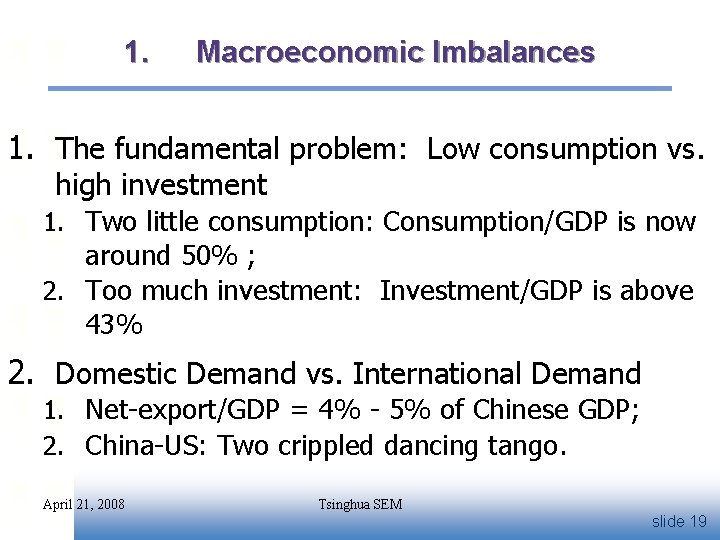
1. Macroeconomic Imbalances 1. The fundamental problem: Low consumption vs. high investment 1. Two little consumption: Consumption/GDP is now around 50% ; 2. Too much investment: Investment/GDP is above 43% 2. Domestic Demand vs. International Demand 1. Net-export/GDP = 4% - 5% of Chinese GDP; 2. China-US: Two crippled dancing tango. April 21, 2008 Tsinghua SEM slide 19
2. Social tensions 1. Social tensions are mounting: Income disparities are increasing; perceived unfairness is increasing 2. Fairness of reform has often been a serious issue: E. g. Managers illegally or immorally acquired state property? April 21, 2008 Tsinghua SEM slide 20
3. Unfitting financial system 1. Huge amount savings are concentrated in the banking sector -- M 2/GDP >175%, a world record 2. Relative small size of the securities and insurance market -- Consequences: High prices of securities asset bubbles - major financial risks are present. April 21, 2008 Tsinghua SEM slide 21
Trade disputes and better positioning in the global economy 4. 1. Continuous trade disputes -- already No. 1 target of trade disputes; 2. Two kinds of disputes 1. Industry/firm specific; 2. economy wide. April 21, 2008 Tsinghua SEM slide 22
5. The barrier of raw material and energy supply 1. The Chinese economy has already been facing the bottleneck of natural resources and energy supply 2. The Chinese economy has already become the world’s leading importer of raw material and energy 1. China has very low per capita natural resources reserve 2. Need to wage a new industrial revolution April 21, 2008 Tsinghua SEM slide 23
Import/Consumption of major raw materials April 21, 2008 Tsinghua SEM slide 24
April 21, 2008 Tsinghua SEM slide 25
3. Mega-trends of the Chinese economy April 21, 2008 Tsinghua SEM slide 26
1. Urbanization and the emergence of mega cities 1. Urbanization will speed up: China has reached the stage of very rapid urbanization 2. Clusters of mega cities (with over 20 million population) will emerge in China: 1. Resources constraints; 2. Cultural factors. 3. Relevant technology and organizations will appear 4. Multiple implications for the fashion and luxury industries April 21, 2008 Tsinghua SEM slide 27
2. A new geography of economic development 1. There will be a few super large economic clusters across China 2. Some area may shrink in GDP 3. Corporate development strategy needs to take this into account April 21, 2008 Tsinghua SEM slide 28
3. The service sector will be the fastest growing segment in China 1. Currently it is only 38%; 2. Economic development implies increasing share of the service sector; 3. China’s service sector will be even more important than that in other economies: 1. Mega cities 2. Resource constrained economy April 21, 2008 Tsinghua SEM slide 29
4. Large scale industrial re-organization and China-based large multinationals 1. The concentration of Chinese industries will increase 2. Industrial reorganization is inevitable 3. Winners are large corporations including multinational, some of which are China-based April 21, 2008 Tsinghua SEM slide 30
5. China will be one of the world’s largest international investors 1. The savings rate of the economy will be persistently high. Two major reasons: 1. Relatively young population; 2. The emergence of the middle class. 2. Investing overseas is inevitable 3. Most likely features of China’s overseas investment: • Portfolio investment > direct investment April 21, 2008 Tsinghua SEM slide 31
6. RMB will become an international currency 1. Reasons:Large size of: GDP+International trade +overseas investment 2. The road to internationalization of the RMB:RMB debt issued overseas RMB settlement of trade complete convertibility of RMB 3. Implications:Chinese monetary policies will have international impact and will have to be coordinated with the world major economies April 21, 2008 Tsinghua SEM slide 32
Take-home Messages 1. The path of China’s economic emergence is very different from those of the developed West; 2. A few mega-trends have already revealed themselves, implying business opportunities. April 21, 2008 Tsinghua SEM slide 33