
Tsallis Interperation in Heavyion HI Physics Ming Shao
- Slides: 22
Tsallis Interperation in Heavy-ion (HI) Physics Ming Shao, Zebo Tang, Yi Li, Zhangbu Xu CPPT/USTC l Introduction & Motivation Why and how to implement Tsallis statistics in Blast-Wave framework l Results − strange hadrons vs. light hadrons − beam energy dependence −J/y radial flow l Conclusion l Nan. Chang, April 19, 2010 1
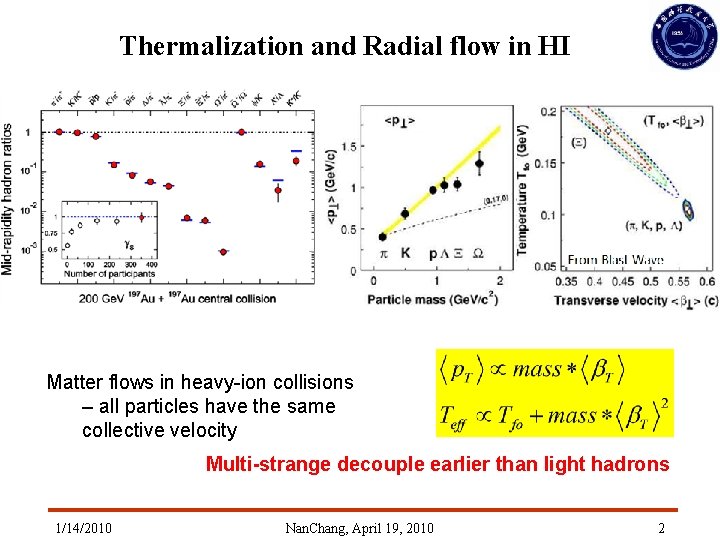
Thermalization and Radial flow in HI Matter flows in heavy-ion collisions – all particles have the same collective velocity Multi-strange decouple earlier than light hadrons 1/14/2010 Nan. Chang, April 19, 2010 2
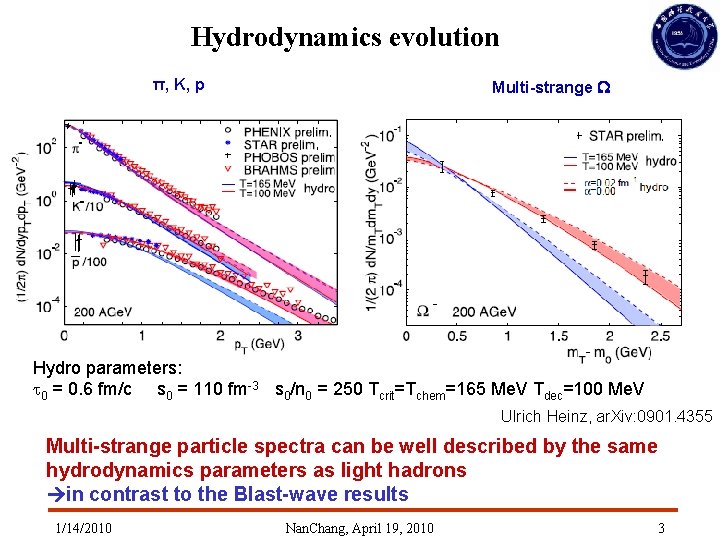
Hydrodynamics evolution π, K, p Multi-strange W Hydro parameters: 0 = 0. 6 fm/c s 0 = 110 fm-3 s 0/n 0 = 250 Tcrit=Tchem=165 Me. V Tdec=100 Me. V Ulrich Heinz, ar. Xiv: 0901. 4355 Multi-strange particle spectra can be well described by the same hydrodynamics parameters as light hadrons in contrast to the Blast-wave results 1/14/2010 Nan. Chang, April 19, 2010 3
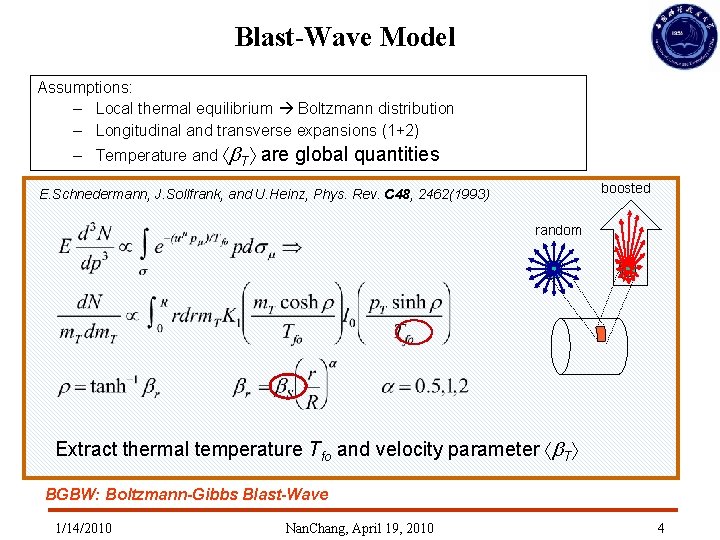
Blast-Wave Model Assumptions: – Local thermal equilibrium Boltzmann distribution – Longitudinal and transverse expansions (1+2) – Temperature and T are global quantities boosted E. Schnedermann, J. Sollfrank, and U. Heinz, Phys. Rev. C 48, 2462(1993) random Extract thermal temperature Tfo and velocity parameter T BGBW: Boltzmann-Gibbs Blast-Wave 1/14/2010 Nan. Chang, April 19, 2010 4
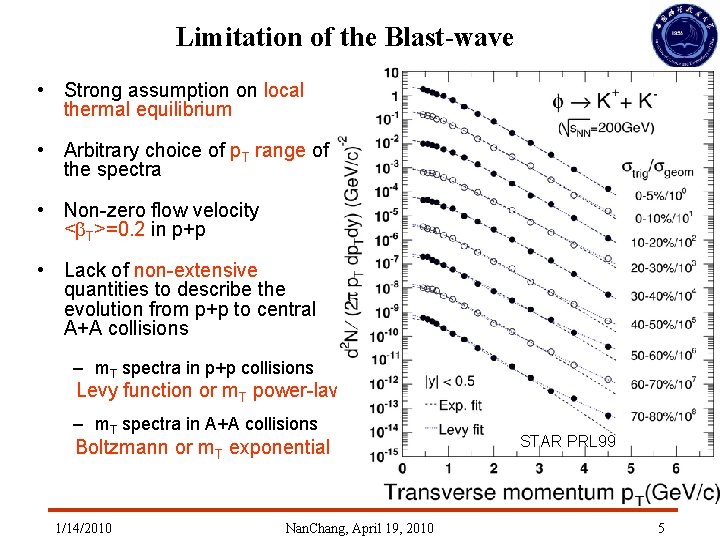
Limitation of the Blast-wave • Strong assumption on local thermal equilibrium • Arbitrary choice of p. T range of the spectra STAR PRC 71 (2005) 64902 Au. Au@200 Ge. V • Non-zero flow velocity <b. T>=0. 2 in p+p • Lack of non-extensive quantities to describe the evolution from p+p to central A+A collisions pp@200 Ge. V minbias – m. T spectra in p+p collisions Levy function or m. T power-law – m. T spectra in A+A collisions Boltzmann or m. T exponential 1/14/2010 Nan. Chang, April 19, 2010 STAR PRL 99 5
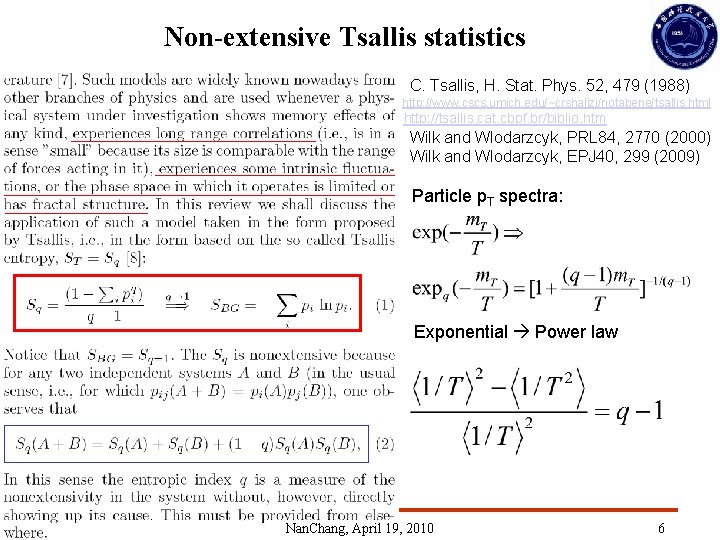
Non-extensive Tsallis statistics C. Tsallis, H. Stat. Phys. 52, 479 (1988) http: //www. cscs. umich. edu/~crshalizi/notabene/tsallis. html http: //tsallis. cat. cbpf. br/biblio. htm Wilk and Wlodarzcyk, PRL 84, 2770 (2000) Wilk and Wlodarzcyk, EPJ 40, 299 (2009) Particle p. T spectra: Exponential Power law 1/14/2010 Nan. Chang, April 19, 2010 6
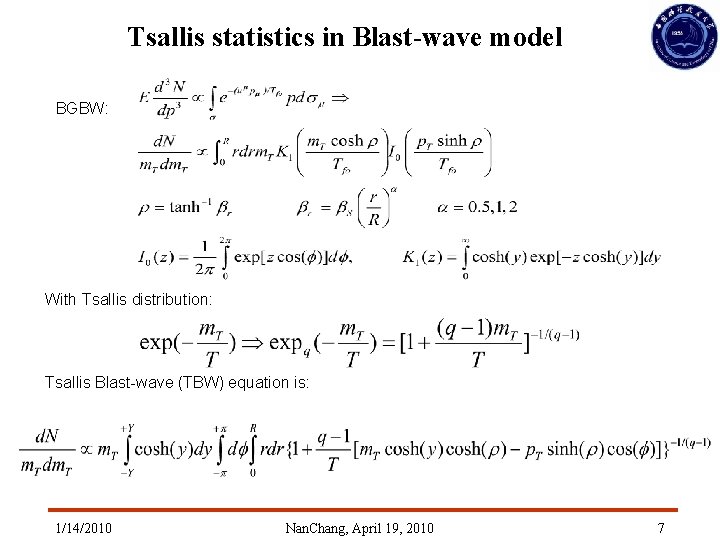
Tsallis statistics in Blast-wave model BGBW: With Tsallis distribution: Tsallis Blast-wave (TBW) equation is: 1/14/2010 Nan. Chang, April 19, 2010 7
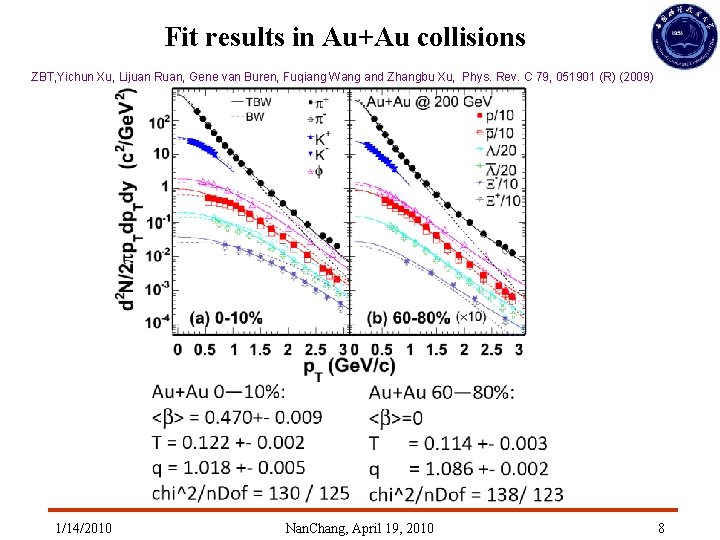
Fit results in Au+Au collisions ZBT, Yichun Xu, Lijuan Ruan, Gene van Buren, Fuqiang Wang and Zhangbu Xu, Phys. Rev. C 79, 051901 (R) (2009) 1/14/2010 Nan. Chang, April 19, 2010 8
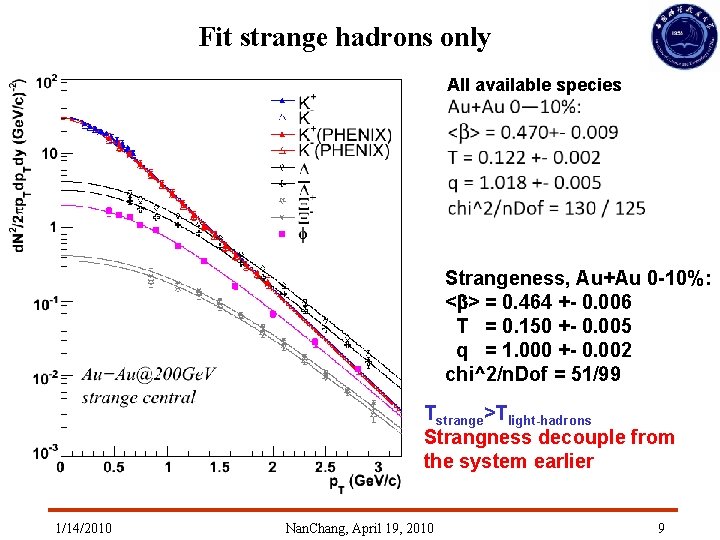
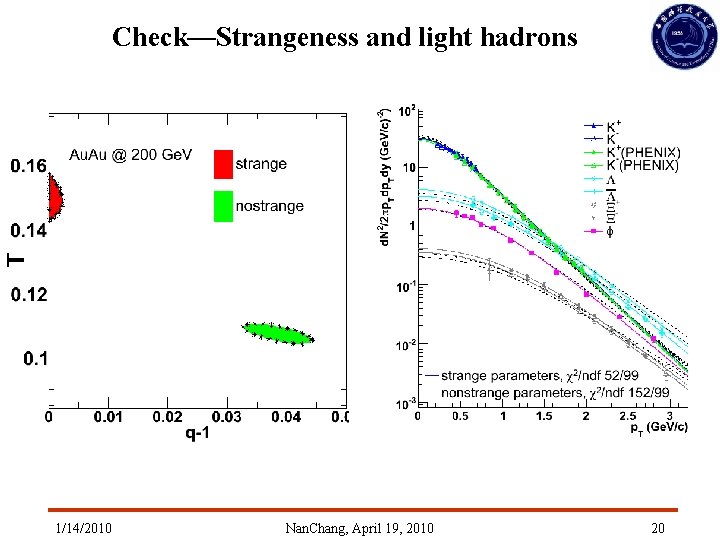
Fit strange hadrons only All available species Strangeness, Au+Au 0 -10%: <b> = 0. 464 +- 0. 006 T = 0. 150 +- 0. 005 q = 1. 000 +- 0. 002 chi^2/n. Dof = 51/99 Tstrange>Tlight-hadrons Strangness decouple from the system earlier 1/14/2010 Nan. Chang, April 19, 2010 9
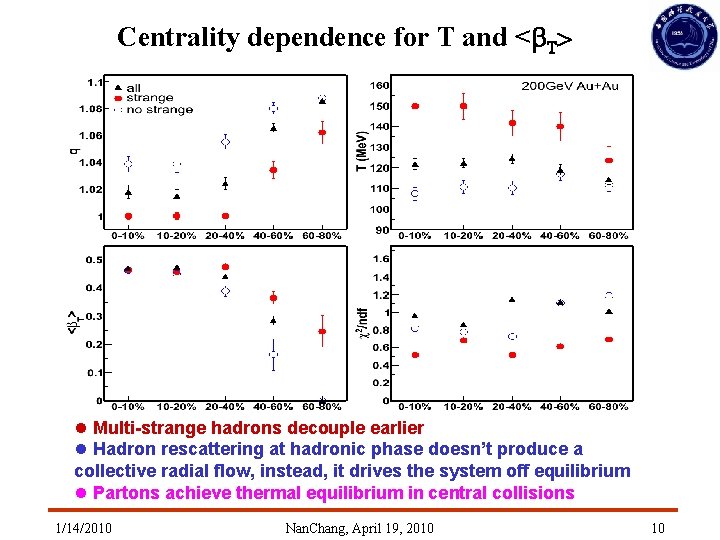
Centrality dependence for T and <b. T> l Multi-strange hadrons decouple earlier l Hadron rescattering at hadronic phase doesn’t produce a collective radial flow, instead, it drives the system off equilibrium l Partons achieve thermal equilibrium in central collisions 1/14/2010 Nan. Chang, April 19, 2010 10
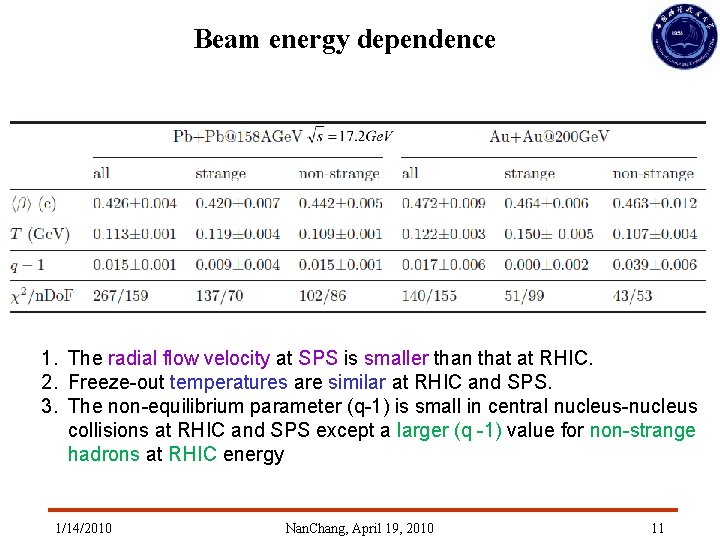
Beam energy dependence 1. The radial flow velocity at SPS is smaller than that at RHIC. 2. Freeze-out temperatures are similar at RHIC and SPS. 3. The non-equilibrium parameter (q-1) is small in central nucleus-nucleus collisions at RHIC and SPS except a larger (q -1) value for non-strange hadrons at RHIC energy 1/14/2010 Nan. Chang, April 19, 2010 11
How about heavy hadrons? 1/14/2010 Nan. Chang, April 19, 2010 12
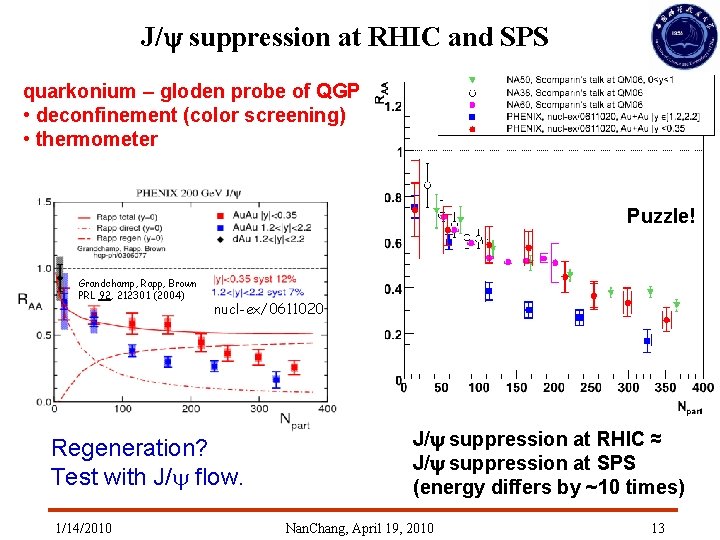
J/y suppression at RHIC and SPS quarkonium – gloden probe of QGP • deconfinement (color screening) • thermometer Puzzle! Grandchamp, Rapp, Brown PRL 92, 212301 (2004) nucl-ex/0611020 Regeneration? Test with J/y flow. 1/14/2010 J/y suppression at RHIC ≈ J/y suppression at SPS (energy differs by ~10 times) Nan. Chang, April 19, 2010 13
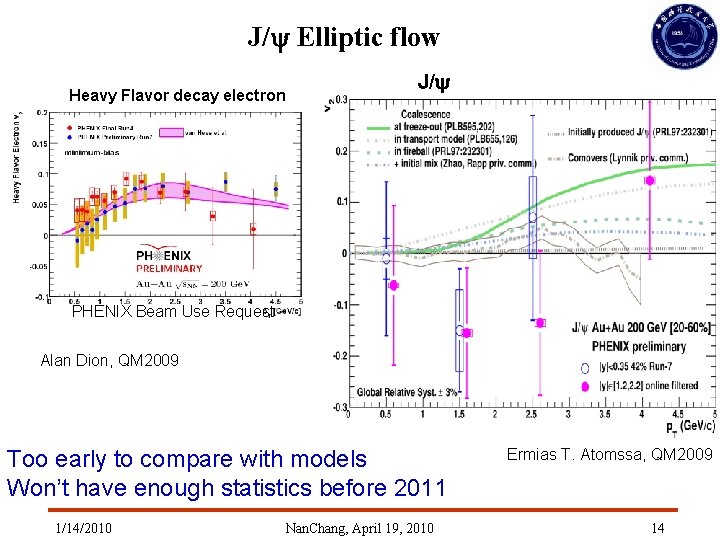
J/y Elliptic flow Heavy Flavor decay electron J/y PHENIX Beam Use Request Alan Dion, QM 2009 Too early to compare with models Won’t have enough statistics before 2011 1/14/2010 Nan. Chang, April 19, 2010 Ermias T. Atomssa, QM 2009 14
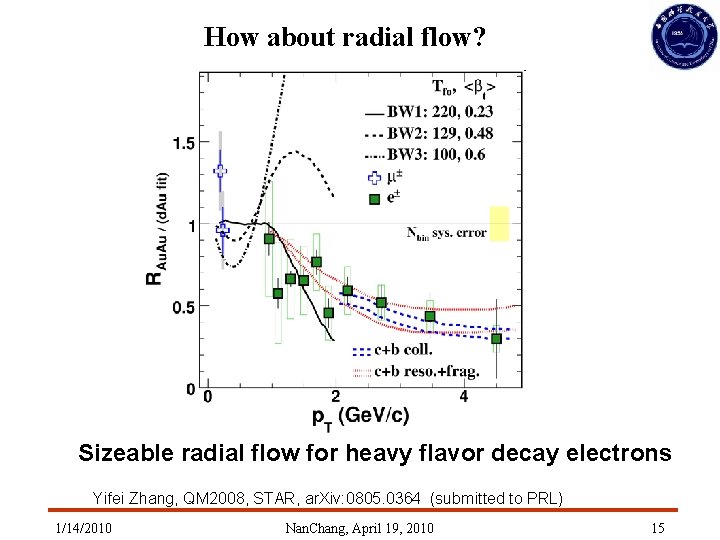
How about radial flow? Sizeable radial flow for heavy flavor decay electrons Yifei Zhang, QM 2008, STAR, ar. Xiv: 0805. 0364 (submitted to PRL) 1/14/2010 Nan. Chang, April 19, 2010 15
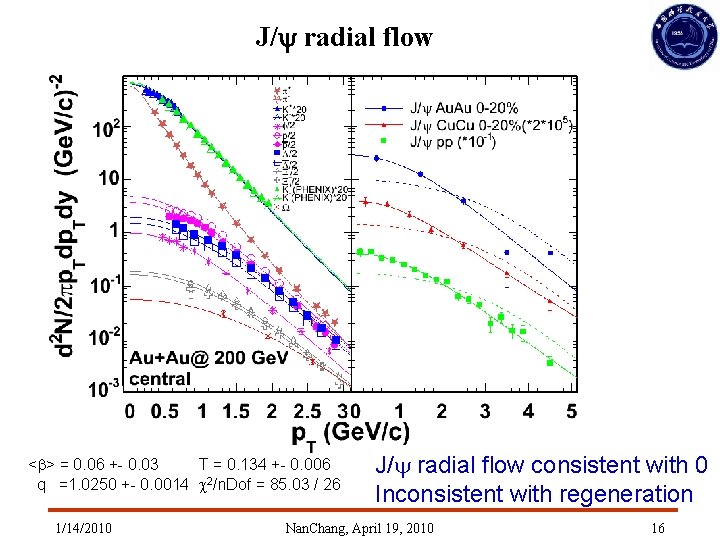
J/y radial flow <b> = 0. 06 +- 0. 03 T = 0. 134 +- 0. 006 q =1. 0250 +- 0. 0014 c 2/n. Dof = 85. 03 / 26 1/14/2010 J/y radial flow consistent with 0 Inconsistent with regeneration Nan. Chang, April 19, 2010 16
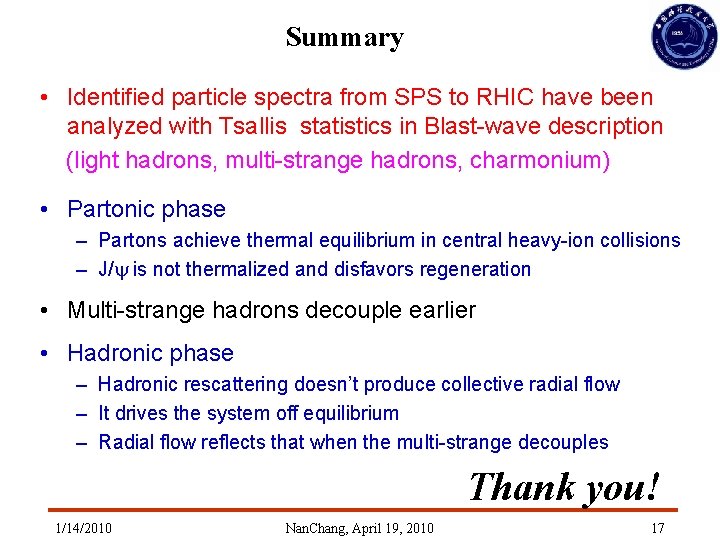
Summary • Identified particle spectra from SPS to RHIC have been analyzed with Tsallis statistics in Blast-wave description (light hadrons, multi-strange hadrons, charmonium) • Partonic phase – Partons achieve thermal equilibrium in central heavy-ion collisions – J/y is not thermalized and disfavors regeneration • Multi-strange hadrons decouple earlier • Hadronic phase – Hadronic rescattering doesn’t produce collective radial flow – It drives the system off equilibrium – Radial flow reflects that when the multi-strange decouples Thank you! 1/14/2010 Nan. Chang, April 19, 2010 17
Back up 1/14/2010 Nan. Chang, April 19, 2010 18
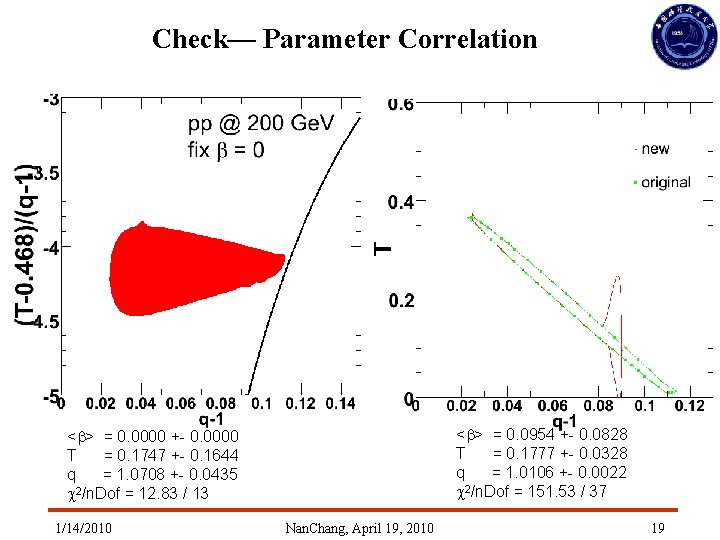
Check— Parameter Correlation <b> = 0. 0954 +- 0. 0828 T = 0. 1777 +- 0. 0328 q = 1. 0106 +- 0. 0022 c 2/n. Dof = 151. 53 / 37 <b> = 0. 0000 +- 0. 0000 T = 0. 1747 +- 0. 1644 q = 1. 0708 +- 0. 0435 2 c /n. Dof = 12. 83 / 13 1/14/2010 Nan. Chang, April 19, 2010 19
Check—Strangeness and light hadrons 1/14/2010 Nan. Chang, April 19, 2010 20
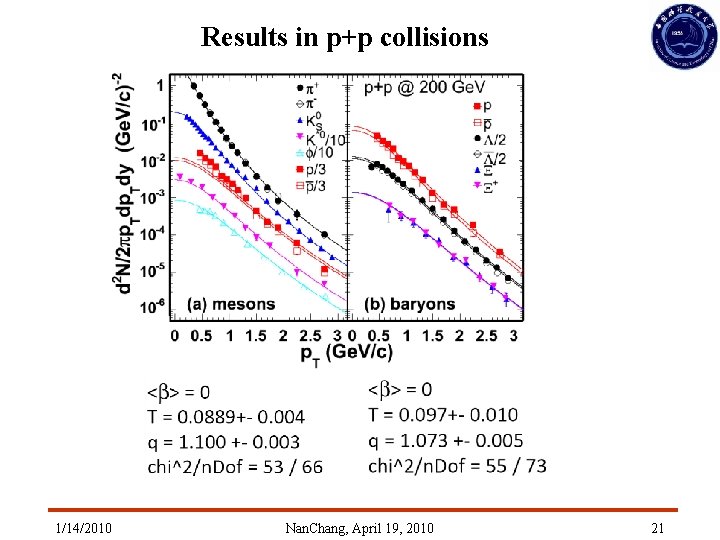
Results in p+p collisions 1/14/2010 Nan. Chang, April 19, 2010 21
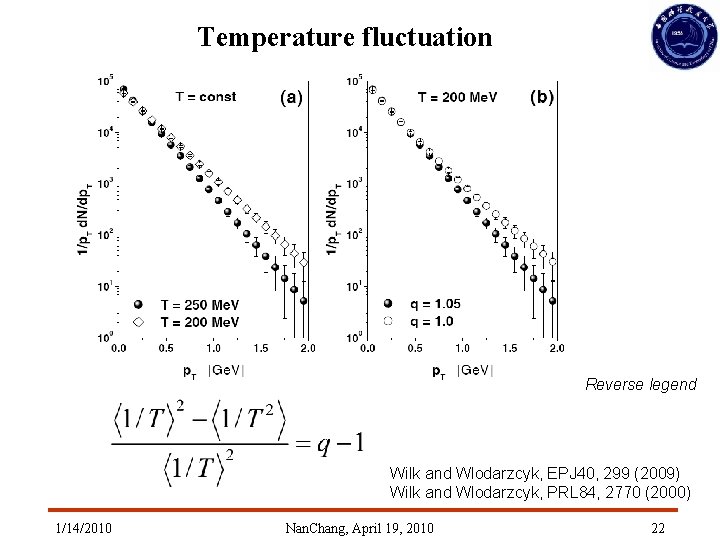
Temperature fluctuation Reverse legend Wilk and Wlodarzcyk, EPJ 40, 299 (2009) Wilk and Wlodarzcyk, PRL 84, 2770 (2000) 1/14/2010 Nan. Chang, April 19, 2010 22