
Truth Discovery and the Problem of Speech Act
Truth Discovery and the Problem of Speech Act Theory within First Amendment Interpretation C. Rodolfo Celis Paper presented at the 3 rd Biannual Meeting of the International Association of Forensic Linguists, Sept 4 -7, 1997, Duke University
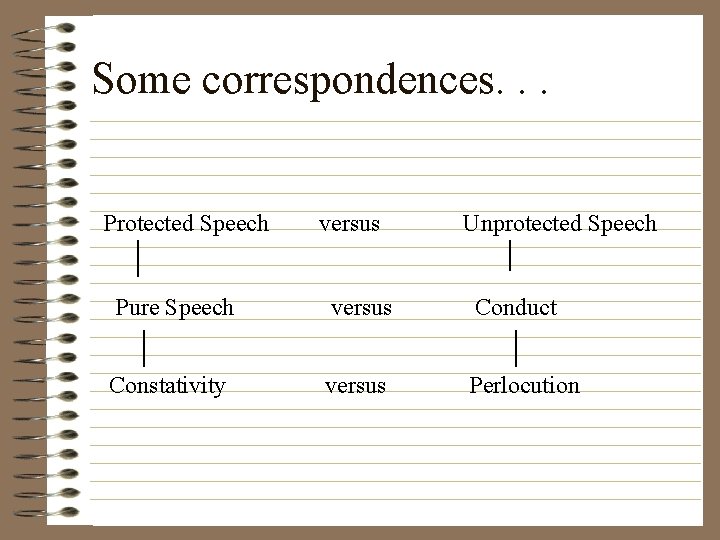
Some correspondences. . . Protected Speech versus Unprotected Speech Pure Speech versus Conduct Constativity versus Perlocution
Bolinger (1972) • “A taste of truth is like a taste of blood. The subject should never have been brought up at all. Now that it has, truth is in the headlines, pushed there by the two-way struggle between governors and governed, each bent on finding out about the other – the governors to sniff out our private feelings, which could pose a threat to our control; the governed to know the decisions that affect them, but of which they may not be the beneficiaries. The medium of all this knowing is language, and linguists are in the line of fire. ”

Some Important First Amendment Cases • • Schenk v. United States (1919) Chaplinksy v. New Hampshire (1942) Cohen v. California (1971) Texas v. Johnson (1989)

Austin (1958) “Performative. Constative” • “Under the heading ‘truth’ what we in fact have is, not a simple quality nor a relation, not indeed one anything, but rather a whole dimension of criticism”
True Confessions • “When is a statement true? The temptation is to answer (at least if we confine ourselves to ‘straightforward’ statements): ‘When it corresponds to the facts. ’ And as a piece of standard English this can hardly be wrong. Indeed, I must confess I do not really think it is wrong at all: theory of truth is a series of truisms. Still, it can be misleading. ”
Return to the 70’s - Context is In • “Right now the prospectors are swarming over presuppositions, higher sentences, and other things whose purpose or effect is exactly to make explicit what writers and speakers get away with in their self-serving prose. Context is in, both linguistic and social. And we have rediscovered the lexicon, including the morass of connotations, euphemisms, and general chicanery…. ”
Fighting words? • “The title of this book is an anti-title. It is designed to call attention to an increasingly popular verbal construct, ‘speech acts, ’ that I propose to delegitimize. ”
Situation-Altering Utterances • “Most linguists and philosophers of language who have dealt with speech act theory have said little about the implications of their work for freedom of speech and the First Amendment. That concern was largely left to law professor Kent Greenawalt, who adopted theory to explain and justify the multitude of exceptions to the First Amendment found in tort and criminal law. Greenawalt’s categories of speech that do not qualify for First Amendment protection are all built on the common premise that they ‘are ways of doing things, not of asserting things’ and are thus ‘subject to regulation on the same bases as most noncommunicative behavior’ that is ‘outside the scope of a principle of free speech. ’ He coins the phrase ‘situation-altering utterances, ’ which he prefers to what he regards as the broader and more ambiguous concepts of performative or illocutionary statements, and which he defines as utterances that are ‘a means for changing the social context in which we live. ’” -- Haiman on Greenawalt
Austin, HTDTWW (109) • “it is the distinction between illocutions and perlocutions which seems likeliest to give trouble”
Direct Perlocution (Austin) • “For clearly any, or almost any, perlocutionary act is liable to be brought off, in sufficiently special circumstances, by the issuing, with or without calculation, of any utterance whatsoever, and in particular by a straightforward constative utterance (if there is such an animal). ”
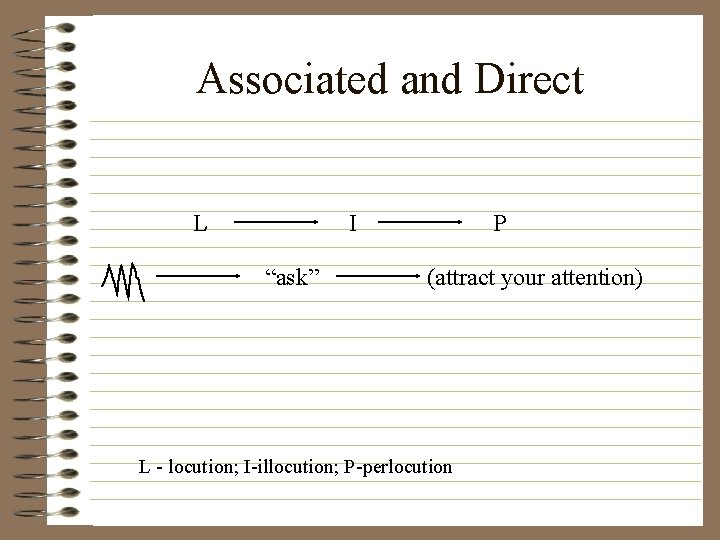
Associated and Direct L I “ask” P (attract your attention) L - locution; I-illocution; P-perlocution
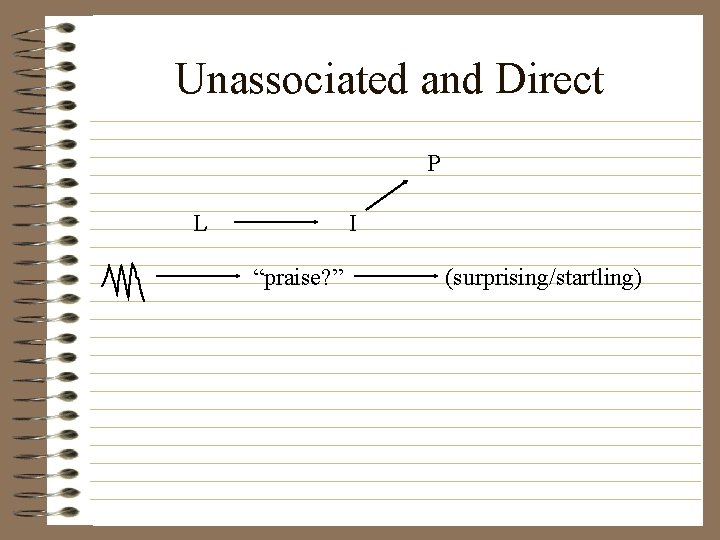
Unassociated and Direct P L I “praise? ” (surprising/startling)
Bolinger’s notion of “context” • “Appropriateness is not to be taken between facts and abstract sentences, but between facts and sentences plus their contexts – and contexts include intentions. ”
FIN
- Slides: 15