
Trusted Passages Meeting Trust Needs of Distributed Applications
“Trusted Passages”: Meeting Trust Needs of Distributed Applications Mustaque Ahamad, Greg Eisenhauer, Jiantao Kong, Wenke Lee, Bryan Payne and Karsten Schwan Georgia Tech Information Security Center & Center for Experimental Computer Systems Georgia Institute of Technology Funded by grants from NSF and Intel.
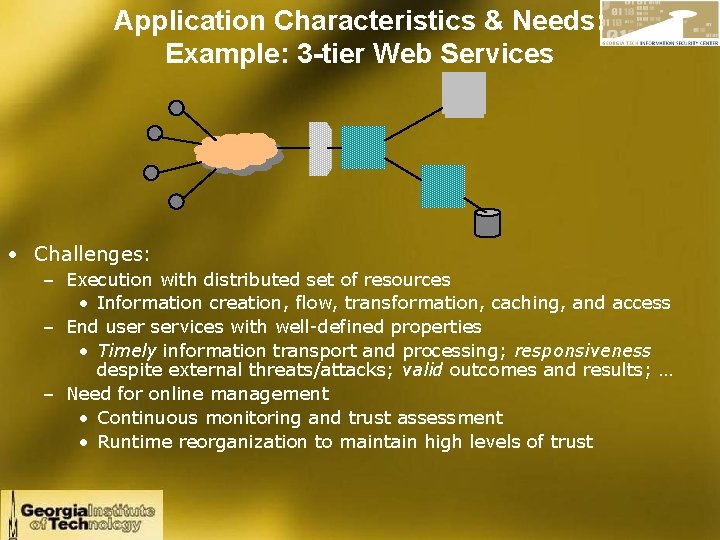
Application Characteristics & Needs: Example: 3 -tier Web Services • Challenges: – Execution with distributed set of resources • Information creation, flow, transformation, caching, and access – End user services with well-defined properties • Timely information transport and processing; responsiveness despite external threats/attacks; valid outcomes and results; … – Need for online management • Continuous monitoring and trust assessment • Runtime reorganization to maintain high levels of trust
Trusted Passages Approach • Create and manage distributed information processing overlays – Example: sets of proxy servers `connecting’ clients with servers • Actively manage the overlays to provide online trust guarantees – Example: monitor proxy server behavior and adjust overlay accordingly
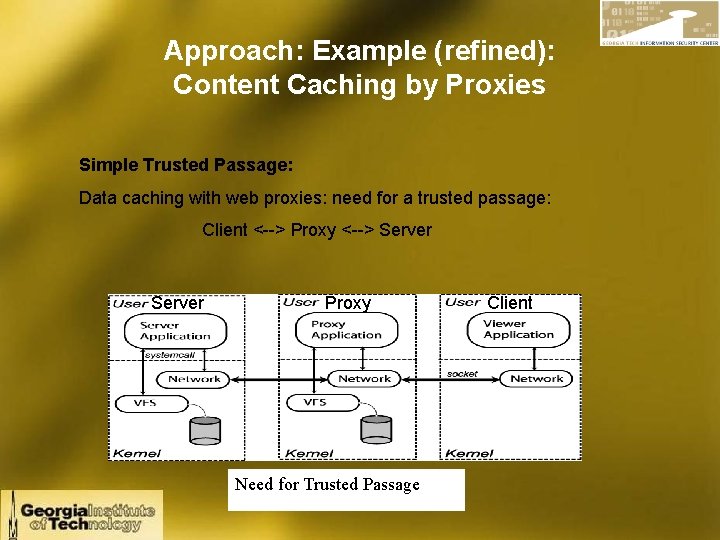
Approach: Example (refined): Content Caching by Proxies Simple Trusted Passage: Data caching with web proxies: need for a trusted passage: Client <--> Proxy <--> Server Proxy Need for Trusted Passage Client
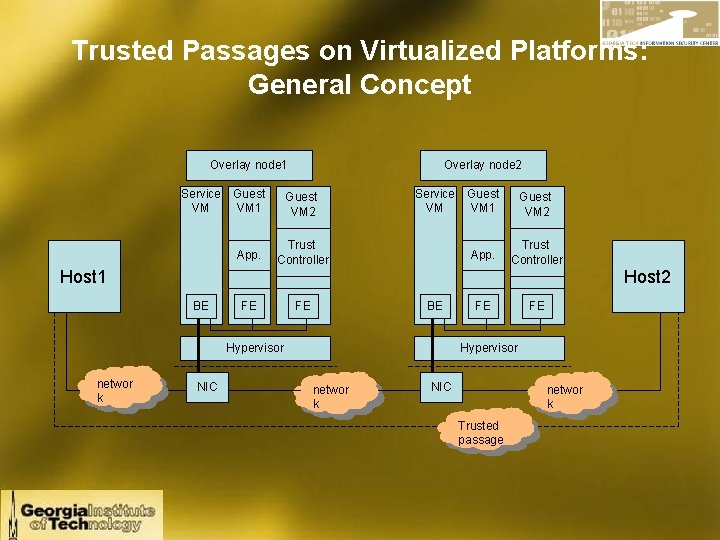
Trusted Passages on Virtualized Platforms: General Concept Overlay node 1 Service Guest VM VM 1 App. Overlay node 2 Guest VM 2 Service Guest VM VM 1 Trust Controller App. Guest VM 2 Trust Controller Host 1 Host 2 BE FE FE BE Hypervisor networ k NIC FE FE Hypervisor networ k NIC networ k Trusted passage
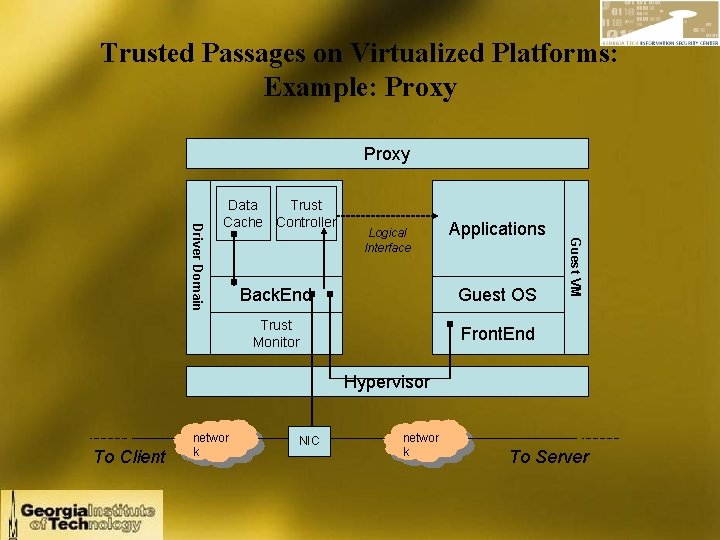
Trusted Passages on Virtualized Platforms: Example: Proxy Logical Interface Applications Back. End Guest OS Trust Monitor Front. End Guest VM Driver Domain Data Trust Cache Controller Hypervisor To Client networ k NIC networ k To Server
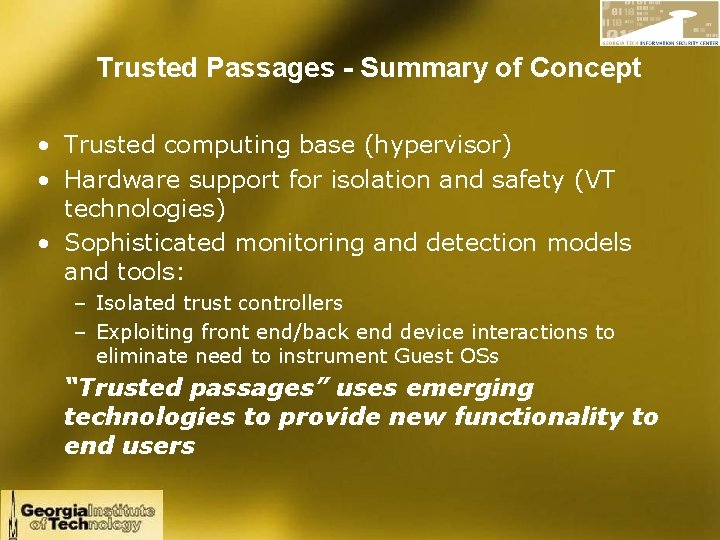
Trusted Passages - Summary of Concept • Trusted computing base (hypervisor) • Hardware support for isolation and safety (VT technologies) • Sophisticated monitoring and detection models and tools: – Isolated trust controllers – Exploiting front end/back end device interactions to eliminate need to instrument Guest OSs “Trusted passages” uses emerging technologies to provide new functionality to end users
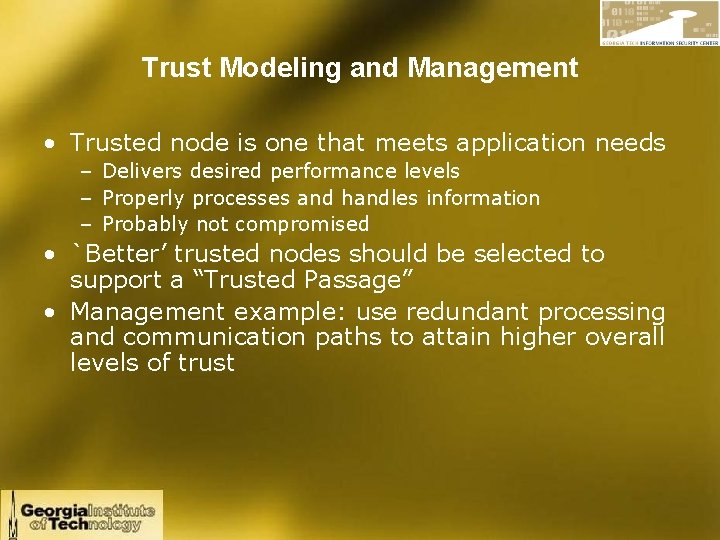
Trust Modeling and Management • Trusted node is one that meets application needs – Delivers desired performance levels – Properly processes and handles information – Probably not compromised • `Better’ trusted nodes should be selected to support a “Trusted Passage” • Management example: use redundant processing and communication paths to attain higher overall levels of trust
Dynamic Trust Evolution • Trust Controller (TC) monitors actions of a VM participating in a “Trusted Passage” – Chosen measurements of VM code and data – Logging of externally observed actions (e. g. , virtualized device access via Service VM) • Trust Controllers compare their measurements for replicated activity • Incorrect results or incorrect operations degrade trust in node, whereas correct operations increase trust level • Experiment with methods like trust incentives
Platform-level Online Monitoring and Introspection • Alternative techniques for monitoring guest OS activity – Intercept system activity (e. g. , devices vs. using hardware like performance counters) – Dynamic integrity checking (e. g. , use OS knowledge to capture and compare key structures jump tables) – Other methods (e. g. , middleware instrumentation) • Evaluate performance impact of monitoring – Assistance from platform monitoring services? • Experiment with trust violations
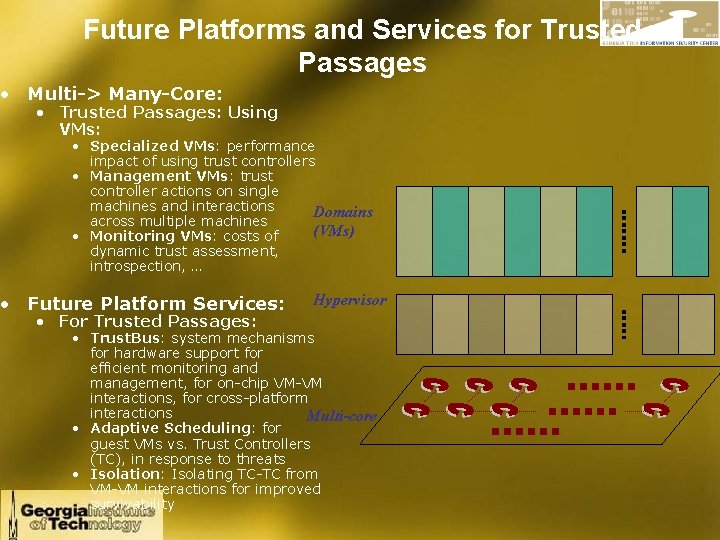
Future Platforms and Services for Trusted Passages • Multi-> Many-Core: • Trusted Passages: Using VMs: • Specialized VMs: performance impact of using trust controllers • Management VMs: trust controller actions on single machines and interactions Domains across multiple machines (VMs) • Monitoring VMs: costs of dynamic trust assessment, introspection, … • Future Platform Services: • For Trusted Passages: Hypervisor • Trust. Bus: system mechanisms for hardware support for efficient monitoring and management, for on-chip VM-VM interactions, for cross-platform interactions Multi-core • Adaptive Scheduling: for guest VMs vs. Trust Controllers (TC), in response to threats • Isolation: Isolating TC-TC from VM-VM interactions for improved survivability
Summary • Trusted Passages: new functionality relevant to large class of applications – Information stream processing (multimedia, event based systems – e. g. , business activity monitoring, caching services with proxies, …) • Exploits new technologies (virtualization, multicore, hardware performance counters) • Research Contributions – Useful trust models and dynamic trust evolution – Platform level monitoring and introspection techniques – Provides insights for potential new services for multicore platforms
- Slides: 12