
Trusted Cloud SQL DBS with Onthefly AES DecryptionEncryption
Trusted Cloud SQL DBS with On-the-fly AES Decryption/Encryption Sushil Jajodia 1, W. Litwin 2 & Th. Schwarz 3 1 George Mason University, Fairfax, VA {jajodia@gmu. edu} 2 Université Paris Dauphine, Lamsade {witold. litwin@dauphine. fr} 3 Thomas Schwarz, Marquette University {thomas. schwarz@marquette. edu}
Our Proposal : Trusted Cloud SQL DBS with Onthe-fly AES Decryption/Encryption • Cloud DB is AES 256 client-side encrypted • We do not trust cloud storage secure otherwise • Especially through the cloud-side encryption • Popular with cloud DB providers these days • Client may send encryption key(s) with a query • Cloud DBS decrypts on-the-fly the data for the query • Does it in protected run-time processing area only • Erases all values there at the end of query processing 2

Our Proposal : Trusted Cloud SQL DBS with On-the-fly AES Decryption/Encryption • We trust the protected run time area secure • Through software and general RAM properties only • Without any specific add-on hardware, usually called Trusted Processing Module (TPM) • Result 1 : Our Cloud DBS can securely process any SQL query over the ciphertext entirely at any typical cloud node • As usual DBS would do for its plaintext DB at that node • Our price is some storage and processing overhead • Remaining practical anyhow • Result 2 : Our DBS finally breaks the 35 -year old stalemate around generally practical cloud DBSs 3
What Follows • Our Rationale more in depth • Reference Architecture of Trusted Cloud DBS • AES DBS Encryption Modes • Deterministic Encryption • Probabilistic Encryption • Trusted SQL for AES DBS, (T-SQL) • T-SQL DDL & DML clauses • Query Processing • Implementing AES DBS over a legacy Cloud DBS • Performance Analysis • Storage Overhead • Processing Overhead • Conclusion & Future Work 4
PROBLEM • Cloud DBs need client-side encryption. • Ideally, queries should be entirely processed at the cloud • Without encryption key knowledge • Unfortunately, any encryption impairs ciphertext queries • Especially with numerical SQL value expressions • Select Prod. Name, Price as price. HT + price. HT*VAT%/100) from…where Price > 1000 • Fully homomorphic encryption scheme would do • But response times remain usually impractical for DBs • By far & despite almost 4 -decade long research upon 5
PROBLEM • Somewhat homomorphic encryption suffices for specific expressions only • Additively homomorphic Paillier scheme appears the most practical. • But supports by definition basically only + - over encrypted data • The stalemate lasts for 35 years • Generally practical client-side encrypted DB remains a dream 6
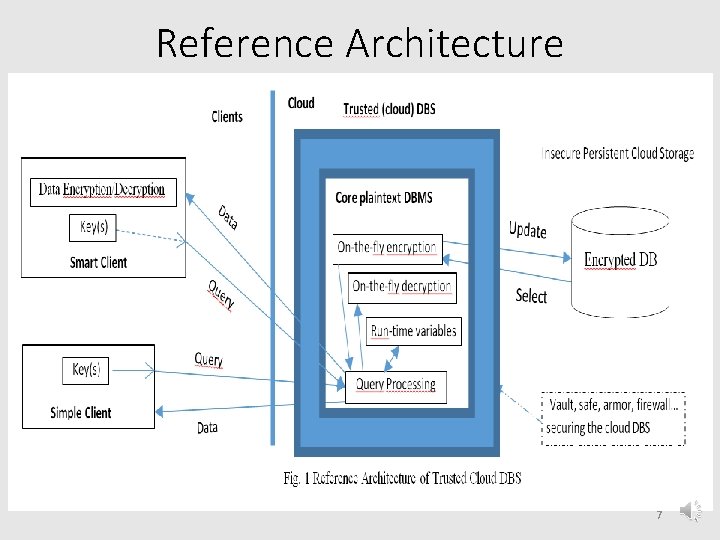
Reference Architecture 7
In Trusted Cloud DBS We Trust : Why ? • Volatile variables are more trusted in practice • Recall universal requests to change your PWD regularly • Cloud DBS software is usually a trusted third-party product • MS, Oracle, SAS, Google… • We already have no choice, but to trust some of these guys • Billions trust Google Chrome or Edge for security of PWDs and UIDs 8
In Trusted Cloud DBS We Trust : Why ? • The most popular processors, i. e. , Intel I 5 and I 7 have now enclaves • Protected RAM areas • Including against Superusers • Moving target defenses may further help • See the paper • Can we formally quantify client’s trust ? • Like we do for encryption schemes ? • Nope to our best knowledge • At least at present • At least since trust is subjective 10
In Trusted Cloud DBS We Trust : Why ? • Can we expect a Trusted DB secure once et forever ? • Not at present • Rathere will be exploits, patches to exploits etc • Can folks accommodate anyway ? • YES • No other choice at present • As we already said 11
Why not TPM ? • Like did MS Cipherbase most recently • See that paper for other references • We do not believe into TPMs on millions of cloud nodes • Anytime soon • Loading client key to TPM has to be trusted secure as well • Whatever the provider might invoke 13
Why AES for Trusted DBS ? • Industry-wide standard • Major cloud DBS players already use it • For cloud-side DB encryption • SQL Server 2016, My. SQL, Google Cloud version of My. SQL… • But they are all still unsafe • Enjoy https: //www. youtube. com/watch? time_continue=15&v=e 4 BS 5 A 4 yqp 0 for SQL Server • Many secondary storage providers have optional AES drivers • Proof of good overhead performance of the algorithm • Below AES = AES 256 14
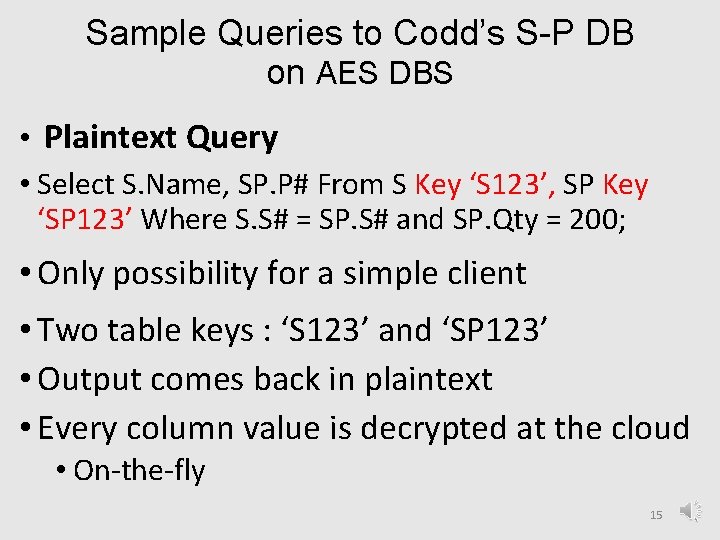
Sample Queries to Codd’s S-P DB on AES DBS • Plaintext Query • Select S. Name, SP. P# From S Key ‘S 123’, SP Key ‘SP 123’ Where S. S# = SP. S# and SP. Qty = 200; • Only possibility for a simple client • Two table keys : ‘S 123’ and ‘SP 123’ • Output comes back in plaintext • Every column value is decrypted at the cloud • On-the-fly 15
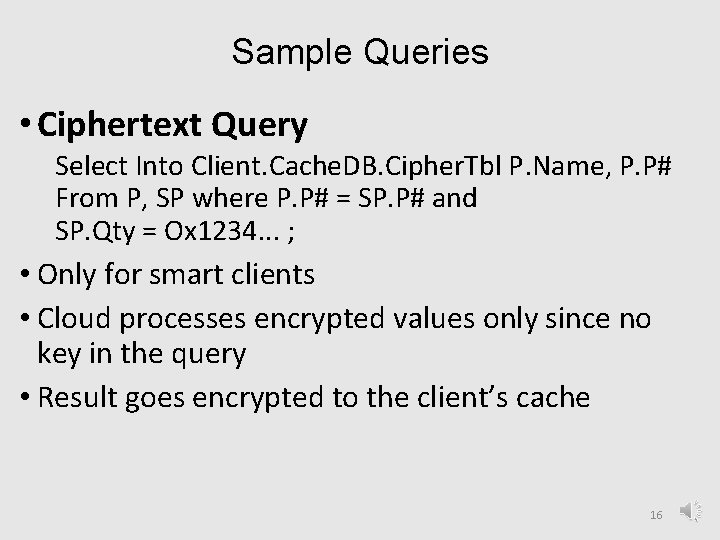
Sample Queries • Ciphertext Query Select Into Client. Cache. DB. Cipher. Tbl P. Name, P. P# From P, SP where P. P# = SP. P# and SP. Qty = Ox 1234. . . ; • Only for smart clients • Cloud processes encrypted values only since no key in the query • Result goes encrypted to the client’s cache 16
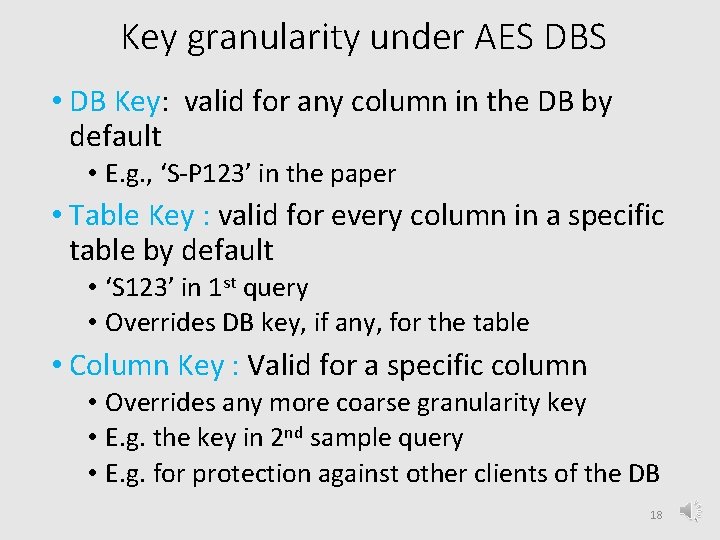
Key granularity under AES DBS • DB Key: valid for any column in the DB by default • E. g. , ‘S-P 123’ in the paper • Table Key : valid for every column in a specific table by default • ‘S 123’ in 1 st query • Overrides DB key, if any, for the table • Column Key : Valid for a specific column • Overrides any more coarse granularity key • E. g. the key in 2 nd sample query • E. g. for protection against other clients of the DB 18
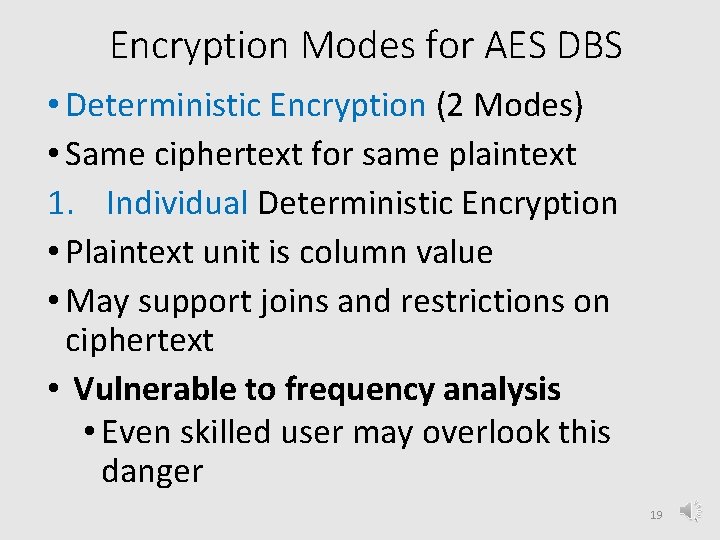
Encryption Modes for AES DBS • Deterministic Encryption (2 Modes) • Same ciphertext for same plaintext 1. Individual Deterministic Encryption • Plaintext unit is column value • May support joins and restrictions on ciphertext • Vulnerable to frequency analysis • Even skilled user may overlook this danger 19
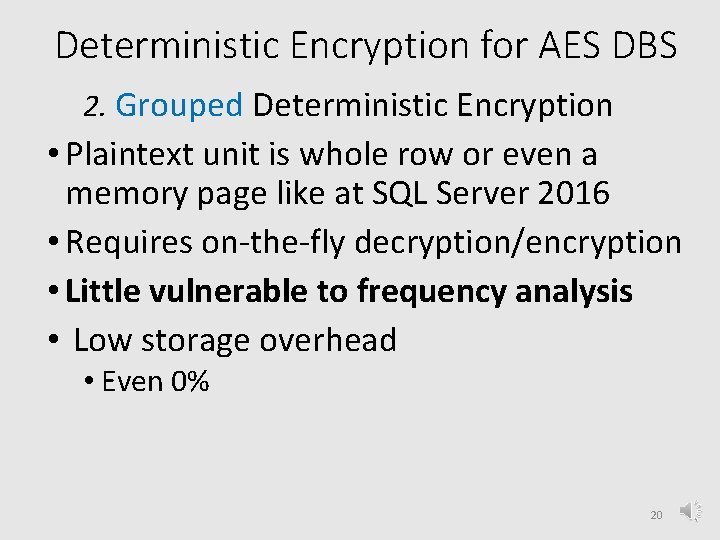
Deterministic Encryption for AES DBS 2. Grouped Deterministic Encryption • Plaintext unit is whole row or even a memory page like at SQL Server 2016 • Requires on-the-fly decryption/encryption • Little vulnerable to frequency analysis • Low storage overhead • Even 0% 20
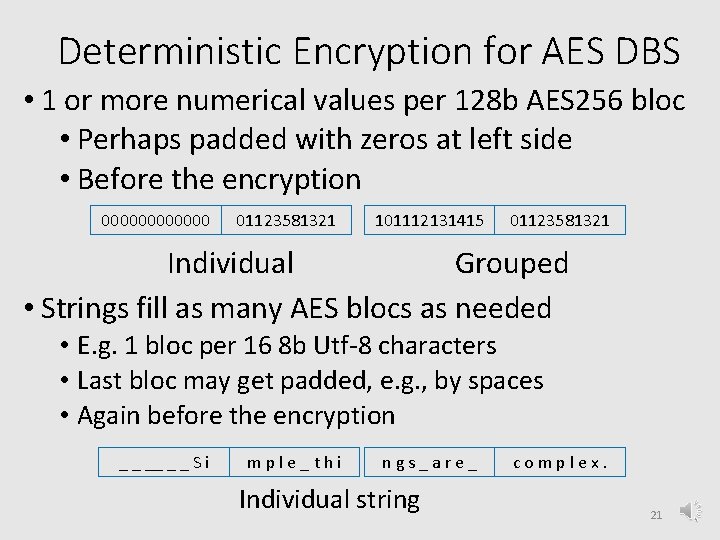
Deterministic Encryption for AES DBS • 1 or more numerical values per 128 b AES 256 bloc • Perhaps padded with zeros at left side • Before the encryption 000000 01123581321 101112131415 01123581321 Individual Grouped • Strings fill as many AES blocs as needed • E. g. 1 bloc per 16 8 b Utf-8 characters • Last bloc may get padded, e. g. , by spaces • Again before the encryption _ _ _ S i m p l e _ t h i n g s _ a r e _ Individual string c o m p l e x. 21
Probabilistic Encryption for AES DBS • Pseudo-random ciphertext for occurrences of same plaintext • Not vulnerable to frequency analysis • On-the-fly decryption/encryption is a must • Client key(s) must come with the query • Default encryption mode for AES DBS 22
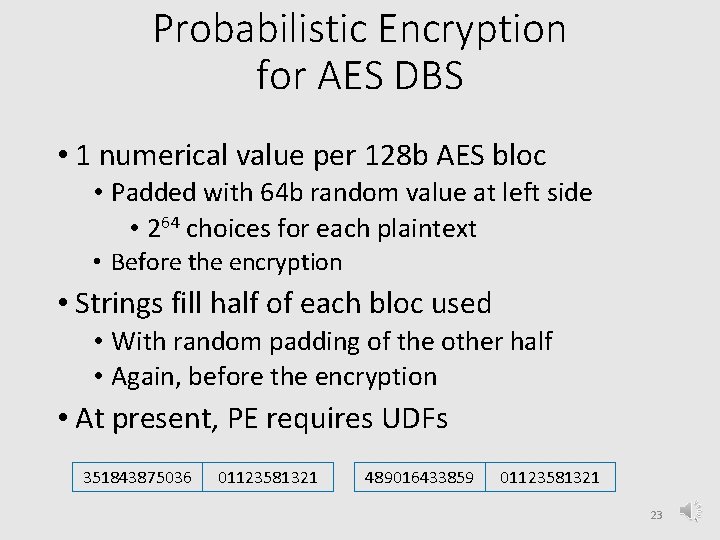
Probabilistic Encryption for AES DBS • 1 numerical value per 128 b AES bloc • Padded with 64 b random value at left side • 264 choices for each plaintext • Before the encryption • Strings fill half of each bloc used • With random padding of the other half • Again, before the encryption • At present, PE requires UDFs 351843875036 01123581321 489016433859 01123581321 23
Trusted SQL (T-SQL) • Any current SQL dialect extended with clauses for client side encryption • Trusted secure when it vehicle sensitive data to and from AES DB • Also called T-SQL • Contains new clauses for both DDL and DML • Geared towards non-procedurality • Statements possibly as simple as usual • Provided use of various defaults • Otherwise they are naturally more complex • See the paper for details we omit below 24
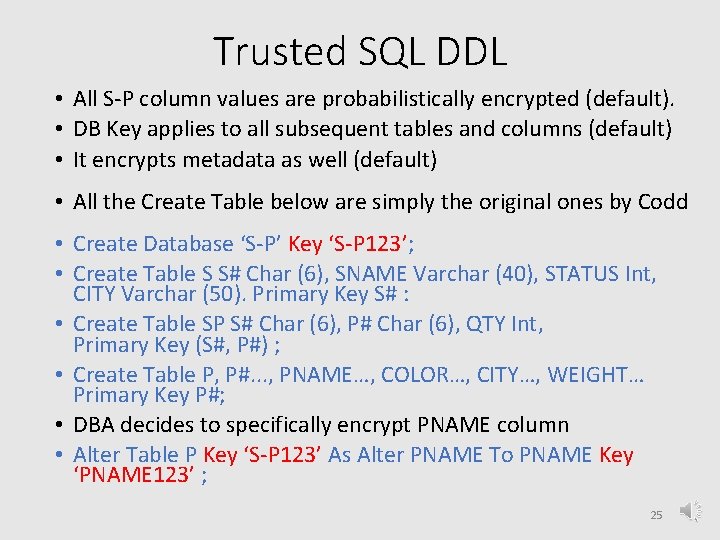
Trusted SQL DDL • All S-P column values are probabilistically encrypted (default). • DB Key applies to all subsequent tables and columns (default) • It encrypts metadata as well (default) • All the Create Table below are simply the original ones by Codd • Create Database ‘S-P’ Key ‘S-P 123’; • Create Table S S# Char (6), SNAME Varchar (40), STATUS Int, CITY Varchar (50). Primary Key S# : • Create Table SP S# Char (6), P# Char (6), QTY Int, Primary Key (S#, P#) ; • Create Table P, P#. . . , PNAME…, COLOR…, CITY…, WEIGHT… Primary Key P#; • DBA decides to specifically encrypt PNAME column • Alter Table P Key ‘S-P 123’ As Alter PNAME To PNAME Key ‘PNAME 123’ ; 25
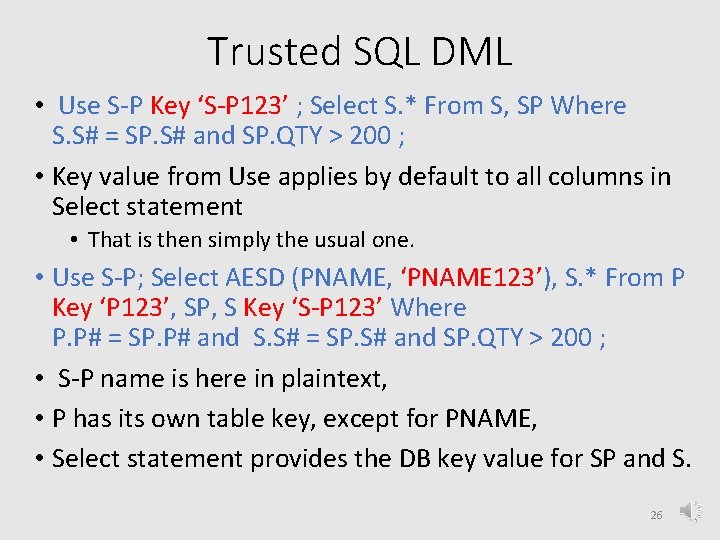
Trusted SQL DML • Use S-P Key ‘S-P 123’ ; Select S. * From S, SP Where S. S# = SP. S# and SP. QTY > 200 ; • Key value from Use applies by default to all columns in Select statement • That is then simply the usual one. • Use S-P; Select AESD (PNAME, ‘PNAME 123’), S. * From P Key ‘P 123’, SP, S Key ‘S-P 123’ Where P. P# = SP. P# and S. S# = SP. S# and SP. QTY > 200 ; • S-P name is here in plaintext, • P has its own table key, except for PNAME, • Select statement provides the DB key value for SP and S. 26
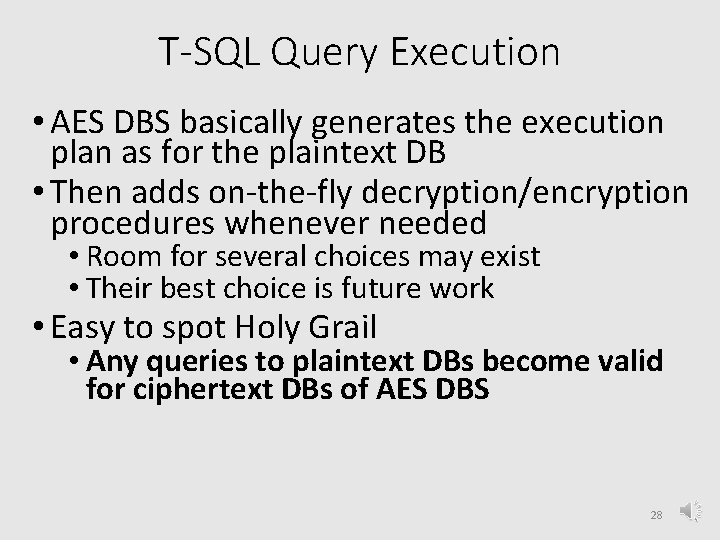
T-SQL Query Execution • AES DBS basically generates the execution plan as for the plaintext DB • Then adds on-the-fly decryption/encryption procedures whenever needed • Room for several choices may exist • Their best choice is future work • Easy to spot Holy Grail • Any queries to plaintext DBs become valid for ciphertext DBs of AES DBS 28
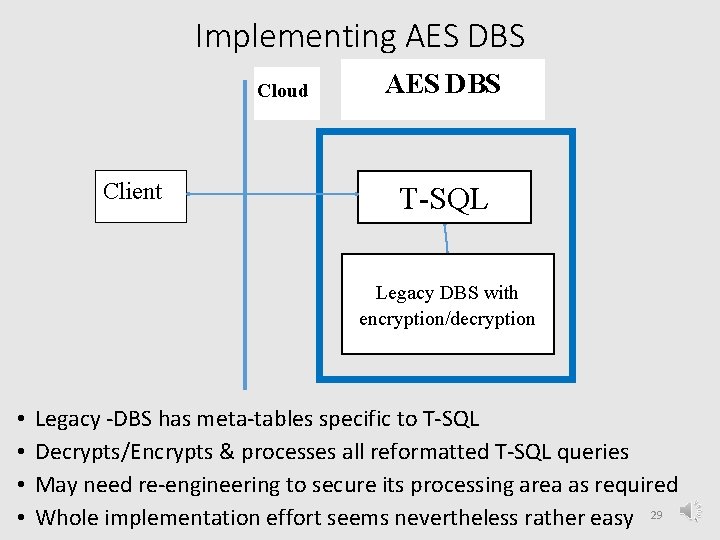
Implementing AES DBS Cloud Client T-SQL Legacy DBS with encryption/decryption • • Legacy -DBS has meta-tables specific to T-SQL Decrypts/Encrypts & processes all reformatted T-SQL queries May need re-engineering to secure its processing area as required Whole implementation effort seems nevertheless rather easy 29
Performance AES Processing Overhead • Truecrypt benchmarks show encryption/decription rate of 1900 MBs on Intel I 5 • Most popular processor • With AES NI instruction set, I 5 661 specifically provides even 4133 MBs rate • With writing back to RAM the rates drops to 783 MBs • For plaintext 880 MBs rate • Largely enough for negligible (13% at most) AES processing overhead for read/write operations of AES DBS. 30
Performance Query Processing Overhead • Decryption of 100 K ciphertext values for SUM could need as little as 0. 2 ms • An independent benchmark for additively (only) homomorphic Paillier showed 1153 ms versus 14 ms of plaintext summation time • Our AES decryption overhead would be thus 1. 5% • I. e. Simply nothing in practice • AES DBS would also end up summing to 82 times faster than Paillier • T needed also 50 ms decryption time at the client • AES DBS ends up 85 times faster finally 31
Performance Storage Overhead • Deterministic Encryption • May have no storage overhead • May have even 100+% overhead • Highly unlikely event • Practical value should be DB specific 32
Performance Storage Overhead • Probabilistic Encryption • At least 100% overhead over a column • May be more for individual small numerals • 32 b or 16 b wide • So we possibly should group column values • As we spoke about • For the DB mixing encryption types the overall overhead should be DB specific 33
CONCLUSION • Despite 35 -year quest, a practical fully homomorphic encryption remains the Holy Grail • So remained a practical client-side encrypted cloud DB • Trusted Cloud SQL AES DBS appears poised to break the stalemate • Worth further work 34
FURTHER WORK • Implementing our DBS first on an existing major cloud DBS • This must have AES encryption/decryption scalar functions or UDFs • 1 st choice : My. SQL • Runner up : SQL Server 2016 35
Thank You for Your Attention • Sushil Jajodia 1, W. Litwin 2 & Th. Schwarz 3 1 George Mason University, Fairfax, VA {jajodia@gmu. edu} 2 Université Paris Dauphine, Lamsade {witold. litwin@dauphine. fr} 3 Thomas Schwarz, Marquette University {thomas. schwarz@marquette. edu} 36
- Slides: 32