
Trust Funds A legal instrument created when one

- Slides: 31
Trust Funds • A legal instrument created when one person transfers title to property to another to be held for the benefit of a beneficiary.
Types of Trusts • Inter vivos (Living) Trust - A trust that is established and funded during the lifetime of the grantor • Third Party Trust - A trust established with the funds of someone other than the beneficiary • Testamentary Trust - A trust created by and as part of a grantors will. This type of trust becomes operable upon the death of the grantor
Types of Trusts, (cont. d’) • Court Ordered Trust - Trust established pursuant to a court order. Usually with the individual’s assets, e. g. , lawsuit settlement. May be established for individual who is incompetent or a minor
Revocable Trust • A trust that may be altered, amended, revoked or terminated by the grantor • If A/R is grantor: – Total principal in trust is countable resource – Payments made to someone other than A/R should be explored as a transfer • If A/R is beneficiary: – Payments made to or for the benefit of the A/R is counted as income in the month received
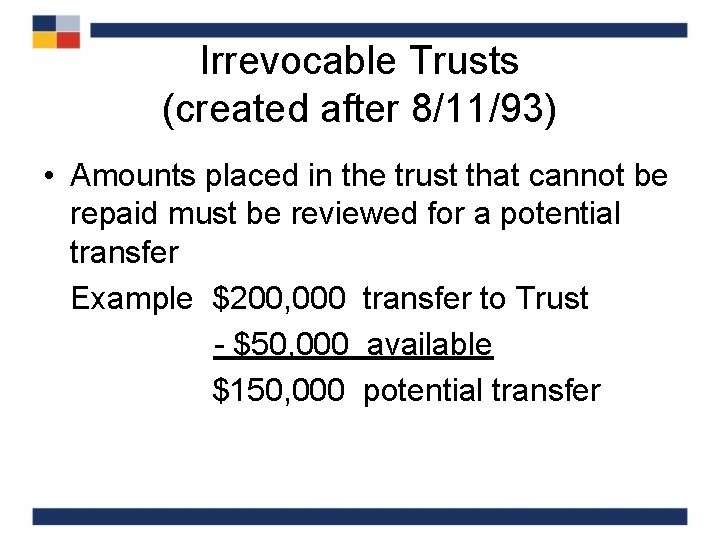
Irrevocable Trusts (created after 8/11/93) • Amounts placed in the trust that cannot be repaid must be reviewed for a potential transfer Example $200, 000 transfer to Trust - $50, 000 available $150, 000 potential transfer
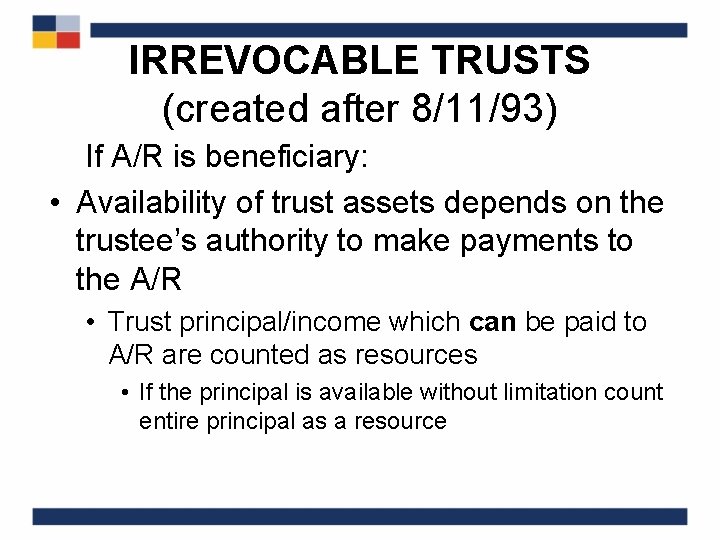
IRREVOCABLE TRUSTS (created after 8/11/93) If A/R is beneficiary: • Availability of trust assets depends on the trustee’s authority to make payments to the A/R • Trust principal/income which can be paid to A/R are counted as resources • If the principal is available without limitation count entire principal as a resource
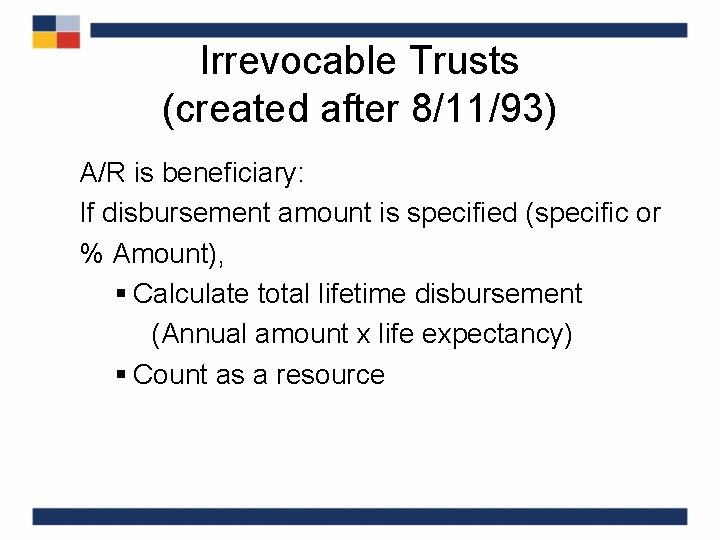
Irrevocable Trusts (created after 8/11/93) A/R is beneficiary: If disbursement amount is specified (specific or % Amount), § Calculate total lifetime disbursement (Annual amount x life expectancy) § Count as a resource
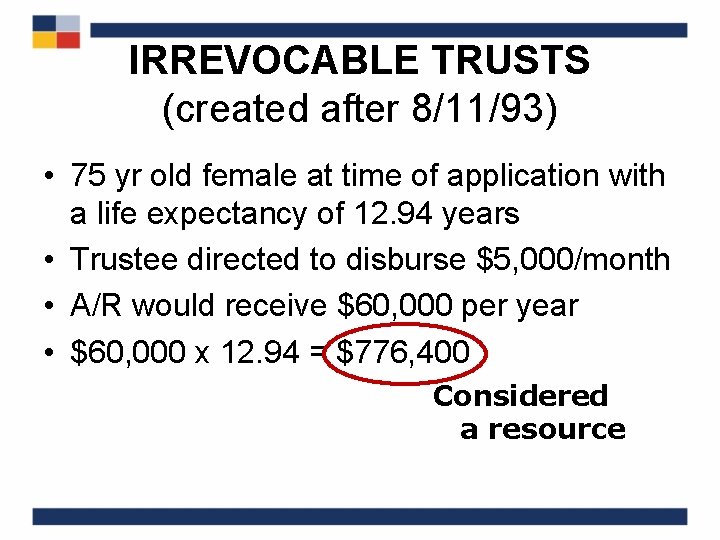
IRREVOCABLE TRUSTS (created after 8/11/93) • 75 yr old female at time of application with a life expectancy of 12. 94 years • Trustee directed to disburse $5, 000/month • A/R would receive $60, 000 per year • $60, 000 x 12. 94 = $776, 400 Considered a resource
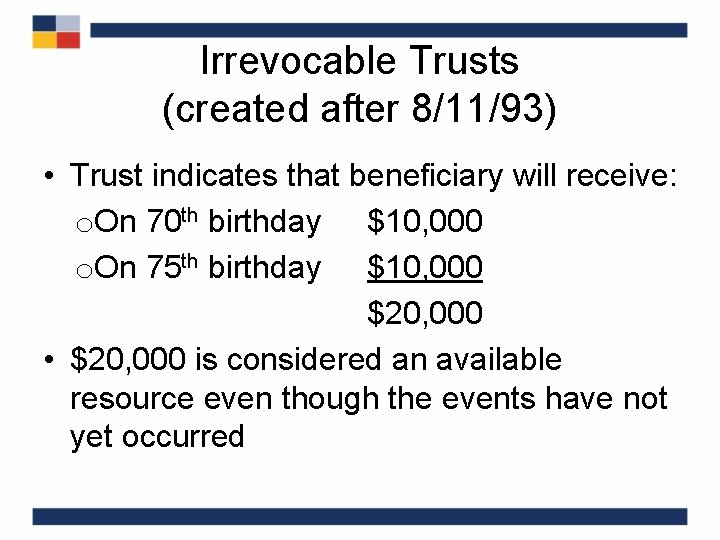
Irrevocable Trusts (created after 8/11/93) • Trust indicates that beneficiary will receive: o. On 70 th birthday $10, 000 o. On 75 th birthday $10, 000 $20, 000 • $20, 000 is considered an available resource even though the events have not yet occurred
Irrevocable Trusts (created after 8/11/93) • If Trust says, “Trustee ‘shall’, or ‘must’, pay net income of the trust…” • Count as unearned income • A/R must pursue available income - even if Trustee has not disbursed the net income in the past
Irrevocable Trusts (created after 8/11/93) • For example, If trust indicates “Trustee must/shall pay all the net income of the trust” • Trust is earning $800. 00 per month from mutual funds, etc. – $800. 00 per month is counted as unearned income to the A/R
Irrevocable Trusts (created after 8/11/93) • Trust states that the trustee has “discretion” to pay income – trustee is making income available to the A/R; count as income in the month received • If retained into subsequent months, count as a resource – trustee is not making income available; cannot count any income and cannot make A/R pursue
Medicaid Implications of Third Party Trust • If A/R is grantor: – Transfer considerations if irrevocable • If A/R is beneficiary: – Principal and Income not considered available unless paid to beneficiary – LDSS may challenge trust in court to force payment for medical bills
Medicaid Implications of Testamentary Trust If A/R is beneficiary: – Principal and Income not considered available unless paid to beneficiary – LDSS may challenge trust in court to force payment for medical bills
Medicaid Implications of Court Ordered Trust • If Exceptions Trust: – Treat according to Exceptions Trust policy • If not Exceptions Trust – Any principal or income that can be paid for the benefit of the A/R is an available resource – Any distributions actually made to A/R are income in month received
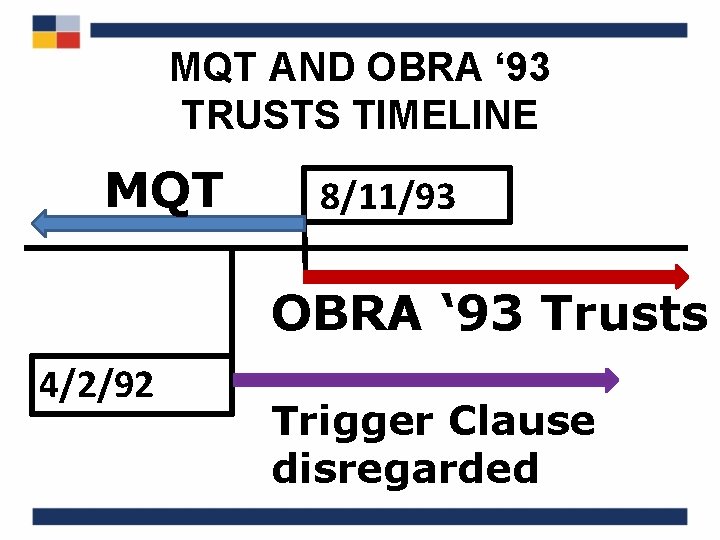
MQT AND OBRA ‘ 93 TRUSTS TIMELINE MQT 8/11/93 OBRA ‘ 93 Trusts 4/2/92 Trigger Clause disregarded
MQT with Trigger Clause • Contains clause which limits or eliminates the trustee’s discretion when a certain event occurs • For MQT with trigger clause created after 4/2/92, LDSS disregards any limitations of trustee’s discretion
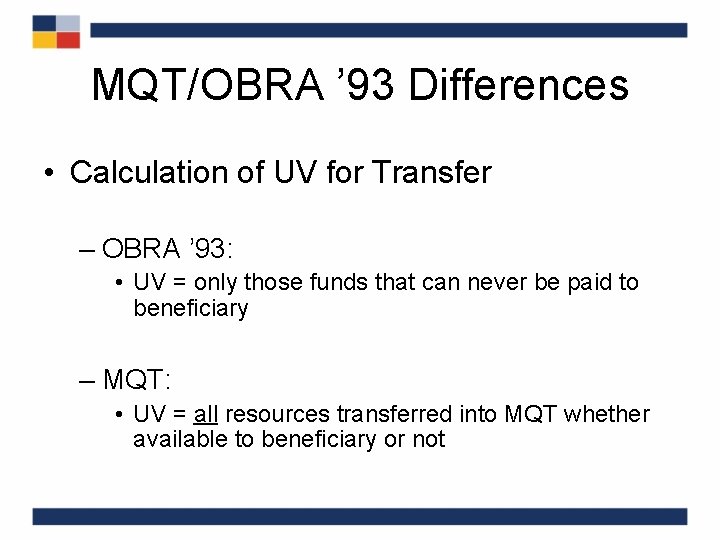
MQT/OBRA ’ 93 Differences • Calculation of UV for Transfer – OBRA ’ 93: • UV = only those funds that can never be paid to beneficiary – MQT: • UV = all resources transferred into MQT whether available to beneficiary or not
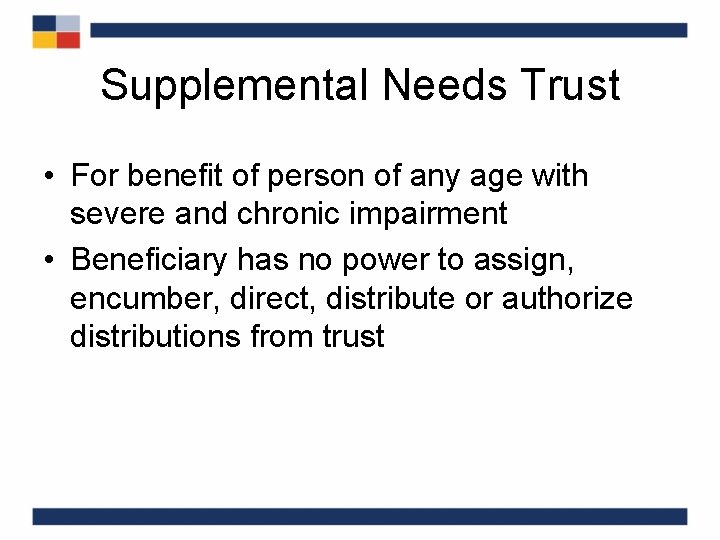
Supplemental Needs Trust • For benefit of person of any age with severe and chronic impairment • Beneficiary has no power to assign, encumber, direct, distribute or authorize distributions from trust
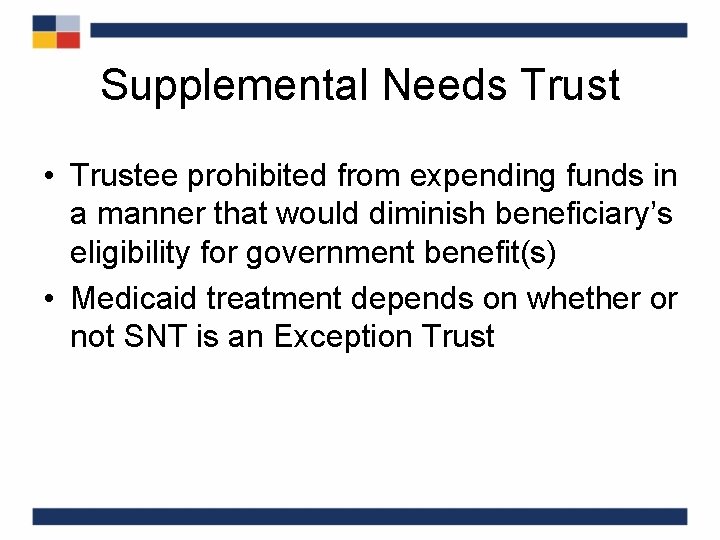
Supplemental Needs Trust • Trustee prohibited from expending funds in a manner that would diminish beneficiary’s eligibility for government benefit(s) • Medicaid treatment depends on whether or not SNT is an Exception Trust
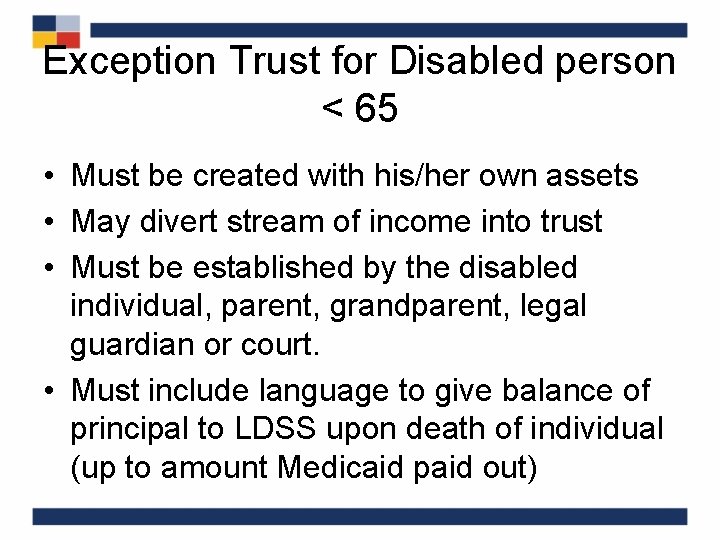
Exception Trust for Disabled person < 65 • Must be created with his/her own assets • May divert stream of income into trust • Must be established by the disabled individual, parent, grandparent, legal guardian or court. • Must include language to give balance of principal to LDSS upon death of individual (up to amount Medicaid paid out)
SNT vs. Exception Trusts • All Exception Trusts are Supplemental Needs Trusts HOWEVER • Not all Supplemental Needs Trusts are Exception Trusts include language to reimburse Medicaid upon death
Pooled Exception Trust • Must be established and managed by nonprofit organization • Assets of individual pooled with other disabled person’s assets but in separate accounts • For disabled person of any age
Pooled Exception Trust • Must be created with individual’s own assets • Individual’s account in trust established by parent, grandparent, legal guardian or court or by the individual • LDSS may recover trust funds not retained by the non-profit organization upon death of individual
Pooled Exception Trust • Individual must be certified disabled – Aged is not automatically disabled – Submit Disability Review information to State Review Team in same manner as for MBIWPD – 05 OMM/INF-1
Exceptions Trust Medicaid Implications • Trust principal and income disregarded unless actually distributed to disabled individual • Distributions counted as income in month received; resources if held after this month
Contributions from Income to Exception Trusts • Income contributed to the trust is excluded when deposited to the trust during the same month the income is received • These amounts are treated as an exclusion, therefore an off-line calculation not entered in MABEL • LDSS has oversight responsibilities
Contributions from Income to Exception Trusts • Chronic Care – Cannot exclude contributions if subject to post eligibility • Nursing Home cases – Institutionalized spouse in NH/Single Institutionalized Individuals – Including ALC status/spousal Impoverishment cases in acute care • Spousal Impoverishment Cases in NHTD, TBI, or MLTC
Exception Trusts Transfer Implications • Funds contributed to the trust before individual reaches age 65 are exempt • Funds deposited to either an individual or pooled trust after age 65 are subject to the transfer of assets rules • GIS 08/MA 020
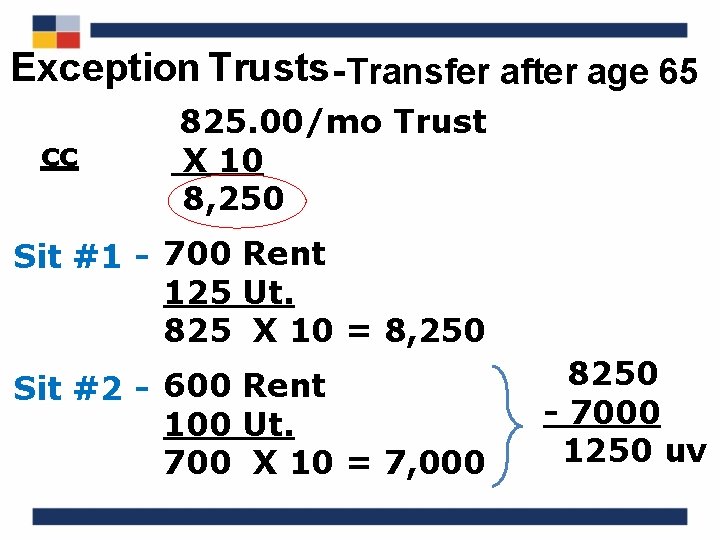
Exception Trusts -Transfer after age 65 cc 825. 00/mo Trust X 10 8, 250 Sit #1 - 700 Rent 125 Ut. 825 X 10 = 8, 250 Sit #2 - 600 Rent 100 Ut. 700 X 10 = 7, 000 8250 - 7000 1250 uv
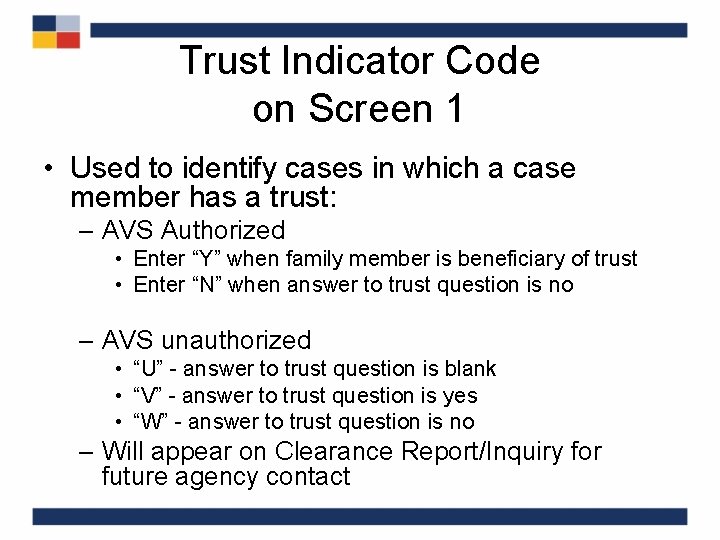
Trust Indicator Code on Screen 1 • Used to identify cases in which a case member has a trust: – AVS Authorized • Enter “Y” when family member is beneficiary of trust • Enter “N” when answer to trust question is no – AVS unauthorized • “U” - answer to trust question is blank • “V” - answer to trust question is yes • “W” - answer to trust question is no – Will appear on Clearance Report/Inquiry for future agency contact