
Trunking Theory In general there are many more
- Slides: 12
Trunking Theory • In general, there are many more users than channels--everyone can’t have a permanent personal channel! • Fortunately, only a small fraction of total users need a channel at any given time • Solution: keep channels in a pool – allocate to user when requested – return to pool when needed 8/31/98 1
Trunking Theory(2) • Applicable to any system with more customers than resources • Basic question: How many subscribers can I have and still guarantee Pr{blocked}< e? 8/31/98 2
Definitions • Grade of Service (GOS): probability that a call is blocked at the busiest time – GOS = 2% for AMPS • Erlang: unit of traffic intensity, callhours/hour – one call per hour that lasts 1/2 hour constitutes 0. 5 Erlangs of traffic 8/31/98 3
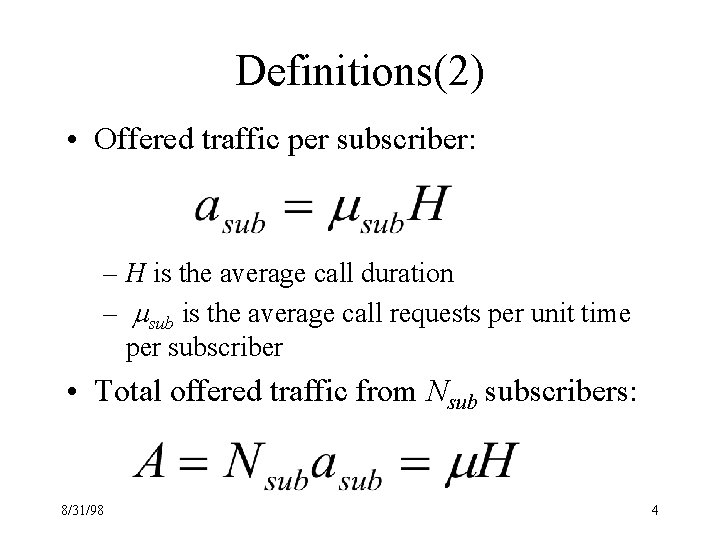
Definitions(2) • Offered traffic per subscriber: – H is the average call duration – msub is the average call requests per unit time per subscriber • Total offered traffic from Nsub subscribers: 8/31/98 4
GOS Calculations We Need: • Probabilistic usage model • How blocked calls are handled – blocked calls cleared – blocked calls delayed 8/31/98 5
Probabilistic Usage Model • Call requests are memoryless • Time intervals between call requests are independent • Pr{call request arrival in Dt} ~ Dt • Very unlikely that two requests will occur at exactly the same time • Long calls are exponentially less likely than short calls 8/31/98 6
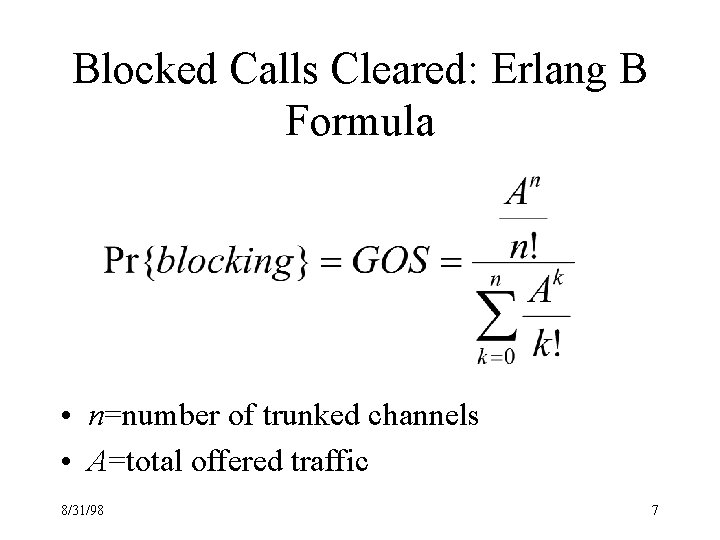
Blocked Calls Cleared: Erlang B Formula • n=number of trunked channels • A=total offered traffic 8/31/98 7
Example 1 • Want to start a 900# business to give directions to freshmen • A market survey shows: – average call arrival rate m=40 calls/hr – average call duration for directions is 1/8 hr – 2% of freshmen lost is acceptable • How many phone operators do I need? 8/31/98 8
Example 1 Solution 8/31/98 9
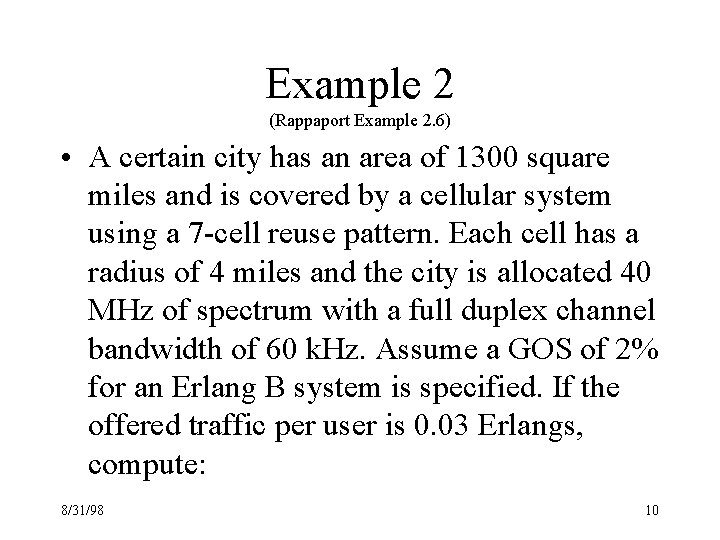
Example 2 (Rappaport Example 2. 6) • A certain city has an area of 1300 square miles and is covered by a cellular system using a 7 -cell reuse pattern. Each cell has a radius of 4 miles and the city is allocated 40 MHz of spectrum with a full duplex channel bandwidth of 60 k. Hz. Assume a GOS of 2% for an Erlang B system is specified. If the offered traffic per user is 0. 03 Erlangs, compute: 8/31/98 10
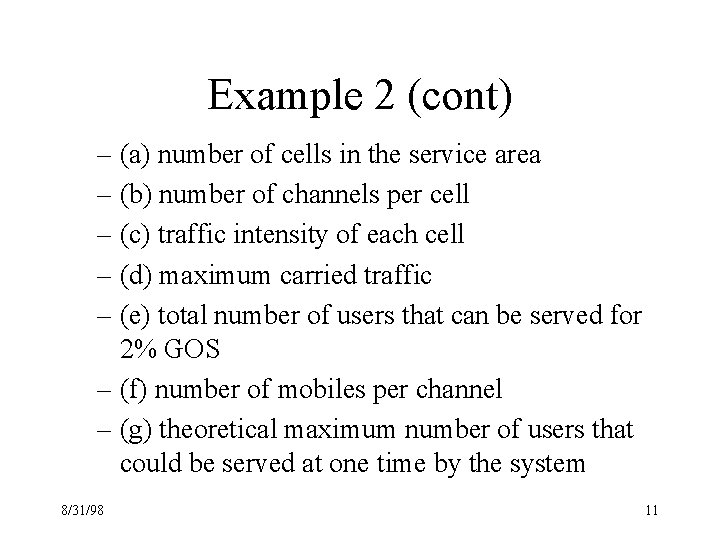
Example 2 (cont) – (a) number of cells in the service area – (b) number of channels per cell – (c) traffic intensity of each cell – (d) maximum carried traffic – (e) total number of users that can be served for 2% GOS – (f) number of mobiles per channel – (g) theoretical maximum number of users that could be served at one time by the system 8/31/98 11
Example 2 Solution 8/31/98 12