
True or false Cyanide is poisonous because it
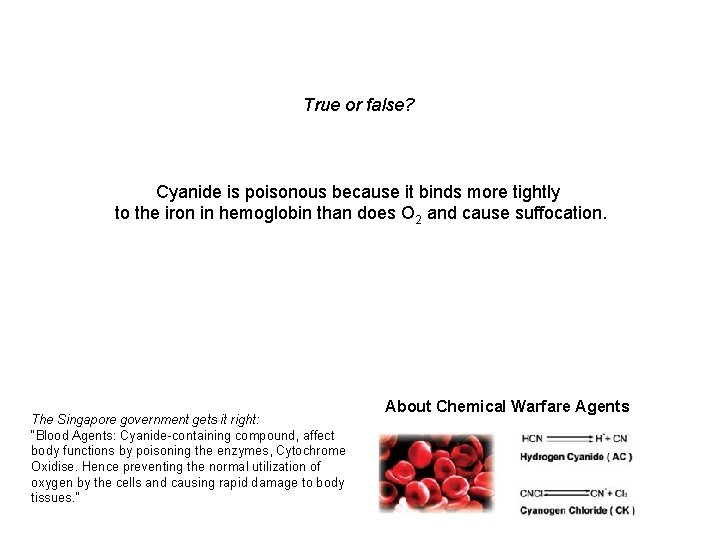
True or false? Cyanide is poisonous because it binds more tightly to the iron in hemoglobin than does O 2 and cause suffocation. The Singapore government gets it right: “Blood Agents: Cyanide-containing compound, affect body functions by poisoning the enzymes, Cytochrome Oxidise. Hence preventing the normal utilization of oxygen by the cells and causing rapid damage to body tissues. ” About Chemical Warfare Agents
False Let’s do the calculation. • You have ~ 2 g Fe in your body; about 1. 5 g of Fe is in your blood as hemoglobin. • 1. 5 g Fe = 0. 03 mol. • Toxicity of cyanide: The LD 50 for ingestion is 50 -200 milligrams, or 1 -3 milligrams per kilogram of body weight, calculated as hydrogen cyanide. The LC 50 for gaseous hydrogen cyanide is 100 -300 parts per million. Inhalation of cyanide in this range results in death within 10 -60 minutes, with death coming more quickly as the concentration increases. Inhalation of 2, 000 parts per million hydrogen cyanide causes death within one minute. • So, if you weigh 60 kg, between 60 -180 mg could be a toxic dose. • Or, 0. 06 -0. 18 g = 0. 002 -0. 007 mol CN- (as HCN) vs 0. 03 mol Fe • That amount of cyanide would block only ~10% of O 2 binding sites in hemoglobin, not enough to kill you. The toxicity of Cyanide is because of its strong binding to Fe in heme in other critical Heme-proteins.
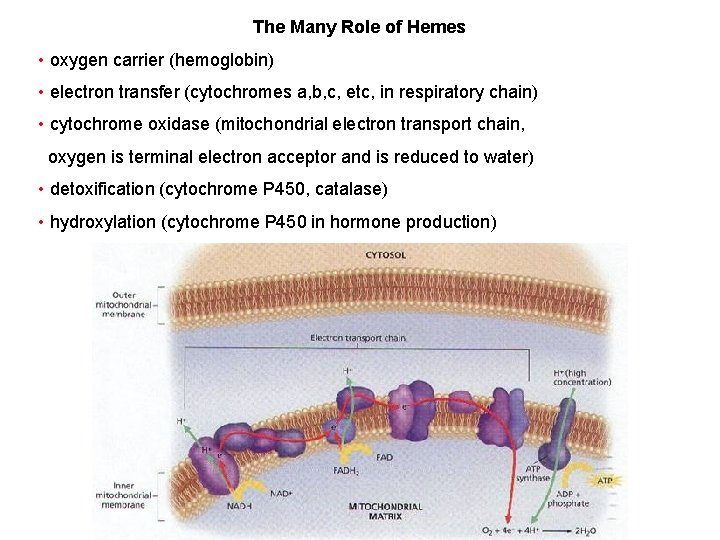
The Many Role of Hemes • oxygen carrier (hemoglobin) • electron transfer (cytochromes a, b, c, etc, in respiratory chain) • cytochrome oxidase (mitochondrial electron transport chain, oxygen is terminal electron acceptor and is reduced to water) • detoxification (cytochrome P 450, catalase) • hydroxylation (cytochrome P 450 in hormone production)
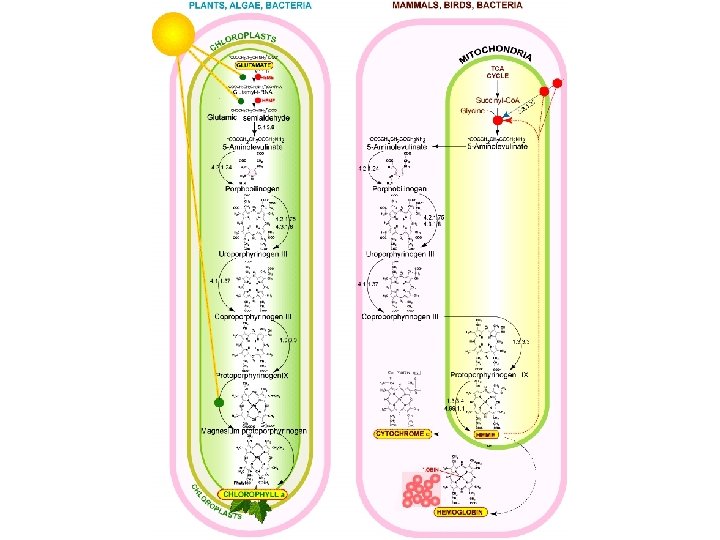
Using Iron Porphyrins as Models for Hemoglobin The system:
Key Features of Hemes • • Fe oxidation state Fe spin state porphyrin oxidation state porphyrin hydrophobicity
How will the spin state of Fe(porphyrin) complexes change on binding imidazole? Intermediate Spin S = 3/2 n=3 High Spin S = 5/2 n=5 Low Spin S = 1/2 n=1
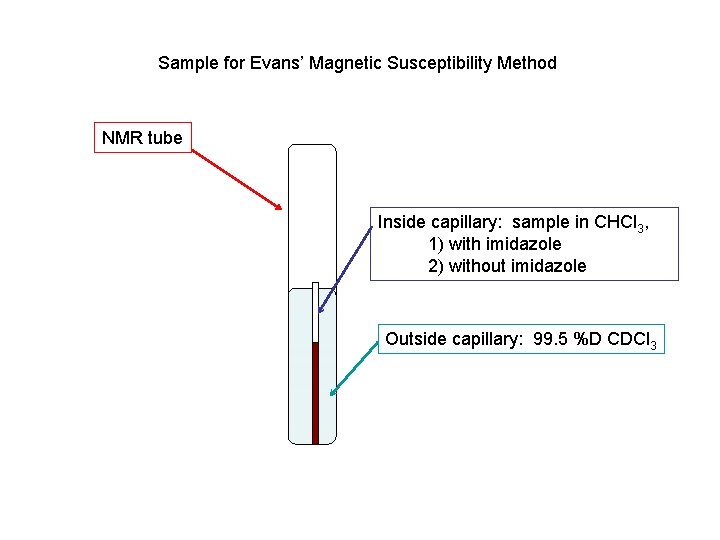
Sample for Evans’ Magnetic Susceptibility Method NMR tube Inside capillary: sample in CHCl 3, 1) with imidazole 2) without imidazole Outside capillary: 99. 5 %D CDCl 3
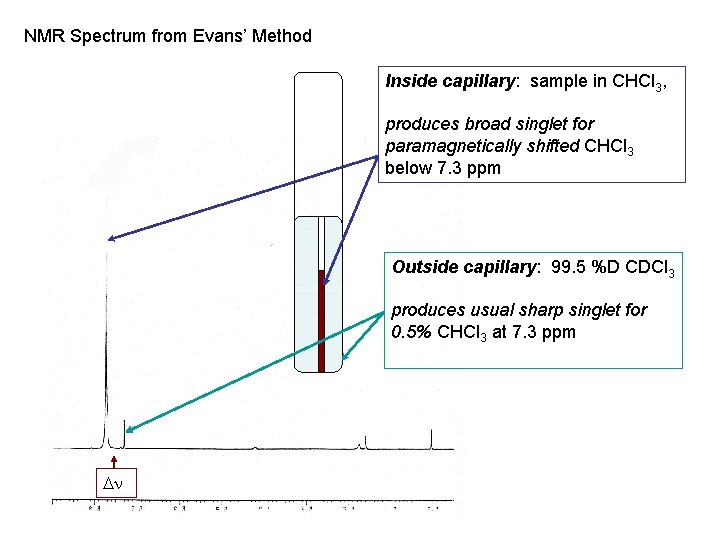
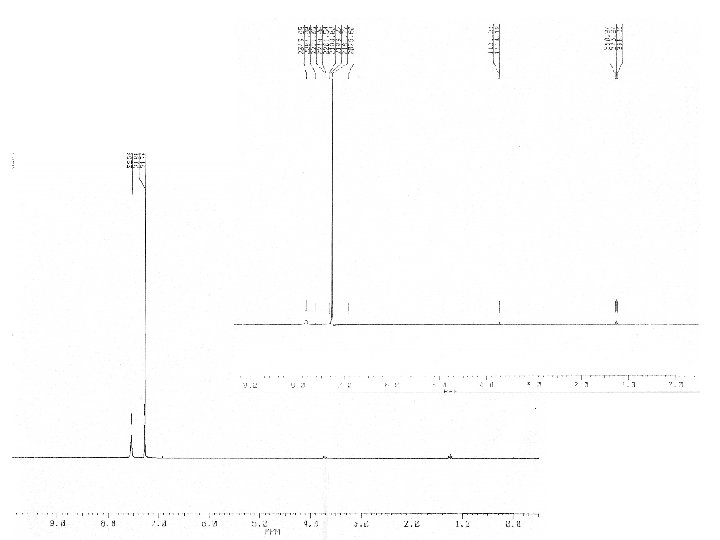
NMR Spectrum from Evans’ Method Inside capillary: sample in CHCl 3, produces broad singlet for paramagnetically shifted CHCl 3 below 7. 3 ppm Outside capillary: 99. 5 %D CDCl 3 produces usual sharp singlet for 0. 5% CHCl 3 at 7. 3 ppm
Why is H resonance in CHCl 3 shifted downfield and broadened? • pseudocontact and contact terms • addition of new small magnetic field to local magnetic fields of neighboring nuclei is used in NMR Shift Reagents to “de-tangle” complicated spectra
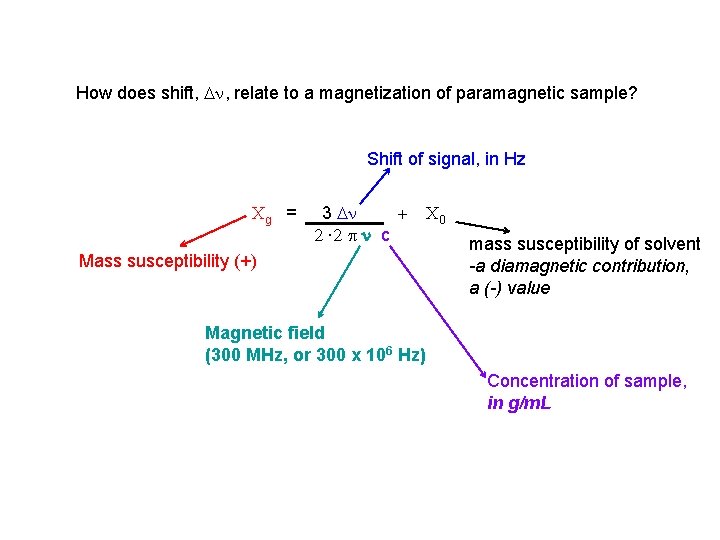
How does shift, , relate to a magnetization of paramagnetic sample? Shift of signal, in Hz g = 3 0 c mass susceptibility of solvent Mass susceptibility (+) -a diamagnetic contribution, a (-) value Magnetic field (300 MHz, or 300 x 106 Hz) Concentration of sample, in g/m. L
Magnetic field lines of flux Magnetic field lines affected by a paramagnetic substance: attracts Susceptibility, X > 0 Magnetic field lines affected by a diamagnetic substance: repels Susceptibility, X < 0
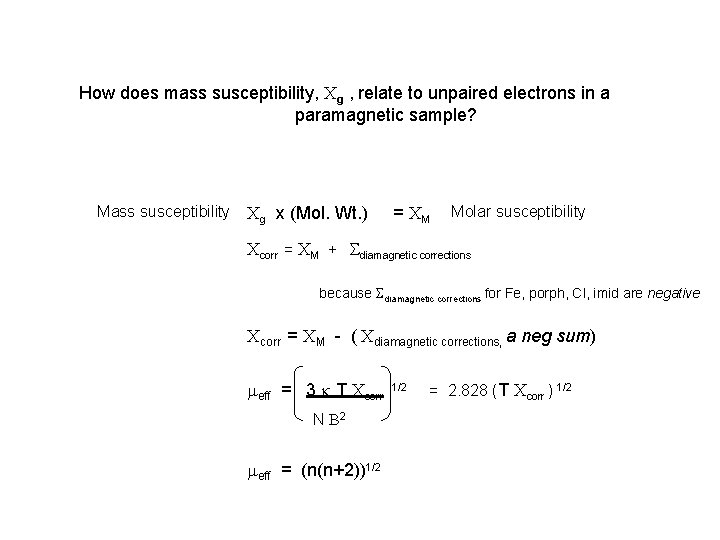
How does mass susceptibility, g , relate to unpaired electrons in a paramagnetic sample? Mass susceptibility g x (Mol. Wt. ) = M Molar susceptibility corr = M + diamagnetic corrections because diamagnetic corrections for Fe, porph, Cl, imid are negative corr = M - ( diamagnetic corrections, a neg sum) eff = 3 T corr N 2 eff = (n(n+2))1/2 = 2. 828 (T corr ) 1/2
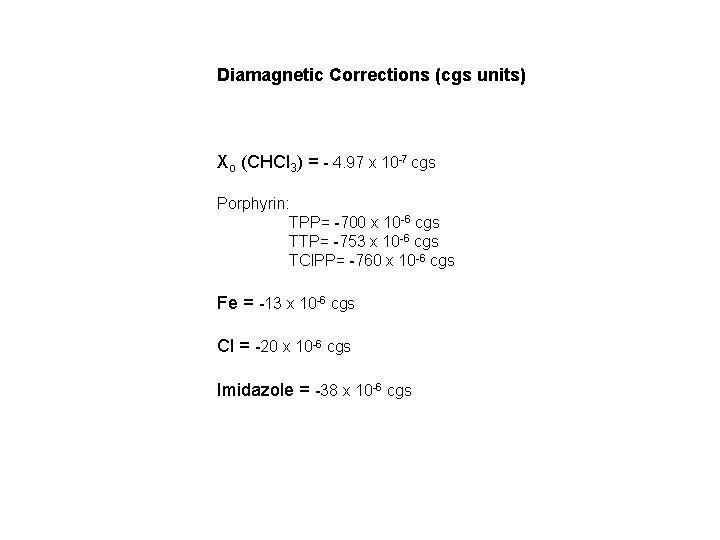
Diamagnetic Corrections (cgs units) Xo (CHCl 3) = - 4. 97 x 10 -7 cgs Porphyrin: TPP= -700 x 10 -6 cgs TTP= -753 x 10 -6 cgs TCl. PP= -760 x 10 -6 cgs Fe = -13 x 10 -6 cgs Cl = -20 x 10 -6 cgs Imidazole = -38 x 10 -6 cgs
The Role of Axial Ligation and the Allosteric Effect in Hemoglobin O 2 Binding
3 d orbitals on Fe Spin State of Fe affects size of ion
Large, high spin Fe(2+): In T state, transmitted by His on protein helix Small, low spin Fe(2+): In R state, transmitted to His on protein helix
- Slides: 18