
True or False A negatively charged object has
True or False? • A negatively charged object has an excess of electrons. • The positive charges move in a metal to balance the movement of free electrons. • The amount of charge depends on the mass of an object.
True or False? • Uncharged materials cannot be attracted by charged materials. • The atoms in the metal plate of an electroscope rearrenge to form eletric dipoles when a charge approaches. • The charges collected by the top comb of a Van Der Graaf generator can distribute around the metal dome because this is connected with the comb by metal connections.
Applied Electrostatics

Inkjet printer Positive plate Fine nozzle Negative plate • The ink droplets are charged as they thrust against the nozzle • The droplets are deflected as they pass between two electrically charged plates A 4 paper • The amount of charge, i. e. the size and direction of the voltage, on the plates keeps changing to drive each droplet to the right place on your paper • What charge will the droplets deflected upwardly have? Why? They will be negatively charged, because -ve charges are attracted by the positive plate at the top and repelled by the negative plate at the bottom.

Photocopier Negative plate Heated rollers Toner (black powder) • The metal plate is electrically charged and the image to photocopy is projected onto it • The lighter parts of your image cause the light to shine on the plate, so that the charge leaks away • The charged bits attract black powder which deposits on the paper • The paper is heated by the heated rolls, so that the powder sticks on it
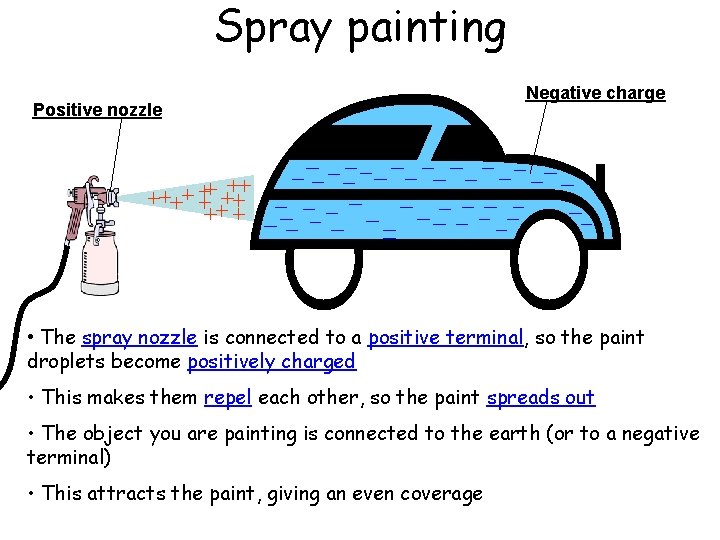
Spray painting Positive nozzle Negative charge • The spray nozzle is connected to a positive terminal, so the paint droplets become positively charged • This makes them repel each other, so the paint spreads out • The object you are painting is connected to the earth (or to a negative terminal) • This attracts the paint, giving an even coverage
- Slides: 6