
True Colors Personality Inventory What hue are you

- Slides: 24
True Colors Personality Inventory What hue are you?
True colors • True Colors is an inventory designed to help you better understand yourself and others • True Colors is an activity used to promote individual differences • True Colors is a self-awareness activity enabling individuals to become aware of personality styles • True Colors is a team builder helping members to understand the preferred styles of their colleagues
True Colors • Each color is reflective of a personality type • You will identify a primary and a secondary color; these are your personality types • The colors you do not choose will still have some characteristics that are representative of you, they are just not your dominant personality type • True Colors is valuable for improving your effectiveness in working with others
What is your color? • Rank each set of word clusters in each row from 4 to 1 • Once you have them ranked, total your answers at the bottom • The color with the highest score is your primary color • The color with the second highest score is your secondary color • If you have a tie, choose the one with which you most identify
Divide into Color Groups • Greens sit together • Golds sit together • Blues sit together • Oranges sit together
In your Color groups • Discuss your color group’s best traits • Discuss your color group’s challenge areas • Choose a spokesperson to share the top 3 of each
About Green • I seek knowledge and understanding • I live by my own standards • I need explanations and answers • I value intelligence, insight, fairness, and justice • I am a natural, non-conformist, a visionary, and a problem solver
About Gold • I follow the rules and respect authority • I have a strong sense of what is right and what is wrong in life • I need to be useful and to belong • I value home, family, and tradition • I am a natural perseverer, a good citizen, and helpful
About Blue • I feel unique and authentic • I look for meaning and significance in my life • I need to contribute, to encourage, and to care • I value integrity and unity in relationships • I am a natural romantic and nurturer and may be poetically inclined
About Orange • I act on a moment’s notice • I consider life a game, here and now • I need fun, variety, stimulation, and excitement • I value skill, resourcefulness and courage • I am a natural trouble-shooter, a performer, a competitor
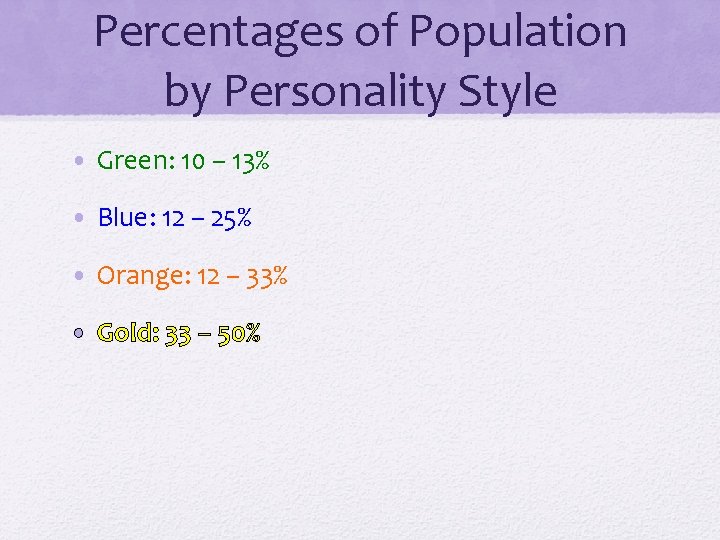
Percentages of Population by Personality Style • Green: 10 – 13% • Blue: 12 – 25% • Orange: 12 – 33% • Gold: 33 – 50%
Why does this matter to us? • Knowing these things about each other and ourselves can help us • • Work with each other better Communicate more effectively Make office time more productive Understand where others are coming from
Have you ever… • Encountered that one person with whom you just couldn’t communicate? • Had days when you felt like you were speaking a foreign language and no one else could understand you? • Tried to get a co-worker to understand your point of view to no avail?
Well, consider this: • Each person approaches projects and conversations differently • Sometimes, understanding how you maybe perceived can help you understand how to better communicate
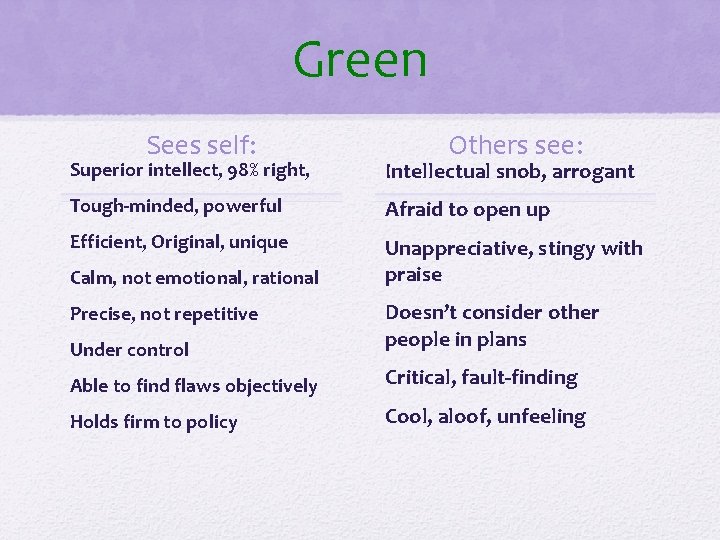
Green Sees self: Others see: Superior intellect, 98% right, Intellectual snob, arrogant Tough-minded, powerful Afraid to open up Efficient, Original, unique Unappreciative, stingy with praise Calm, not emotional, rational Under control Doesn’t consider other people in plans Able to find flaws objectively Critical, fault-finding Holds firm to policy Cool, aloof, unfeeling Precise, not repetitive
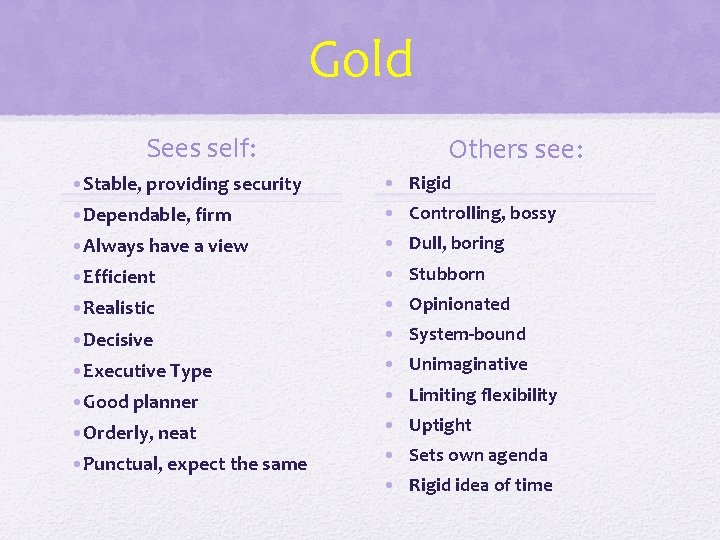
Gold Sees self: Others see: • Stable, providing security • Rigid • Dependable, firm • Controlling, bossy • Always have a view • Dull, boring • Efficient • Stubborn • Realistic • Opinionated • Decisive • System-bound • Executive Type • Unimaginative • Good planner • Orderly, neat • Punctual, expect the same • Limiting flexibility • Uptight • Sets own agenda • Rigid idea of time
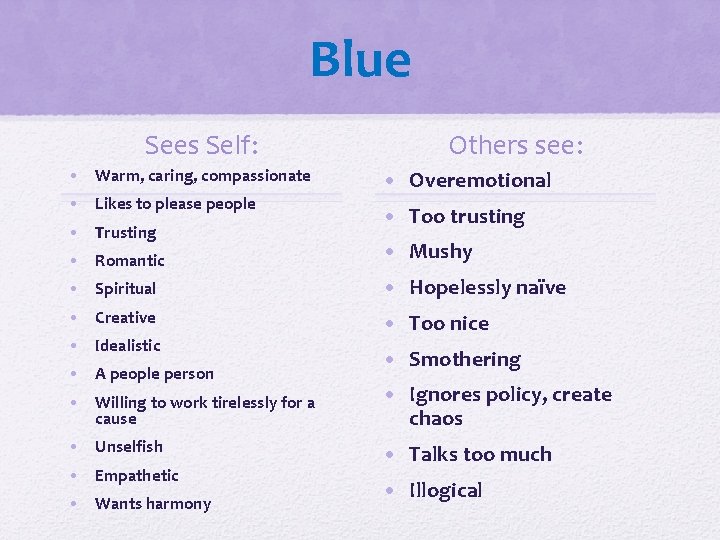
Blue Sees Self: • Warm, caring, compassionate • Likes to please people • Trusting Others see: • Overemotional • Too trusting • Romantic • Mushy • Spiritual • Hopelessly naïve • Creative • Too nice • Idealistic • A people person • Smothering • Willing to work tirelessly for a cause • Ignores policy, create chaos • Unselfish • Talks too much • Empathetic • Wants harmony • Illogical
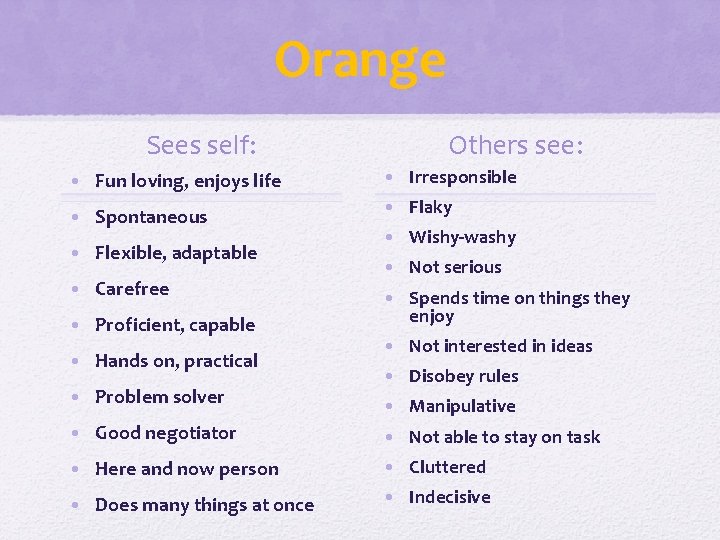
Orange Sees self: Others see: • Fun loving, enjoys life • Irresponsible • Spontaneous • Flaky • Flexible, adaptable • Carefree • Proficient, capable • Hands on, practical • Problem solver • Wishy-washy • Not serious • Spends time on things they enjoy • Not interested in ideas • Disobey rules • Manipulative • Good negotiator • Not able to stay on task • Here and now person • Cluttered • Does many things at once • Indecisive
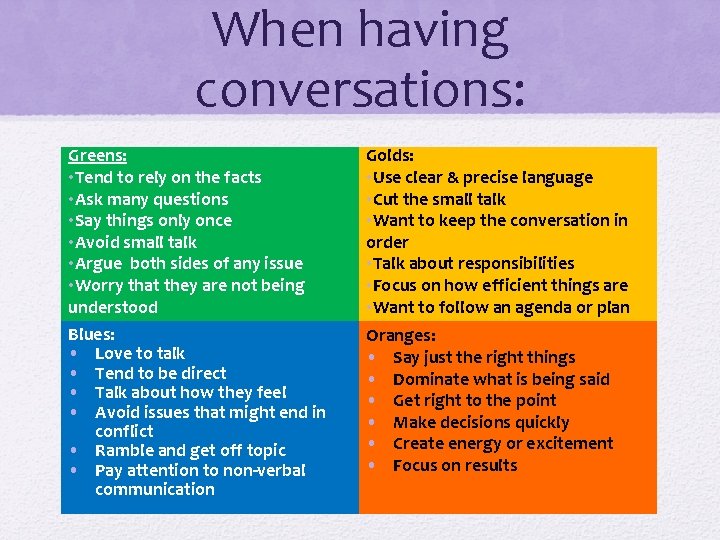
When having conversations: Greens: • Tend to rely on the facts • Ask many questions • Say things only once • Avoid small talk • Argue both sides of any issue • Worry that they are not being understood Golds: • Use clear & precise language • Cut the small talk • Want to keep the conversation in order • Talk about responsibilities • Focus on how efficient things are • Want to follow an agenda or plan Blues: • Love to talk • Tend to be direct • Talk about how they feel • Avoid issues that might end in conflict • Ramble and get off topic • Pay attention to non-verbal communication Oranges: • Say just the right things • Dominate what is being said • Get right to the point • Make decisions quickly • Create energy or excitement • Focus on results
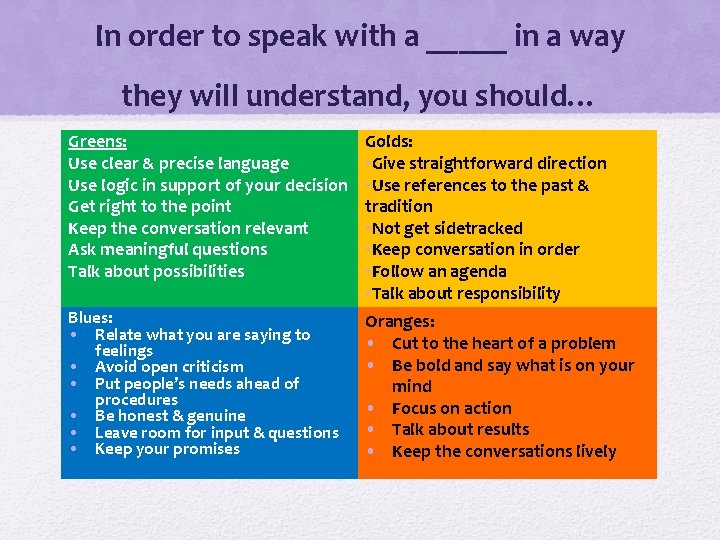
In order to speak with a _____ in a way they will understand, you should… Greens: Use clear & precise language Use logic in support of your decision Get right to the point Keep the conversation relevant Ask meaningful questions Talk about possibilities Golds: • Give straightforward direction • Use references to the past & tradition • Not get sidetracked • Keep conversation in order • Follow an agenda • Talk about responsibility Blues: • Relate what you are saying to feelings • Avoid open criticism • Put people’s needs ahead of procedures • Be honest & genuine • Leave room for input & questions • Keep your promises Oranges: • Cut to the heart of a problem • Be bold and say what is on your mind • Focus on action • Talk about results • Keep the conversations lively
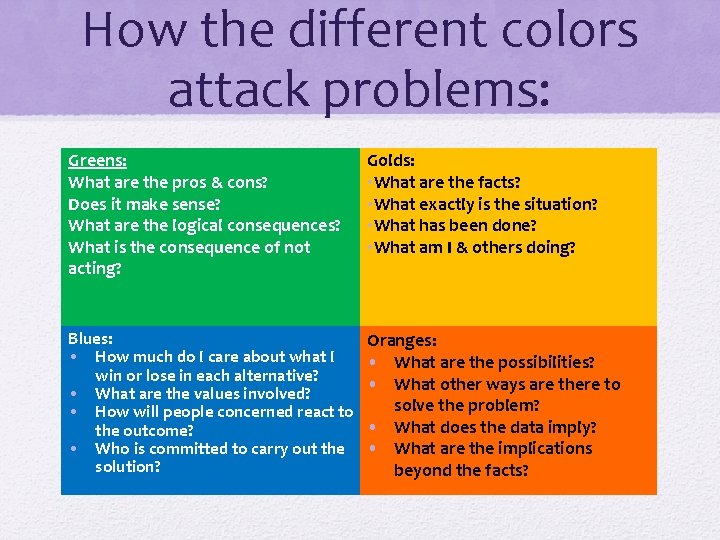
How the different colors attack problems: Greens: What are the pros & cons? Does it make sense? What are the logical consequences? What is the consequence of not acting? Golds: • What are the facts? • What exactly is the situation? • What has been done? • What am I & others doing? Blues: • How much do I care about what I win or lose in each alternative? • What are the values involved? • How will people concerned react to the outcome? • Who is committed to carry out the solution? Oranges: • What are the possibilities? • What other ways are there to solve the problem? • What does the data imply? • What are the implications beyond the facts?
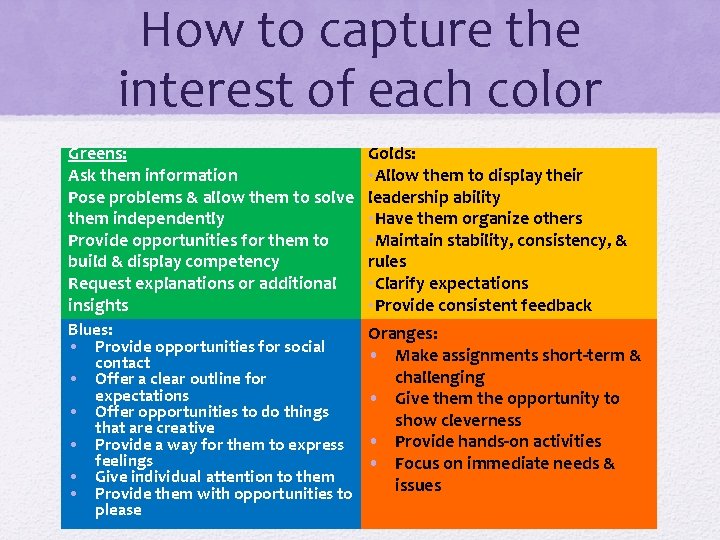
How to capture the interest of each color Greens: Ask them information Pose problems & allow them to solve them independently Provide opportunities for them to build & display competency Request explanations or additional insights Golds: • Allow them to display their leadership ability • Have them organize others • Maintain stability, consistency, & rules • Clarify expectations • Provide consistent feedback Blues: • Provide opportunities for social contact • Offer a clear outline for expectations • Offer opportunities to do things that are creative • Provide a way for them to express feelings • Give individual attention to them • Provide them with opportunities to please Oranges: • Make assignments short-term & challenging • Give them the opportunity to show cleverness • Provide hands-on activities • Focus on immediate needs & issues
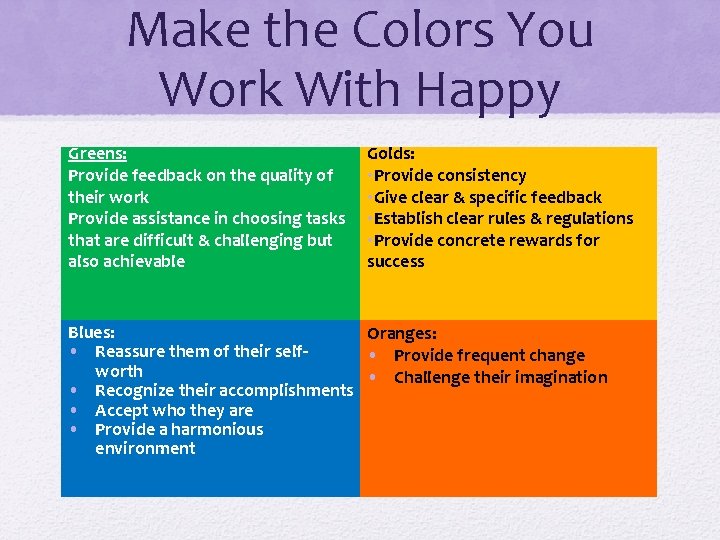
Make the Colors You Work With Happy Greens: Provide feedback on the quality of their work Provide assistance in choosing tasks that are difficult & challenging but also achievable Golds: • Provide consistency • Give clear & specific feedback • Establish clear rules & regulations • Provide concrete rewards for success Blues: Oranges: • Reassure them of their self • Provide frequent change worth • Challenge their imagination • Recognize their accomplishments • Accept who they are • Provide a harmonious environment
Conclusions • Everyone has some of each color within their lead color • We all have strengths and weaknesses • Try to play to each other’s strengths and consider how others approach ideas, projects, and communication • Use this information to become a better communicator and team player