
Truancy Intervention Program Blue Earth County Attorneys Office

Truancy Intervention Program Blue Earth County Attorney’s Office Revised 2. 19
Agenda n THE LAW n LEGAL CONSEQUENCES n THE TIP PROGRAM n WHAT PARENTS AND STUDENTS ARE REQUIRED TO DO

Minnesota Truancy Law n All children, ages 12 -18, must attend school every day for every class period. Minn. Stat. 260 C. 007, subd. 19. n n Once a student turns 18, truancy does not apply. Any absences from school or class must be excused with a legally recognized excuse.
Legal Definition of a Truant n n n A continuing truant is a child between the ages of 12 through 18 who is absent from school without a lawful excuse for three or more class periods on three school days. Minn. Stat. 260 A. 02, subd. 3. A habitual truant is a child under the age of 18 years who is absent from attendance at school without a lawful excuse for one or more class periods on seven school days. In addition, a habitual truant is a child who is 17 years old without a lawful excuse for one or more class periods on seven school days and who has not lawfully withdrawn.
Excused Absences n n Acceptable excused absences include: n Sickness n Doctor’s Visit n Religious Holiday n Extreme Family Emergency If a child misses class or school for any of the above reasons, the parent must properly communicate the absence to the school attendance coordinator or the absence will be unexcused.
Unexcused Absences n Unexcused absences which are illegal are: n n n Babysitting Tardy (if over the threshold as designated by the school) Work Rest due to work Travel (unless pre-approved by school) Missing or getting kicked off of the bus Weather (unless school is cancelled) Oversleeping Helping out at home Car trouble Child is not immunized
The Bottom Line n Truancy is missing school without a lawful excuse. Students are required to attend school every day for every class period. It is the law and court sanctions may occur if the absences do not stop.
CONSEQUENCES & PENALTIES FOR TRUANCY n Truancy Intervention Program n Truancy Petition n CHIPS Petition
Truancy Intervention Program Process
TIP Meeting n The school makes a referral to the program if the child is having problems with attendance. This may occur as early as 3 unexcused absences when the child is considered a “continuing truant. ” n n n Parents and their child are required to attend a group informational meeting with a member of the County Attorney’s Office. After this meeting, the school monitors attendance for improvement. If attendance improves, no further action is taken.
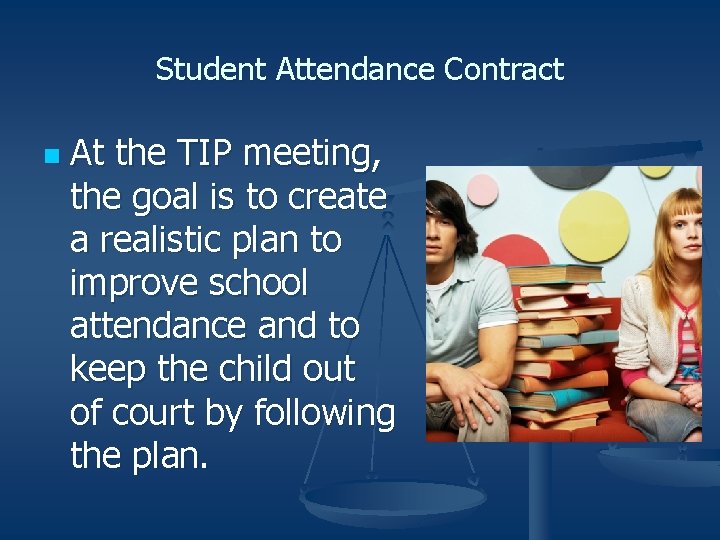
Student Attendance Contract n At the TIP meeting, the goal is to create a realistic plan to improve school attendance and to keep the child out of court by following the plan.
Continued Unexcused Absences n If school attendance does not improve after the informational meeting further intervention efforts may be made and ultimately a Truancy Petition will be filed with the Court.
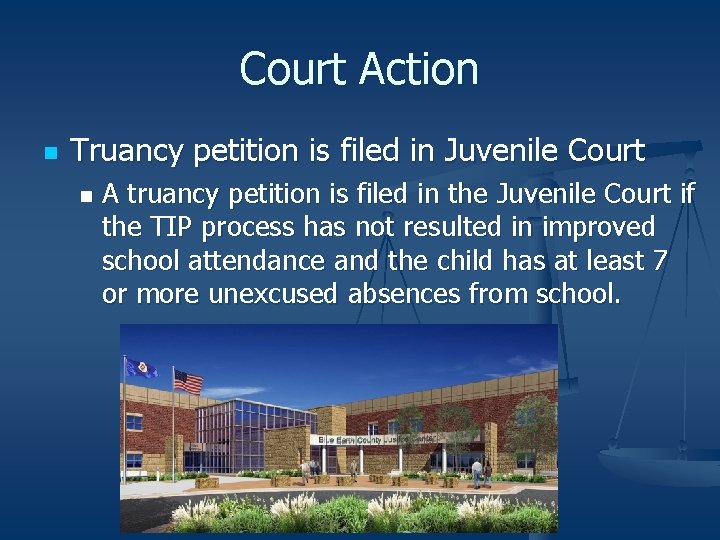
Court Action n Truancy petition is filed in Juvenile Court n A truancy petition is filed in the Juvenile Court if the TIP process has not resulted in improved school attendance and the child has at least 7 or more unexcused absences from school.
Results n The filing of a truancy n petition means that we have failed to solve the attendance problem through the Truancy Intervention Program process. The filing of a truancy petition results in losing control over the situation. At this time a Blue Earth County District Court Judge will take control of the child’s school attendance and related issues.
CONSEQUENCES & PENALTIES FOR TRUANCY n A Child in Need of Protection or Services (CHIPS) petition may be filed in Juvenile Court. n The parents will be named on the petition n Proceedings will be open to the public.
CONSEQUENCES & PENALTIES FOR TRUANCY n n The Court may fine the Child up to $100. The Court will order the family to work with an assigned Probation Agent and to follow the rules that the Probation agent sets.
CONSEQUENCES & PENALTIES FOR TRUANCY n n n The Court may take away the child’s phone or other electronic devices. The Court may order the child to complete community work service hours. The Court may order the child to follow a curfew.
CONSEQUENCES & PENALTIES FOR TRUANCY n The Court may order the Parents/Guardians to compel the child’s attendance and deliver the child to school at the beginning of each school day for a period of time specified by the Court.
CONSEQUENCES & PENALTIES FOR TRUANCY n n n The Court may order the child to attend family or individual counseling. The Court may order the child to participate in a chemical use assessment and to follow recommendations. The Court may also order random drug or alcohol testing.
CONSEQUENCES & PENALTIES FOR TRUANCY n n The Court may revoke or delay all driving privileges up until a student’s 18 th birthday. The Court may find both a child and a parent/guardian in civil contempt of court for knowingly violating a juvenile court order. The purpose of civil contempt is to coerce compliance and can result in a fine and/or incarceration.
CONSEQUENCES & PENALTIES FOR TRUANCY n n The Court may order that the child be placed on house arrest and subject to Electronic Home Monitoring. The child cannot leave the residence unless at school n or with a parent. n
CONSEQUENCES & PENALTIES FOR TRUANCY n The Court may order that the child be removed from home and placed in a shelter care, foster care, or short term residential facility. n Parents/guardians can be required to pay a fee for placement.
REMEMBER n n The most significant consequences for truancy are not court sanctions. Children who fail to attend school are more likely to become involved in other negative and illegal activities that severely limit later opportunities in life. Uncorrected truancy is the beginning of a lifetime of unmet potential and failed experiences
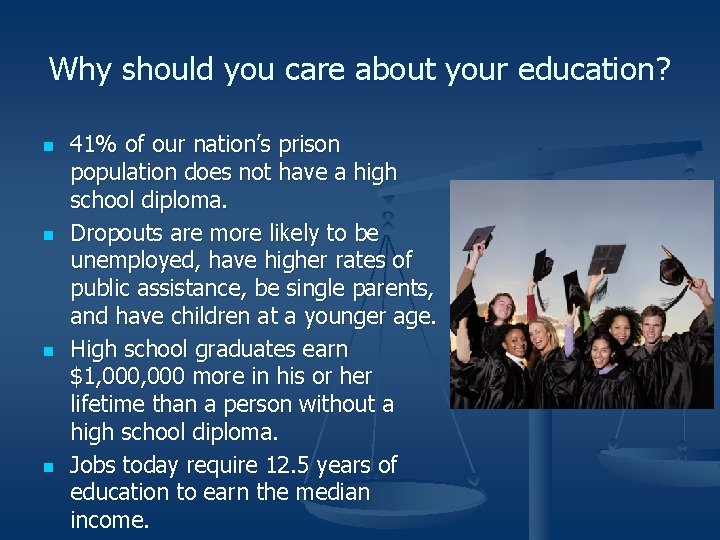
Why should you care about your education? n n 41% of our nation’s prison population does not have a high school diploma. Dropouts are more likely to be unemployed, have higher rates of public assistance, be single parents, and have children at a younger age. High school graduates earn $1, 000 more in his or her lifetime than a person without a high school diploma. Jobs today require 12. 5 years of education to earn the median income.
Final Message n The law requires youn Failure to improve to attend school your attendance will every day for every result in a referral to class period. the next step of the TIP program and may ultimately result in court action.
- Slides: 25