
Troubleshooting Guidelines 1 Gather information using Critical Thinking
Troubleshooting Guidelines 1. Gather information using “Critical Thinking Questions” and “Critical Thinking Actions” 2. Apply solid engineering fundamentals. 3. Separate observations from hypotheses or conjectures. 4. Independently verify data using field measurements and observations, when possible. Department of Chemical Engineering, University of Michigan, Ann Arbor 12/7/2020 1
Troubleshooting Guidelines 5. Make rigorous comparisons of faulty operation with satisfactory (normal) operations. 6. Spend time in the unit making direct observations -- Even if you are not sure what to expect. 7. Consider the entire system related to the problem. -- Not just one piece of equipment Department of Chemical Engineering, University of Michigan, Ann Arbor 12/7/2020 2
Troubleshooting Guidelines 8. Practice good listening skills. Recall Steve Covey “Listen, Listen” 9. Do not reject serendipitous results. Joel Barker’s “Paradigm Filter Effect” 10. Do not fall in love with a hypothesis – seek to reject, as well as to accept. Department of Chemical Engineering, University of Michigan, Ann Arbor 12/7/2020 3
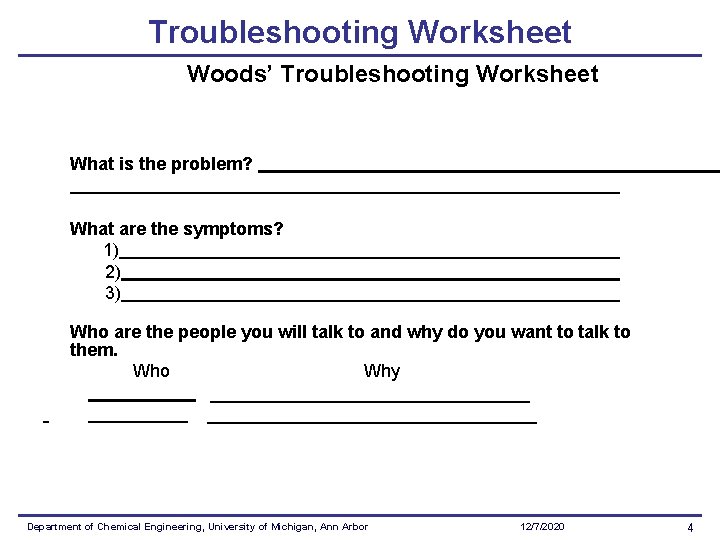
Troubleshooting Worksheet Woods’ Troubleshooting Worksheet What is the problem? What are the symptoms? 1) 2) 3) Who are the people you will talk to and why do you want to talk to them. Who Why _________________________________ Department of Chemical Engineering, University of Michigan, Ann Arbor 12/7/2020 4
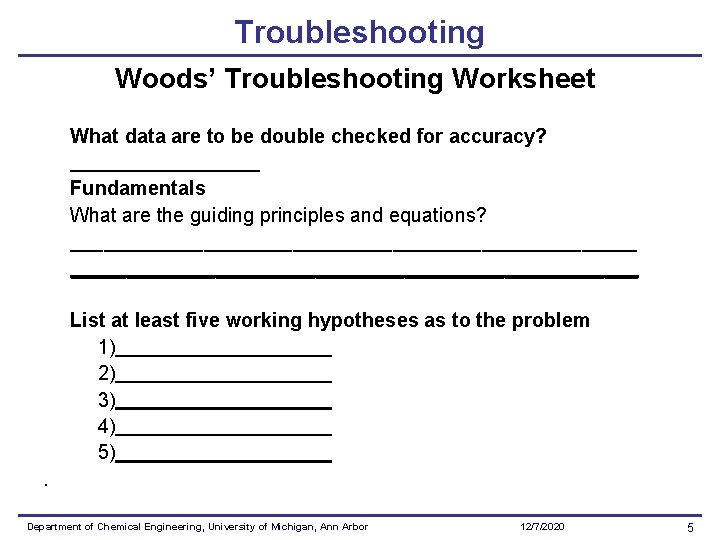
Troubleshooting Woods’ Troubleshooting Worksheet What data are to be double checked for accuracy? Fundamentals What are the guiding principles and equations? ___________________________________________________ List at least five working hypotheses as to the problem 1) 2) 3) 4) 5). Department of Chemical Engineering, University of Michigan, Ann Arbor 12/7/2020 5
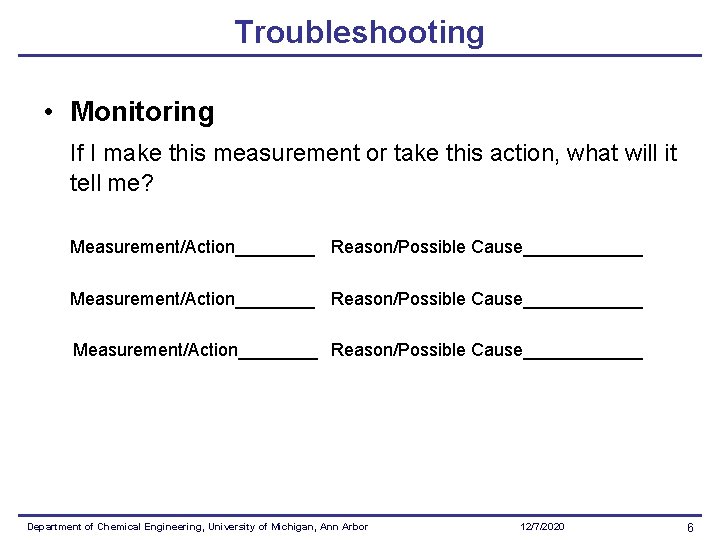
Troubleshooting • Monitoring If I make this measurement or take this action, what will it tell me? Measurement/Action________ Reason/Possible Cause____________ Measurement/Action____ Reason/Possible Cause______ Department of Chemical Engineering, University of Michigan, Ann Arbor 12/7/2020 6
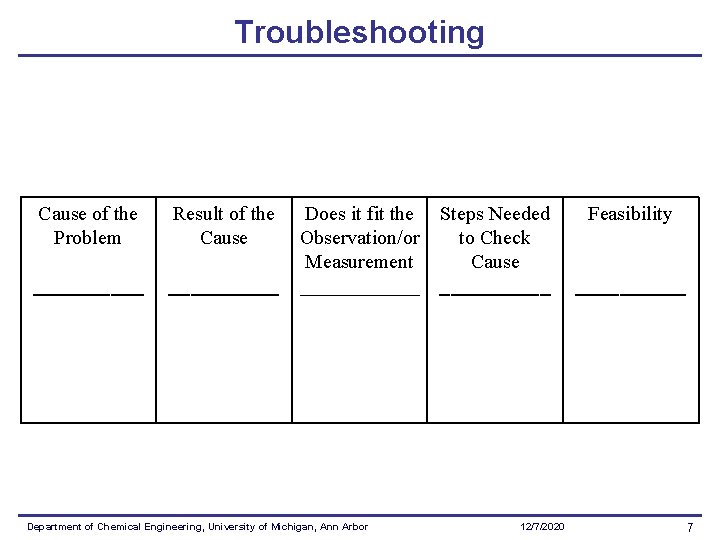
Troubleshooting Cause of the Problem _____ Result of the Cause Does it fit the Steps Needed Observation/or to Check Measurement Cause ____________ Department of Chemical Engineering, University of Michigan, Ann Arbor 12/7/2020 Feasibility _____ 7
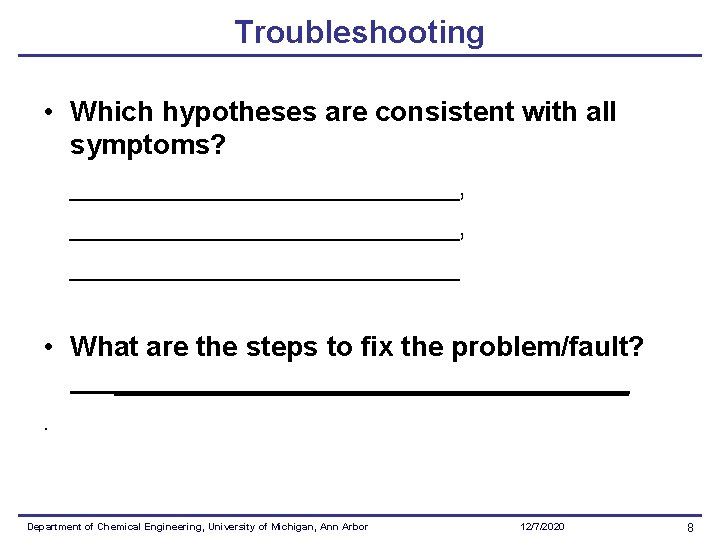
Troubleshooting • Which hypotheses are consistent with all symptoms? _________________________, _____________ • What are the steps to fix the problem/fault? _________________. Department of Chemical Engineering, University of Michigan, Ann Arbor 12/7/2020 8
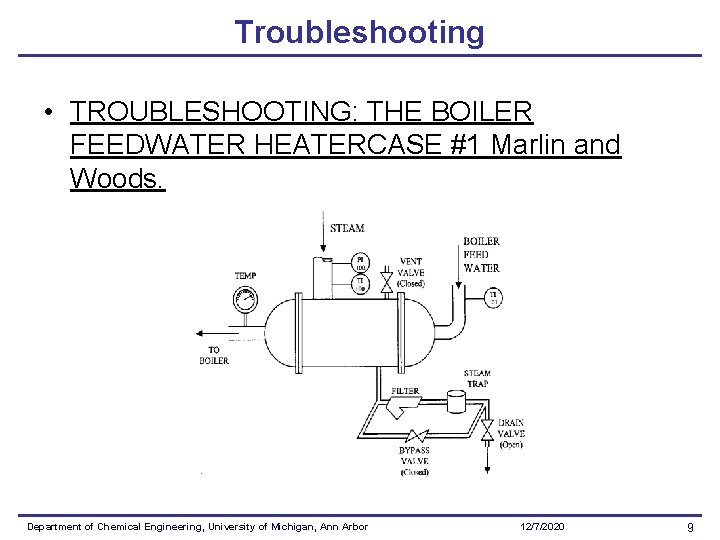
Troubleshooting • TROUBLESHOOTING: THE BOILER FEEDWATER HEATERCASE #1 Marlin and Woods. Department of Chemical Engineering, University of Michigan, Ann Arbor 12/7/2020 9
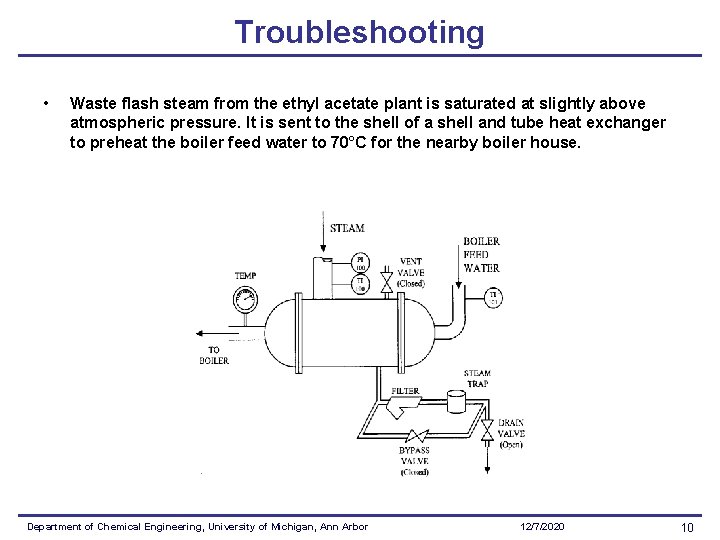
Troubleshooting • Waste flash steam from the ethyl acetate plant is saturated at slightly above atmospheric pressure. It is sent to the shell of a shell and tube heat exchanger to preheat the boiler feed water to 70°C for the nearby boiler house. Department of Chemical Engineering, University of Michigan, Ann Arbor 12/7/2020 10
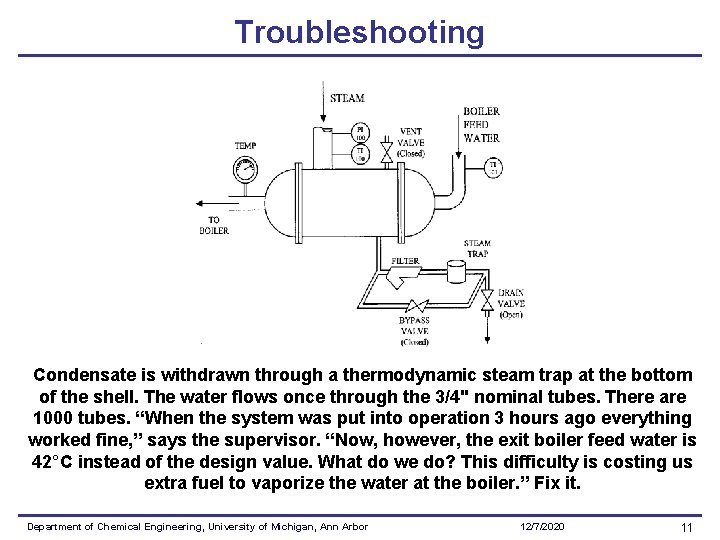
Troubleshooting Condensate is withdrawn through a thermodynamic steam trap at the bottom of the shell. The water flows once through the 3/4" nominal tubes. There are 1000 tubes. “When the system was put into operation 3 hours ago everything worked fine, ” says the supervisor. “Now, however, the exit boiler feed water is 42°C instead of the design value. What do we do? This difficulty is costing us extra fuel to vaporize the water at the boiler. ” Fix it. Department of Chemical Engineering, University of Michigan, Ann Arbor 12/7/2020 11
• What are the fundamentals of heat exchange? Department of Chemical Engineering, University of Michigan, Ann Arbor 12/7/2020 12
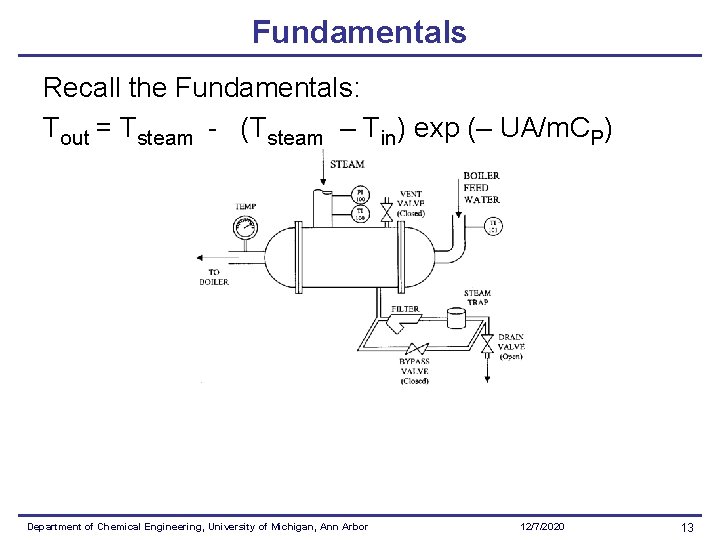
Fundamentals Recall the Fundamentals: Tout = Tsteam - (Tsteam – Tin) exp (– UA/m. CP) Department of Chemical Engineering, University of Michigan, Ann Arbor 12/7/2020 13
Fundamentals Recall the Fundamentals: Tout = Tsteam - (Tsteam – Tin) exp (– UA/m. CP) Discuss each term Department of Chemical Engineering, University of Michigan, Ann Arbor 12/7/2020 14
Fundamentals Tout = Tsteam - (Tsteam – Tin) exp (– UA/m. CP) The overall heat transfer coefficient U is related to the individual heat transfer coefficients inside (hi) and outside (ho) by the equation 1/U= 1/ho + 1/hi The shell side (outside) heat transfer coefficient would be about For water: ho=1500 W/m 2 C (outside) For air: ho=10 W/m 2 C (outside: shell side) For steam: ho=20, 000 W/m 2 C (outside: shell side) Tube side (Inside) heat transfer coefficient For water: hi=1500 W/m 2 C. (inside : tube side) Department of Chemical Engineering, University of Michigan, Ann Arbor 12/7/2020 15
• Brainstorm Five Possible Causes Department of Chemical Engineering, University of Michigan, Ann Arbor 12/7/2020 16
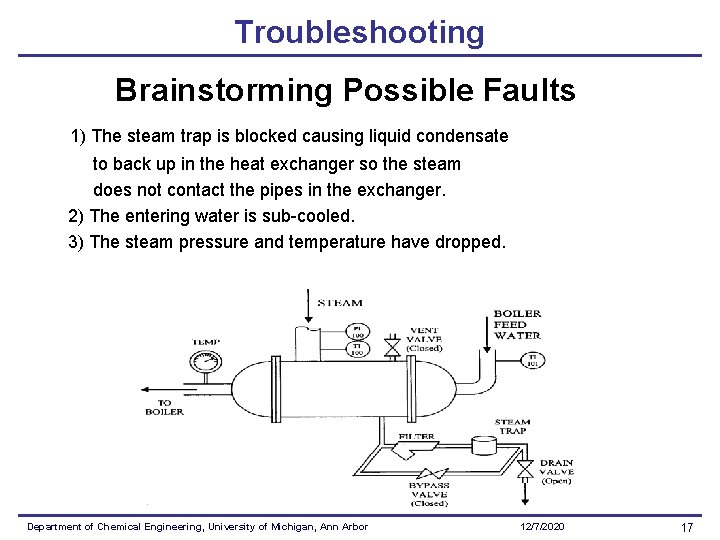
Troubleshooting Brainstorming Possible Faults 1) The steam trap is blocked causing liquid condensate to back up in the heat exchanger so the steam does not contact the pipes in the exchanger. 2) The entering water is sub-cooled. 3) The steam pressure and temperature have dropped. Department of Chemical Engineering, University of Michigan, Ann Arbor 12/7/2020 17
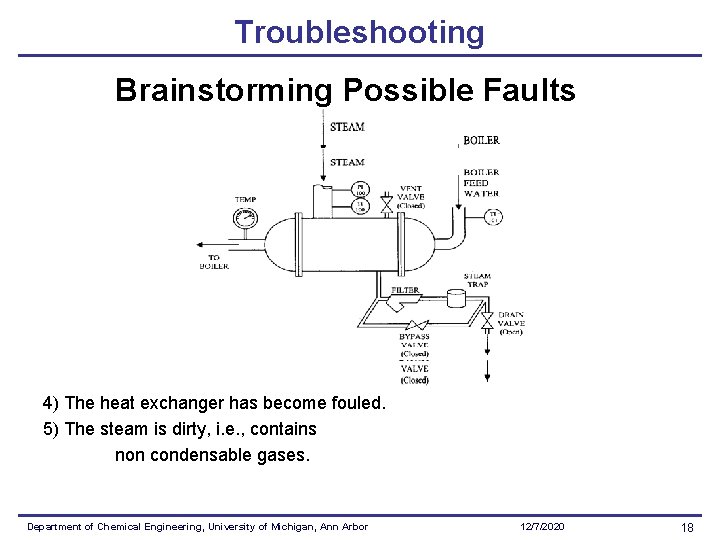
Troubleshooting Brainstorming Possible Faults 4) The heat exchanger has become fouled. 5) The steam is dirty, i. e. , contains non condensable gases. Department of Chemical Engineering, University of Michigan, Ann Arbor 12/7/2020 18
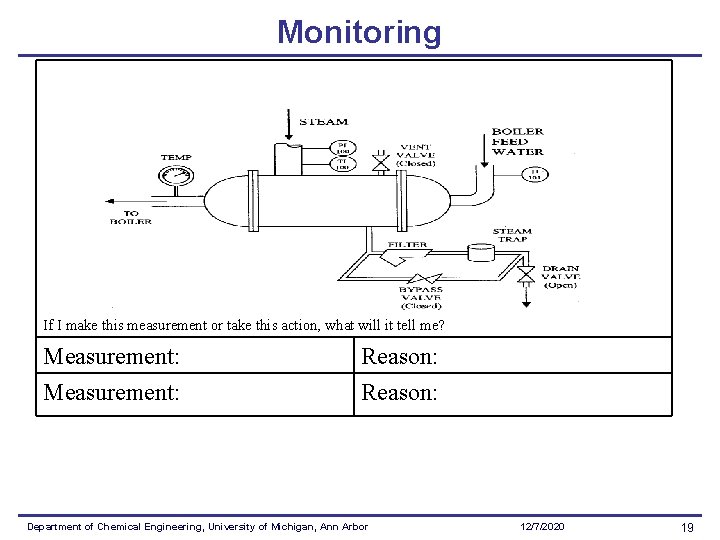
Monitoring If I make this measurement or take this action, what will it tell me? Measurement: Reason: Department of Chemical Engineering, University of Michigan, Ann Arbor 12/7/2020 19
Monitoring • Make a list of the measurements to be made • For each measurement give the reason you are making the measurements. • What are possible outcomes of the measurement and what will they tell you. Department of Chemical Engineering, University of Michigan, Ann Arbor 12/7/2020 20
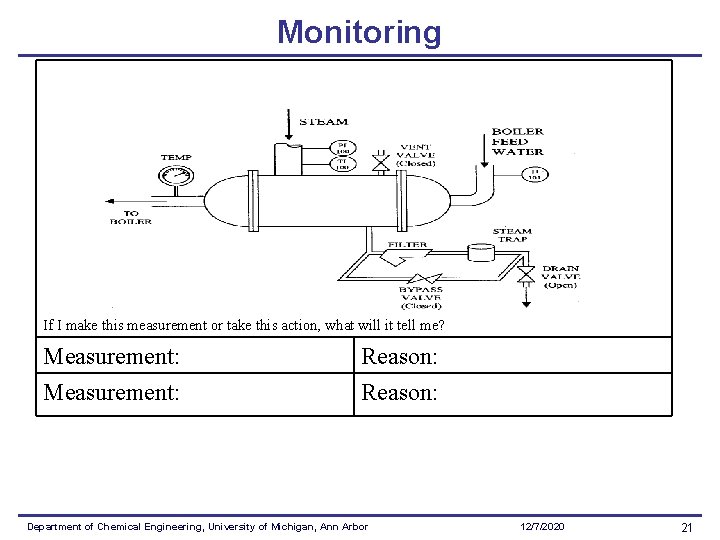
Monitoring If I make this measurement or take this action, what will it tell me? Measurement: Reason: Department of Chemical Engineering, University of Michigan, Ann Arbor 12/7/2020 21
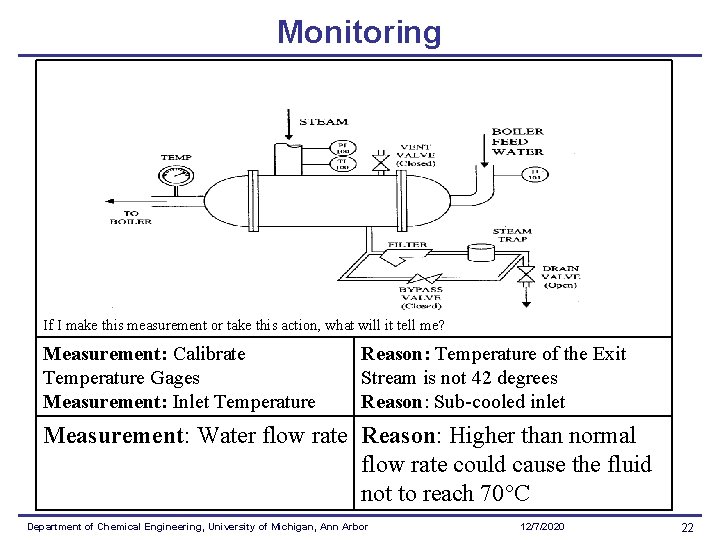
Monitoring If I make this measurement or take this action, what will it tell me? Measurement: Calibrate Temperature Gages Measurement: Inlet Temperature Reason: Temperature of the Exit Stream is not 42 degrees Reason: Sub-cooled inlet Measurement: Water flow rate Reason: Higher than normal flow rate could cause the fluid not to reach 70 C Department of Chemical Engineering, University of Michigan, Ann Arbor 12/7/2020 22

Troubleshooting • Monitoring If I make this measurement or take this action, what will it tell me? Measurement/Action________ Reason/Possible Cause____________ Measurement/Action____ Reason/Possible Cause______ Department of Chemical Engineering, University of Michigan, Ann Arbor 12/7/2020 23
Monitoring • Make a list of the actions you will carry out. Department of Chemical Engineering, University of Michigan, Ann Arbor 12/7/2020 24
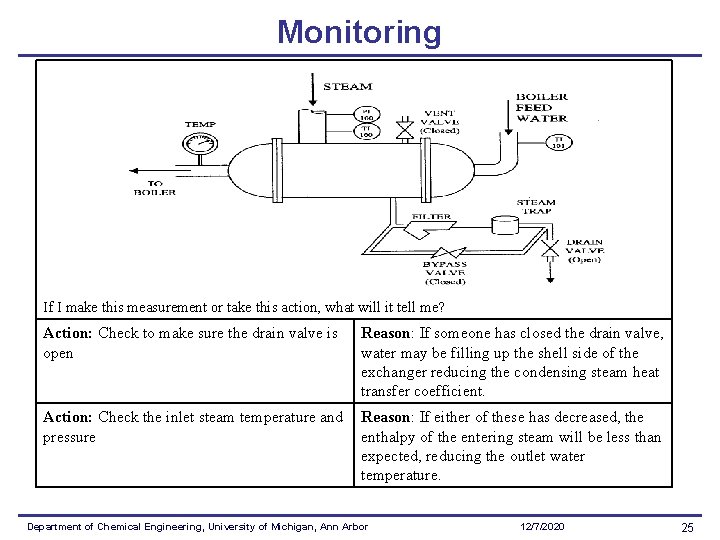
Monitoring If I make this measurement or take this action, what will it tell me? Action: Check to make sure the drain valve is open Reason: If someone has closed the drain valve, water may be filling up the shell side of the exchanger reducing the condensing steam heat transfer coefficient. Action: Check the inlet steam temperature and pressure Reason: If either of these has decreased, the enthalpy of the entering steam will be less than expected, reducing the outlet water temperature. Department of Chemical Engineering, University of Michigan, Ann Arbor 12/7/2020 25
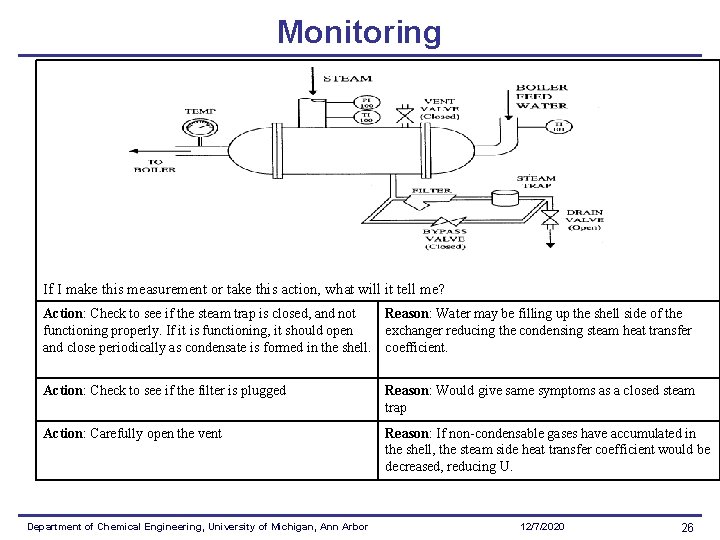
Monitoring If I make this measurement or take this action, what will it tell me? Action: Check to see if the steam trap is closed, and not Reason: Water may be filling up the shell side of the functioning properly. If it is functioning, it should open exchanger reducing the condensing steam heat transfer and close periodically as condensate is formed in the shell. coefficient. Action: Check to see if the filter is plugged Reason: Would give same symptoms as a closed steam trap Action: Carefully open the vent Reason: If non-condensable gases have accumulated in the shell, the steam side heat transfer coefficient would be decreased, reducing U. Department of Chemical Engineering, University of Michigan, Ann Arbor 12/7/2020 26
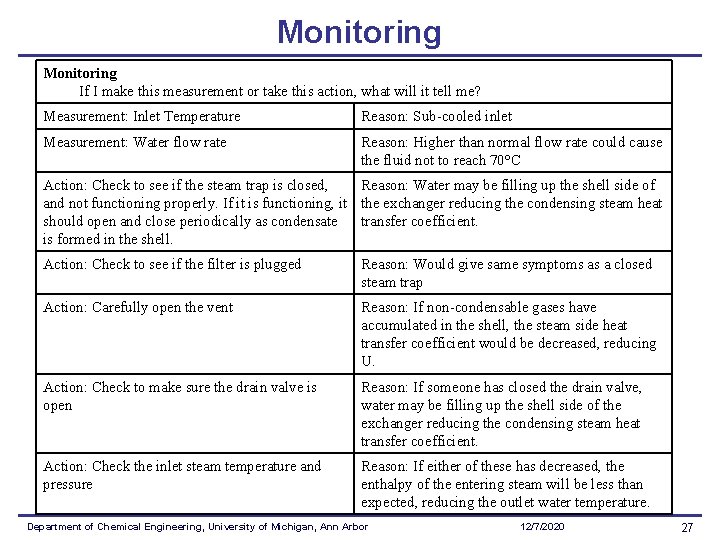
Monitoring If I make this measurement or take this action, what will it tell me? Measurement: Inlet Temperature Reason: Sub-cooled inlet Measurement: Water flow rate Reason: Higher than normal flow rate could cause the fluid not to reach 70 C Action: Check to see if the steam trap is closed, Reason: Water may be filling up the shell side of and not functioning properly. If it is functioning, it the exchanger reducing the condensing steam heat should open and close periodically as condensate transfer coefficient. is formed in the shell. Action: Check to see if the filter is plugged Reason: Would give same symptoms as a closed steam trap Action: Carefully open the vent Reason: If non-condensable gases have accumulated in the shell, the steam side heat transfer coefficient would be decreased, reducing U. Action: Check to make sure the drain valve is open Reason: If someone has closed the drain valve, water may be filling up the shell side of the exchanger reducing the condensing steam heat transfer coefficient. Action: Check the inlet steam temperature and pressure Reason: If either of these has decreased, the enthalpy of the entering steam will be less than expected, reducing the outlet water temperature. Department of Chemical Engineering, University of Michigan, Ann Arbor 12/7/2020 27

Troubleshooting Cause of the Problem Result of the Cause Does it fit the Observation/or Measurement Department of Chemical Engineering, University of Michigan, Ann Arbor Steps Needed to Check Cause 12/7/2020 Feasibility 28
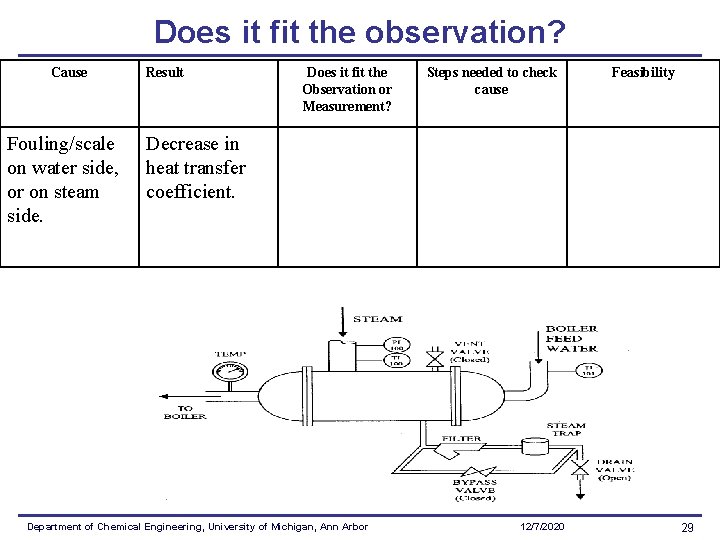
Does it fit the observation? Cause Fouling/scale on water side, or on steam side. Result Does it fit the Observation or Measurement? Steps needed to check cause Feasibility Decrease in heat transfer coefficient. Department of Chemical Engineering, University of Michigan, Ann Arbor 12/7/2020 29
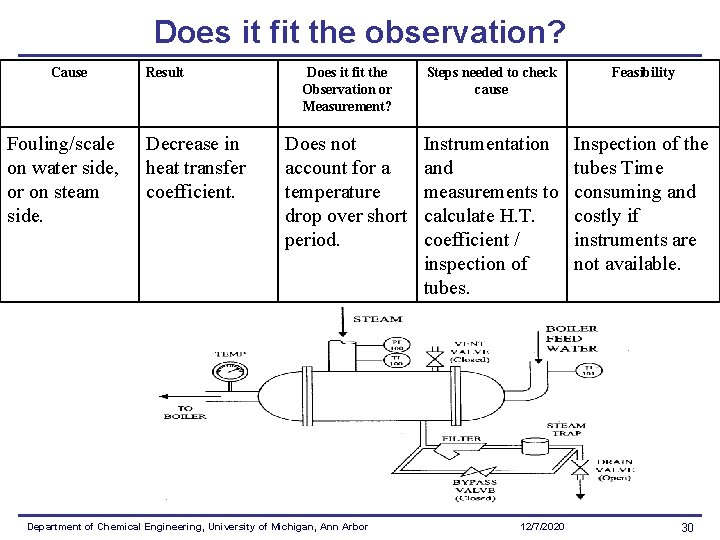
Does it fit the observation? Cause Fouling/scale on water side, or on steam side. Result Decrease in heat transfer coefficient. Does it fit the Observation or Measurement? Steps needed to check cause Feasibility Does not account for a temperature drop over short period. Instrumentation and measurements to calculate H. T. coefficient / inspection of tubes. Inspection of the tubes Time consuming and costly if instruments are not available. Department of Chemical Engineering, University of Michigan, Ann Arbor 12/7/2020 30
CLASSIFICATION FACT vs. OPINIONATED FACTS 31
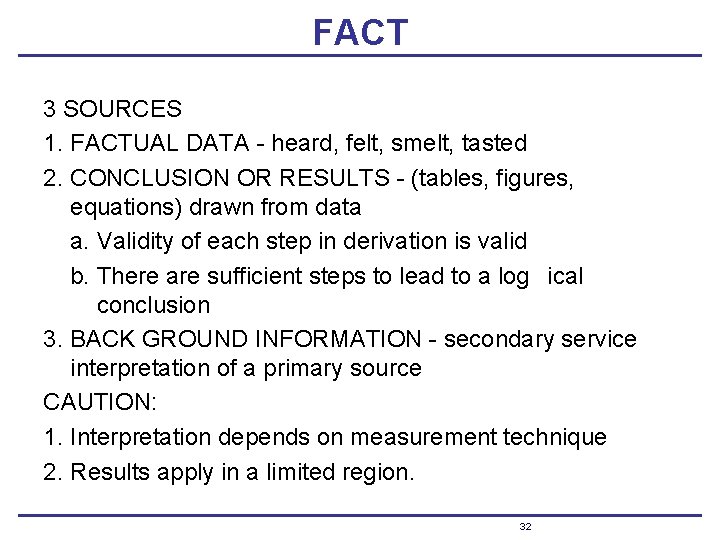
FACT 3 SOURCES 1. FACTUAL DATA - heard, felt, smelt, tasted 2. CONCLUSION OR RESULTS - (tables, figures, equations) drawn from data a. Validity of each step in derivation is valid b. There are sufficient steps to lead to a log ical conclusion 3. BACK GROUND INFORMATION - secondary service interpretation of a primary source CAUTION: 1. Interpretation depends on measurement technique 2. Results apply in a limited region. 32
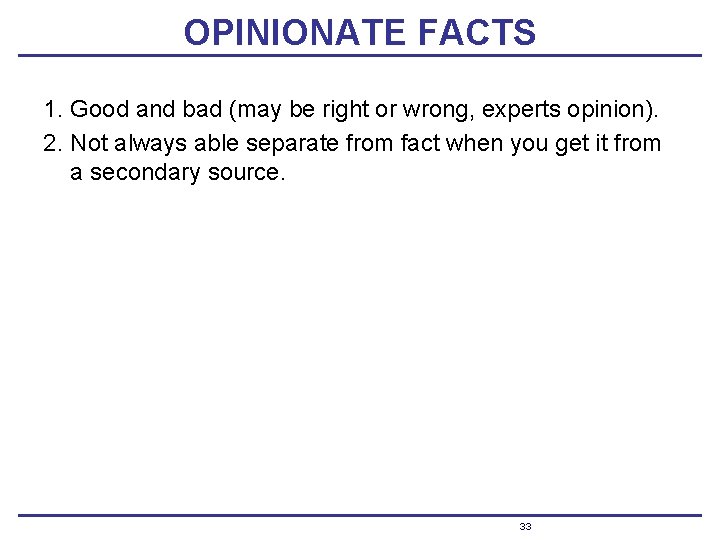
OPINIONATE FACTS 1. Good and bad (may be right or wrong, experts opinion). 2. Not always able separate from fact when you get it from a secondary source. 33
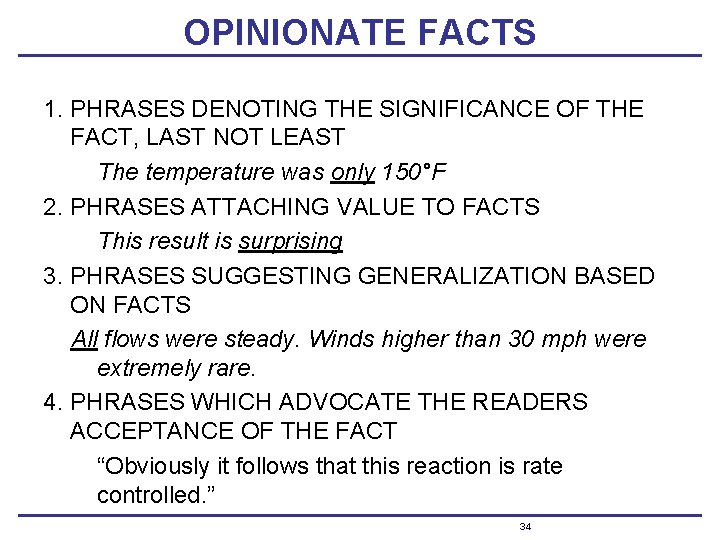
OPINIONATE FACTS 1. PHRASES DENOTING THE SIGNIFICANCE OF THE FACT, LAST NOT LEAST The temperature was only 150°F 2. PHRASES ATTACHING VALUE TO FACTS This result is surprising 3. PHRASES SUGGESTING GENERALIZATION BASED ON FACTS All flows were steady. Winds higher than 30 mph were extremely rare. 4. PHRASES WHICH ADVOCATE THE READERS ACCEPTANCE OF THE FACT “Obviously it follows that this reaction is rate controlled. ” 34
OPINION Based On 1. Years of experience 2. Self interests 3. Habit 4. The will to a. believe b. disbelieve 35
ANALYSIS Identify • Elements • Relationships • Omissions Distinguish • Fact From Opinion • Conclusions From Evidence Detect • Fallacies In Logic • Missing Information • Incorrectly Defined Problems Recognize • Unstated Assumptions • What Particulars Are Relevant 36
Troubleshooting Procedure 1) Compare the data obtained under normal operation with that obtained under faulty operating conditions. 2) Brainstorm all the things that could explain the fault. Department of Chemical Engineering, University of Michigan, Ann Arbor 12/7/2020 37
Troubleshooting Procedure 3) Use K-T analysis (either PA or PPA modified form) and other troubleshooting strategies to deduce what happened during the faulty run. Present an analysis in the form of a table or chart. Department of Chemical Engineering, University of Michigan, Ann Arbor 12/7/2020 38
Troubleshooting 4) Choose the most likely cause or set of conditions that produced the data and then run the equipment at these incorrect conditions to attempt to reproduce the data to verify the hypothesis. Department of Chemical Engineering, University of Michigan, Ann Arbor 12/7/2020 39
Troubleshooting Procedure 5) Suggest a new troubleshooting scenario. After supervisor approval, collect data and describe how another engineer should approach the problem. Department of Chemical Engineering, University of Michigan, Ann Arbor 12/7/2020 40
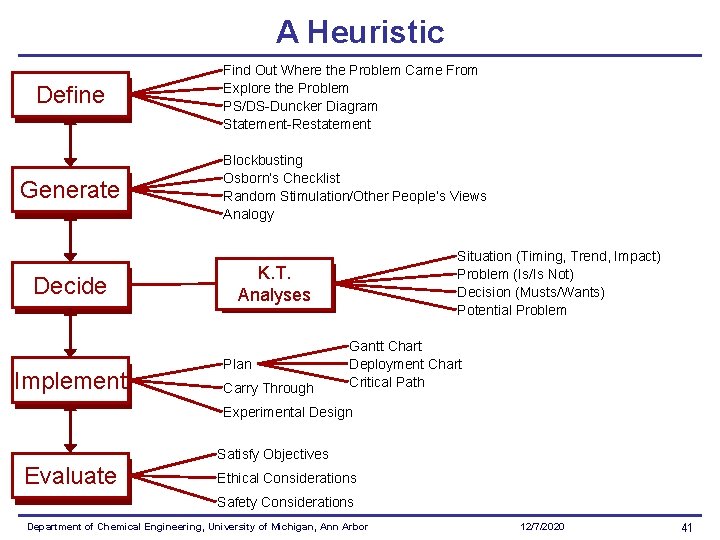
A Heuristic Define Find Out Where the Problem Came From Explore the Problem PS/DS-Duncker Diagram Statement-Restatement Generate Blockbusting Osborn’s Checklist Random Stimulation/Other People’s Views Analogy Decide Implement Situation (Timing, Trend, Impact) Problem (Is/Is Not) Decision (Musts/Wants) Potential Problem K. T. Analyses Plan Carry Through Gantt Chart Deployment Chart Critical Path Experimental Design Satisfy Objectives Evaluate Ethical Considerations Safety Considerations Department of Chemical Engineering, University of Michigan, Ann Arbor 12/7/2020 41
- Slides: 41