
Troubleshooting an Enterprise Network Introducing Routing and Switching
Troubleshooting an Enterprise Network Introducing Routing and Switching in the Enterprise – Chapter 9 ITE I Chapter 6 © 2006 Cisco Systems, Inc. All rights reserved. Cisco Public 1

Objectives § Explain the importance of uptime and the types of issues that cause failure. § Isolate and correct switching problems. § Isolate and correct routing issues. § Isolate and correct WAN configurations. § Isolate and correct ACL issues. ITE 1 Chapter 6 © 2006 Cisco Systems, Inc. All rights reserved. Cisco Public 2

Explain the Importance of Uptime and the Types of Issues that Cause Failure § Reduction in uptime can have a negative impact on a business § Downtime results in lost productivity and customer frustration ITE 1 Chapter 6 © 2006 Cisco Systems, Inc. All rights reserved. Cisco Public 3
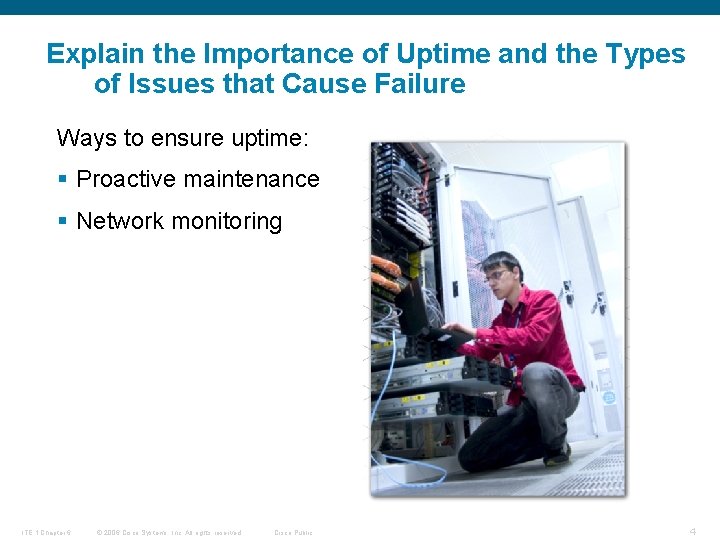
Explain the Importance of Uptime and the Types of Issues that Cause Failure Ways to ensure uptime: § Proactive maintenance § Network monitoring ITE 1 Chapter 6 © 2006 Cisco Systems, Inc. All rights reserved. Cisco Public 4
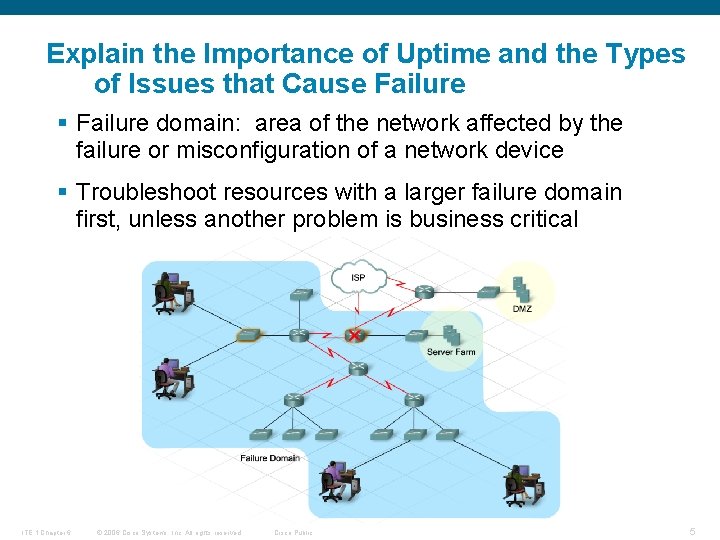
Explain the Importance of Uptime and the Types of Issues that Cause Failure § Failure domain: area of the network affected by the failure or misconfiguration of a network device § Troubleshoot resources with a larger failure domain first, unless another problem is business critical ITE 1 Chapter 6 © 2006 Cisco Systems, Inc. All rights reserved. Cisco Public 5
Explain the Importance of Uptime and the Types of Issues that Cause Failure Troubleshooting approaches: § Top-down § Bottom-up § Divide and conquer § Trial and error § Substitution ITE 1 Chapter 6 © 2006 Cisco Systems, Inc. All rights reserved. Cisco Public 6
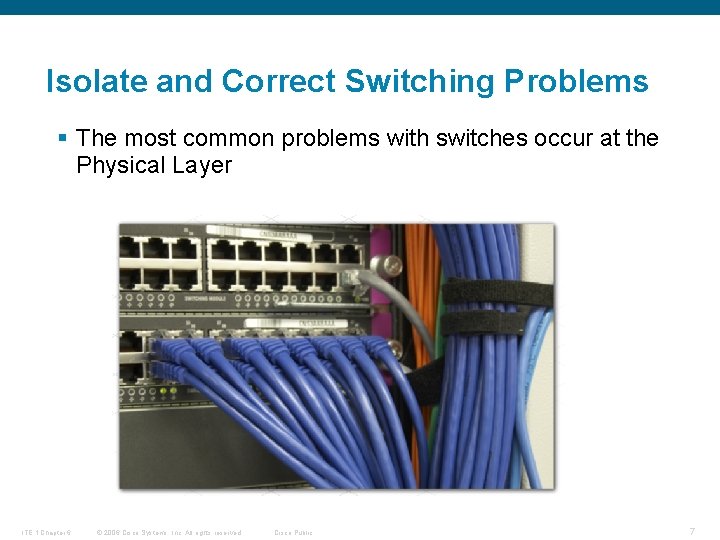
Isolate and Correct Switching Problems § The most common problems with switches occur at the Physical Layer ITE 1 Chapter 6 © 2006 Cisco Systems, Inc. All rights reserved. Cisco Public 7
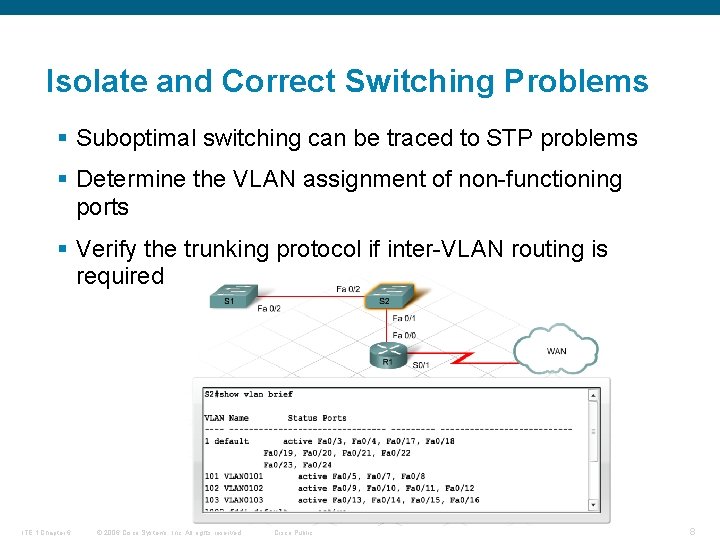
Isolate and Correct Switching Problems § Suboptimal switching can be traced to STP problems § Determine the VLAN assignment of non-functioning ports § Verify the trunking protocol if inter-VLAN routing is required ITE 1 Chapter 6 © 2006 Cisco Systems, Inc. All rights reserved. Cisco Public 8
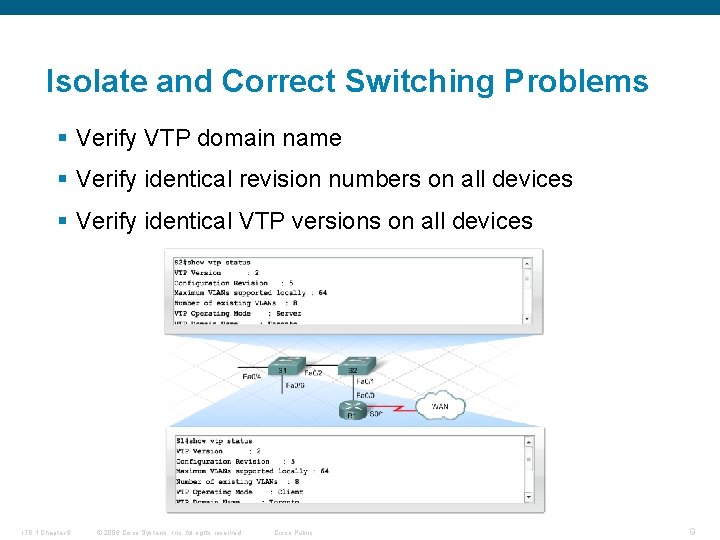
Isolate and Correct Switching Problems § Verify VTP domain name § Verify identical revision numbers on all devices § Verify identical VTP versions on all devices ITE 1 Chapter 6 © 2006 Cisco Systems, Inc. All rights reserved. Cisco Public 9
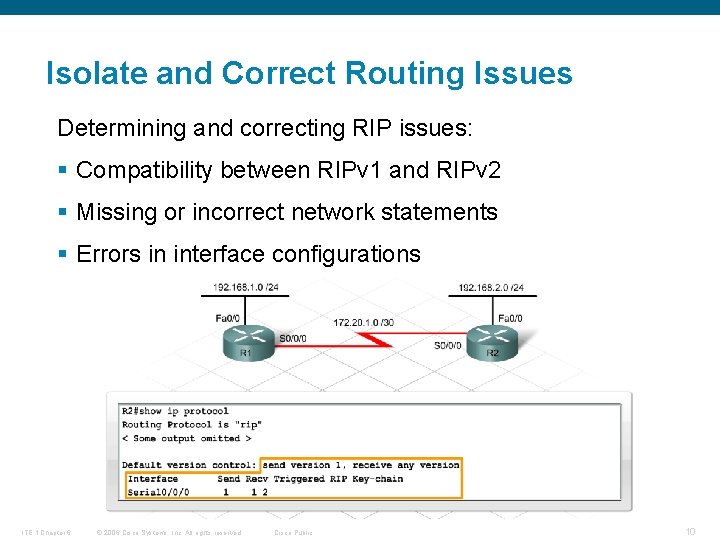
Isolate and Correct Routing Issues Determining and correcting RIP issues: § Compatibility between RIPv 1 and RIPv 2 § Missing or incorrect network statements § Errors in interface configurations ITE 1 Chapter 6 © 2006 Cisco Systems, Inc. All rights reserved. Cisco Public 10
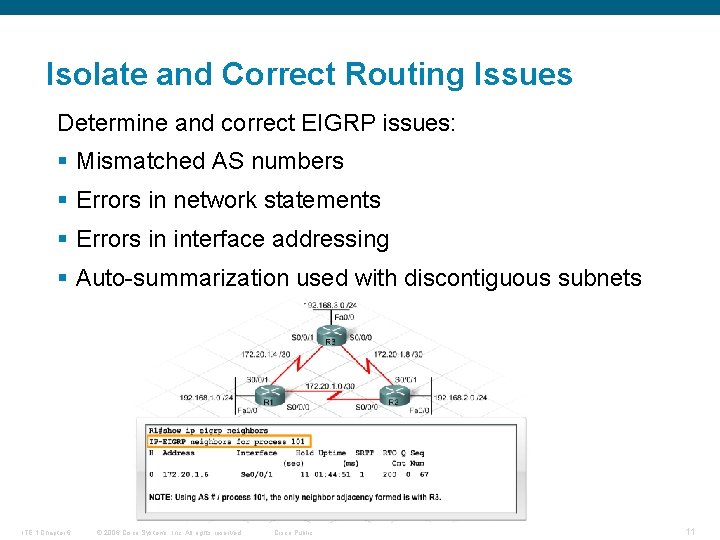
Isolate and Correct Routing Issues Determine and correct EIGRP issues: § Mismatched AS numbers § Errors in network statements § Errors in interface addressing § Auto-summarization used with discontiguous subnets ITE 1 Chapter 6 © 2006 Cisco Systems, Inc. All rights reserved. Cisco Public 11

Isolate and Correct Routing Issues Determine and correct OSPF issues: § Mismatched authentication or timer intervals § Errors in wildcard masks or network statements § Errors in interface configurations ITE 1 Chapter 6 © 2006 Cisco Systems, Inc. All rights reserved. Cisco Public 12
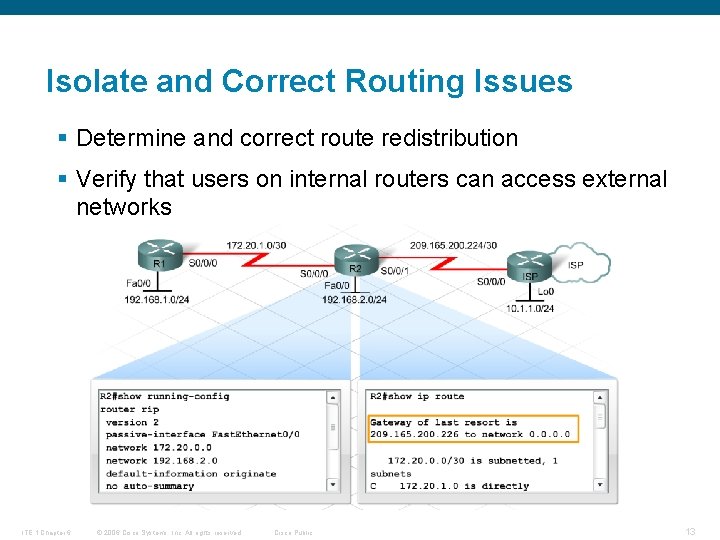
Isolate and Correct Routing Issues § Determine and correct route redistribution § Verify that users on internal routers can access external networks ITE 1 Chapter 6 © 2006 Cisco Systems, Inc. All rights reserved. Cisco Public 13
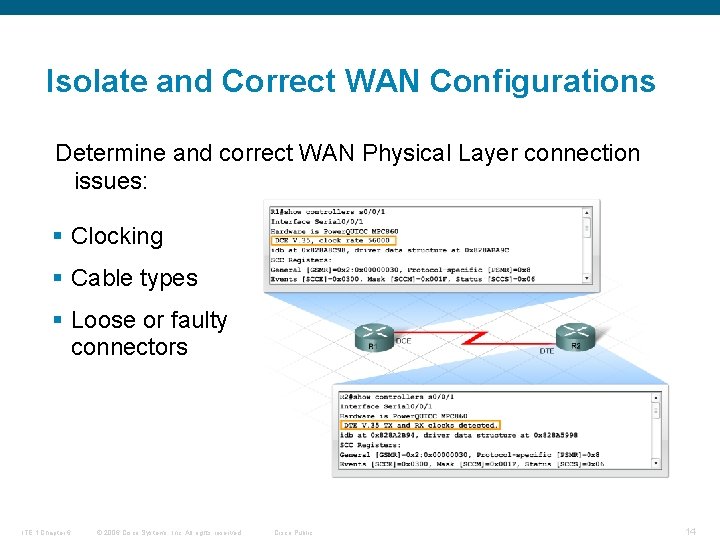
Isolate and Correct WAN Configurations Determine and correct WAN Physical Layer connection issues: § Clocking § Cable types § Loose or faulty connectors ITE 1 Chapter 6 © 2006 Cisco Systems, Inc. All rights reserved. Cisco Public 14
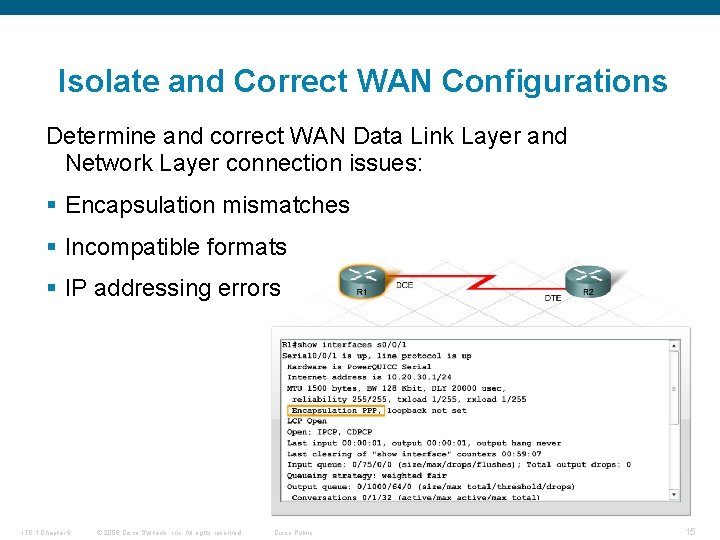
Isolate and Correct WAN Configurations Determine and correct WAN Data Link Layer and Network Layer connection issues: § Encapsulation mismatches § Incompatible formats § IP addressing errors ITE 1 Chapter 6 © 2006 Cisco Systems, Inc. All rights reserved. Cisco Public 15
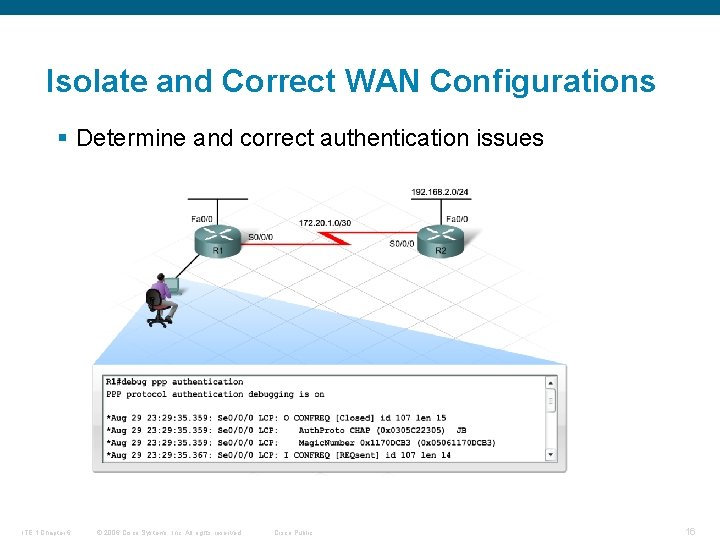
Isolate and Correct WAN Configurations § Determine and correct authentication issues ITE 1 Chapter 6 © 2006 Cisco Systems, Inc. All rights reserved. Cisco Public 16
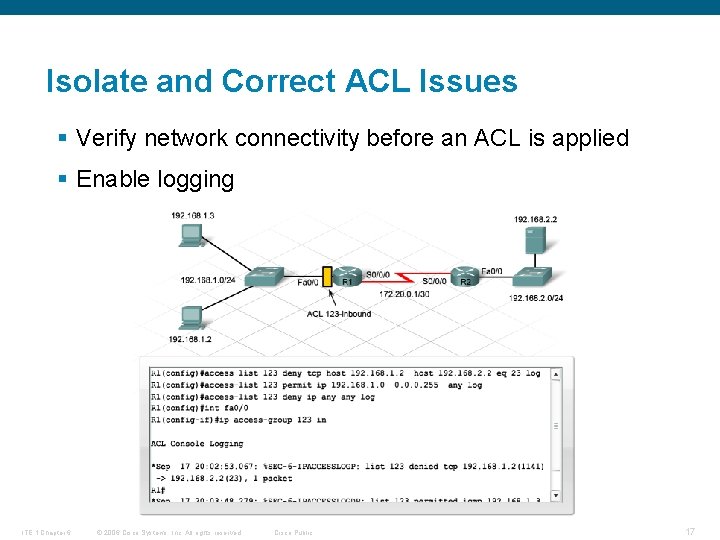
Isolate and Correct ACL Issues § Verify network connectivity before an ACL is applied § Enable logging ITE 1 Chapter 6 © 2006 Cisco Systems, Inc. All rights reserved. Cisco Public 17
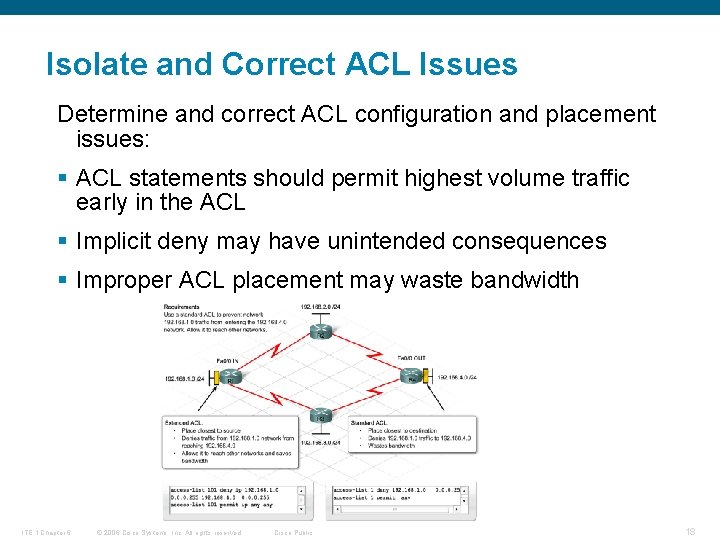
Isolate and Correct ACL Issues Determine and correct ACL configuration and placement issues: § ACL statements should permit highest volume traffic early in the ACL § Implicit deny may have unintended consequences § Improper ACL placement may waste bandwidth ITE 1 Chapter 6 © 2006 Cisco Systems, Inc. All rights reserved. Cisco Public 18
Summary § Adherence to the three-layer hierarchical network design model assists in troubleshooting § When troubleshooting a network, determine the scope of the problem and isolate the issue to a specific failure domain. § The most common problems with switches occur at the Physical Layer. § Use debug commands to isolate problems, not to monitor normal network operation. § When troubleshooting PPP, verify that the LCP has been opened, authentication and NCP completed. § ACLs can create complications in network operations. ITE 1 Chapter 6 © 2006 Cisco Systems, Inc. All rights reserved. Cisco Public 19

ITE 1 Chapter 6 © 2006 Cisco Systems, Inc. All rights reserved. Cisco Public 20
- Slides: 20