
Troposhere The bottom layer where temperature decreases with
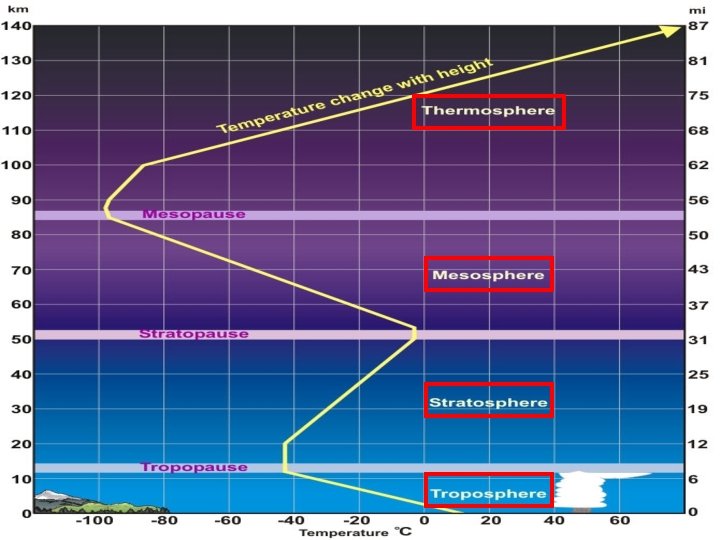
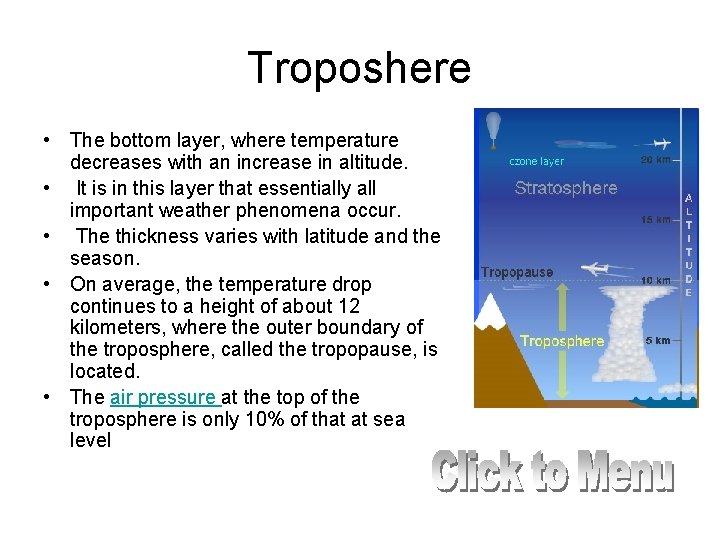
Troposhere • The bottom layer, where temperature decreases with an increase in altitude. • It is in this layer that essentially all important weather phenomena occur. • The thickness varies with latitude and the season. • On average, the temperature drop continues to a height of about 12 kilometers, where the outer boundary of the troposphere, called the tropopause, is located. • The air pressure at the top of the troposphere is only 10% of that at sea level
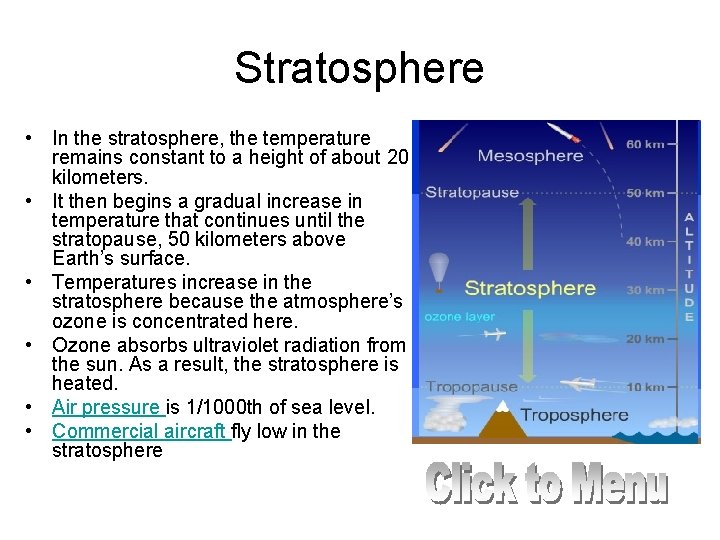
Stratosphere • In the stratosphere, the temperature remains constant to a height of about 20 kilometers. • It then begins a gradual increase in temperature that continues until the stratopause, 50 kilometers above Earth’s surface. • Temperatures increase in the stratosphere because the atmosphere’s ozone is concentrated here. • Ozone absorbs ultraviolet radiation from the sun. As a result, the stratosphere is heated. • Air pressure is 1/1000 th of sea level. • Commercial aircraft fly low in the stratosphere
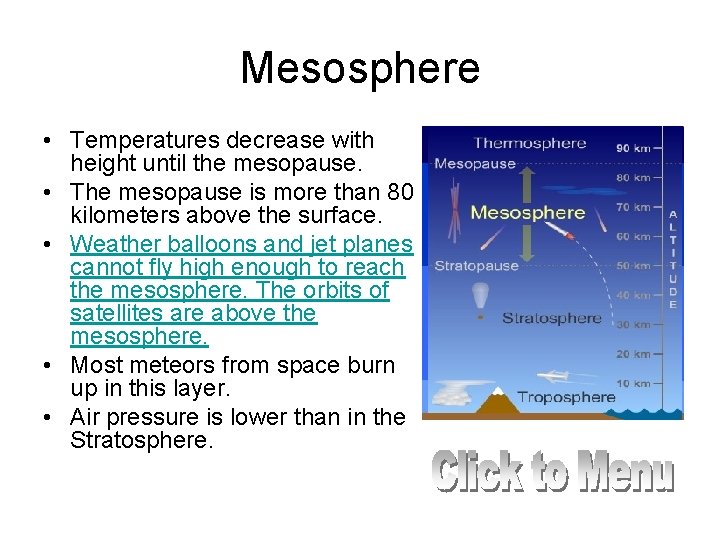
Mesosphere • Temperatures decrease with height until the mesopause. • The mesopause is more than 80 kilometers above the surface. • Weather balloons and jet planes cannot fly high enough to reach the mesosphere. The orbits of satellites are above the mesosphere. • Most meteors from space burn up in this layer. • Air pressure is lower than in the Stratosphere.
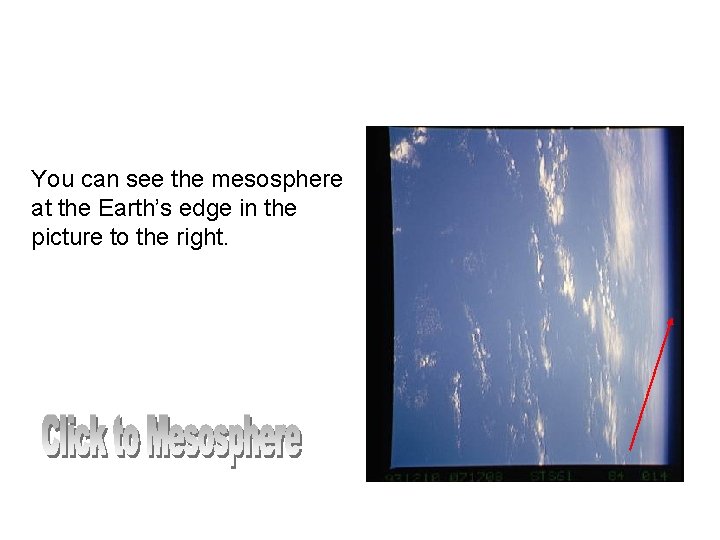
You can see the mesosphere at the Earth’s edge in the picture to the right.
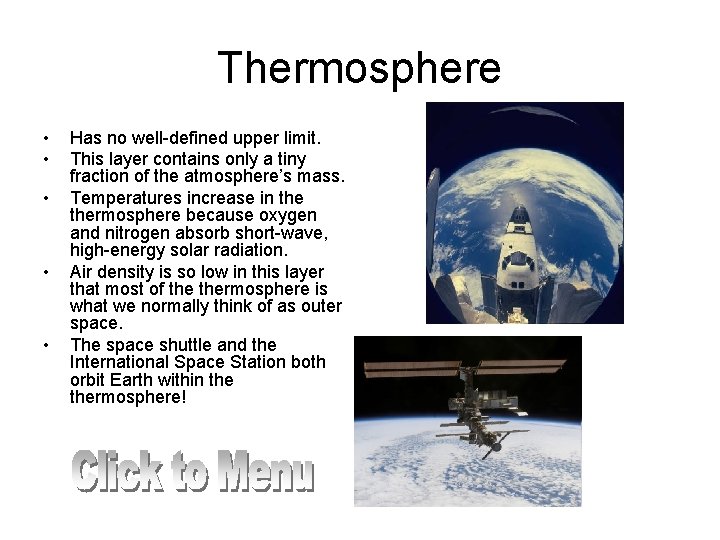
Thermosphere • • • Has no well-defined upper limit. This layer contains only a tiny fraction of the atmosphere’s mass. Temperatures increase in thermosphere because oxygen and nitrogen absorb short-wave, high-energy solar radiation. Air density is so low in this layer that most of thermosphere is what we normally think of as outer space. The space shuttle and the International Space Station both orbit Earth within thermosphere!
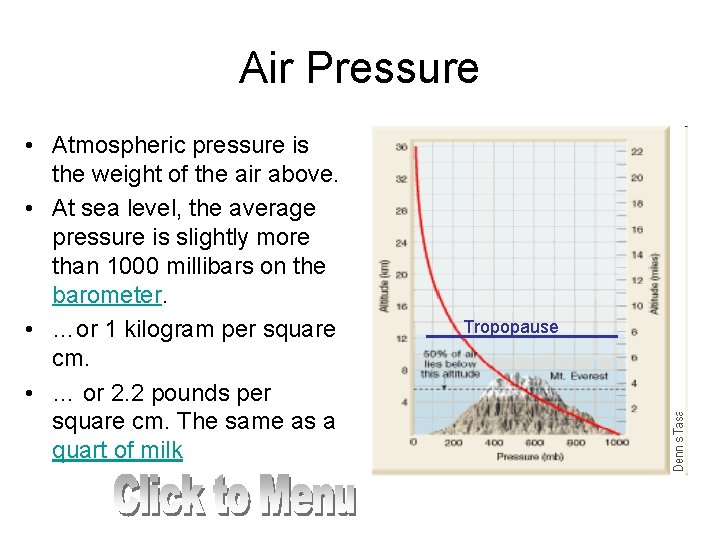
Air Pressure • Atmospheric pressure is the weight of the air above. • At sea level, the average pressure is slightly more than 1000 millibars on the barometer. • …or 1 kilogram per square cm. • … or 2. 2 pounds per square cm. The same as a quart of milk Tropopause
- Slides: 7