
TROPICAL CYCLONE STRUCTURE TCS 08 FIELD EXPERIMENT IN



- Slides: 14
TROPICAL CYCLONE STRUCTURE (TCS 08) FIELD EXPERIMENT IN THE WESTERN NORTH PACIFIC DURING 2008 Russell L. Elsberry (Naval Postgraduate School) Ronald J. Ferek (Office of Naval Research) Simon Chang (Naval Research Laboratory) Daniel Eleuterio (Naval Research Laboratory) Patrick A. Harr (Naval Postgraduate School) SPONSORS Office of Naval Research Laboratory Air Force* National Science Foundation * With thanks to LCOL Kurt Brueske 62 nd Interdepartmental Hurricane Conference, Charleston, SC, 3 -7 March 2008
Key science questions to be addressed in a program aimed at increased understanding and predictability of tropical cyclone characteristics during formation, intensification, and recurvature over the western North Pacific • Highlights – Incorporates multiple space and time scales • Large scale controls – Global and basin-wide spatial scales – Medium-range and synoptic temporal scales • Mesoscale organization pathways – During formation – During intensification – Primary hypotheses with respect to: • Large-scale role in pre-conditioning or inhibition due to ventilation • Mesoscale organizational pathways leading to construction of a potential vorticity monolith – Role of low-level convergence associated with deep convective cells – Stratiform regions of mesoscale convective systems • Relative roles of environmental and vortex structures in determining the evolution of the outer wind structure – In tandem with the THORPEX Pacific Asian Regional Campaign (T-PARC) 62 nd Interdepartmental Hurricane Conference, Charleston, SC, 3 -7 March 2008
FORMATION: SCIENCE HYPOTHESES Science hypotheses Mesoscale processes determine the location and timing of tropical cyclone formation within the favorable environment Top-down: MCV near center merges with monsoon depression circulation Bottom-up: Low-level cyclonic vortices form from intense convection in “sweet spot” Environmental processes lead to amplification of the secondary circulation that spin-up the tropical cyclone, but may inhibit via ventilation Concept of operations Global model forecasts for potential cloud clusters Regional model forecasts for likely mesoscale organization Satellite (geostationary and polar-orbiting for continual monitoring, crosschecking against model output, and aircraft briefing and in-flight support) 62 nd Interdepartmental Hurricane Conference, Charleston, SC, 3 -7 March 2008
STRUCTURE: SCIENCE HYPOTHESES Environmental dominance: Outer wind structure evolves only slowly from the structure determined at the time of formation Internally determined: Dynamic and thermodynamic imbalances in the inner region generate outward-and-upward-propagating Rossby waves that modify the outer wind structure Super-intensity: Frequent dropwindsonde releases through the eyewall of typhoons will detect structures leading to super-intensity 62 nd Interdepartmental Hurricane Conference, Charleston, SC, 3 -7 March 2008
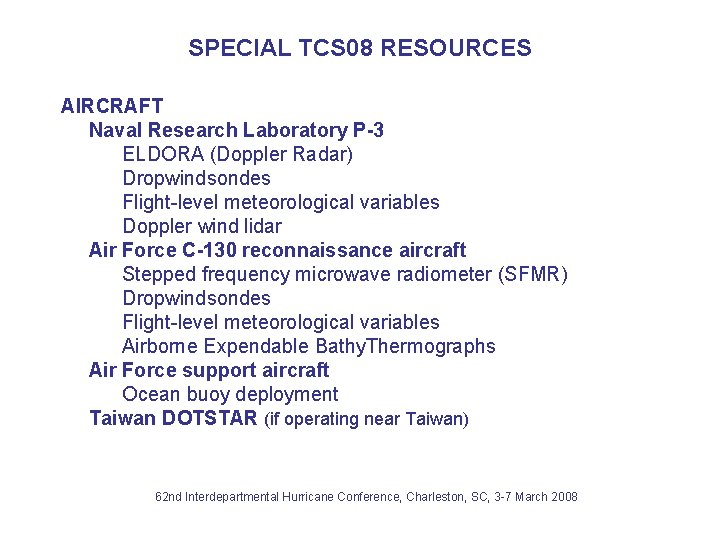
SPECIAL TCS 08 RESOURCES AIRCRAFT Naval Research Laboratory P-3 ELDORA (Doppler Radar) Dropwindsondes Flight-level meteorological variables Doppler wind lidar Air Force C-130 reconnaissance aircraft Stepped frequency microwave radiometer (SFMR) Dropwindsondes Flight-level meteorological variables Airborne Expendable Bathy. Thermographs Air Force support aircraft Ocean buoy deployment Taiwan DOTSTAR (if operating near Taiwan) 62 nd Interdepartmental Hurricane Conference, Charleston, SC, 3 -7 March 2008
Combined missions during tropical cyclone formation Use of Eldora to measure characteristics associated with deep convection Doppler Wind Lidar for inflow measurements Use of WC-130 to measure the environmental characteristics BASE OF OPERATIONS AT ANDERSEN AFB, GUAM 62 nd Interdepartmental Hurricane Conference, Charleston, SC, 3 -7 March 2008
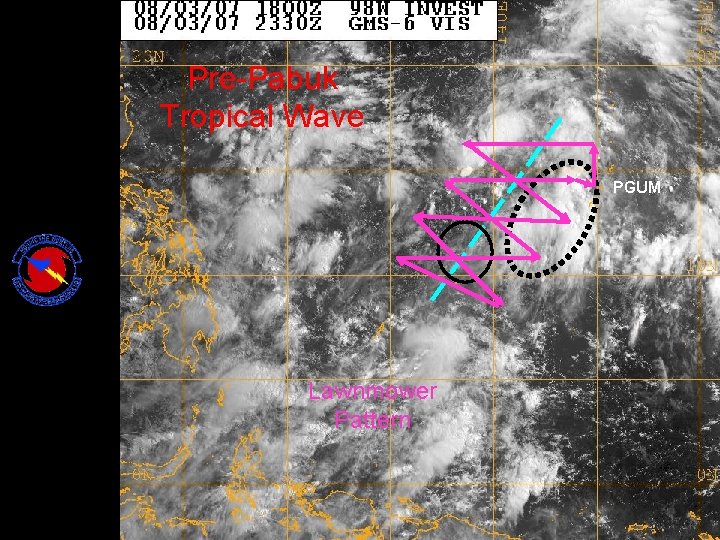
Pre-Pabuk Tropical Wave PGUM Lawnmower Pattern
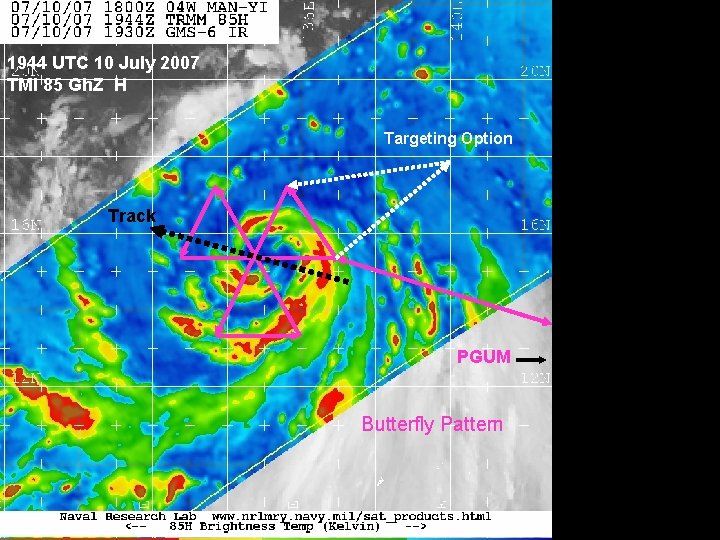
Tropical Storm WC-130 J Survey: BUTTERFLY 1944 UTC 10 July 2007 TMI 85 Gh. Z H Targeting Option Track PA~300 -700 mb, IAS~280 -240 kt (280 kt transit) Leg radii~110 nm 9. 5 hr duration 1. 5 hr creep/day GPS Dropsonde: PGUM Butterfly Pattern Man Yi 7 sondes per leg +3 = 24 total (eyewall multisonde ~5 per leg = +15; 39 total) AXBTs: 7 AXBTs per leg +2 diagonals x 4 = 29 total
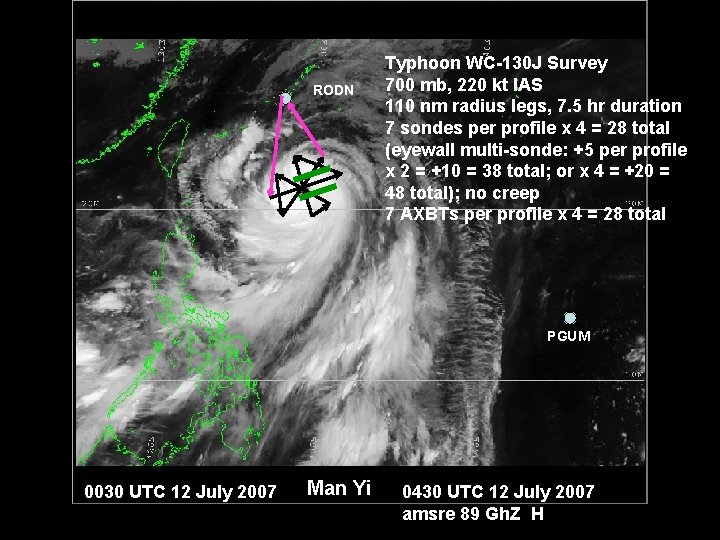
RODN Typhoon WC-130 J Survey 700 mb, 220 kt IAS 110 nm radius legs, 7. 5 hr duration 7 sondes per profile x 4 = 28 total (eyewall multi-sonde: +5 per profile x 2 = +10 = 38 total; or x 4 = +20 = 48 total); no creep 7 AXBTs per profile x 4 = 28 total PGUM 0030 UTC 12 July 2007 Man Yi 0430 UTC 12 July 2007 amsre 89 Gh. Z H
SPECIAL TCS 08 RESOURCES SATELLITE MTSAT Continual monitoring during all phases of operations Rapid scan – desirable during all flight operations Polar-orbiters Microwave for convective structure Scatterometers NUMERICAL MODEL ANALYSES AND FORECASTS Global models (NOGAPS, GFS, UKMO, ECMWF) Environmental conditions in all phases Focus attention on cloud clusters Mesoscale models Naval Research Lab COAMPS Central Weather Bureau NFS and WRF 62 nd Interdepartmental Hurricane Conference, Charleston, SC, 3 -7 March 2008
VALIDATION OF SATELLITE ALGORITHMS WESTERN NORTH PACIFIC TROPICAL CYCLONE STRUCTURE AND STRUCTURE CHANGE INCLUDING INTENSITY CHANGE AF C-130 STEPPED FREQUENCY MICROWAVE RADIOMETER (SFMR) AND DROPWINDSONDES AT ALL STAGES FROM FORMATION TO EXTRATROPICAL TRANSITION IN COOPERATION WITH T-PARC DOPPLER WIND LIDAR ON NRL P-3 VERTICAL PROFILES OF WIND VECTORS TO THE SURFACE (CROSS-CALIBRATION WITH C-130 SFMR) IN CLOUD-FREE SCENES – FIRST TIME IN TROPICAL CYCLONE COHERENT WIND STRUCTURES IN BOUNDARY LAYER OVER OCEAN IN TROPICAL CYCLONES (Emmitt and Foster) 62 nd Interdepartmental Hurricane Conference, Charleston, SC, 3 -7 March 2008
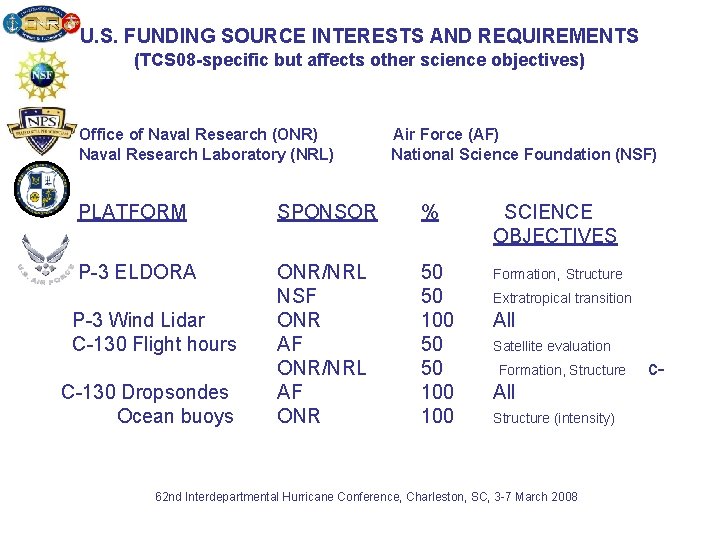
U. S. FUNDING SOURCE INTERESTS AND REQUIREMENTS (TCS 08 -specific but affects other science objectives) Office of Naval Research (ONR) Naval Research Laboratory (NRL) Air Force (AF) National Science Foundation (NSF) PLATFORM SPONSOR % SCIENCE OBJECTIVES P-3 ELDORA ONR/NRL NSF ONR AF ONR/NRL AF ONR 50 50 100 100 Formation, Structure P-3 Wind Lidar C-130 Flight hours C-130 Dropsondes Ocean buoys Extratropical transition All Satellite evaluation Formation, Structure All Structure (intensity) 62 nd Interdepartmental Hurricane Conference, Charleston, SC, 3 -7 March 2008 c-
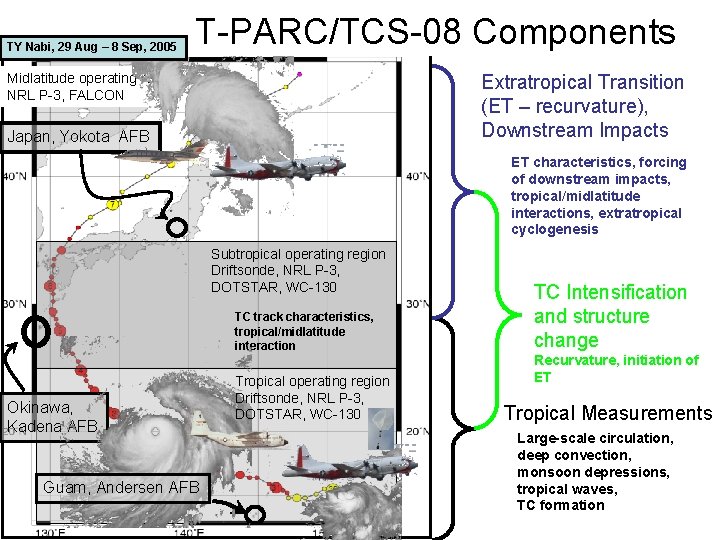
TY Nabi, 29 Aug – 8 Sep, 2005 T-PARC/TCS-08 Components Midlatitude operating region NRL P-3, FALCON Extratropical Transition (ET – recurvature), Downstream Impacts Japan, Yokota AFB ET characteristics, forcing of downstream impacts, tropical/midlatitude interactions, extratropical cyclogenesis Subtropical operating region Driftsonde, NRL P-3, DOTSTAR, WC-130 TC track characteristics, tropical/midlatitude interaction Okinawa, Kadena AFB Guam, Andersen AFB Tropical operating region Driftsonde, NRL P-3, DOTSTAR, WC-130 TC Intensification and structure change Recurvature, initiation of ET Tropical Measurements Large-scale circulation, deep convection, monsoon depressions, tropical waves, TC formation
What are the key structural aspects of the tropical cyclone and its environment that limit the predictability of recurvature and the start of extratropical transition over the subtropical western North Pacific? Increase in forecast uncertainty over tropical and midlatitude regions often occurs due to tropical cyclones and the movement of tropical cyclones into the midlatitudes TY Tokage, October 2004 Tracks from the JMA ensemble prediction system 62 nd Interdepartmental Hurricane Conference, Charleston, SC, 3 -7 March 2008 Tracks supplied by Dr. T. Nakazawa