
Tropical Cyclone Heat Potential Changes between 1993 and
Tropical Cyclone Heat Potential Changes between 1993 and 2012 Joshua Coupe
Outline I. TCHP and it’s role in tropical cyclogenesis II. Methods/Data -- what I set out to accomplish III. How SST and TCHP changed from 1993 to 2012 A. Atlantic Hurricane Basin B. West Pacific Hurricane Basin IV. TCHP’s implied relationship with: A. Number of named storms B. Accumulated Cyclone Energy V. Conclusion A. Limitations of my interpretations

What is TCHP? → Tropical Cyclone Heat Potential (KJ/cm²) → representation of the oceanic energy available for tropical cyclogenesis → essentially the maximum bound on latent heat flux
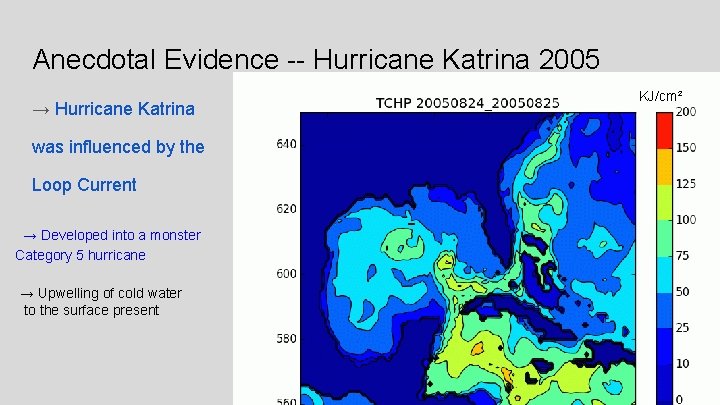
Anecdotal Evidence -- Hurricane Katrina 2005 → Hurricane Katrina was influenced by the Loop Current → Developed into a monster Category 5 hurricane → Upwelling of cold water to the surface present KJ/cm²
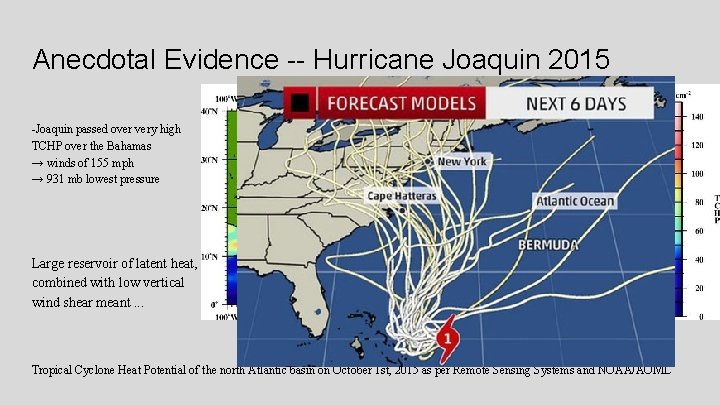
Anecdotal Evidence -- Hurricane Joaquin 2015 -Joaquin passed over very high TCHP over the Bahamas → winds of 155 mph → 931 mb lowest pressure Large reservoir of latent heat, combined with low vertical wind shear meant. . . Tropical Cyclone Heat Potential of the north Atlantic basin on October 1 st, 2015 as per Remote Sensing Systems and NOAA/AOML
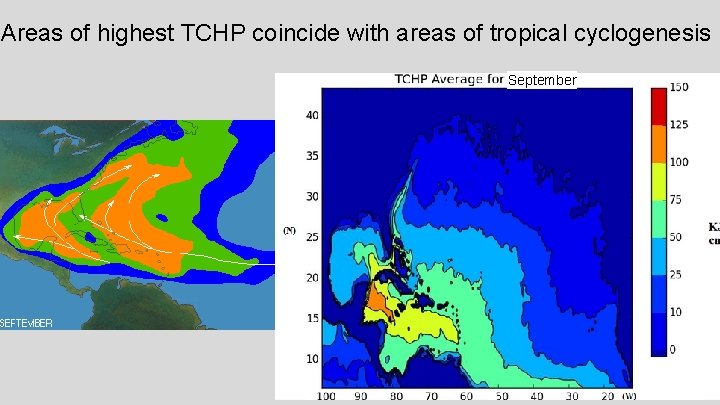
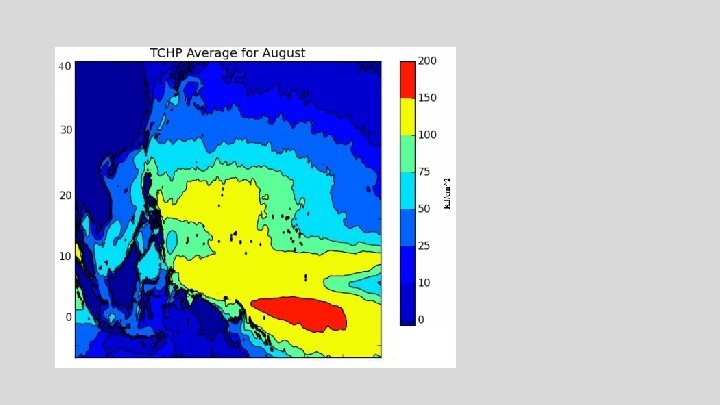
Areas of highest TCHP coincide with areas of tropical cyclogenesis September
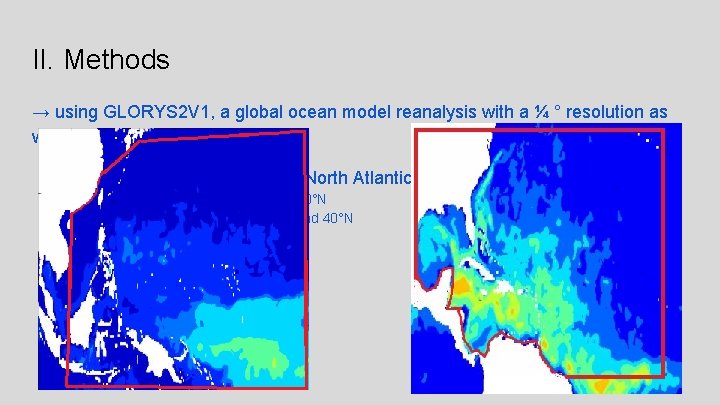
II. Methods → using GLORYS 2 V 1, a global ocean model reanalysis with a ¼ ° resolution as well as temperature profiles - calculated TCHP for both the North Atlantic and northwest Pacific basins - Atlantic: 20°W to 98°W, 5°N to 40°N Pacific: 115°E and 180°E, 5°N and 40°N
II. Methods/Data → using GLORYS 2 V 1, a global ocean model reanalysis with a ¼ ° resolution as well as temperature profiles - calculated TCHP for both the North Atlantic and northwest Pacific basins - - Atlantic: 20°W to 98°W, 5°N to 40°N Pacific: 115°E and 180°E, 5°N and 40°N Timing: Hurricane Season for Atlantic Basin (June to November) Global calculation took too much time and memory - stuck with two of most active basins
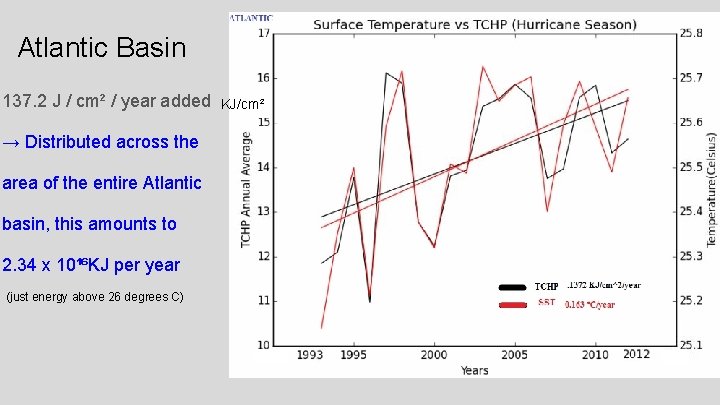
Atlantic Basin 137. 2 J / cm² / year added → Distributed across the area of the entire Atlantic basin, this amounts to 2. 34 x 10¹⁶KJ per year (just energy above 26 degrees C) KJ/cm²
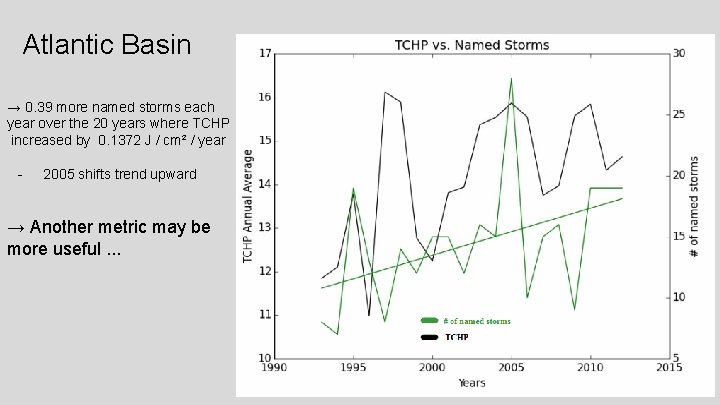
Atlantic Basin → 0. 39 more named storms each year over the 20 years where TCHP increased by 0. 1372 J / cm² / year - 2005 shifts trend upward → Another metric may be more useful. . .
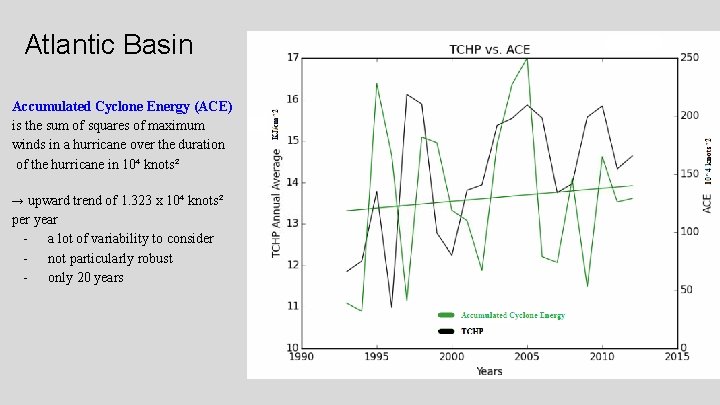
Atlantic Basin Accumulated Cyclone Energy (ACE) is the sum of squares of maximum winds in a hurricane over the duration of the hurricane in 10⁴ knots² → upward trend of 1. 323 x 10⁴ knots² per year - a lot of variability to consider - not particularly robust - only 20 years
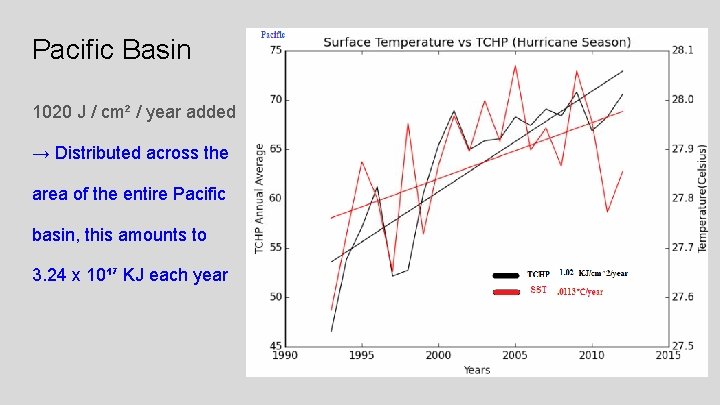
Pacific Basin 1020 J / cm² / year added → Distributed across the area of the entire Pacific basin, this amounts to 3. 24 x 10¹⁷ KJ each year
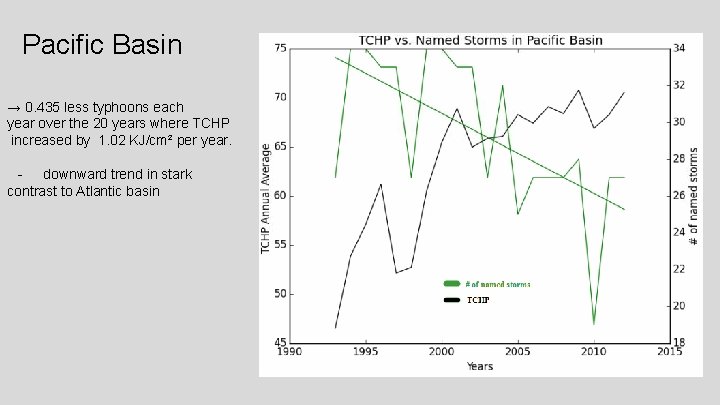
Pacific Basin → 0. 435 less typhoons each year over the 20 years where TCHP increased by 1. 02 KJ/cm² per year. - downward trend in stark contrast to Atlantic basin
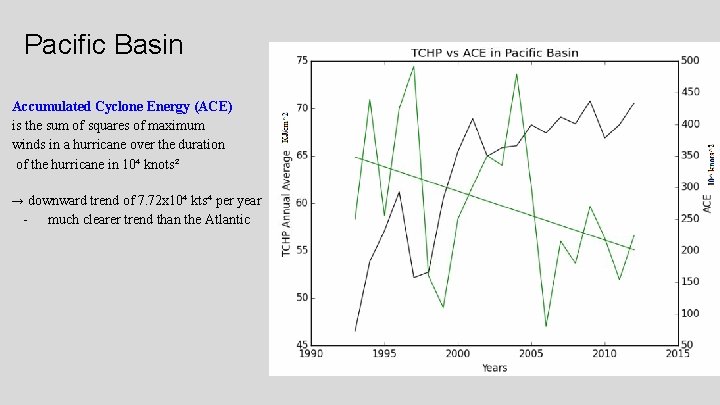
Pacific Basin Accumulated Cyclone Energy (ACE) is the sum of squares of maximum winds in a hurricane over the duration of the hurricane in 10⁴ knots² → downward trend of 7. 72 x 10⁴ kts⁴ per year - much clearer trend than the Atlantic
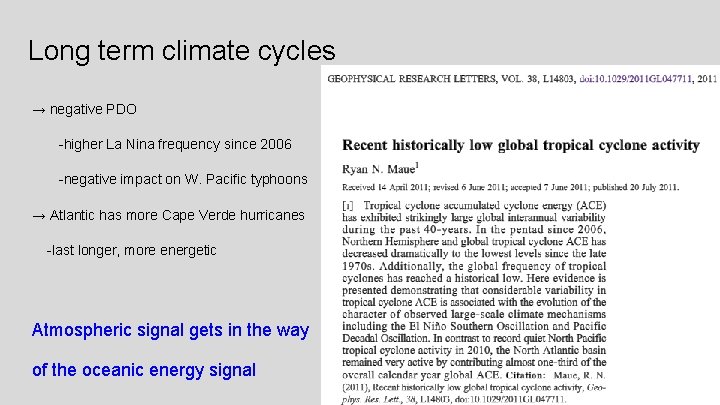
Long term climate cycles → negative PDO -higher La Nina frequency since 2006 -negative impact on W. Pacific typhoons → Atlantic has more Cape Verde hurricanes -last longer, more energetic Atmospheric signal gets in the way of the oceanic energy signal
Conclusions → The upper bound of energy available for tropical cyclogenesis has risen over the past 20 years in both the Atlantic and Pacific basins →Under ideal atmospheric conditions, tropical cyclogenesis should be more intense (as the ocean is on board) -> however, the atmospheric component gets in the way ->an investigation of the oceanic-atmospheric interaction would paint a better picture of how tropical cyclogenesis is changing with time
References Baik, J. -J. and J. -S. Paek (1998): A climatology of sea surface temperature and the maximum intensity of western North Pacific tropical cyclones. J. Meteor. Soc. Japan, 76, 129– 137 Briegel, L. M. and W. M. Frank (1997): Large-scale influences of tropical cyclogenesis in the western North Pacific. Mon. Wea. Rev. , 125, 1397– 1413 Emanuel, K. (2005) Increasing destructiveness of tropical cyclones over the past 30 years. Nature, 436, 686 -688. Fei-Pun, I. , Lin, I. , Lo, M. , (2013): Recent increase in high tropical cyclone heat potential area in the Western North Pacific Ocean, Geophysical Research Letters, 4680 -4684 Ferry, N. , Parent, L. , Barnier, B. , et al(2013). GLORYS 2 V 1 Global Ocean Reanalysis of the Altimetric Era (1993 to 2009) at Mesoscale. , Mercator Ocean Quarterly Newsletter. Fu, B. , Li, T. , Peng, M. , (2007): Analysis of Tropical Cyclogenesis in the Western North Pacific for 2000 and 2001, Weather and Forecasting, 22, 763 -780 Hurricane Joaquin Advisory Archive (2015), NOAA National Hurricane Center. http: //www. nhc. noaa. gov/archive/2015/refresh/JOAQUIN+shtml/120925. shtml? Jaimes, B. and Shay, L. , , 2009: Mixed Layer Cooling in Mesoscale Oceanic Eddies during Hurricanes Katrina and Rita. Mon. Wea. Rev. , 137, 4188– 4207. Joint Typhoon Warning Center (2014). 2014 Annual Tropical Cyclone Report: Western Pacific (PDF)(Report). United States Navy, United States Air Force. Kozar, M. and Misra, V. (2015), Statistical Prediction of Integrated Kinetic Energy in North Atlantic Tropical Cyclones. Center for Ocean-
More references. . . Kossin, J. P. , S. J. Camargo, and M. Sitkowski (2010), Climate modulation of North Atlantic hurricane tracks, J. Clim. , 23, 3057– 3076, Landsea, Chris. , (2015): How many tropical cyclones have there been each year in the Atlantic basin? , NOAA Hurricane Research Division Atlantic Oceanographic & Meteorological Laboratory. Maue, R. , (2011), Recent historically low global tropical cyclone activity. Geophysical Research Letters, 38, LI 4803. Wada, A. and Usui, N (2007). , Importance of Tropical Cyclone Heat Potential for Tropical Cyclone Intensity and Intensification in the Western North Pacific, Journal of Oceanography, 63, 427 -447 Wada A. and Chan, JCL (2008) Relationship between typhoon activity and upper ocean heat content. Geophys Res Lett 35: L 17603. Wada, A. , (2015), Verification of tropical cyclone heat potential for tropical cyclone intensity forecasting in the Western North Pacific, Journal of Oceanography, 71, 373 -387 Landsea, Chris. , (2015): How many tropical cyclones have there been each year in the Atlantic basin? , NOAA Hurricane Research Division Atlantic Oceanographic & Meteorological Laboratory.
- Slides: 19