
Trochanteric fracture Trochanteric fracture More common in female


- Slides: 13
Trochanteric fracture
Trochanteric fracture • More common in female Mechanism of injury : – Direct trauma : RTA , fall – Indirect trauma : muscle pull Clinical features : – Pain – Marked shortening of the lower limb – Complete external rotation deformity – Swelling – Ecchymosis – Tenderness over the greater trochanter
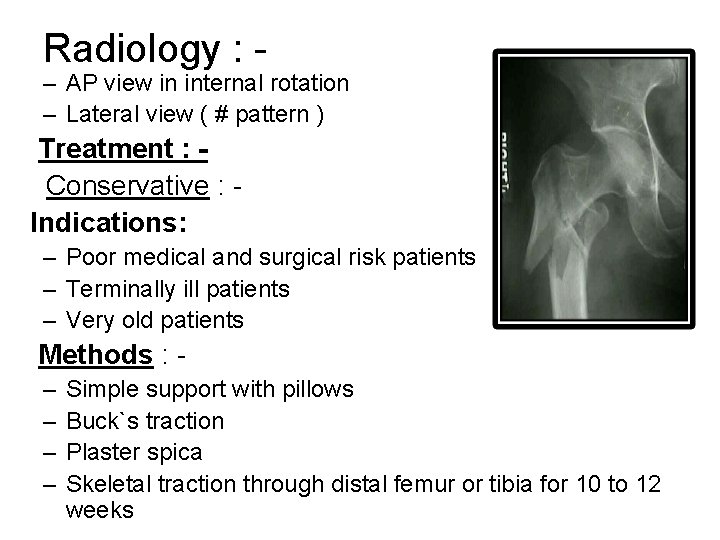
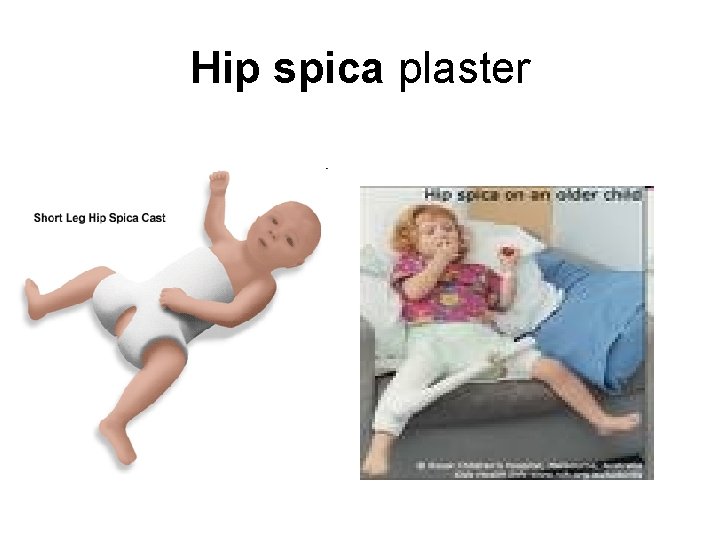
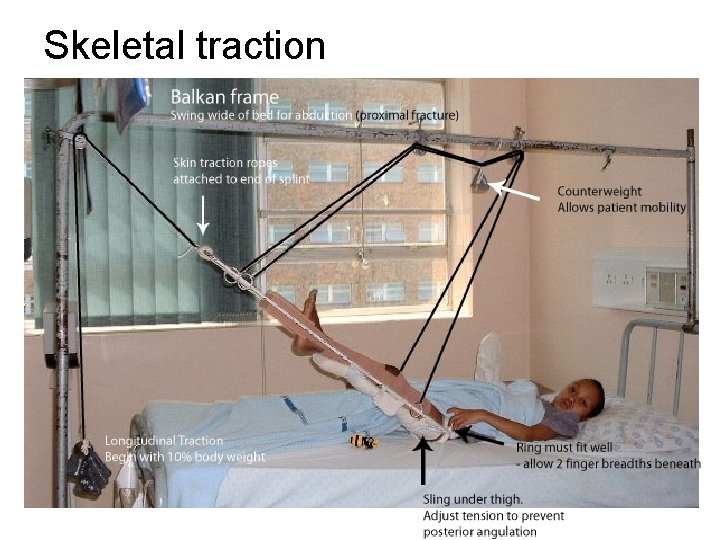
Radiology : - – AP view in internal rotation – Lateral view ( # pattern ) Treatment : Conservative : Indications: – Poor medical and surgical risk patients – Terminally ill patients – Very old patients Methods : – – Simple support with pillows Buck`s traction Plaster spica Skeletal traction through distal femur or tibia for 10 to 12 weeks
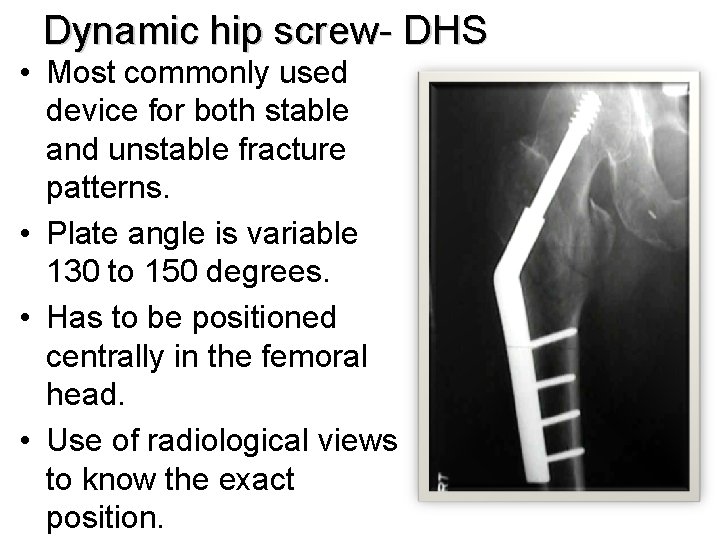
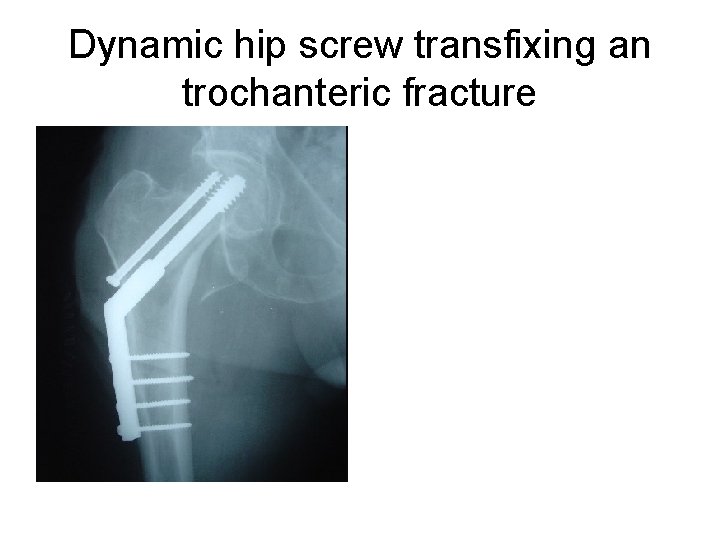
Dynamic hip screw- DHS • Most commonly used device for both stable and unstable fracture patterns. • Plate angle is variable 130 to 150 degrees. • Has to be positioned centrally in the femoral head. • Use of radiological views to know the exact position.
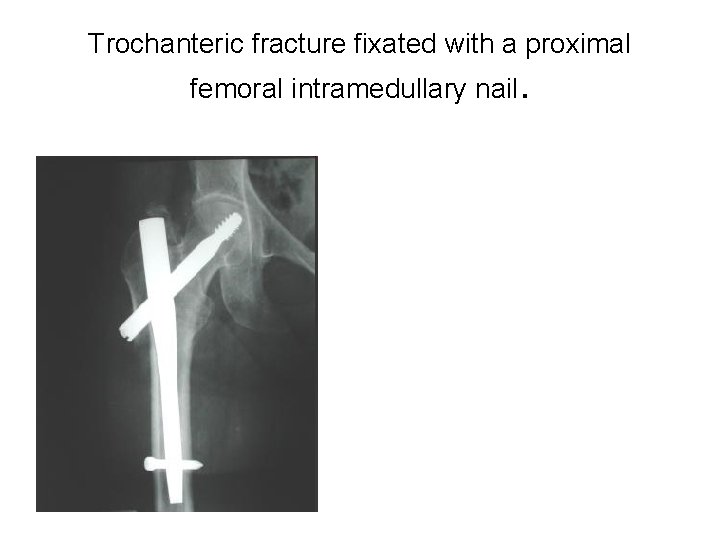
Trochanteric fracture fixated with a proximal femoral intramedullary nail.
Buck's traction A longitudinal skin traction applied to extremity in one direction with a single pulley, and keeping the leg in extended position without hip flexion. It is used to treat fractures, to realign broken bones, to correct contractures or deformities, and for knee immobilization.
Hip spica plaster
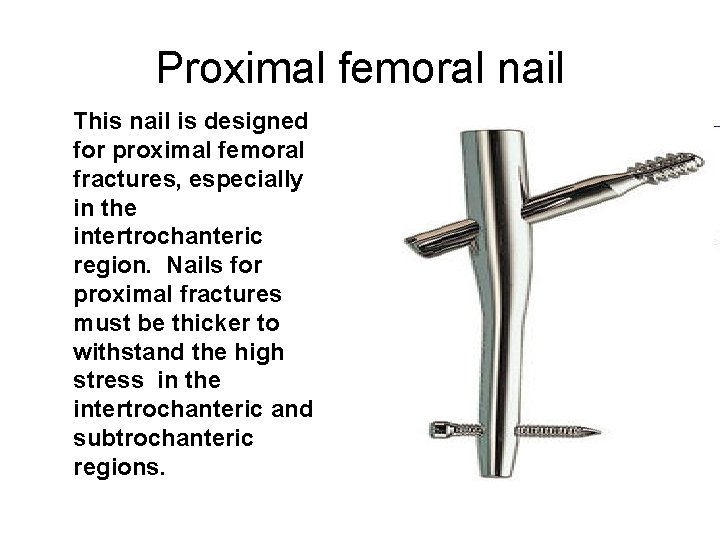
Proximal femoral nail This nail is designed for proximal femoral fractures, especially in the intertrochanteric region. Nails for proximal fractures must be thicker to withstand the high stress in the intertrochanteric and subtrochanteric regions.
Dynamic hip screw transfixing an trochanteric fracture
Skeletal traction
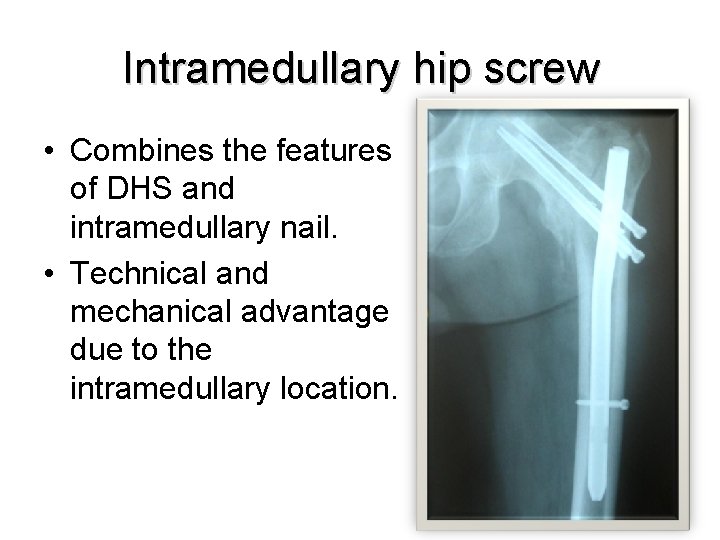
Intramedullary hip screw • Combines the features of DHS and intramedullary nail. • Technical and mechanical advantage due to the intramedullary location.
Surgical complications • Loss of fixation, might be due to– Improper placing. – Improper reduction. • Nonunion – Less than 2%. – Usually in unstable fracture.
• Malunion – Results in coxa vara ( decreased femoral neck shaft angle). – shortening of limb. – Leads to limping. – If minor shortening -shoe raise is advised. – In young people with severe deformity osteotomy and internal fixation is required. • Traumatic Osteoarthritis • Avascular necrosis ( rare )