
TRIPLE PELVIC OSTEOTOMY FOR THE TREATMENT OF HIP
- Slides: 14
TRIPLE PELVIC OSTEOTOMY FOR THE TREATMENT OF HIP DYSPLASIA
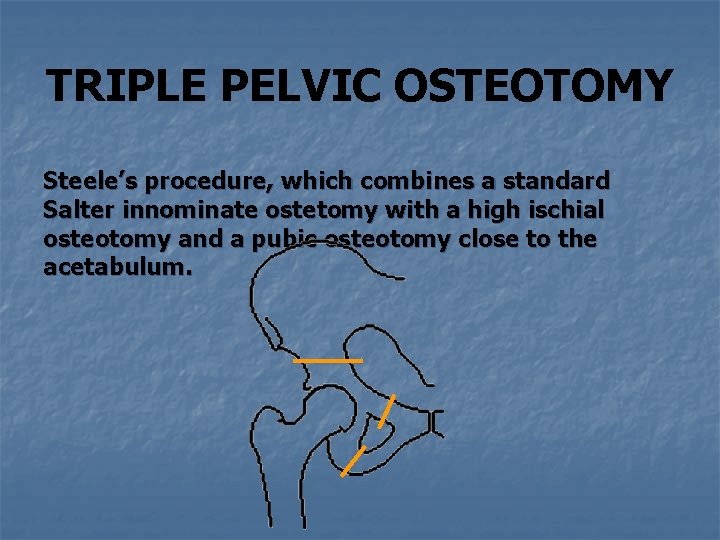
TRIPLE PELVIC OSTEOTOMY Steele’s procedure, which combines a standard Salter innominate ostetomy with a high ischial osteotomy and a pubic osteotomy close to the acetabulum.
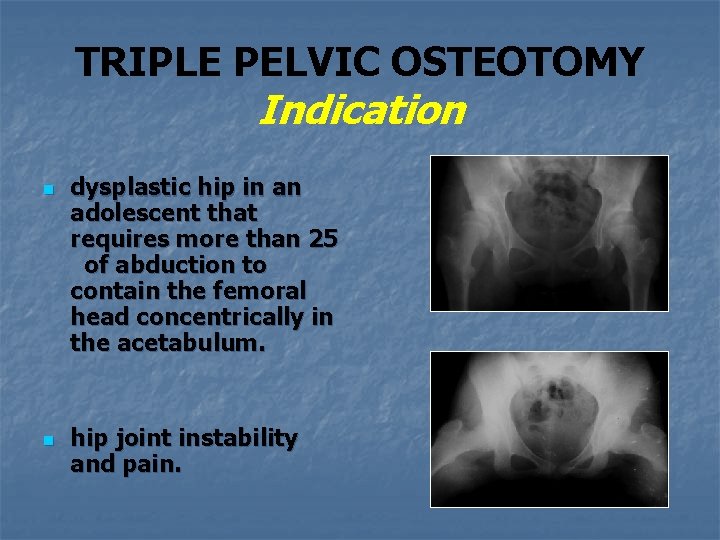
TRIPLE PELVIC OSTEOTOMY Indication n n dysplastic hip in an adolescent that requires more than 25 of abduction to contain the femoral head concentrically in the acetabulum. hip joint instability and pain.
TRIPLE PELVIC OSTEOTOMY Requisites 1. A congruous hip that can be concentrically reduced 2. A hip with adequate articular cartilage space 3. Functional range and motion 4. No upper age limit
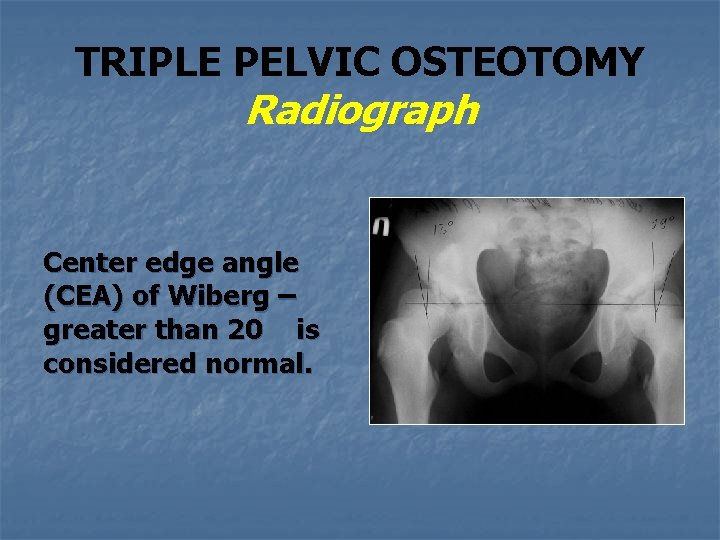
TRIPLE PELVIC OSTEOTOMY Radiograph Center edge angle (CEA) of Wiberg – greater than 20 is considered normal.
TRIPLE PELVIC OSTEOTOMY Goal The goals of osteotomy are: n decrease the joint stress n improve the functional range of motion n increase the femoral head coverage n relieve the pain
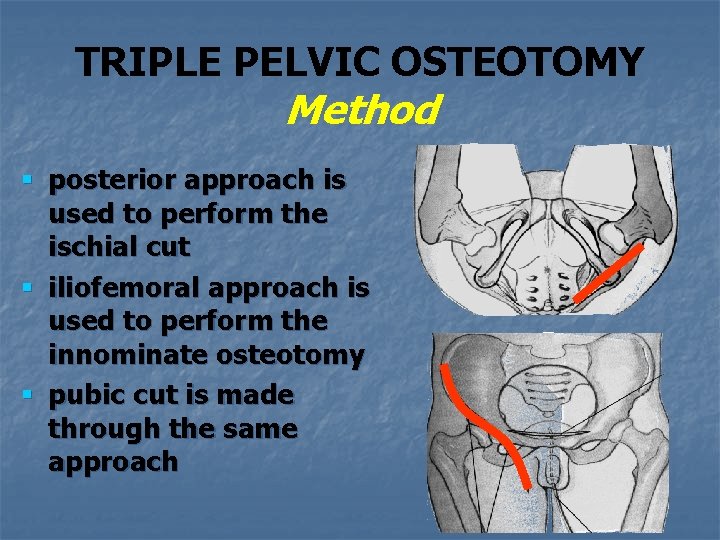
TRIPLE PELVIC OSTEOTOMY Method § posterior approach is used to perform the ischial cut § iliofemoral approach is used to perform the innominate osteotomy § pubic cut is made through the same approach
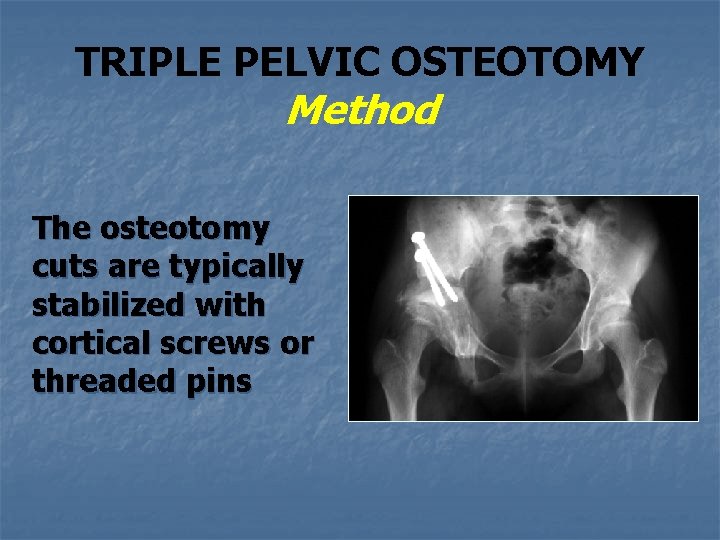
TRIPLE PELVIC OSTEOTOMY Method The osteotomy cuts are typically stabilized with cortical screws or threaded pins
TRIPLE PELVIC OSTEOTOMY Materials - between 1999 and 2007 ten patients (12 joints) underwent Steel procedure - there were 4 boys and 6 girls - the average of patients was 11. 5 yrs - the cause of hip dysplasia was DDH in 9 patients and Perthes disease in 1 patient
TRIPLE PELVIC OSTEOTOMY Materials - preoperatively all patients had X-rays in neutral position and in 30˚ of abduction - the average of central edge angle (CEA) of Wiberg was 12. 5˚ (range 8˚-19˚) - all patients showed congruent reduction in abduction
TRIPLE PELVIC OSTEOTOMY Methods - we used two cancellous screws for internal fixation in 9 patients and threaded pins in one patient - only in three cases we used hip spica cast - non weight bearing ambulation started on the 4 -5 day postoperatively - partial weight bearing was allowed after 8 weeks and full weight bearing after 4 -6 months.
TRIPLE PELVIC OSTEOTOMY Results - the follow-up results were seen in 9 patients from ? ? ? 6 months to 8 years - all patients, besides one, improved clinically and had less limping and no pain - the CEA angle increased significantly from … to 28˚ - in follow-up no one patient had loss of correction
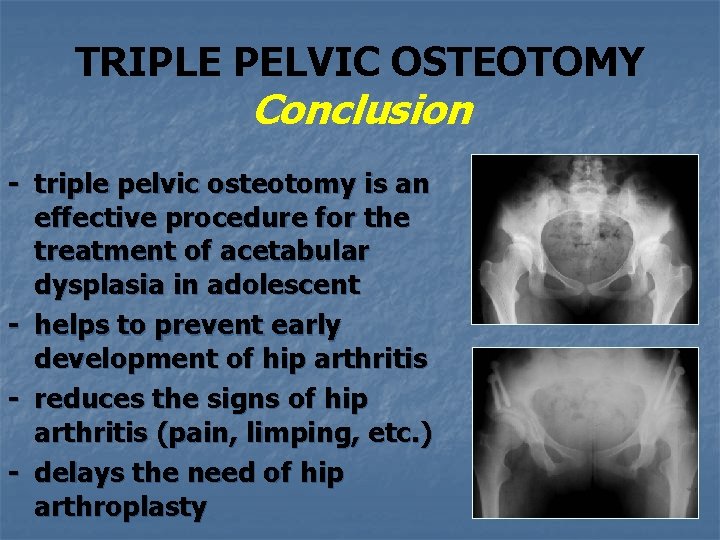
TRIPLE PELVIC OSTEOTOMY Conclusion - triple pelvic osteotomy is an effective procedure for the treatment of acetabular dysplasia in adolescent - helps to prevent early development of hip arthritis - reduces the signs of hip arthritis (pain, limping, etc. ) - delays the need of hip arthroplasty
TRIPLE PELVIC OSTEOTOMY THANK YOU !