
Triple Antibiotic Pastes and their role in Regenerative

Triple Antibiotic Pastes and their role in Regenerative Endodontics
Triple Antibiotic Paste 1. Introduction 2. TAP composition 3. Application of TAP in Endodontics 4. Efficacy 5. Regenerative Endodontic Therapy 6. History of Regenerative Endodontics 7. Uses of TAP in Regenerative Endodontics 8. Biocompatibility 9. Drawbacks 10. Ultimate goal ﺹ 08: 53 30/09/2020
Introduction • Endodontic therapy or root canal therapy is a sequence of treatment for the infected pulp of a tooth, which results in the elimination of infection and the protection of the decontaminated tooth from future microbial invasion. • The infection of the canal system is considered to be poly microbial infection both aerobic & non aerobic bacteria. • Because of complexity of root canal infection, it is unlikely to consider that single antibiotic gives sterile canal system. ﺹ 08: 53 30/09/2020
• Uses of antibiotics in endodontics first reported in 1951 by Grossman, known as poly antibiotic paste (Penicillin, Bacitracin, Streptomycin, Caprylate Sodium). • Hoshino et al, 1996 each antibiotic used alone is in effective against bacteria. Therefore It is essential to use combination of antibiotics to act against all endodontic pathogens and to prevent resistance. • Sato et al, 1996 developed Triple Antibiotic Paste ( Metronidazole, Ciprofloxacin, Minocycline). • Metronidazole selectively toxic to anaerobic bacteria, Protozoa. • Ciprofloxacin (bactericidal) act against gram –ve bacteria. • Minocycline (bacteriostatic) act against gram +ve, -ve Bacteria. ﺹ 08: 53 30/09/2020
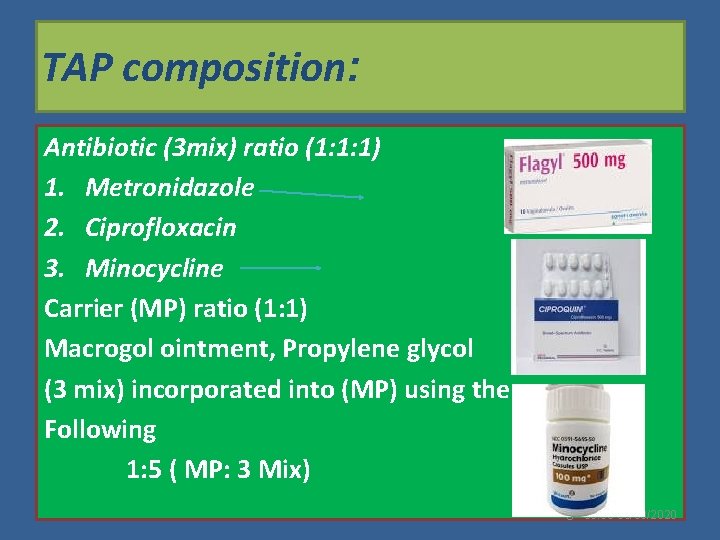
TAP composition: Antibiotic (3 mix) ratio (1: 1: 1) 1. Metronidazole 1. 2. Metronidazole Ciprofloxacin 2. Ciprofloxacin 3. Minocycline Carrier (MP) ratio (1: 1) Macrogol ointment, Propylene glycol (3 mix) incorporated into (MP) using the Following 1: 5 ( MP: 3 Mix) ﺹ 08: 53 30/09/2020
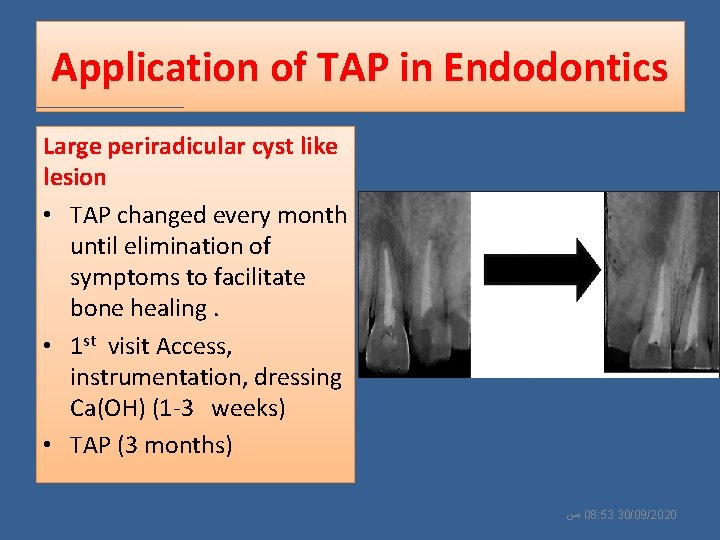
Application of TAP in Endodontics Large periradicular cyst like lesion • TAP changed every month until elimination of symptoms to facilitate bone healing. • 1 st visit Access, instrumentation, dressing Ca(OH) (1 -3 weeks) • TAP (3 months) ﺹ 08: 53 30/09/2020
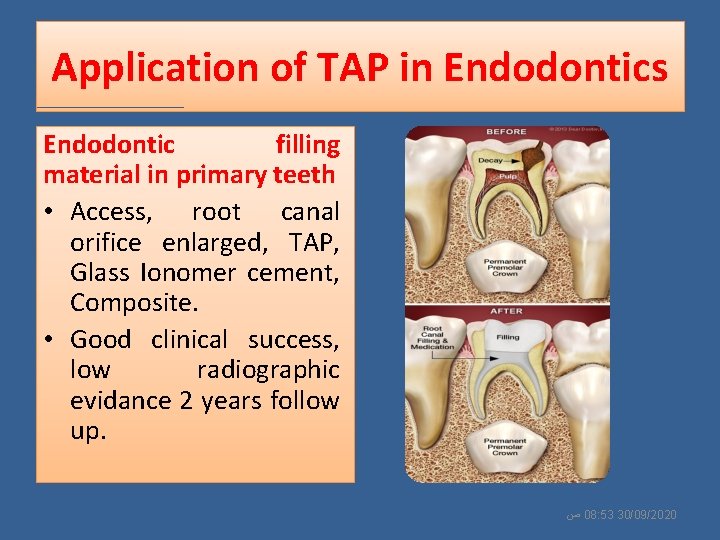
Application of TAP in Endodontics Endodontic filling material in primary teeth • Access, root canal orifice enlarged, TAP, Glass Ionomer cement, Composite. • Good clinical success, low radiographic evidance 2 years follow up. ﺹ 08: 53 30/09/2020
Efficacy Hashino et al study: • Preclinical model(dog study) • 60 teeth accessed and infected • X-ray: Apical periodontitis • Sampled : 1) before irrigation 2) After irrigation 1. 25% Na. OCL 3) 2 weeks after delivery of TAP ﺹ 08: 53 30/09/2020
Conclusion of study: 1. Before irrigation, all teeth +ve culture anaerobic bacteria 2. After irrigation 1. 25% Na. OCL, 10% teeth bacteria free 3. 2 weeks after delivery of TAP, 70% teeth bacteria free ﺹ 08: 53 30/09/2020
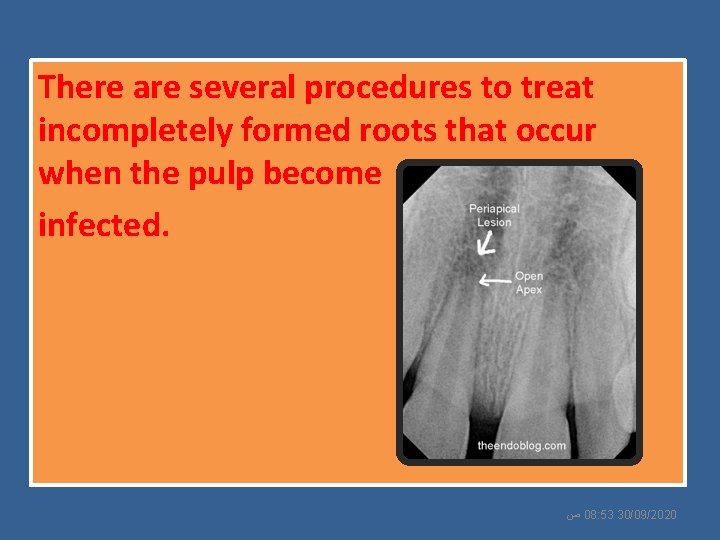
There are several procedures to treat incompletely formed roots that occur when the pulp become infected. ﺹ 08: 53 30/09/2020
• Apexification: method induce calcified barrier in a root with open apex • Apexogenesis : vital pulp therapy procedure performed to encourage continuous physiological development & formation of the root end. ﺹ 08: 53 30/09/2020
Regenerative Endodontic Therapy It is biologically based procedure designed to restore function to a damaged and non functioning pulp and subsequent completion of root development. 1. Mesenchymal stem cell differentiated into odontoblast like cell. 2. Scaffolds (clot) and growth factors guiding development. ﺹ 08: 53 30/09/2020
History of Regenerative Endodontics 1. Nygard Ostby : pioneer of regenerative endodontic procedures in early 1960. 2. Iwaya et al, 2001 : described a procedure which they termed Revascularization. 3. Strobl et al, 2003: Radiographic asssessments, laser Doppler Flometry. 4. Banchs & Trope, 2004 : Revascularization, necrotic immature permanent premolar with open apex and large apical lesion. 5. Claus et al, 2004 ; Ritter et al, 2004: Histological tissue regeneration in animals. 6. Trope, 2008 : Revascularization; nature of tissue formed posttreatment unpredictable. ﺹ 08: 53 30/09/2020
History con. 7. Huang , 2008: Revascularization; restoration of vascularity to tissue or organ. 8. Wang et al, 2010: studies on animals; apposition material may be dentin, cementum or even bone. 9. Lenzi & Trope, 2012: Revitalization; nonspecific vital tissue forms in the root canal. 10. Emi shimizu et al, 2012: Histological evaluation of revascularization procedure. ﺹ 08: 53 30/09/2020
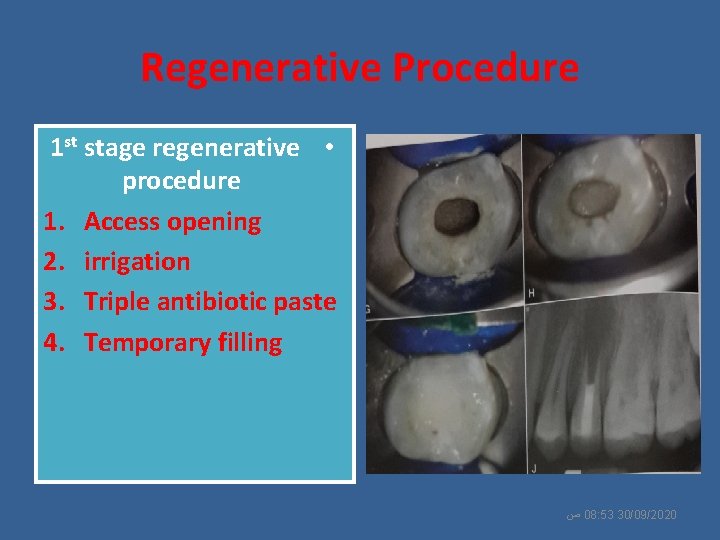
Regenerative Procedure 1 st stage regenerative • procedure 1. Access opening 2. irrigation 3. Triple antibiotic paste 4. Temporary filling ﺹ 08: 53 30/09/2020
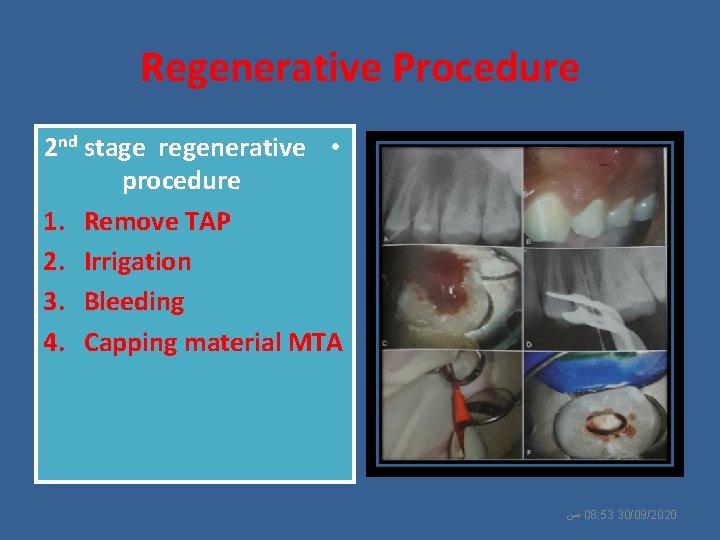
Regenerative Procedure 2 nd stage regenerative • procedure 1. Remove TAP 2. Irrigation 3. Bleeding 4. Capping material MTA ﺹ 08: 53 30/09/2020
Uses of TAP in Regenerative Endodontics: • Used to create an environment favorable for ingrowth of vasculature and regenerative cells by reducing or eradicating bacteria in the canal space of teeth with necrotic pulp and incompletely formed apices. ﺹ 08: 53 30/09/2020
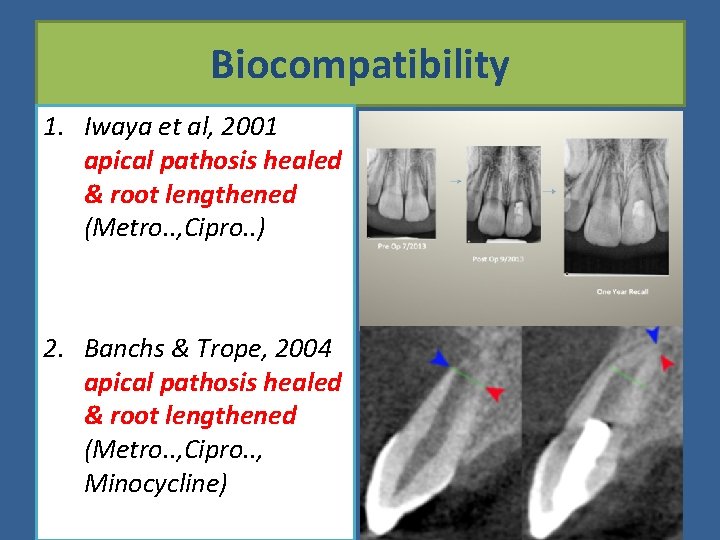
Biocompatibility 1. Iwaya et al, 2001 apical pathosis healed & root lengthened (Metro. . , Cipro. . ) 2. Banchs & Trope, 2004 apical pathosis healed & root lengthened (Metro. . , Cipro. . , Minocycline) ﺹ 08: 54 30/09/2020
Drawbacks: 1. May stain the teeth (Minocycline : staining crown and root above gingival margin). 2. Allergic reactions( Induction of inflammatory response). 3. Concern TAP it may cause bacterial resistance. ﺹ 08: 54 30/09/2020
Ultimate Goal In clinical trials, besides immature permanent teeth with necrotic pulp, regenerative endodontic therapy has been employed to treat 1. mature permanent teeth with necrotic pulps. 2. teeth with persistent apical periodontitis after primary root canal therapy. 3. traumatized teeth associated horizontal root fractures, root resorption, and avulsion. ﺹ 08: 54 30/09/2020

08: 54 30/09/2020 ﺹ
- Slides: 21