
TRIP Overview Georgia Towing and Recovery Incentive Program
- Slides: 21
TRIP Overview Georgia Towing and Recovery Incentive Program (TRIP) TRIP is an initiative of the Traffic Incident Management Enhancement (TIME) Task Force Strategic Vision. n TRIP is a recovery incentive program to pay heavy-duty recovery companies a monetary bonus for clearing commercial vehicle wrecks quickly. n Similar program on Florida’s Turnpike n
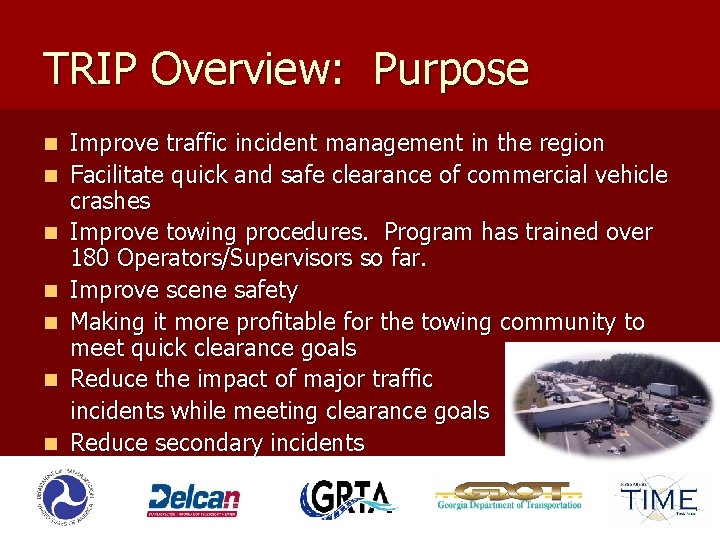
TRIP Overview: Purpose n n n n Improve traffic incident management in the region Facilitate quick and safe clearance of commercial vehicle crashes Improve towing procedures. Program has trained over 180 Operators/Supervisors so far. Improve scene safety Making it more profitable for the towing community to meet quick clearance goals Reduce the impact of major traffic incidents while meeting clearance goals Reduce secondary incidents
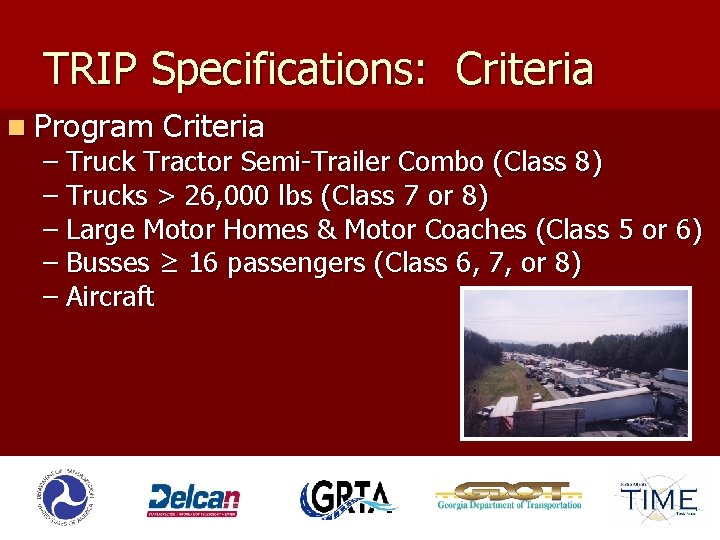
TRIP Specifications: Criteria n Program Criteria – Truck Tractor Semi-Trailer Combo (Class 8) – Trucks > 26, 000 lbs (Class 7 or 8) – Large Motor Homes & Motor Coaches (Class 5 or 6) – Busses ≥ 16 passengers (Class 6, 7, or 8) – Aircraft
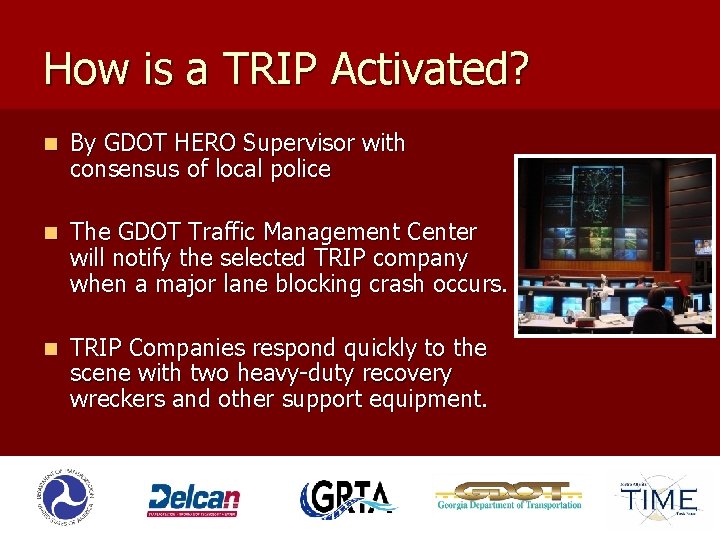
How is a TRIP Activated? n By GDOT HERO Supervisor with consensus of local police n The GDOT Traffic Management Center will notify the selected TRIP company when a major lane blocking crash occurs. n TRIP Companies respond quickly to the scene with two heavy-duty recovery wreckers and other support equipment.
TRIP Qualifications: Response Times Supervisor: n 30 minutes (5: 30 am – 7: 00 pm, Monday – Friday) n 45 minutes (any other time than above) Equipment (2 recovery trucks and support truck): n 45 minutes (5: 30 am – 7: 00 pm, Monday – Friday) n 60 minutes (any other time than above)
What are the requirements to participate in TRIP? n n n Prompt, predictable contractor response and 24/7 equipment availability. Minimum of one 30 ton and one 50 ton recovery wrecker with full sets of tools. Support truck with an extensive array of equipment and full traffic control & fluid spill mitigation capability. Other specialized heavy equipment (low-boys, bobcats, tractor-trailers) Highly trained operators with full certification in advanced heavy towing and recovery as well as MUTCD traffic control and Hazardous Material awareness. also TIM ‘Quick Clearance’ strategies
TRIP Maintenance n After Incident Review (AIR) – every TRIP activation! n Periodic Inspections n Investigate complaints n On-going COMPANY training (8 hours annually)
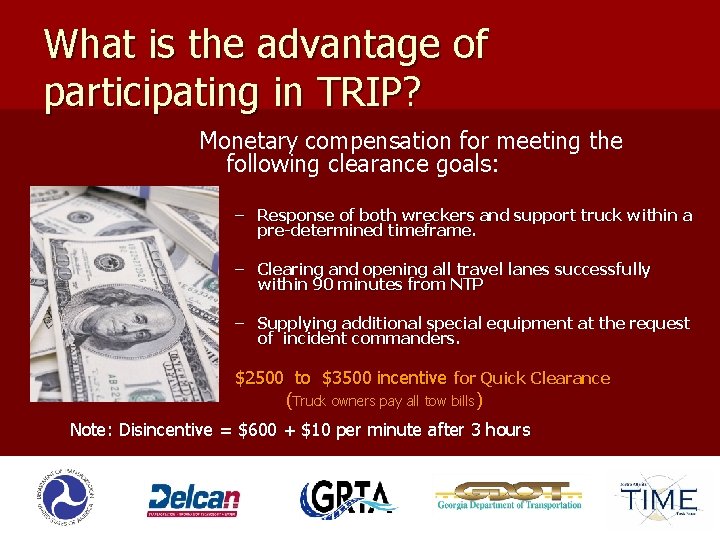
What is the advantage of participating in TRIP? Monetary compensation for meeting the following clearance goals: – Response of both wreckers and support truck within a pre-determined timeframe. – Clearing and opening all travel lanes successfully within 90 minutes from NTP – Supplying additional special equipment at the request of incident commanders. $2500 to $3500 incentive for Quick Clearance (Truck owners pay all tow bills) Note: Disincentive = $600 + $10 per minute after 3 hours
TRIP Overview: Performance Measures n n n n Reduction in Response Times Improvement in Roadway Clearance Times Reduction in Travel Lane Blockage Reduction in Secondary Incidents Reduction in Incident Clearance Times Dollar Saving from Reduced Congestion Improved Air Quality
TRIP Overview: Benefits n n Towing Industry: Safety & Monetary Incentives Incident Responders: Improved roadway clearance times = SAFETY Transportation Industry: Improve congestion, get the roadways open quicker, make the public happy Traveling Motorist: Less frustration and more reliable travel times
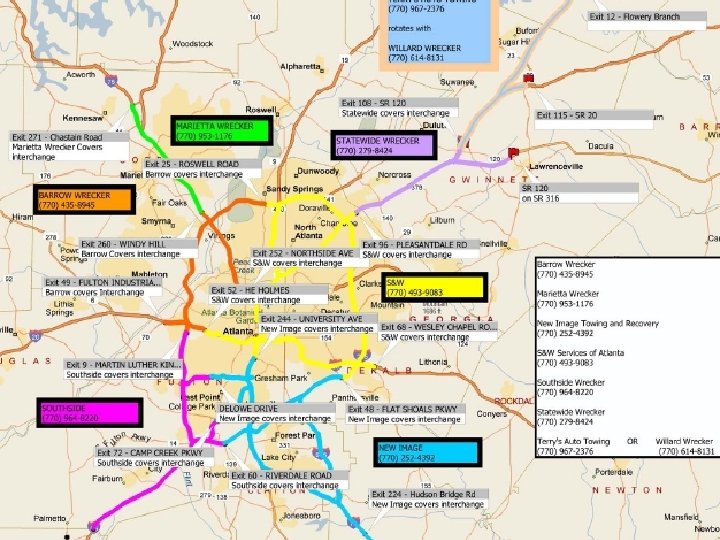
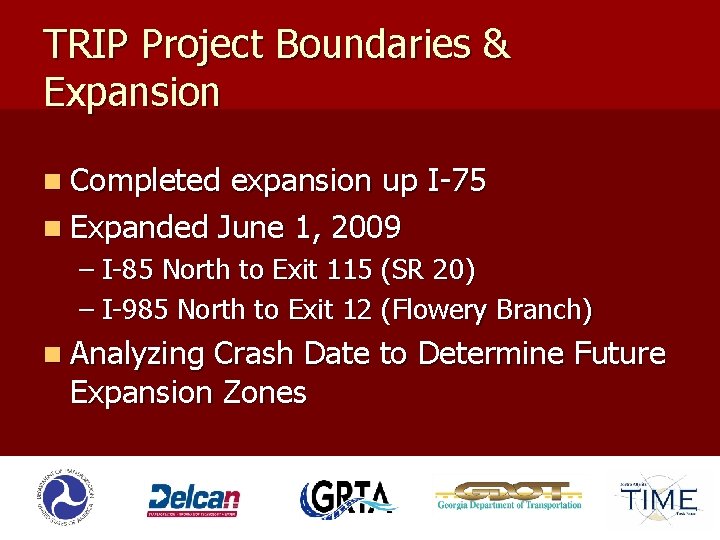
TRIP Project Boundaries & Expansion n Completed expansion up I-75 n Expanded June 1, 2009 – I-85 North to Exit 115 (SR 20) – I-985 North to Exit 12 (Flowery Branch) n Analyzing Crash Date to Determine Future Expansion Zones
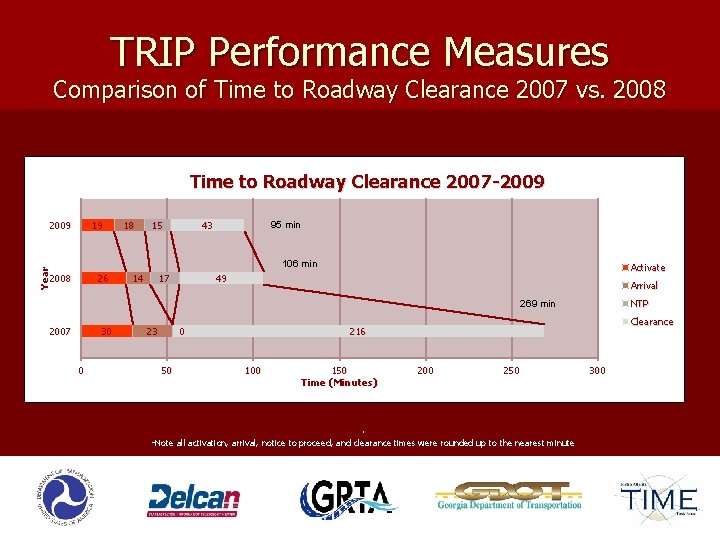
TRIP Performance Measures Comparison of Time to Roadway Clearance 2007 vs. 2008 Time to Roadway Clearance 2007 -2009 19 18 15 43 95 min Year 106 min 2008 26 14 17 Activate 49 Arrival NTP 269 min 2007 30 0 23 0 50 Clearance 216 100 150 Time (Minutes) 200 250 . -Note all activation, arrival, notice to proceed, and clearance times were rounded up to the nearest minute 300
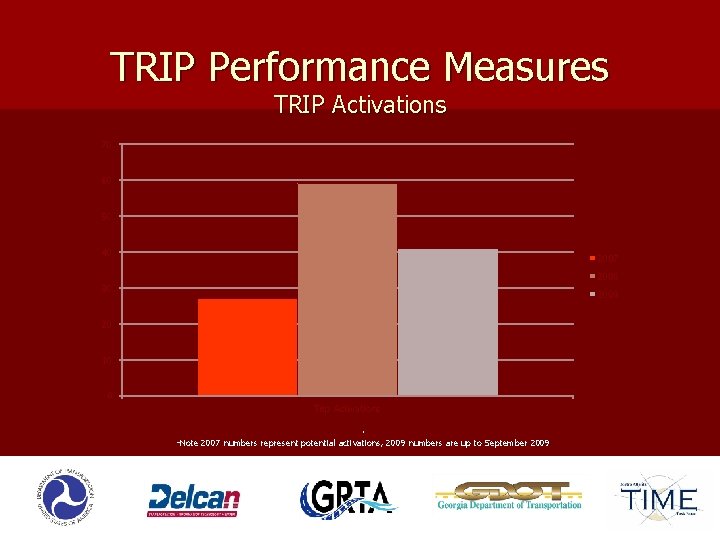
TRIP Performance Measures TRIP Activations 70 60 50 40 2007 2008 30 2009 20 10 0 Trip Activations. -Note 2007 numbers represent potential activations, 2009 numbers are up to September 2009
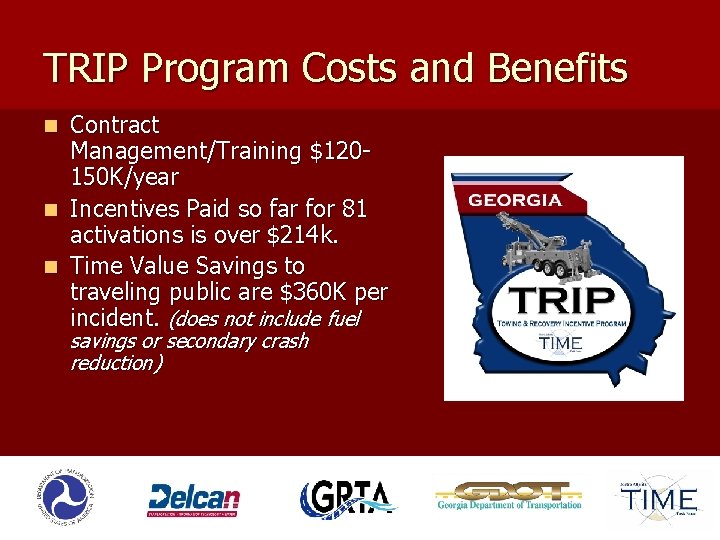
TRIP Program Costs and Benefits Contract Management/Training $120150 K/year n Incentives Paid so far for 81 activations is over $214 k. n Time Value Savings to traveling public are $360 K per incident. (does not include fuel n savings or secondary crash reduction)
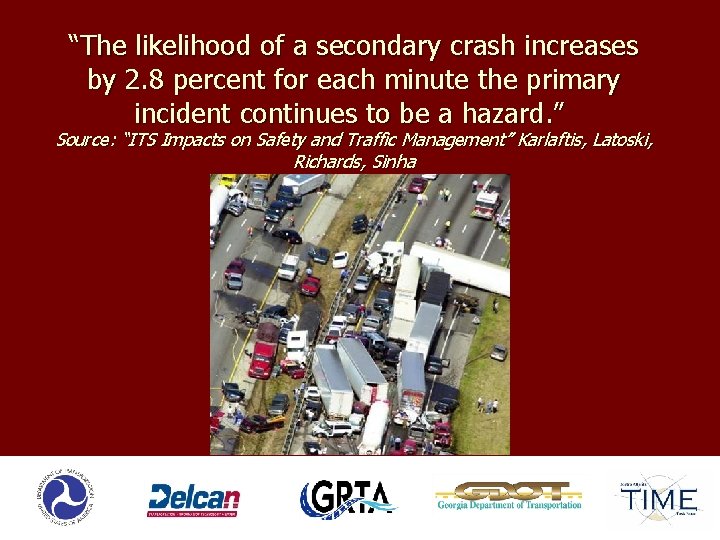
“The likelihood of a secondary crash increases by 2. 8 percent for each minute the primary incident continues to be a hazard. ” Source: “ITS Impacts on Safety and Traffic Management” Karlaftis, Latoski, Richards, Sinha
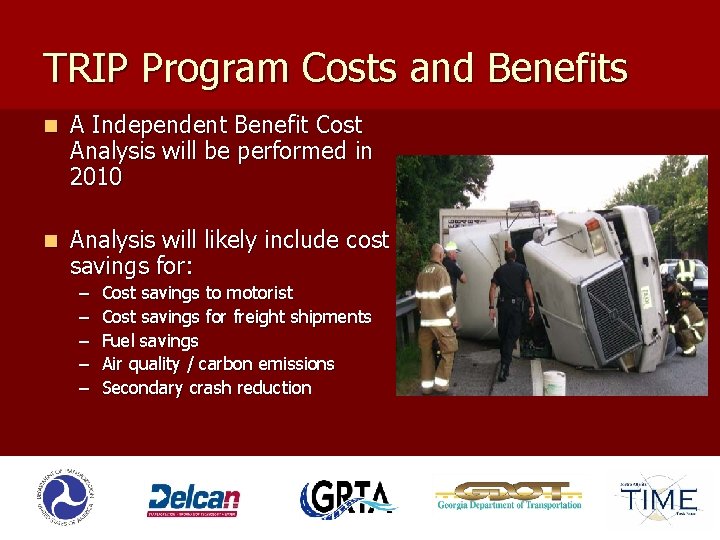
TRIP Program Costs and Benefits n A Independent Benefit Cost Analysis will be performed in 2010 n Analysis will likely include cost savings for: – – – Cost savings to motorist Cost savings for freight shipments Fuel savings Air quality / carbon emissions Secondary crash reduction
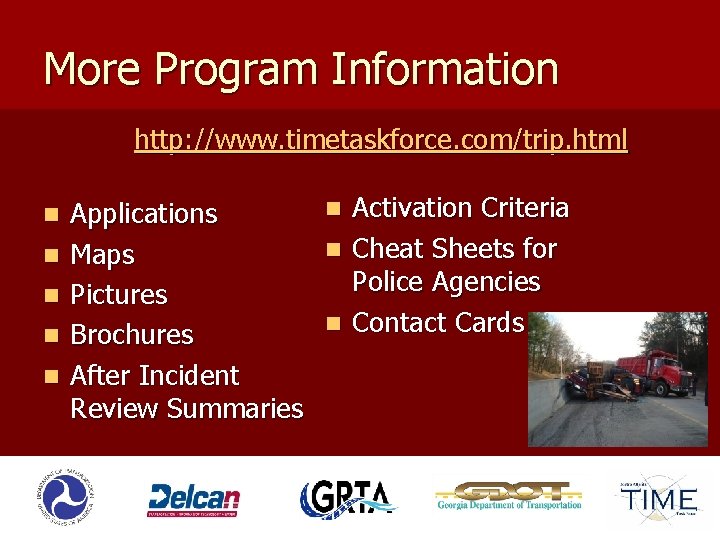
More Program Information http: //www. timetaskforce. com/trip. html n n n Applications Maps Pictures Brochures After Incident Review Summaries Activation Criteria n Cheat Sheets for Police Agencies n Contact Cards n
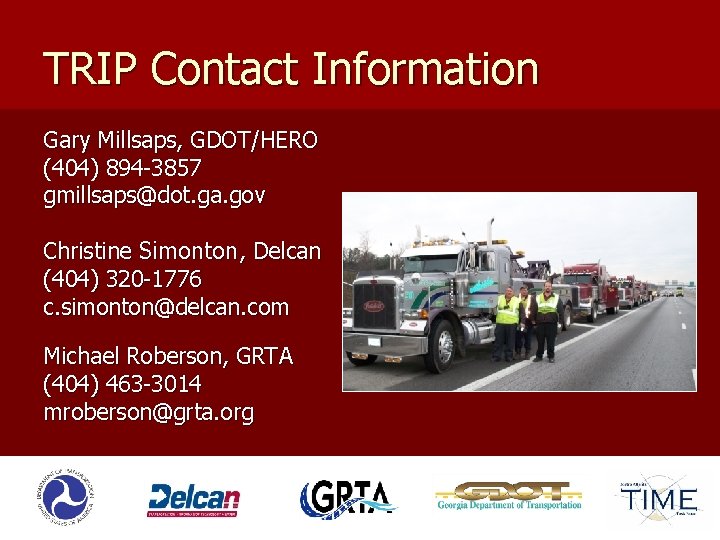
TRIP Contact Information Gary Millsaps, GDOT/HERO (404) 894 -3857 gmillsaps@dot. ga. gov Christine Simonton, Delcan (404) 320 -1776 c. simonton@delcan. com Michael Roberson, GRTA (404) 463 -3014 mroberson@grta. org
QUESTIONS?