
Trip Distribution TAZ 1 1080 A 20 min
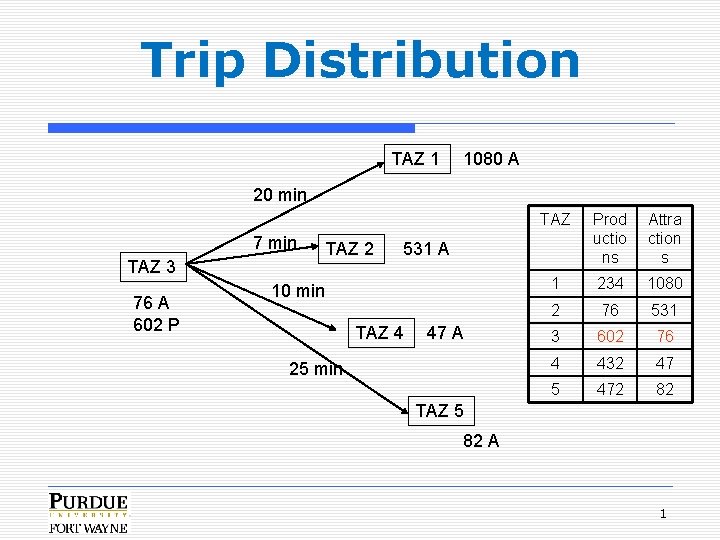
Trip Distribution TAZ 1 1080 A 20 min 7 min TAZ 3 TAZ 2 76 A 602 P TAZ Prod uctio ns Attra ction s 1 234 1080 2 76 531 3 602 76 4 432 47 5 472 82 531 A 10 min TAZ 4 47 A 25 min TAZ 5 82 A 1
Inputs and Outputs Ø Input Ø Trip generation - productions & attractions (balanced by purpose) Ø Path skimming - travel times or impedances Ø Travel times in form of matrix, each cell represents time it takes to travel from one TAZ to another Ø Output of trip distribution model: trip table or OD matrix, each cell represents number of person trips between each zonal exchange 2

Impedance: Travel Time Matrix Trip Generation P & A per purpose TAZ Productions Attractions TAZ 1 2 3 4 5 1 234 1080 1 4 12 8 15 21 2 76 531 2 6 3 9 23 14 3 602 76 3 20 7 4 10 25 4 432 47 4 12 18 8 4 17 5 472 82 5 24 19 23 15 8 Trip Distribution TAZ 1 2 3 4 5 1 199 2 15 2 16 2 35 25 12 3 147 350 78 19 8 4 330 90 4 6 2 5 369 90 7 5 1 1080 Attraction 531 76 47 234 76 602 432 472 1816 Production 82 3
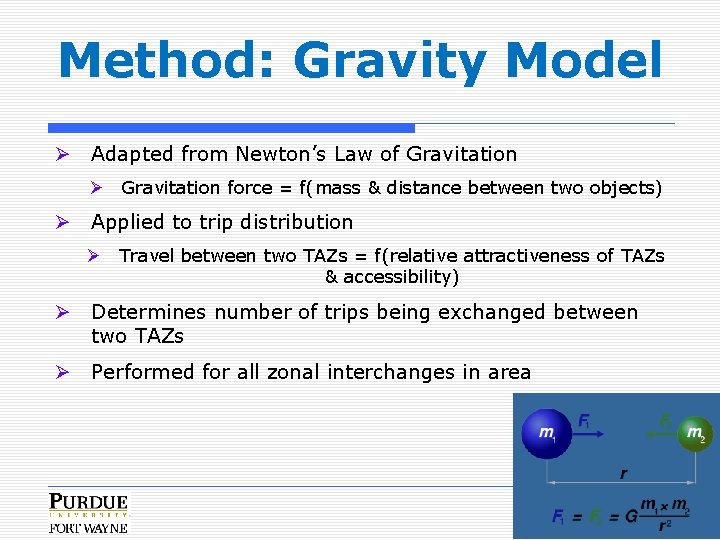
Method: Gravity Model Ø Adapted from Newton’s Law of Gravitation Ø Gravitation force = f(mass & distance between two objects) Ø Applied to trip distribution Ø Travel between two TAZs = f(relative attractiveness of TAZs & accessibility) Ø Determines number of trips being exchanged between two TAZs Ø Performed for all zonal interchanges in area 4
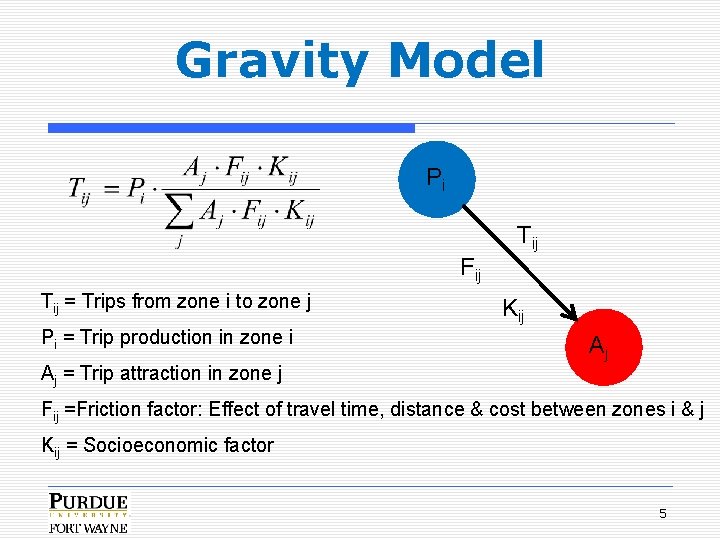
Gravity Model Pi Tij Fij Tij = Trips from zone i to zone j Pi = Trip production in zone i Aj = Trip attraction in zone j Kij Aj Fij =Friction factor: Effect of travel time, distance & cost between zones i & j Kij = Socioeconomic factor 5
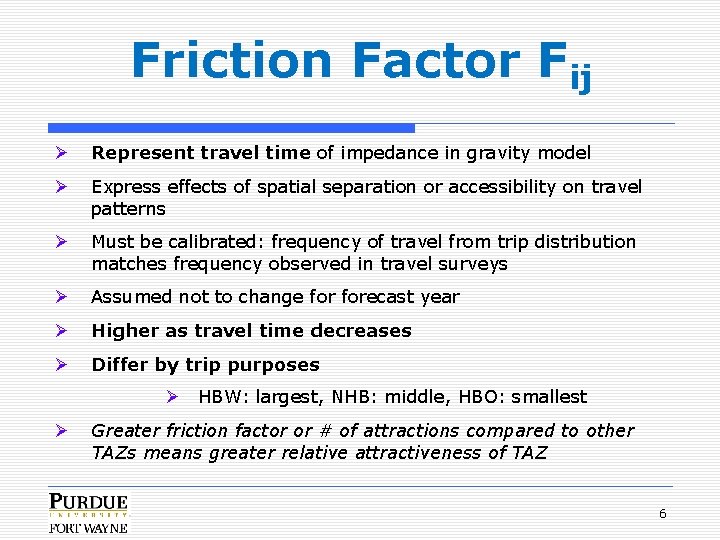
Friction Factor Fij Ø Represent travel time of impedance in gravity model Ø Express effects of spatial separation or accessibility on travel patterns Ø Must be calibrated: frequency of travel from trip distribution matches frequency observed in travel surveys Ø Assumed not to change forecast year Ø Higher as travel time decreases Ø Differ by trip purposes Ø HBW: largest, NHB: middle, HBO: smallest Ø Greater friction factor or # of attractions compared to other TAZs means greater relative attractiveness of TAZ 6
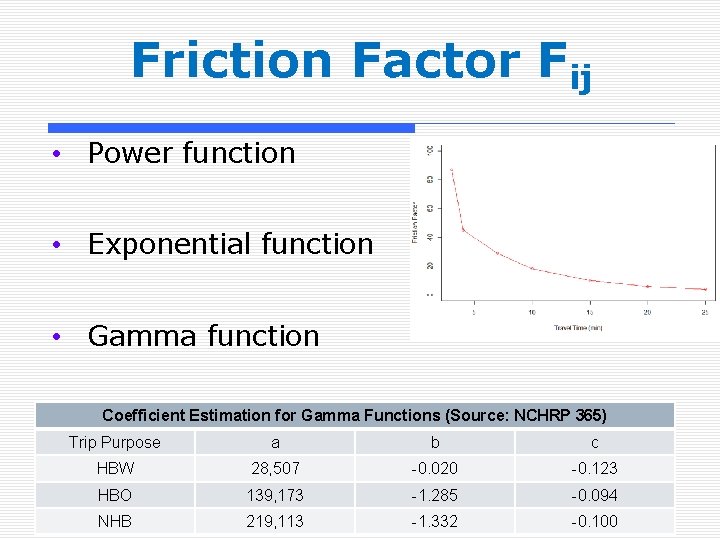
Friction Factor Fij • Power function • Exponential function • Gamma function Coefficient Estimation for Gamma Functions (Source: NCHRP 365) Trip Purpose a b c HBW 28, 507 -0. 020 -0. 123 HBO 139, 173 -1. 285 -0. 094 NHB 219, 113 -1. 332 -0. 100 7
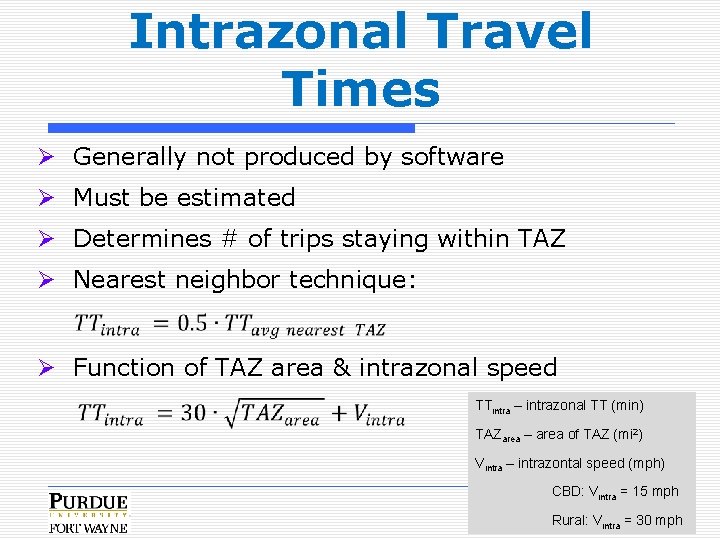
Intrazonal Travel Times Ø Generally not produced by software Ø Must be estimated Ø Determines # of trips staying within TAZ Ø Nearest neighbor technique: Ø Function of TAZ area & intrazonal speed TTintra – intrazonal TT (min) TAZarea – area of TAZ (mi 2) Vintra – intrazontal speed (mph) CBD: Vintra = 15 mph 8 Rural: Vintra = 30 mph
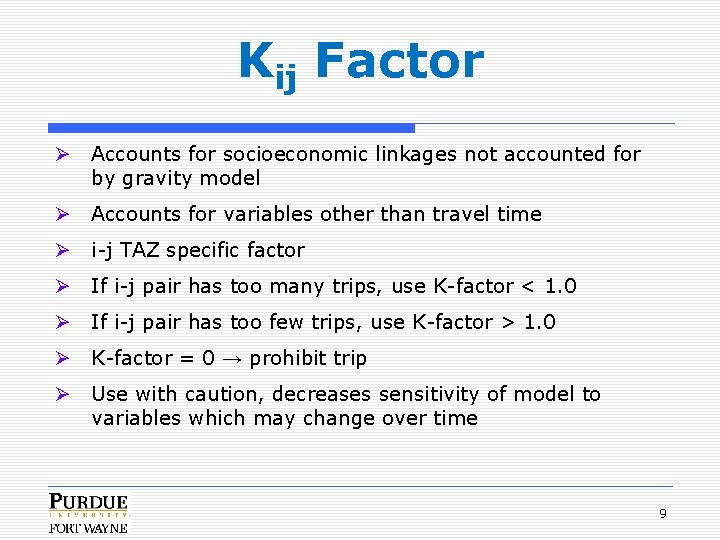
Kij Factor Ø Accounts for socioeconomic linkages not accounted for by gravity model Ø Accounts for variables other than travel time Ø i-j TAZ specific factor Ø If i-j pair has too many trips, use K-factor < 1. 0 Ø If i-j pair has too few trips, use K-factor > 1. 0 Ø K-factor = 0 → prohibit trip Ø Use with caution, decreases sensitivity of model to variables which may change over time 9
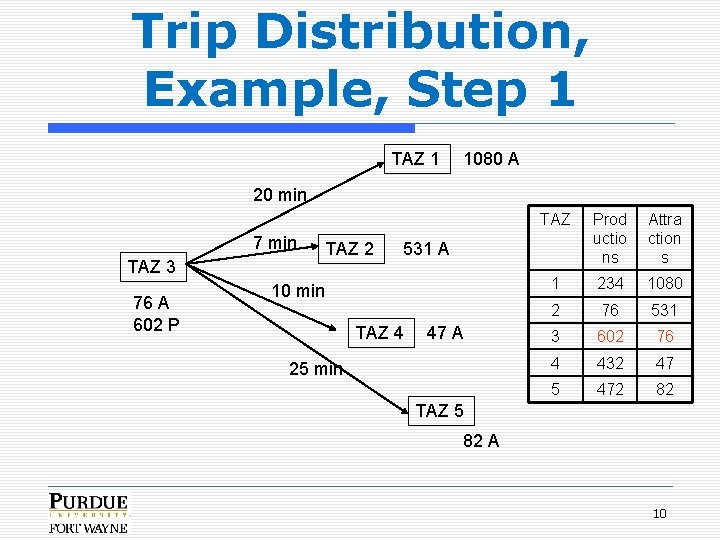
Trip Distribution, Example, Step 1 TAZ 1 1080 A 20 min 7 min TAZ 3 TAZ 2 76 A 602 P TAZ Prod uctio ns Attra ction s 1 234 1080 2 76 531 3 602 76 4 432 47 5 472 82 531 A 10 min TAZ 4 47 A 25 min TAZ 5 82 A 10
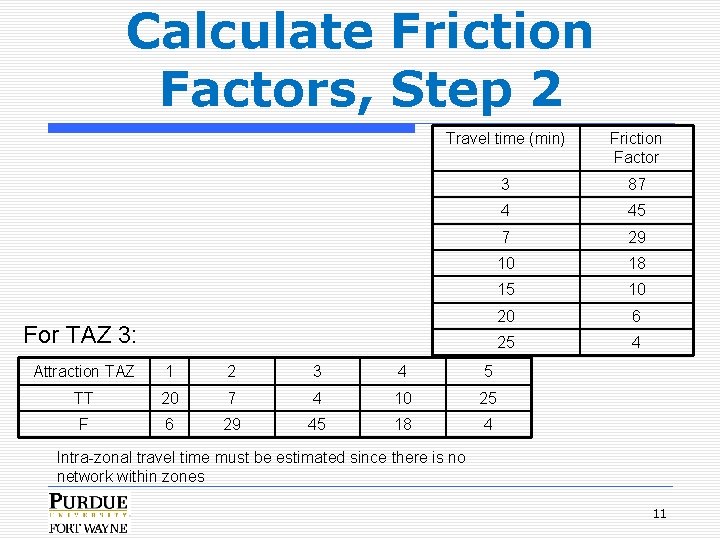
Calculate Friction Factors, Step 2 Travel time (min) Friction Factor 3 87 4 45 7 29 10 18 15 10 20 6 25 4 For TAZ 3: Attraction TAZ 1 2 3 4 5 TT 20 7 4 10 25 F 6 29 45 18 4 Intra-zonal travel time must be estimated since there is no network within zones 11
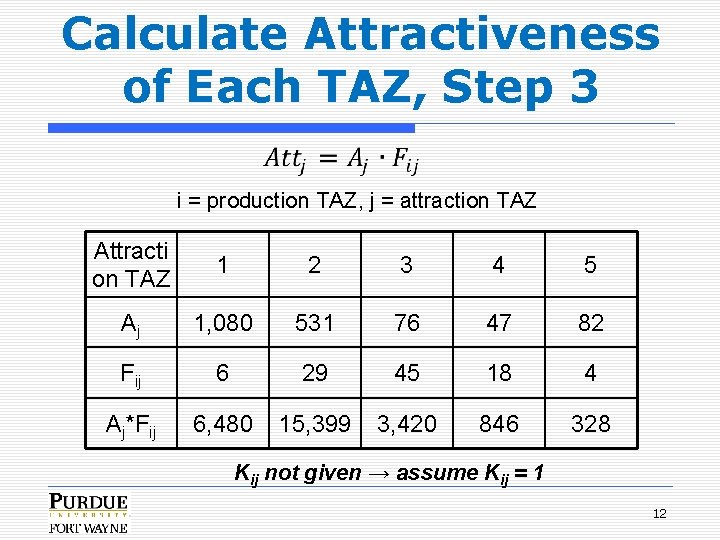
Calculate Attractiveness of Each TAZ, Step 3 i = production TAZ, j = attraction TAZ Attracti on TAZ 1 2 3 4 5 Aj 1, 080 531 76 47 82 Fij 6 29 45 18 4 Aj*Fij 6, 480 15, 399 3, 420 846 328 Kij not given → assume Kij = 1 12
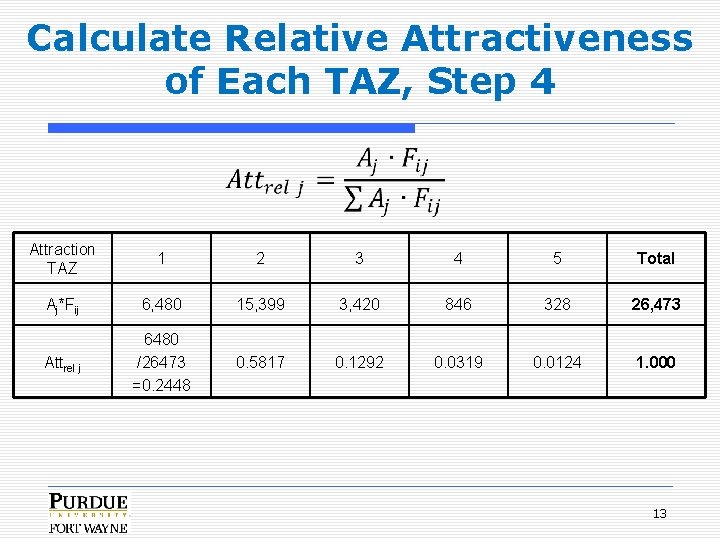
Calculate Relative Attractiveness of Each TAZ, Step 4 Attraction TAZ 1 2 3 4 5 Total Aj*Fij 6, 480 15, 399 3, 420 846 328 26, 473 Attrel j 6480 /26473 =0. 2448 0. 5817 0. 1292 0. 0319 0. 0124 1. 000 13
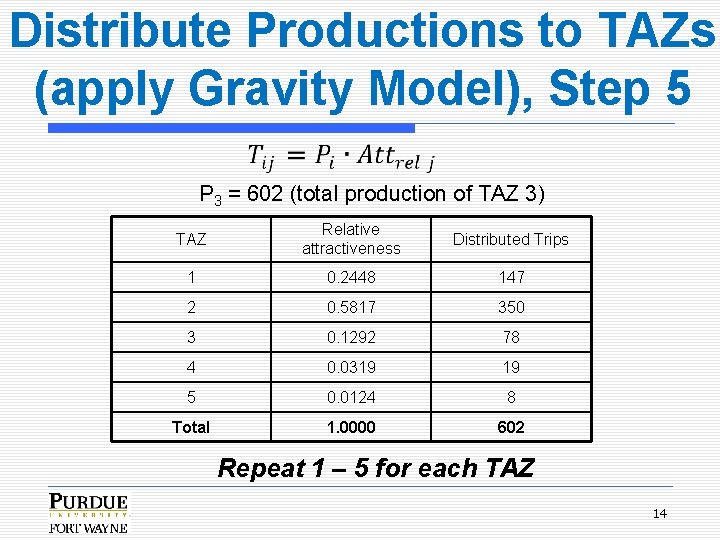
Distribute Productions to TAZs (apply Gravity Model), Step 5 P 3 = 602 (total production of TAZ 3) TAZ Relative attractiveness Distributed Trips 1 0. 2448 147 2 0. 5817 350 3 0. 1292 78 4 0. 0319 19 5 0. 0124 8 Total 1. 0000 602 Repeat 1 – 5 for each TAZ 14
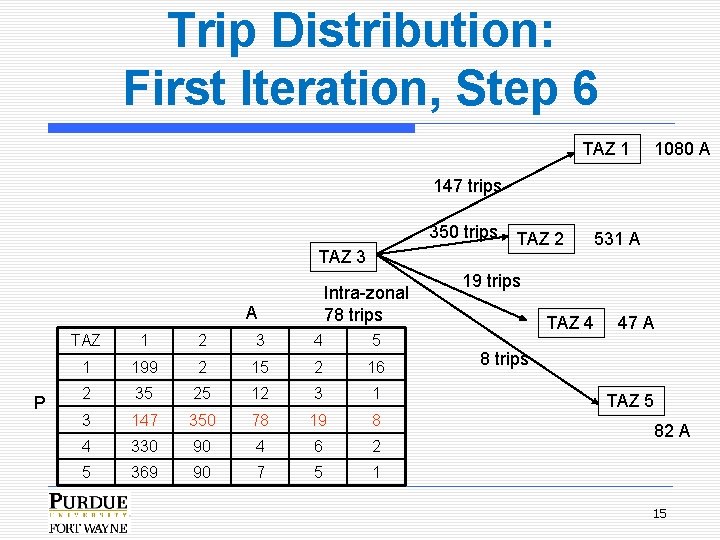
Trip Distribution: First Iteration, Step 6 TAZ 1 1080 A 147 trips 350 trips TAZ 2 TAZ 3 Intra-zonal 78 trips A P TAZ 1 2 3 4 5 1 199 2 15 2 16 2 35 25 12 3 147 350 78 19 8 4 330 90 4 6 2 5 369 90 7 5 1 531 A 19 trips TAZ 4 47 A 8 trips TAZ 5 82 A 15
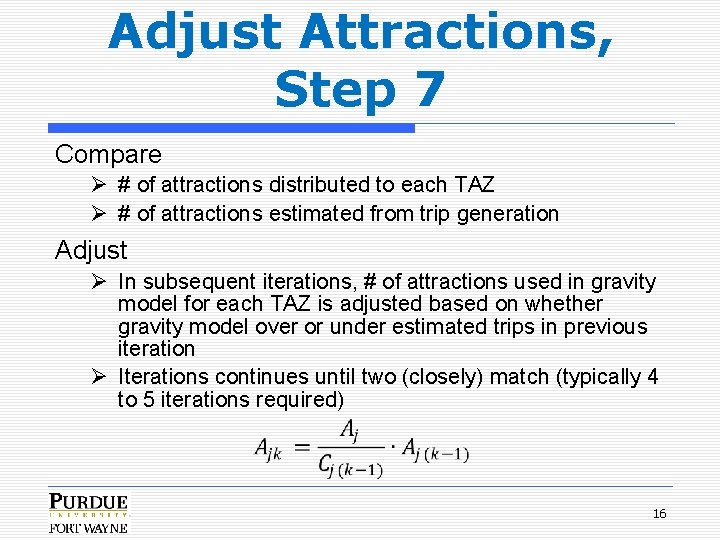
Adjust Attractions, Step 7 Compare Ø # of attractions distributed to each TAZ Ø # of attractions estimated from trip generation Adjust Ø In subsequent iterations, # of attractions used in gravity model for each TAZ is adjusted based on whether gravity model over or under estimated trips in previous iteration Ø Iterations continues until two (closely) match (typically 4 to 5 iterations required) 16
- Slides: 16