
TRIMMING Why and when Trimming is defined as
- Slides: 10
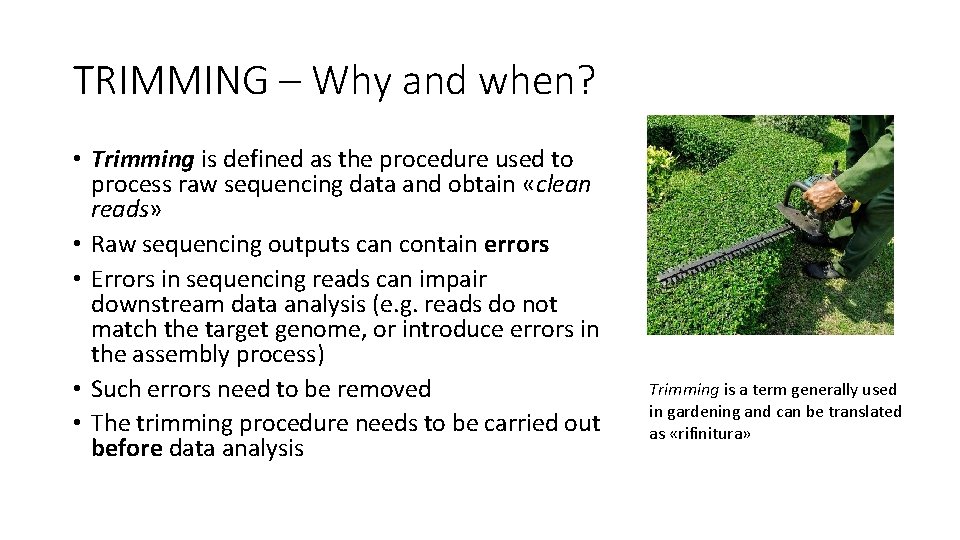
TRIMMING – Why and when? • Trimming is defined as the procedure used to process raw sequencing data and obtain «clean reads» • Raw sequencing outputs can contain errors • Errors in sequencing reads can impair downstream data analysis (e. g. reads do not match the target genome, or introduce errors in the assembly process) • Such errors need to be removed • The trimming procedure needs to be carried out before data analysis Trimming is a term generally used in gardening and can be translated as «rifinitura»
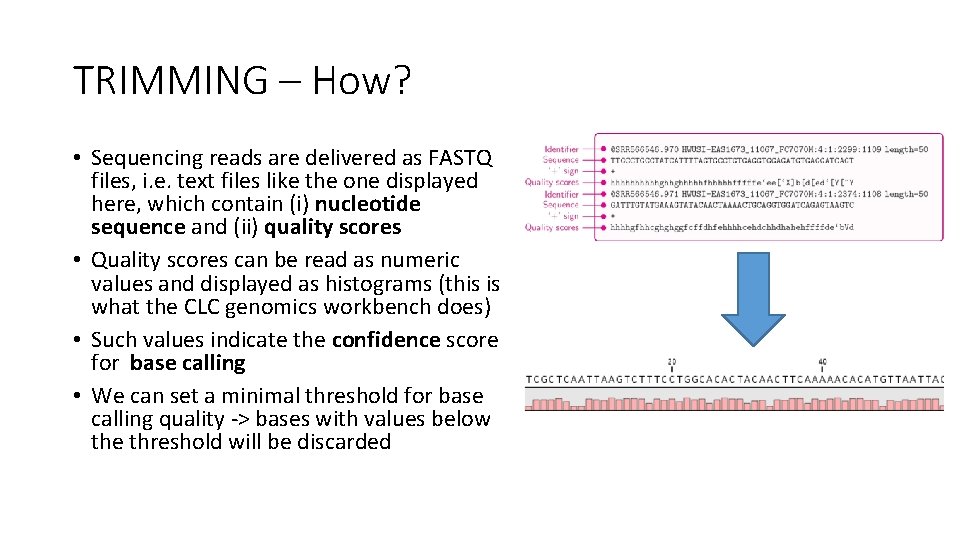
TRIMMING – How? • Sequencing reads are delivered as FASTQ files, i. e. text files like the one displayed here, which contain (i) nucleotide sequence and (ii) quality scores • Quality scores can be read as numeric values and displayed as histograms (this is what the CLC genomics workbench does) • Such values indicate the confidence score for base calling • We can set a minimal threshold for base calling quality -> bases with values below the threshold will be discarded
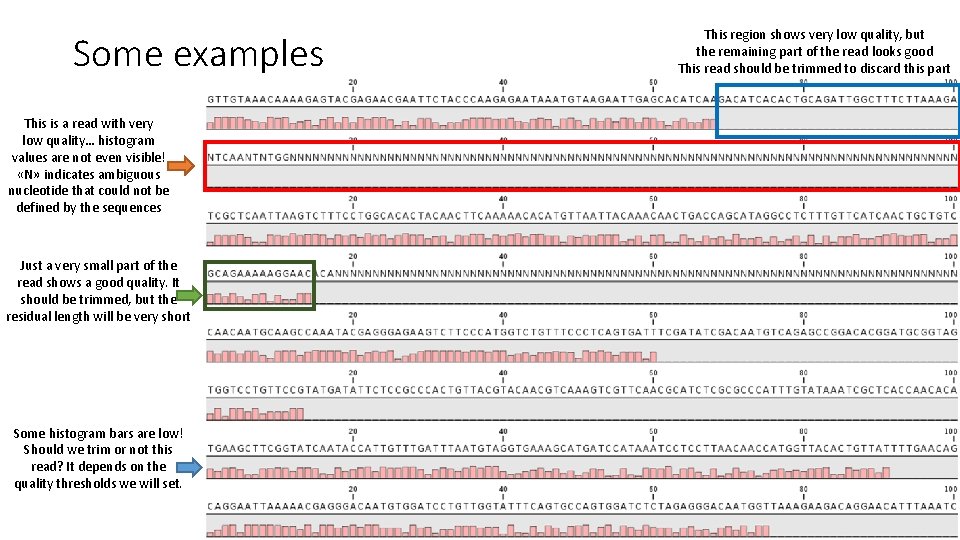
Some examples This is a read with very low quality… histogram values are not even visible! «N» indicates ambiguous nucleotide that could not be defined by the sequences Just a very small part of the read shows a good quality. It should be trimmed, but the residual length will be very short Some histogram bars are low! Should we trim or not this read? It depends on the quality thresholds we will set. This region shows very low quality, but the remaining part of the read looks good This read should be trimmed to discard this part
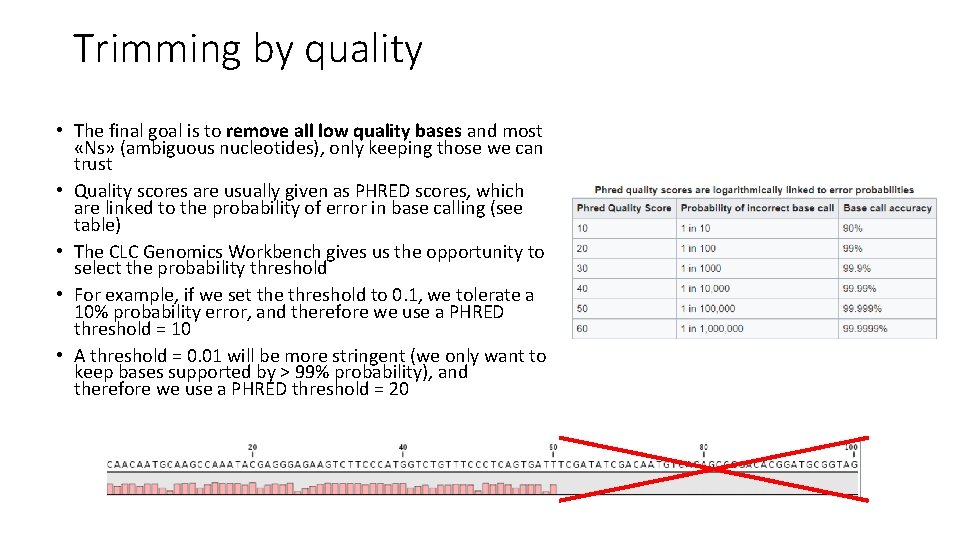
Trimming by quality • The final goal is to remove all low quality bases and most «Ns» (ambiguous nucleotides), only keeping those we can trust • Quality scores are usually given as PHRED scores, which are linked to the probability of error in base calling (see table) • The CLC Genomics Workbench gives us the opportunity to select the probability threshold • For example, if we set the threshold to 0. 1, we tolerate a 10% probability error, and therefore we use a PHRED threshold = 10 • A threshold = 0. 01 will be more stringent (we only want to keep bases supported by > 99% probability), and therefore we use a PHRED threshold = 20
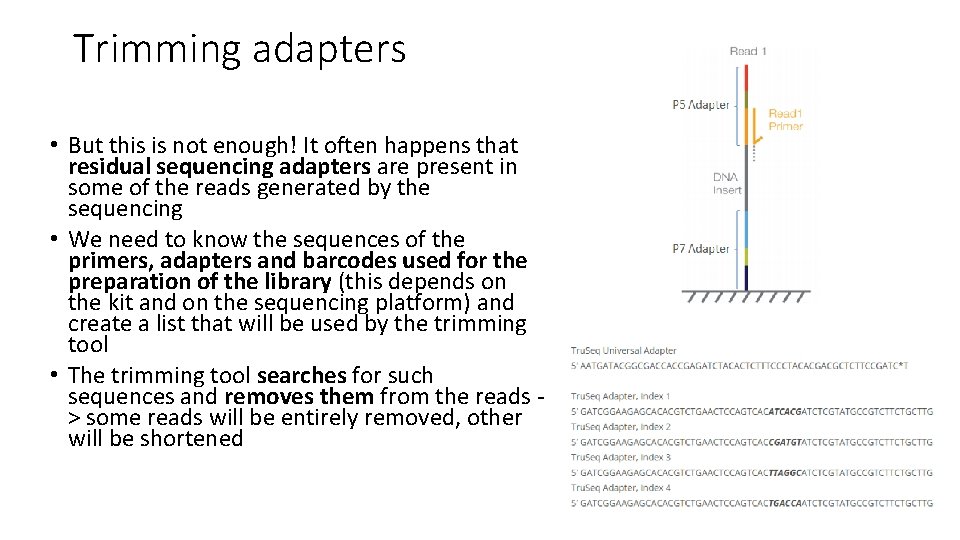
Trimming adapters • But this is not enough! It often happens that residual sequencing adapters are present in some of the reads generated by the sequencing • We need to know the sequences of the primers, adapters and barcodes used for the preparation of the library (this depends on the kit and on the sequencing platform) and create a list that will be used by the trimming tool • The trimming tool searches for such sequences and removes them from the reads > some reads will be entirely removed, other will be shortened
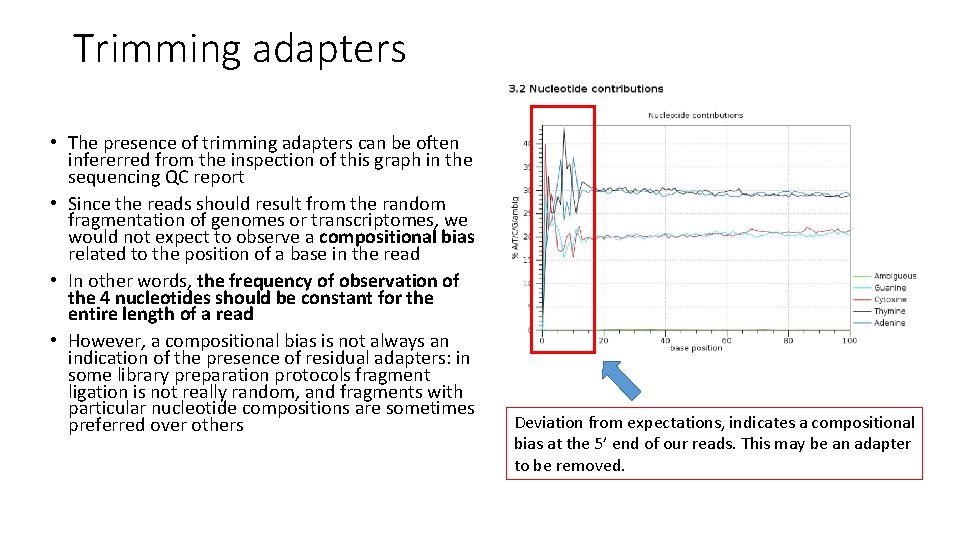
Trimming adapters • The presence of trimming adapters can be often infererred from the inspection of this graph in the sequencing QC report • Since the reads should result from the random fragmentation of genomes or transcriptomes, we would not expect to observe a compositional bias related to the position of a base in the read • In other words, the frequency of observation of the 4 nucleotides should be constant for the entire length of a read • However, a compositional bias is not always an indication of the presence of residual adapters: in some library preparation protocols fragment ligation is not really random, and fragments with particular nucleotide compositions are sometimes preferred over others Deviation from expectations, indicates a compositional bias at the 5’ end of our reads. This may be an adapter to be removed.
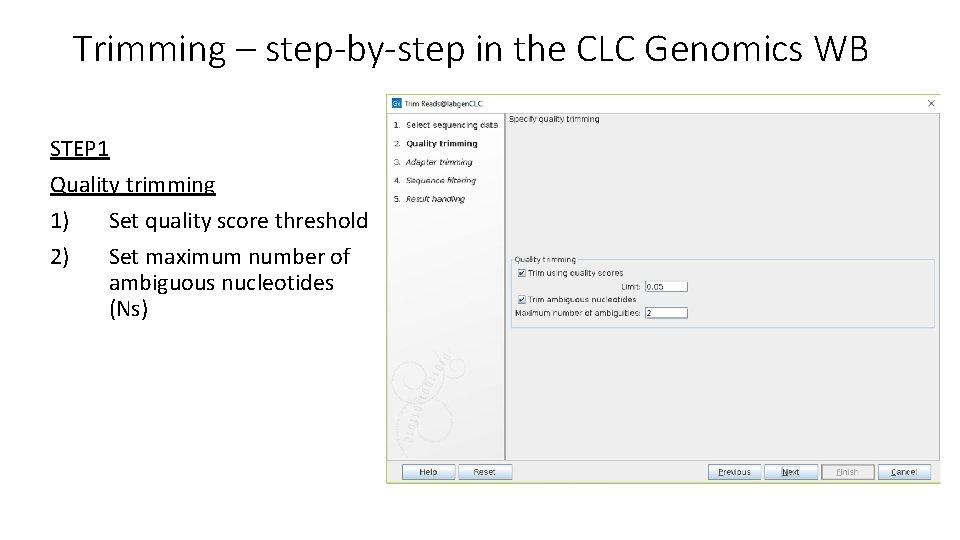
Trimming – step-by-step in the CLC Genomics WB STEP 1 Quality trimming 1) Set quality score threshold 2) Set maximum number of ambiguous nucleotides (Ns)
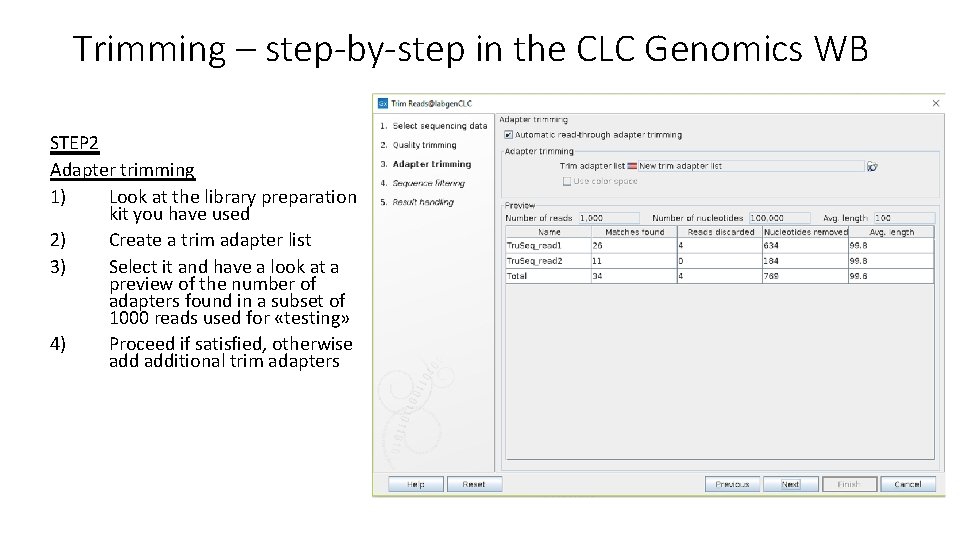
Trimming – step-by-step in the CLC Genomics WB STEP 2 Adapter trimming 1) Look at the library preparation kit you have used 2) Create a trim adapter list 3) Select it and have a look at a preview of the number of adapters found in a subset of 1000 reads used for «testing» 4) Proceed if satisfied, otherwise additional trim adapters
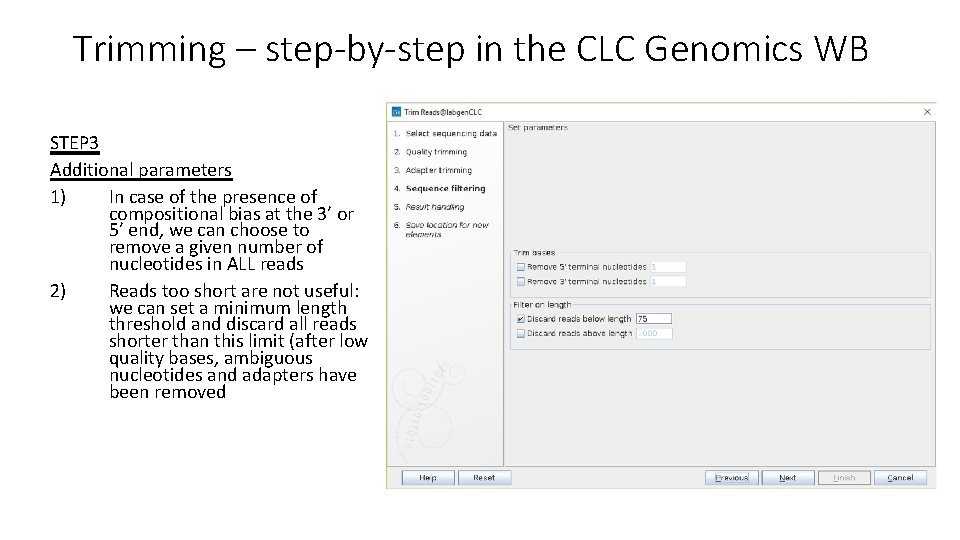
Trimming – step-by-step in the CLC Genomics WB STEP 3 Additional parameters 1) In case of the presence of compositional bias at the 3’ or 5’ end, we can choose to remove a given number of nucleotides in ALL reads 2) Reads too short are not useful: we can set a minimum length threshold and discard all reads shorter than this limit (after low quality bases, ambiguous nucleotides and adapters have been removed
Trimming – final expected outcome • We expect to obtain clean reads, ready for downstream analysis without any further modification • However, keep in mind that reads will be shorter on average, and often in a much lower number than those we originally had (because many of them have been discarded during the trimming procedure) • We need to ask ourselves whether the number of reads we got after the trimming is fine for our dowstream application… if the number is too low, we migth want to use less stringent parameters and perform a softer trimming