
Trigonometry The study of Angles Standard Position Quadrant
- Slides: 22
Trigonometry The study of. . . Angles.
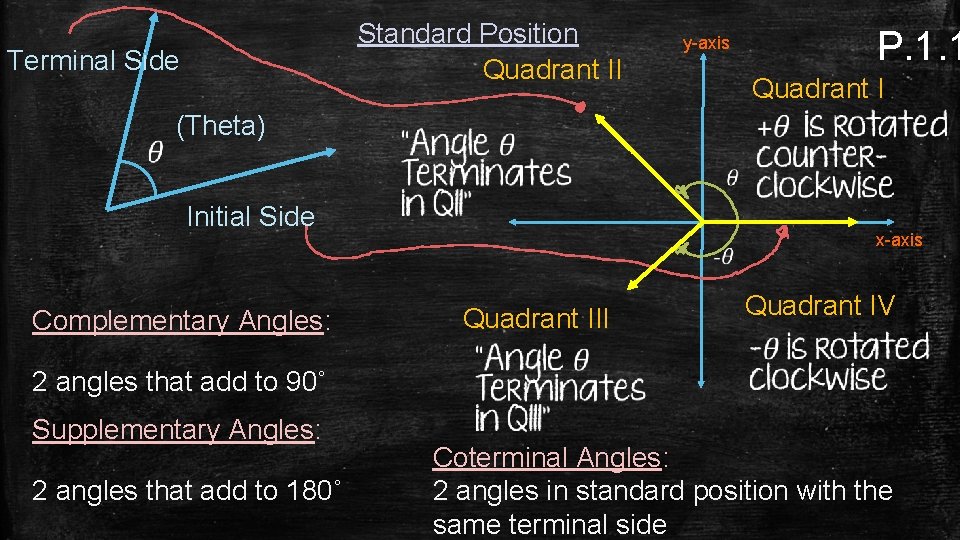
Standard Position Quadrant II Terminal Side y-axis P. 1. 1 Quadrant I (Theta) Initial Side Complementary Angles: x-axis Quadrant III Quadrant IV 2 angles that add to 90˚ Supplementary Angles: 2 angles that add to 180˚ Coterminal Angles: 2 angles in standard position with the same terminal side
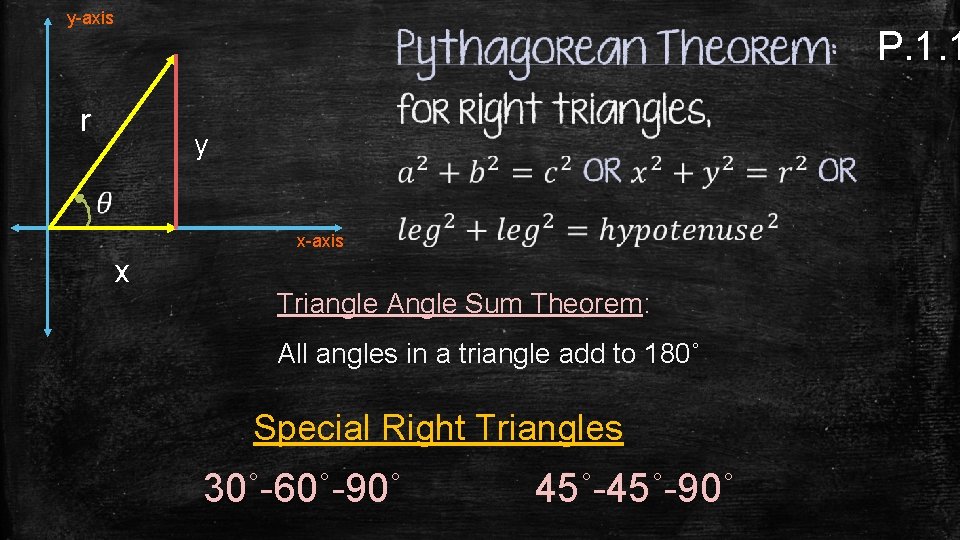
y-axis P. 1. 1 r y x-axis x Triangle Angle Sum Theorem: All angles in a triangle add to 180˚ Special Right Triangles 30˚-60˚-90˚ 45˚-90˚
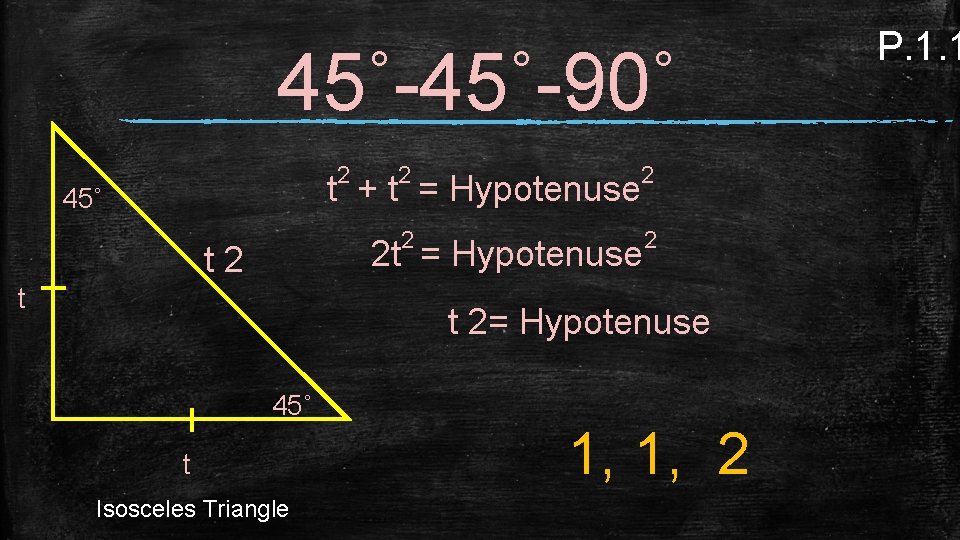
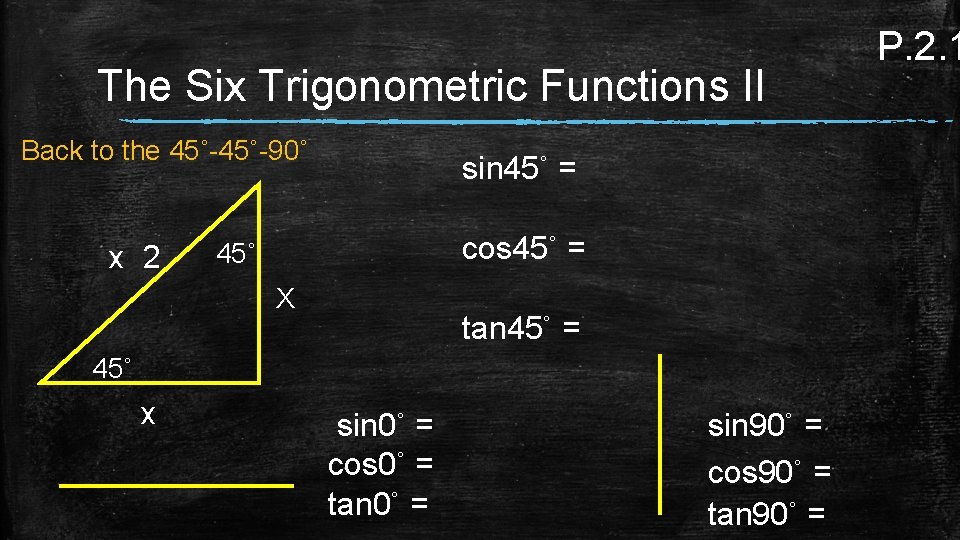
45˚-90˚ 2 2 2 t + t = Hypotenuse 45˚ 2 t = Hypotenuse t 2 t t 2= Hypotenuse 45˚ t Isosceles Triangle 1, 1, 2 P. 1. 1
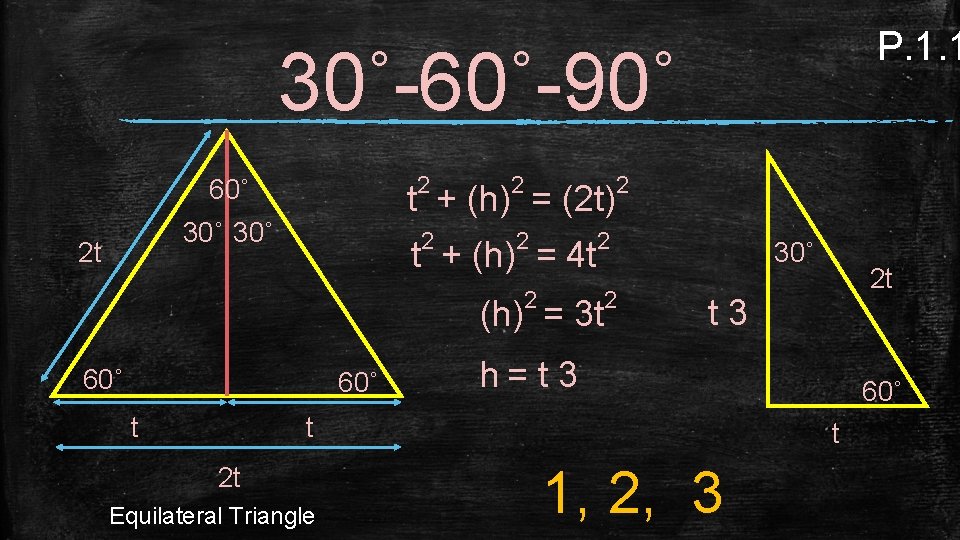
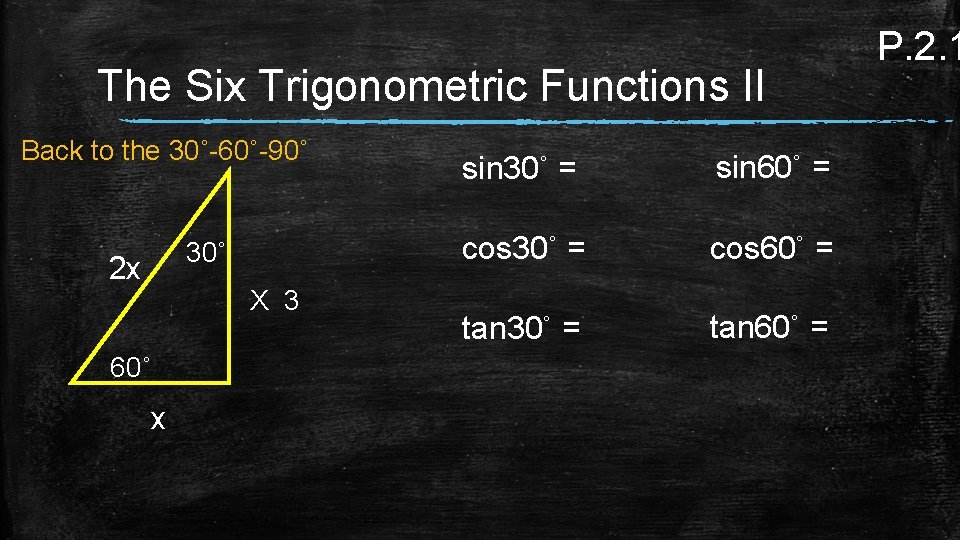
P. 1. 1 30˚-60˚-90˚ 60˚ 2 2 2 t + (h) = (2 t) 30˚ 2 t 2 t + (h) = 4 t 2 2 (h) = 3 t 60˚ 2 2 30˚ t 3 h= t 3 t t 2 t Equilateral Triangle 2 t 60˚ t 1, 2, 3
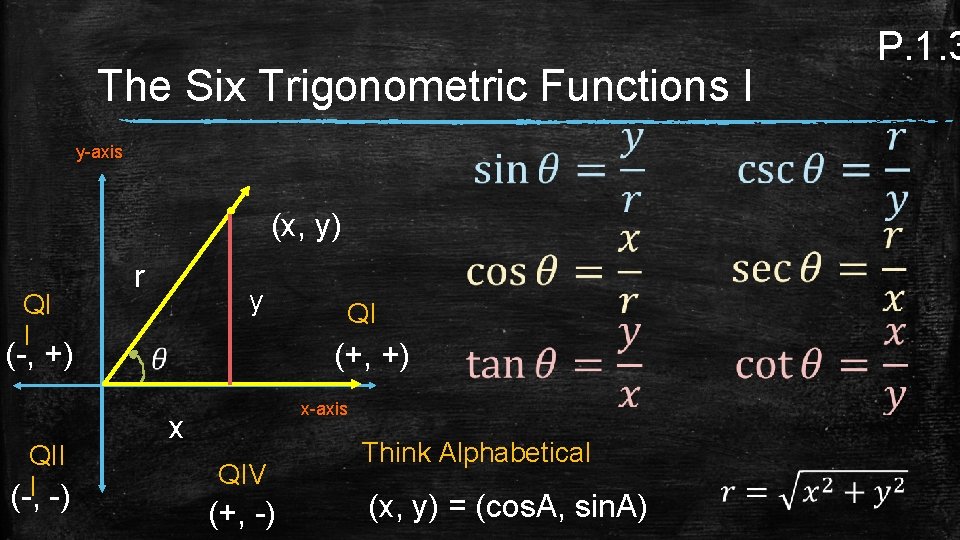
The Six Trigonometric Functions I y-axis (x, y) QI I r y (-, +) QII (-, I -) QI (+, +) x-axis x QIV (+, -) Think Alphabetical (x, y) = (cos. A, sin. A) P. 1. 3
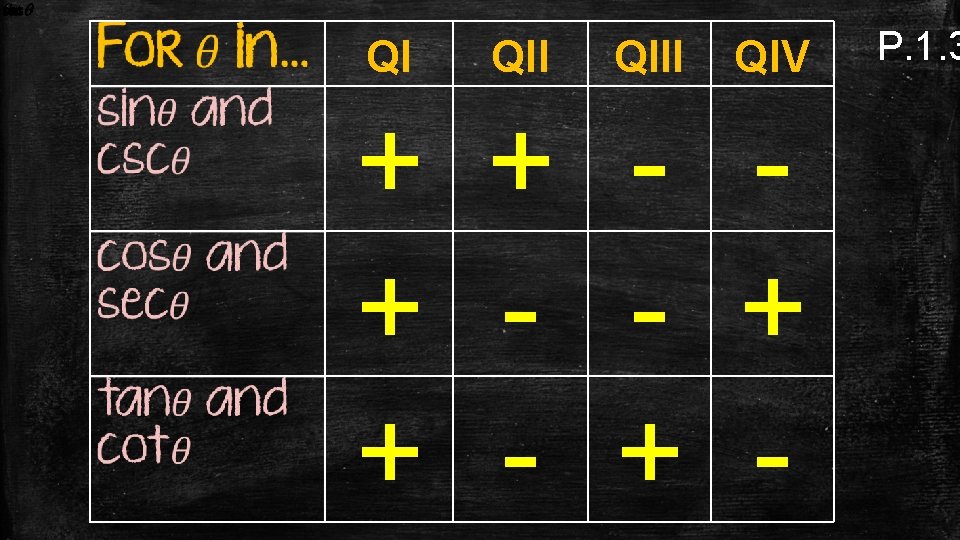
QI QIII QIV + + - - + + - P. 1. 3
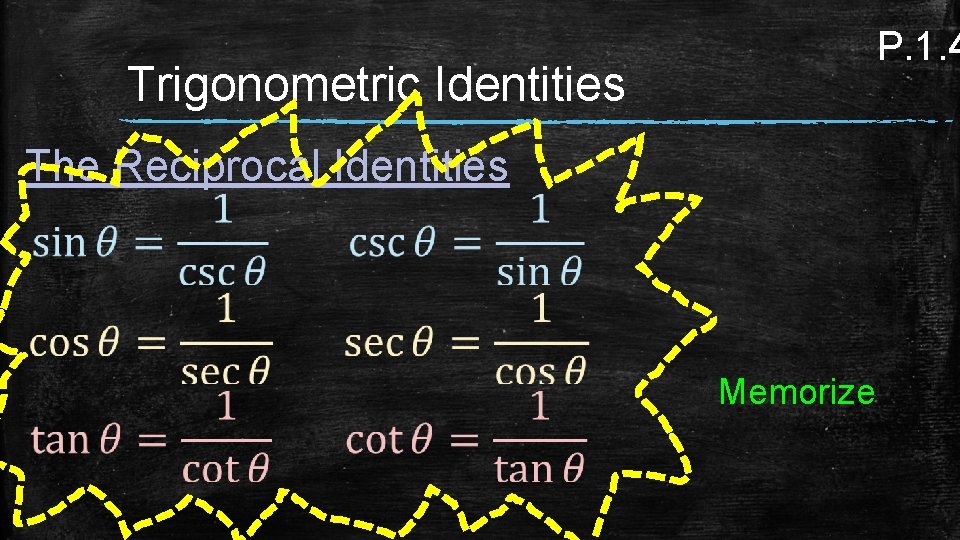
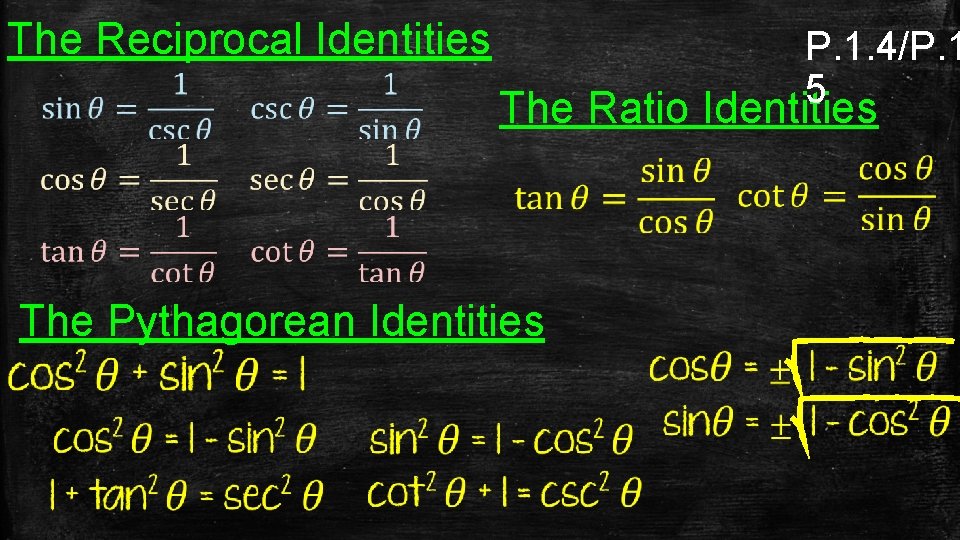
P. 1. 4 Trigonometric Identities The Reciprocal Identities Memorize
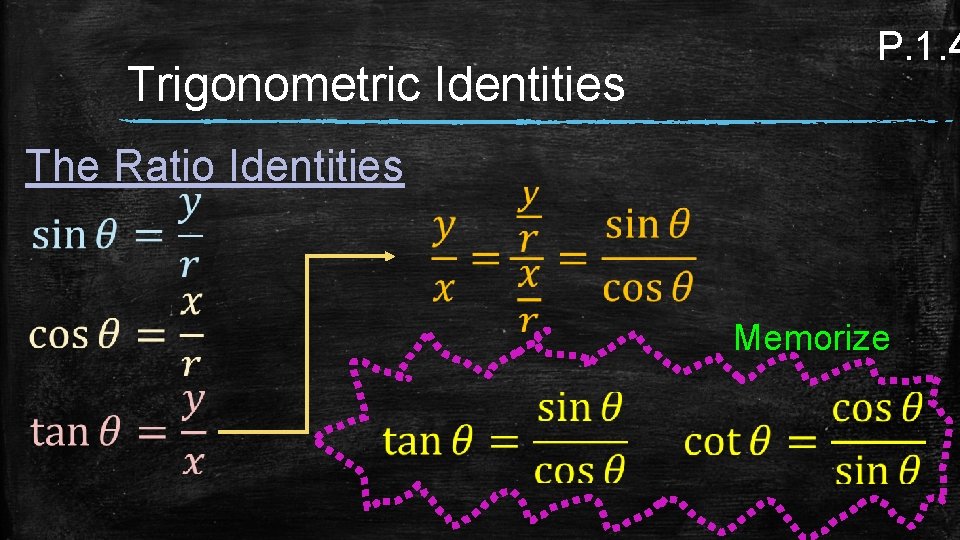
Trigonometric Identities P. 1. 4 The Ratio Identities Memorize
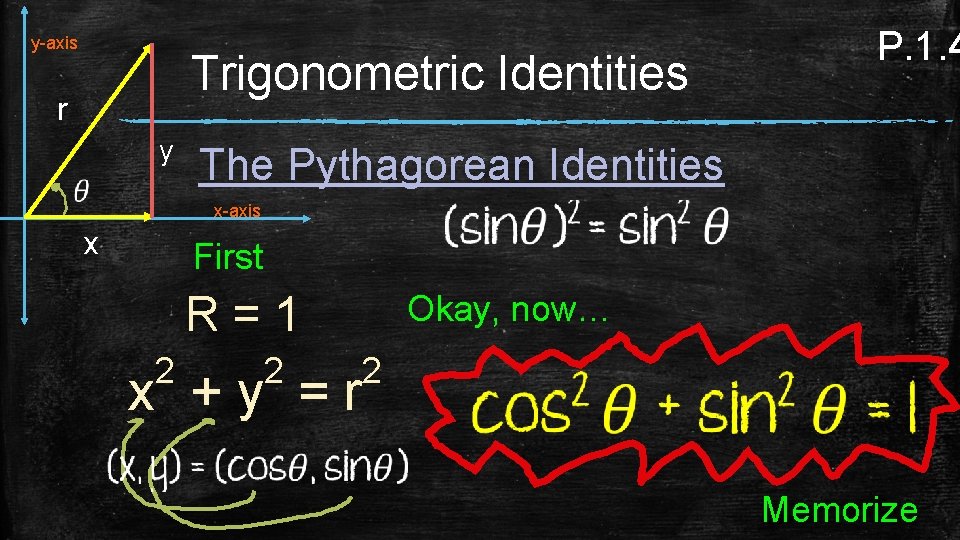
y-axis Trigonometric Identities r y P. 1. 4 The Pythagorean Identities x-axis x First R=1 2 2 x +y =r Okay, now… 2 Memorize
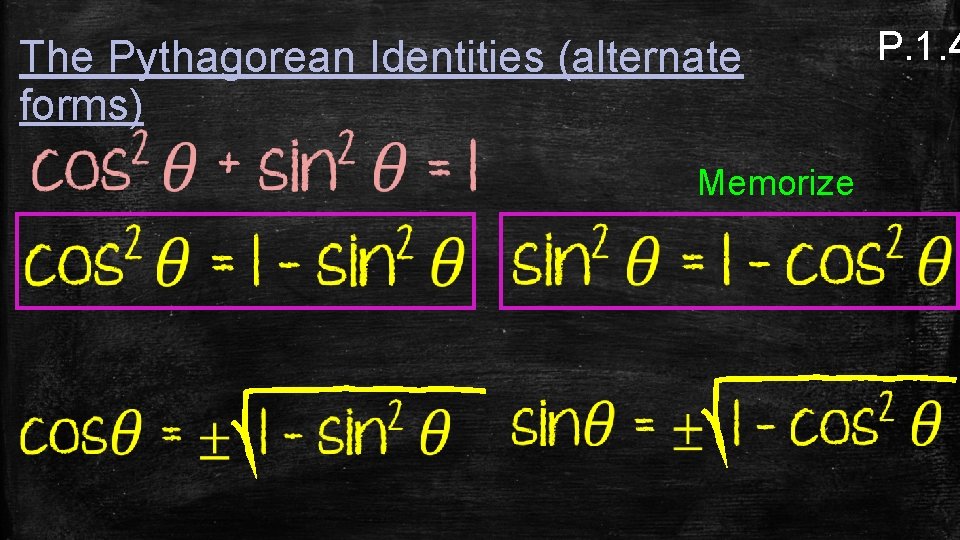
The Pythagorean Identities (alternate forms) Memorize P. 1. 4
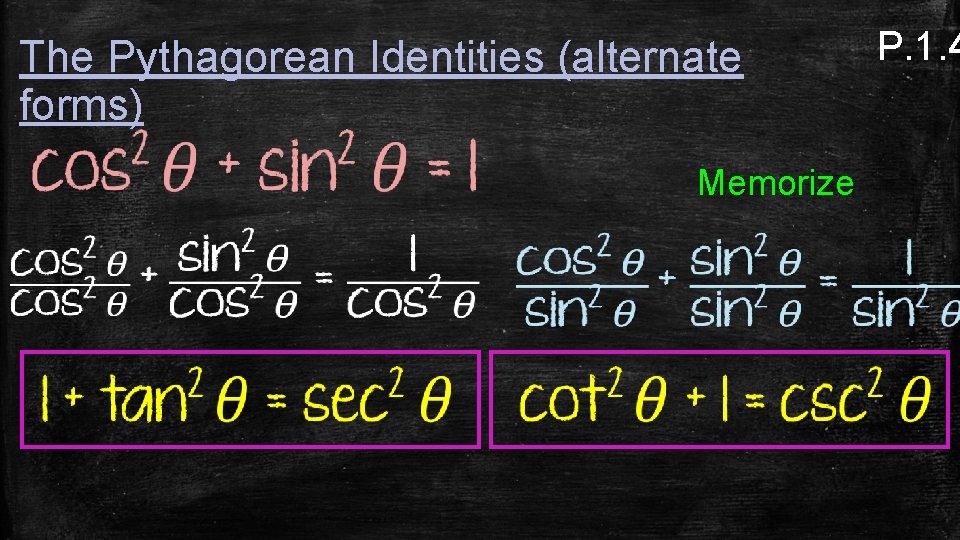
The Pythagorean Identities (alternate forms) Memorize P. 1. 4
The Reciprocal Identities P. 1. 4/P. 1 5 The Ratio Identities The Pythagorean Identities
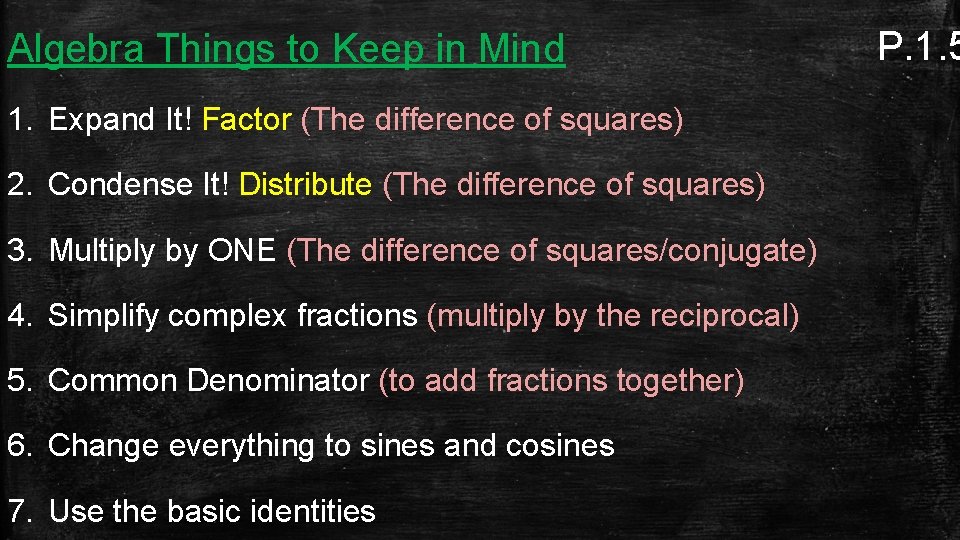
Algebra Things to Keep in Mind 1. Expand It! Factor (The difference of squares) 2. Condense It! Distribute (The difference of squares) 3. Multiply by ONE (The difference of squares/conjugate) 4. Simplify complex fractions (multiply by the reciprocal) 5. Common Denominator (to add fractions together) 6. Change everything to sines and cosines 7. Use the basic identities P. 1. 5
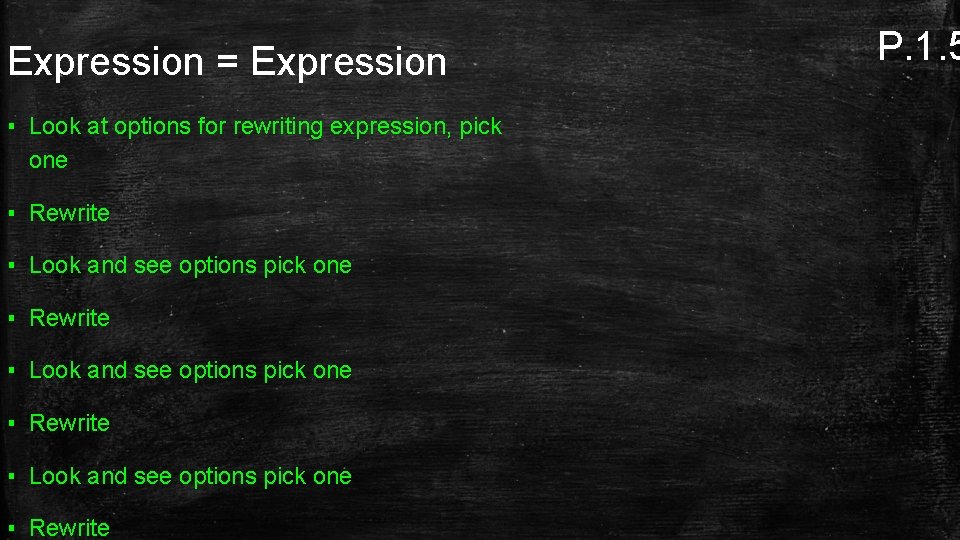
Expression = Expression ▪ Look at options for rewriting expression, pick one ▪ Rewrite ▪ Look and see options pick one ▪ Rewrite P. 1. 5
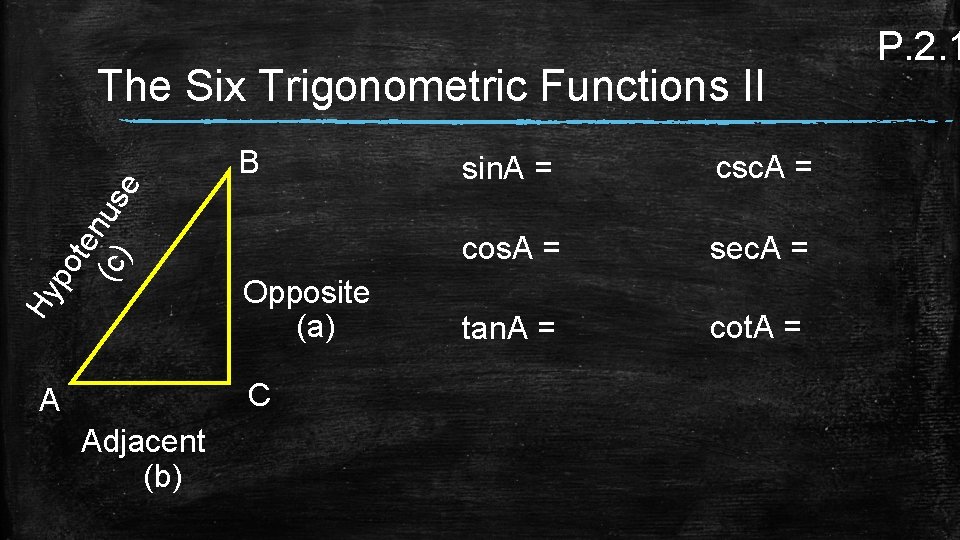
The Six Trigonometric Functions II Hy po ten (c) us e B Opposite (a) C A Adjacent (b) sin. A = csc. A = cos. A = sec. A = tan. A = cot. A = P. 2. 1
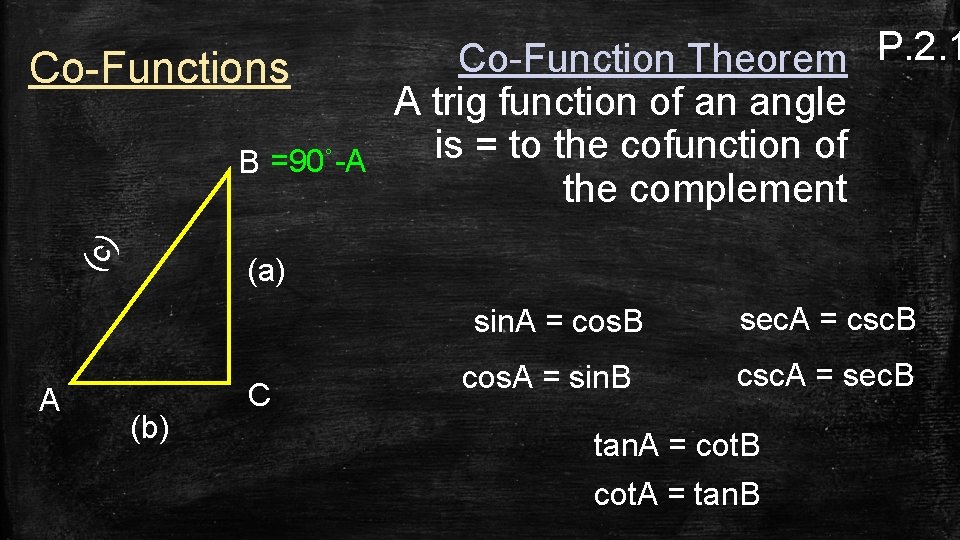
Co-Functions (c) B =90˚-A Co-Function Theorem P. 2. 1 A trig function of an angle is = to the cofunction of the complement (a) sin. A = cos. B A (b) C cos. A = sin. B sec. A = csc. B csc. A = sec. B tan. A = cot. B cot. A = tan. B
The Six Trigonometric Functions II Back to the 30˚-60˚-90˚ 30˚ 2 x X 3 60˚ x sin 30˚ = sin 60˚ = cos 30˚ = cos 60˚ = tan 30˚ = tan 60˚ = P. 2. 1
The Six Trigonometric Functions II Back to the 45˚-90˚ x 2 sin 45˚ = cos 45˚ = 45˚ X tan 45˚ = 45˚ x sin 0˚ = cos 0˚ = tan 0˚ = sin 90˚ = cos 90˚ = tan 90˚ = P. 2. 1
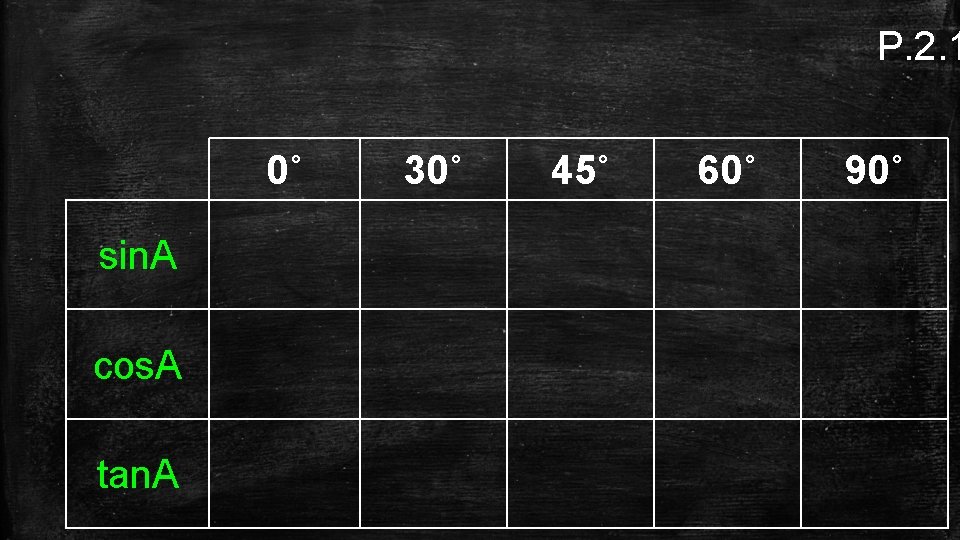
P. 2. 1 0˚ sin. A cos. A tan. A 30˚ 45˚ 60˚ 90˚
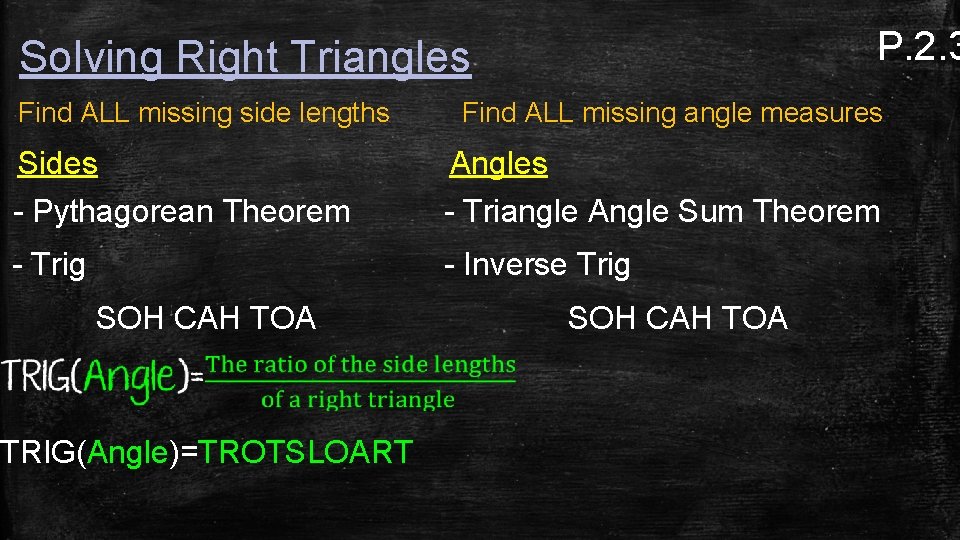
P. 2. 3 Solving Right Triangles Find ALL missing side lengths Find ALL missing angle measures Sides Angles - Pythagorean Theorem - Triangle Angle Sum Theorem - Trig - Inverse Trig SOH CAH TOA TRIG(Angle)=TROTSLOART SOH CAH TOA
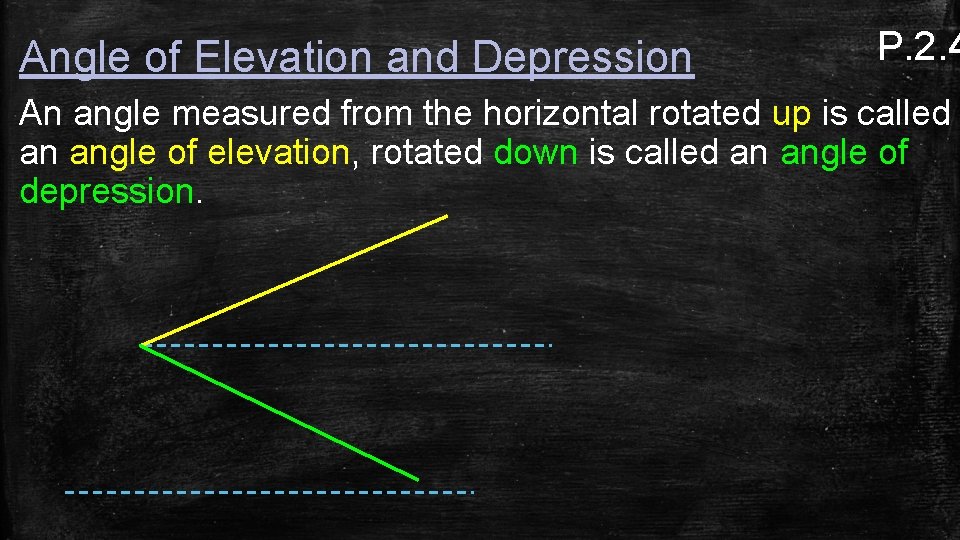
Angle of Elevation and Depression P. 2. 4 An angle measured from the horizontal rotated up is called an angle of elevation, rotated down is called an angle of depression.