
Trigonometry Review part 4 Graphing Trigonometric Functions This
- Slides: 14
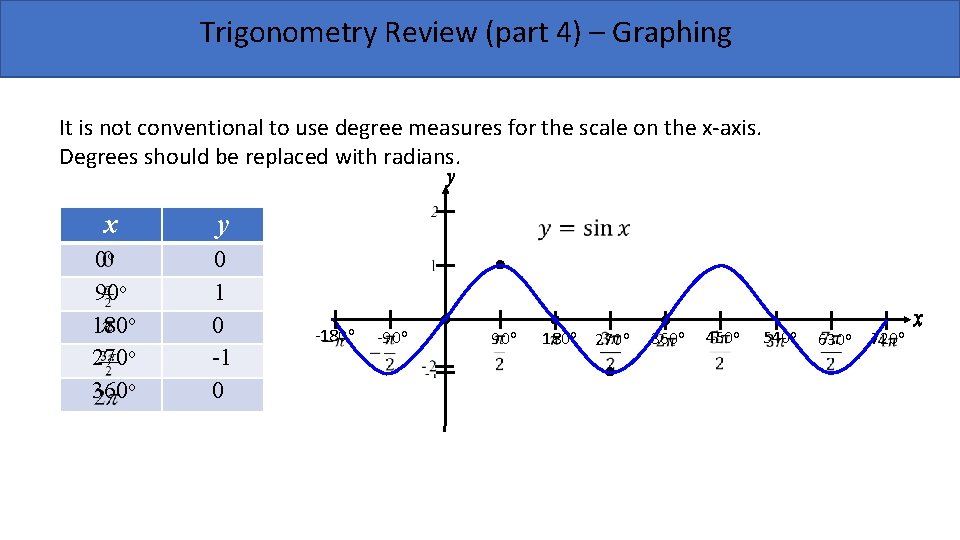
Trigonometry Review (part 4) – Graphing Trigonometric Functions This guide presents a very basic idea of graphing the six trigonometric functions. All students should understand the general shape and relationships between the graphs of the different functions. Also, students should be aware that each graph can be translated (shifted), reflected (flipped), or dilated (stretched). The first time we learned how to graph equations, we did it by plotting points; pick convenient x-values, find y-values (or vice-versa) until you could see the shape of the graph. This method, although not necessarily the fastest or most efficient, always works. For this reason, we will start graphing trigonometric functions using the same method.
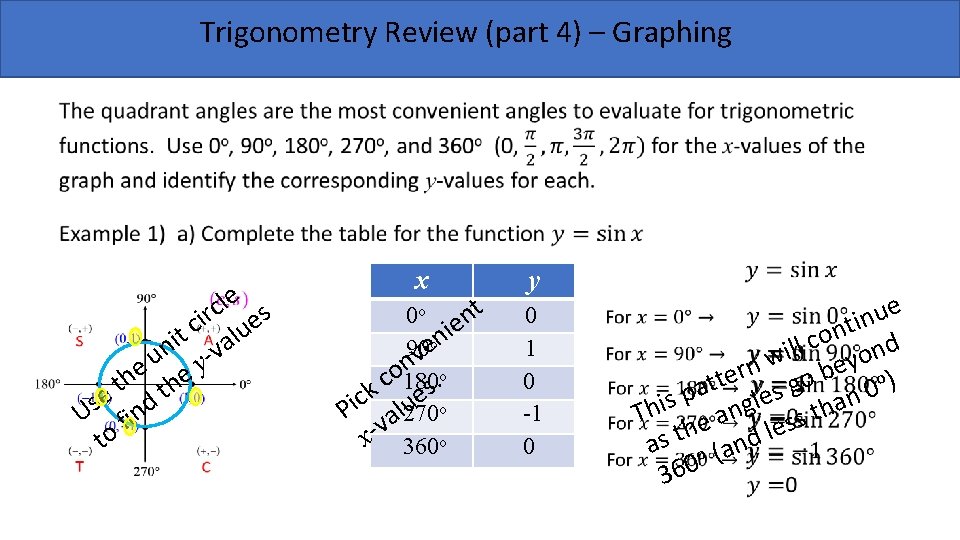
Trigonometry Review (part 4) – Graphing e l c ir ues c l t i a n -v u e ey h t th e Us find to x 0 o ent i n o e 90 v n o o c 180 s. k eo c i u l P va 270 x- 360 o y 0 1 0 -1 0 e u n i t n o c d l l n i o w y e n r b o) te s go t a 0 p e n l s a i g h h n t T a s s e e h l t d s a o (an 360
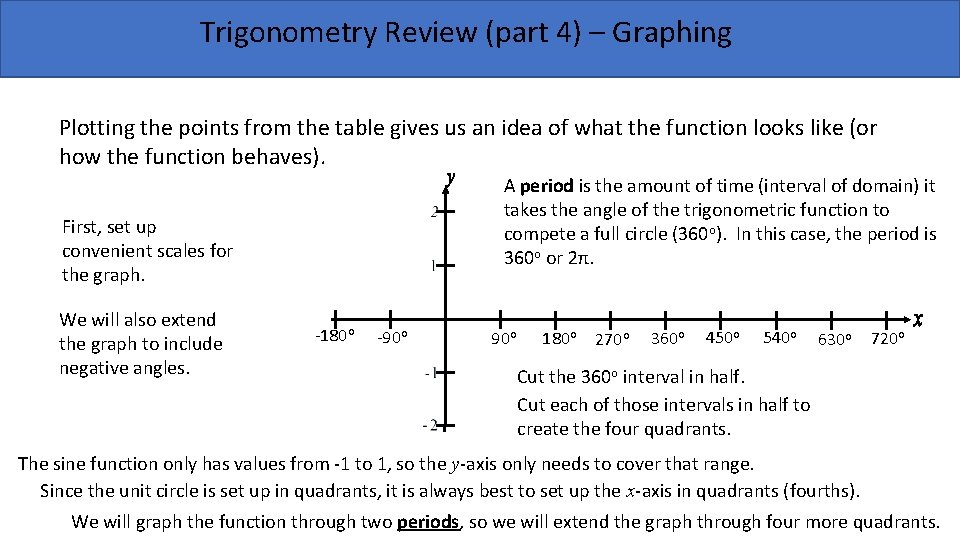
Trigonometry Review (part 4) – Graphing Plotting the points from the table gives us an idea of what the function looks like (or how the function behaves). A period is the amount of time (interval of domain) it takes the angle of the trigonometric function to compete a full circle (360 o). In this case, the period is 360 o or 2π. First, set up convenient scales for the graph. We will also extend the graph to include negative angles. -180 o -90 o 180 o 270 o 360 o 450 o 540 o 630 o 720 o Cut the 360 o interval in half. Cut each of those intervals in half to create the four quadrants. The sine function only has values from -1 to 1, so the y-axis only needs to cover that range. Since the unit circle is set up in quadrants, it is always best to set up the x-axis in quadrants (fourths). We will graph the function through two periods, so we will extend the graph through four more quadrants.
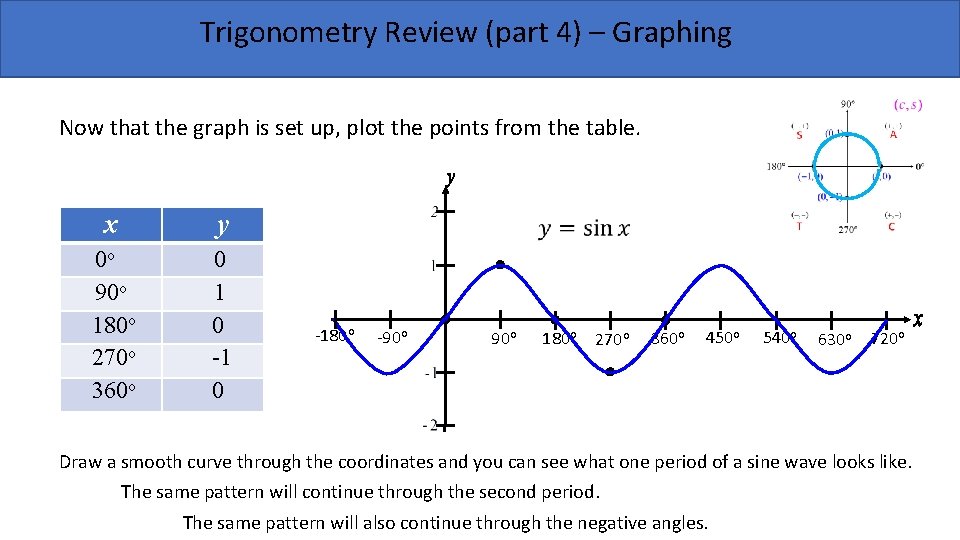
Trigonometry Review (part 4) – Graphing Now that the graph is set up, plot the points from the table. x y 0 o 90 o 180 o 270 o 360 o 0 1 0 -180 o -90 o 180 o 270 o 360 o 450 o 540 o 630 o 720 o Draw a smooth curve through the coordinates and you can see what one period of a sine wave looks like. The same pattern will continue through the second period. The same pattern will also continue through the negative angles.
Trigonometry Review (part 4) – Graphing It is not conventional to use degree measures for the scale on the x-axis. Degrees should be replaced with radians. x y 0 o 90 o 180 o 270 o 360 o 0 1 0 -180 o -90 o 180 o 270 o 360 o 450 o 540 o 630 o 720 o
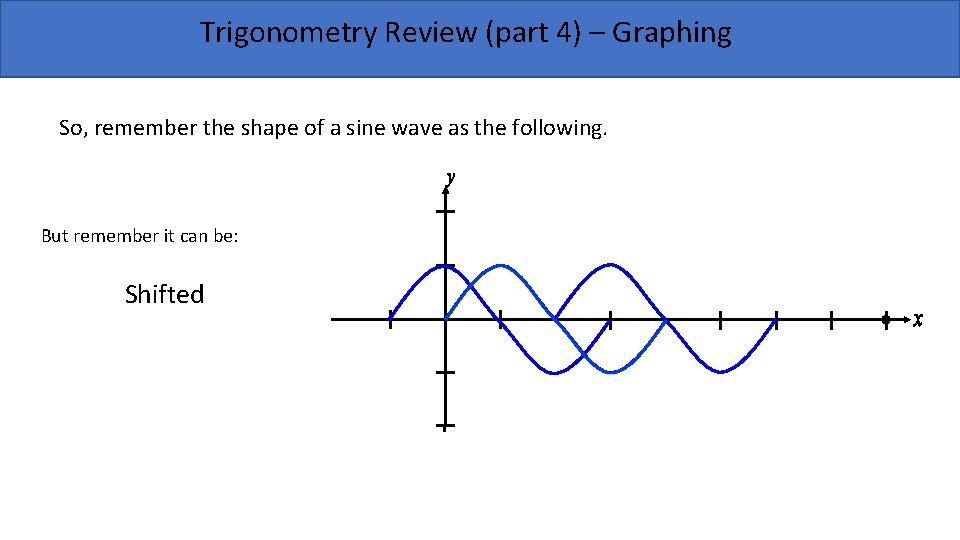
Trigonometry Review (part 4) – Graphing So, remember the shape of a sine wave as the following. But remember it can be: Shifted
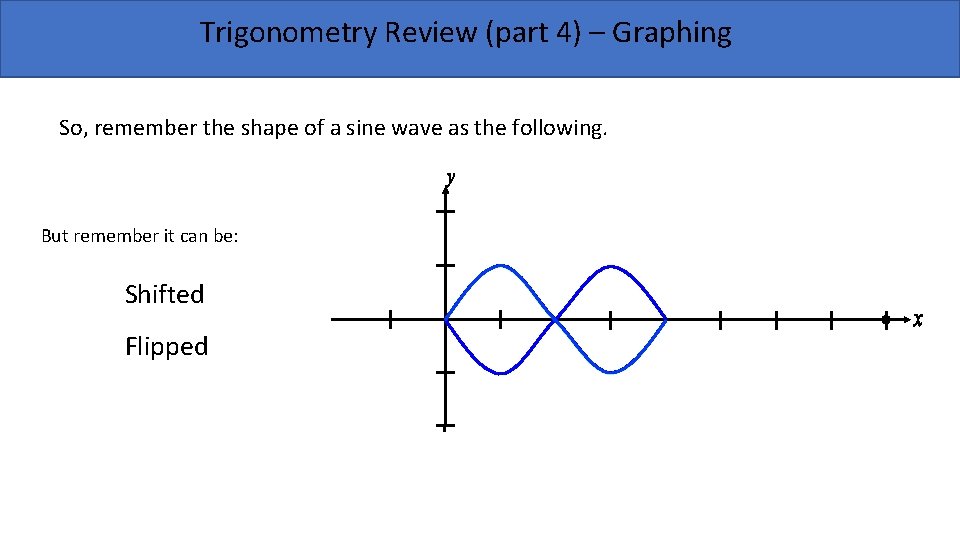
Trigonometry Review (part 4) – Graphing So, remember the shape of a sine wave as the following. But remember it can be: Shifted Flipped
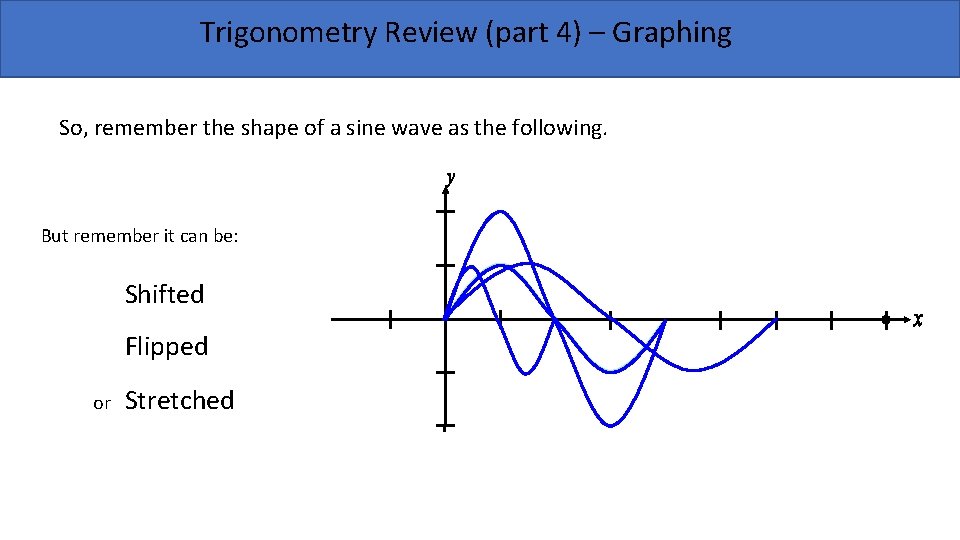
Trigonometry Review (part 4) – Graphing So, remember the shape of a sine wave as the following. But remember it can be: Shifted Flipped or Stretched
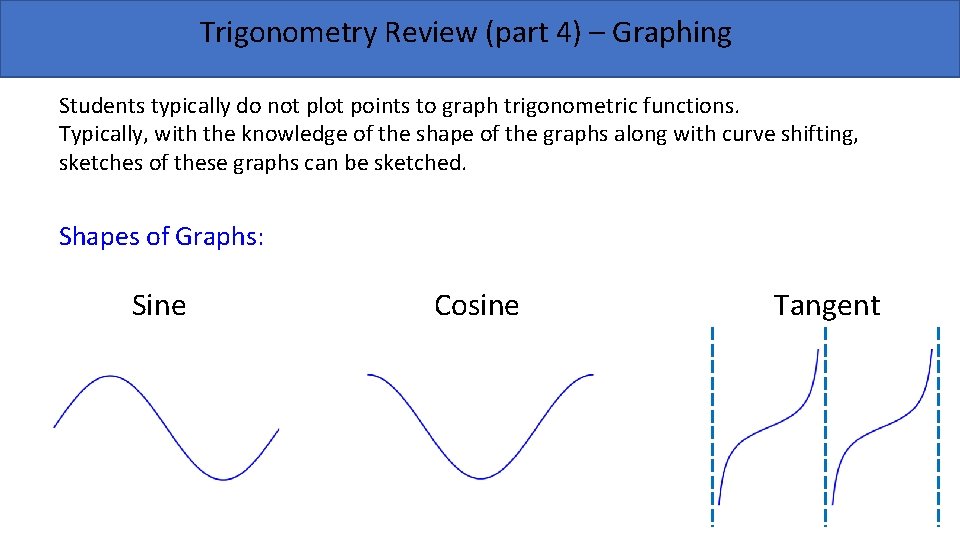
Trigonometry Review (part 4) – Graphing Students typically do not plot points to graph trigonometric functions. Typically, with the knowledge of the shape of the graphs along with curve shifting, sketches of these graphs can be sketched. Shapes of Graphs: Sine Cosine Tangent
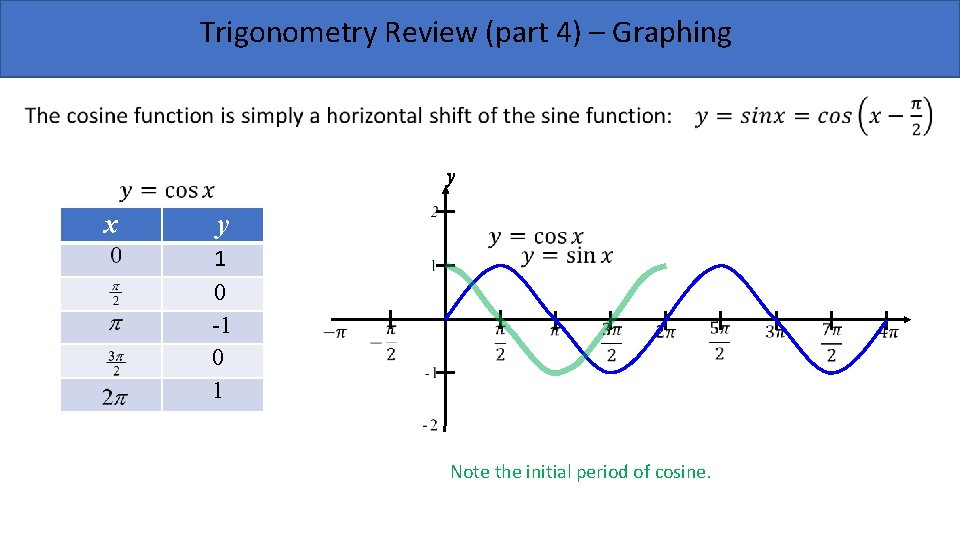
Trigonometry Review (part 4) – Graphing x y 1 0 -1 0 1 Note the initial period of cosine.
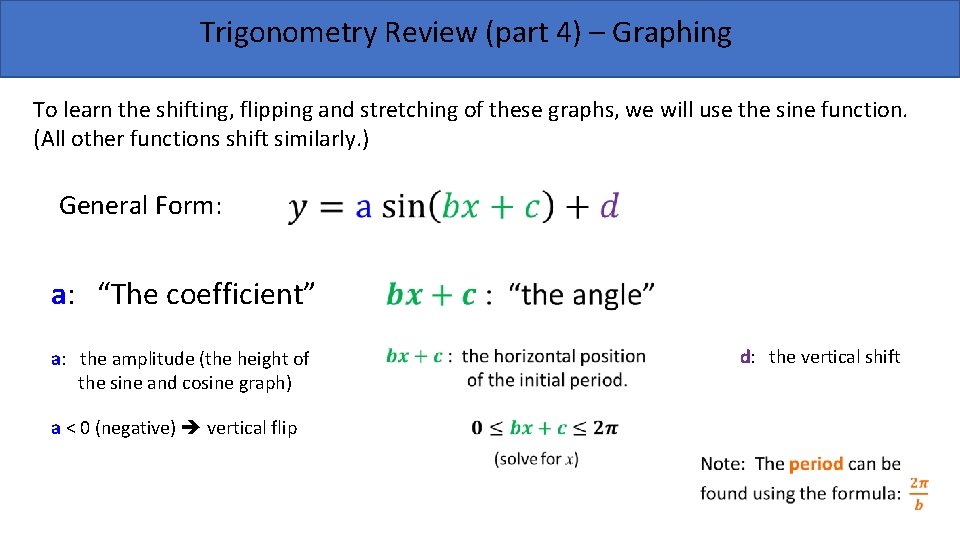
Trigonometry Review (part 4) – Graphing To learn the shifting, flipping and stretching of these graphs, we will use the sine function. (All other functions shift similarly. ) General Form: a: “The coefficient” a: the amplitude (the height of the sine and cosine graph) a < 0 (negative) vertical flip d: the vertical shift
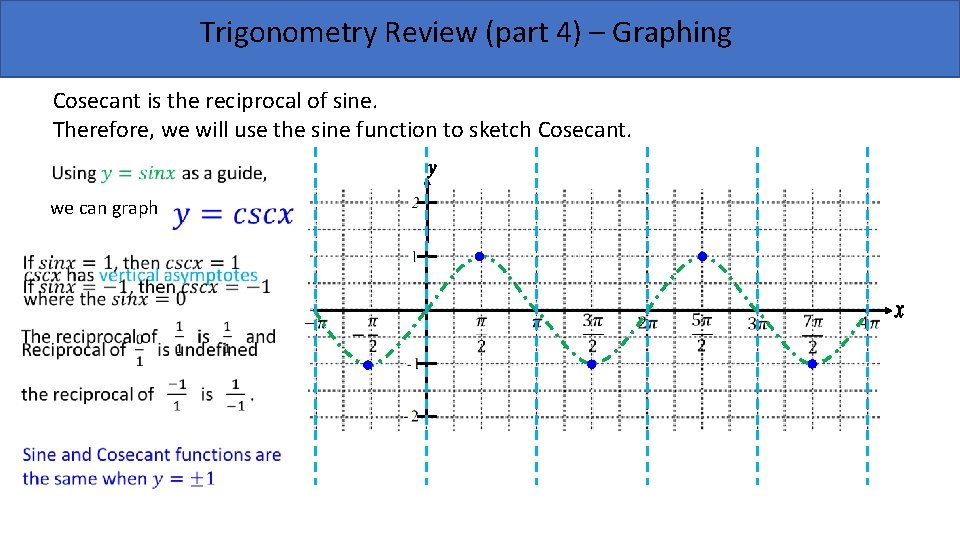
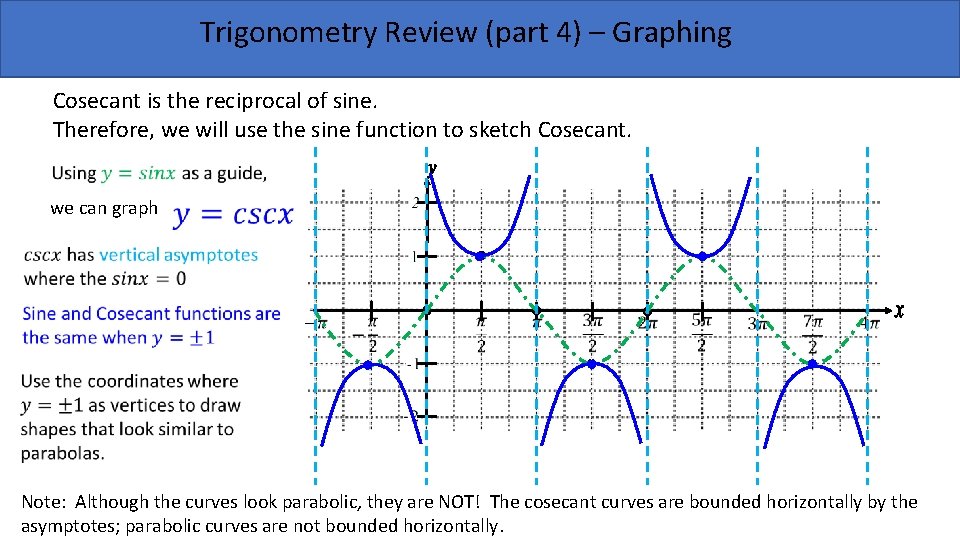
Trigonometry Review (part 4) – Graphing Cosecant is the reciprocal of sine. Therefore, we will use the sine function to sketch Cosecant. we can graph
Trigonometry Review (part 4) – Graphing Cosecant is the reciprocal of sine. Therefore, we will use the sine function to sketch Cosecant. we can graph ‘ Note: Although the curves look parabolic, they are NOT! The cosecant curves are bounded horizontally by the asymptotes; parabolic curves are not bounded horizontally.
Sorry. This presentation is incomplete. • There will be more slides to come.