
Trigger Card TRIGGERS WARNING SIGNS Things that make
- Slides: 2
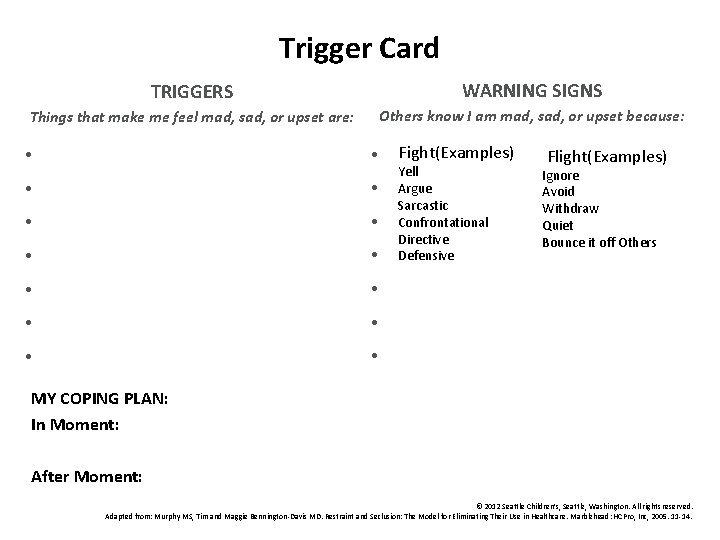
Trigger Card TRIGGERS WARNING SIGNS Things that make me feel mad, sad, or upset are: Others know I am mad, sad, or upset because: • • • • Fight(Examples) Yell Argue Sarcastic Confrontational Directive Defensive Flight(Examples) Ignore Avoid Withdraw Quiet Bounce it off Others MY COPING PLAN: In Moment: After Moment: © 2012 Seattle Children’s, Seattle, Washington. All rights reserved. Adapted from: Murphy MS, Tim and Maggie Bennington-Davis MD. Restraint and Seclusion: The Model for Eliminating Their Use in Healthcare. Marblehead: HCPro, Inc, 2005. 11 -14.
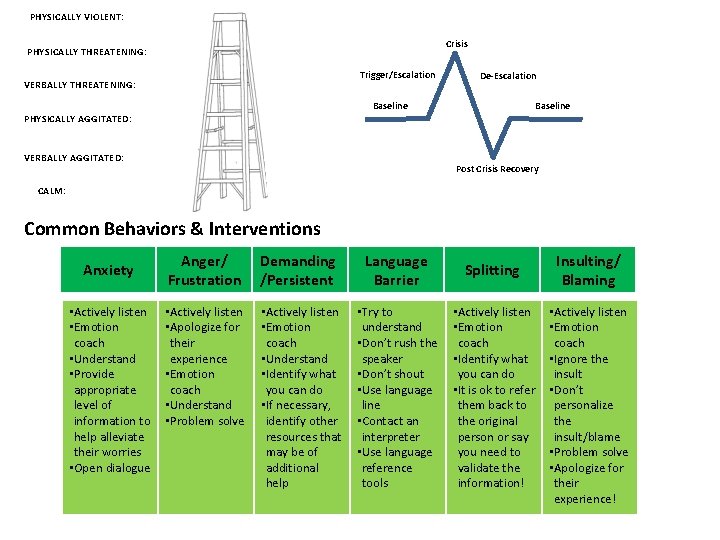
PHYSICALLY VIOLENT: Crisis PHYSICALLY THREATENING: Trigger/Escalation VERBALLY THREATENING: De-Escalation Baseline PHYSICALLY AGGITATED: VERBALLY AGGITATED: Post Crisis Recovery CALM: Common Behaviors & Interventions Anxiety • Actively listen • Emotion coach • Understand • Provide appropriate level of information to help alleviate their worries • Open dialogue Anger/ Frustration Demanding /Persistent Language Barrier Splitting • Actively listen • Apologize for their experience • Emotion coach • Understand • Problem solve • Actively listen • Emotion coach • Understand • Identify what you can do • If necessary, identify other resources that may be of additional help • Try to understand • Don’t rush the speaker • Don’t shout • Use language line • Contact an interpreter • Use language reference tools • Actively listen • Emotion coach • Identify what you can do • It is ok to refer them back to the original person or say you need to validate the information! Insulting/ Blaming • Actively listen • Emotion coach • Ignore the insult • Don’t personalize the insult/blame • Problem solve • Apologize for their experience!