
Trigger Analysis Avi Yagil UCSD 14 June2007 HCPSS
- Slides: 24
Trigger & Analysis Avi Yagil UCSD 14 -June-2007 HCPSS - Triggers & Analysis
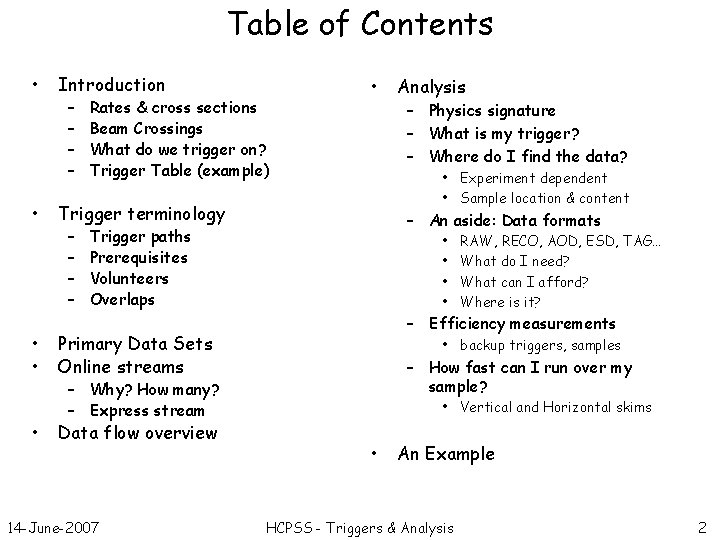
Table of Contents • • • Introduction – – Rates & cross sections Beam Crossings What do we trigger on? Trigger Table (example) • – An aside: Data formats Trigger paths Prerequisites Volunteers Overlaps • • • backup triggers, samples – How fast can I run over my sample? – Why? How many? – Express stream 14 -June-2007 RAW, RECO, AOD, ESD, TAG… What do I need? What can I afford? Where is it? – Efficiency measurements Primary Data Sets Online streams Data flow overview – Physics signature – What is my trigger? – Where do I find the data? • Experiment dependent • Sample location & content Trigger terminology – – Analysis • Vertical and Horizontal skims • An Example HCPSS - Triggers & Analysis 2
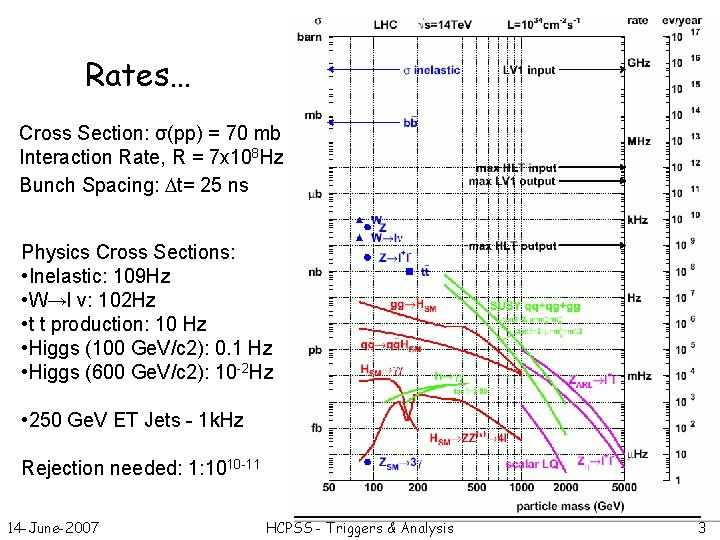
Rates… Cross Section: σ(pp) = 70 mb Interaction Rate, R = 7 x 10⁸ Hz Bunch Spacing: t= 25 ns Physics Cross Sections: • Inelastic: 109 Hz • W→l ν: 102 Hz • t t production: 10 Hz • Higgs (100 Ge. V/c 2): 0. 1 Hz • Higgs (600 Ge. V/c 2): 10 -2 Hz • 250 Ge. V ET Jets - 1 k. Hz Rejection needed: 1: 1010 -11 14 -June-2007 HCPSS - Triggers & Analysis 3
Time to think? Bunch Spacing… Less time to think, MUCH more to think about… 14 -June-2007 HCPSS - Triggers & Analysis 4
From P. Sphicas, Trigger @LHC talk - i 14 -June-2007 HCPSS - Triggers & Analysis 5
From P. Sphicas, Trigger @LHC talk - ii 14 -June-2007 HCPSS - Triggers & Analysis 6
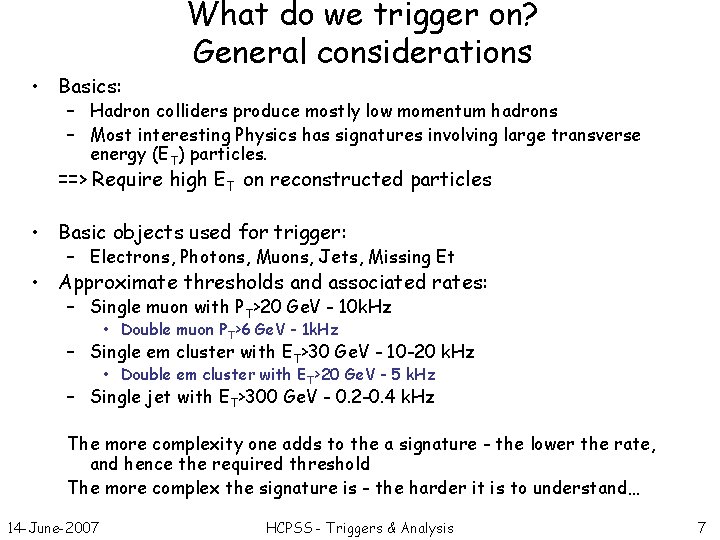
• Basics: What do we trigger on? General considerations – Hadron colliders produce mostly low momentum hadrons – Most interesting Physics has signatures involving large transverse energy (ET) particles. ==> Require high ET on reconstructed particles • Basic objects used for trigger: – Electrons, Photons, Muons, Jets, Missing Et • Approximate thresholds and associated rates: – Single muon with PT>20 Ge. V - 10 k. Hz • Double muon PT>6 Ge. V - 1 k. Hz – Single em cluster with ET>30 Ge. V - 10 -20 k. Hz • Double em cluster with ET>20 Ge. V - 5 k. Hz – Single jet with ET>300 Ge. V - 0. 2 -0. 4 k. Hz The more complexity one adds to the a signature - the lower the rate, and hence the required threshold The more complex the signature is - the harder it is to understand… 14 -June-2007 HCPSS - Triggers & Analysis 7
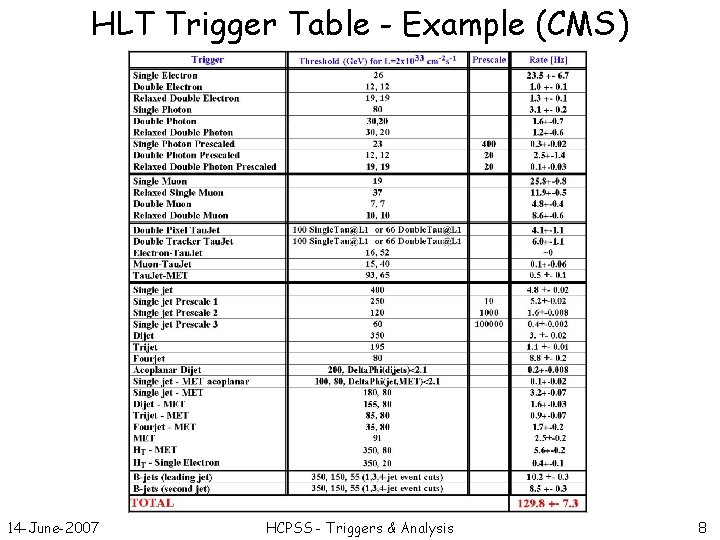
HLT Trigger Table - Example (CMS) 14 -June-2007 HCPSS - Triggers & Analysis 8
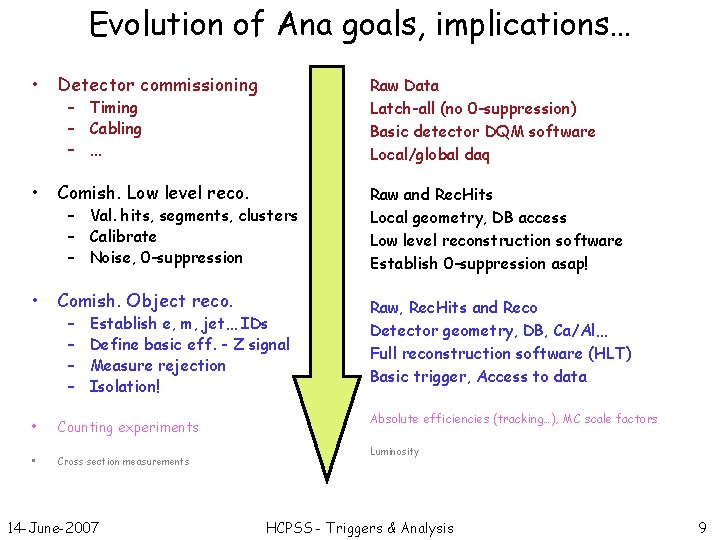
Evolution of Ana goals, implications… • Detector commissioning Raw Data Latch-all (no 0 -suppression) Basic detector DQM software Local/global daq • Comish. Low level reco. Raw and Rec. Hits Local geometry, DB access Low level reconstruction software Establish 0 -suppression asap! • Comish. Object reco. Raw, Rec. Hits and Reco Detector geometry, DB, Ca/Al… Full reconstruction software (HLT) Basic trigger, Access to data • Counting experiments • Cross section measurements – Timing – Cabling – … – Val. hits, segments, clusters – Calibrate – Noise, 0 -suppression – – Establish e, m, jet… IDs Define basic eff. - Z signal Measure rejection Isolation! 14 -June-2007 Absolute efficiencies (tracking…), MC scale factors Luminosity HCPSS - Triggers & Analysis 9
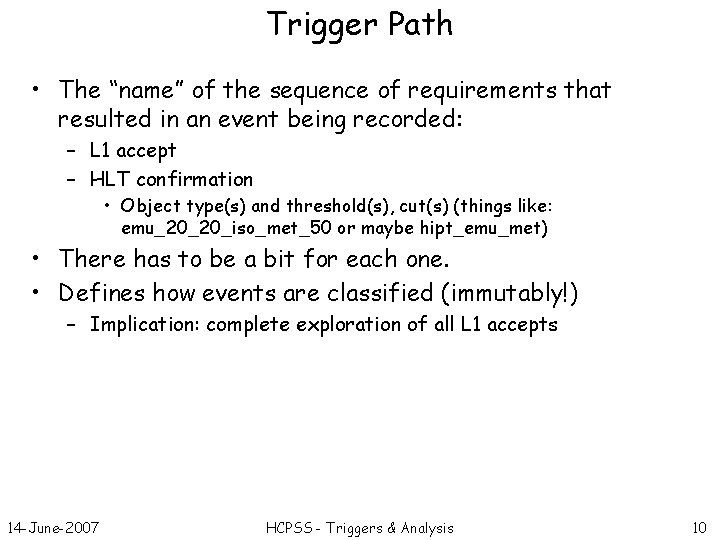
Trigger Path • The “name” of the sequence of requirements that resulted in an event being recorded: – L 1 accept – HLT confirmation • Object type(s) and threshold(s), cut(s) (things like: emu_20_20_iso_met_50 or maybe hipt_emu_met) • There has to be a bit for each one. • Defines how events are classified (immutably!) – Implication: complete exploration of all L 1 accepts 14 -June-2007 HCPSS - Triggers & Analysis 10
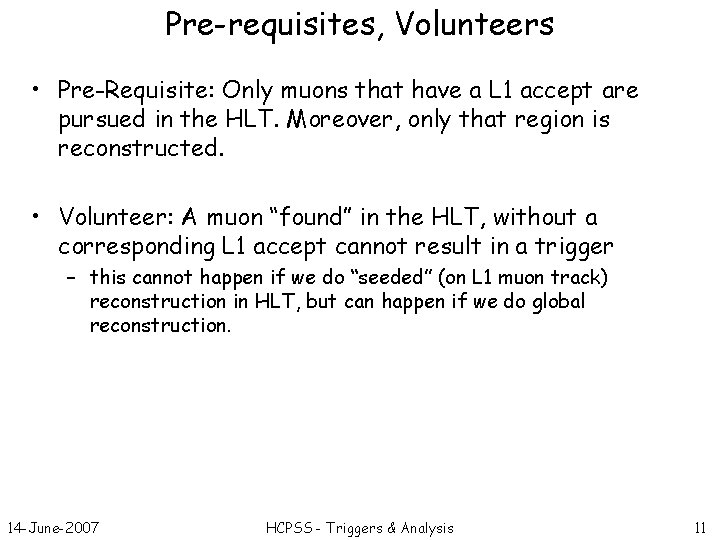
Pre-requisites, Volunteers • Pre-Requisite: Only muons that have a L 1 accept are pursued in the HLT. Moreover, only that region is reconstructed. • Volunteer: A muon “found” in the HLT, without a corresponding L 1 accept cannot result in a trigger – this cannot happen if we do “seeded” (on L 1 muon track) reconstruction in HLT, but can happen if we do global reconstruction. 14 -June-2007 HCPSS - Triggers & Analysis 11
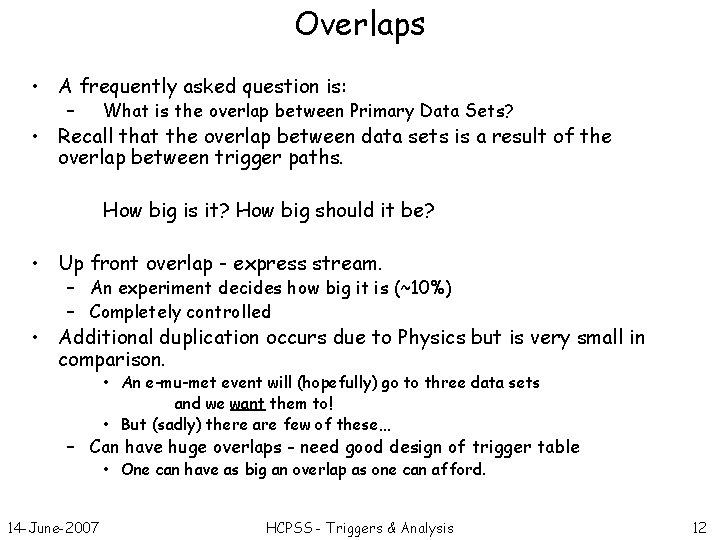
Overlaps • A frequently asked question is: – What is the overlap between Primary Data Sets? • Recall that the overlap between data sets is a result of the overlap between trigger paths. How big is it? How big should it be? • Up front overlap - express stream. – An experiment decides how big it is (~10%) – Completely controlled • Additional duplication occurs due to Physics but is very small in comparison. • An e-mu-met event will (hopefully) go to three data sets and we want them to! • But (sadly) there are few of these… – Can have huge overlaps - need good design of trigger table • One can have as big an overlap as one can afford. 14 -June-2007 HCPSS - Triggers & Analysis 12
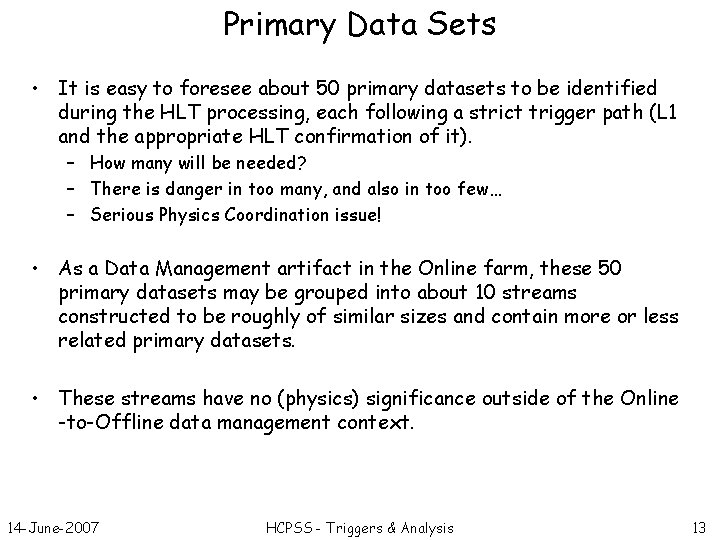
Primary Data Sets • It is easy to foresee about 50 primary datasets to be identified during the HLT processing, each following a strict trigger path (L 1 and the appropriate HLT confirmation of it). – How many will be needed? – There is danger in too many, and also in too few… – Serious Physics Coordination issue! • As a Data Management artifact in the Online farm, these 50 primary datasets may be grouped into about 10 streams constructed to be roughly of similar sizes and contain more or less related primary datasets. • These streams have no (physics) significance outside of the Online -to-Offline data management context. 14 -June-2007 HCPSS - Triggers & Analysis 13
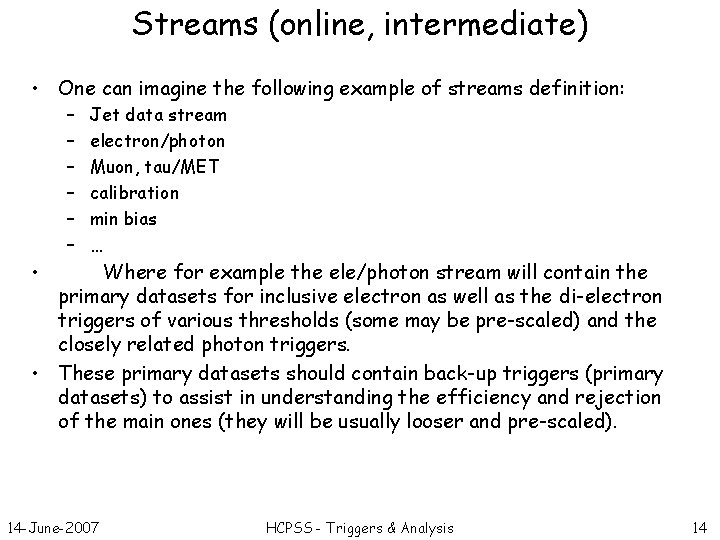
Streams (online, intermediate) • One can imagine the following example of streams definition: – – – Jet data stream electron/photon Muon, tau/MET calibration min bias … • Where for example the ele/photon stream will contain the primary datasets for inclusive electron as well as the di-electron triggers of various thresholds (some may be pre-scaled) and the closely related photon triggers. • These primary datasets should contain back-up triggers (primary datasets) to assist in understanding the efficiency and rejection of the main ones (they will be usually looser and pre-scaled). 14 -June-2007 HCPSS - Triggers & Analysis 14
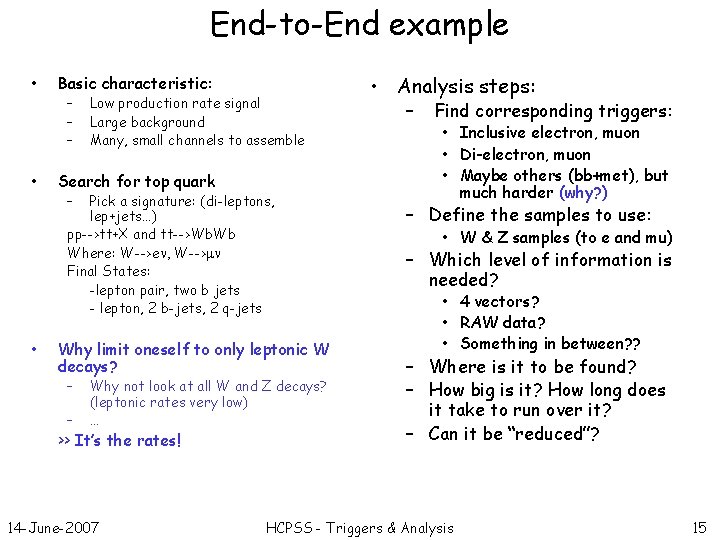
End-to-End example • • • Basic characteristic: – – – Low production rate signal Large background Many, small channels to assemble Search for top quark – Pick a signature: (di-leptons, lep+jets…) pp-->tt+X and tt-->Wb. Wb Where: W-->e W--> Final States: -lepton pair, two b jets - lepton, 2 b-jets, 2 q-jets Why limit oneself to only leptonic W decays? – – Why not look at all W and Z decays? (leptonic rates very low) … >> It’s the rates! 14 -June-2007 • Analysis steps: – Find corresponding triggers: • Inclusive electron, muon • Di-electron, muon • Maybe others (bb+met), but much harder (why? ) – Define the samples to use: • W & Z samples (to e and mu) – Which level of information is needed? • 4 vectors? • RAW data? • Something in between? ? – Where is it to be found? – How big is it? How long does it take to run over it? – Can it be “reduced”? HCPSS - Triggers & Analysis 15
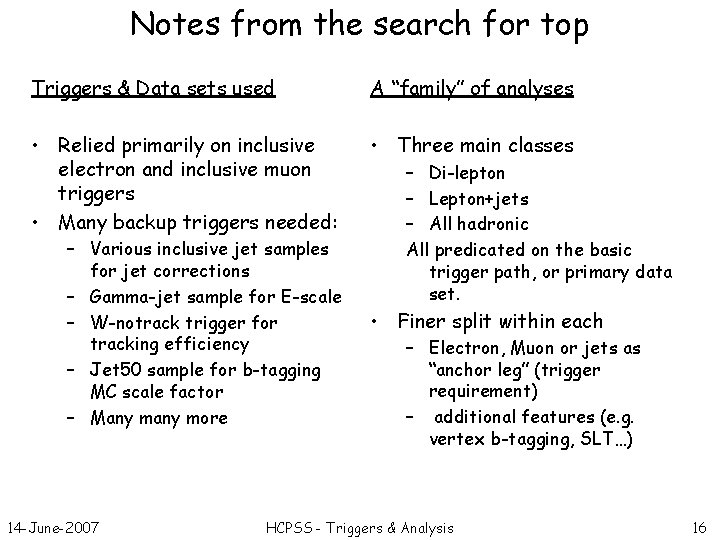
Notes from the search for top Triggers & Data sets used A “family” of analyses • Relied primarily on inclusive electron and inclusive muon triggers • Many backup triggers needed: • Three main classes – Various inclusive jet samples for jet corrections – Gamma-jet sample for E-scale – W-notrack trigger for tracking efficiency – Jet 50 sample for b-tagging MC scale factor – Many more 14 -June-2007 – Di-lepton – Lepton+jets – All hadronic All predicated on the basic trigger path, or primary data set. • Finer split within each – Electron, Muon or jets as “anchor leg” (trigger requirement) – additional features (e. g. vertex b-tagging, SLT…) HCPSS - Triggers & Analysis 16
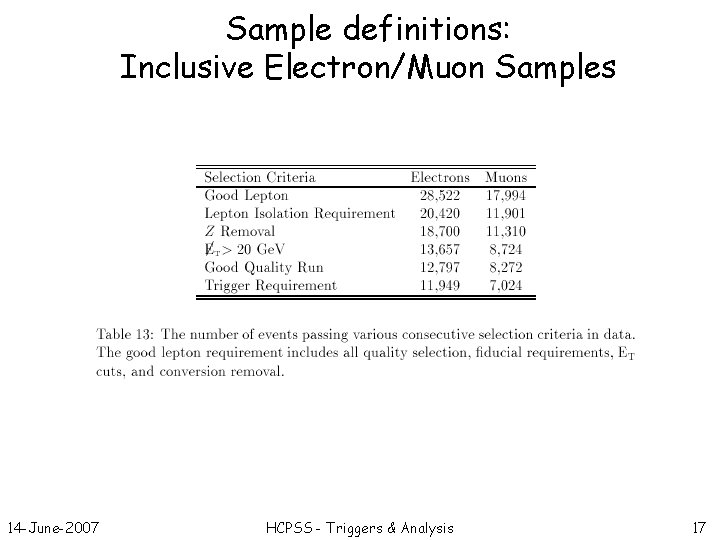
Sample definitions: Inclusive Electron/Muon Samples 14 -June-2007 HCPSS - Triggers & Analysis 17
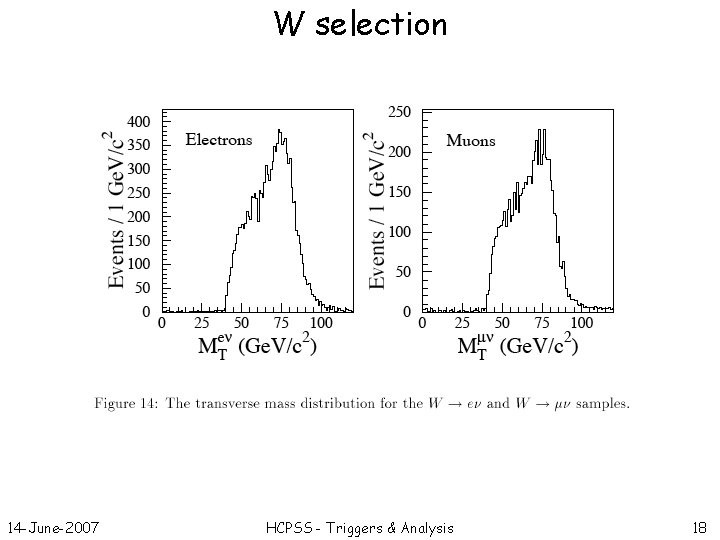
W selection 14 -June-2007 HCPSS - Triggers & Analysis 18
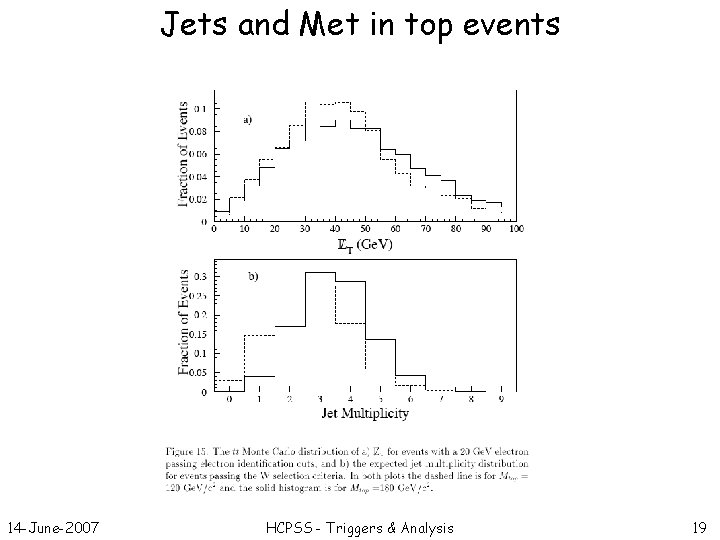
Jets and Met in top events 14 -June-2007 HCPSS - Triggers & Analysis 19
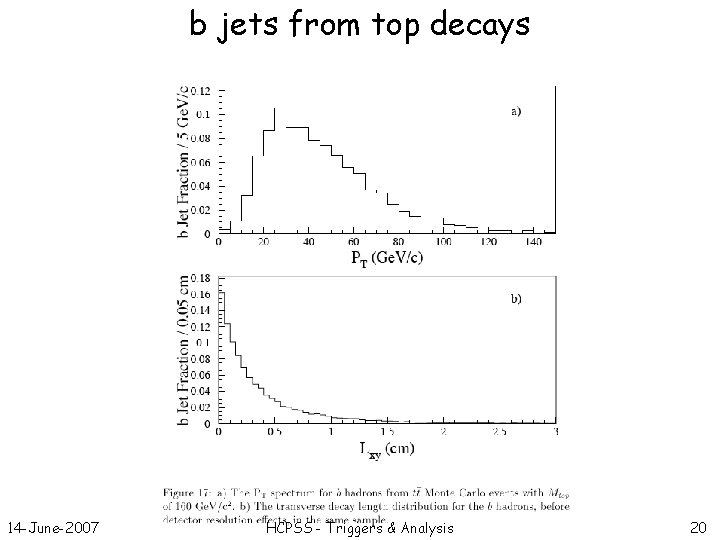
b jets from top decays 14 -June-2007 HCPSS - Triggers & Analysis 20
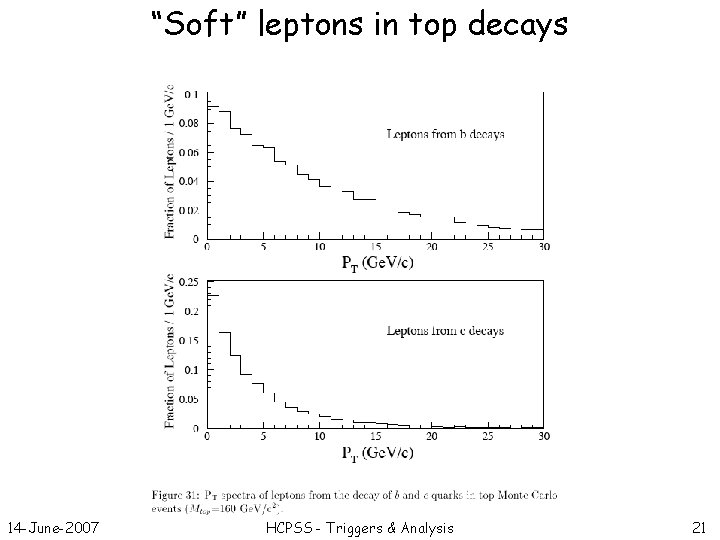
“Soft” leptons in top decays 14 -June-2007 HCPSS - Triggers & Analysis 21
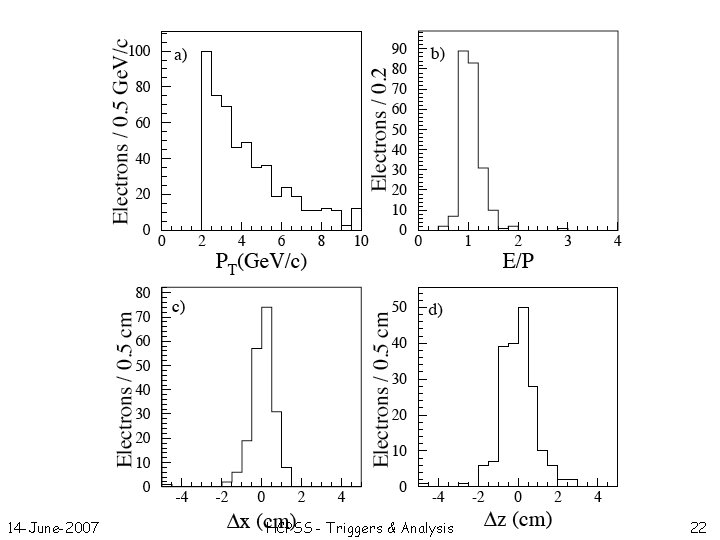
14 -June-2007 HCPSS - Triggers & Analysis 22
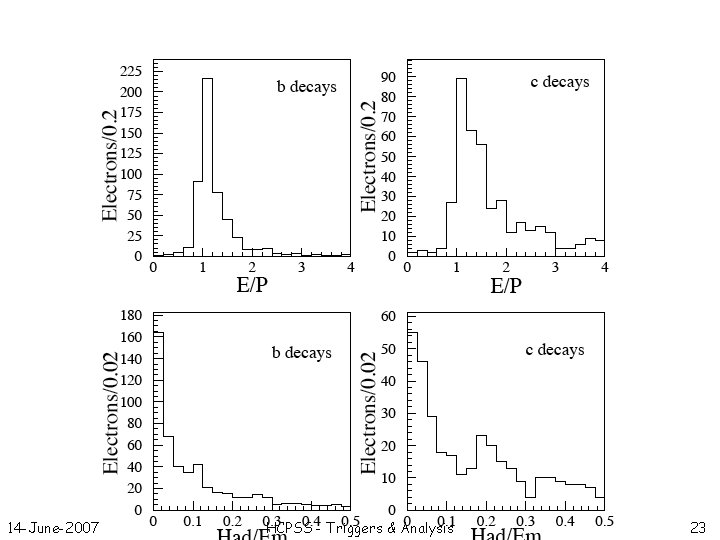
14 -June-2007 HCPSS - Triggers & Analysis 23
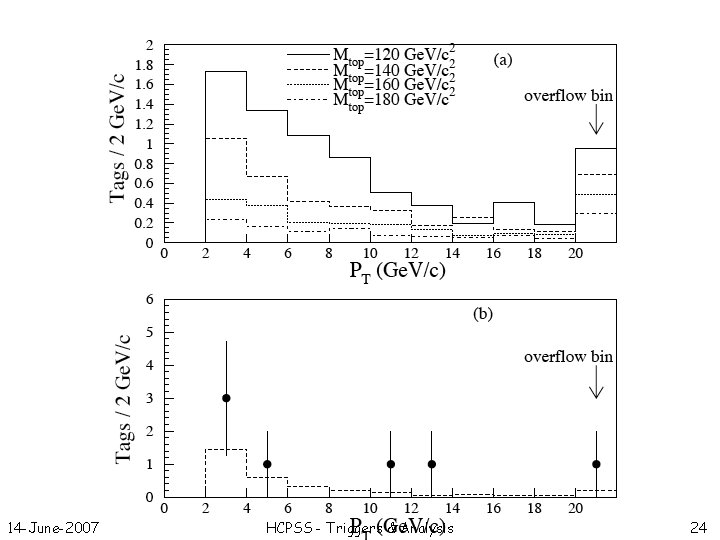
14 -June-2007 HCPSS - Triggers & Analysis 24