
Trig Identities and Formulae AS 91575 4 credits











- Slides: 61
Trig Identities and Formulae AS 91575 4 credits
Inverse Trig Functions 8/03/2021 • I can recognise and evaluate an inverse trig function
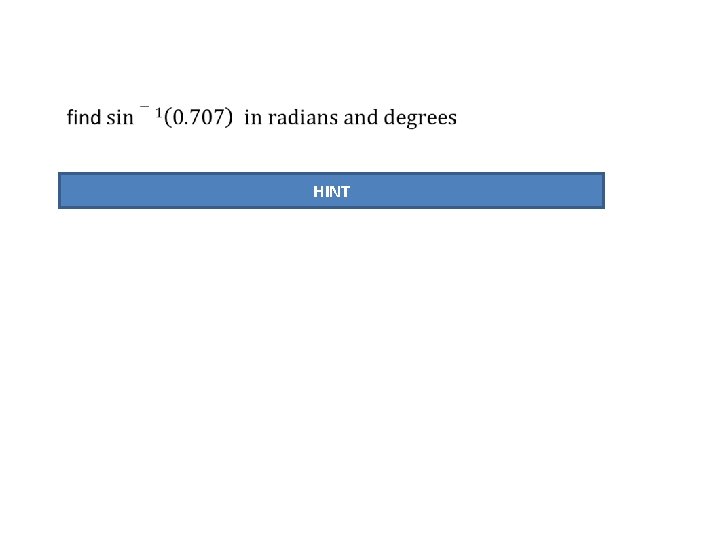
It’s ok all we need to do is use a calculator in radians and then degrees HINT
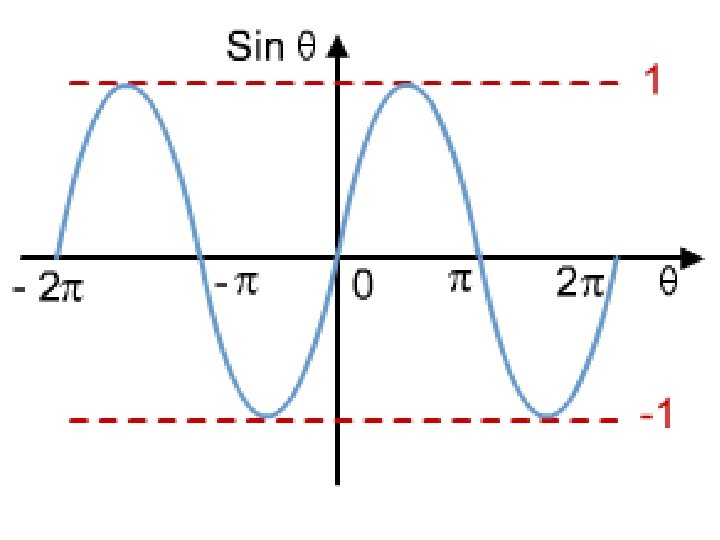
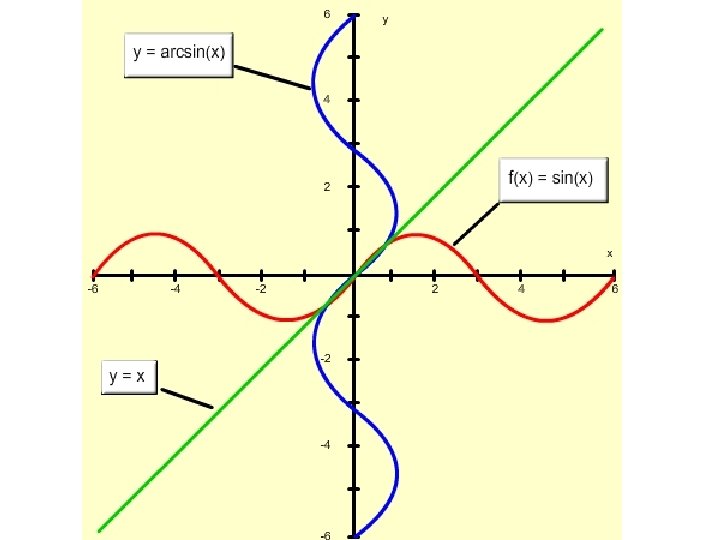
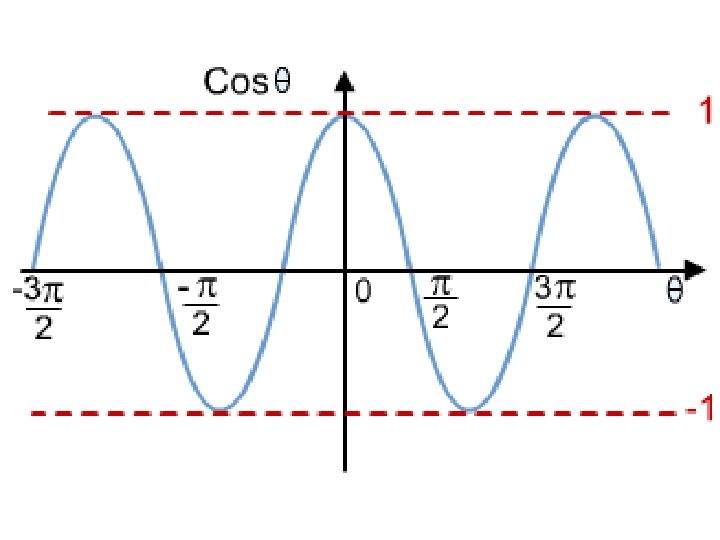
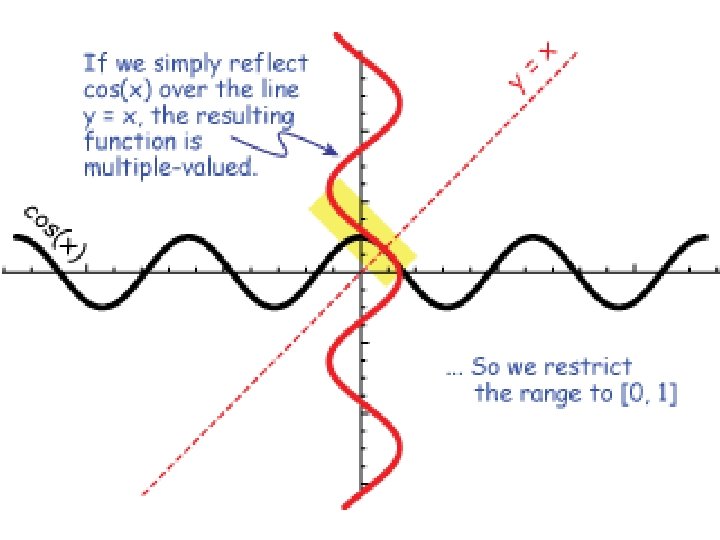
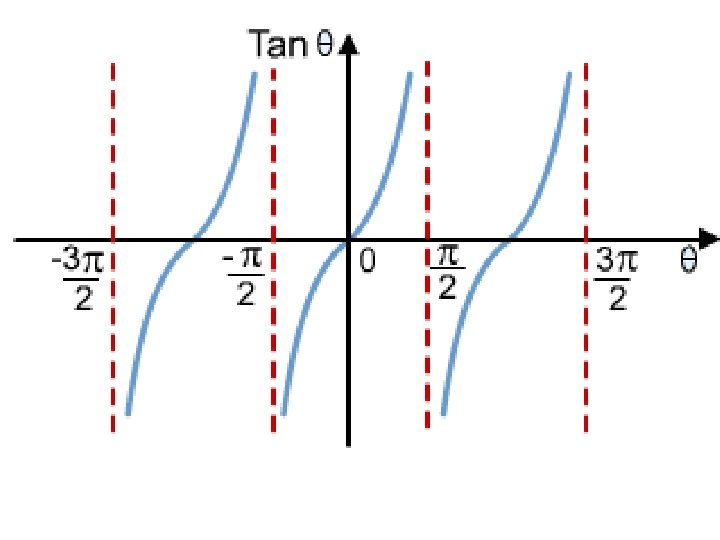
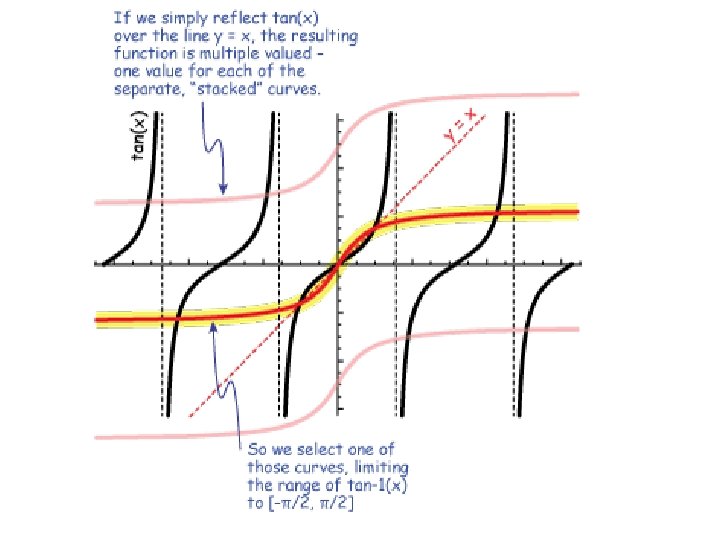
Graphs of Inverse Trig Functions 8/03/2021 • I can recognise the graphs of inverse trig functions • I am aware of the term relations in this context
oh dear me
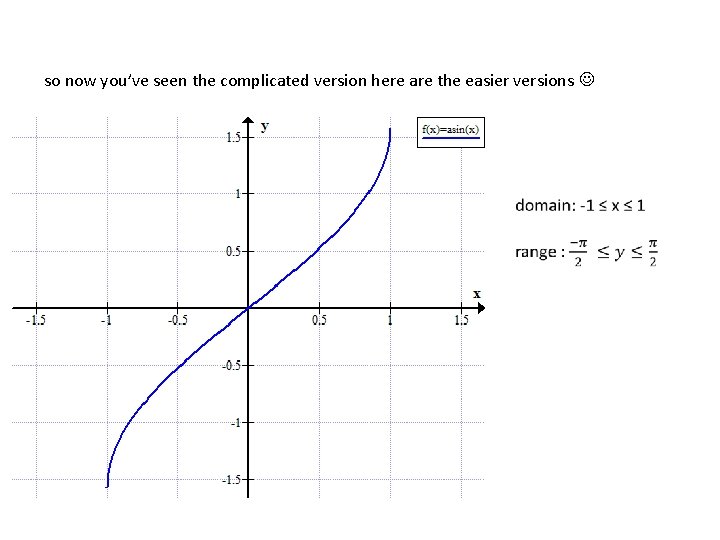
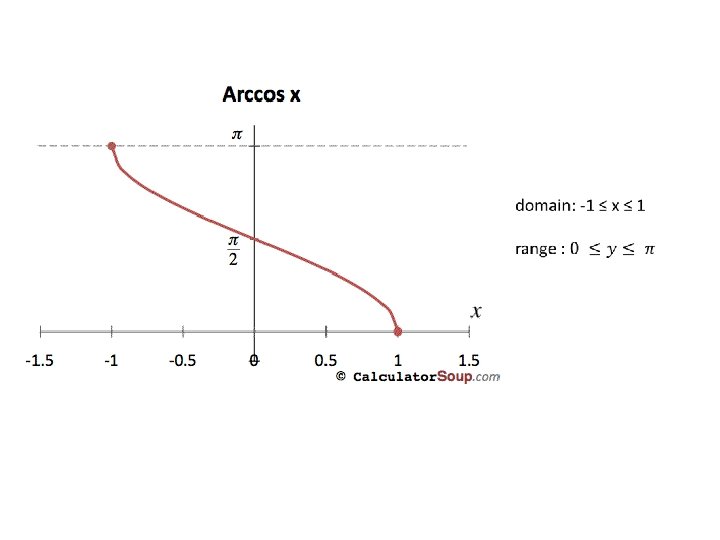
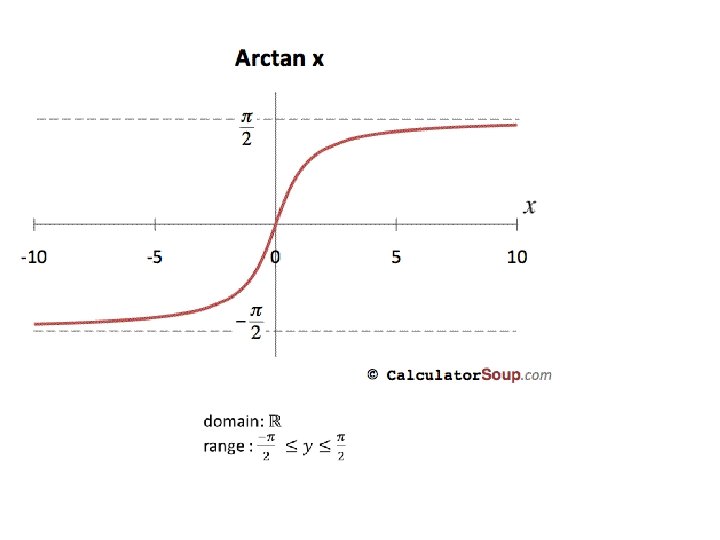
so now you’ve seen the complicated version here are the easier versions
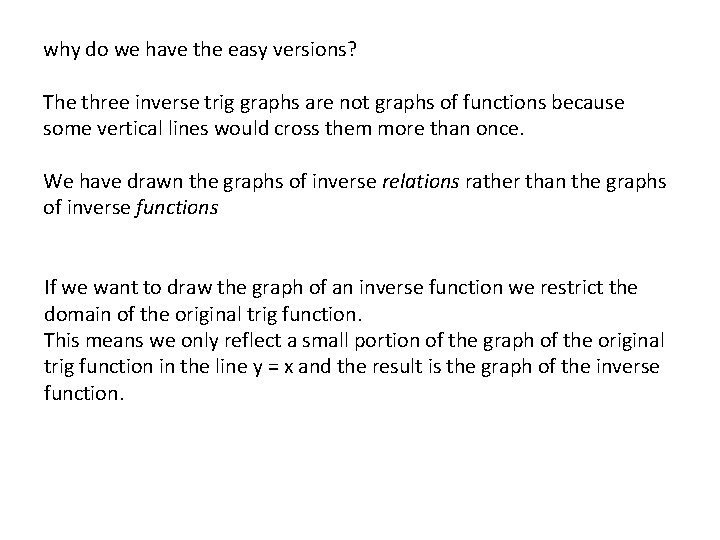
why do we have the easy versions? The three inverse trig graphs are not graphs of functions because some vertical lines would cross them more than once. We have drawn the graphs of inverse relations rather than the graphs of inverse functions If we want to draw the graph of an inverse function we restrict the domain of the original trig function. This means we only reflect a small portion of the graph of the original trig function in the line y = x and the result is the graph of the inverse function.
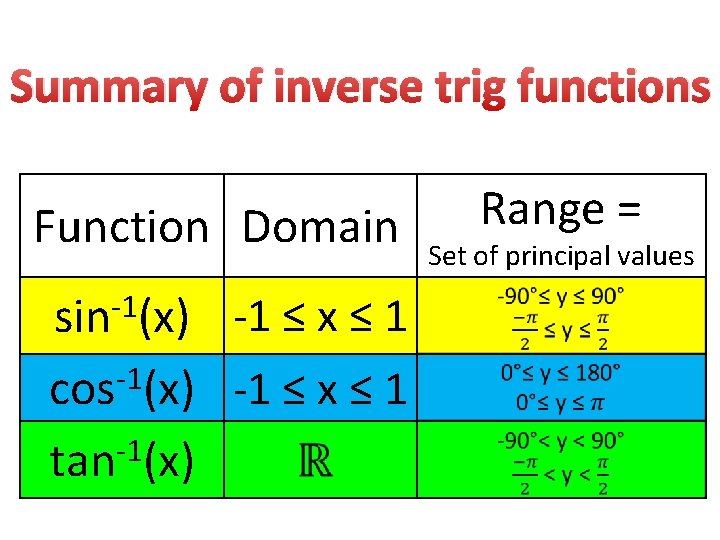
Summary of inverse trig functions Function Domain -1 sin (x) -1 ≤ x ≤ 1 -1 cos (x) -1 ≤ x ≤ 1 -1 tan (x) Range = Set of principal values
Inverses for the Reciprocal Trig Functions 8/03/2021 • I can calculate the inverses of reciprocal trig functions
what do you think sec -1(x) means? ?
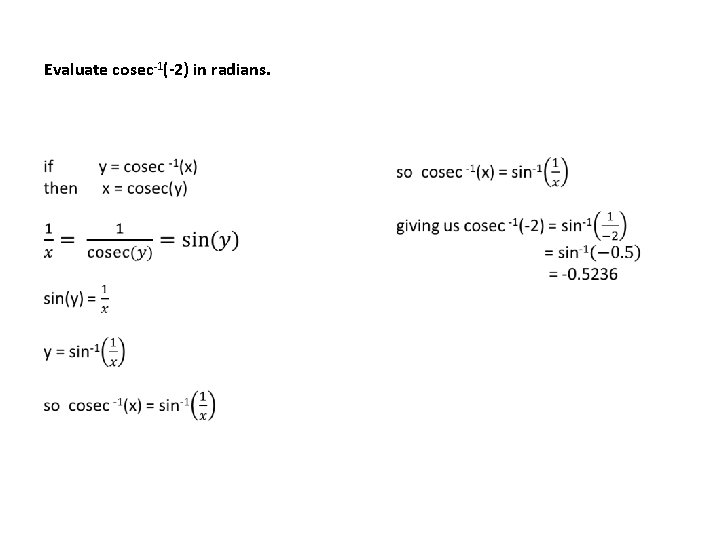
Evaluate cosec-1(-2) in radians.
• I can calculate the inverses of reciprocal trig functions exercise 7. 01 page 114
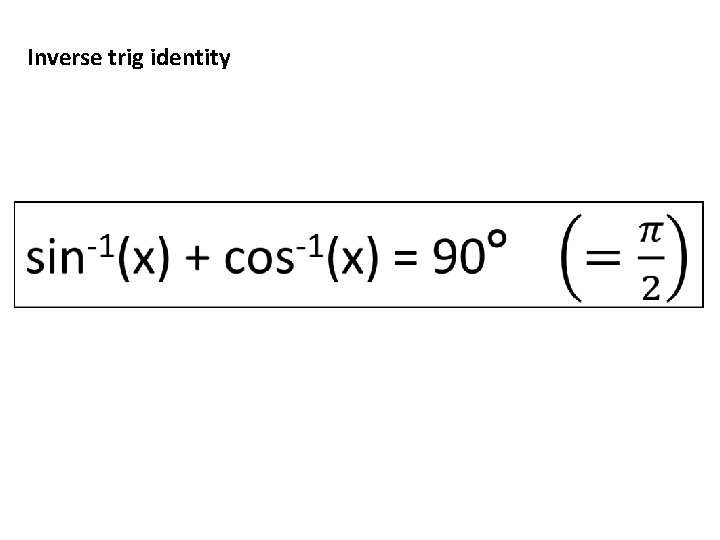
Inverse trig identity
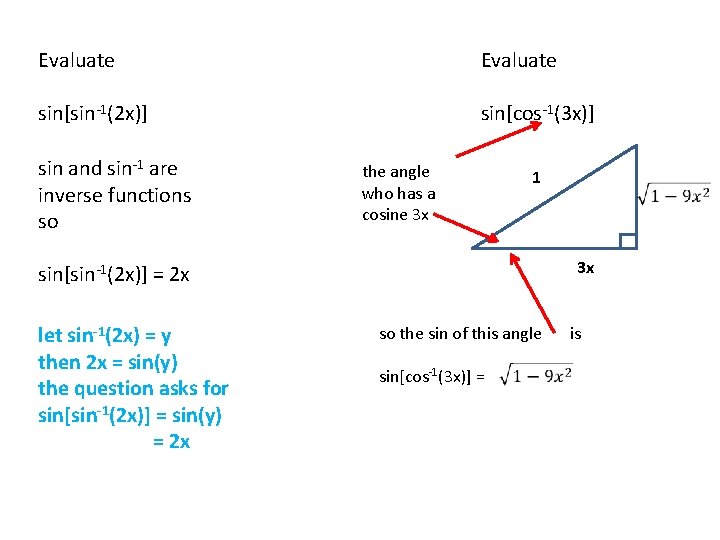
Evaluate sin[sin-1(2 x)] sin[cos-1(3 x)] sin and sin-1 are inverse functions so the angle who has a cosine 3 x 3 x sin[sin-1(2 x)] = 2 x let sin-1(2 x) = y then 2 x = sin(y) the question asks for sin[sin-1(2 x)] = sin(y) = 2 x 1 so the sin of this angle is sin[cos-1(3 x)] =
• I can calculate the inverses of reciprocal trig functions exercise 7. 02 page 115
Trigonometric Equations 8/03/2021 • I can find the principal solution to a trig equation • I can find all the solutions to a trig equation
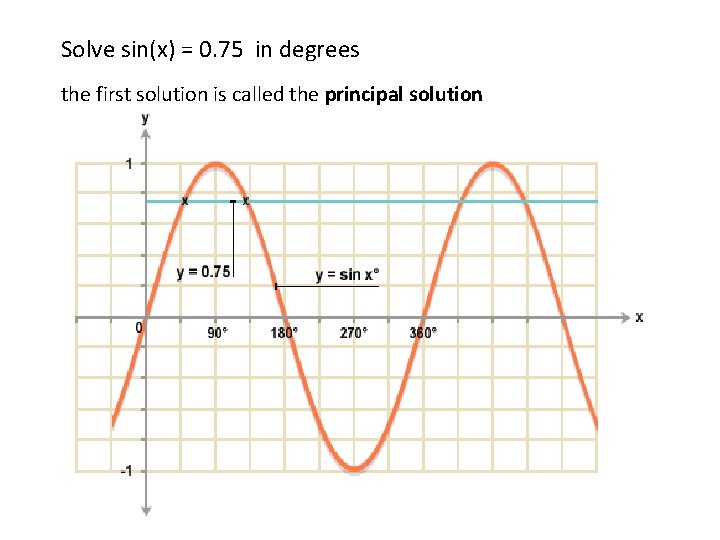
Solve sin(x) = 0. 75 in degrees the first solution is called the principal solution
• I can find the principal solution to a trig equation • I can find all the solutions to a trig equation exercise 7. 03 page 117
8/03/2021
a message from your maths teacher It is easier to work in degrees and then convert to radians
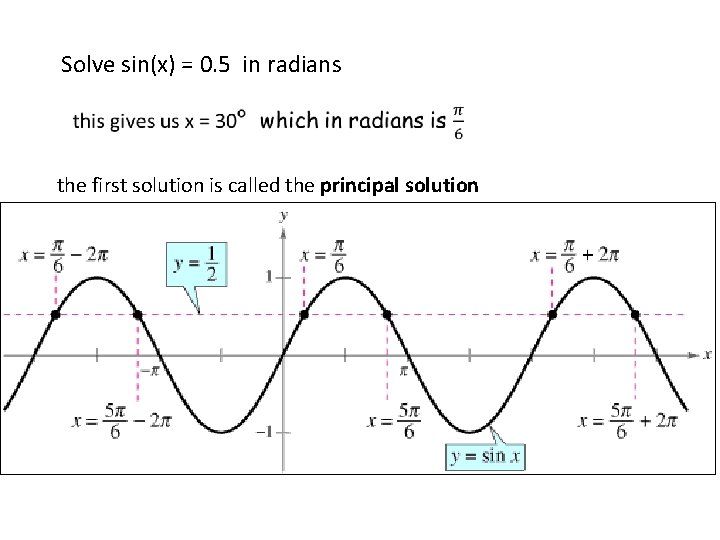
Solve sin(x) = 0. 5 in radians the first solution is called the principal solution
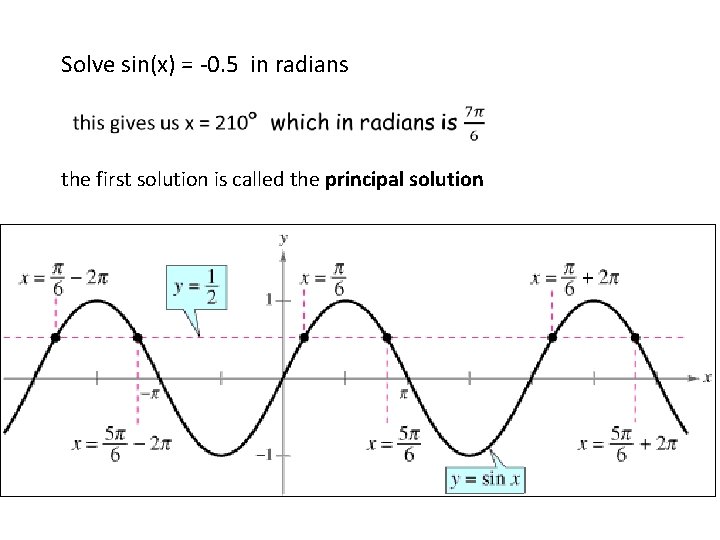
Solve sin(x) = -0. 5 in radians the first solution is called the principal solution
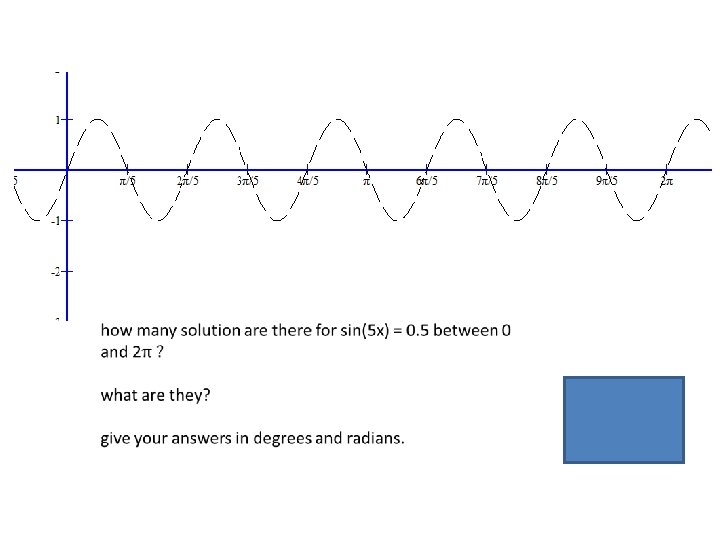
Multiple Solutions 8/03/2021 • I can find the multiple solutions to a trig equation
10 solutions
• I can find the multiple solutions to a trig equation exercise 7. 05 page 121
Solving Trig equations by factorising 8/03/2021 • I can factorise trig equations and then find the solution in degrees or radians
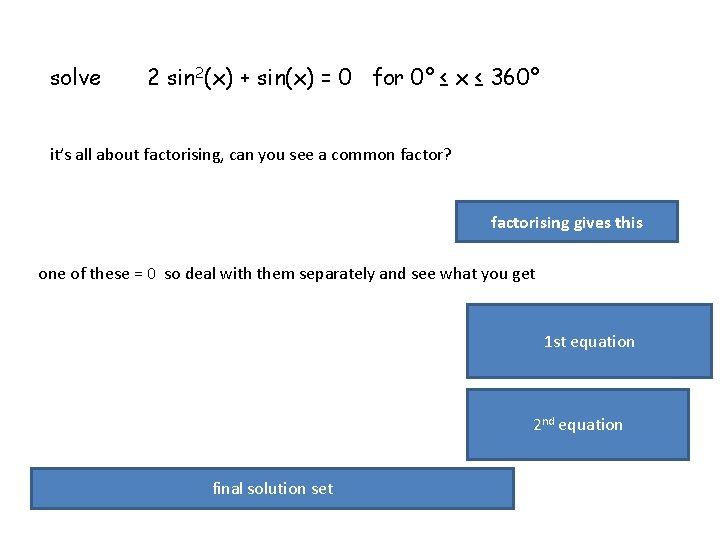
solve 2 sin 2(x) + sin(x) = 0 for 0° ≤ x ≤ 360° it’s all about factorising, can you see a common factor? sin(x)[2 sin(x) + 1] = 0 factorising gives this one of these = 0 so deal with them separately and see what you get sin(x) = 0 gives 1 st equation 0°, 180°, 360° 2 sin(x) + 1 = 0 gives 2 nd equation 210 ° and 330° final solution set the equation has 5 solutions { 0°, 180°, 210°, 330°, 360°}
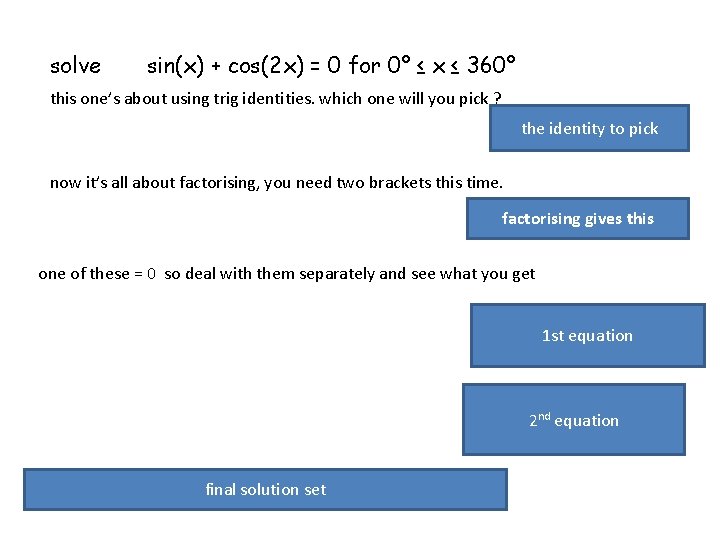
solve sin(x) + cos(2 x) = 0 for 0° ≤ x ≤ 360° this one’s about using trig identities. which one will you pick ? 2(x) cos(2 x) = 1 – 2 sin the identity to pick now it’s all about factorising, you need two brackets this time. [2 sin(x) + 1][sin(x) – 1 ]= 0 factorising gives this one of these = 0 so deal with them separately and see what you get sin(x) - 1 = 0 gives 1 st equation 90° 2 sin(x) + 1 = 0 gives 2 nd equation 210 ° and 330° the equation has 3 solutions { 90°, 210°, 330°} final solution set
• I can factorise trig equations and then find the solution in degrees or radians exercise 7. 06 page 122
Converting Sums to Products 8/03/2021 • I can solve trig equations by converting sums to products
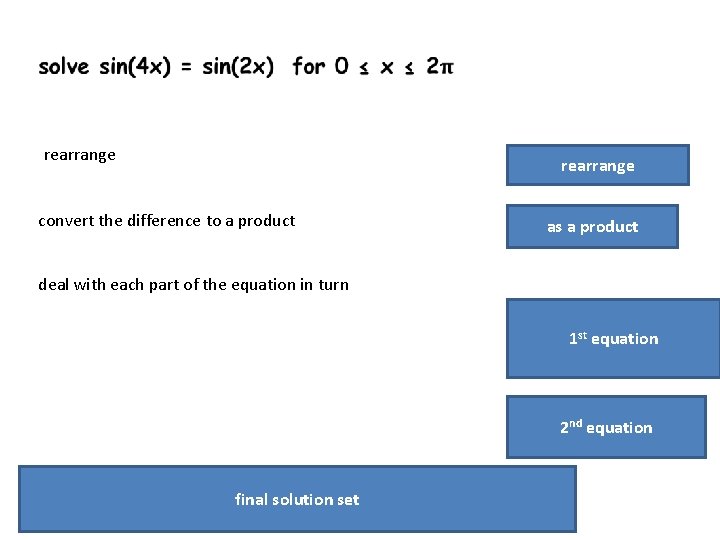
rearrange convert the difference to a product sin(4 x) – sin(2 x) = 0 rearrange 2 cos(3 x)sin(x) = 0 as a product deal with each part of the equation in turn cos(3 x) = 0 gives 1 st equation 30°, 90°, 150°, 210°, 270°, 330° sin(x) = 0 gives nd equation 0°, 2180°, 360° there are 9 solutions altogether final solution set
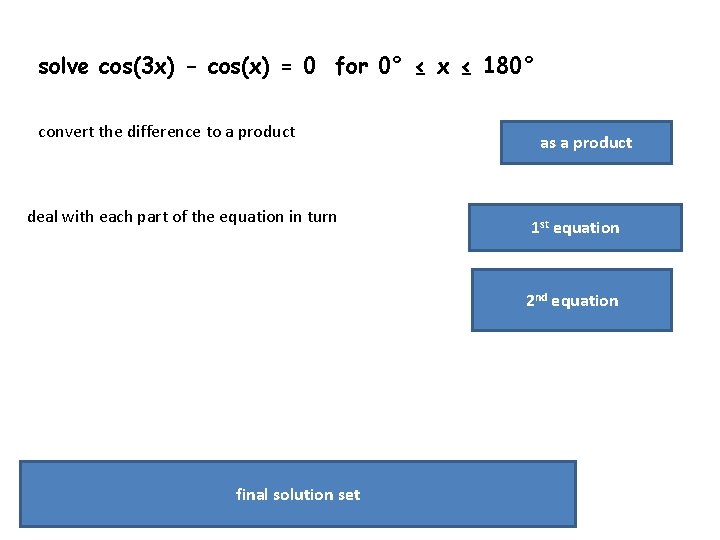
solve cos(3 x) - cos(x) = 0 for 0° ≤ x ≤ 180° convert the difference to a product deal with each part of the equation in turn 2 sin(2 x)sin(-x) = 0 as a product -2 sin(2 x)sin(x) = 0 sin(2 x) = 0 gives 1 st equation 0°, 90°, 180° sin(x) = 0 gives 2 nd equation 0°, 180° there are 3 solutions altogether final solution set
• I can solve trig equations by converting sums to products exercise 7. 07 page 123
• I have consolidated my understanding with exercise 7. 08 page 124
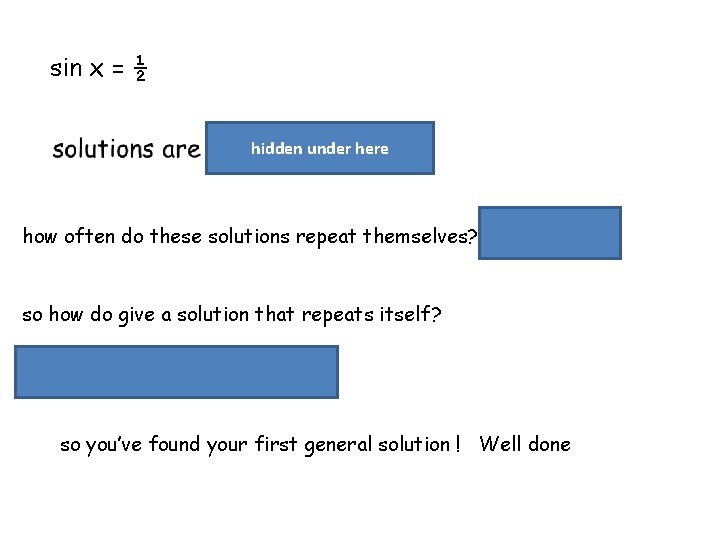
sin x = ½ hidden under here how often do these solutions repeat themselves? so how do give a solution that repeats itself? so you’ve found your first general solution ! Well done
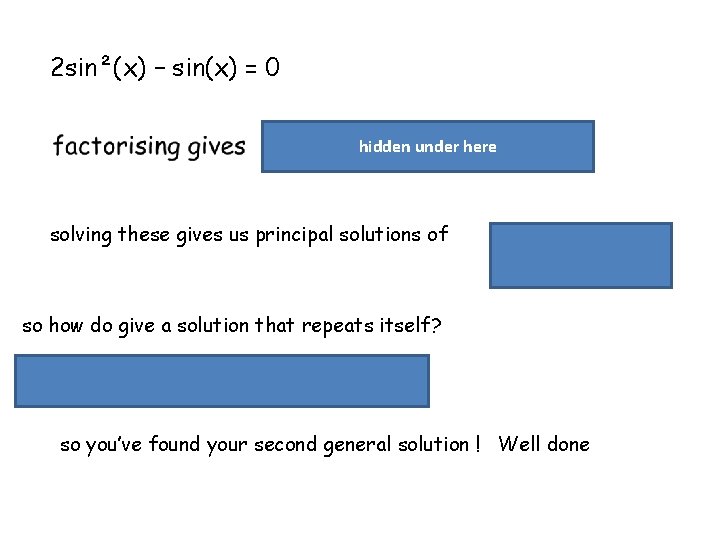
2 sin²(x) – sin(x) = 0 hidden under here solving these gives us principal solutions of so how do give a solution that repeats itself? so you’ve found your second general solution ! Well done
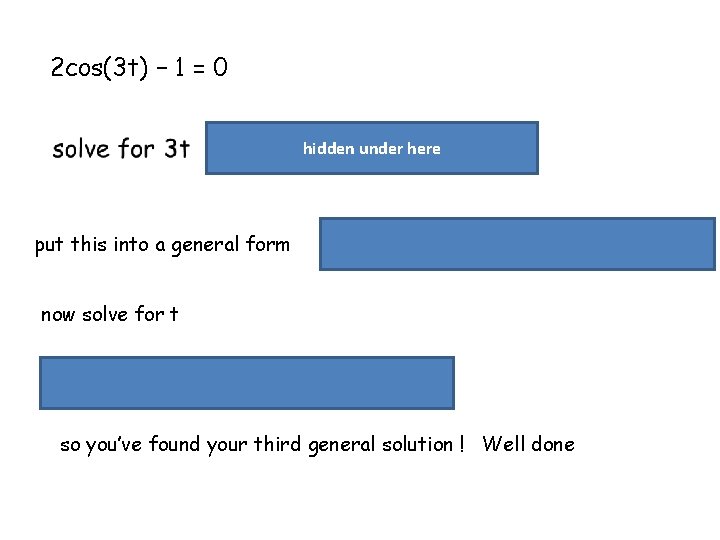
2 cos(3 t) – 1 = 0 hidden under here put this into a general form now solve for t so you’ve found your third general solution ! Well done
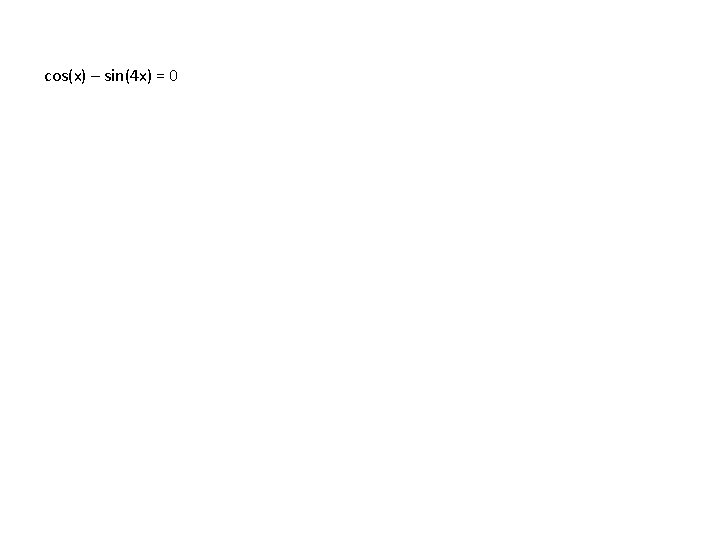
cos(x) – sin(4 x) = 0
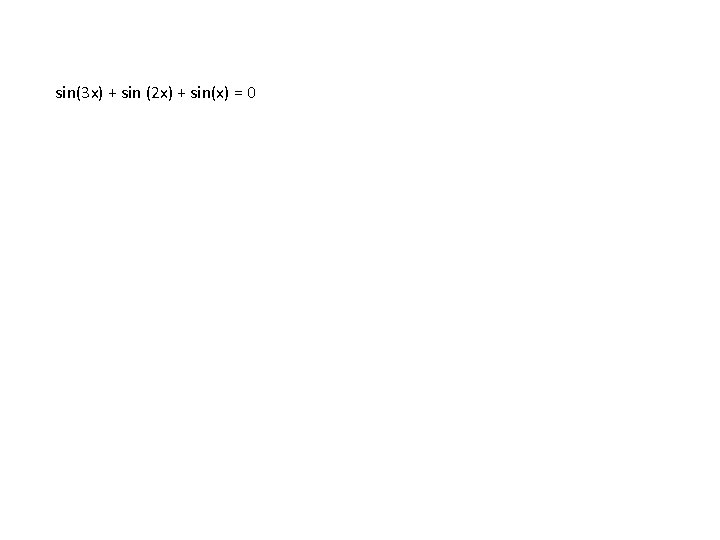
sin(3 x) + sin (2 x) + sin(x) = 0
• I have no idea what’s happening and wish I’d stayed at home