
TRIANGLE INEQUALITIES TEXTBOOK LESSON 5 5 MM 1
TRIANGLE INEQUALITIES (TEXTBOOK LESSON 5. 5) MM 1 G 3 b -Understand use the triangle inequality, the side-angle inequality, and the exterior angle inequality.
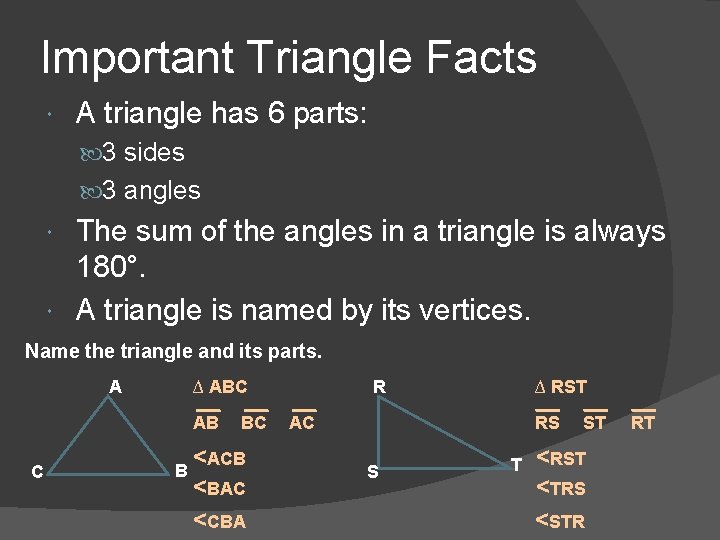
Important Triangle Facts A triangle has 6 parts: 3 sides 3 angles The sum of the angles in a triangle is always 180°. A triangle is named by its vertices. Name the triangle and its parts. A ∆ ABC AB C B BC <ACB <BAC <CBA R ∆ RST AC RS S T ST <RST <TRS <STR RT
Classifying Triangles Classify triangles by the side lengths. Equilateral – all sides are equal Isosceles – at least two sides are equal Scalene – no sides are equal Classify triangles by angle measures. Right – has one 90⁰ angle Acute – all angles are less than 90⁰ Obtuse – has one angle greater than 90⁰ Equiangular – all angles are equal Do Parts I and II of the Triangle Notes Handout.
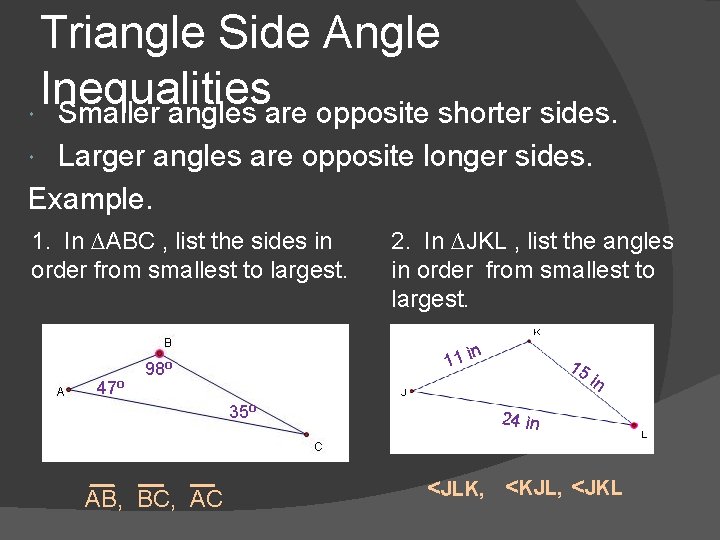
Triangle Side Angle Inequalities Smaller angles are opposite shorter sides. Larger angles are opposite longer sides. Example. 1. In ∆ABC , list the sides in order from smallest to largest. 47⁰ n 11 i 98⁰ 35⁰ AB, BC, AC 2. In ∆JKL , list the angles in order from smallest to largest. 15 in 24 in <JLK, <KJL, <JKL
Handout straight edges and compasses Construct triangles: 3”, 4”, 5” 2”, 3”, 6”
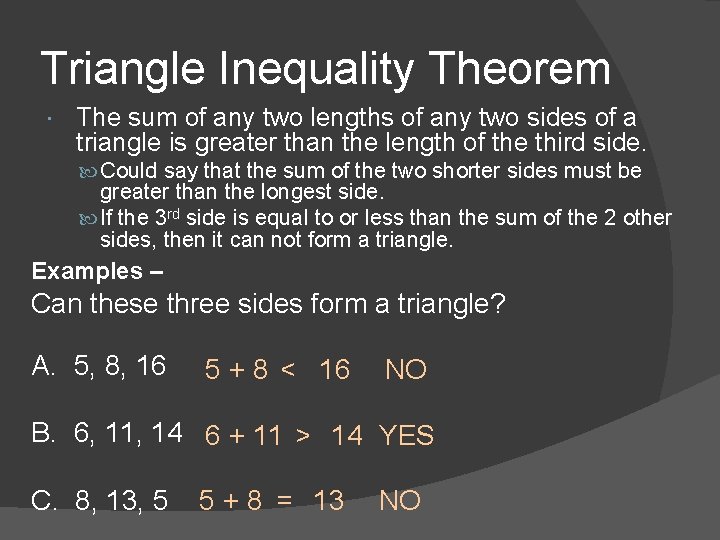
Triangle Inequality Theorem The sum of any two lengths of any two sides of a triangle is greater than the length of the third side. Could say that the sum of the two shorter sides must be greater than the longest side. If the 3 rd side is equal to or less than the sum of the 2 other sides, then it can not form a triangle. Examples – Can these three sides form a triangle? A. 5, 8, 16 5 + 8 < 16 NO B. 6, 11, 14 6 + 11 > 14 YES C. 8, 13, 5 5 + 8 = 13 NO
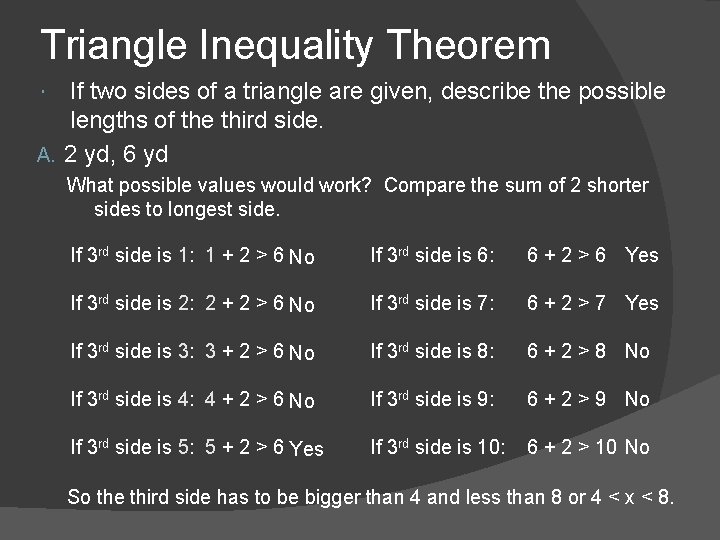
Triangle Inequality Theorem If two sides of a triangle are given, describe the possible lengths of the third side. A. 2 yd, 6 yd What possible values would work? Compare the sum of 2 shorter sides to longest side. If 3 rd side is 1: 1 + 2 > 6 No If 3 rd side is 6: 6 + 2 > 6 Yes If 3 rd side is 2: 2 + 2 > 6 No If 3 rd side is 7: 6 + 2 > 7 Yes If 3 rd side is 3: 3 + 2 > 6 No If 3 rd side is 8: 6 + 2 > 8 No If 3 rd side is 4: 4 + 2 > 6 No If 3 rd side is 9: 6 + 2 > 9 No If 3 rd side is 5: 5 + 2 > 6 Yes If 3 rd side is 10: 6 + 2 > 10 No So the third side has to be bigger than 4 and less than 8 or 4 < x < 8.
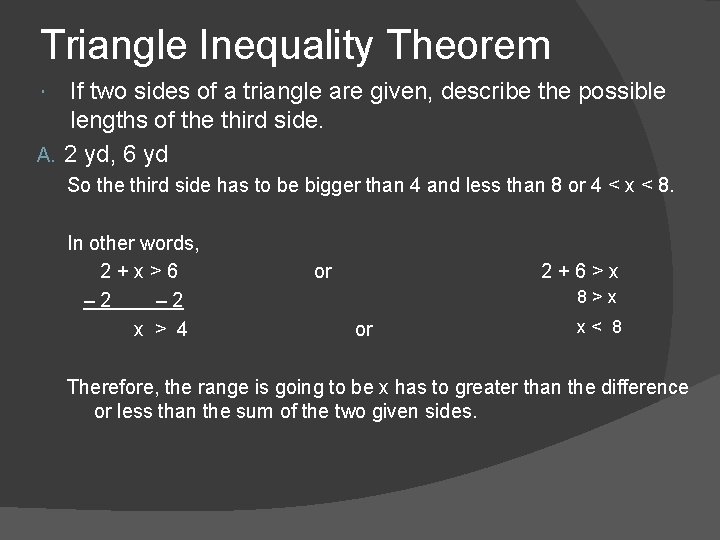
Triangle Inequality Theorem If two sides of a triangle are given, describe the possible lengths of the third side. A. 2 yd, 6 yd So the third side has to be bigger than 4 and less than 8 or 4 < x < 8. In other words, 2+x>6 – 2 x > 4 or 2+6>x 8>x or x< 8 Therefore, the range is going to be x has to greater than the difference or less than the sum of the two given sides.
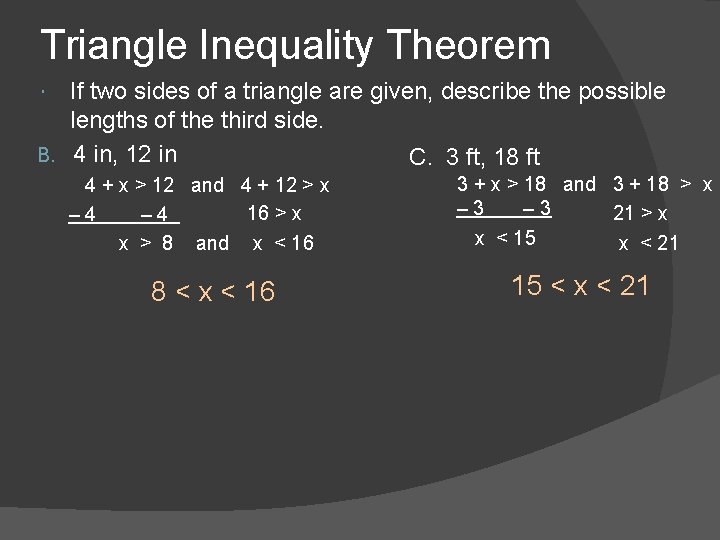
Triangle Inequality Theorem If two sides of a triangle are given, describe the possible lengths of the third side. B. 4 in, 12 in C. 3 ft, 18 ft 4 + x > 12 and 4 + 12 > x 16 > x – 4 x > 8 and x < 16 8 < x < 16 3 + x > 18 and 3 + 18 > x – 3 21 > x x < 15 x < 21 15 < x < 21
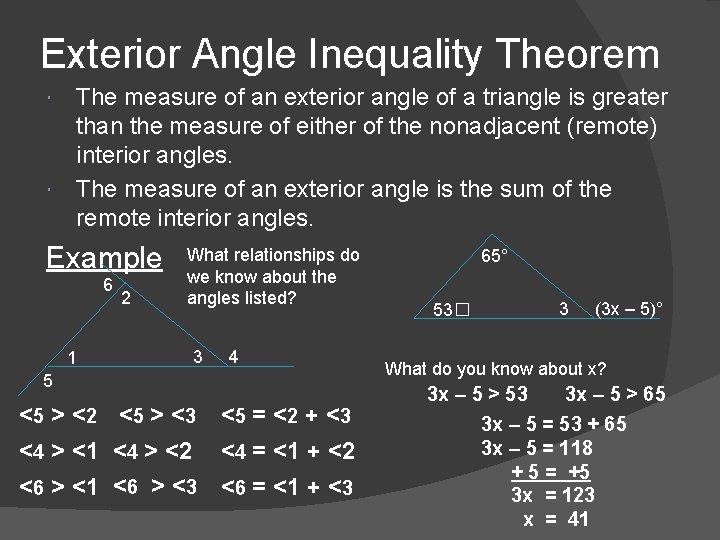
Exterior Angle Inequality Theorem The measure of an exterior angle of a triangle is greater than the measure of either of the nonadjacent (remote) interior angles. The measure of an exterior angle is the sum of the remote interior angles. Example 6 1 2 What relationships do we know about the angles listed? 3 4 5 <5 > < 2 <5 > < 3 <5 = < 2 + < 3 <4 > <1 <4 > <2 <4 = <1 + <2 <6 > <1 <6 > <3 <6 = <1 + <3 65° 53� 3 (3 x – 5)° What do you know about x? 3 x – 5 > 53 3 x – 5 > 65 3 x – 5 = 53 + 65 3 x – 5 = 118 + 5 = +5 3 x = 123 x = 41
Classwork/Homework Textbook p 287 (4 -9, 13 -24 all)
- Slides: 11