
Triage Tags Patients brought by EMS Tag will
Triage Tags § Patients brought by EMS § Tag will be applied to patient by EMS § Patients directed to appropriate treatment area in the hospital based on color of triage tag § MCI/Disaster patients presenting to ED by own transportation § Triage tags in disaster cage in basement § Triage tags will be available in the ED § Decon room § At Triage § Should be used and applied to patients as they enter the hospital via the triage area where-ever this has been established
Triage § Primary triage- START and Jump. Start § Segregates casualties into groups § Walkers move to another area § The more critically injured, but still a smaller crowd, left to sort through to determine reds and yellows § Secondary triage § Refines our clinical picture § Uses a physiological scoring system & anatomical examination
Primary vs Secondary Triage (The 1 st vs Subsequent Triage) § Jump. START triage will be performed in the field – IF the patient is brought by EMS § If the patient accesses the ED on their own, triage will need to be set up and performed at the ED § If the patient comes to ED via EMS, ED should use the secondary triage (RTS) as their reassessment process
Secondary Triage § Glasgow coma scale (GCS) – 3 -15 points üBest eye opening üBest verbal response üBest motor response § § § Respiratory rate Systolic B/P Secondary triage scores calculate RR and B/P based on adult norms § Secondary triage scores have not been modified for pediatric normal RR and B/P
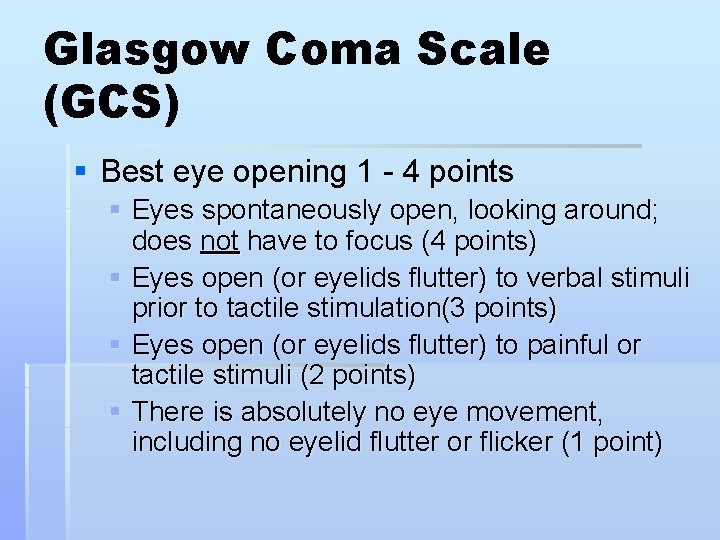
Glasgow Coma Scale (GCS) § Best eye opening 1 - 4 points § Eyes spontaneously open, looking around; does not have to focus (4 points) § Eyes open (or eyelids flutter) to verbal stimuli prior to tactile stimulation(3 points) § Eyes open (or eyelids flutter) to painful or tactile stimuli (2 points) § There is absolutely no eye movement, including no eyelid flutter or flicker (1 point)
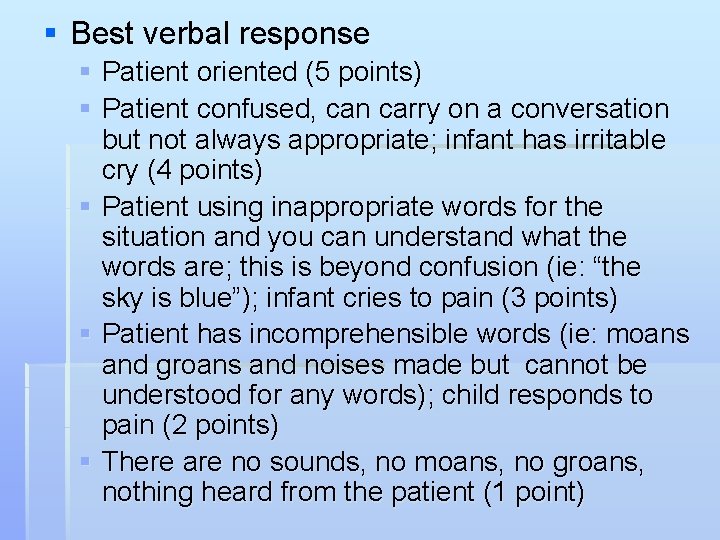
§ Best verbal response § Patient oriented (5 points) § Patient confused, can carry on a conversation but not always appropriate; infant has irritable cry (4 points) § Patient using inappropriate words for the situation and you can understand what the words are; this is beyond confusion (ie: “the sky is blue”); infant cries to pain (3 points) § Patient has incomprehensible words (ie: moans and groans and noises made but cannot be understood for any words); child responds to pain (2 points) § There are no sounds, no moans, no groans, nothing heard from the patient (1 point)
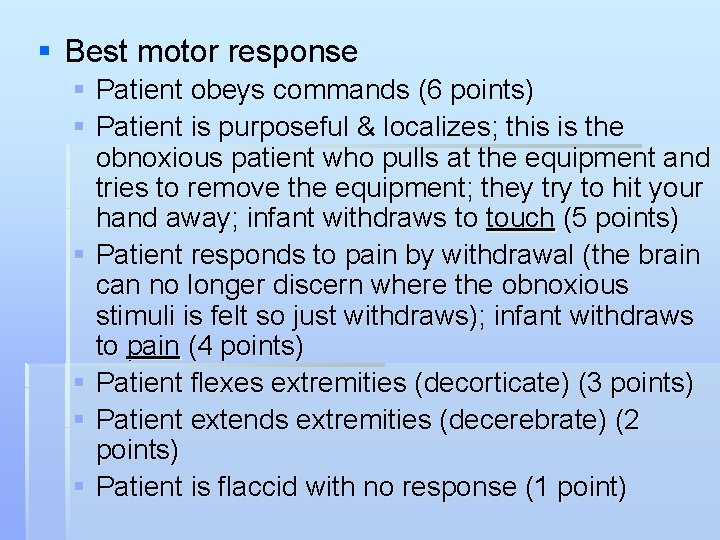
§ Best motor response § Patient obeys commands (6 points) § Patient is purposeful & localizes; this is the obnoxious patient who pulls at the equipment and tries to remove the equipment; they try to hit your hand away; infant withdraws to touch (5 points) § Patient responds to pain by withdrawal (the brain can no longer discern where the obnoxious stimuli is felt so just withdraws); infant withdraws to pain (4 points) § Patient flexes extremities (decorticate) (3 points) § Patient extends extremities (decerebrate) (2 points) § Patient is flaccid with no response (1 point)
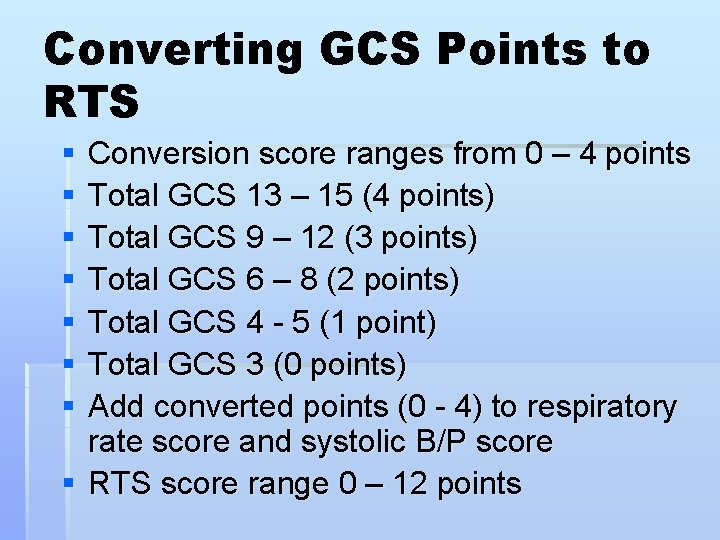
Converting GCS Points to RTS § § § § Conversion score ranges from 0 – 4 points Total GCS 13 – 15 (4 points) Total GCS 9 – 12 (3 points) Total GCS 6 – 8 (2 points) Total GCS 4 - 5 (1 point) Total GCS 3 (0 points) Add converted points (0 - 4) to respiratory rate score and systolic B/P score § RTS score range 0 – 12 points

§ Respiratory rate – 0 – 4 points § 10 – 29 breaths per minute (4 points) § 30 or more breaths per minute (3 points) § 6 - 9 breaths per minute (2 points) § 1 – 5 breaths per minute (1 point) § 0 breaths (0 points) § Points added to GCS conversion points (0 - 4) and to systolic B/P score (0 – 4) § RTS score ranges 0 - 12
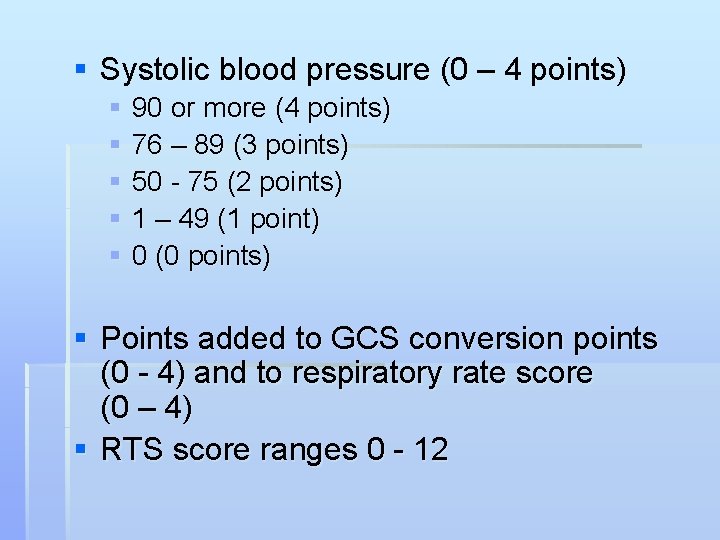
§ Systolic blood pressure (0 – 4 points) § 90 or more (4 points) § 76 – 89 (3 points) § 50 - 75 (2 points) § 1 – 49 (1 point) § 0 (0 points) § Points added to GCS conversion points (0 - 4) and to respiratory rate score (0 – 4) § RTS score ranges 0 - 12
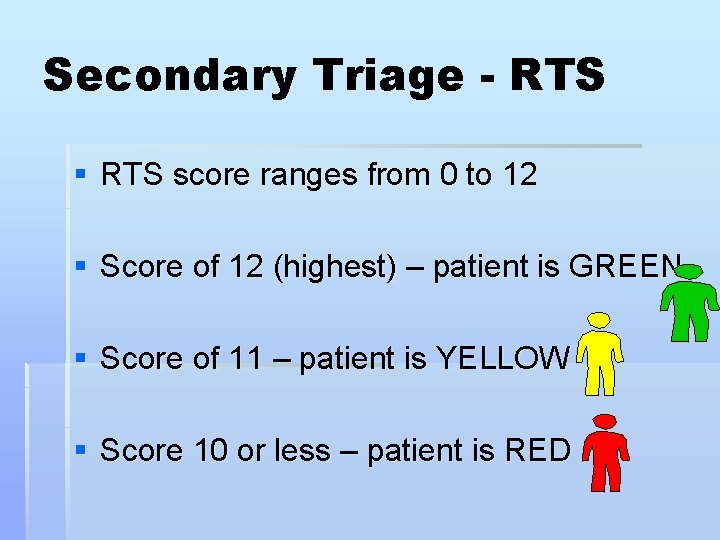
Secondary Triage - RTS § RTS score ranges from 0 to 12 § Score of 12 (highest) – patient is GREEN § Score of 11 – patient is YELLOW § Score 10 or less – patient is RED
Scenario Practice § Use worksheet at end of power point as resource for START & Jump. START triage and the secondary triage process § Place patients in the appropriate categories § Check answers at the end of the practice scenarios § Some scenarios are based in the field – does not matter as triage is performed the same in all settings (and you might be dispatched to help in the field if requested)
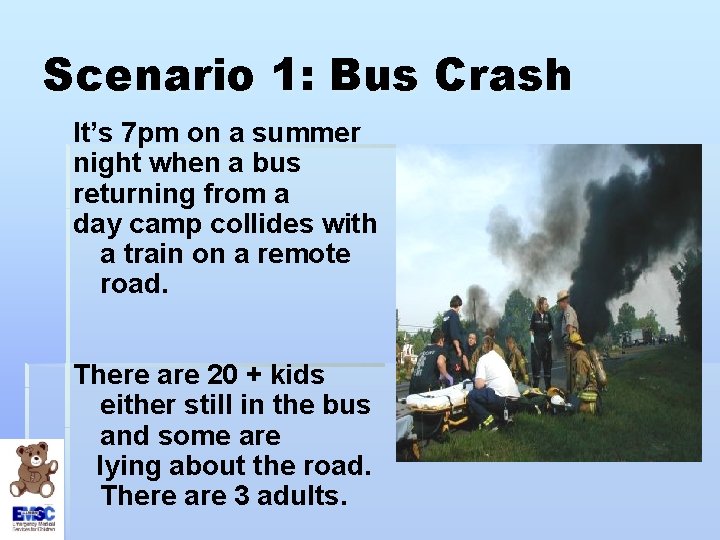
Scenario 1: Bus Crash It’s 7 pm on a summer night when a bus returning from a day camp collides with a train on a remote road. There are 20 + kids either still in the bus and some are lying about the road. There are 3 adults.
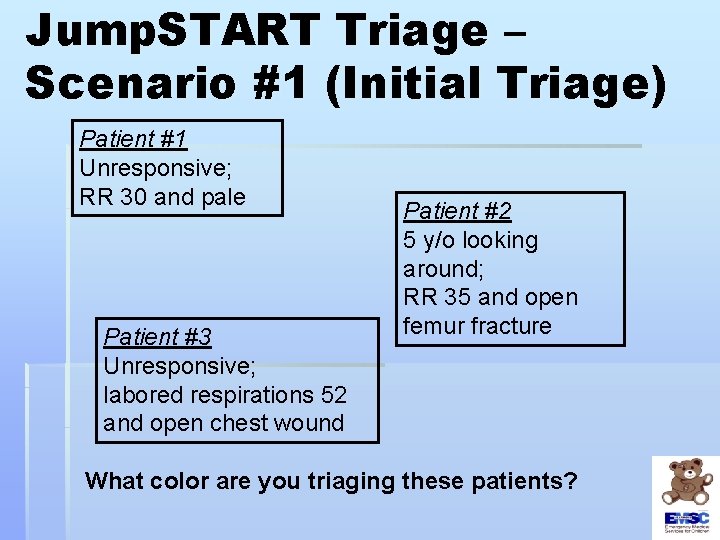
Jump. START Triage – Scenario #1 (Initial Triage) Patient #1 Unresponsive; RR 30 and pale Patient #3 Unresponsive; labored respirations 52 and open chest wound Patient #2 5 y/o looking around; RR 35 and open femur fracture What color are you triaging these patients?

Initial Jump. START Triage Scenario #1 § Patient #1 – RED § RR okay at 30 (between 15 and 45) § Patient is unresponsive § Patient #2 – YELLOW § Not able to walk so initially made yellow until retriaged – then may stay yellow or be triaged as green or red § Even though RR okay at 35 (between 15 and 45) § Even though looking around (awake) § Patient #3 – RED § Labored RR of 52 (> 45) § Unresponsive
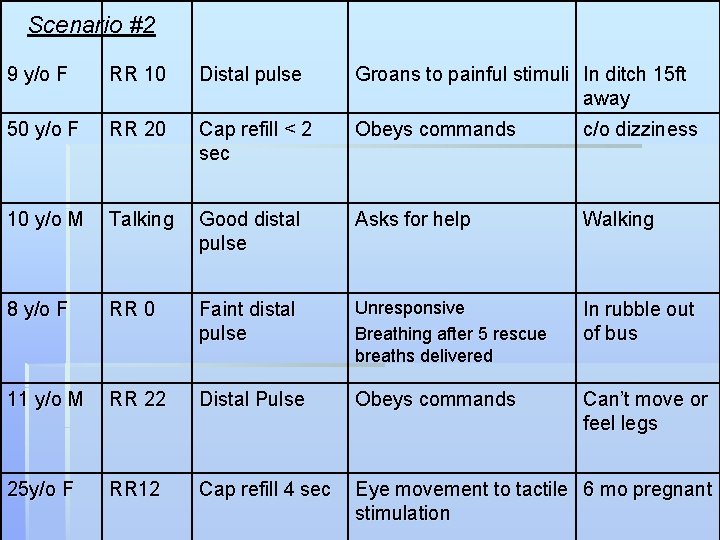
Scenario #2 9 y/o F RR 10 Distal pulse Groans to painful stimuli In ditch 15 ft away 50 y/o F RR 20 Cap refill < 2 sec Obeys commands c/o dizziness 10 y/o M Talking Good distal pulse Asks for help Walking 8 y/o F RR 0 Faint distal pulse Unresponsive Breathing after 5 rescue breaths delivered In rubble out of bus 11 y/o M RR 22 Distal Pulse Obeys commands Can’t move or feel legs 25 y/o F RR 12 Cap refill 4 sec Eye movement to tactile 6 mo pregnant stimulation
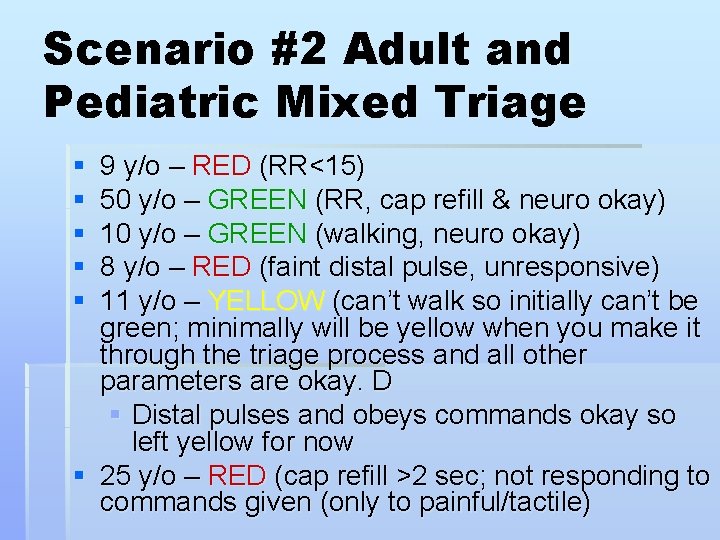
Scenario #2 Adult and Pediatric Mixed Triage § § § 9 y/o – RED (RR<15) 50 y/o – GREEN (RR, cap refill & neuro okay) 10 y/o – GREEN (walking, neuro okay) 8 y/o – RED (faint distal pulse, unresponsive) 11 y/o – YELLOW (can’t walk so initially can’t be green; minimally will be yellow when you make it through the triage process and all other parameters are okay. D § Distal pulses and obeys commands okay so left yellow for now § 25 y/o – RED (cap refill >2 sec; not responding to commands given (only to painful/tactile)
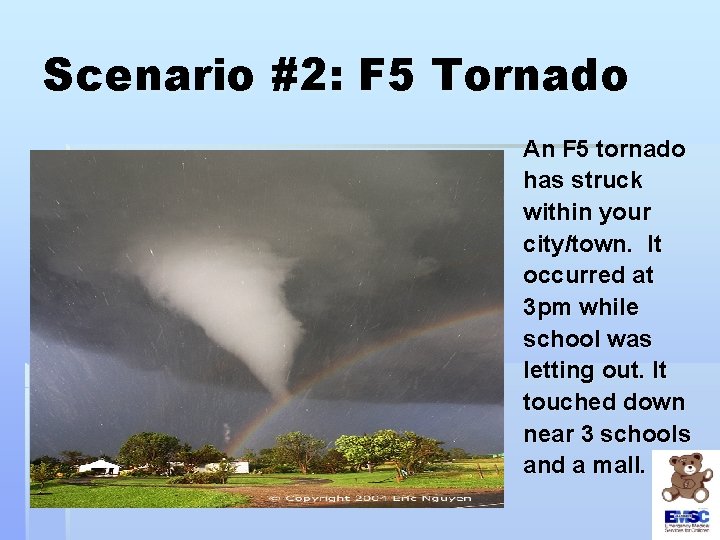
Scenario #2: F 5 Tornado An F 5 tornado has struck within your city/town. It occurred at 3 pm while school was letting out. It touched down near 3 schools and a mall.
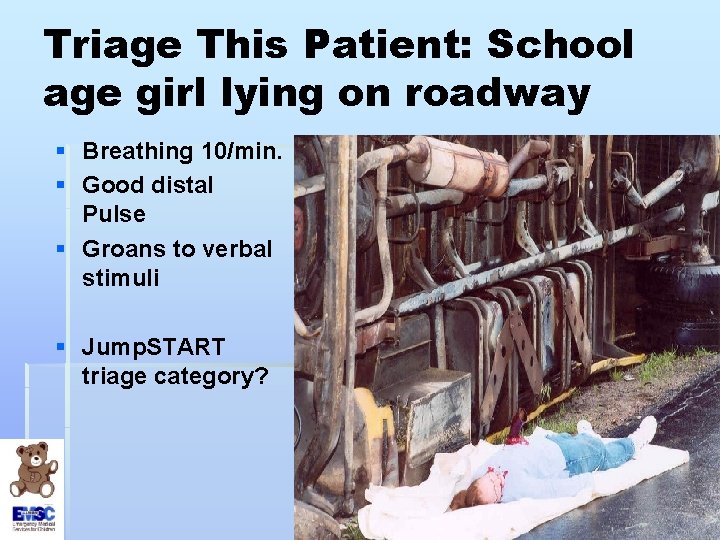
Triage This Patient: School age girl lying on roadway § Breathing 10/min. § Good distal Pulse § Groans to verbal stimuli § Jump. START triage category?
§ Patient is categorized as a RED § Respiratory rate (RR) is 10 (<15) § Do not even need to get to the type of AVPU response patient has § This patient is categorized influenced by respiratory rate and then rescuer must move onto next patient for triage § Patient care not delivered during triage § Patient care delivered in treatment

Triage This Patient: School age girl found; refuses to walk § Open arm fracture visible § RR 26, radial pulse present § Alert and talking § Jump. START triage category?
§ Open arm fracture could be a distracting injury – so don’t get distracted § Stay with physiological parameters § Not able to walk so automatically at minimum a YELLOW § Respiratory rate 26 (okay 15 - 45) § Neurologically okay (alert and talking) § Patient remains triaged as YELLOW § In secondary triage may be upgraded to GREEN (RTS most likely a 12)
Infants/Non-walkers § Evaluate this group of patients starting triage with the breathing assessment
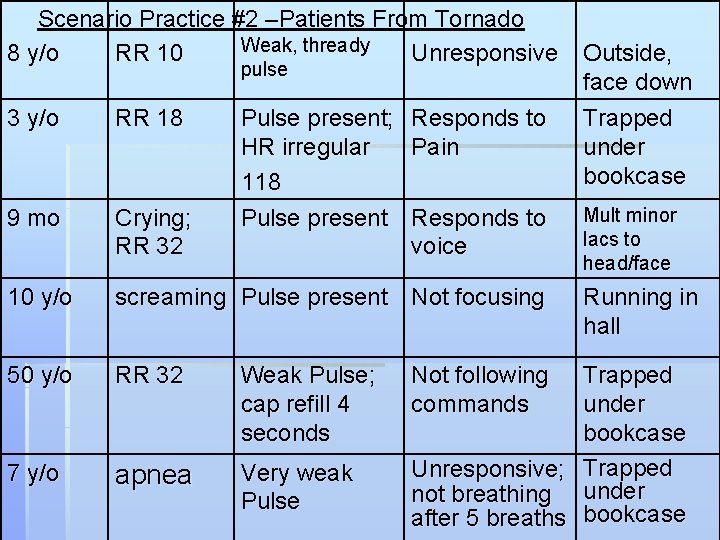
Scenario Practice #2 –Patients From Tornado Weak, thready 8 y/o RR 10 Unresponsive pulse 3 y/o RR 18 Pulse present; HR irregular 118 Pulse present Responds to Pain 9 mo Crying; RR 32 10 y/o screaming Pulse present Not focusing 50 y/o RR 32 Weak Pulse; cap refill 4 seconds 7 y/o apnea Very weak Pulse Responds to voice Not following commands Outside, face down Trapped under bookcase Mult minor lacs to head/face Running in hall Trapped under bookcase Unresponsive; Trapped not breathing under after 5 breaths bookcase
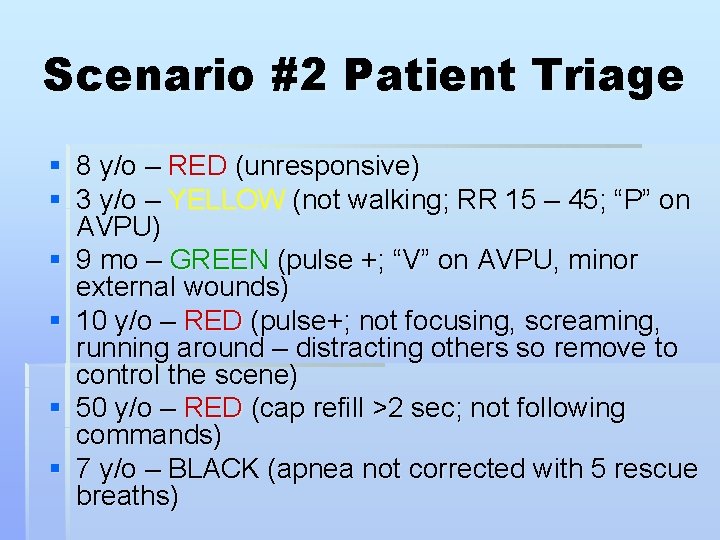
Scenario #2 Patient Triage § 8 y/o – RED (unresponsive) § 3 y/o – YELLOW (not walking; RR 15 – 45; “P” on AVPU) § 9 mo – GREEN (pulse +; “V” on AVPU, minor external wounds) § 10 y/o – RED (pulse+; not focusing, screaming, running around – distracting others so remove to control the scene) § 50 y/o – RED (cap refill >2 sec; not following commands) § 7 y/o – BLACK (apnea not corrected with 5 rescue breaths)
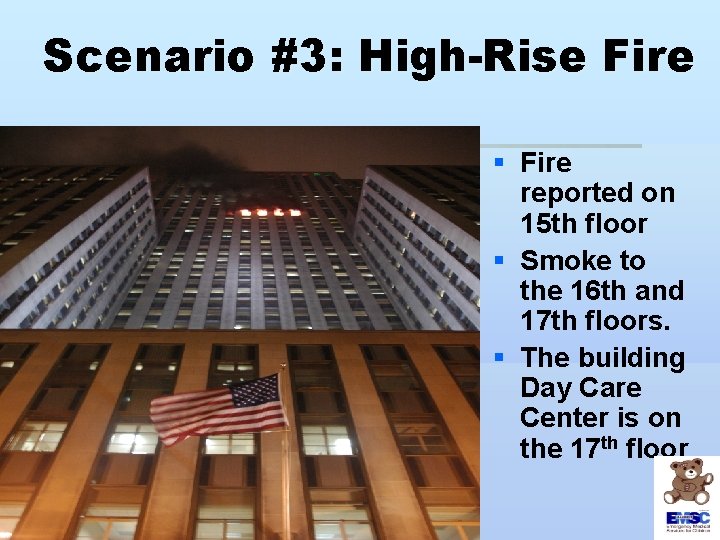
Scenario #3: High-Rise Fire § Fire reported on 15 th floor § Smoke to the 16 th and 17 th floors. § The building Day Care Center is on the 17 th floor
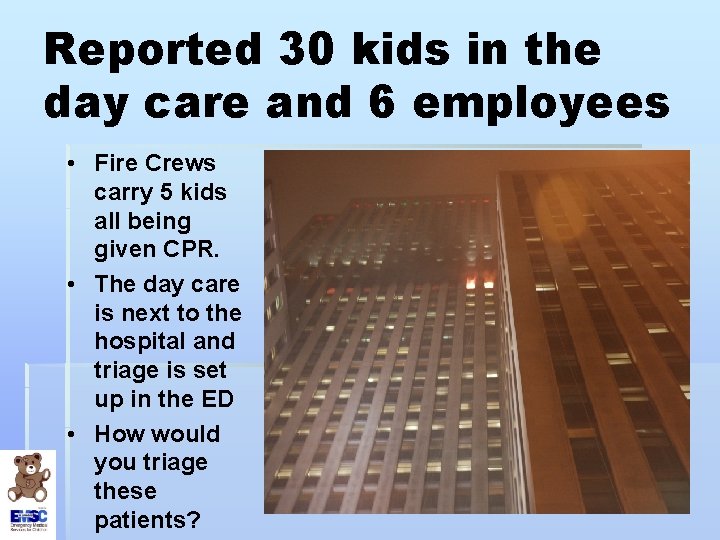
Reported 30 kids in the day care and 6 employees • Fire Crews carry 5 kids all being given CPR. • The day care is next to the hospital and triage is set up in the ED • How would you triage these patients?
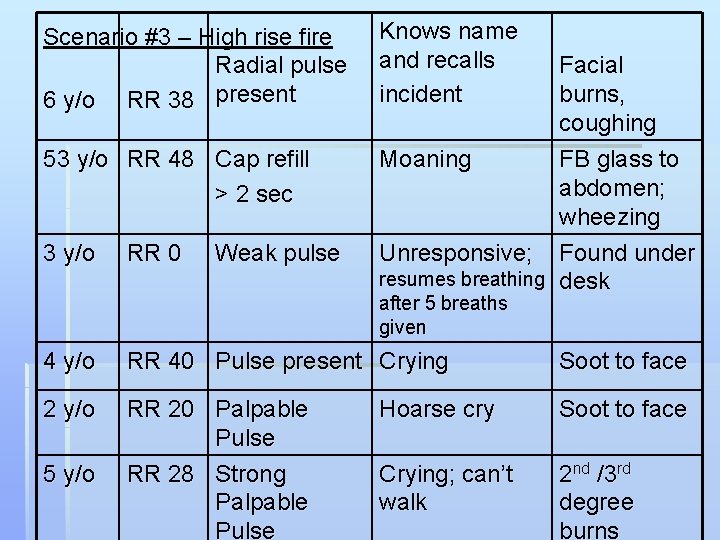
Scenario #3 – High rise fire Radial pulse 6 y/o RR 38 present 53 y/o RR 48 Cap refill > 2 sec 3 y/o RR 0 Weak pulse Knows name and recalls incident Facial burns, coughing Moaning FB glass to abdomen; wheezing Unresponsive; Found under resumes breathing desk after 5 breaths given 4 y/o RR 40 Pulse present Crying Soot to face 2 y/o RR 20 Palpable Pulse RR 28 Strong Palpable Pulse Hoarse cry Soot to face Crying; can’t walk 2 nd /3 rd degree burns 5 y/o
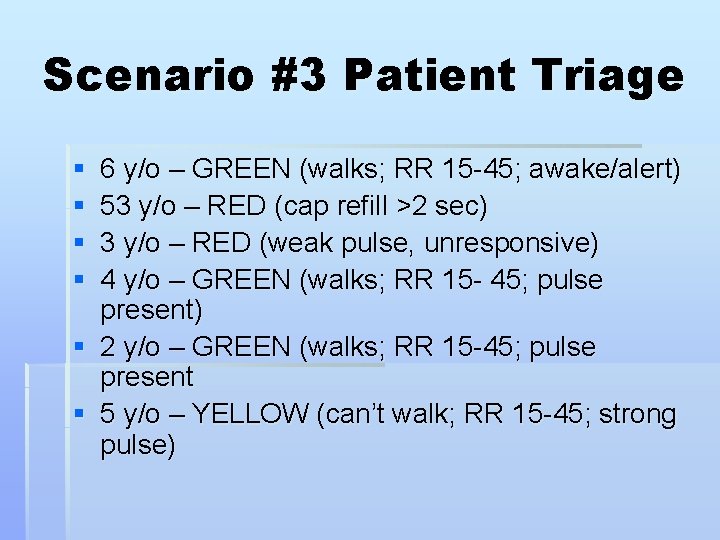
Scenario #3 Patient Triage § § 6 y/o – GREEN (walks; RR 15 -45; awake/alert) 53 y/o – RED (cap refill >2 sec) 3 y/o – RED (weak pulse, unresponsive) 4 y/o – GREEN (walks; RR 15 - 45; pulse present) § 2 y/o – GREEN (walks; RR 15 -45; pulse present § 5 y/o – YELLOW (can’t walk; RR 15 -45; strong pulse)
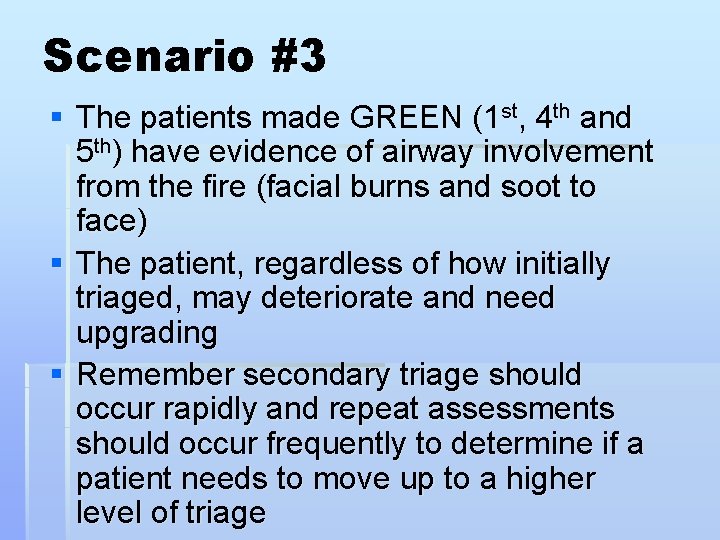
Scenario #3 § The patients made GREEN (1 st, 4 th and 5 th) have evidence of airway involvement from the fire (facial burns and soot to face) § The patient, regardless of how initially triaged, may deteriorate and need upgrading § Remember secondary triage should occur rapidly and repeat assessments should occur frequently to determine if a patient needs to move up to a higher level of triage
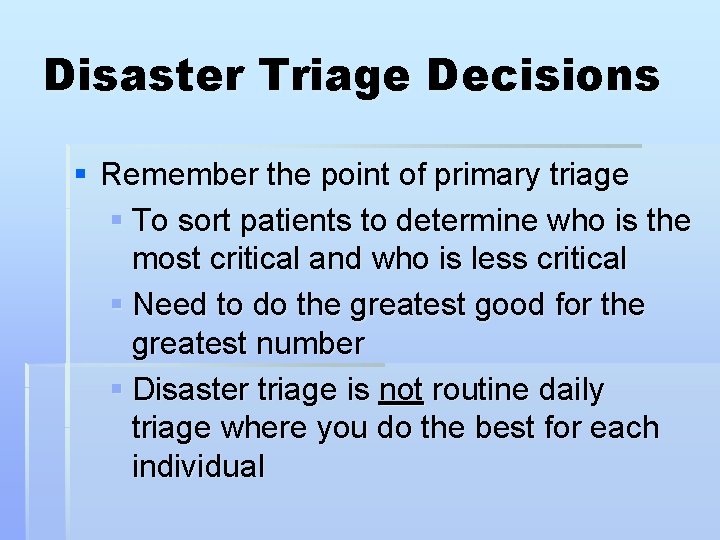
Disaster Triage Decisions § Remember the point of primary triage § To sort patients to determine who is the most critical and who is less critical § Need to do the greatest good for the greatest number § Disaster triage is not routine daily triage where you do the best for each individual
- Slides: 31