
Triadimenol CIPAC 398 4796R Stereospecific Identity Test for
- Slides: 20
Triadimenol CIPAC 398 4796/R Stereospecific Identity Test for Triadimenol – report Gerhard Krautstrunk, Silke Wagner, Dieter Strassburg, Martin Feyerabend June 2011
Background and Objective Background: § The triadimenol FAO specification defines a certain ratio for the two diastereomers. § A method extension for the identification and determination of triadimenol content and also implicitly, the diastereomer ratio in TC, EC, and WG formulations was presented at the CIPAC Meeting in 2009 and provisionally adopted as a CIPAC method. The method for the determination of the diastereomer ratio (CIPAC method 398/TC/M 3 and CIPAC Doc. Nr. 4687) still needed to be peer validated. Objective: § Present the outcome of the peer validation to demonstrate that CIPAC method 398/TC/M 3 and CIPAC Doc. Nr. 4687 are suitable for the determination of the diastereomer ratio for triadimenol.
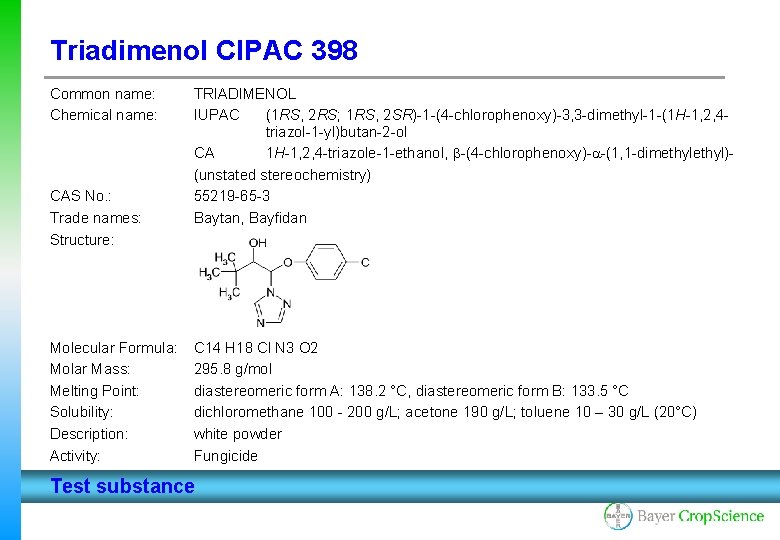
Triadimenol CIPAC 398 Common name: Chemical name: CAS No. : Trade names: Structure: Molecular Formula: Molar Mass: Melting Point: Solubility: Description: Activity: TRIADIMENOL IUPAC (1 RS, 2 RS; 1 RS, 2 SR)-1 -(4 -chlorophenoxy)-3, 3 -dimethyl-1 -(1 H-1, 2, 4 triazol-1 -yl)butan-2 -ol CA 1 H-1, 2, 4 -triazole-1 -ethanol, -(4 -chlorophenoxy)- -(1, 1 -dimethyl)(unstated stereochemistry) 55219 -65 -3 Baytan, Bayfidan C 14 H 18 Cl N 3 O 2 295. 8 g/mol diastereomeric form A: 138. 2 °C, diastereomeric form B: 133. 5 °C dichloromethane 100 - 200 g/L; acetone 190 g/L; toluene 10 – 30 g/L (20°C) white powder Fungicide Test substance
Triadimenol Stereochemistry Triadimenol is a mixture of diasteromers with a defined ratio
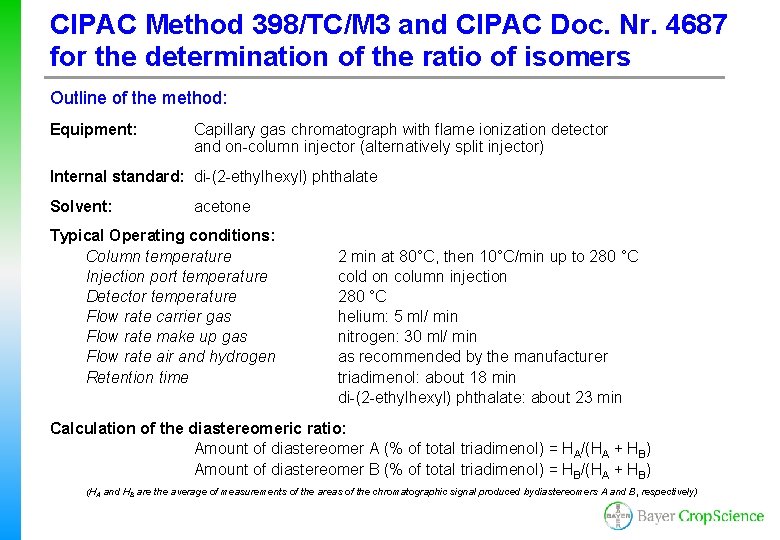
CIPAC Method 398/TC/M 3 and CIPAC Doc. Nr. 4687 for the determination of the ratio of isomers Outline of the method: Equipment: Capillary gas chromatograph with flame ionization detector and on-column injector (alternatively split injector) Internal standard: di-(2 -ethylhexyl) phthalate Solvent: acetone Typical Operating conditions: Column temperature Injection port temperature Detector temperature Flow rate carrier gas Flow rate make up gas Flow rate air and hydrogen Retention time 2 min at 80°C, then 10°C/min up to 280 °C cold on column injection 280 °C helium: 5 ml/ min nitrogen: 30 ml/ min as recommended by the manufacturer triadimenol: about 18 min di-(2 -ethylhexyl) phthalate: about 23 min Calculation of the diastereomeric ratio: Amount of diastereomer A (% of total triadimenol) = HA/(HA + HB) Amount of diastereomer B (% of total triadimenol) = HB/(HA + HB) (HA and HB are the average of measurements of the areas of the chromatographic signal produced bydiastereomers A and B, respectively)
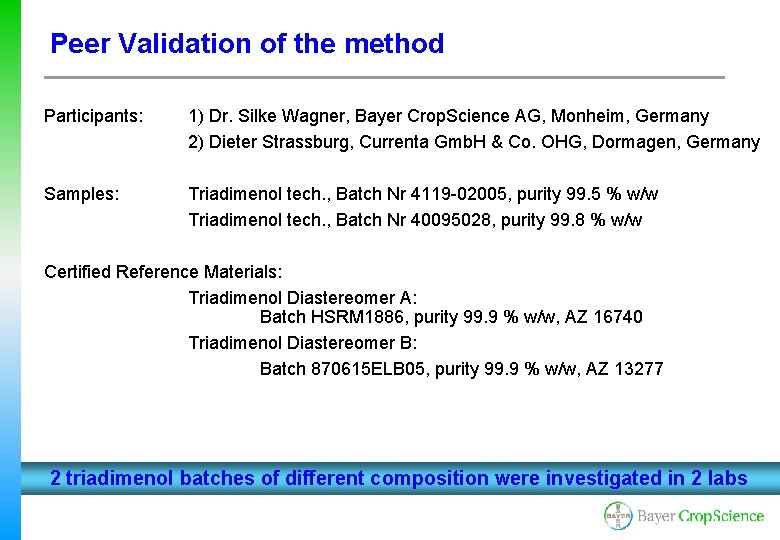
Peer Validation of the method Participants: 1) Dr. Silke Wagner, Bayer Crop. Science AG, Monheim, Germany 2) Dieter Strassburg, Currenta Gmb. H & Co. OHG, Dormagen, Germany Samples: Triadimenol tech. , Batch Nr 4119 -02005, purity 99. 5 % w/w Triadimenol tech. , Batch Nr 40095028, purity 99. 8 % w/w Certified Reference Materials: Triadimenol Diastereomer A: Batch HSRM 1886, purity 99. 9 % w/w, AZ 16740 Triadimenol Diastereomer B: Batch 870615 ELB 05, purity 99. 9 % w/w, AZ 13277 2 triadimenol batches of different composition were investigated in 2 labs
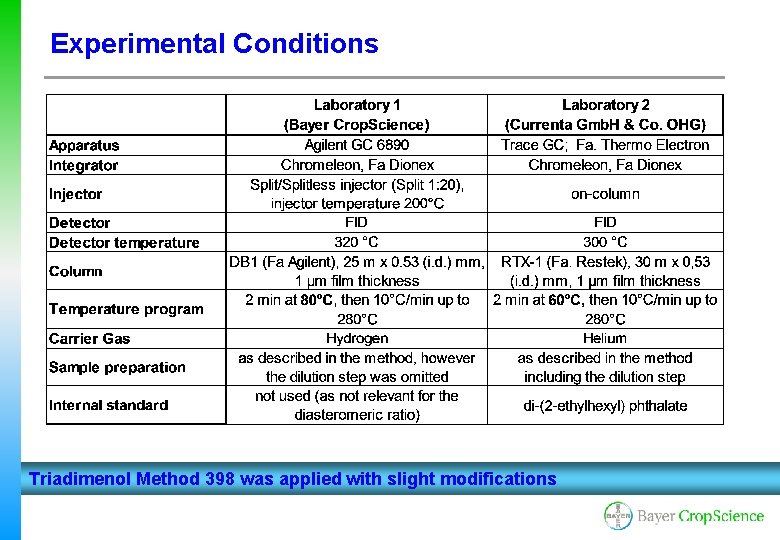
Experimental Conditions Triadimenol Method 398 was applied with slight modifications
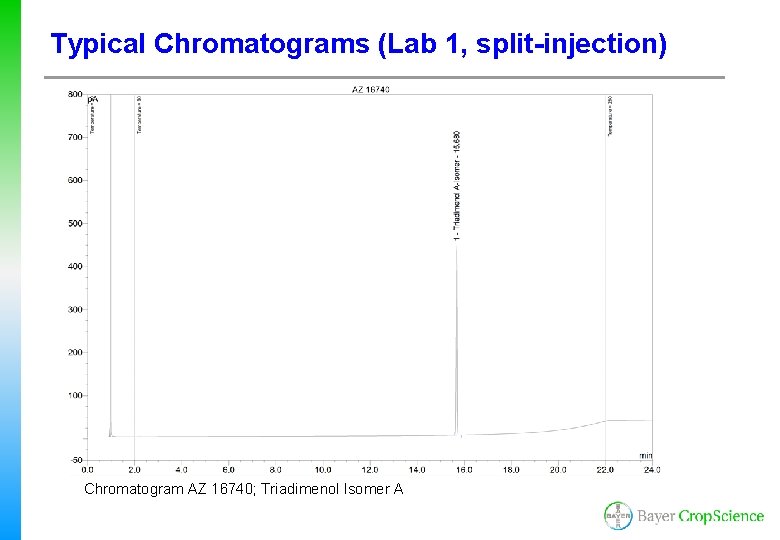
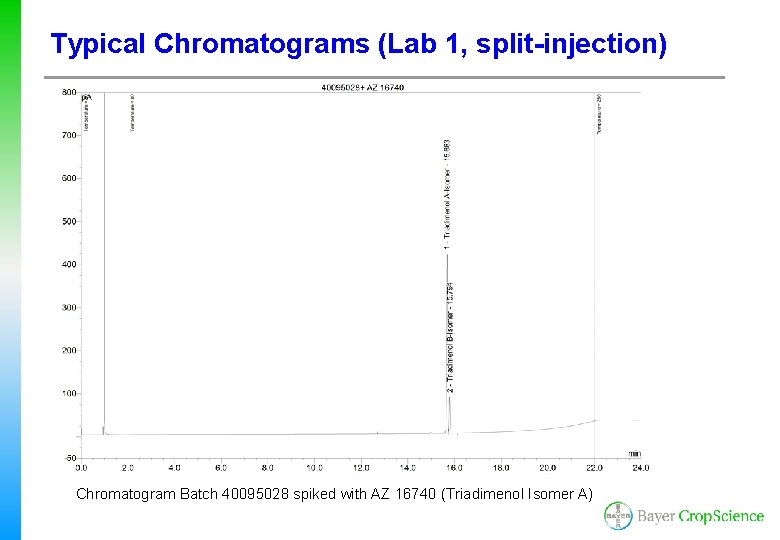
Typical Chromatograms (Lab 1, split-injection) Chromatogram AZ 16740; Triadimenol Isomer A
Typical Chromatograms (Lab 1, split-injection) Chromatogram AZ 13277; Triadimenol Isomer B
Typical Chromatograms (Lab 1, split-injection) Chromatogram Batch 40095028 spiked with AZ 16740 (Triadimenol Isomer A)
Typical Chromatograms (Lab 1, split-injection) Chromatogram Batch 40095028 spiked with AZ 13277 (Triadimenol Isomer B)
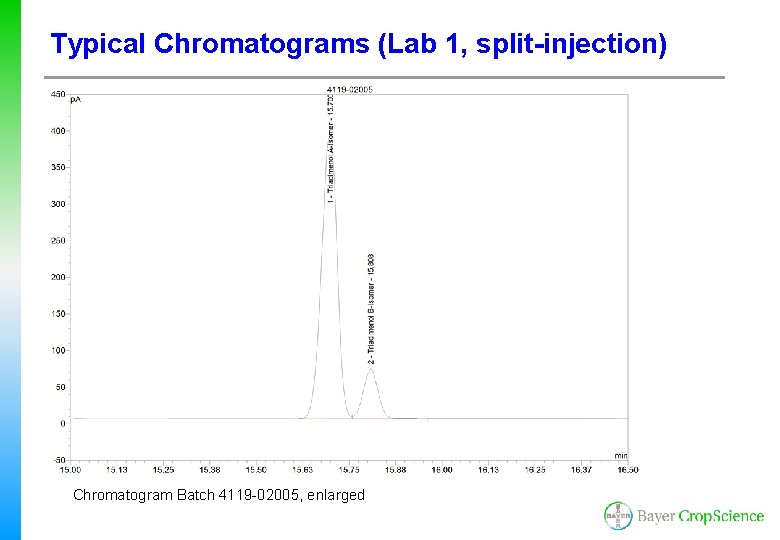
Typical Chromatograms (Lab 1, split-injection) Chromatogram Batch 4119 -02005
Typical Chromatograms (Lab 1, split-injection) Chromatogram Batch 4119 -02005, enlarged
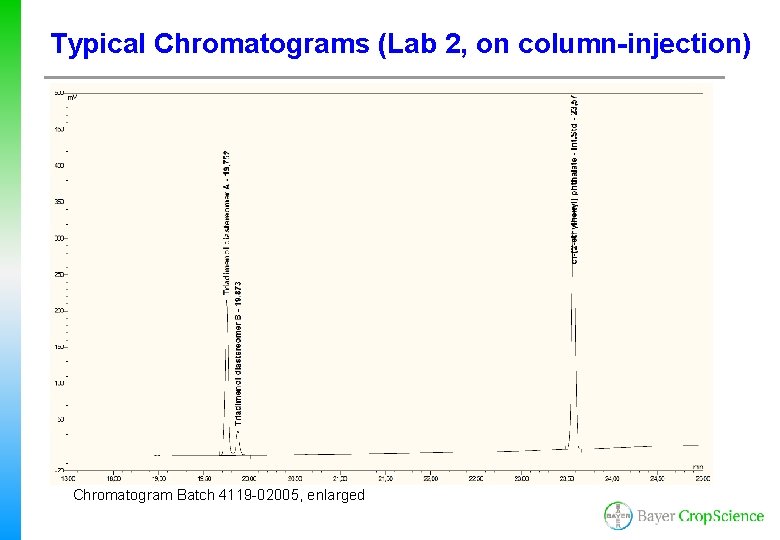
Typical Chromatograms (Lab 2, on column-injection) Chromatogram Batch 4119 -02005
Typical Chromatograms (Lab 2, on column-injection) Chromatogram Batch 4119 -02005, enlarged
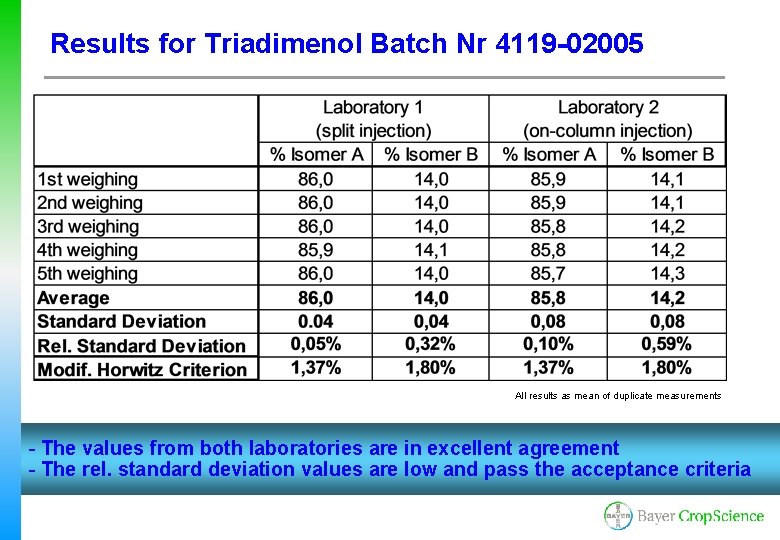
Results for Triadimenol Batch Nr 4119 -02005 All results as mean of duplicate measurements - The values from both laboratories are in excellent agreement - The rel. standard deviation values are low and pass the acceptance criteria
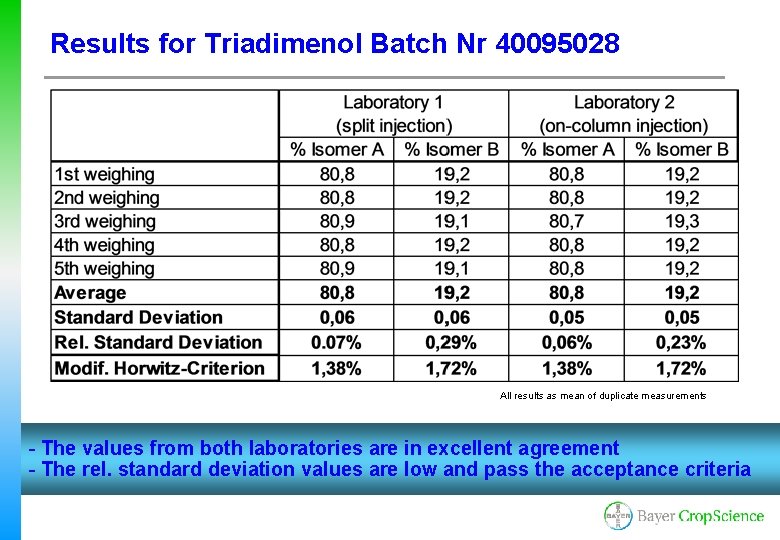
Results for Triadimenol Batch Nr 40095028 All results as mean of duplicate measurements - The values from both laboratories are in excellent agreement - The rel. standard deviation values are low and pass the acceptance criteria
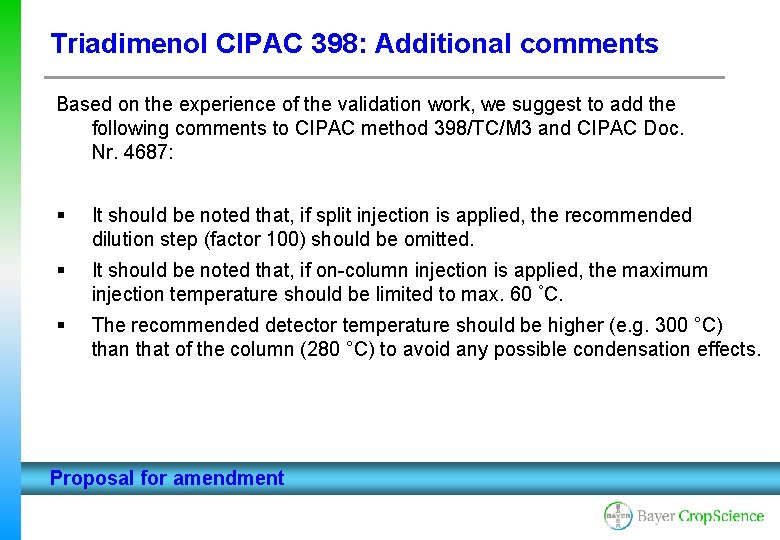
Triadimenol CIPAC 398: Additional comments Based on the experience of the validation work, we suggest to add the following comments to CIPAC method 398/TC/M 3 and CIPAC Doc. Nr. 4687: § It should be noted that, if split injection is applied, the recommended dilution step (factor 100) should be omitted. § It should be noted that, if on-column injection is applied, the maximum injection temperature should be limited to max. 60 °C. § The recommended detector temperature should be higher (e. g. 300 °C) than that of the column (280 °C) to avoid any possible condensation effects. Proposal for amendment
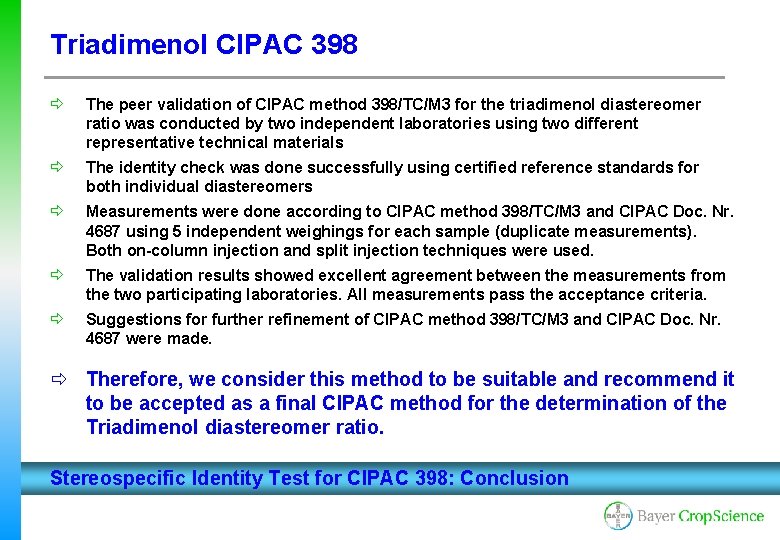
Triadimenol CIPAC 398 ð The peer validation of CIPAC method 398/TC/M 3 for the triadimenol diastereomer ratio was conducted by two independent laboratories using two different representative technical materials ð The identity check was done successfully using certified reference standards for both individual diastereomers ð Measurements were done according to CIPAC method 398/TC/M 3 and CIPAC Doc. Nr. 4687 using 5 independent weighings for each sample (duplicate measurements). Both on-column injection and split injection techniques were used. ð The validation results showed excellent agreement between the measurements from the two participating laboratories. All measurements pass the acceptance criteria. ð Suggestions for further refinement of CIPAC method 398/TC/M 3 and CIPAC Doc. Nr. 4687 were made. ð Therefore, we consider this method to be suitable and recommend it to be accepted as a final CIPAC method for the determination of the Triadimenol diastereomer ratio. Stereospecific Identity Test for CIPAC 398: Conclusion
Triadimenol CIPAC 398 Thank you for your kind attention