
Triad 4 Test Study Guide Key West Valley

- Slides: 21
Triad 4 Test Study Guide Key West Valley High School AP Chemistry Mr. Mata
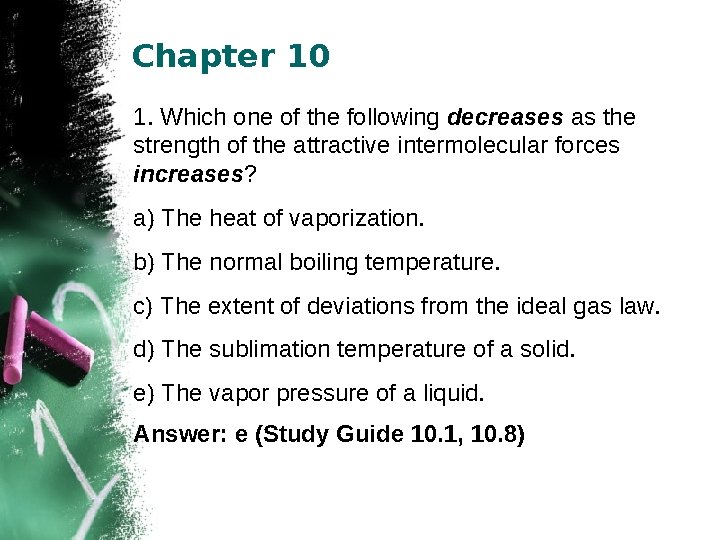
Chapter 10 1. Which one of the following decreases as the strength of the attractive intermolecular forces increases? a) The heat of vaporization. b) The normal boiling temperature. c) The extent of deviations from the ideal gas law. d) The sublimation temperature of a solid. e) The vapor pressure of a liquid. Answer: e (Study Guide 10. 1, 10. 8)
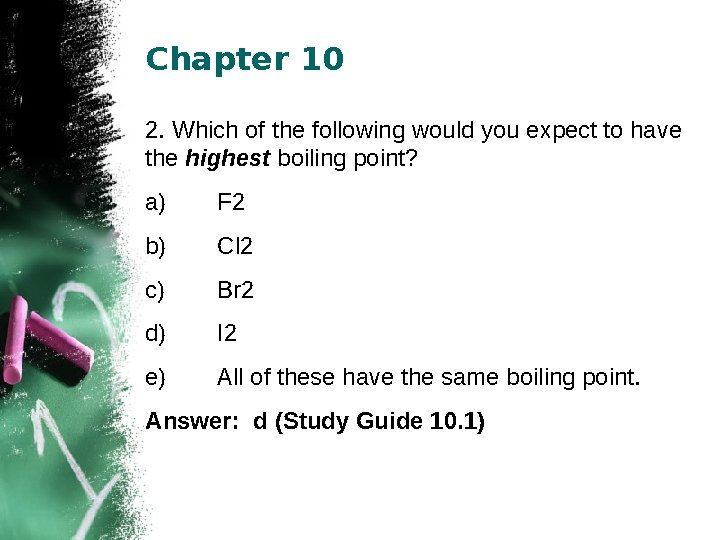
Chapter 10 2. Which of the following would you expect to have the highest boiling point? a) F 2 b) Cl 2 c) Br 2 d) I 2 e) All of these have the same boiling point. Answer: d (Study Guide 10. 1)
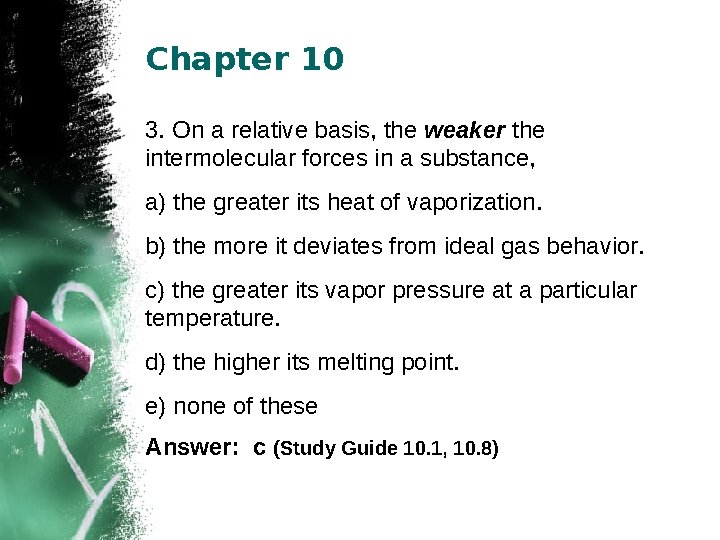
Chapter 10 3. On a relative basis, the weaker the intermolecular forces in a substance, a) the greater its heat of vaporization. b) the more it deviates from ideal gas behavior. c) the greater its vapor pressure at a particular temperature. d) the higher its melting point. e) none of these Answer: c (Study Guide 10. 1, 10. 8)
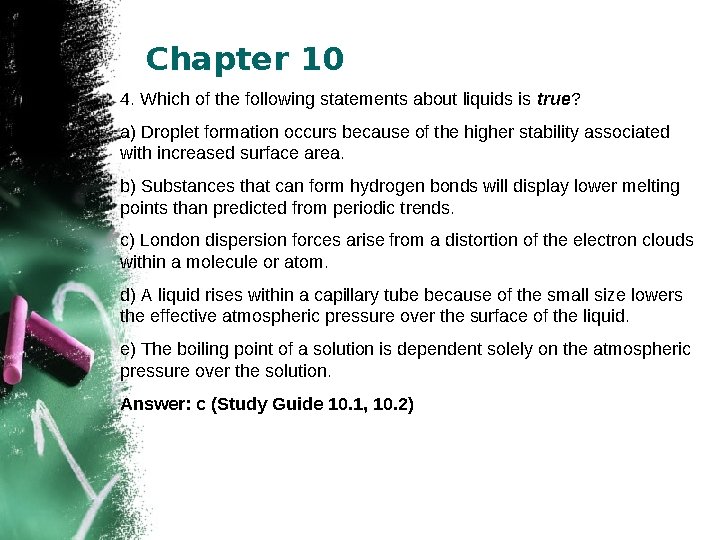
Chapter 10 4. Which of the following statements about liquids is true? a) Droplet formation occurs because of the higher stability associated with increased surface area. b) Substances that can form hydrogen bonds will display lower melting points than predicted from periodic trends. c) London dispersion forces arise from a distortion of the electron clouds within a molecule or atom. d) A liquid rises within a capillary tube because of the small size lowers the effective atmospheric pressure over the surface of the liquid. e) The boiling point of a solution is dependent solely on the atmospheric pressure over the solution. Answer: c (Study Guide 10. 1, 10. 2)
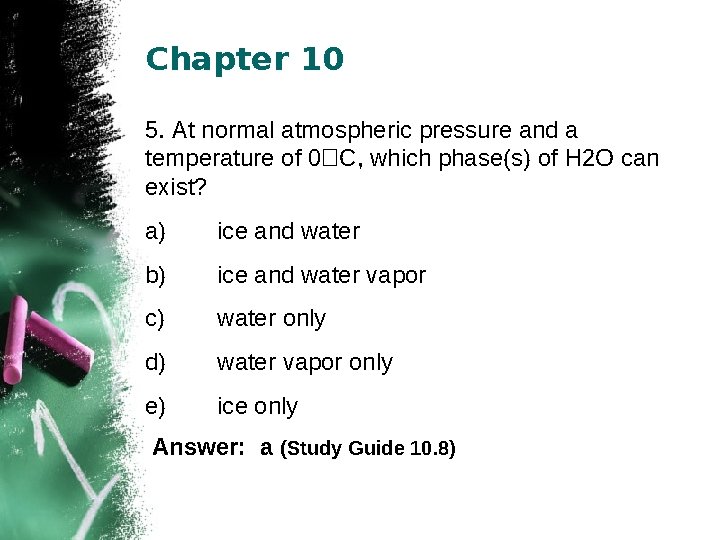
Chapter 10 5. At normal atmospheric pressure and a temperature of 0 C, which phase(s) of H 2 O can exist? a) ice and water b) ice and water vapor c) water only d) water vapor only e) ice only Answer: a (Study Guide 10. 8)
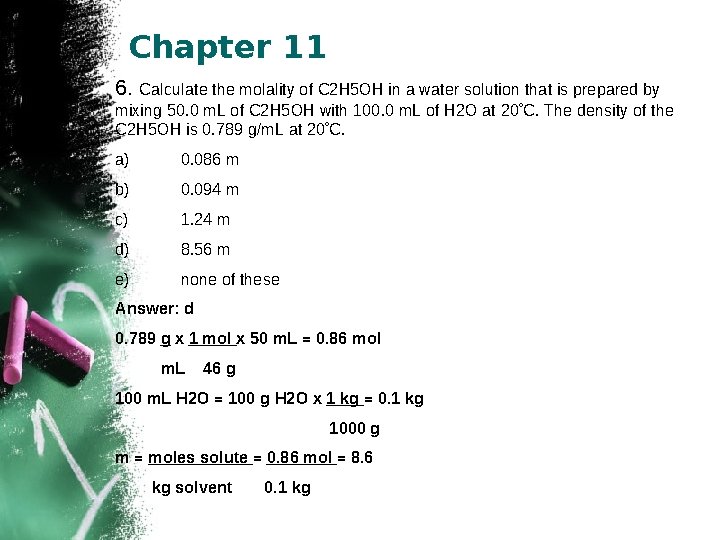
Chapter 11 6. Calculate the molality of C 2 H 5 OH in a water solution that is prepared by mixing 50. 0 m. L of C 2 H 5 OH with 100. 0 m. L of H 2 O at 20 C. The density of the C 2 H 5 OH is 0. 789 g/m. L at 20 C. a) 0. 086 m b) 0. 094 m c) 1. 24 m d) 8. 56 m e) none of these Answer: d 0. 789 g x 1 mol x 50 m. L = 0. 86 mol m. L 46 g 100 m. L H 2 O = 100 g H 2 O x 1 kg = 0. 1 kg 1000 g m = moles solute = 0. 86 mol = 8. 6 kg solvent 0. 1 kg
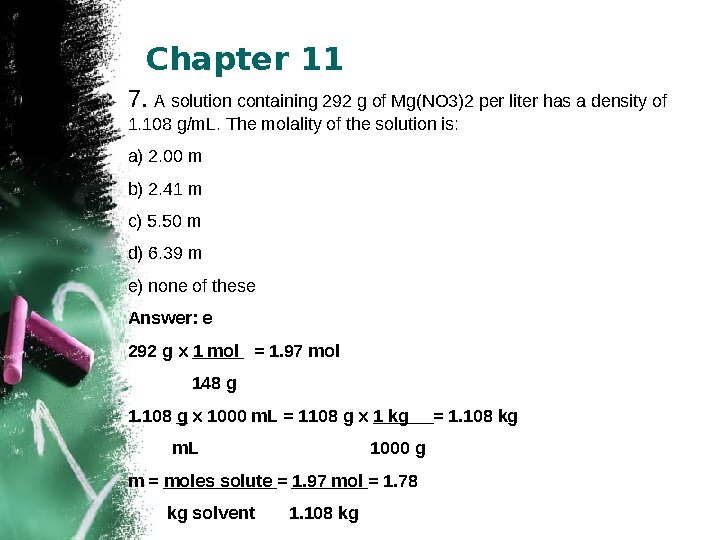
Chapter 11 7. A solution containing 292 g of Mg(NO 3)2 per liter has a density of 1. 108 g/m. L. The molality of the solution is: a) 2. 00 m b) 2. 41 m c) 5. 50 m d) 6. 39 m e) none of these Answer: e 292 g x 1 mol = 1. 97 mol 148 g 1. 108 g x 1000 m. L = 1108 g x 1 kg m. L 1000 g m = moles solute = 1. 97 mol = 1. 78 kg solvent 1. 108 kg = 1. 108 kg
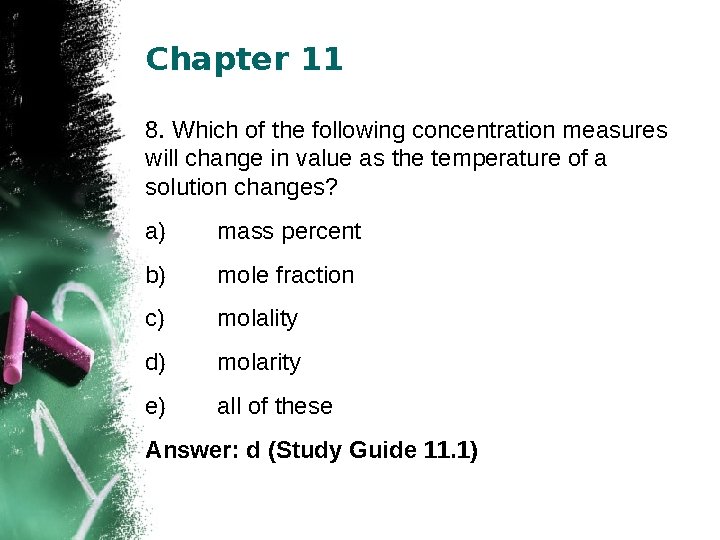
Chapter 11 8. Which of the following concentration measures will change in value as the temperature of a solution changes? a) mass percent b) mole fraction c) molality d) molarity e) all of these Answer: d (Study Guide 11. 1)
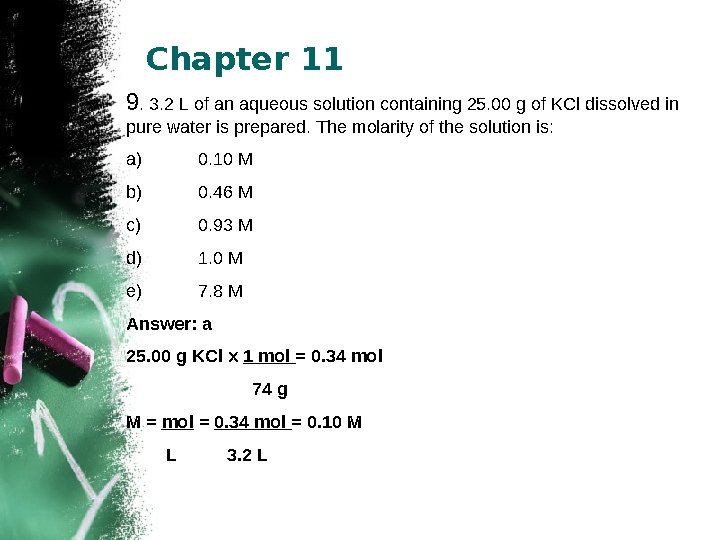
Chapter 11 9. 3. 2 L of an aqueous solution containing 25. 00 g of KCl dissolved in pure water is prepared. The molarity of the solution is: a) 0. 10 M b) 0. 46 M c) 0. 93 M d) 1. 0 M e) 7. 8 M Answer: a 25. 00 g KCl x 1 mol = 0. 34 mol 74 g M = mol = 0. 34 mol = 0. 10 M L 3. 2 L
Chapter 11 10. Which of the following favors the solubility of an ionic solid in a liquid solvent? a) a large magnitude of the solvation energy of the ions b) a small magnitude of the lattice energy of the solute c) a large polarity of the solvent d) all of these e) none of these Answer: d (Study Guide 11. 2)
Chapter 12 11. Consider the reaction 2 H 2 + O 2 -> 2 H 2 O What is the ratio of the initial rate of the appearance of water to the initial rate of disappearance of oxygen? a) 1: 1 b) 2: 1 c) 1: 2 d) 2: 2 e) 3: 2 Answer: b; 2 mol H 2 O : 1 mol O 2 2: 1 (Study Guide 12. 1)
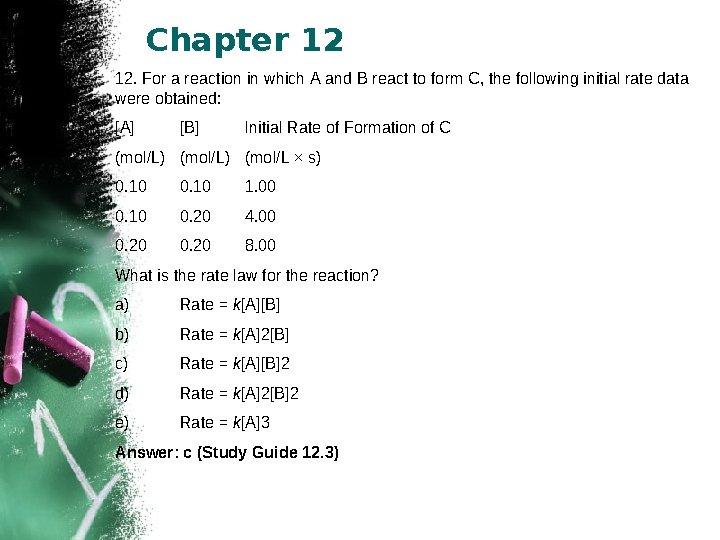
Chapter 12 12. For a reaction in which A and B react to form C, the following initial rate data were obtained: [A] [B] Initial Rate of Formation of C (mol/L) (mol/L × s) 0. 10 1. 00 0. 10 0. 20 4. 00 0. 20 8. 00 What is the rate law for the reaction? a) Rate = k[A][B] b) Rate = k[A]2[B] c) Rate = k[A][B]2 d) Rate = k[A]2[B]2 e) Rate = k[A]3 Answer: c (Study Guide 12. 3)
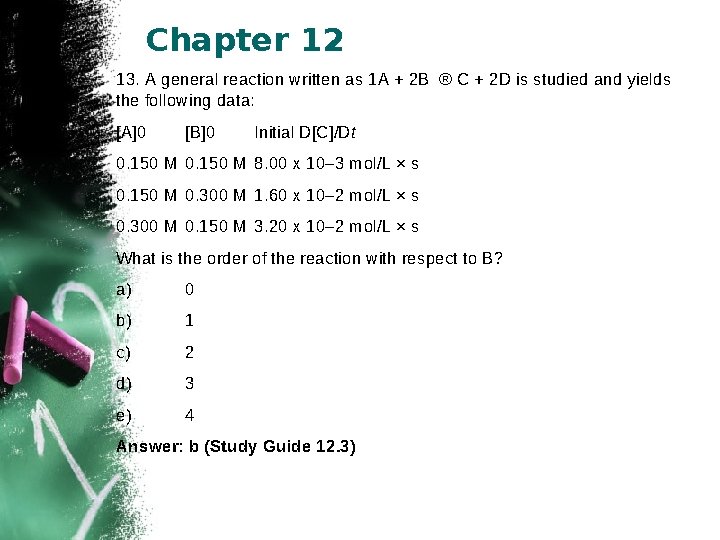
Chapter 12 13. A general reaction written as 1 A + 2 B ® C + 2 D is studied and yields the following data: [A]0 [B]0 Initial D[C]/Dt 0. 150 M 8. 00 x 10– 3 mol/L × s 0. 150 M 0. 300 M 1. 60 x 10– 2 mol/L × s 0. 300 M 0. 150 M 3. 20 x 10– 2 mol/L × s What is the order of the reaction with respect to B? a) 0 b) 1 c) 2 d) 3 e) 4 Answer: b (Study Guide 12. 3)
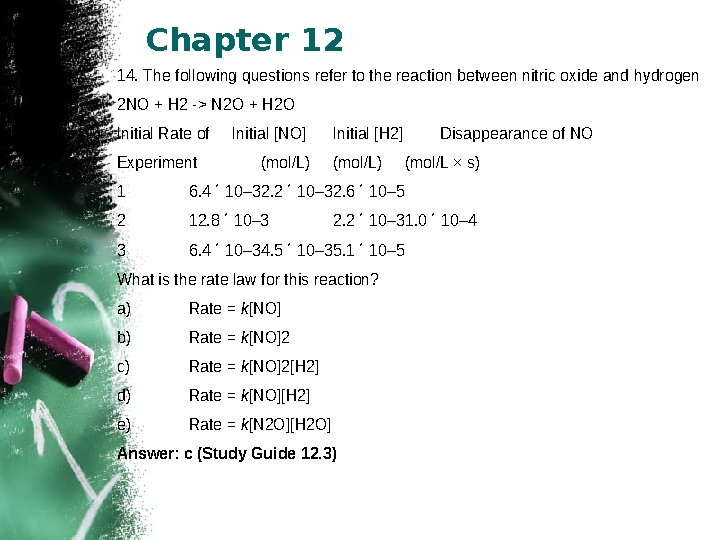
Chapter 12 14. The following questions refer to the reaction between nitric oxide and hydrogen 2 NO + H 2 -> N 2 O + H 2 O Initial Rate of Experiment Initial [NO] (mol/L) Initial [H 2] (mol/L) 1 6. 4 ´ 10– 32. 2 ´ 10– 32. 6 ´ 10– 5 2 12. 8 ´ 10– 3 3 6. 4 ´ 10– 34. 5 ´ 10– 35. 1 ´ 10– 5 Rate = k[NO] b) Rate = k[NO]2 c) Rate = k[NO]2[H 2] d) Rate = k[NO][H 2] e) Rate = k[N 2 O][H 2 O] (mol/L × s) 2. 2 ´ 10– 31. 0 ´ 10– 4 What is the rate law for this reaction? a) Disappearance of NO Answer: c (Study Guide 12. 3)
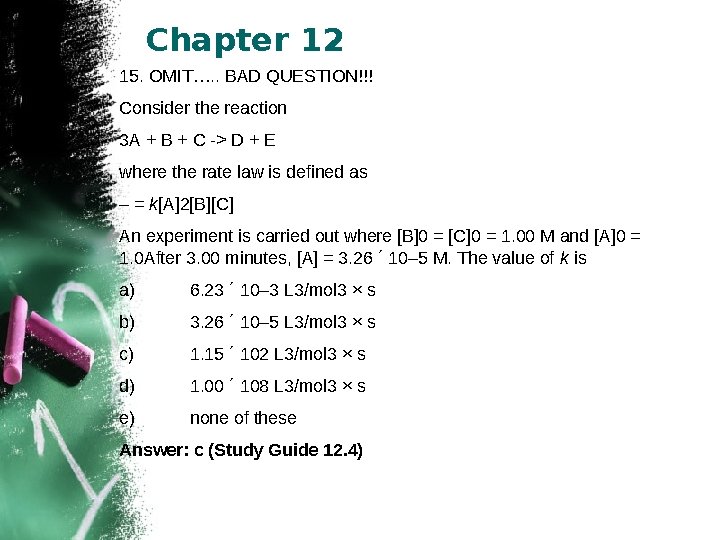
Chapter 12 15. OMIT…. . BAD QUESTION!!! Consider the reaction 3 A + B + C -> D + E where the rate law is defined as – = k[A]2[B][C] An experiment is carried out where [B]0 = [C]0 = 1. 00 M and [A]0 = 1. 0 After 3. 00 minutes, [A] = 3. 26 ´ 10– 5 M. The value of k is a) 6. 23 ´ 10– 3 L 3/mol 3 × s b) 3. 26 ´ 10– 5 L 3/mol 3 × s c) 1. 15 ´ 102 L 3/mol 3 × s d) 1. 00 ´ 108 L 3/mol 3 × s e) none of these Answer: c (Study Guide 12. 4)
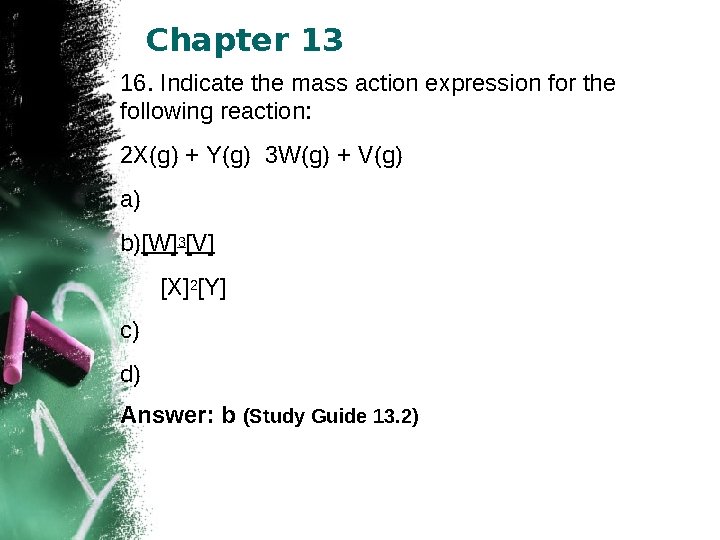
Chapter 13 16. Indicate the mass action expression for the following reaction: 2 X(g) + Y(g) 3 W(g) + V(g) a) b)[W]3[V] [X]2[Y] c) d) Answer: b (Study Guide 13. 2)
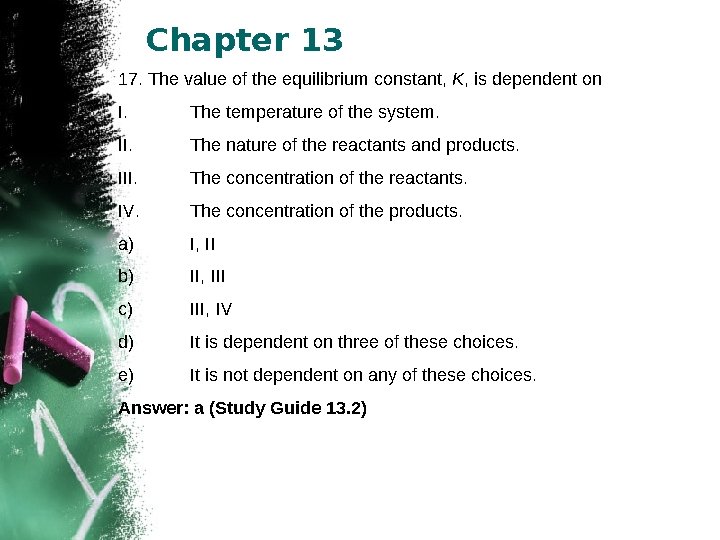
Chapter 13 17. The value of the equilibrium constant, K, is dependent on I. The temperature of the system. II. The nature of the reactants and products. III. The concentration of the reactants. IV. The concentration of the products. a) I, II b) II, III c) III, IV d) It is dependent on three of these choices. e) It is not dependent on any of these choices. Answer: a (Study Guide 13. 2)
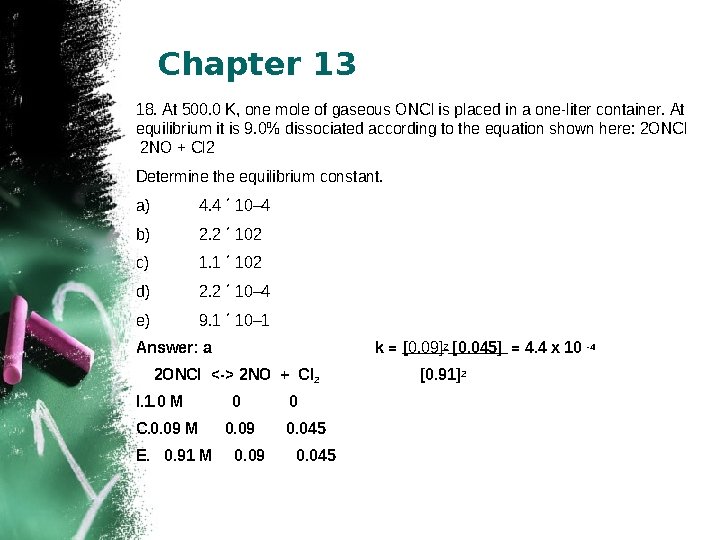
Chapter 13 18. At 500. 0 K, one mole of gaseous ONCl is placed in a one-liter container. At equilibrium it is 9. 0% dissociated according to the equation shown here: 2 ONCl 2 NO + Cl 2 Determine the equilibrium constant. a) 4. 4 ´ 10– 4 b) 2. 2 ´ 102 c) 1. 1 ´ 102 d) 2. 2 ´ 10– 4 e) 9. 1 ´ 10– 1 Answer: a k = [0. 09]2 [0. 045] = 4. 4 x 10 -4 2 ONCl <-> 2 NO + Cl 2 I. 1. 0 M C. 0. 09 M E. 0. 91 M 0 0. 09 0 0. 045 [0. 91]2
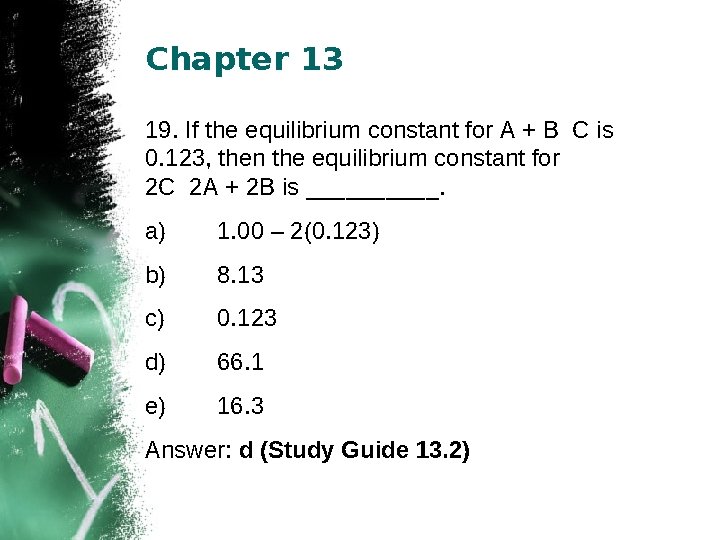
Chapter 13 19. If the equilibrium constant for A + B C is 0. 123, then the equilibrium constant for 2 C 2 A + 2 B is _____. a) 1. 00 – 2(0. 123) b) 8. 13 c) 0. 123 d) 66. 1 e) 16. 3 Answer: d (Study Guide 13. 2)
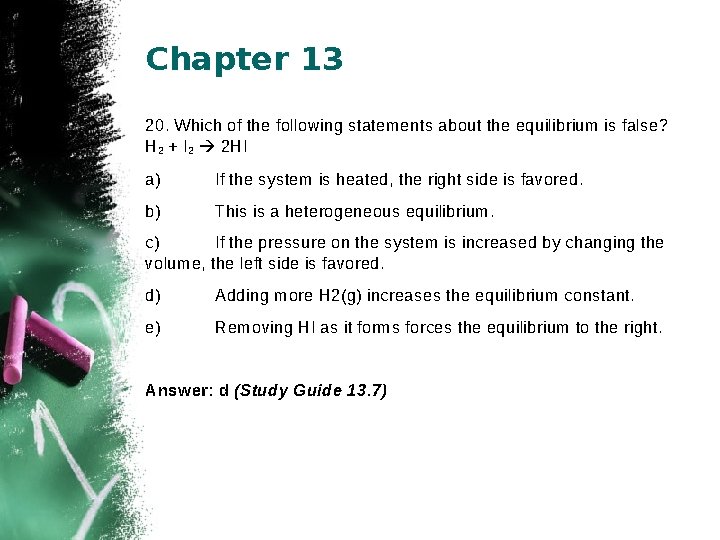
Chapter 13 20. Which of the following statements about the equilibrium is false? H 2 + I 2 2 HI a) If the system is heated, the right side is favored. b) This is a heterogeneous equilibrium. c) If the pressure on the system is increased by changing the volume, the left side is favored. d) Adding more H 2(g) increases the equilibrium constant. e) Removing HI as it forms forces the equilibrium to the right. Answer: d (Study Guide 13. 7)