
Trends Pathways for STEM Major Aspirants A Look
- Slides: 18
Trends & Pathways for STEM Major Aspirants: A Look at National Data Tanya Figueroa, Krystle P. Cobian, Sylvia Hurtado, & Kevin Eagan Understanding Interventions March 2017| San Antonio, Texas
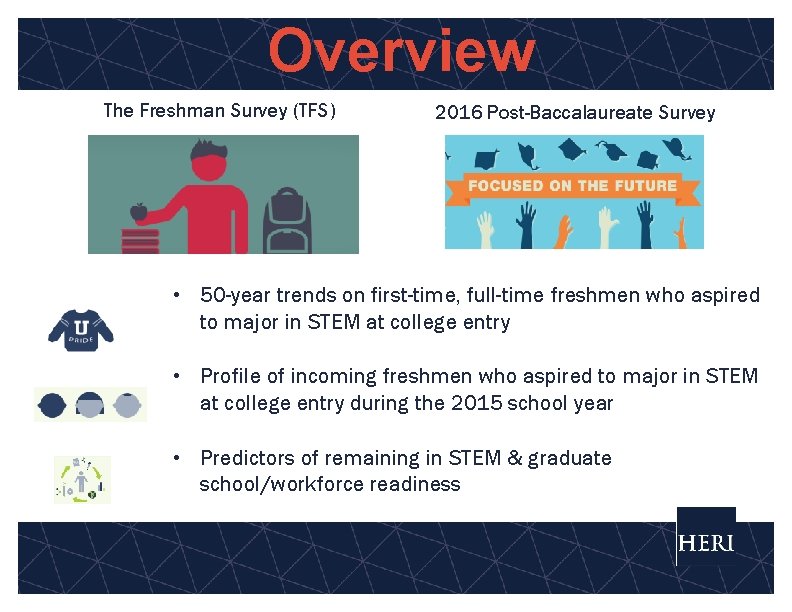
Overview The Freshman Survey (TFS) 2016 Post-Baccalaureate Survey • 50 -year trends on first-time, full-time freshmen who aspired to major in STEM at college entry • Profile of incoming freshmen who aspired to major in STEM at college entry during the 2015 school year • Predictors of remaining in STEM & graduate school/workforce readiness
50 Years of Aspirants
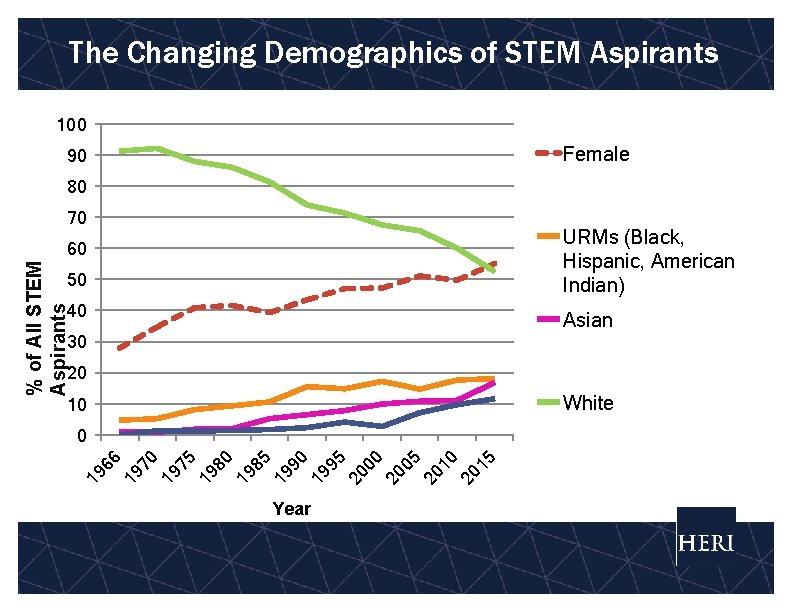
The Changing Demographics of STEM Aspirants 100 Female 90 80 70 URMs (Black, Hispanic, American Indian) % of All STEM Aspirants 60 50 40 Asian 30 20 White 10 19 66 19 70 19 75 19 80 19 85 19 90 19 95 20 00 20 05 20 10 20 15 0 Year
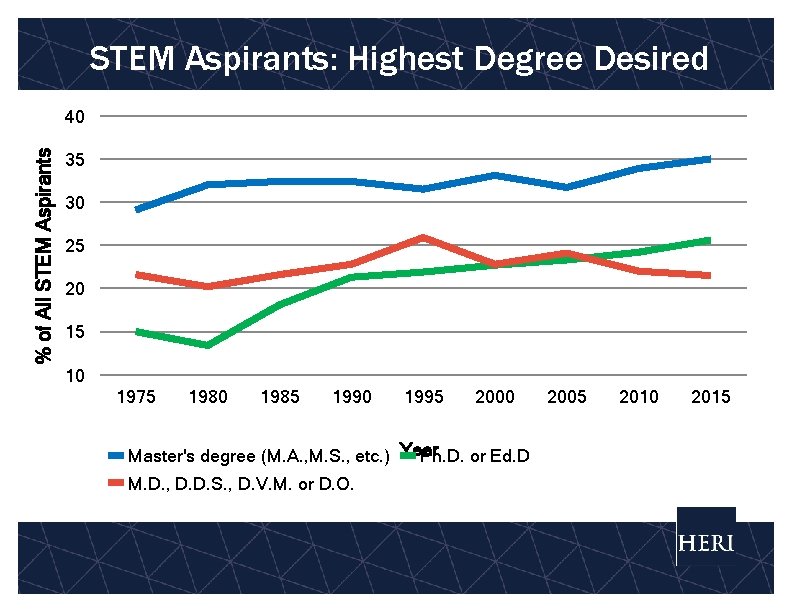
STEM Aspirants: Highest Degree Desired % of All STEM Aspirants 40 35 30 25 20 15 10 1975 1980 1985 1990 1995 2000 Master's degree (M. A. , M. S. , etc. ) Year Ph. D. or Ed. D M. D. , D. D. S. , D. V. M. or D. O. 2005 2010 2015
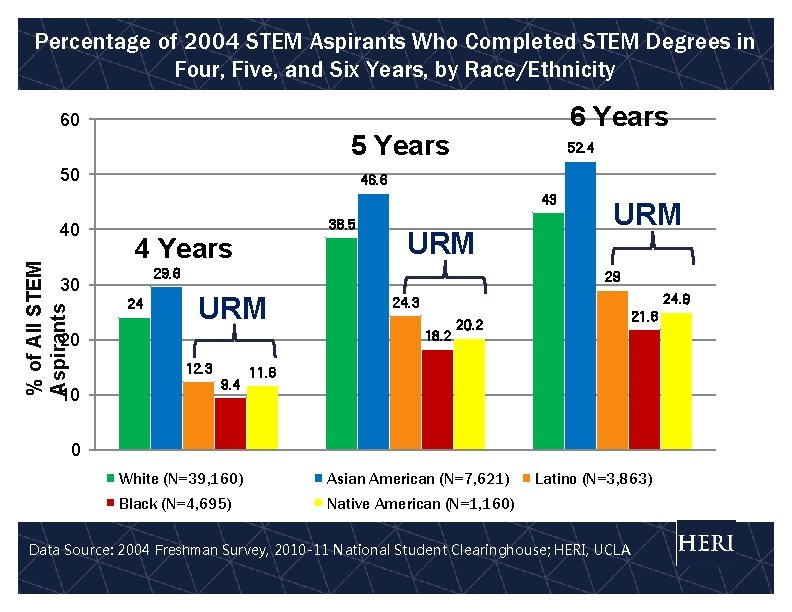
Percentage of 2004 STEM Aspirants Who Completed STEM Degrees in Four, Five, and Six Years, by Race/Ethnicity 60 6 Years 50 52. 4 46. 6 43 % of All STEM Aspirants 40 38. 5 4 Years 29. 6 30 24 29 URM 24. 9 24. 3 18. 2 20 12. 3 10 URM 9. 4 21. 8 20. 2 11. 6 0 White (N=39, 160) Asian American (N=7, 621) Black (N=4, 695) Native American (N=1, 160) Latino (N=3, 863) Data Source: 2004 Freshman Survey, 2010 -11 National Student Clearinghouse; HERI, UCLA
Characteristics of STEM Aspirants at College Entry
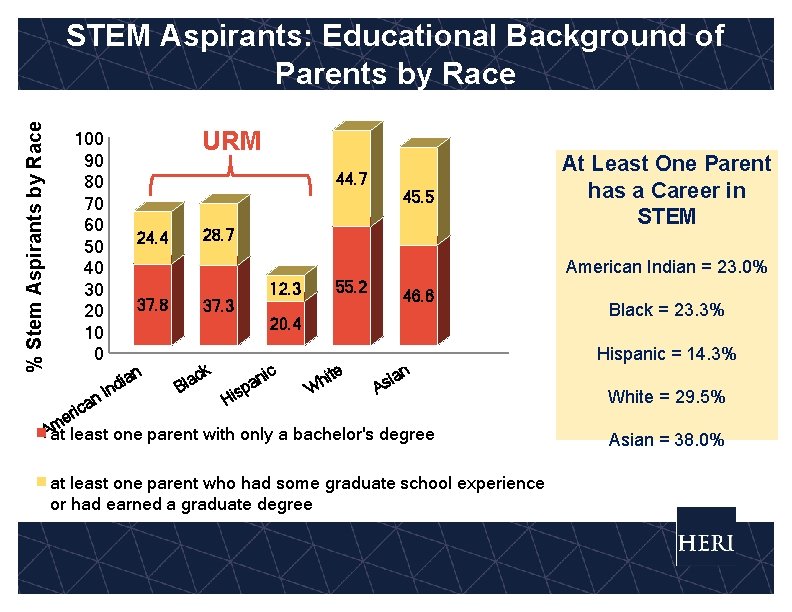
% Stem Aspirants by Race STEM Aspirants: Educational Background of Parents by Race URM 100 90 80 70 60 50 40 30 20 10 0 44. 7 24. 4 c eri 28. 7 American Indian = 23. 0% 37. 8 n an 45. 5 At Least One Parent has a Career in STEM ia d n I 37. 3 46. 6 20. 4 k c Bla 55. 2 12. 3 s Hi nic a p W e hit ian s A m Aat least one parent with only a bachelor's degree at least one parent who had some graduate school experience or had earned a graduate degree Black = 23. 3% Hispanic = 14. 3% White = 29. 5% Asian = 38. 0%
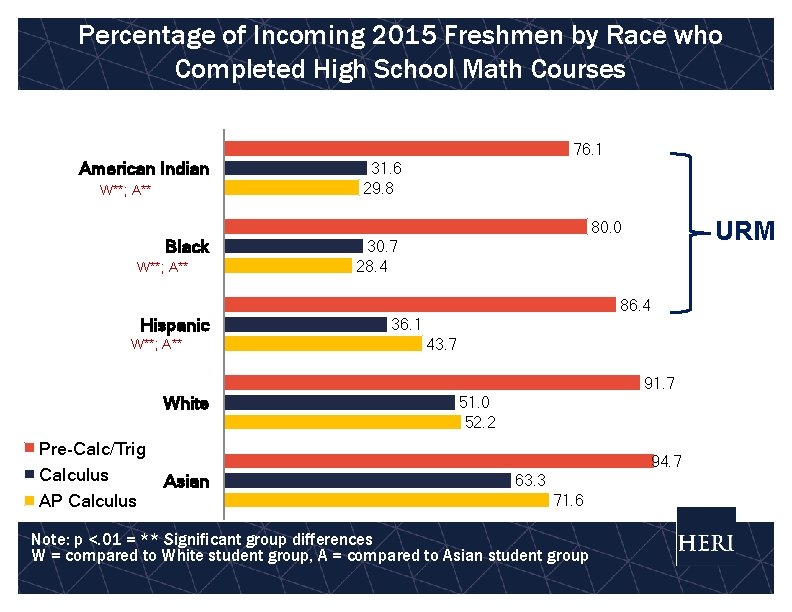
Percentage of Incoming 2015 Freshmen by Race who Completed High School Math Courses 76. 1 American Indian W**; A** 31. 6 29. 8 URM 80. 0 Black W**; A** 30. 7 28. 4 86. 4 Hispanic W**; A** 36. 1 43. 7 91. 7 White Pre-Calc/Trig Calculus AP Calculus 51. 0 52. 2 94. 7 Asian 63. 3 71. 6 Note: p <. 01 = ** Significant group differences W = compared to White student group, A = compared to Asian student group
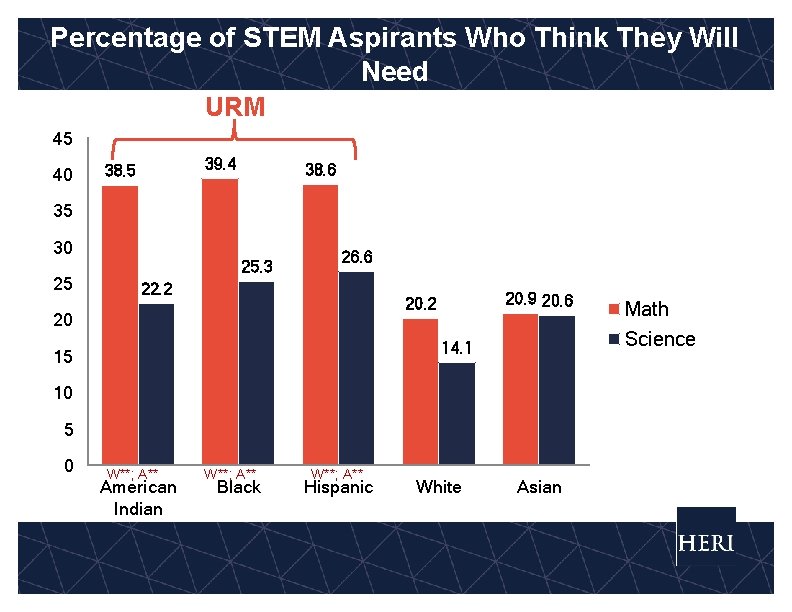
Percentage of STEM Aspirants Who Think They Will Need Tutoring or Remedial Work in Math or Science by Race URM 45 40 39. 4 38. 5 38. 6 35 30 25 25. 3 26. 6 22. 2 20. 9 20. 6 20. 2 20 14. 1 15 10 5 0 W**; A** American Indian W**; A** Black W**; A** Hispanic White Asian Math Science
STEM
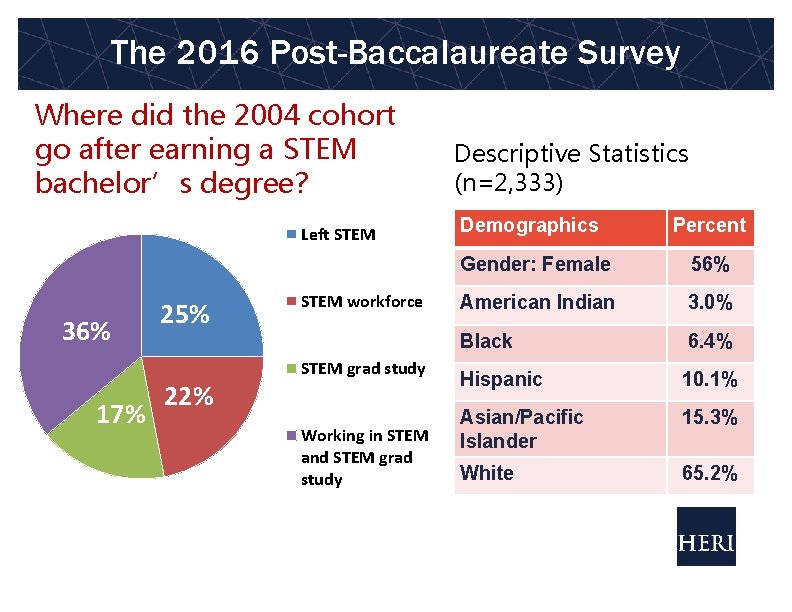
The 2016 Post-Baccalaureate Survey Where did the 2004 cohort go after earning a STEM bachelor’s degree? Left STEM 36% 17% 25% 22% STEM workforce STEM grad study Working in STEM and STEM grad study Descriptive Statistics (n=2, 333) Demographics Percent Gender: Female 56% American Indian 3. 0% Black 6. 4% Hispanic 10. 1% Asian/Pacific Islander 15. 3% White 65. 2%
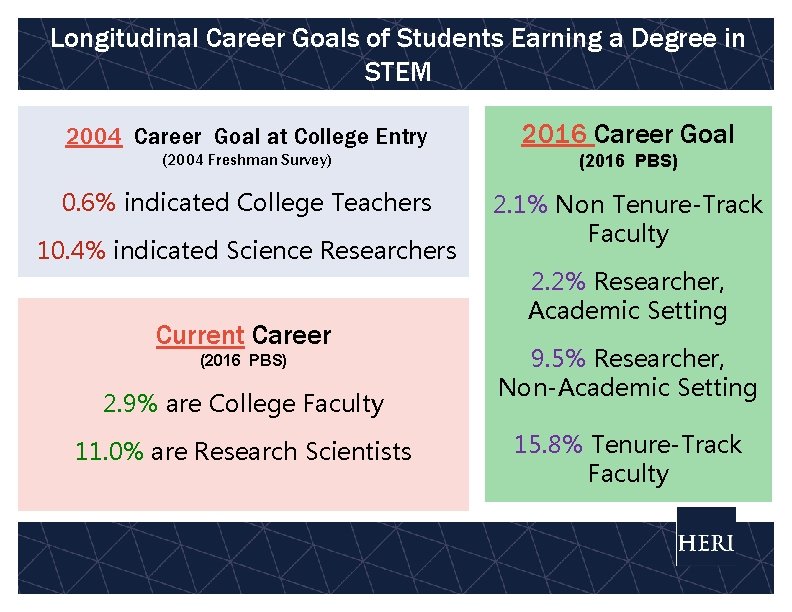
Longitudinal Career Goals of Students Earning a Degree in STEM 2004 Career Goal at College Entry 2016 Career Goal (2004 Freshman Survey) (2016 PBS) 0. 6% indicated College Teachers 2. 1% Non Tenure-Track Faculty 10. 4% indicated Science Researchers Current Career (2016 PBS) 2. 9% are College Faculty 11. 0% are Research Scientists 2. 2% Researcher, Academic Setting 9. 5% Researcher, Non-Academic Setting 15. 8% Tenure-Track Faculty
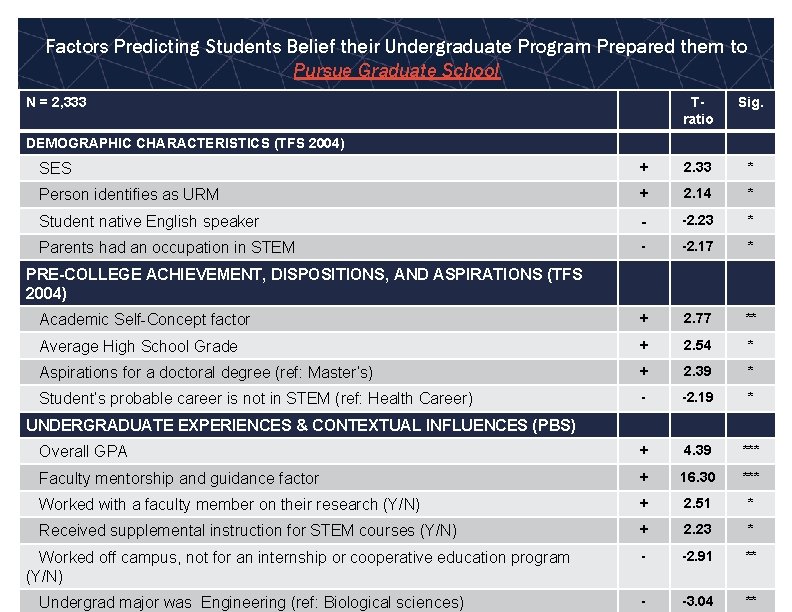
Factors Predicting Students Belief their Undergraduate Program Prepared them to Pursue Graduate School N = 2, 333 Tratio Sig. DEMOGRAPHIC CHARACTERISTICS (TFS 2004) SES + 2. 33 * Person identifies as URM + 2. 14 * Student native English speaker - -2. 23 * Parents had an occupation in STEM - -2. 17 * Academic Self-Concept factor + 2. 77 ** Average High School Grade + 2. 54 * Aspirations for a doctoral degree (ref: Master’s) + 2. 39 * Student’s probable career is not in STEM (ref: Health Career) - -2. 19 * Overall GPA + 4. 39 *** Faculty mentorship and guidance factor + 16. 30 *** Worked with a faculty member on their research (Y/N) + 2. 51 * Received supplemental instruction for STEM courses (Y/N) + 2. 23 * - -2. 91 ** - -3. 04 ** PRE-COLLEGE ACHIEVEMENT, DISPOSITIONS, AND ASPIRATIONS (TFS 2004) UNDERGRADUATE EXPERIENCES & CONTEXTUAL INFLUENCES (PBS) Worked off campus, not for an internship or cooperative education program (Y/N) Undergrad major was Engineering (ref: Biological sciences)
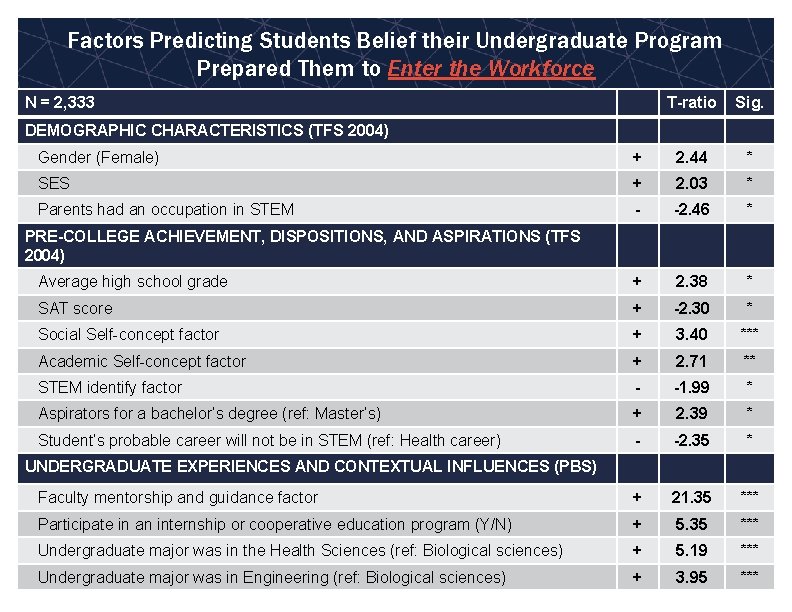
Factors Predicting Students Belief their Undergraduate Program Prepared Them to Enter the Workforce N = 2, 333 Ability to Enter Workforce T-ratio Sig. DEMOGRAPHIC CHARACTERISTICS (TFS 2004) Gender (Female) + 2. 44 * SES + 2. 03 * Parents had an occupation in STEM - -2. 46 * Average high school grade + 2. 38 * SAT score + -2. 30 * Social Self-concept factor + 3. 40 *** Academic Self-concept factor + 2. 71 ** STEM identify factor - -1. 99 * Aspirators for a bachelor’s degree (ref: Master’s) + 2. 39 * Student‘s probable career will not be in STEM (ref: Health career) - -2. 35 * Faculty mentorship and guidance factor + 21. 35 *** Participate in an internship or cooperative education program (Y/N) + 5. 35 *** Undergraduate major was in the Health Sciences (ref: Biological sciences) + 5. 19 *** Undergraduate major was in Engineering (ref: Biological sciences) + 3. 95 *** PRE-COLLEGE ACHIEVEMENT, DISPOSITIONS, AND ASPIRATIONS (TFS 2004) UNDERGRADUATE EXPERIENCES AND CONTEXTUAL INFLUENCES (PBS)
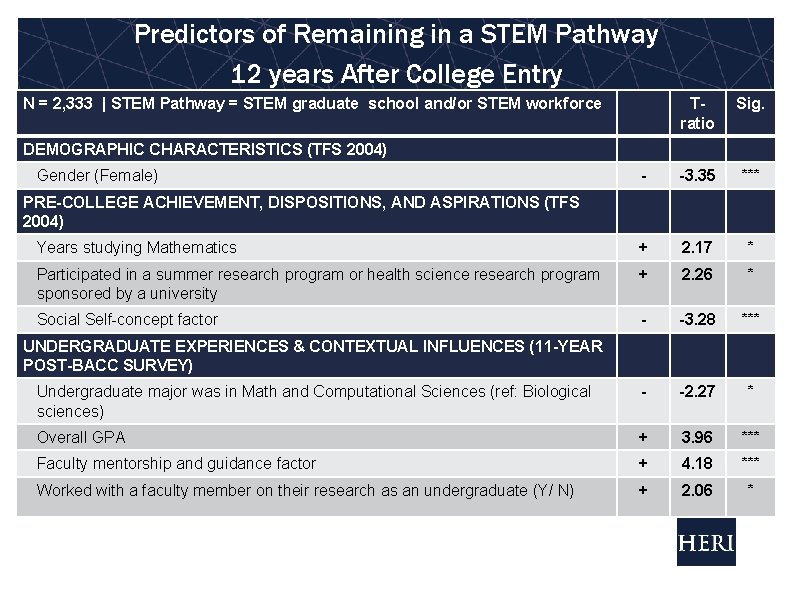
Predictors of Remaining in a STEM Pathway 12 years After College Entry N = 2, 333 | STEM Pathway = STEM graduate school and/or STEM workforce Tratio Sig. - -3. 35 *** Years studying Mathematics + 2. 17 * Participated in a summer research program or health science research program sponsored by a university + 2. 26 * Social Self-concept factor - -3. 28 *** Undergraduate major was in Math and Computational Sciences (ref: Biological sciences) - -2. 27 * Overall GPA + 3. 96 *** Faculty mentorship and guidance factor + 4. 18 *** Worked with a faculty member on their research as an undergraduate (Y/ N) + 2. 06 * DEMOGRAPHIC CHARACTERISTICS (TFS 2004) Gender (Female) PRE-COLLEGE ACHIEVEMENT, DISPOSITIONS, AND ASPIRATIONS (TFS 2004) UNDERGRADUATE EXPERIENCES & CONTEXTUAL INFLUENCES (11 -YEAR POST-BACC SURVEY)
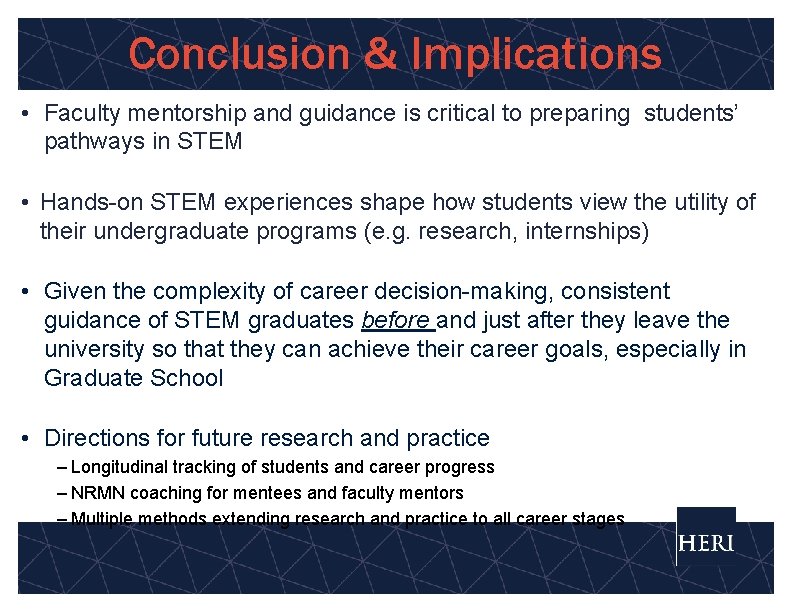
Conclusion & Implications • Faculty mentorship and guidance is critical to preparing students’ pathways in STEM • Hands-on STEM experiences shape how students view the utility of their undergraduate programs (e. g. research, internships) • Given the complexity of career decision-making, consistent guidance of STEM graduates before and just after they leave the university so that they can achieve their career goals, especially in Graduate School • Directions for future research and practice – Longitudinal tracking of students and career progress – NRMN coaching for mentees and faculty mentors – Multiple methods extending research and practice to all career stages
Contact Us Faculty/Co-PIs: Sylvia Hurtado Kevin Eagan Postdoctoral Scholar: Administrative Staff: Tanya Figueroa Dominique Harrison Graduate Research Assistants: Ashlee Wilkins Tracy Teel Ana Gomez Damani White-Lewis Krystle Cobian Papers and reports are available for download from project website: http: //heri. ucla. edu/nih Project e-mail: herinih@ucla. edu