
Trends In Unlicensed Spread Spectrum Devices Presentation at
- Slides: 12
Trends In Unlicensed Spread Spectrum Devices Presentation at FCC Commission Meeting May 10, 2001 Office of Engineering and Technology Federal Communications Commission
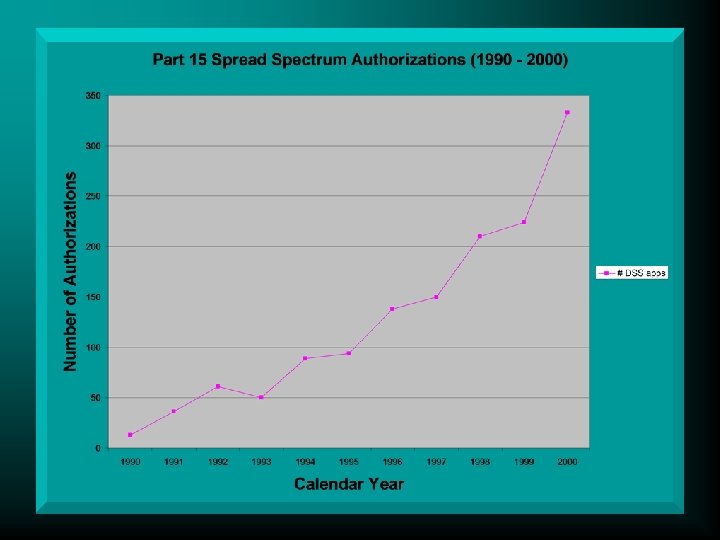
Birth of An Industry n Spread spectrum technology was originally developed for military applications n FCC first established provisions for Part 15 unlicensed spread spectrum devices in 1985 n Little activity in first few years n Then it started to grow!
Regulatory Principles n Minimal rules to control interference n Encourage innovation through flexibility n Adjust the rules periodically in response to technology advances & other developments n Broad rules provide a framework for the private sector to develop detailed standards
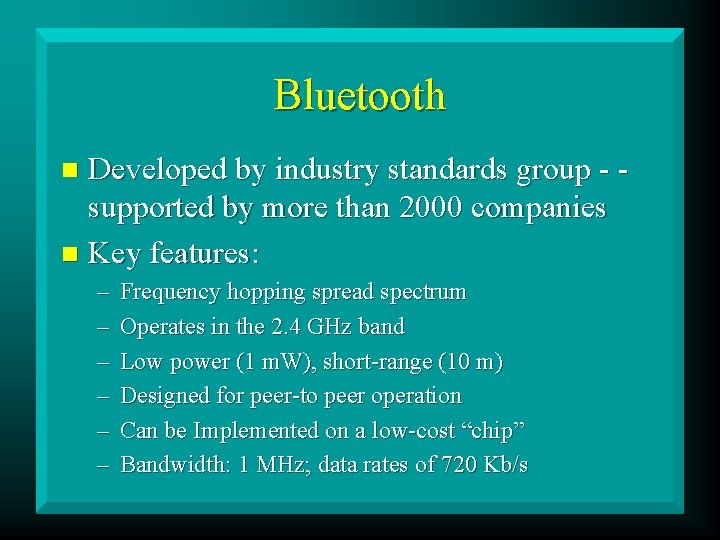
Bluetooth Developed by industry standards group - supported by more than 2000 companies n Key features: n – – – Frequency hopping spread spectrum Operates in the 2. 4 GHz band Low power (1 m. W), short-range (10 m) Designed for peer-to peer operation Can be Implemented on a low-cost “chip” Bandwidth: 1 MHz; data rates of 720 Kb/s
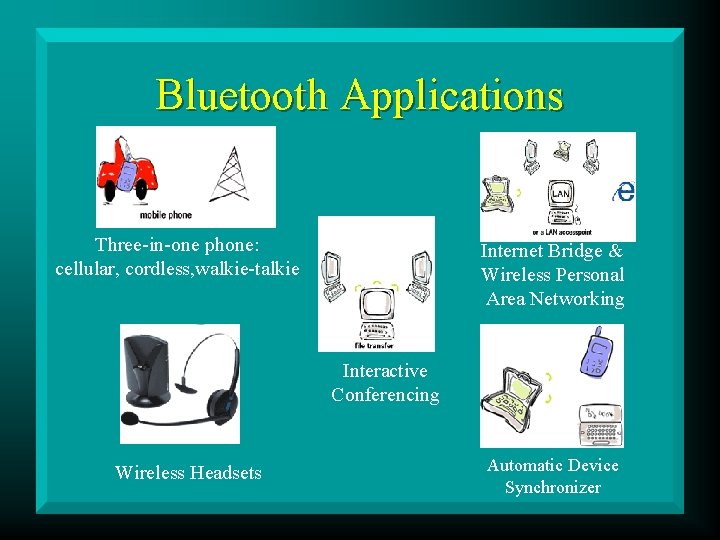
Bluetooth Applications Three-in-one phone: cellular, cordless, walkie-talkie Internet Bridge & Wireless Personal Area Networking Interactive Conferencing Wireless Headsets Automatic Device Synchronizer
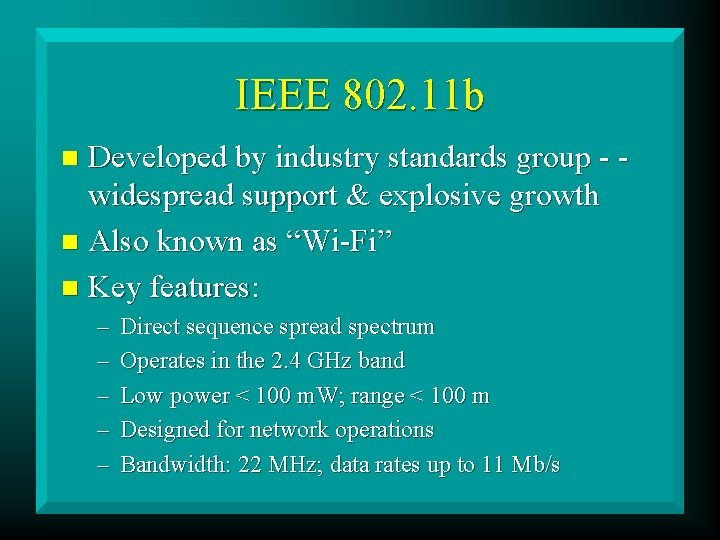
IEEE 802. 11 b Developed by industry standards group - widespread support & explosive growth n Also known as “Wi-Fi” n Key features: n – – – Direct sequence spread spectrum Operates in the 2. 4 GHz band Low power < 100 m. W; range < 100 m Designed for network operations Bandwidth: 22 MHz; data rates up to 11 Mb/s
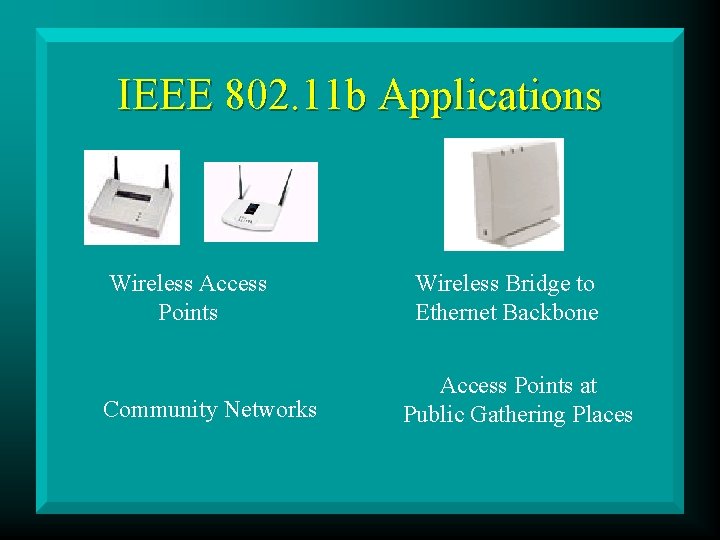
IEEE 802. 11 b Applications Wireless Access Points Community Networks Wireless Bridge to Ethernet Backbone Access Points at Public Gathering Places
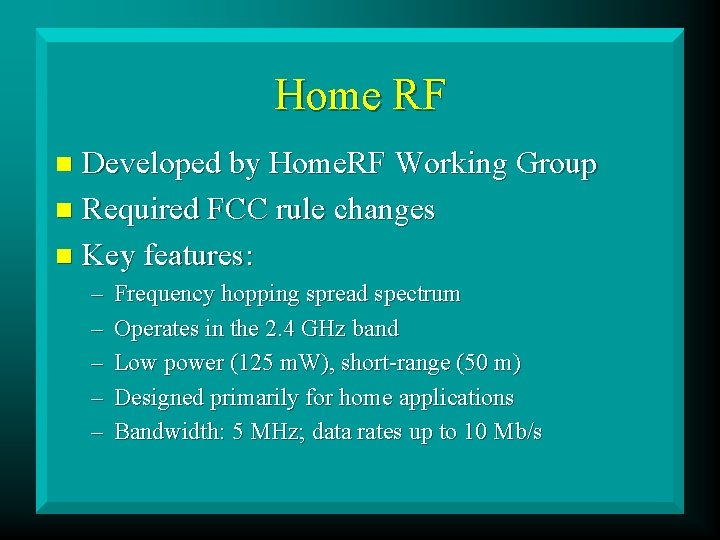
Home RF Developed by Home. RF Working Group n Required FCC rule changes n Key features: n – – – Frequency hopping spread spectrum Operates in the 2. 4 GHz band Low power (125 m. W), short-range (50 m) Designed primarily for home applications Bandwidth: 5 MHz; data rates up to 10 Mb/s
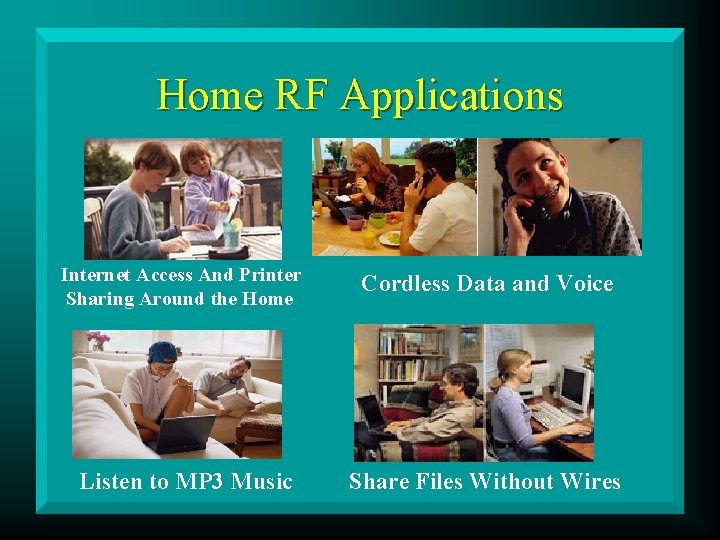
Home RF Applications Internet Access And Printer Sharing Around the Home Cordless Data and Voice Listen to MP 3 Music Share Files Without Wires
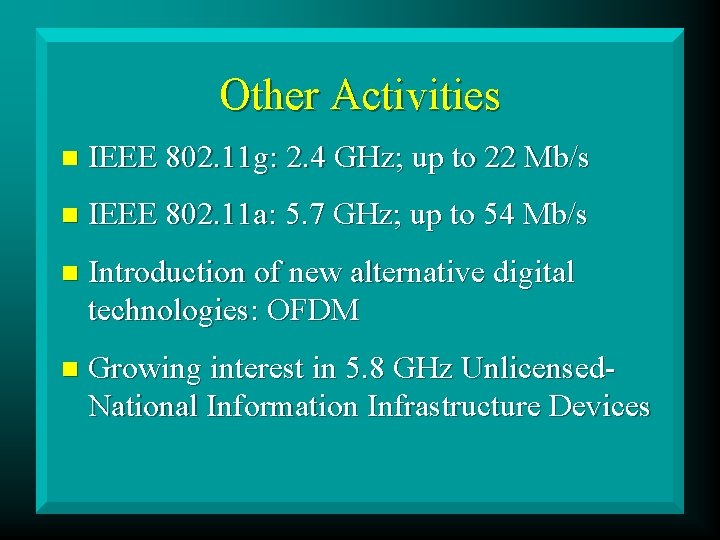
Other Activities n IEEE 802. 11 g: 2. 4 GHz; up to 22 Mb/s n IEEE 802. 11 a: 5. 7 GHz; up to 54 Mb/s n Introduction of new alternative digital technologies: OFDM n Growing interest in 5. 8 GHz Unlicensed. National Information Infrastructure Devices
Conclusion n Spread spectrum and other unlicensed technologies are evolving at a rapid pace n Benefits businesses and consumers n Rules require periodic review to eliminate impediments to new technology n Notice of Proposed Rule Making we are presenting advances this objective