
Trends in U S Electric Power Markets and

- Slides: 16
Trends in U. S. Electric Power Markets and Renewable Integration 18 December 2018 Erik Ela, Ph. D Principal Technical Leader eela@epri. com 21 st Century Power Partnership Webinar © 2015 Electric Power Research Institute, Inc. All rights reserved.
Agenda § North American ISO & RTO introduction – Current products and services § How does variable energy resources (wind and solar) impact market outcomes and changing design? § How are the markets evolving going forward due to changing resource mix? – Specific California Examples 2 © 2015 Electric Power Research Institute, Inc. All rights reserved.
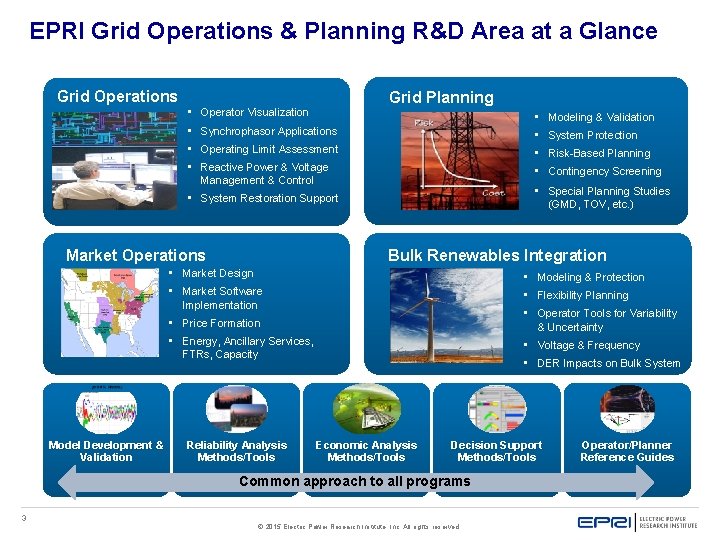
EPRI Grid Operations & Planning R&D Area at a Glance Grid Operations Grid Planning • Operator Visualization • Modeling & Validation • Synchrophasor Applications • System Protection • Operating Limit Assessment • Risk-Based Planning • Reactive Power & Voltage Management & Control • Contingency Screening • Special Planning Studies (GMD, TOV, etc. ) • System Restoration Support Bulk Renewables Integration Market Operations Model Development & Validation • Market Design • Modeling & Protection • Market Software Implementation • Flexibility Planning • Price Formation • Operator Tools for Variability & Uncertainty • Energy, Ancillary Services, FTRs, Capacity • Voltage & Frequency Reliability Analysis Methods/Tools Economic Analysis Methods/Tools • DER Impacts on Bulk System Decision Support Methods/Tools Common approach to all programs 3 © 2015 Electric Power Research Institute, Inc. All rights reserved. Operator/Planner Reference Guides
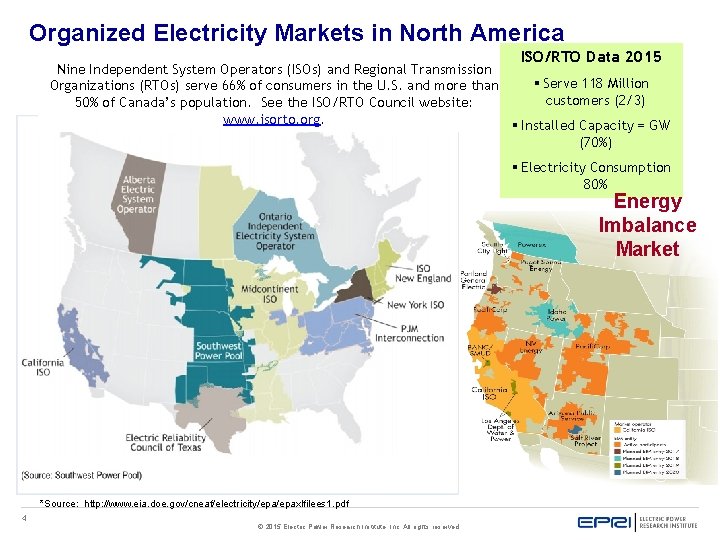
Organized Electricity Markets in North America ISO/RTO Data 2015 Nine Independent System Operators (ISOs) and Regional Transmission § Serve 118 Million Organizations (RTOs) serve 66% of consumers in the U. S. and more than customers (2/3) 50% of Canada’s population. See the ISO/RTO Council website: www. isorto. org. § Installed Capacity = GW (70%) § Electricity Consumption 80% Energy Imbalance Market *Source: http: //www. eia. doe. gov/cneaf/electricity/epaxlfilees 1. pdf 4 © 2015 Electric Power Research Institute, Inc. All rights reserved.
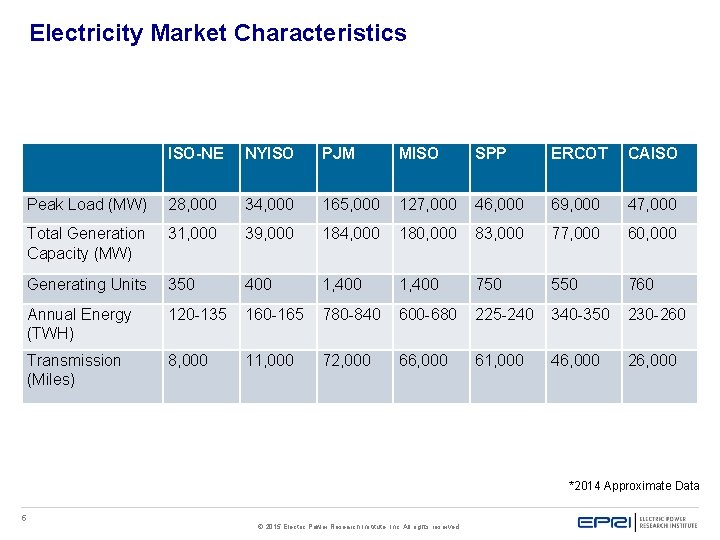
Electricity Market Characteristics ISO-NE NYISO PJM MISO Peak Load (MW) 28, 000 34, 000 165, 000 Total Generation Capacity (MW) 31, 000 39, 000 Generating Units 350 Annual Energy (TWH) Transmission (Miles) SPP ERCOT CAISO 127, 000 46, 000 69, 000 47, 000 184, 000 180, 000 83, 000 77, 000 60, 000 400 1, 400 750 550 760 120 -135 160 -165 780 -840 600 -680 225 -240 340 -350 230 -260 8, 000 11, 000 72, 000 66, 000 61, 000 46, 000 26, 000 *2014 Approximate Data 5 © 2015 Electric Power Research Institute, Inc. All rights reserved.
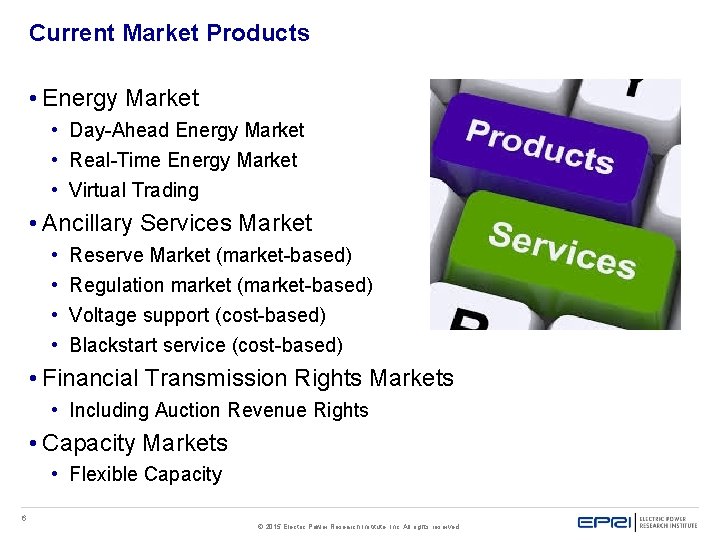
Current Market Products • Energy Market • Day-Ahead Energy Market • Real-Time Energy Market • Virtual Trading • Ancillary Services Market • • Reserve Market (market-based) Regulation market (market-based) Voltage support (cost-based) Blackstart service (cost-based) • Financial Transmission Rights Markets • Including Auction Revenue Rights • Capacity Markets • Flexible Capacity 6 © 2015 Electric Power Research Institute, Inc. All rights reserved.
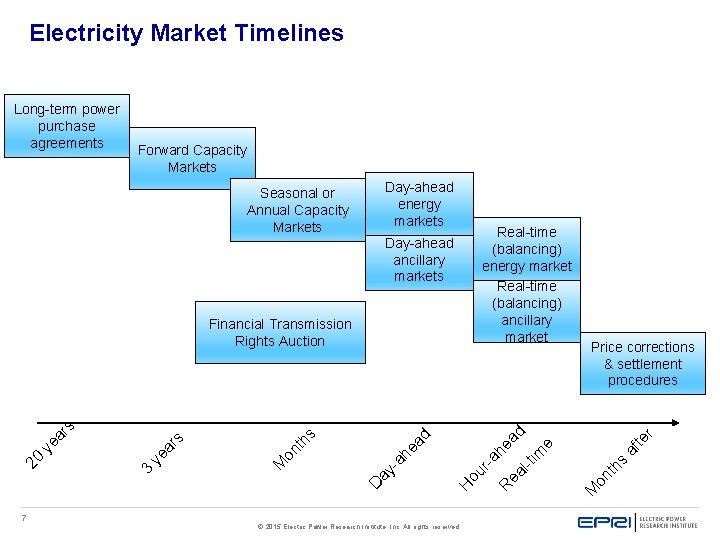
Electricity Market Timelines Long-term power purchase agreements Forward Capacity Markets Day-ahead energy markets Seasonal or Annual Capacity Markets Real-time (balancing) energy market Real-time (balancing) ancillary market Day-ahead ancillary markets Financial Transmission Rights Auction s r a e y 20 7 y 3 e s ar s h nt a he ah o M d d ea ay D © 2015 Electric Power Research Institute, Inc. All rights reserved. -a r u o H r te f a e it m la e R Price corrections & settlement procedures M hs t on
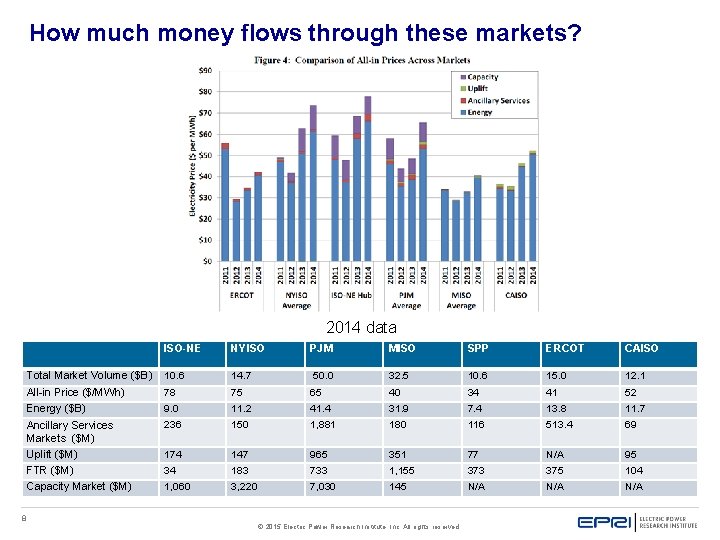
How much money flows through these markets? 2014 data 8 ISO-NE NYISO PJM MISO SPP ERCOT CAISO Total Market Volume ($B) 10. 6 14. 7 50. 0 32. 5 10. 6 15. 0 12. 1 All-in Price ($/MWh) Energy ($B) 78 75 65 40 34 41 52 9. 0 11. 2 41. 4 31. 9 7. 4 13. 8 11. 7 Ancillary Services Markets ($M) Uplift ($M) FTR ($M) Capacity Market ($M) 236 150 1, 881 180 116 513. 4 Potomac Economics, ERCOT State of the Market Report, 2014 69 174 147 965 351 77 N/A 95 34 183 733 1, 155 373 375 104 1, 060 3, 220 7, 030 145 N/A N/A © 2015 Electric Power Research Institute, Inc. All rights reserved.
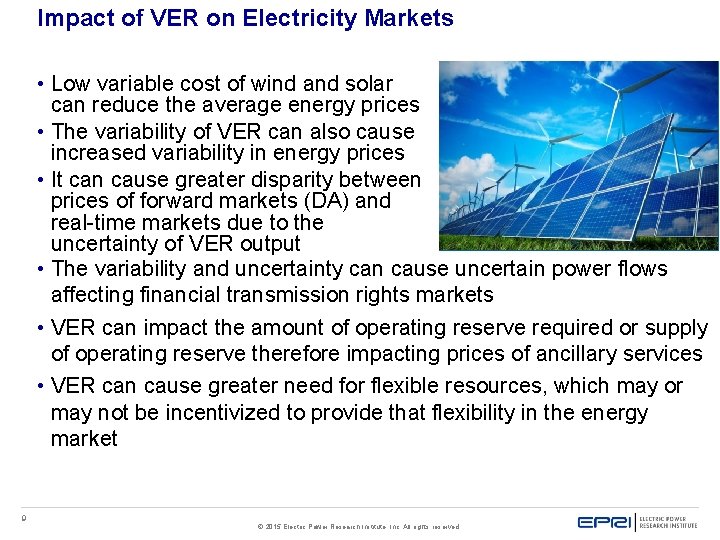
Impact of VER on Electricity Markets • Low variable cost of wind and solar can reduce the average energy prices • The variability of VER can also cause increased variability in energy prices • It can cause greater disparity between prices of forward markets (DA) and real-time markets due to the uncertainty of VER output • The variability and uncertainty can cause uncertain power flows affecting financial transmission rights markets • VER can impact the amount of operating reserve required or supply of operating reserve therefore impacting prices of ancillary services • VER can cause greater need for flexible resources, which may or may not be incentivized to provide that flexibility in the energy market 9 © 2015 Electric Power Research Institute, Inc. All rights reserved.
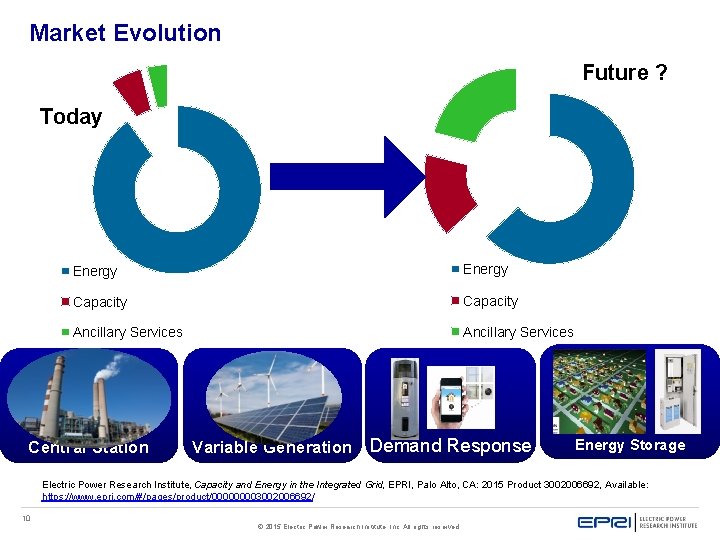
Market Evolution Future ? Today Energy Capacity Ancillary Services Central Station Variable Generation Demand Response Energy Storage Electric Power Research Institute, Capacity and Energy in the Integrated Grid, EPRI, Palo Alto, CA: 2015 Product 3002006692, Available: https: //www. epri. com/#/pages/product/00003002006692/ 10 © 2015 Electric Power Research Institute, Inc. All rights reserved.
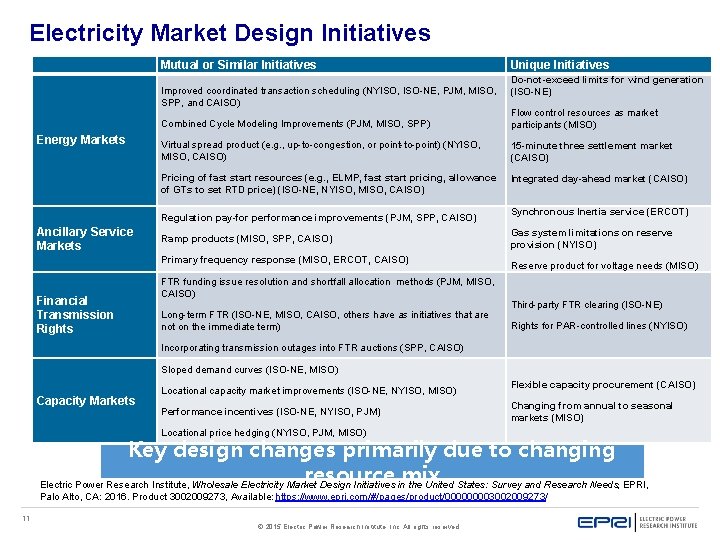
Electricity Market Design Initiatives Mutual or Similar Initiatives Improved coordinated transaction scheduling (NYISO, ISO-NE, PJM, MISO, SPP, and CAISO) Energy Markets Flow control resources as market participants (MISO) Virtual spread product (e. g. , up-to-congestion, or point-to-point) (NYISO, MISO, CAISO) 15 -minute three settlement market (CAISO) Pricing of fast start resources (e. g. , ELMP, fast start pricing, allowance of GTs to set RTD price) (ISO-NE, NYISO, MISO, CAISO) Integrated day-ahead market (CAISO) Ramp products (MISO, SPP, CAISO) Primary frequency response (MISO, ERCOT, CAISO) Financial Transmission Rights Do-not-exceed limits for wind generation (ISO-NE) Combined Cycle Modeling Improvements (PJM, MISO, SPP) Regulation pay-for performance improvements (PJM, SPP, CAISO) Ancillary Service Markets Unique Initiatives FTR funding issue resolution and shortfall allocation methods (PJM, MISO, CAISO) Long-term FTR (ISO-NE, MISO, CAISO, others have as initiatives that are not on the immediate term) Synchronous Inertia service (ERCOT) Gas system limitations on reserve provision (NYISO) Reserve product for voltage needs (MISO) Third-party FTR clearing (ISO-NE) Rights for PAR-controlled lines (NYISO) Incorporating transmission outages into FTR auctions (SPP, CAISO) Sloped demand curves (ISO-NE, MISO) Capacity Markets Locational capacity market improvements (ISO-NE, NYISO, MISO) Performance incentives (ISO-NE, NYISO, PJM) Flexible capacity procurement (CAISO) Changing from annual to seasonal markets (MISO) Locational price hedging (NYISO, PJM, MISO) Key design changes primarily due to changing resource mix Electric Power Research Institute, Wholesale Electricity Market Design Initiatives in the United States: Survey and Research Needs, EPRI, Palo Alto, CA: 2016. Product 3002009273, Available: https: //www. epri. com/#/pages/product/00003002009273/ 11 © 2015 Electric Power Research Institute, Inc. All rights reserved.
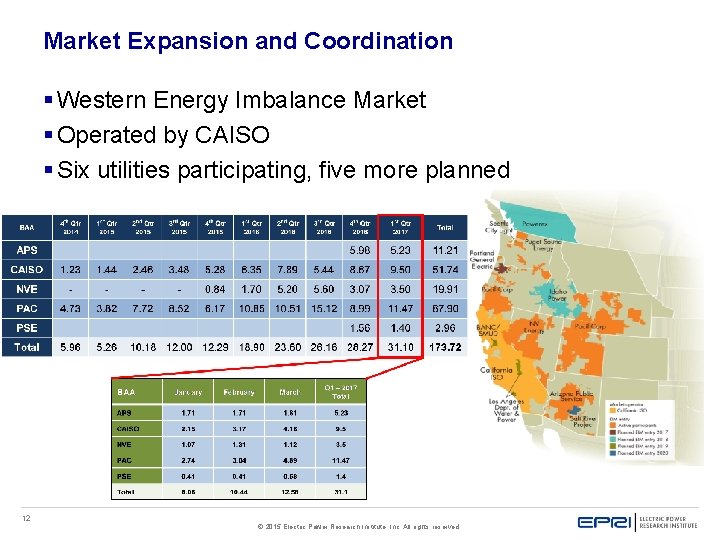
Market Expansion and Coordination § Western Energy Imbalance Market § Operated by CAISO § Six utilities participating, five more planned 12 © 2015 Electric Power Research Institute, Inc. All rights reserved.
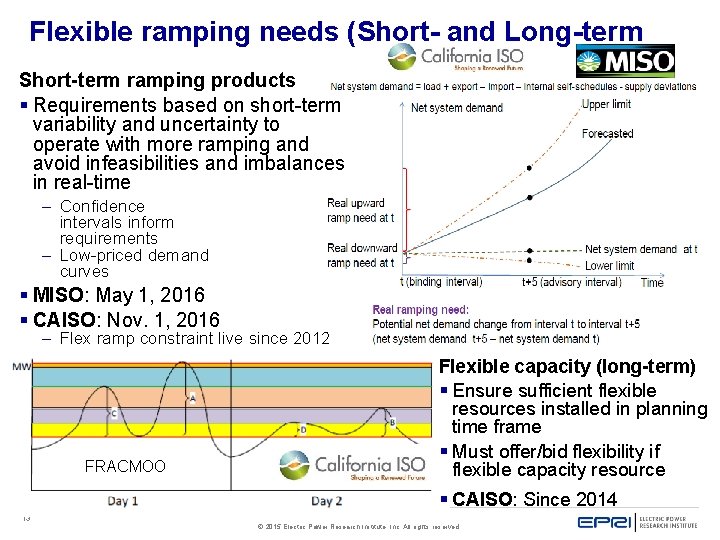
Flexible ramping needs (Short- and Long-term Short-term ramping products § Requirements based on short-term variability and uncertainty to operate with more ramping and avoid infeasibilities and imbalances in real-time – Confidence intervals inform requirements – Low-priced demand curves § MISO: May 1, 2016 § CAISO: Nov. 1, 2016 – Flex ramp constraint live since 2012 FRACMOO Flexible capacity (long-term) § Ensure sufficient flexible resources installed in planning time frame § Must offer/bid flexibility if flexible capacity resource § CAISO: Since 2014 13 © 2015 Electric Power Research Institute, Inc. All rights reserved.
Greatest R&D Challenges § More resources may be needed for fewer periods, but still needed – Do they have the long-term incentives to avoid retirement? – Will demand response and a smarter grid reduce the need for resources? § Are there proper incentives to get the increased amount of flexibility on the system that is needed to maintain system reliability – Short-term: Attract available flexibility to provide this flexibility – Long-term: Attract new or existing facilities to build or modify with flexibility attributes § How are “essential reliability services” being incentivized – Services that used to be inherent that may be declining 14 © 2015 Electric Power Research Institute, Inc. All rights reserved.
Greatest R&D Challenges (2) § What is the right price? – Non-Convexities, uplift vs. price, out-of-market vs. in-the-market, alignment of pricing and reliability § How can the market function properly with new policies that favor technologies for reasons other than cost or reliability? – Environmental, job preservation, fuel diversity, local tax § Changing resource mixes have new characteristics: Technology agnostic vs. realism? – Energy storage technologies, demand response, renewables, distributed energy, natural gas § Simplicity vs. complexity – Do stochastics, reactive power, multi-state configurations need to be part of the market clearing? 15 © 2015 Electric Power Research Institute, Inc. All rights reserved.
Together…Shaping the Future of Electricity 16 © 2015 Electric Power Research Institute, Inc. All rights reserved.