
Trends in the periodic table Ionization Energy Atomic
Trends in the periodic table: Ionization Energy Atomic Radius Electron Affinity Electronegativity
Background • Electrons can jump between shells (Bohr’s model supported by line spectra) • The electrons can be pushed so far that they escape the attraction of the nucleus • Losing an electron is called ionization • An ion is an atom that has either a net positive or net negative charge • Q: what would the charge be on an atom that lost an electron? Gained two electrons? • A: +1 (because your losing a -ve electron) • A: -2 (because you gain 2 -ve electrons)
Atomic Radius • Is an estimate of the size of an atom from its nucleus to its outer perimeter • Measured in picometres (pm) = 1012
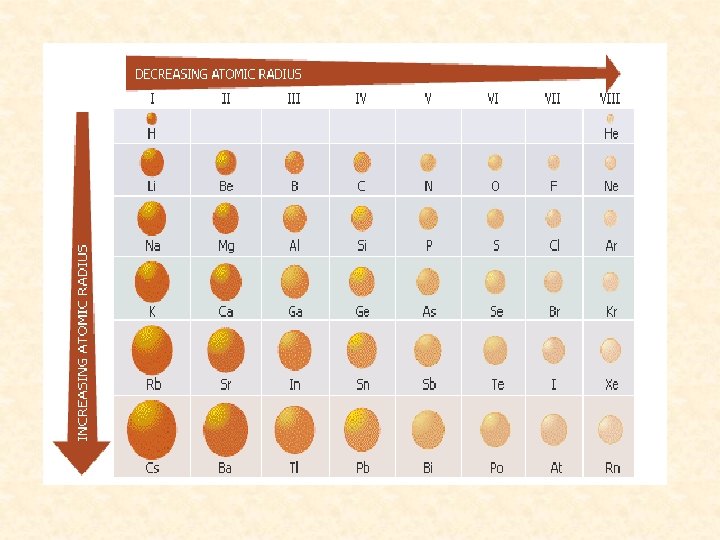
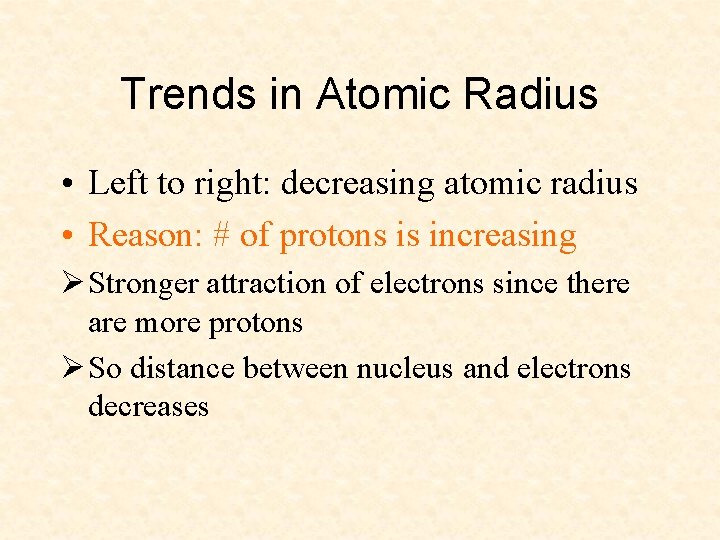
Trends in Atomic Radius • Left to right: decreasing atomic radius • Reason: # of protons is increasing Ø Stronger attraction of electrons since there are more protons Ø So distance between nucleus and electrons decreases

Atomic Radius Trends cont’d • Trend #2: down a group increasing atomic radius • Reason: # of electrons is increasing, therefore the number of shells increases AND screening effect occurs Ø More shells means that the electrons are further away from the nucleus Ø The electrons in the outer shells are also repelled by the negative charges of the inner electrons (screening effect)
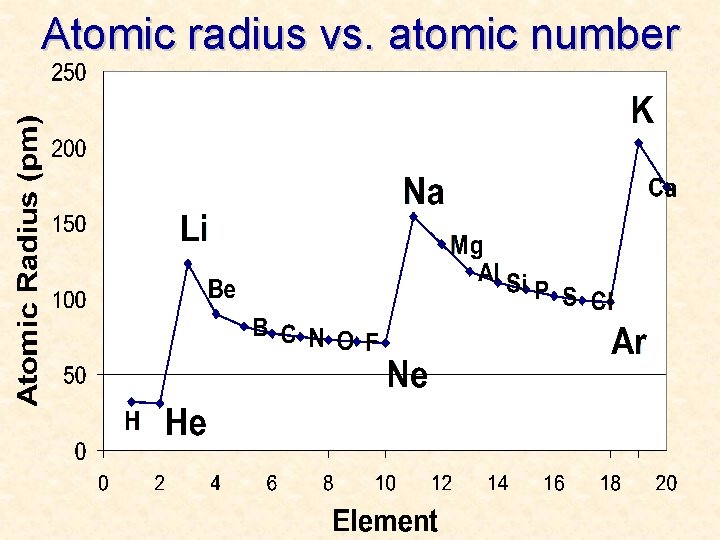
Atomic radius vs. atomic number
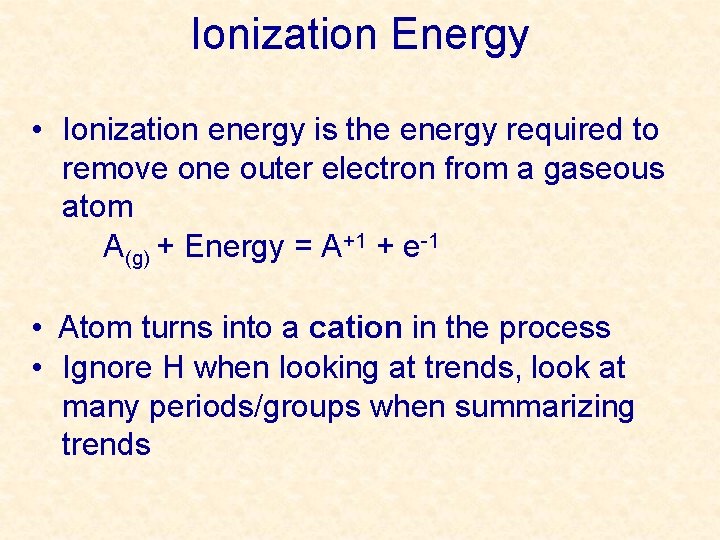
Ionization Energy • Ionization energy is the energy required to remove one outer electron from a gaseous atom A(g) + Energy = A+1 + e-1 • Atom turns into a cation in the process • Ignore H when looking at trends, look at many periods/groups when summarizing trends
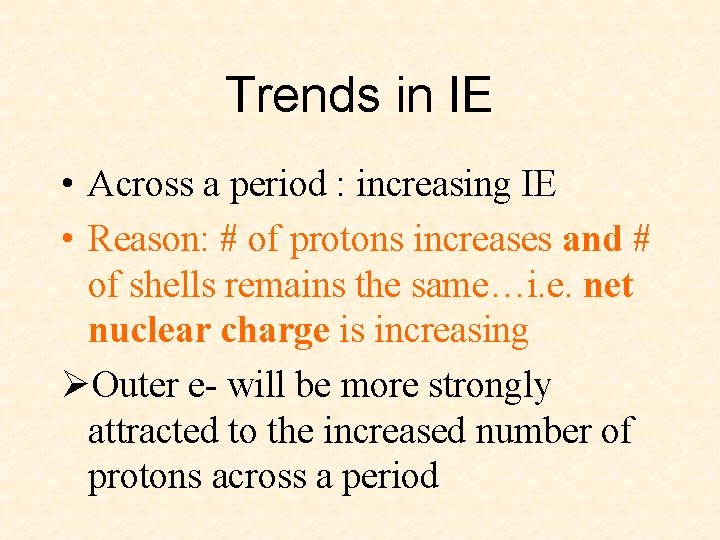
Trends in IE • Across a period : increasing IE • Reason: # of protons increases and # of shells remains the same…i. e. net nuclear charge is increasing ØOuter e- will be more strongly attracted to the increased number of protons across a period
Trends in IE cont’d • Down a group : decreasing IE • Reason : the number of electrons increases and so there are more shells. Since there are more shells, the e- are held more loosely. The e- are held more loosely since they are father away from the pull of the nucleus, making it easier to remove an e • Plus -the screening effect also contributes to the ease of removal of an e-

Ionization Energy vs. atomic #

Multiple Ionization Energies • It is possible to remove every single electron from an atom one at a time. • 1 st IE, 2 nd IE and 3 rd IE refer to the energy required to remove 1, 2 and 3 electrons • However, the amount of energy required to do this varies but follows a pattern • The pattern can be used to determine the group to which the element belongs… a sudden large increase between the amounts indicates that the octet is broken. Example: 3. 5 k. J, 32. 5 k. J, 38. 7 k. J …. difficult to remove the second electron. Element must have 1 valence. • What do you think the IE would be to remove one, two versus three electrons from Ba? ?
Electron Affinity • The energy released when an electron is added to a gaseous atom • A(g) + e-1 = A-1 + energy • The atom turns into an anion in the process • The process for fluorine can be represented as follows: F (g) + e- F- (g) + energy
Trends in EA • Across a period : increasing e- affinity • Reason: there is an increased nuclear attraction AND the elements on the right side of the table (except the noble gases) are close to achieving the full octet so they really want electrons! • The atoms on the left side don’t want them because they need to lose e- in order to achieve a full octet AND they have a weak nuclear charge
Trends in EA cont’d • Down a group: decreasing electron affinity • Reason: there are more orbitals and the atomic radius is greater. Since the atomic radius is greater there is less nuclear attraction so there is also less electron affinity.
The Relationship between IE and EA • A large value of IE indicates that the removal of an e- is difficult and so it probably won’t happen • On the other hand, a large EA value indicates that a lot of energy is released when an e- is added to an atom and so it would probably occur.
Electronegativity • A property that determines how strongly the electrons are held by an atom within a compound. • H : H H : F • An atom that is highly electronegative would be small (since the strength of the nuclear pull decreases with distance) and have close to an octet to begin with…like F • Values were determined by a scientist named Pauling and are relative to each other…thus no units for EN
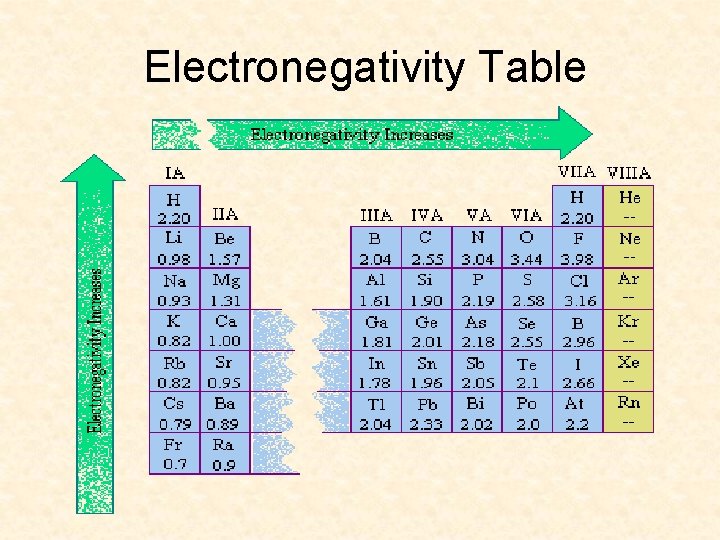
Electronegativity Table
Trends in EN • EN increases across a period • EN can be explained in terms of atomic structure. Across a period, the number of protons increases and the number of shells remains the same. • Therefore, the shared e- on the periphery will be more strongly attracted to the nucleus, giving a higher EN
Trends in EN cont’d • EN decreases down a group • The reason for this is that there are greater numbers of shells. The outer eexperience a shielding effect and therefore don’t feel the pull of the protons as much as the inner electrons.
Let’s see • F is the most electronegative atom (value of 4. 0) • O is very electronegativity (value of 3. 4) • N, Cl are Br are next with values close to 3. 0 • Clem said “Chemistry is FON Bruce”! • Lowest value is Fr (0. 7) • Noble gases do not have EN values
∆EN or END • The electronegativity difference (∆ EN or END) is important in a molecular compound…the value tells you if there is unequal sharing between atoms …which could lead to partial charges in the molecule …this could cause attraction between the molecules …properties like melting point would increase …the molecule could be polar and behave completely different than a non-polar molecule
Summarize all the periodic trends discussed Trend Atomic radius Ionization energy Electron affinity Electronegativity Across a period going left to right UP a group (bottom to top)
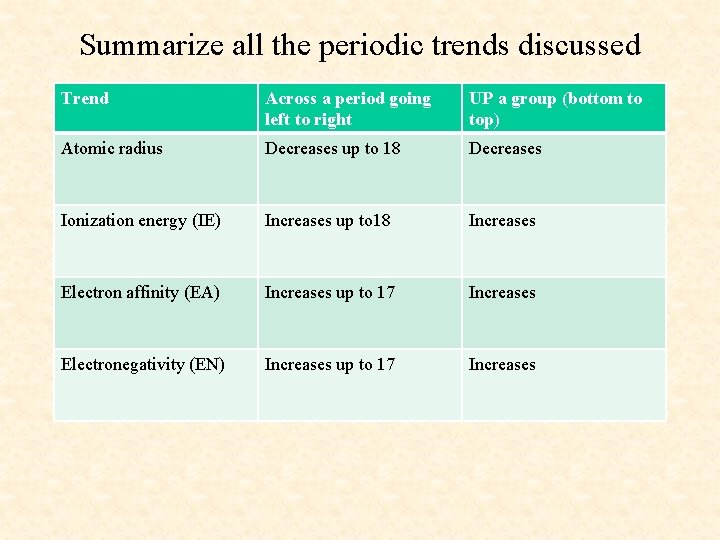
Summarize all the periodic trends discussed Trend Across a period going left to right UP a group (bottom to top) Atomic radius Decreases up to 18 Decreases Ionization energy (IE) Increases up to 18 Increases Electron affinity (EA) Increases up to 17 Increases Electronegativity (EN) Increases up to 17 Increases
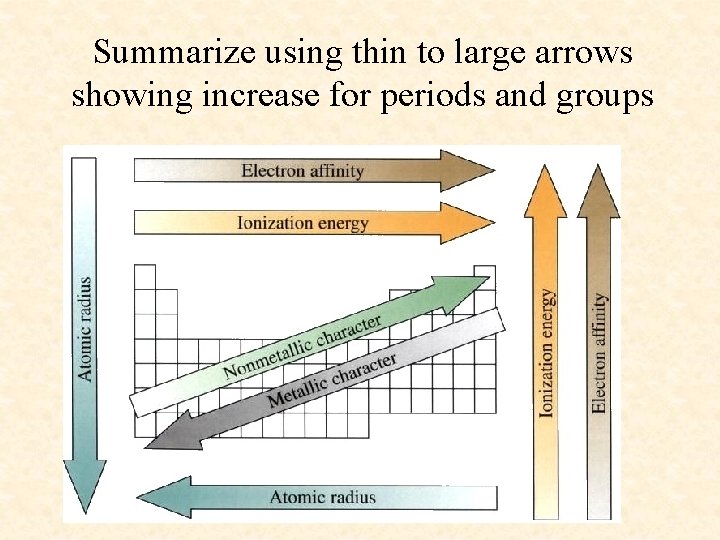
Summarize using thin to large arrows showing increase for periods and groups
- Slides: 25