
TRENDS IN THE PERIODIC TABLE ATOMIC RADIUS IONIZATION
TRENDS IN THE PERIODIC TABLE: ATOMIC RADIUS IONIZATION ENERGY ELECTRON AFFINITY ELECTRONEGATIVITY
CAN STUDYING CHEMISTRY BE TRENDY? As you look at the periodic table and focus in on the elements and their characteristics, you can see there are noticeable patterns (trends) that go across a period (horizontal row) on the periodic table. These quantitative characteristics that follow distinct patterns across the periodic table are called periodic trends. Remember…Mendeleev didn’t get all the fame and fortune for nothing – he was crazy smart! The periodic trends that we will be studying are: Atomic Radius Ionization Energy Electron Affinity Electronegativity
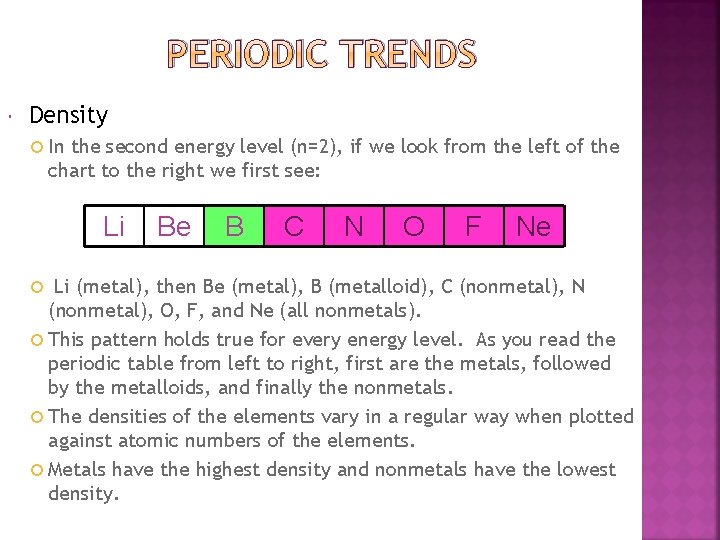
PERIODIC TRENDS Density In the second energy level (n=2), if we look from the left of the chart to the right we first see: Li Be B C N O F Ne Li (metal), then Be (metal), B (metalloid), C (nonmetal), N (nonmetal), O, F, and Ne (all nonmetals). This pattern holds true for every energy level. As you read the periodic table from left to right, first are the metals, followed by the metalloids, and finally the nonmetals. The densities of the elements vary in a regular way when plotted against atomic numbers of the elements. Metals have the highest density and nonmetals have the lowest density.
FACTORS AFFECTING PERIODIC TRENDS Influenced by Number of Energy Levels (Size) The distance between the nucleus and the outer electrons Higher energy levels are further away from the nucleus Electrons in these levels are affected less by the electrostatic pull towards the nucleus. Shielding Inner shell electrons have the ability to block the nuclear pull (charge on p+) on the outer electrons This mainly effects group trends. Nuclear Charge The number of protons in the nucleus Higher charge pulls electrons in closer towards the nucleus This greatly effects period trends because shielding effect is not an issue across a period. Electron Effect Configuration Filled and Half-filled sublevels are more stable, thus causing exceptions to some trends
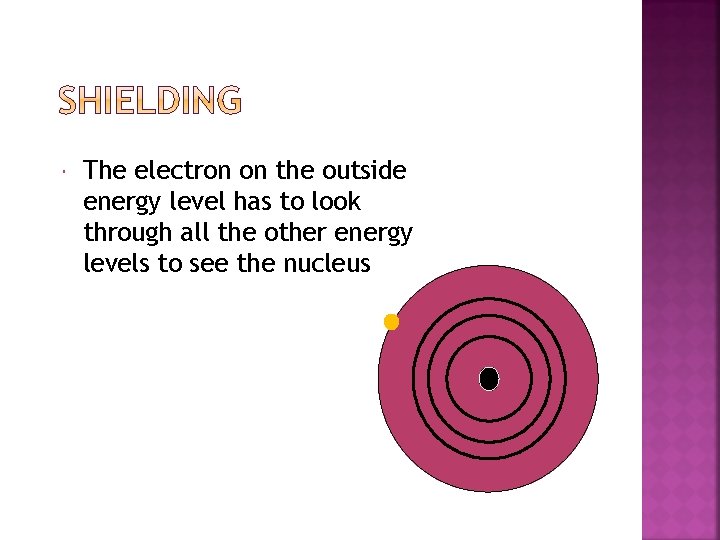
The electron on the outside energy level has to look through all the other energy levels to see the nucleus
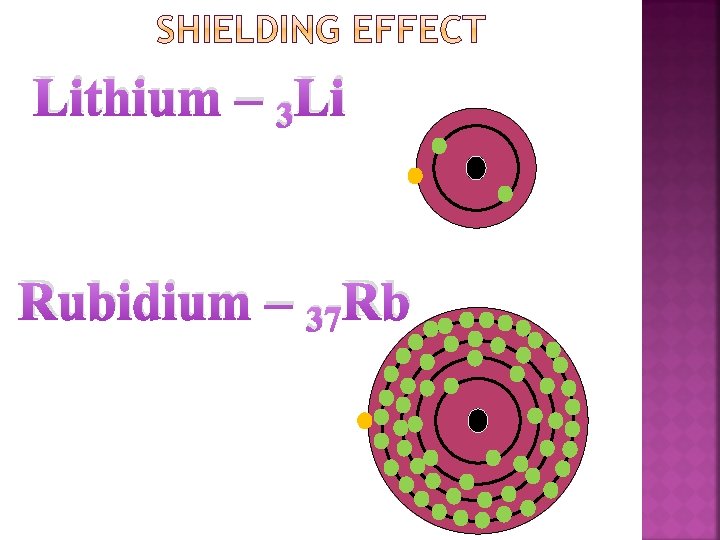
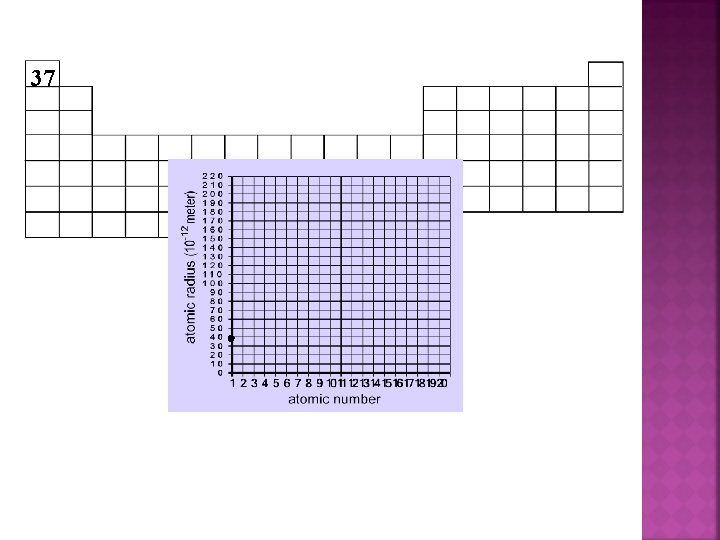
Lithium – 3 Li Rubidium – 37 Rb
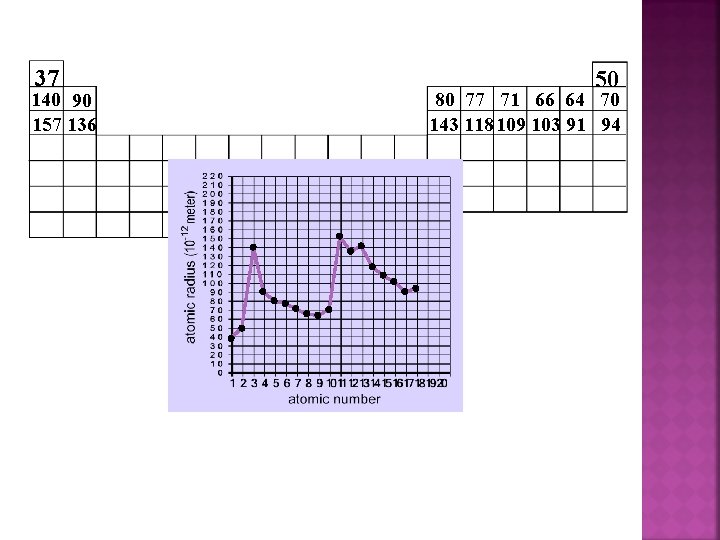
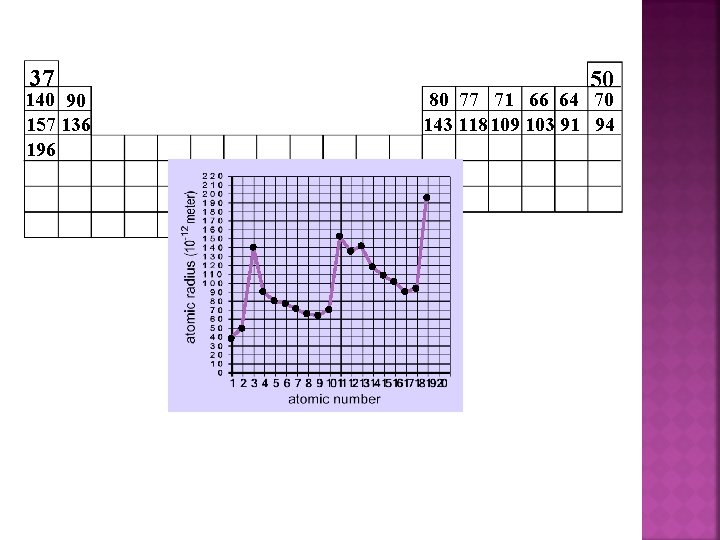
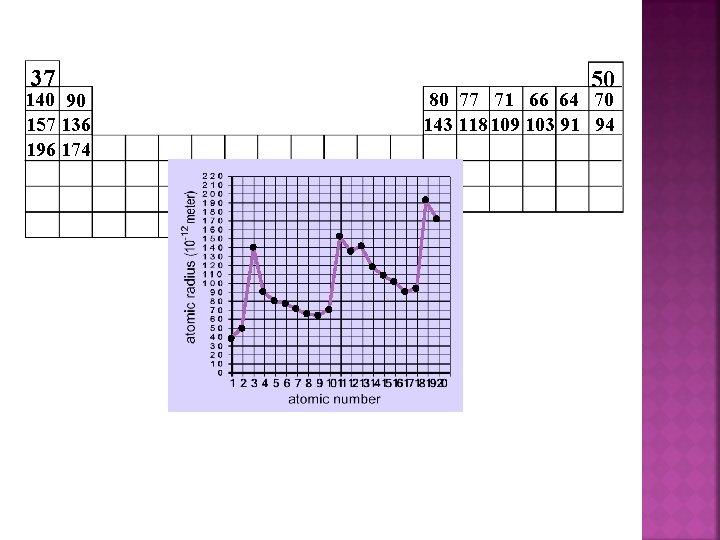
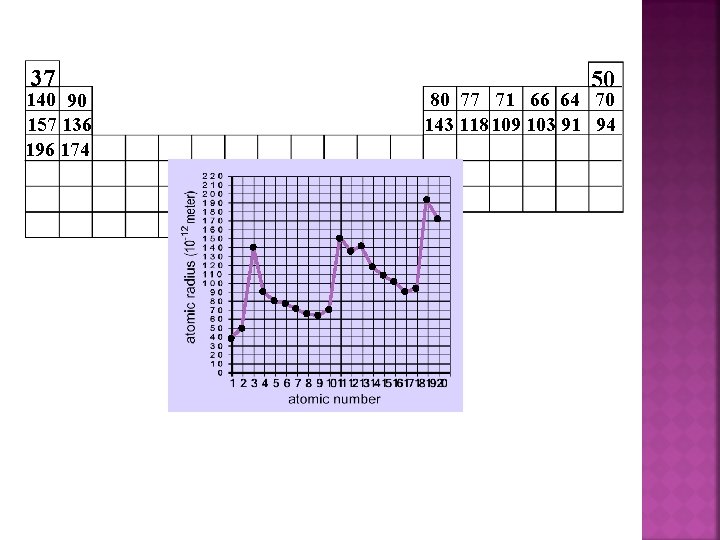
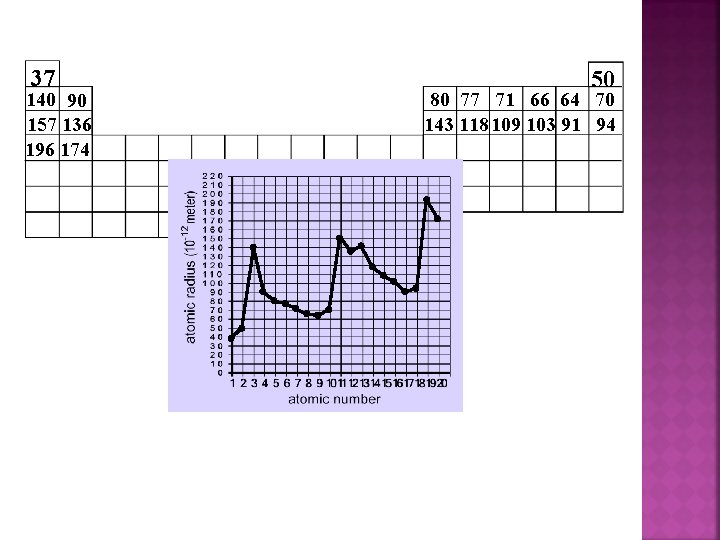
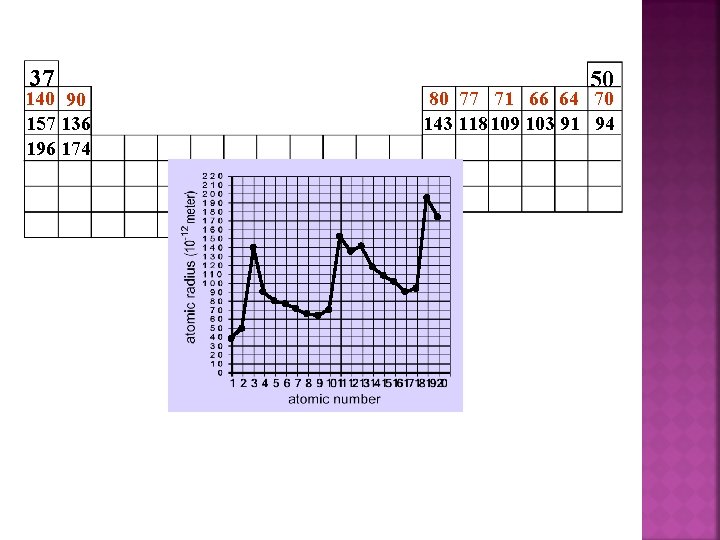
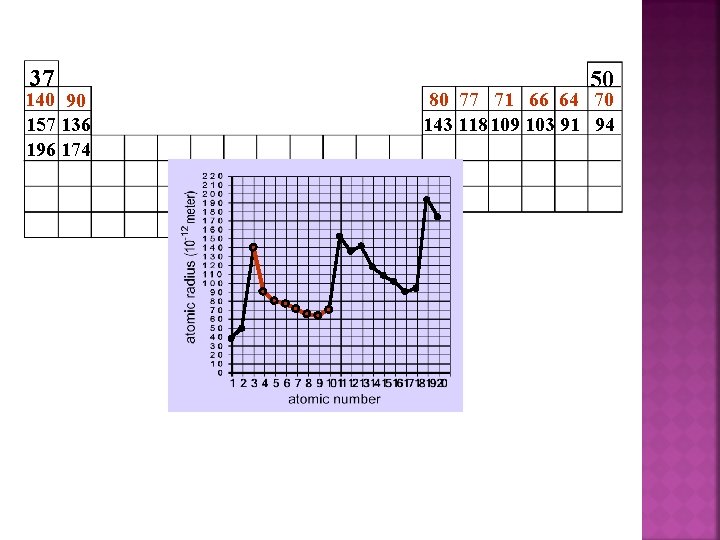
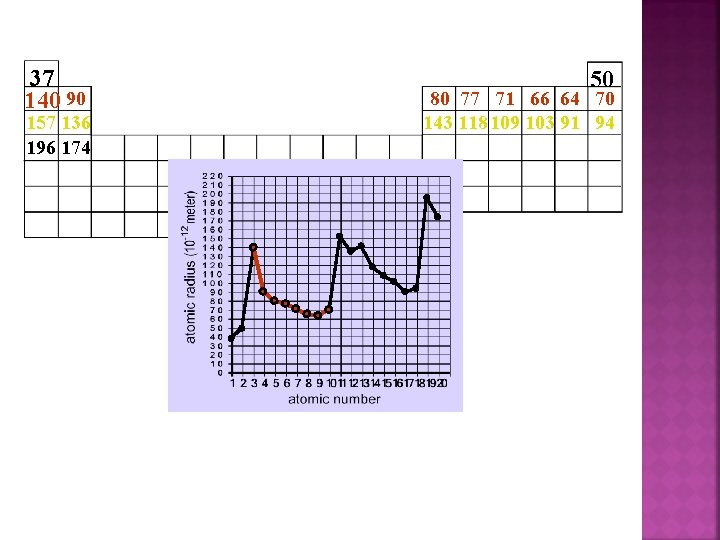
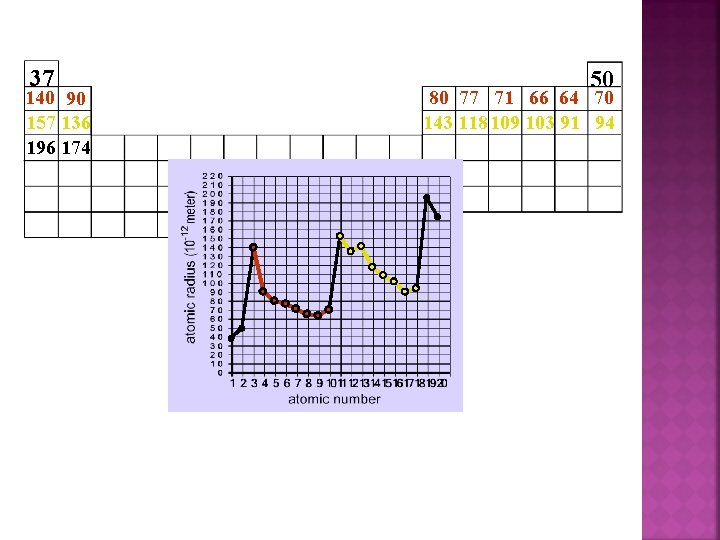
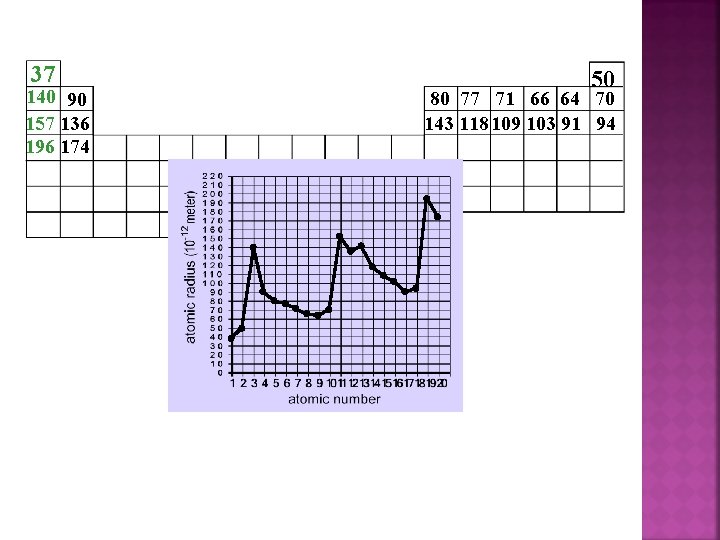
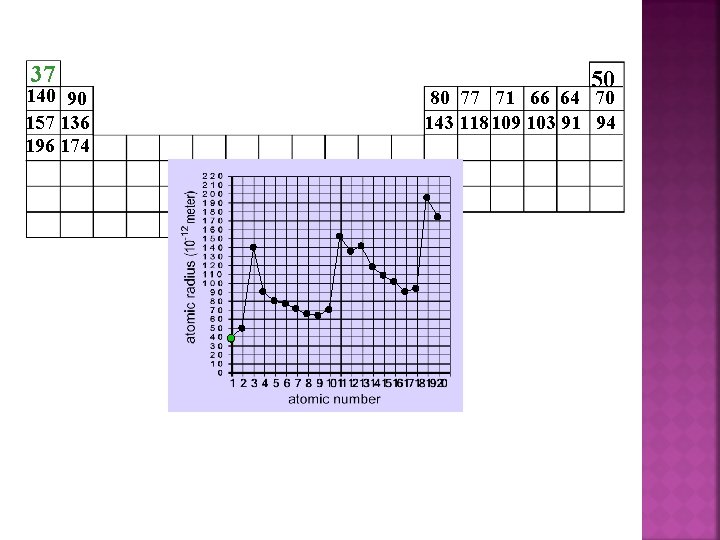
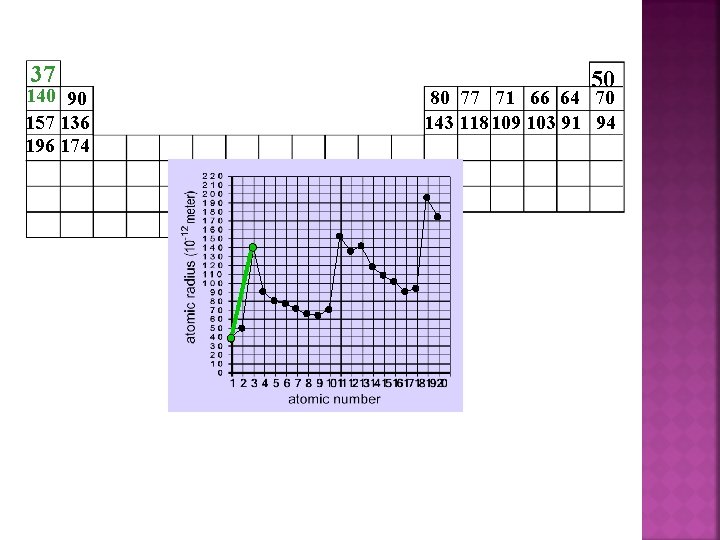
ATOMIC SIZE – RADII OF ATOMS It is difficult to measure the radius of an atom simply because the electron is in constant random motion about the nucleus. The electron cloud doesn’t have a definite edge. Scientists took a diatomic molecule and measured the distance between the two nuclei. Cutting the number in half gives the approximate radius of each of the atoms.
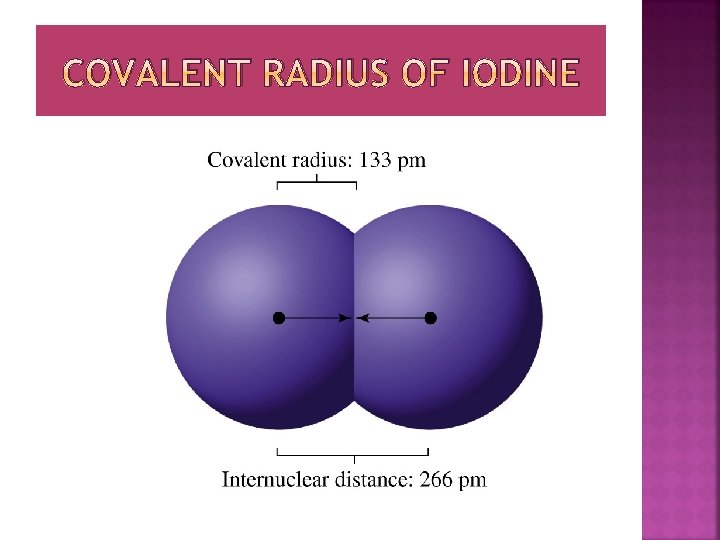
COVALENT RADIUS OF IODINE
Determining the Atomic Radius of a Nonmetal (Carbon)
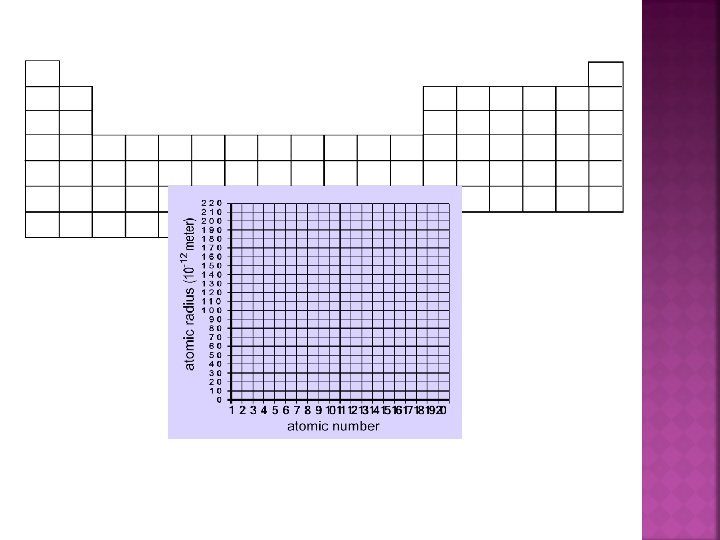
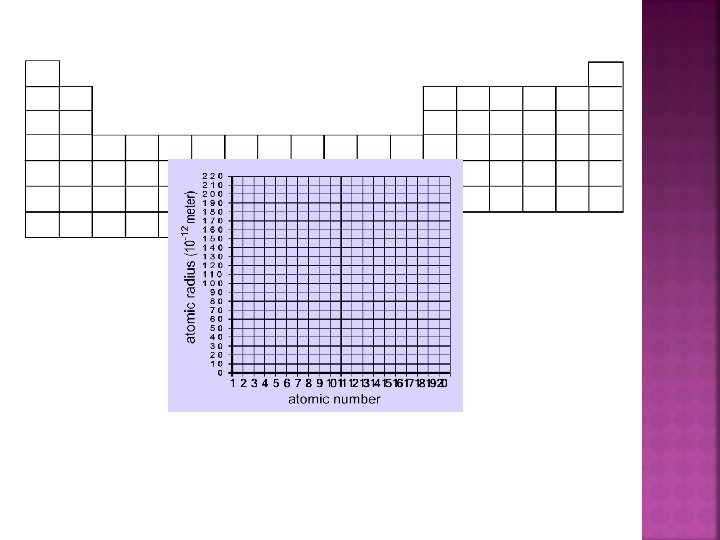
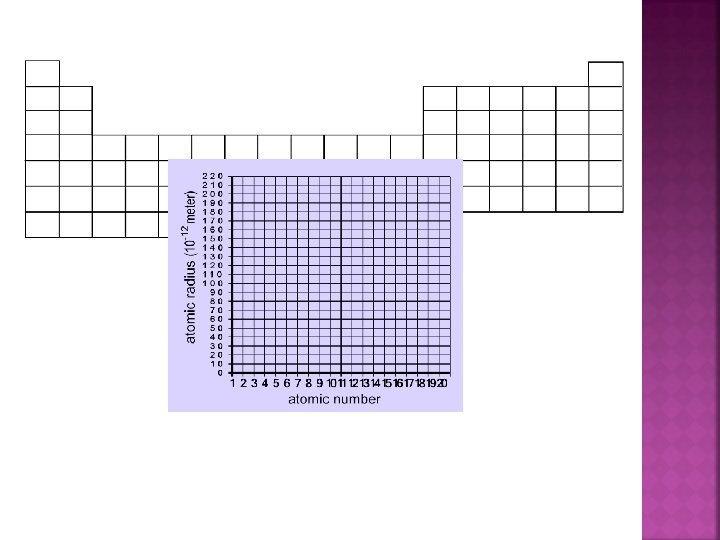
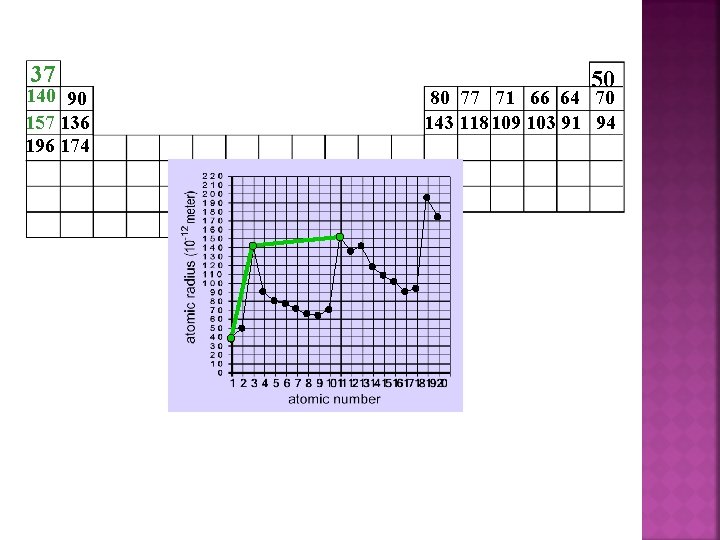
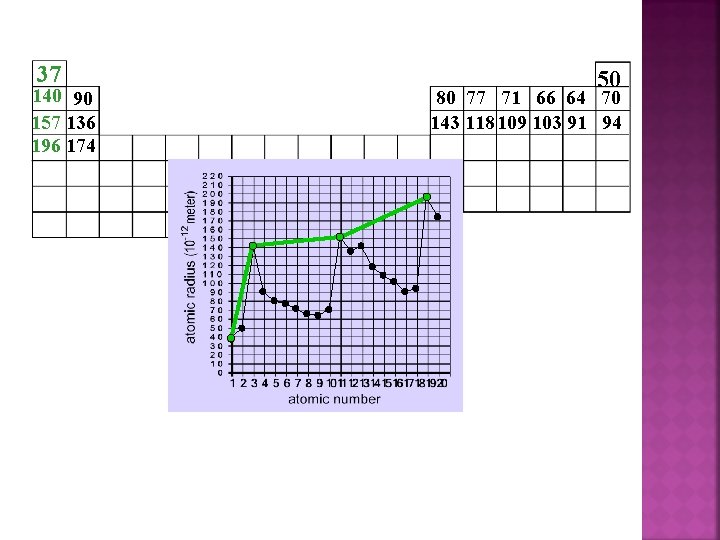
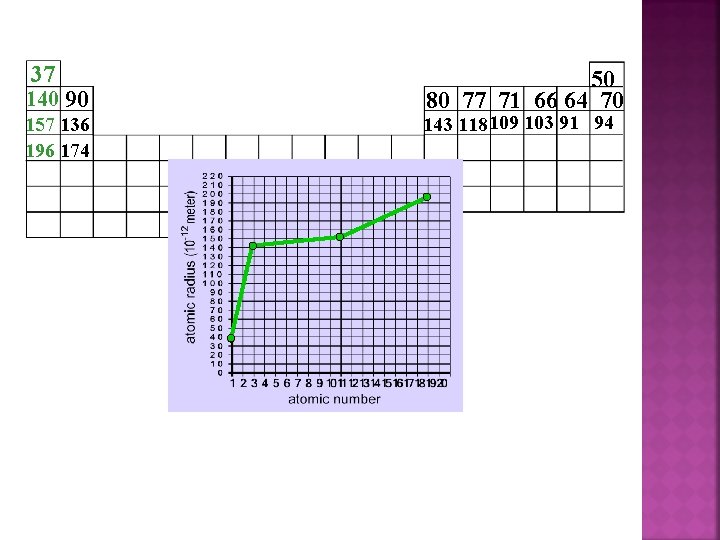
Atomic radii in picometers (10 -12 m)
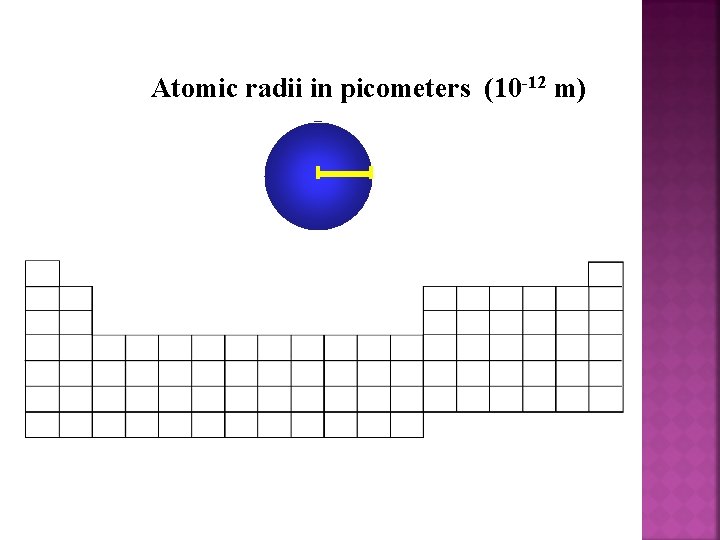
Atomic radii in picometers (10 -12 m)
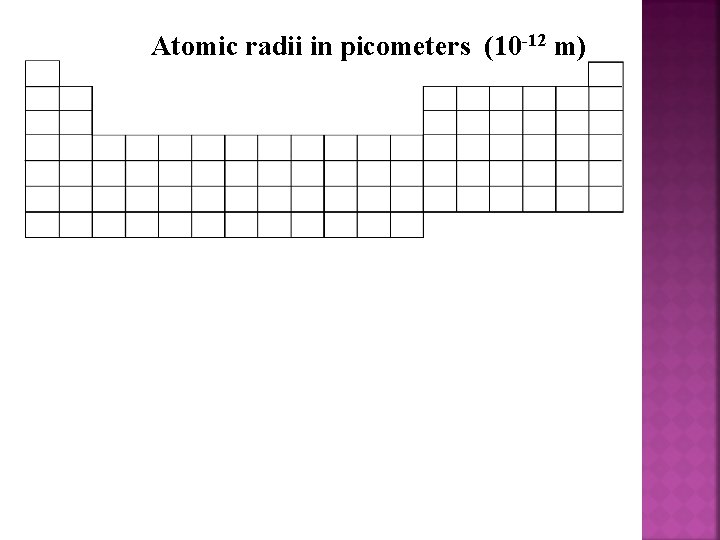
Atomic radii in picometers (10 -12 m)
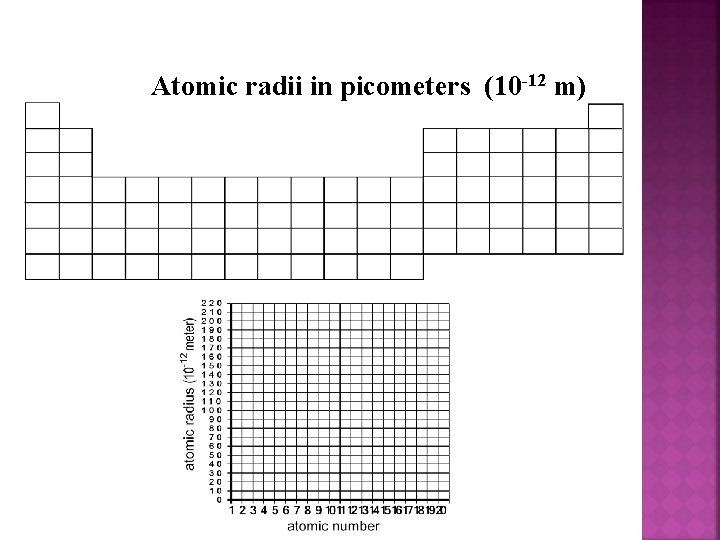
Atomic radii in picometers (10 -12 m)
37
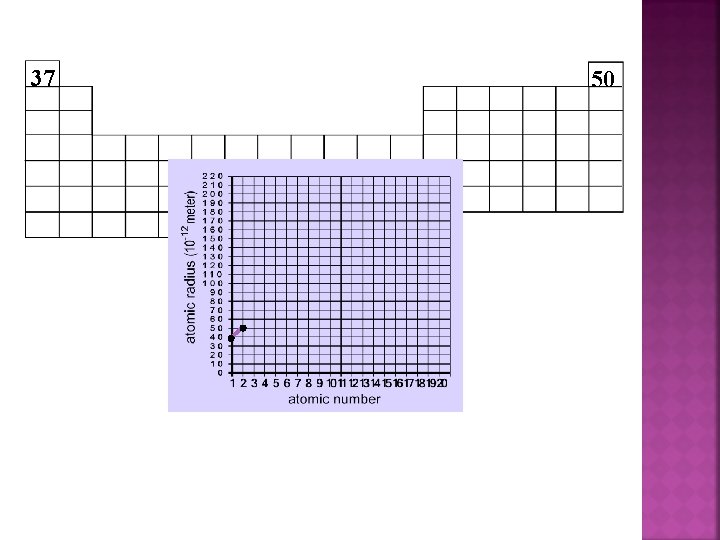
37 50
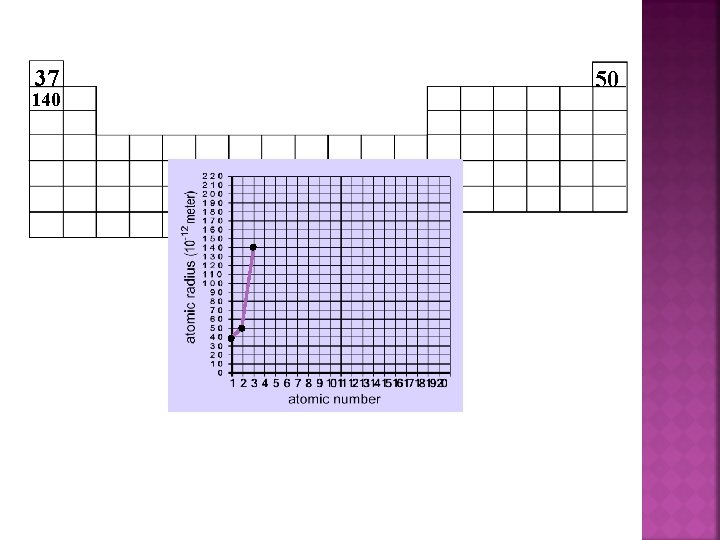
37 140 50
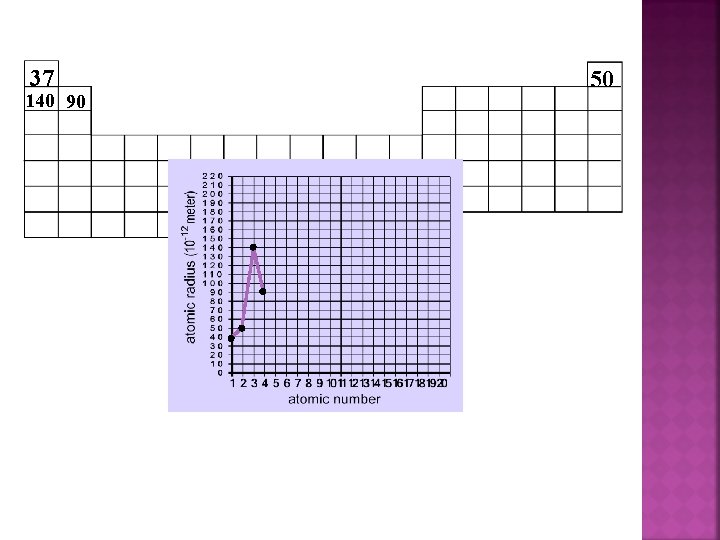
37 140 90 50
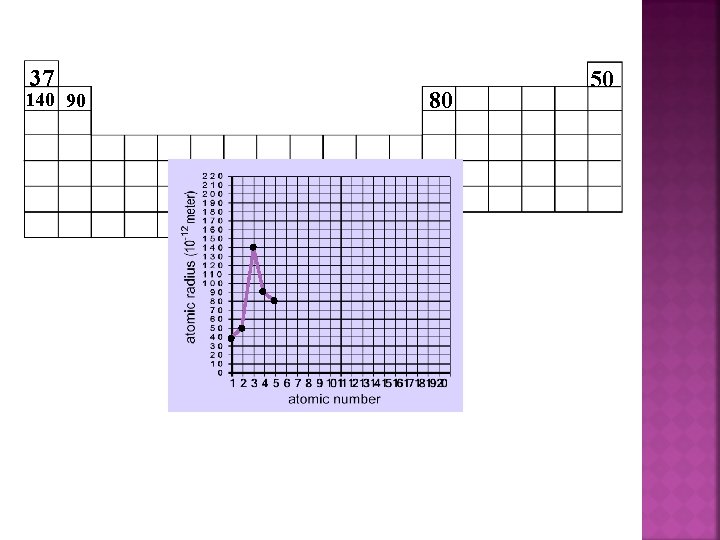
37 140 90 80 50
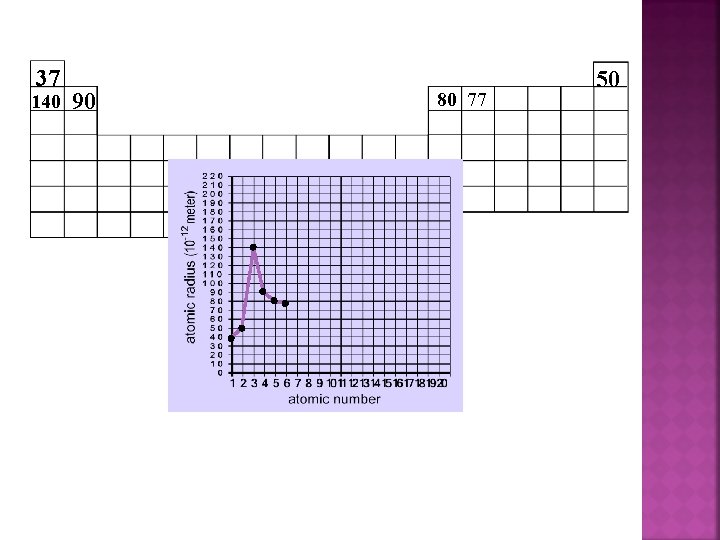
37 140 90 80 77 50
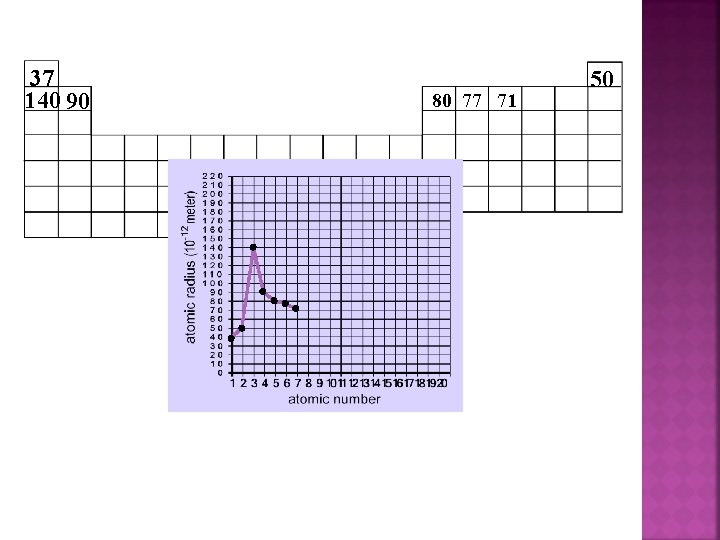
37 140 90 80 77 71 50
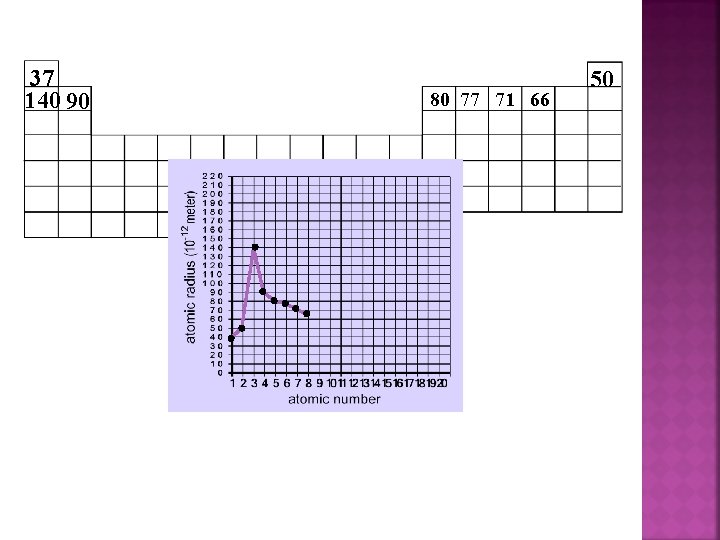
37 140 90 80 77 71 66 50
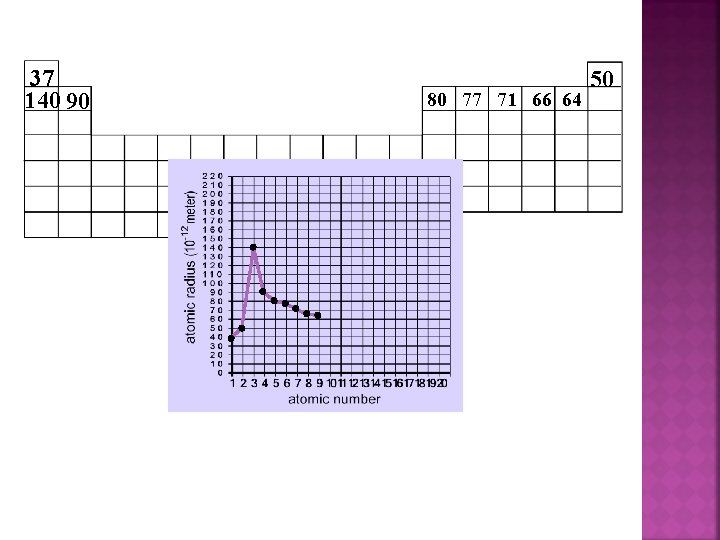
37 140 90 80 77 71 66 64 50
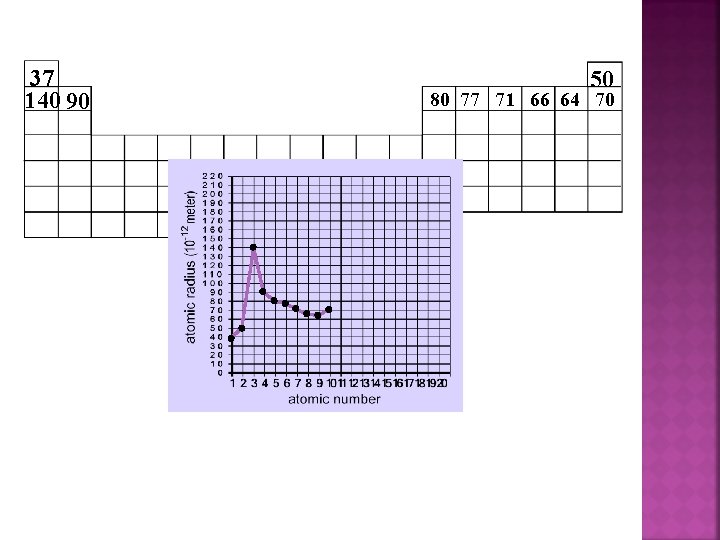
37 140 90 50 80 77 71 66 64 70
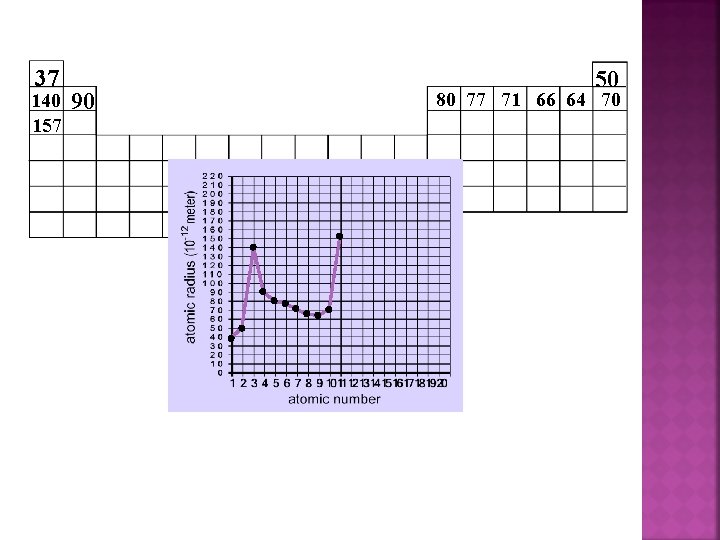
37 140 157 90 50 80 77 71 66 64 70
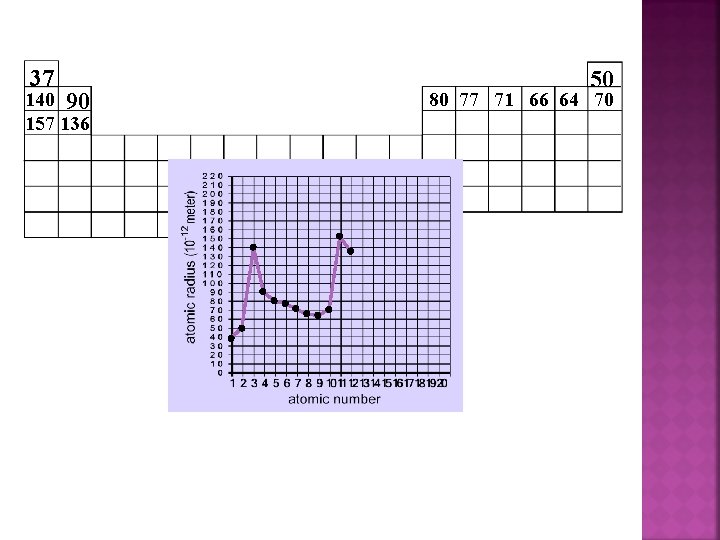
37 140 90 157 136 50 80 77 71 66 64 70
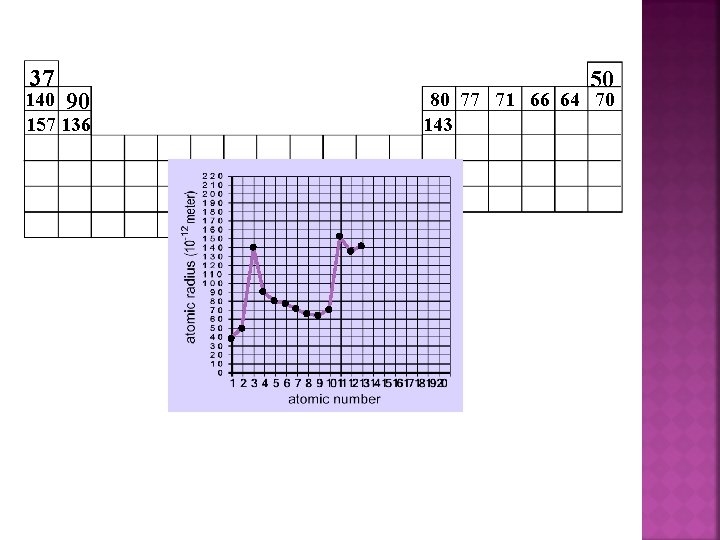
37 140 90 157 136 50 80 77 71 66 64 70 143
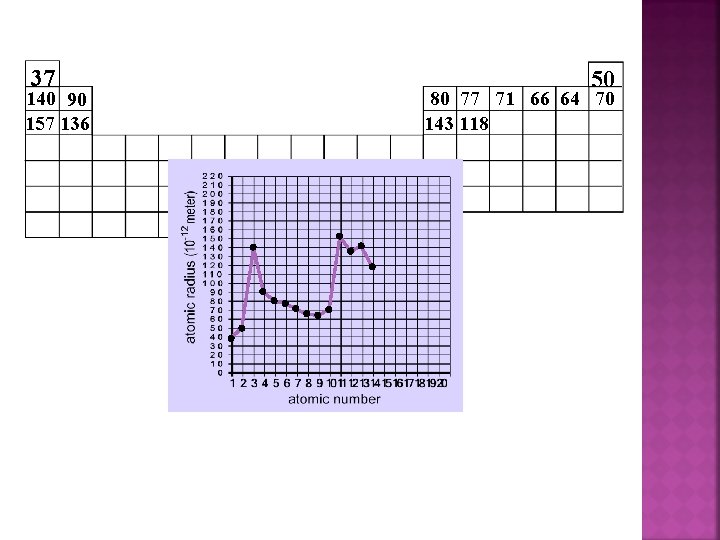
37 140 90 157 136 50 80 77 71 66 64 70 143 118
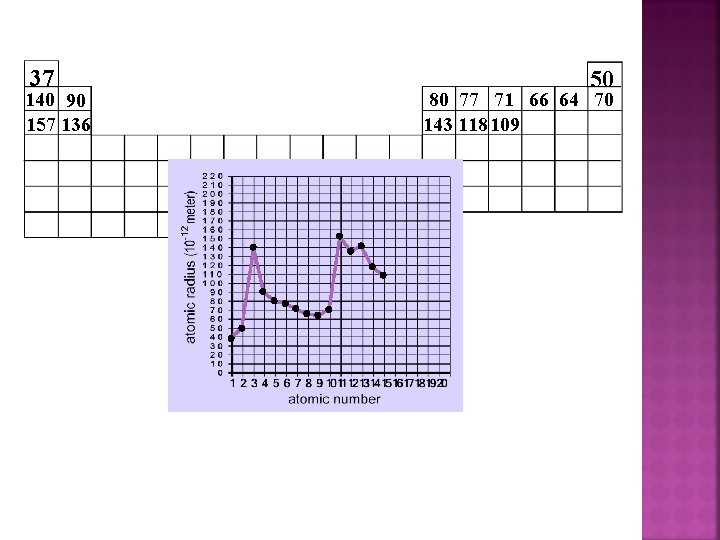
37 140 90 157 136 50 80 77 71 66 64 70 143 118109
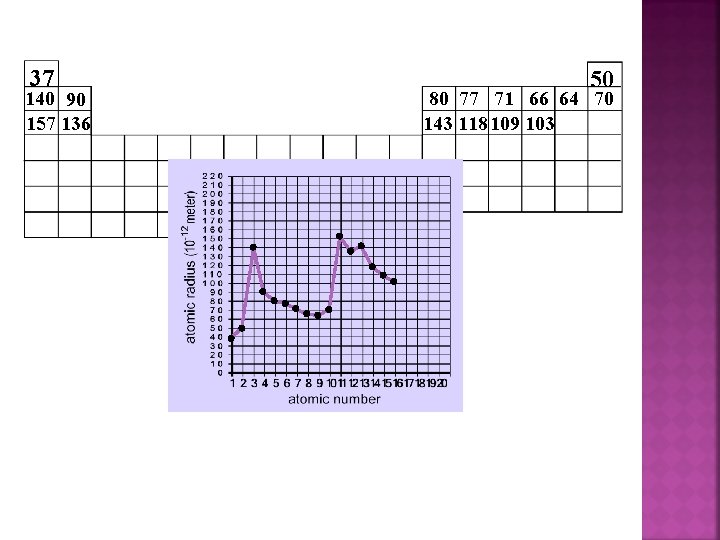
37 140 90 157 136 50 80 77 71 66 64 70 143 118109 103
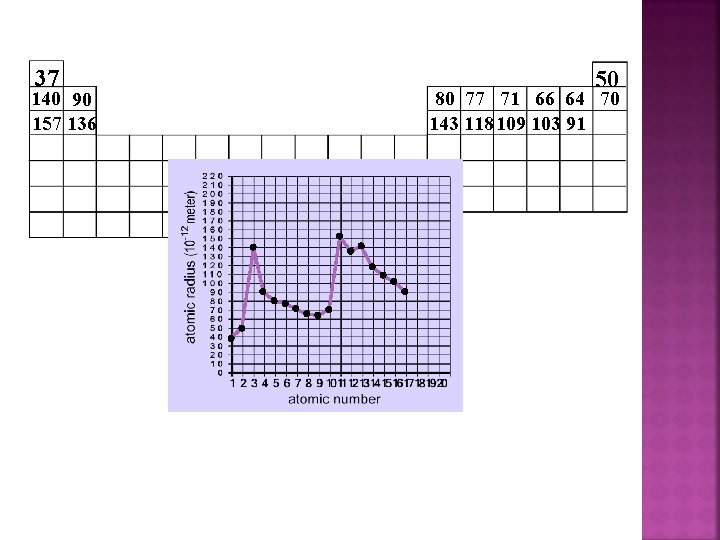
37 140 90 157 136 50 80 77 71 66 64 70 143 118109 103 91
37 140 90 157 136 50 80 77 71 66 64 70 143 118109 103 91 94
37 140 90 157 136 196 50 80 77 71 66 64 70 143 118109 103 91 94
37 140 90 157 136 196 174 50 80 77 71 66 64 70 143 118109 103 91 94
37 140 90 157 136 196 174 50 80 77 71 66 64 70 143 118109 103 91 94
37 140 90 157 136 196 174 50 80 77 71 66 64 70 143 118109 103 91 94
37 140 90 157 136 196 174 50 80 77 71 66 64 70 143 118109 103 91 94
37 140 90 157 136 196 174 50 80 77 71 66 64 70 143 118109 103 91 94
37 140 90 157 136 196 174 50 80 77 71 66 64 70 143 118109 103 91 94
37 140 90 157 136 196 174 50 80 77 71 66 64 70 143 118109 103 91 94
37 140 90 157 136 196 174 50 80 77 71 66 64 70 143 118109 103 91 94
37 140 90 157 136 196 174 50 80 77 71 66 64 70 143 118109 103 91 94
37 140 90 157 136 196 174 50 80 77 71 66 64 70 143 118109 103 91 94
37 140 90 157 136 196 174 50 80 77 71 66 64 70 143 118109 103 91 94
37 140 90 157 136 196 174 50 80 77 71 66 64 70 143 118109 103 91 94
37 140 90 157 136 196 174 50 80 77 71 66 64 70 143 118 109 103 91 94
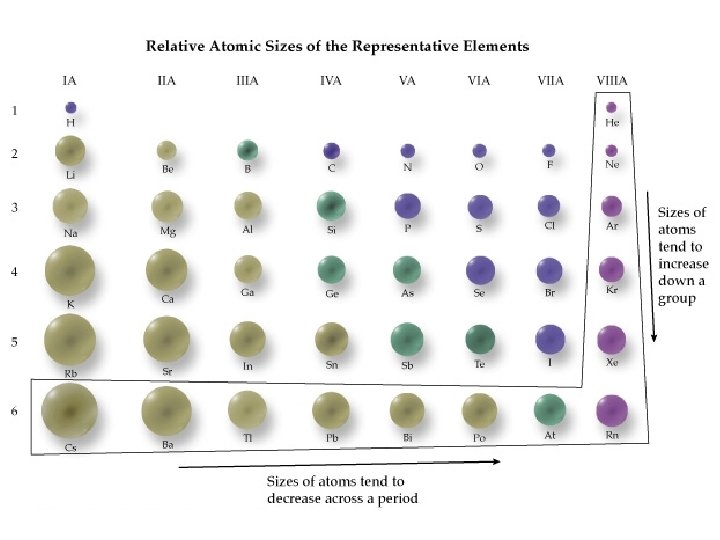
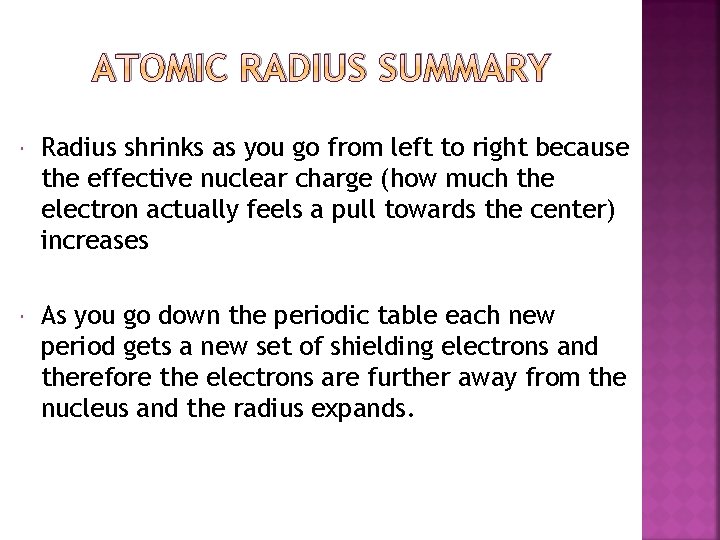
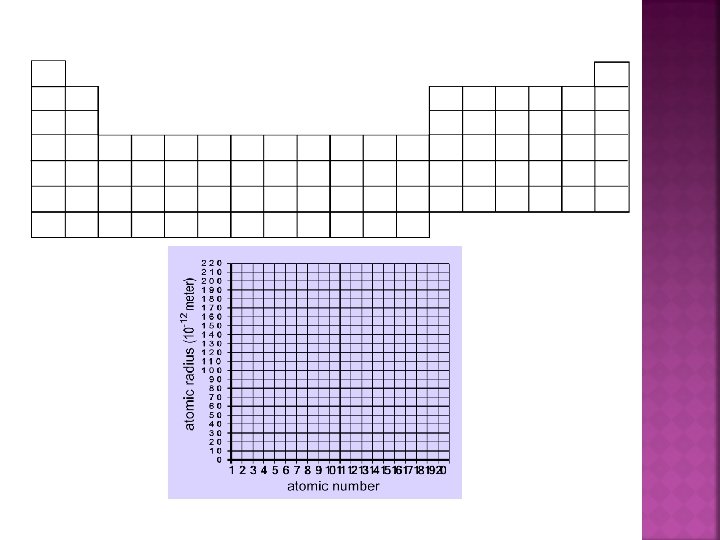
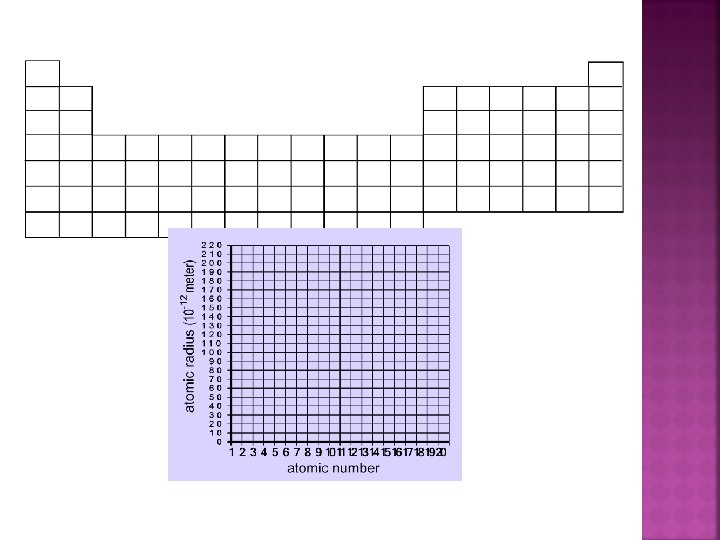
ATOMIC RADIUS SUMMARY Radius shrinks as you go from left to right because the effective nuclear charge (how much the electron actually feels a pull towards the center) increases As you go down the periodic table each new period gets a new set of shielding electrons and therefore the electrons are further away from the nucleus and the radius expands.
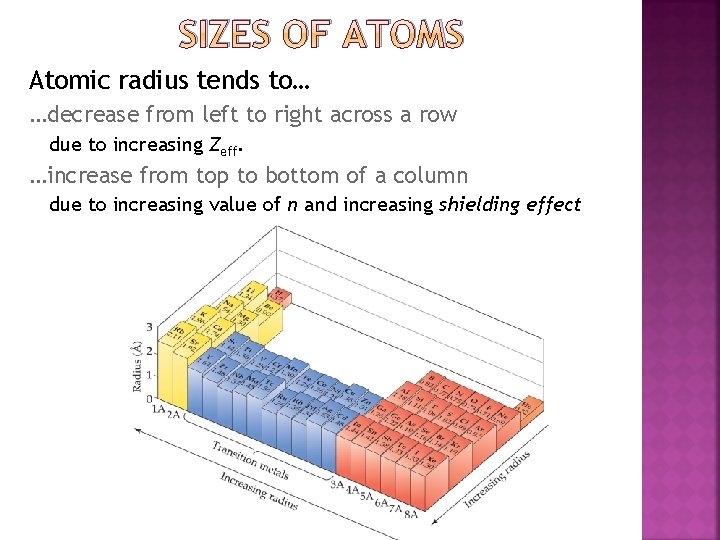
SIZES OF ATOMS Atomic radius tends to… …decrease from left to right across a row due to increasing Zeff. …increase from top to bottom of a column due to increasing value of n and increasing shielding effect
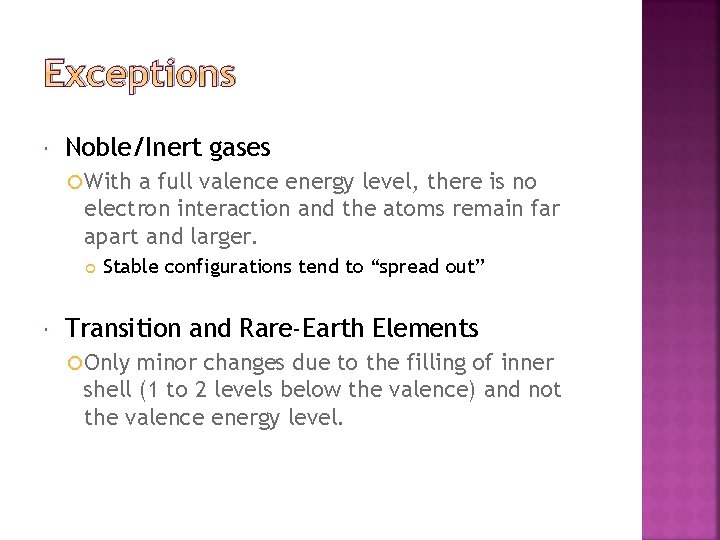
Exceptions Noble/Inert gases With a full valence energy level, there is no electron interaction and the atoms remain far apart and larger. Stable configurations tend to “spread out” Transition and Rare-Earth Elements Only minor changes due to the filling of inner shell (1 to 2 levels below the valence) and not the valence energy level.
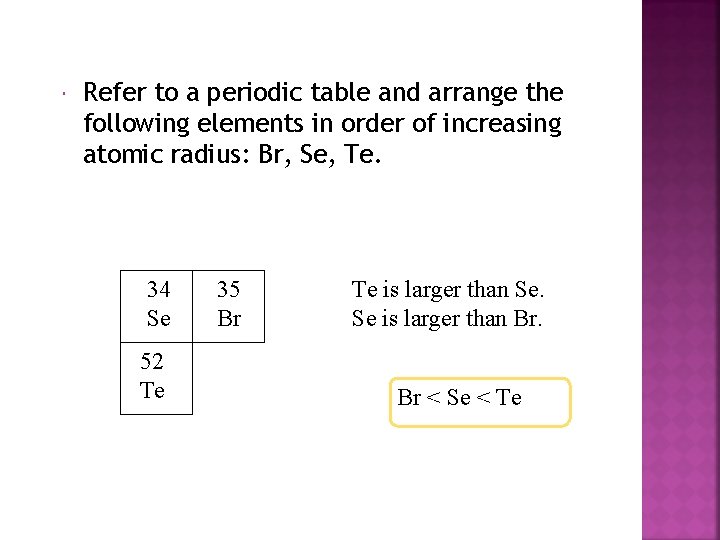
Refer to a periodic table and arrange the following elements in order of increasing atomic radius: Br, Se, Te. 34 Se 52 Te 35 Br Te is larger than Se. Se is larger than Br. Br < Se < Te
Explain why Fluorine has a smaller atomic radius than both Oxygen and Chlorine.
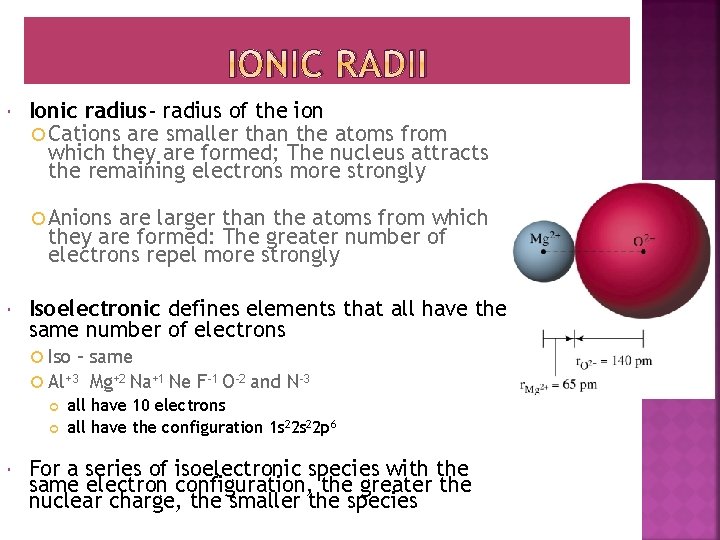
IONIC RADII Ionic radius- radius of the ion Cations are smaller than the atoms from which they are formed; The nucleus attracts the remaining electrons more strongly Anions are larger than the atoms from which they are formed: The greater number of electrons repel more strongly Isoelectronic defines elements that all have the same number of electrons Iso - same Al+3 Mg+2 Na+1 Ne F-1 O-2 and N-3 all have 10 electrons all have the configuration 1 s 22 p 6 For a series of isoelectronic species with the same electron configuration, the greater the nuclear charge, the smaller the species

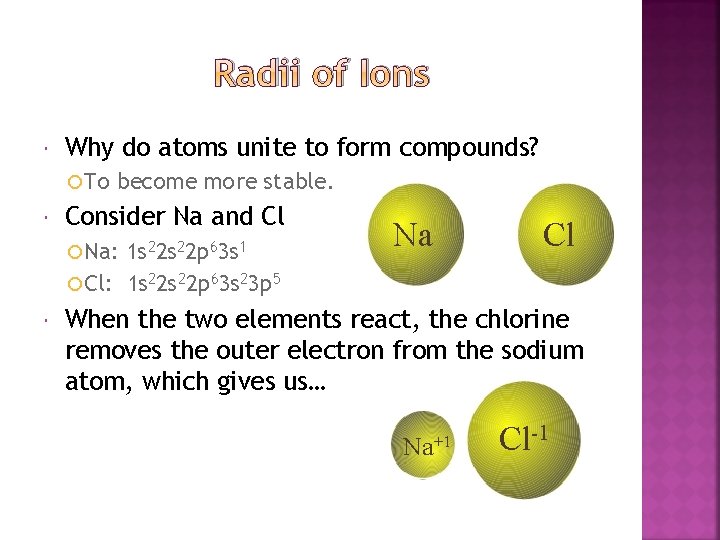
Radii of Ions Why do atoms unite to form compounds? To become more stable. Consider Na and Cl Na: 1 s 22 p 63 s 1 Cl: 1 s 22 p 63 s 23 p 5 Na Na Cl When the two elements react, the chlorine removes the outer electron from the sodium atom, which gives us… Na+1 -1 Cl Cl-1
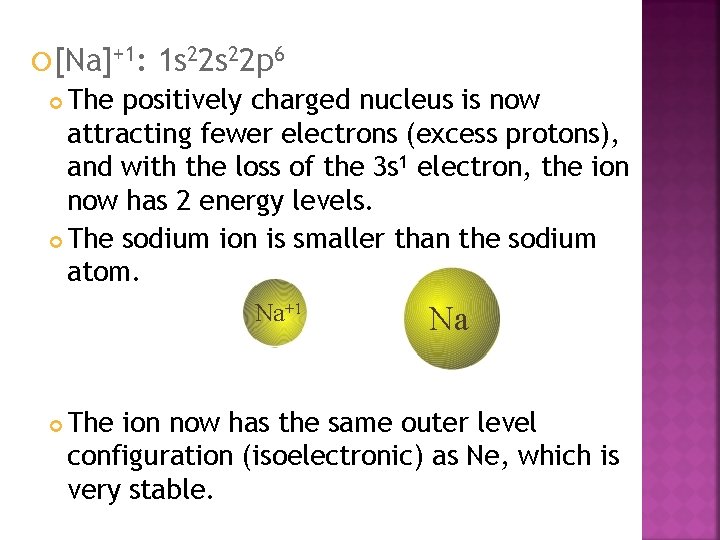
[Na]+1: 1 s 22 p 6 The positively charged nucleus is now attracting fewer electrons (excess protons), and with the loss of the 3 s 1 electron, the ion now has 2 energy levels. The sodium ion is smaller than the sodium atom. Na+1 Na Na The ion now has the same outer level configuration (isoelectronic) as Ne, which is very stable.
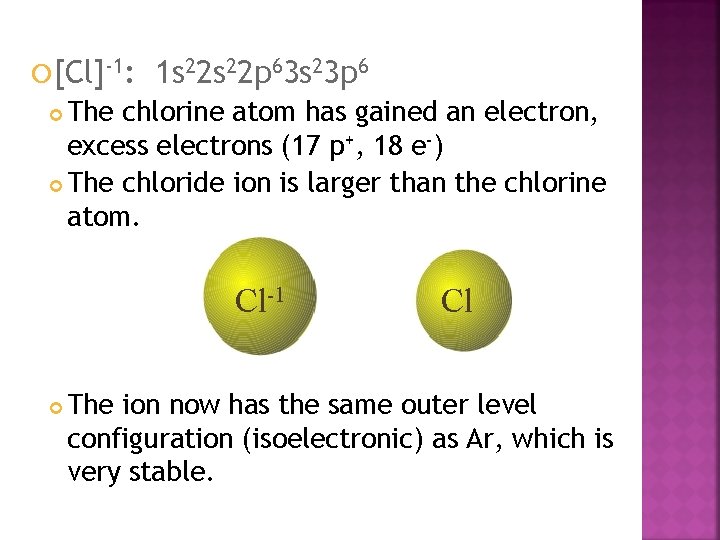
[Cl]-1: 1 s 22 p 63 s 23 p 6 The chlorine atom has gained an electron, excess electrons (17 p+, 18 e-) The chloride ion is larger than the chlorine atom. Cl-1 Cl The ion now has the same outer level configuration (isoelectronic) as Ar, which is very stable.
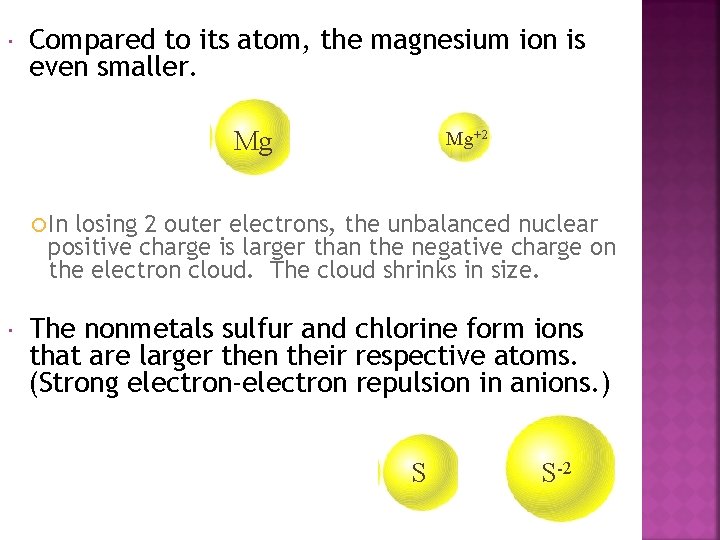
Compared to its atom, the magnesium ion is even smaller. Mg Mg+2 In losing 2 outer electrons, the unbalanced nuclear positive charge is larger than the negative charge on the electron cloud. The cloud shrinks in size. The nonmetals sulfur and chlorine form ions that are larger then their respective atoms. (Strong electron-electron repulsion in anions. ) S S-2
Metallic ions on the left and middle of the table are formed by the loss of electrons. They are smaller than atoms from which they are formed. Nonmetallic ions are located on the right side of the table. They are formed by the gain of electrons and are larger than the atoms from which they are formed. The metallic ions have an outer level configuration that resembles that of the noble gas at the end of the preceding period. Nonmetallic ions have an outer level resembling that of the noble gas to the right in the same period.
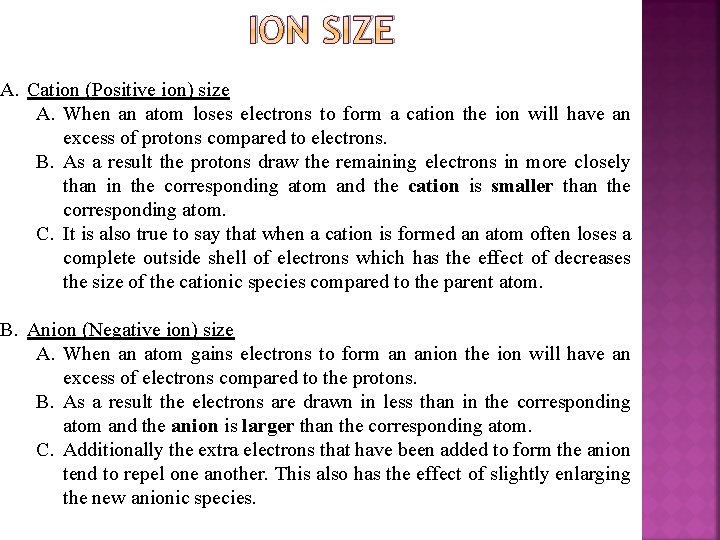
ION SIZE A. Cation (Positive ion) size A. When an atom loses electrons to form a cation the ion will have an excess of protons compared to electrons. B. As a result the protons draw the remaining electrons in more closely than in the corresponding atom and the cation is smaller than the corresponding atom. C. It is also true to say that when a cation is formed an atom often loses a complete outside shell of electrons which has the effect of decreases the size of the cationic species compared to the parent atom. B. Anion (Negative ion) size A. When an atom gains electrons to form an anion the ion will have an excess of electrons compared to the protons. B. As a result the electrons are drawn in less than in the corresponding atom and the anion is larger than the corresponding atom. C. Additionally the extra electrons that have been added to form the anion tend to repel one another. This also has the effect of slightly enlarging the new anionic species.
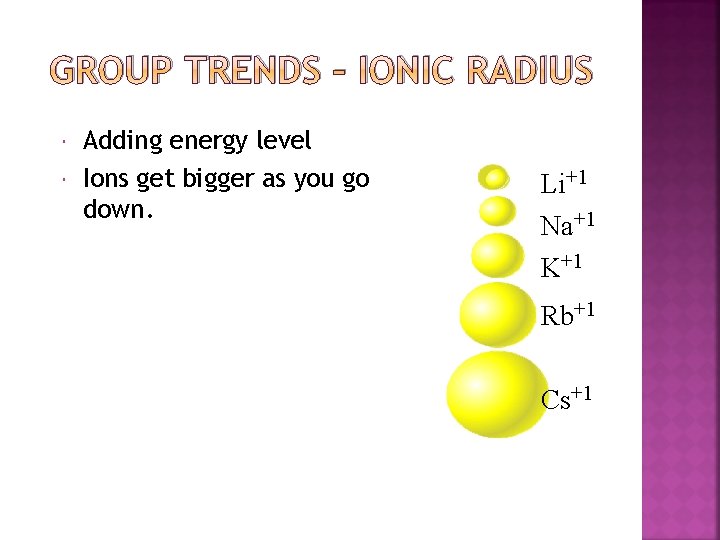
GROUP TRENDS – IONIC RADIUS Adding energy level Ions get bigger as you go down. Li+1 Na+1 K+1 Rb+1 Cs+1
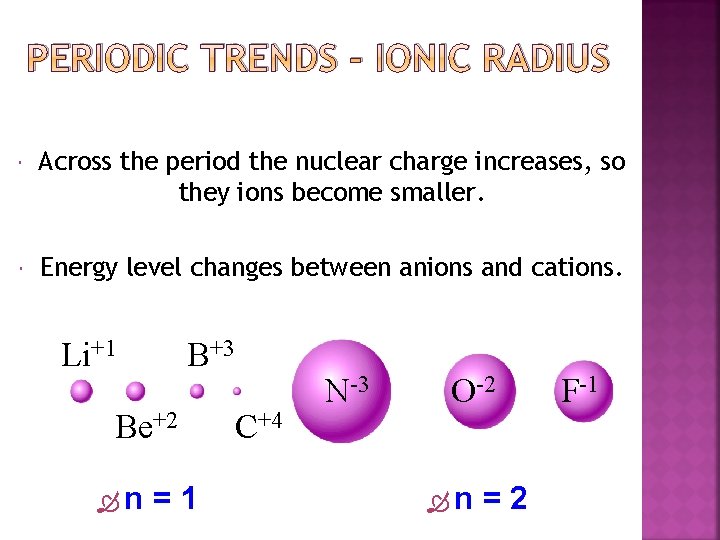
PERIODIC TRENDS – IONIC RADIUS Across the period the nuclear charge increases, so they ions become smaller. Energy level changes between anions and cations. Li+1 B+3 Be+2 n =1 C+4 N-3 O-2 n =2 F-1
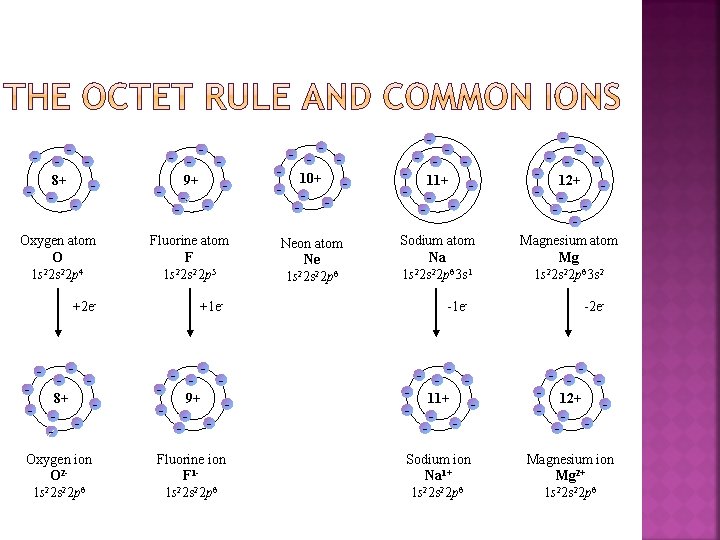
- - - - 9+ - - 10+ - - 11+ - - Oxygen atom O 2 1 s 2 s 22 p 4 Fluorine atom F 2 1 s 2 s 22 p 5 Neon atom Ne 2 1 s 2 s 22 p 6 Sodium atom Na 2 1 s 2 s 22 p 63 s 1 - 8+ - - - +2 e- - 8+ - Oxygen ion O 21 s 22 p 6 +1 e- - - - 12+ - Magnesium atom Mg 2 1 s 2 s 22 p 63 s 2 -2 e- - 9+ - - 11+ - - 12+ - - Fluorine ion F 11 s 22 p 6 Sodium ion Na 1+ 1 s 22 p 6 Magnesium ion Mg 2+ 1 s 22 p 6
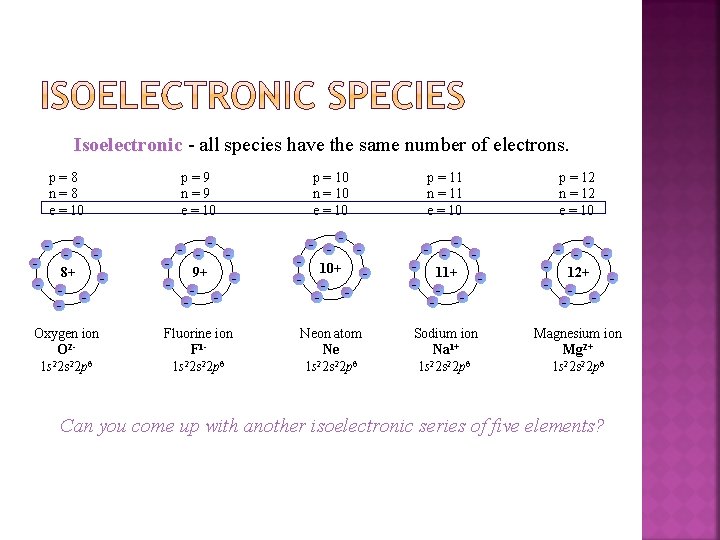
Isoelectronic - all species have the same number of electrons. p=8 n=8 e = 10 - - 8+ - Oxygen ion O 21 s 22 p 6 p=9 n=9 e = 10 p = 10 n = 10 e = 10 p = 11 n = 11 e = 10 p = 12 n = 12 e = 10 - 9+ - - 10+ - - 11+ - - 12+ - - Fluorine ion F 11 s 22 p 6 Neon atom Ne 2 1 s 2 s 22 p 6 Sodium ion Na 1+ 1 s 22 p 6 Magnesium ion Mg 2+ 1 s 22 p 6 Can you come up with another isoelectronic series of five elements?
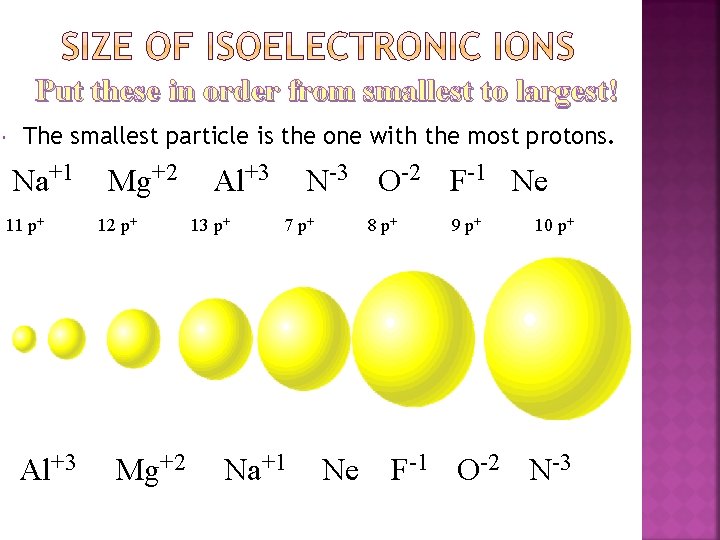
Put these in order from smallest to largest! The smallest particle is the one with the most protons. Na+1 Mg+2 Al+3 N-3 O-2 F-1 Ne 11 p+ Al+3 12 p+ Mg+2 13 p+ 7 p+ Na+1 8 p+ Ne 9 p+ 10 p+ F-1 O-2 N-3
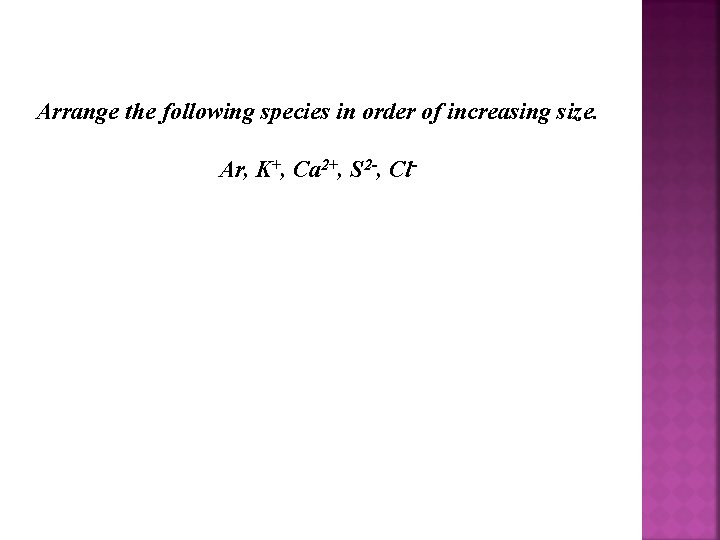
Arrange the following species in order of increasing size. Ar, K+, Ca 2+, S 2 -, Cl-
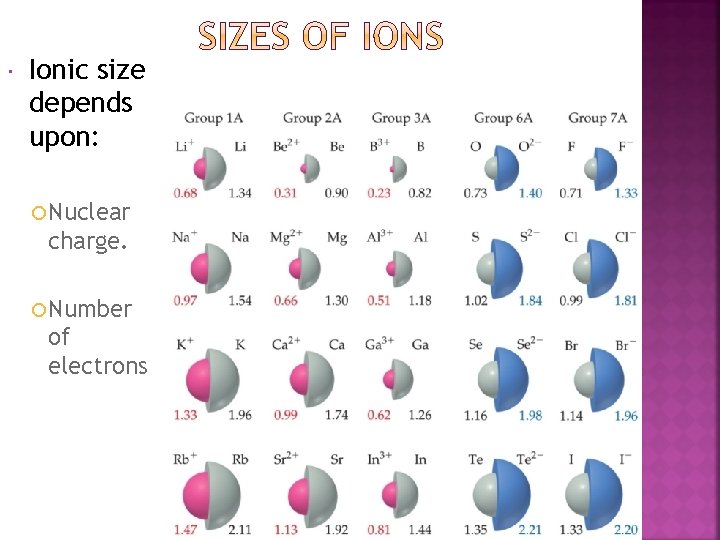
Ionic size depends upon: Nuclear charge. Number of electrons
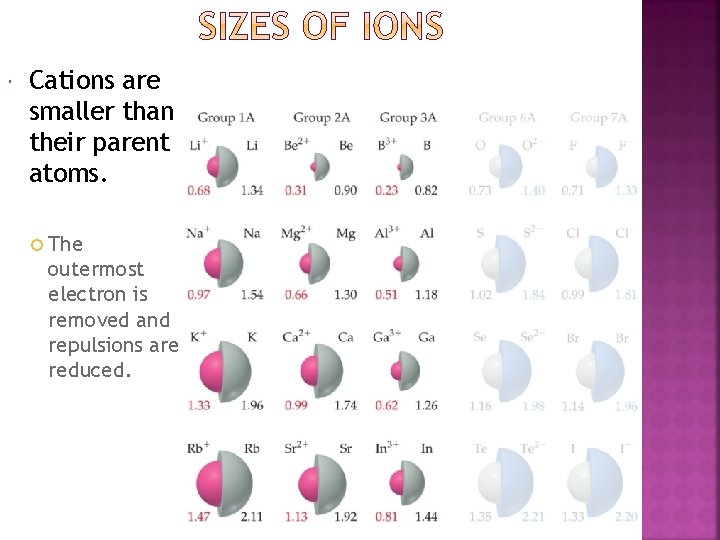
Cations are smaller than their parent atoms. The outermost electron is removed and repulsions are reduced.
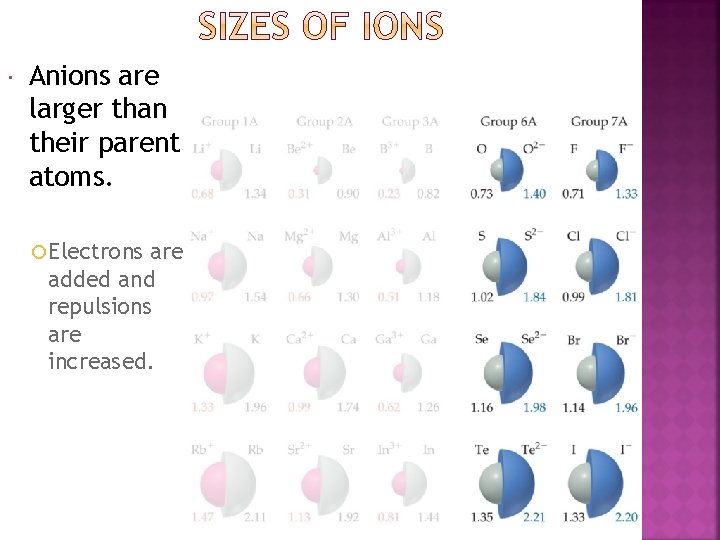
Anions are larger than their parent atoms. Electrons are added and repulsions are increased.
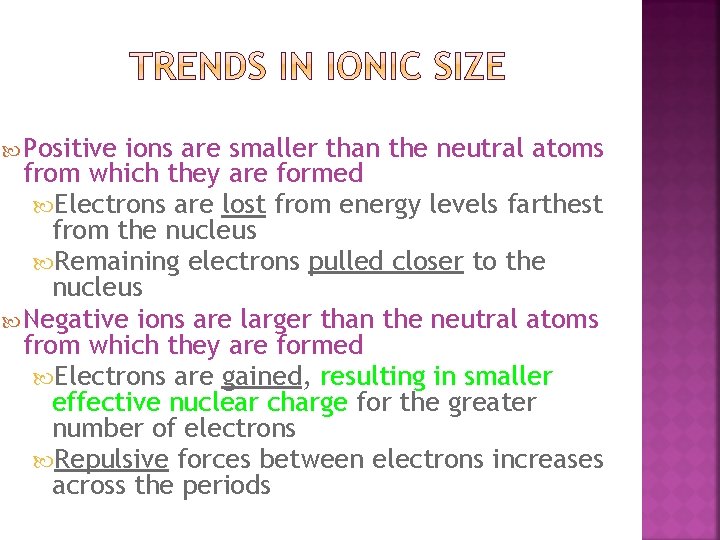
Positive ions are smaller than the neutral atoms from which they are formed Electrons are lost from energy levels farthest from the nucleus Remaining electrons pulled closer to the nucleus Negative ions are larger than the neutral atoms from which they are formed Electrons are gained, resulting in smaller effective nuclear charge for the greater number of electrons Repulsive forces between electrons increases across the periods
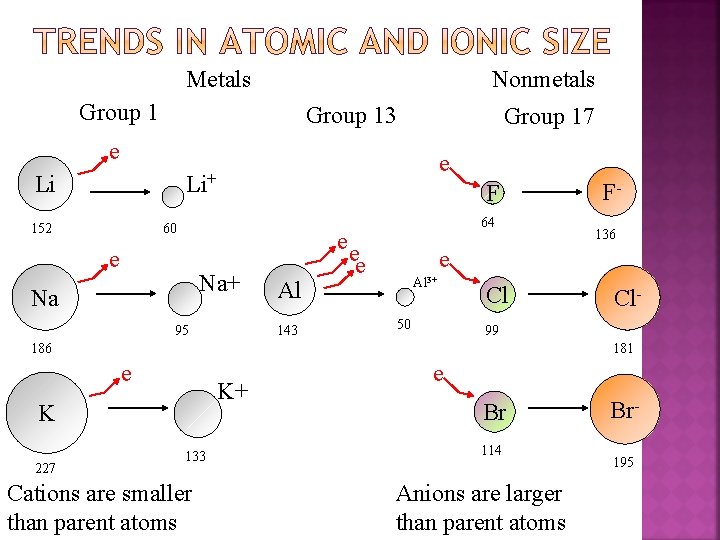
Metals Nonmetals Group 13 Group 17 e e Li+ Li 152 F 60 e Na+ Na 95 Al 143 64 ee e 136 e Al 3+ 50 Cl Cl- 99 186 181 e K+ K 227 F- 133 Cations are smaller than parent atoms e Br 114 Anions are larger than parent atoms Br 195
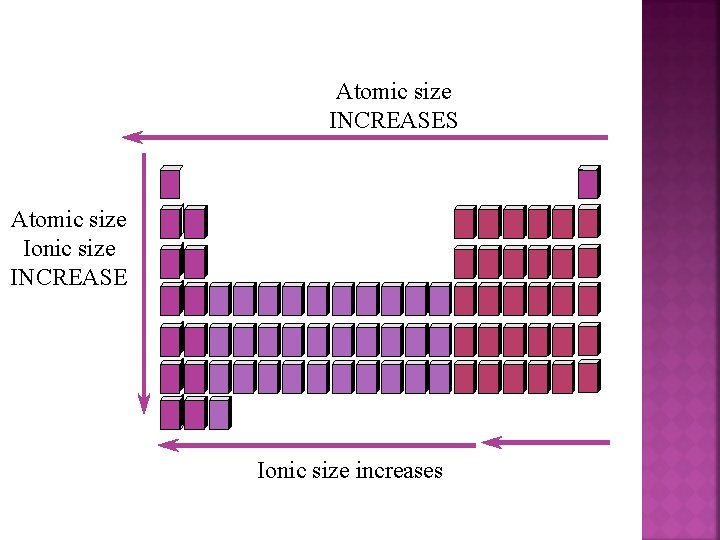
Atomic size INCREASES Atomic size Ionic size INCREASE Ionic size increases
Atoms need to gain or lose electrons to become stable. Use electron configurations to predict oxidation numbers. Of course, there always exceptions to the rule Look for patterns!!!!
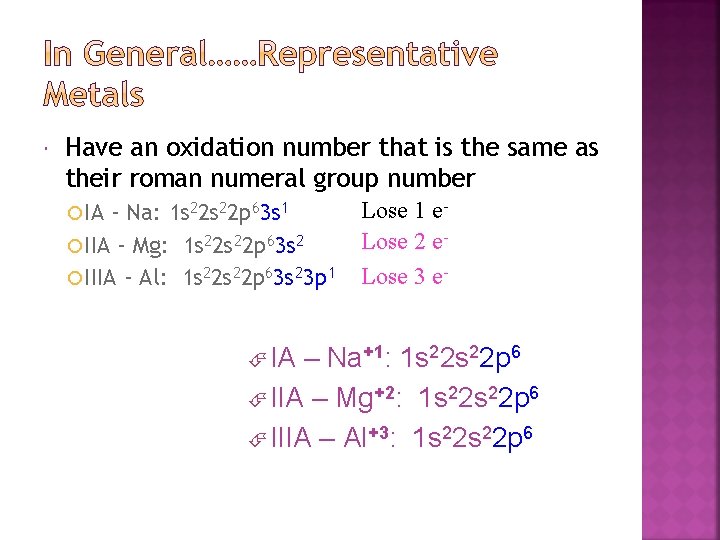
Have an oxidation number that is the same as their roman numeral group number IA - Na: 1 s 22 p 63 s 1 IIA - Mg: 1 s 22 p 63 s 2 IIIA - Al: 1 s 22 p 63 s 23 p 1 IA Lose 1 e. Lose 2 e. Lose 3 e- – Na+1: 1 s 22 p 6 IIA – Mg+2: 1 s 22 p 6 IIIA – Al+3: 1 s 22 p 6
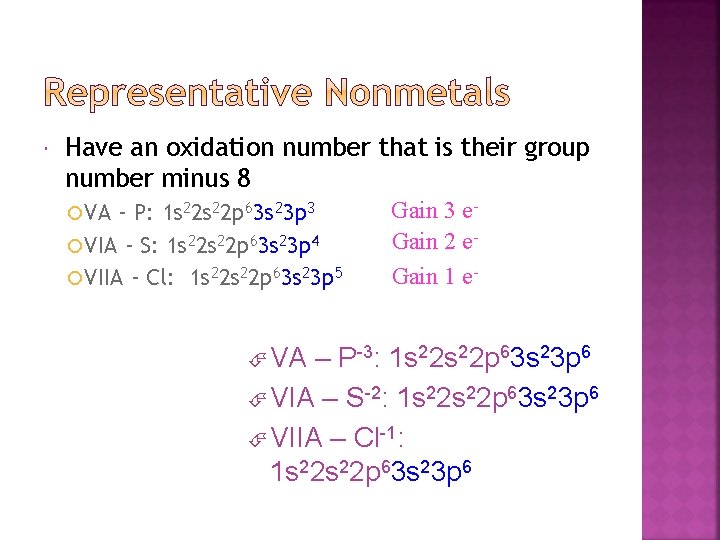
Have an oxidation number that is their group number minus 8 VA - P: 1 s 22 p 63 s 23 p 3 VIA - S: 1 s 22 p 63 s 23 p 4 VIIA - Cl: 1 s 22 p 63 s 23 p 5 VA Gain 3 e. Gain 2 e. Gain 1 e- – P-3: 1 s 22 p 63 s 23 p 6 VIA – S-2: 1 s 22 p 63 s 23 p 6 VIIA – Cl-1: 1 s 22 p 63 s 23 p 6
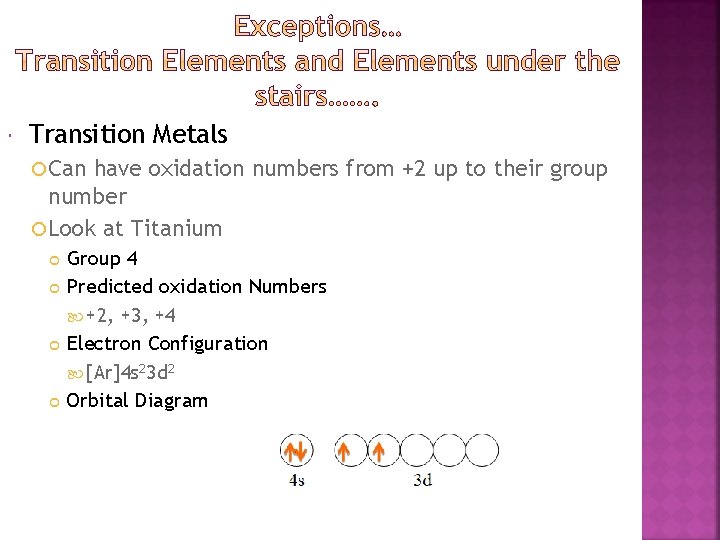
Transition Metals Can have oxidation numbers from +2 up to their group number Look at Titanium Group 4 Predicted oxidation Numbers +2, +3, +4 Electron Configuration [Ar]4 s 23 d 2 Orbital Diagram
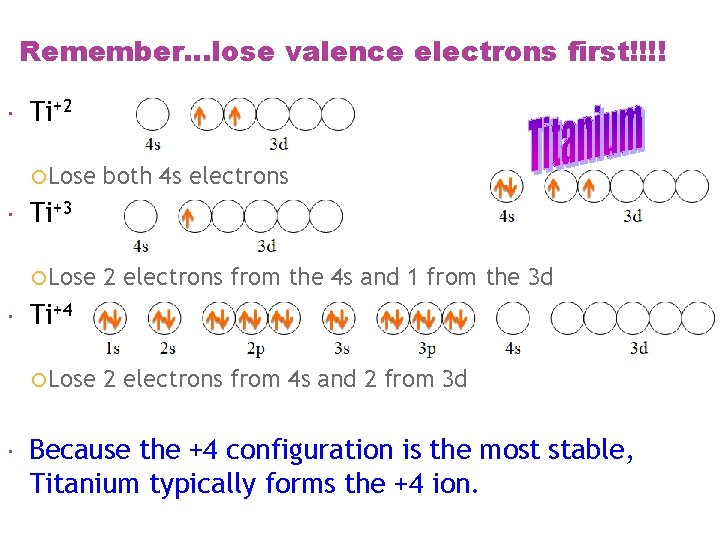
Remember. . . lose valence electrons first!!!! Ti+2 Lose Ti+3 Lose 2 electrons from the 4 s and 1 from the 3 d Ti+4 Lose both 4 s electrons 2 electrons from 4 s and 2 from 3 d Because the +4 configuration is the most stable, Titanium typically forms the +4 ion.

Group 8 Predicted oxidation Numbers +2, +3, +4, +5, +6, +7, +8 Electron Configuration [Ar]4 s 23 d 6 Orbital Diagram Fe+2 Lose both 4 s electrons Fe+3 Lose both 4 s electrons and 1 -3 d electron Because the +3 configuration is the most stable, Iron typically forms the +3 ion
The elements under the staircase (that have a “d” sublevel in their configuration) are SPECIAL. They can have multiple oxidation numbers, like transition metals. They can lose all of their valence electrons, and/or They can lose only their p electrons. But they must lose all of their p electrons as a single entity. They cannot lose them one electron at a time
Thallium Electron Configuration [Xe] 6 s 24 f 145 d 106 p 1 Possible Oxidation Numbers Lose entire valence or Lose only p sublevel. Either +3, +1 Lead Electron Configuration [Xe] 6 s 24 f 145 d 106 p 2 Possible Oxidation Numbers Lose entire valence or Lose only p sublevel. Either +4, +2 Bismuth Electron Configuration [Xe] 6 s 24 f 145 d 106 p 3 Possible Oxidation Numbers Lose entire valence or Lose only p sublevel. Either +5, +3
• Energy is required to remove an electron from an atom to form a cation. • This Ionization energy ( E) is the amount of energy needed to remove an electron from the gaseous atom in its ground state. • Ionization energy is always positive ( E > 0). • Larger values of E mean that the electron is more tightly bound to the atom and is harder to remove.
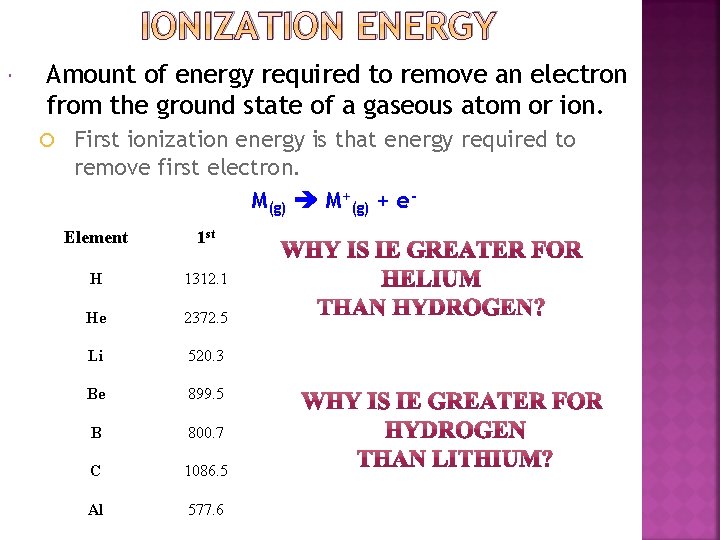
IONIZATION ENERGY Amount of energy required to remove an electron from the ground state of a gaseous atom or ion. First ionization energy is that energy required to remove first electron. M(g) M+(g) + e. Element 1 st H 1312. 1 He 2372. 5 Li 520. 3 Be 899. 5 B 800. 7 C 1086. 5 Al 577. 6
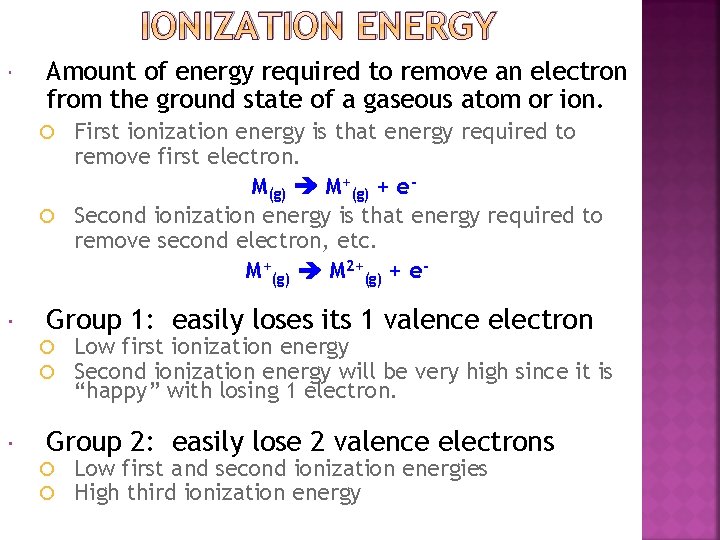
IONIZATION ENERGY Amount of energy required to remove an electron from the ground state of a gaseous atom or ion. First ionization energy is that energy required to remove first electron. M(g) M+(g) + e Second ionization energy is that energy required to remove second electron, etc. M+(g) M 2+(g) + e Group 1: easily loses its 1 valence electron Low first ionization energy Second ionization energy will be very high since it is “happy” with losing 1 electron. Group 2: easily lose 2 valence electrons Low first and second ionization energies High third ionization energy
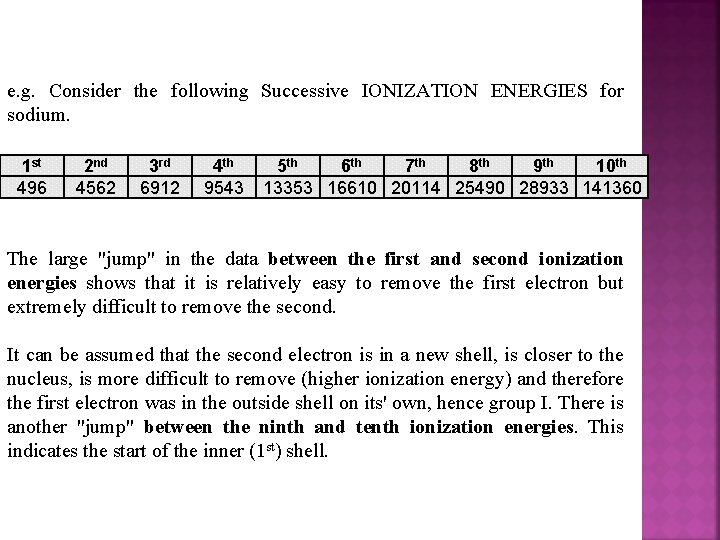
e. g. Consider the following Successive IONIZATION ENERGIES for sodium. 1 st 496 2 nd 4562 3 rd 6912 4 th 9543 5 th 6 th 7 th 8 th 9 th 10 th 13353 16610 20114 25490 28933 141360 The large "jump" in the data between the first and second ionization energies shows that it is relatively easy to remove the first electron but extremely difficult to remove the second. It can be assumed that the second electron is in a new shell, is closer to the nucleus, is more difficult to remove (higher ionization energy) and therefore the first electron was in the outside shell on its' own, hence group I. There is another "jump" between the ninth and tenth ionization energies. This indicates the start of the inner (1 st) shell.
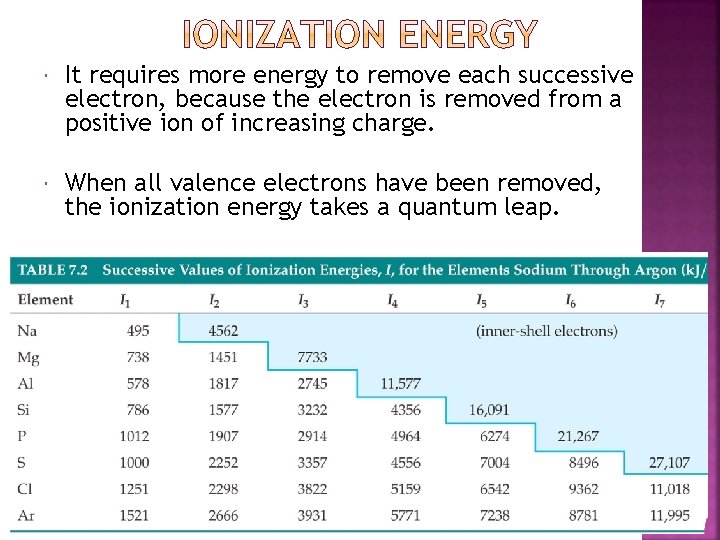
It requires more energy to remove each successive electron, because the electron is removed from a positive ion of increasing charge. When all valence electrons have been removed, the ionization energy takes a quantum leap.
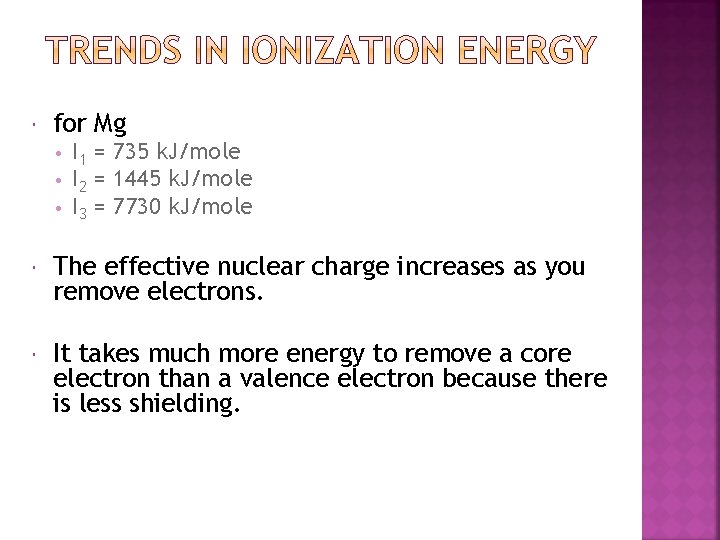
for Mg • I 1 • I 2 • I 3 = 735 k. J/mole = 1445 k. J/mole = 7730 k. J/mole The effective nuclear charge increases as you remove electrons. It takes much more energy to remove a core electron than a valence electron because there is less shielding.
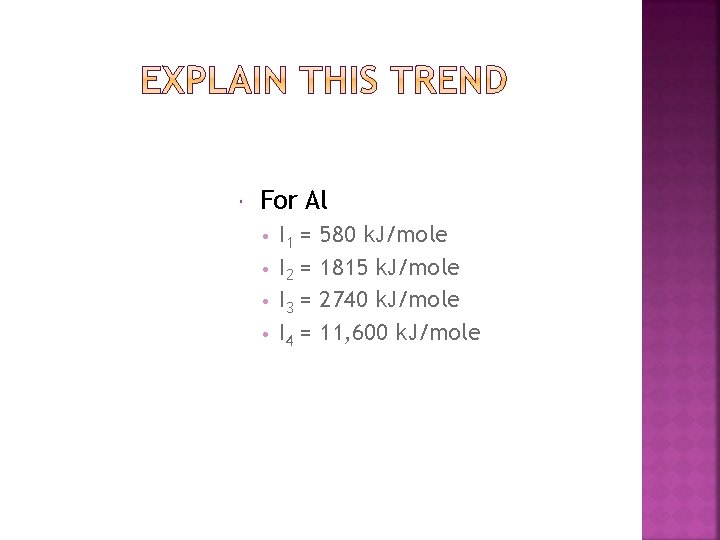
For Al • I 1 • I 2 = = • I 3 = • I 4 = 580 k. J/mole 1815 k. J/mole 2740 k. J/mole 11, 600 k. J/mole
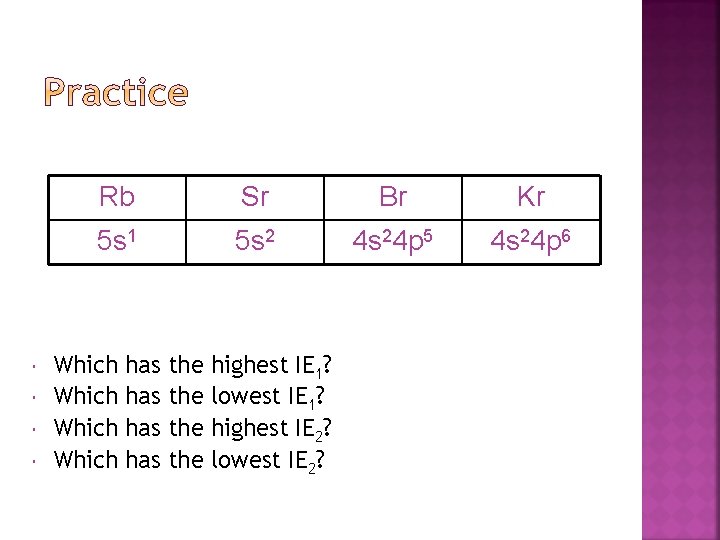
Rb Sr Br Kr 5 s 1 5 s 2 4 s 24 p 5 4 s 24 p 6 Which has has the the highest IE 1? lowest IE 1? highest IE 2? lowest IE 2?
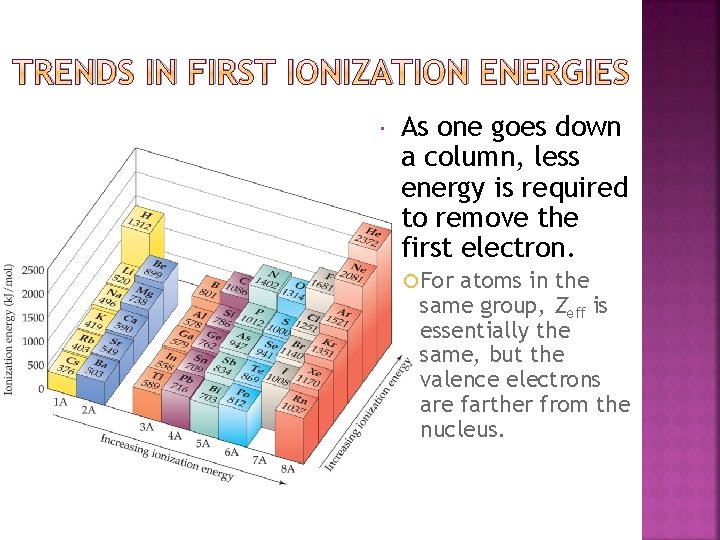
TRENDS IN FIRST IONIZATION ENERGIES As one goes down a column, less energy is required to remove the first electron. For atoms in the same group, Zeff is essentially the same, but the valence electrons are farther from the nucleus.
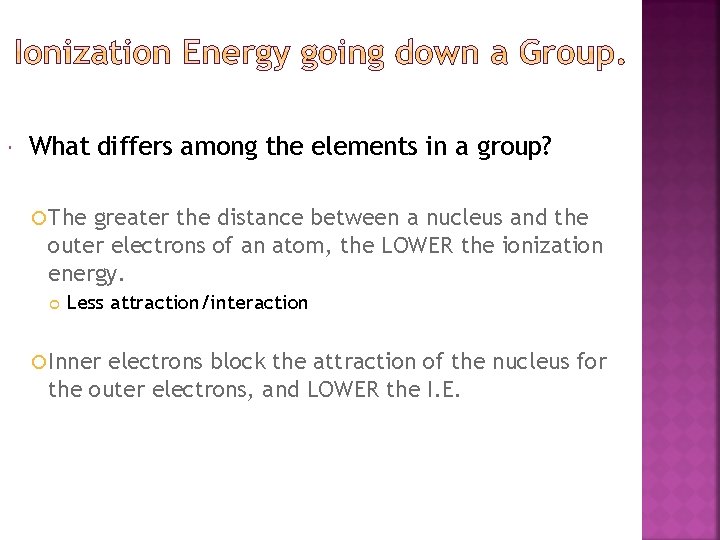
What differs among the elements in a group? The greater the distance between a nucleus and the outer electrons of an atom, the LOWER the ionization energy. Less attraction/interaction Inner electrons block the attraction of the nucleus for the outer electrons, and LOWER the I. E.
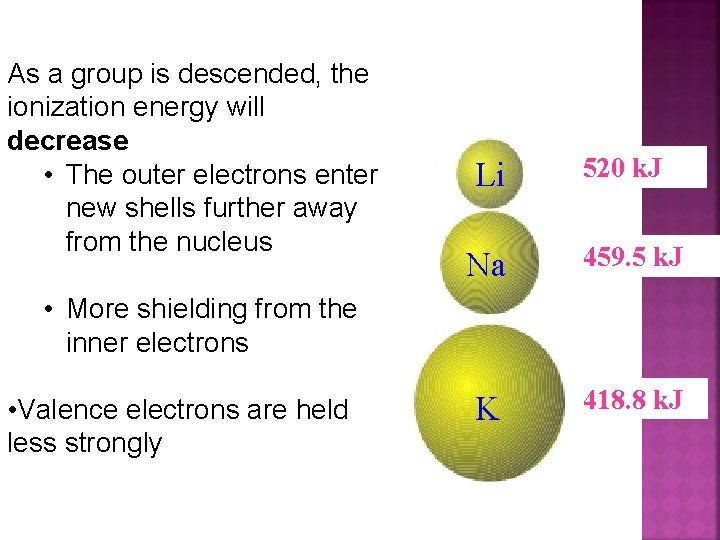
As a group is descended, the ionization energy will decrease • The outer electrons enter new shells further away from the nucleus Li 520 k. J Na 459. 5 k. J K 418. 8 k. J • More shielding from the inner electrons • Valence electrons are held less strongly
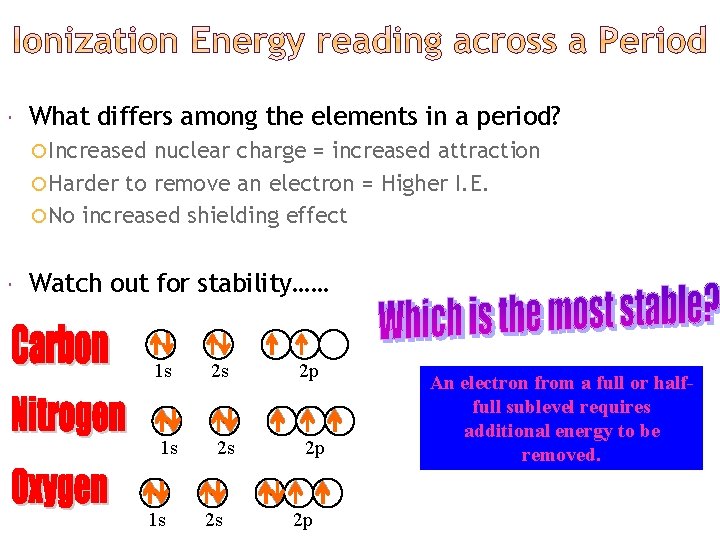
What differs among the elements in a period? Increased nuclear charge = increased attraction Harder to remove an electron = Higher I. E. No increased shielding effect Watch out for stability…… 1 s 2 s 2 p An electron from a full or halffull sublevel requires additional energy to be removed.
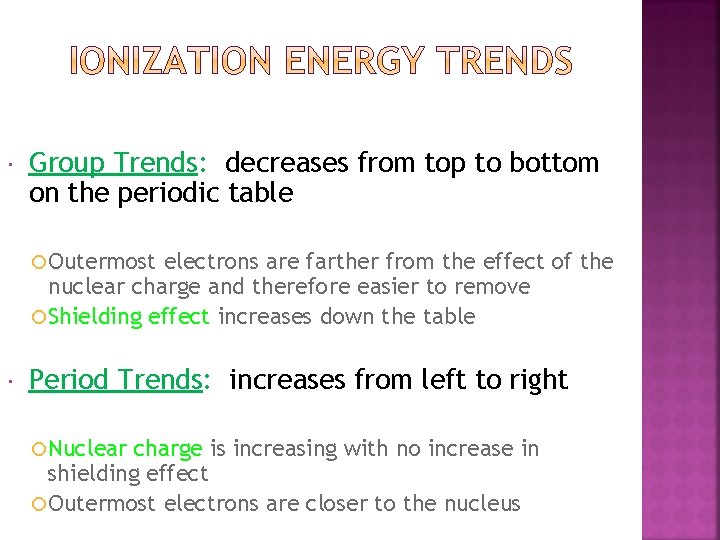
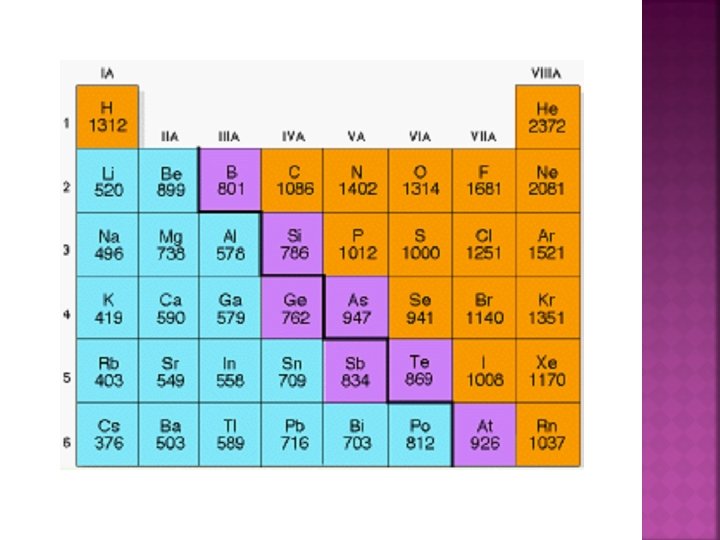
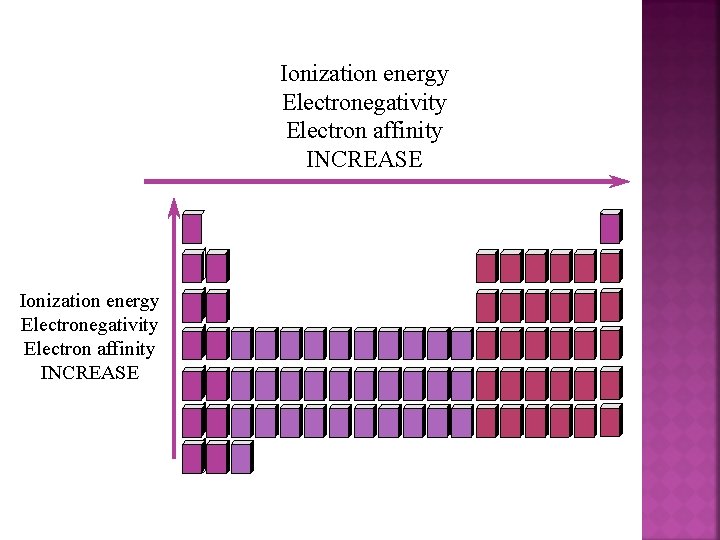
Group Trends: decreases from top to bottom on the periodic table Outermost electrons are farther from the effect of the nuclear charge and therefore easier to remove Shielding effect increases down the table Period Trends: increases from left to right Nuclear charge is increasing with no increase in shielding effect Outermost electrons are closer to the nucleus
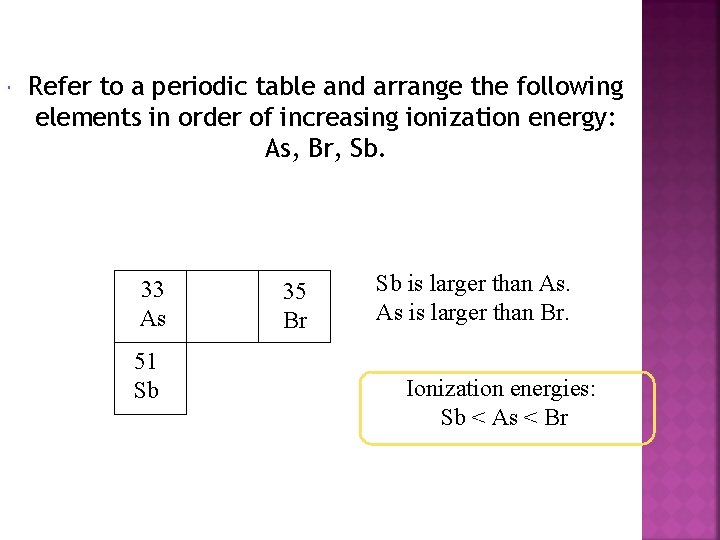
Refer to a periodic table and arrange the following elements in order of increasing ionization energy: As, Br, Sb. 33 As 51 Sb 35 Br Sb is larger than As. As is larger than Br. Ionization energies: Sb < As < Br
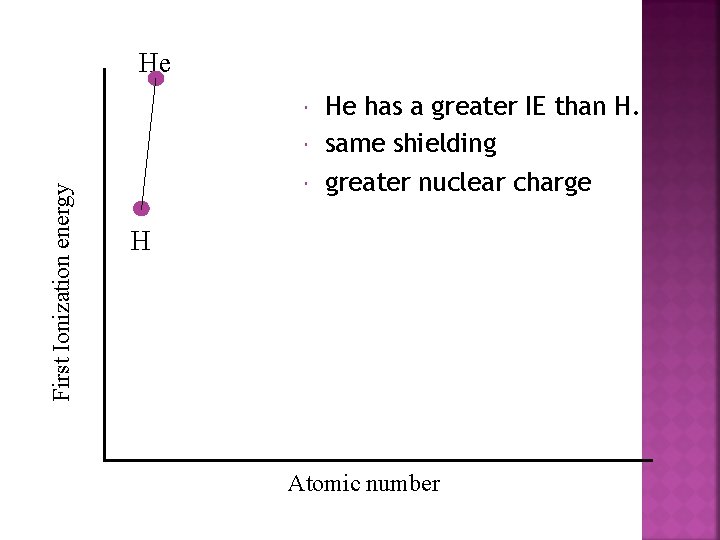
He He has a greater IE than H. same shielding greater nuclear charge First Ionization energy H Atomic number
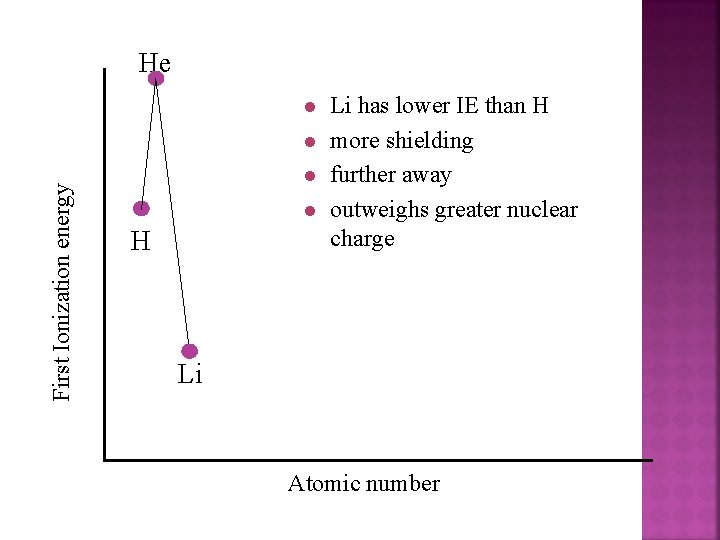
He l First Ionization energy l l l H Li has lower IE than H more shielding further away outweighs greater nuclear charge Li Atomic number
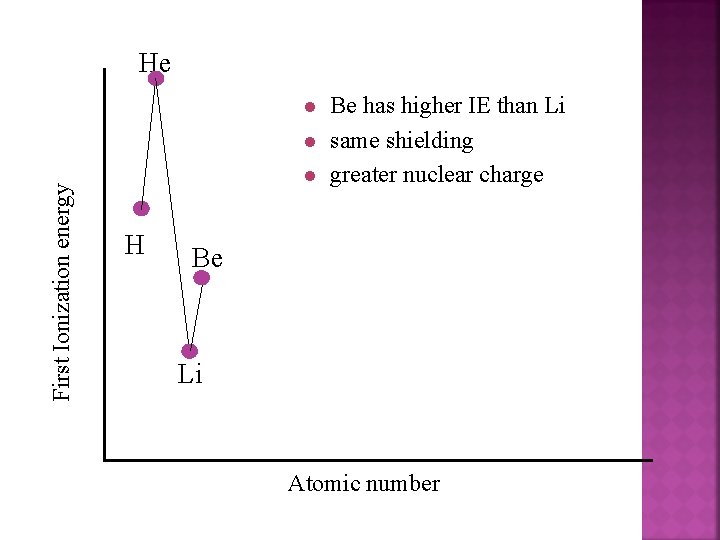
He l First Ionization energy l l H Be has higher IE than Li same shielding greater nuclear charge Be Li Atomic number
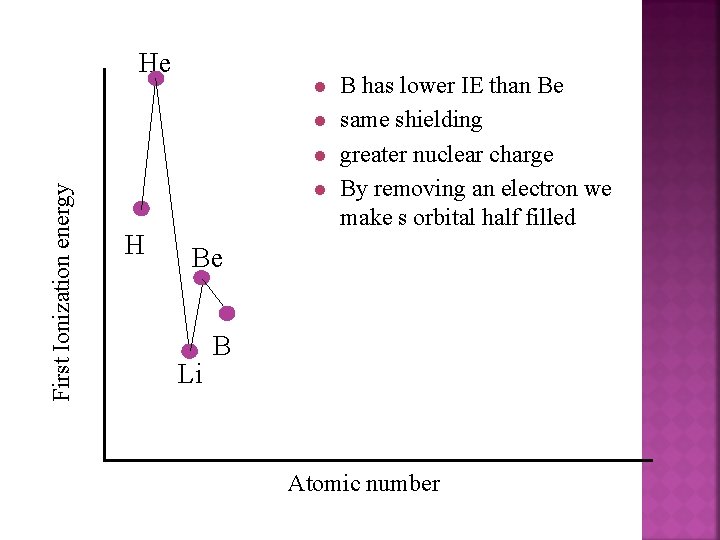
He l l First Ionization energy l l H B has lower IE than Be same shielding greater nuclear charge By removing an electron we make s orbital half filled Be Li B Atomic number
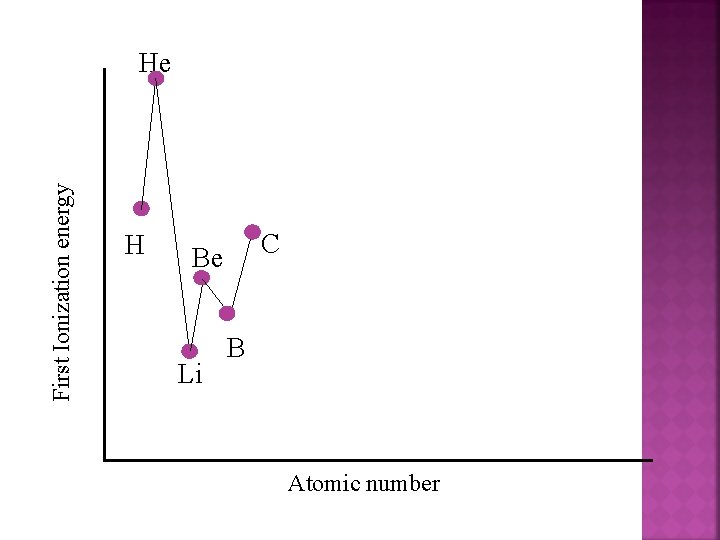
First Ionization energy He H Be Li C B Atomic number
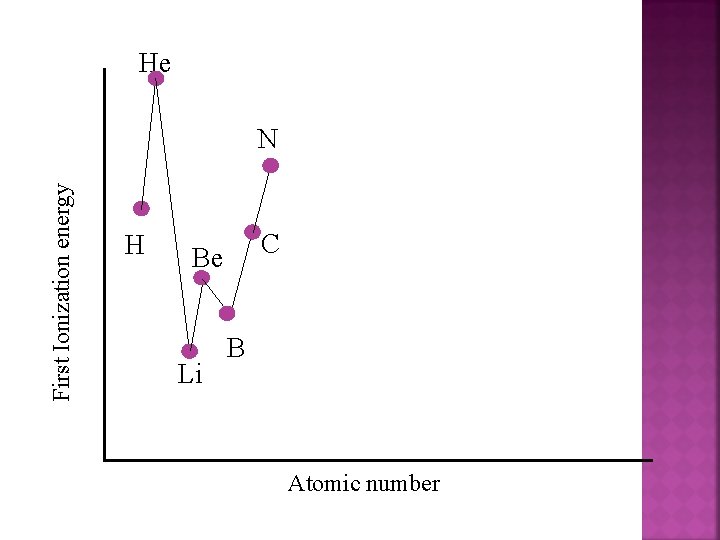
He First Ionization energy N H C Be Li B Atomic number
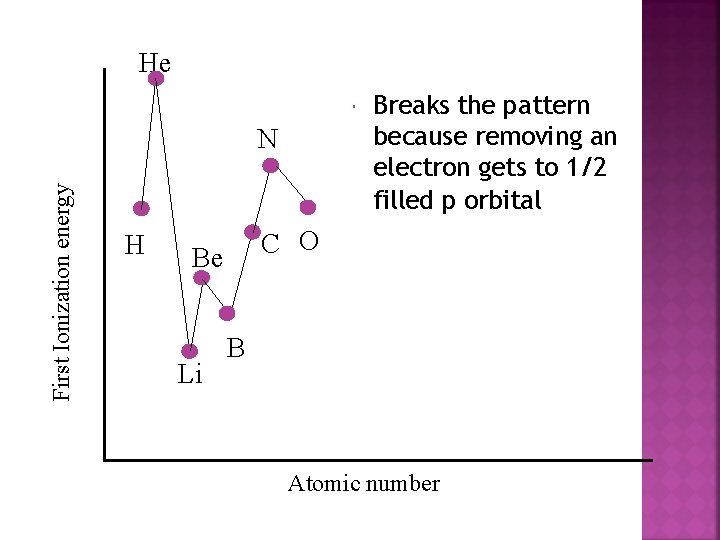
He First Ionization energy N H C O Be Li Breaks the pattern because removing an electron gets to 1/2 filled p orbital B Atomic number
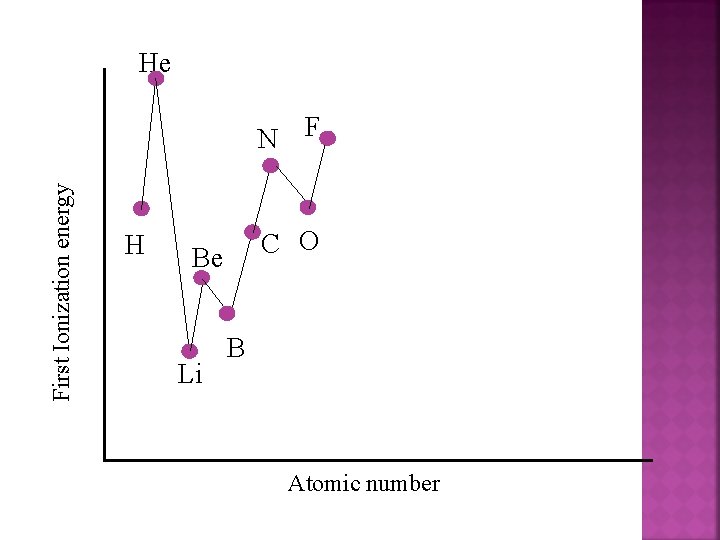
He First Ionization energy N F H C O Be Li B Atomic number
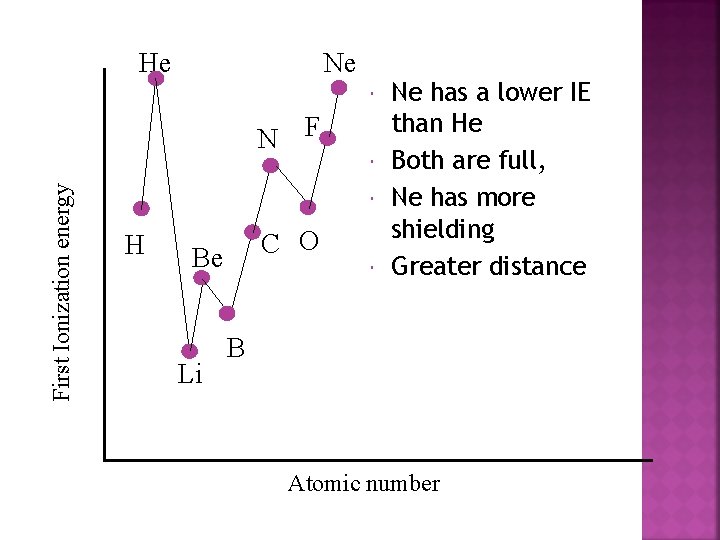
Ne He First Ionization energy N F H C O Be Li Ne has a lower IE than He Both are full, Ne has more shielding Greater distance B Atomic number
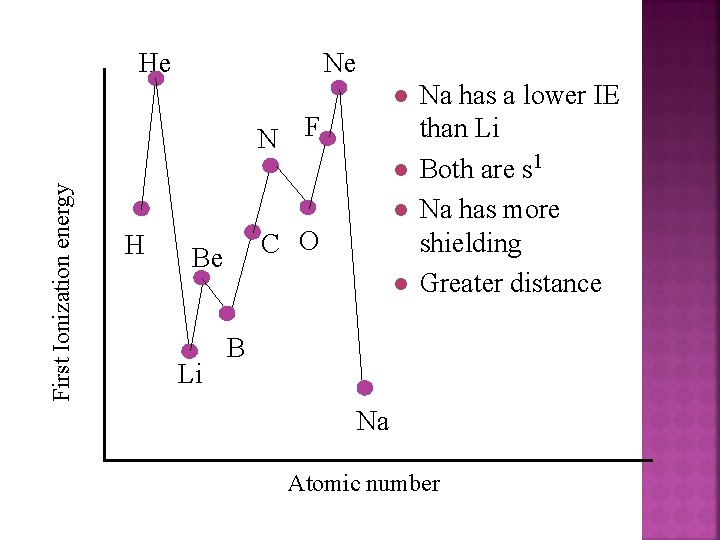
Ne He l N F First Ionization energy l l H C O Be Li l Na has a lower IE than Li Both are s 1 Na has more shielding Greater distance B Na Atomic number
I. E. decreases as you read down the table. In a period, I. E. increases from left to right
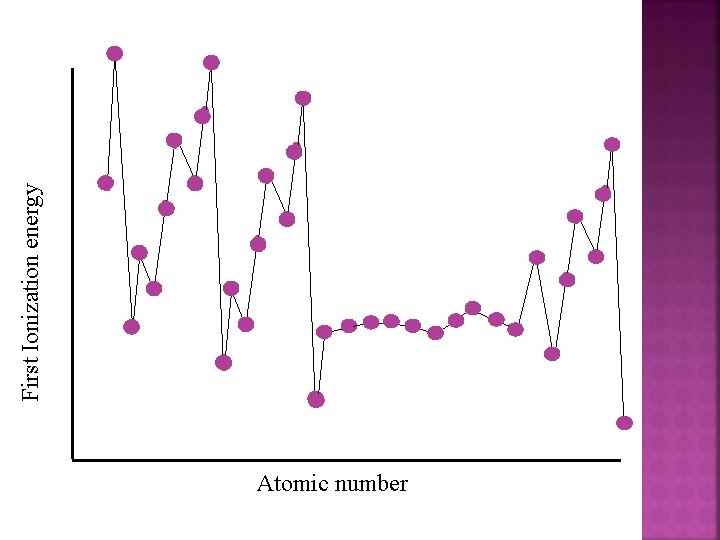
Atomic number First Ionization energy
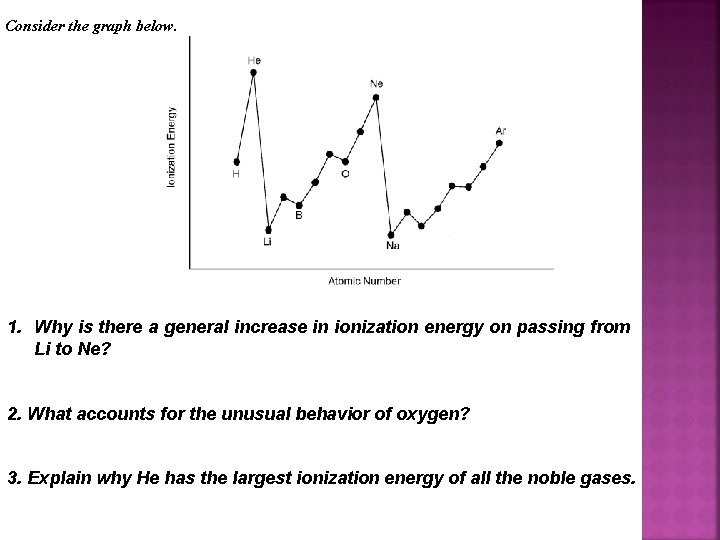
Consider the graph below. 1. Why is there a general increase in ionization energy on passing from Li to Ne? 2. What accounts for the unusual behavior of oxygen? 3. Explain why He has the largest ionization energy of all the noble gases.
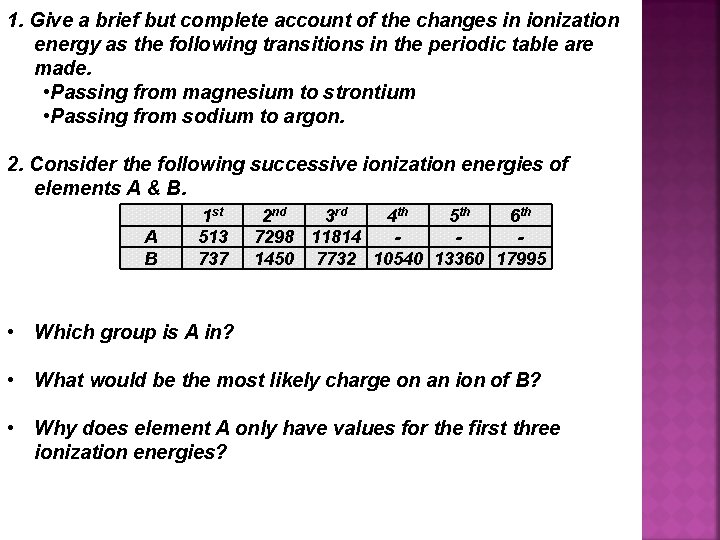
1. Give a brief but complete account of the changes in ionization energy as the following transitions in the periodic table are made. • Passing from magnesium to strontium • Passing from sodium to argon. 2. Consider the following successive ionization energies of elements A & B. A B 1 st 513 737 2 nd 3 rd 4 th 5 th 6 th 7298 11814 1450 7732 10540 13360 17995 • Which group is A in? • What would be the most likely charge on an ion of B? • Why does element A only have values for the first three ionization energies?
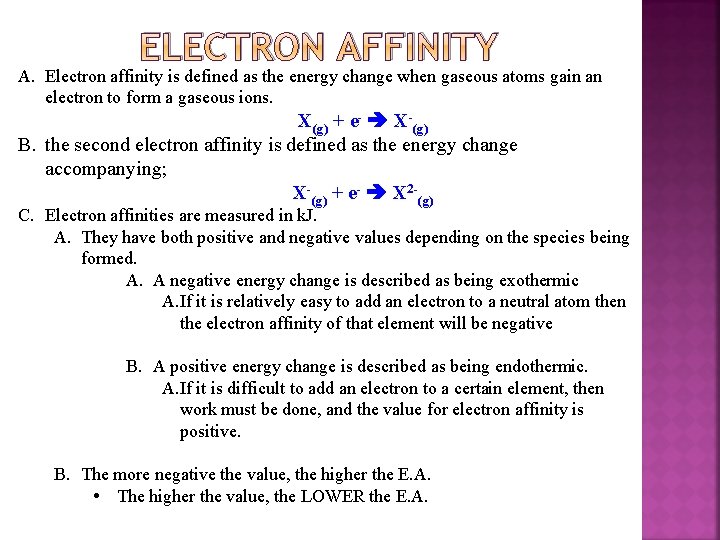
ELECTRON AFFINITY A. Electron affinity is defined as the energy change when gaseous atoms gain an electron to form a gaseous ions. X(g) + e- X-(g) B. the second electron affinity is defined as the energy change accompanying; X-(g) + e- X 2 -(g) C. Electron affinities are measured in k. J. A. They have both positive and negative values depending on the species being formed. A. A negative energy change is described as being exothermic A. If it is relatively easy to add an electron to a neutral atom then the electron affinity of that element will be negative B. A positive energy change is described as being endothermic. A. If it is difficult to add an electron to a certain element, then work must be done, and the value for electron affinity is positive. B. The more negative the value, the higher the E. A. • The higher the value, the LOWER the E. A.
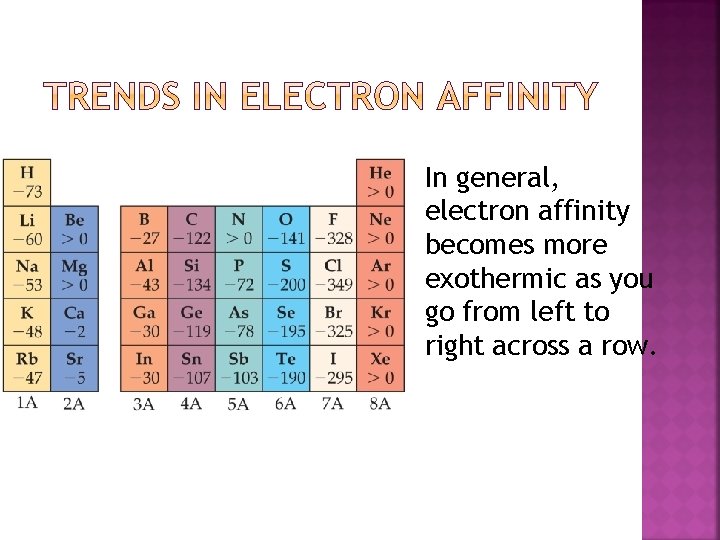
In general, electron affinity becomes more exothermic as you go from left to right across a row.
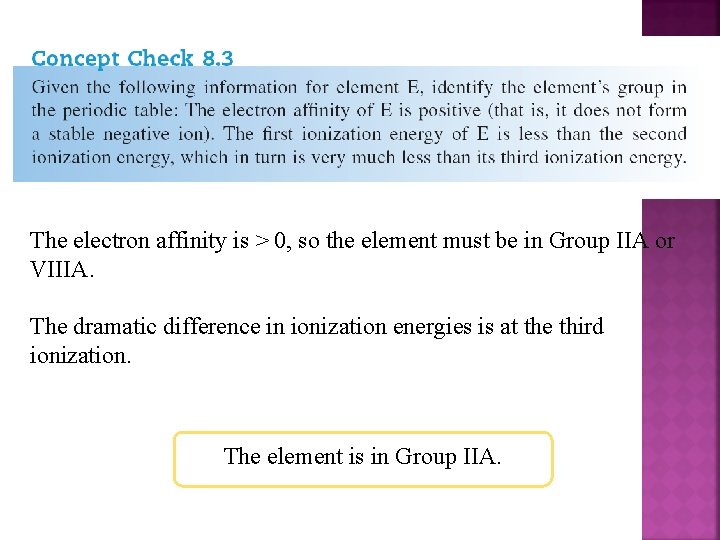
The electron affinity is > 0, so the element must be in Group IIA or VIIIA. The dramatic difference in ionization energies is at the third ionization. The element is in Group IIA.
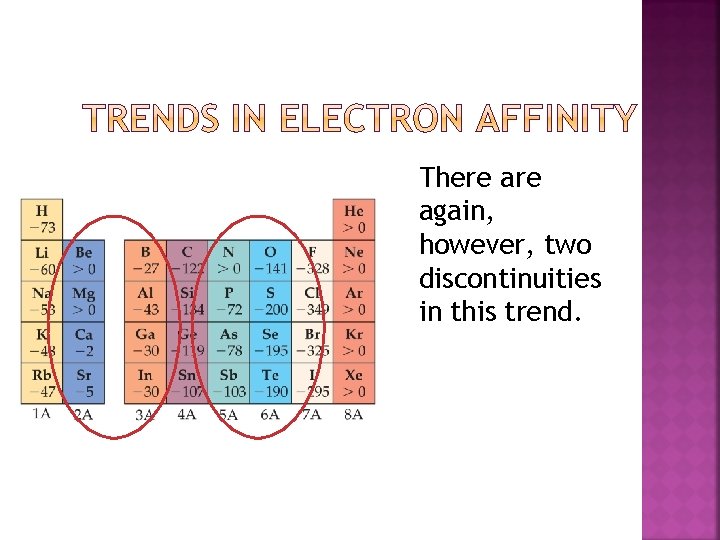
There again, however, two discontinuities in this trend.
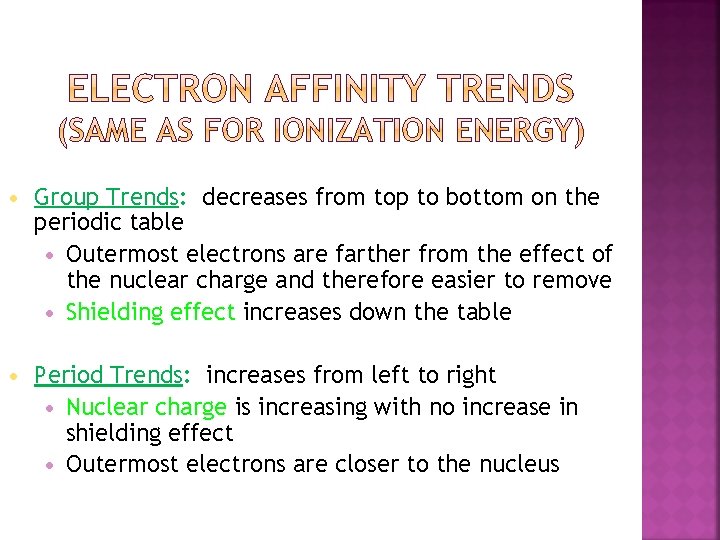
• Group Trends: decreases from top to bottom on the periodic table • Outermost electrons are farther from the effect of the nuclear charge and therefore easier to remove • Shielding effect increases down the table • Period Trends: increases from left to right • Nuclear charge is increasing with no increase in shielding effect • Outermost electrons are closer to the nucleus
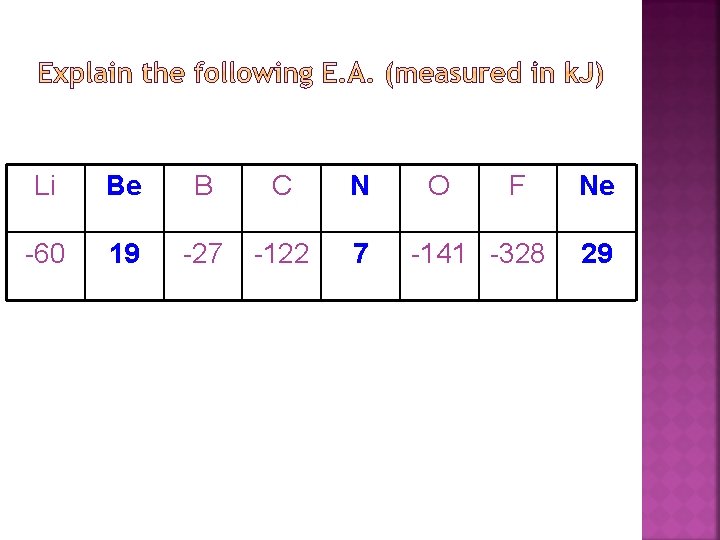
Li Be B C N -60 19 -27 -122 7 O F -141 -328 Ne 29
Both E. A. and I. E. are properties of isolated atoms. They do not involve interaction between/among atoms. Scientists need a scale to compare the relating abilities of elements to attract electrons when their atoms are combined. ELECTRONEGATIVITY (E. N. ) is the tendency for an atom to attract electrons to itself when it is chemically combined with another element How fair it shares. Electronegativity is like two atoms playing tug of war in the playground. In general the big kid wins and the little kid goes home crying. Big electronegativity means it pulls the electron toward itself. Atoms with large negative electron affinity have larger electronegativity.
EN is influenced by the same factors that affect I. E. and E. A. The most active/reactive metals has low E. N. Fluorine has the highest EN of all the elements Any bond involving F, the electrons will be more attracted to the Fluorine atom than to any other atom. Why are there no E. N. for VIIIA elements? Typically, not involved in bonding
In the top right (F) you have a very strong nucleus with very little shielding. You have a very strong pull towards F. So strong it can pull neighboring atom’s electrons towards it. In the bottom left you have an atom with an enormous amount of shielding and very little effective nuclear charge making it to the valence electron. There is very little pull towards the nucleus.
Electronegativity Trends (Similar to Ionization Energy) • Group Trends: decreases from top to bottom on the periodic table • Outermost electrons are farther from the effect of the nuclear charge and therefore more difficult to attract • Shielding effect increases down the table • Period Trends: increases from left to right • Nuclear charge is increasing with no increase in shielding effect • Outermost electrons are closer to the nucleus and attracted more easily
Ionization energy Electronegativity Electron affinity INCREASE
- Slides: 127